Author: subhashr325

  • Treasury Bill Auction Dates Explained: 2026 Schedule Guide

    Treasury Bill Auction Dates Explained: 2026 Schedule Guide

    Treasury Bill Auction Dates Explained

    SR

    Subhash Rukade

    Founder, FinanceInvestment

    Published: September 21, 2026Updated: September 21, 2026Reading Time: ~13 min

    When Are Treasury Bills Auctioned?

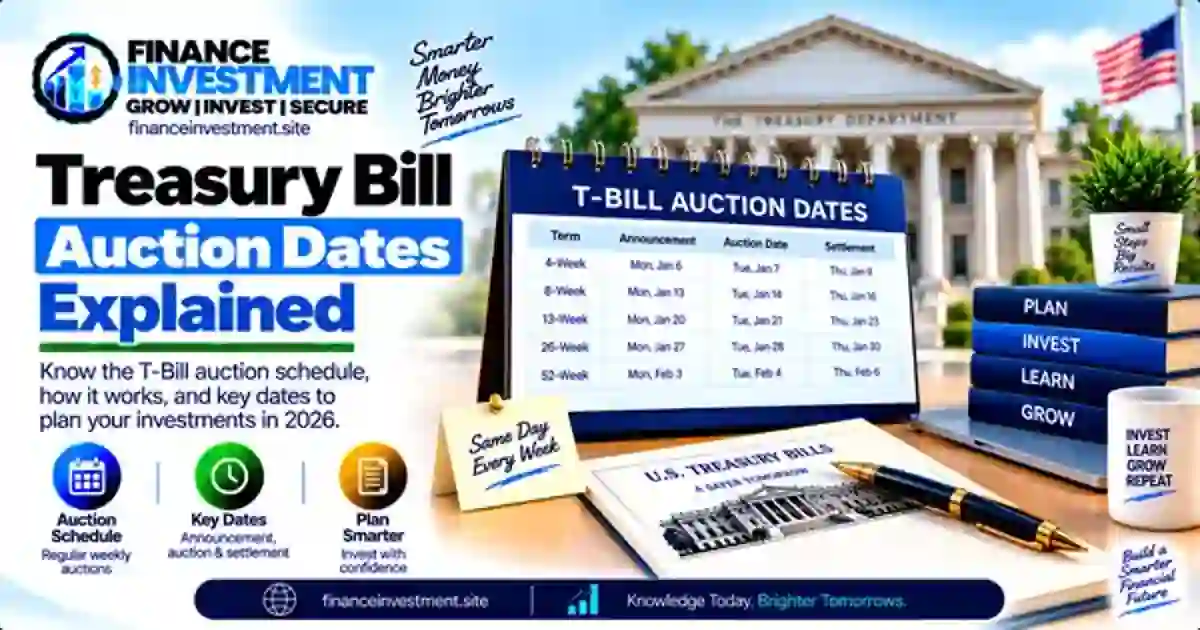
    Treasury Bill Auction Dates Explained 2026 scheduleKnowing Treasury Bill Auction Dates Explained can make the buying process much easier. If you are planning to purchase a T-bill, you may see three different dates: the announcement date, the auction date, and the issue date. Each one has a different purpose, so confusing them can lead to missed deadlines or poor planning.

    Treasury bills follow recurring auction patterns based on their maturity terms, but the exact dates can change because of holidays, Treasury funding needs, or other scheduling changes. That is why the current official Treasury schedule should always be checked before placing an order.

    If you are new to T-bills, you can first review our

    Treasury Bills Explained guide

    for the basics. This article then takes the next step by focusing specifically on the auction calendar and the dates you need to watch.

    What You’ll Learn

    • How the Treasury bill auction calendar is organized
    • What announcement, auction, and issue dates mean
    • How 4-, 8-, 13-, 17-, 26-, and 52-week bills fit into the schedule
    • How to find the latest official Treasury auction dates
    • How to plan a T-bill purchase without relying on an outdated calendar

    Quick Answer: When Are Treasury Bills Auctioned?

    Regular Treasury bills follow recurring auction patterns. The 4-, 6-, 8-, 13-, 17-, and 26-week bills are generally offered weekly, while the 52-week bill is generally offered every four weeks. The exact date for a particular offering should be confirmed through the current Treasury schedule and offering announcement before you place an order.

    Key Takeaways

    • The announcement date is when Treasury publishes the offering details for a specific bill.
    • The auction date is when Treasury conducts the auction and determines the price and applicable auction rate.
    • The issue date is when the newly auctioned Treasury bill is issued and settlement occurs.
    • Regular auction patterns help with planning, but holidays and other Treasury scheduling changes can shift individual dates.
    • For an actual purchase, check the current official Treasury offering information instead of relying only on a general calendar.

    Table of Contents

    Treasury Bill Auction Dates at a Glance

    Treasury bills follow recurring auction patterns based on their maturity terms. That makes the general calendar useful for planning, but it should not be treated as a list of guaranteed dates. The specific offering announcement is the better source when you are preparing to buy a particular T-bill.

    Bill TermTypical FrequencyUsual Auction Day
    4-weekWeeklyThursday
    6-weekWeeklyTuesday
    8-weekWeeklyThursday
    13-weekWeeklyMonday
    17-weekWeeklyWednesday
    26-weekWeeklyMonday
    52-weekEvery 4 weeksTuesday

    QUICK TAKE: The days shown above are the Treasury’s usual auction pattern for regular bills. They are not a substitute for the current offering announcement. Holidays and other special circumstances can change the timing, so check TreasuryDirect for the specific auction you plan to purchase.

    Treasury Bill Auction Dates: A Beginner’s Guide
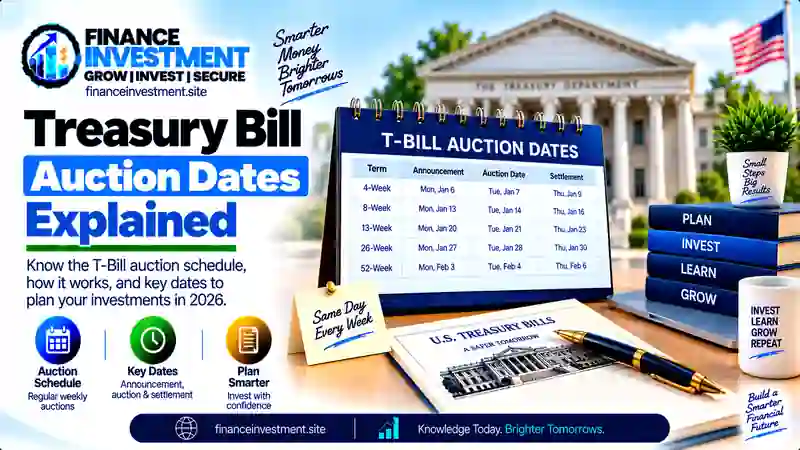
    Treasury Bill Auction Dates ExplainedFor a first-time buyer, a Treasury bill auction calendar can seem confusing because several dates appear for the same offering. The easiest way to read it is to separate the process into three stages: the announcement, the auction, and the issue. Each date marks a different step.

    1. Identify the Bill Term

    Regular Treasury bills currently include 4-, 6-, 8-, 13-, 17-, 26-, and 52-week terms. The 4-, 6-, 8-, 13-, 17-, and 26-week bills generally follow weekly auction patterns, while the 52-week bill generally follows a four-week cycle.

    2. Check the Specific Offering

    Once you know the bill term you want, find the specific offering on TreasuryDirect. The official offering announcement provides the dates and terms for that particular auction. This matters because a general recurring schedule can change for holidays or other special circumstances.

    3. Plan Around the Auction

    If you are buying through TreasuryDirect, review the purchase instructions and deadline shown for the offering. If you are using a brokerage, check that firm’s order deadline because it may differ from Treasury’s schedule. Give yourself enough time to complete the order before the applicable cutoff.

    BEGINNER TIP: Treat the recurring calendar as a planning tool, not as a guaranteed list of dates. Before placing an order, verify the specific offering, auction date, issue date, and applicable purchase deadline.

    How Treasury Bill Auction Dates Work

    A Treasury bill auction follows a sequence that starts with an offering announcement and ends with the bill’s issue and settlement. The recurring calendar helps you anticipate an auction, while the specific offering announcement provides the dates and terms for that particular bill.

    Step 1: Treasury Announces the Offering

    Treasury first publishes an official offering announcement. It identifies the security and provides details such as the auction date, issue date, maturity date, offering amount, and bidding information. When you need the exact details for an upcoming T-bill, this specific announcement is more useful than a general calendar pattern.

    Step 2: Investors Submit Bids

    Treasury auctions can include both noncompetitive and competitive bids. A noncompetitive bidder agrees to accept the auction result and, under the applicable rules, receives the amount requested if the bid qualifies. A competitive bidder specifies the discount rate they are willing to accept. Depending on the auction result, a competitive bid can be accepted in full, accepted in part, or rejected.

    Step 3: Treasury Conducts the Auction

    Treasury evaluates competitive bids according to the rates submitted and accepts bids until the offering is filled under the auction rules. Treasury bills are sold through a single-price auction, meaning successful competitive and noncompetitive bidders receive the same purchase price for that offering.

    Step 4: The Bill Is Issued and Settled

    On the issue date, the newly auctioned bill is issued and the transaction is settled. The security then appears in the investor’s TreasuryDirect or brokerage account, depending on where it was purchased. An investor who later wants to sell before maturity must use the applicable secondary market rather than the original auction.

    EXPERT TIP: Use the recurring auction schedule for planning, but use the specific offering announcement as your final reference. That is where you confirm the dates and terms for the T-bill you intend to purchase.

    Benefits and Drawbacks of Following the Treasury Bill Auction Calendar

    A Treasury bill auction calendar can make short-term investing easier to organize. It gives you a framework for planning potential purchases and maturity dates. Still, a schedule is only a planning tool and does not determine the final terms of an individual auction.

    Potential Benefits

    • Helps you anticipate when regular T-bill offerings may be auctioned.
    • Makes it easier to coordinate purchases with expected cash needs.
    • Can help with planning a short-term Treasury ladder.
    • Gives you a starting point for researching a specific upcoming offering.

    Potential Drawbacks

    • A recurring schedule does not guarantee the exact date of every offering.
    • Holidays and other Treasury scheduling changes can affect the timing.
    • The calendar cannot tell you the final auction rate or purchase price in advance.
    • Selling before maturity means using the secondary market, where the price can differ from your original purchase price.

    WHAT TO REMEMBER: Use the auction calendar to plan ahead, but use the individual Treasury offering announcement to confirm the dates and terms for a specific T-bill. The schedule helps you prepare; it does not replace the official offering details.

    Treasury Bill Auction Schedule Comparison

    The table below compares the regular Treasury bill terms, their usual auction frequency, and the normal timing between auction and issue. These patterns are useful for planning, but an individual offering can follow a different date because of holidays or other Treasury scheduling changes.

    Bill TermUsual FrequencyUsual Auction DayUsual Issue Timing
    4-weekWeeklyThursdayFollowing Tuesday
    6-weekWeeklyTuesdayThursday
    8-weekWeeklyThursdayFollowing Tuesday
    13-weekWeeklyMondayThursday after auction
    17-weekWeeklyWednesdayFollowing Tuesday
    26-weekWeeklyMondayThursday after auction
    52-weekEvery 4 weeksTuesdayThursday

    HOW TO USE THIS TABLE: Choose the bill term that fits your time horizon, then use its usual auction pattern as a planning reference. Before placing an order, confirm the exact auction and issue dates in the current Treasury offering announcement.

    Costs, Risks & Expert Tips for Treasury Bill Auctions

    Knowing the auction date is only one part of planning a T-bill purchase. You should also check the purchase method, applicable costs, tax treatment, and what could happen if you need your money before maturity.

    Costs and Taxes to Check

    • TreasuryDirect does not charge a purchase commission for Treasury marketable securities. A brokerage may have its own fees, commissions, or transaction rules.
    • Treasury bill income is generally subject to federal income tax but is exempt from state and local income taxes.
    • If you sell before maturity, your brokerage’s applicable transaction costs and the secondary-market price can affect the amount you receive.

    Timing and Market Risks

    The recurring auction schedule should be treated as a planning guide, not a guarantee of every individual date. Treasury can change auction timing because of holidays or other special circumstances. Also, buying at auction does not mean you can later sell at the same price. A bill sold before maturity is subject to the secondary market, where prices can move.

    EXPERT TIP: Before placing an order, verify the specific offering’s auction date, issue date, maturity date, and applicable purchase deadline. Then check your platform’s instructions. The recurring calendar helps you plan, but the individual offering should be your final reference.

    Common Treasury Bill Auction Date Mistakes

    Most auction-date mistakes happen when investors rely on a familiar calendar pattern without checking the specific offering. A few simple checks can make the process much easier to manage.

    Mistakes to Avoid

    • Confusing the announcement and auction dates.
      The announcement provides the offering details, while the auction is when Treasury conducts the sale.
    • Treating the usual weekday as a guaranteed date.
      Regular patterns can change because of holidays or other Treasury scheduling circumstances.
    • Forgetting the issue date.
      The bill’s issue and settlement occur after the auction according to the offering schedule.
    • Not checking the applicable purchase deadline.
      TreasuryDirect and brokerage platforms can have different ordering instructions or cutoffs.

    Real-Life Example: Planning a T-Bill Purchase

    Suppose Maria wants to invest $10,000 in a 13-week Treasury bill. She starts by looking at the regular auction pattern, which gives her a general idea of when an offering may occur. She does not stop there. Maria checks the specific Treasury offering announcement before placing her order.

    She verifies the auction date, issue date, maturity date, and applicable purchase instructions. If she is using a brokerage, she also checks that firm’s order deadline. Because she confirms the individual offering instead of relying only on the recurring calendar, Maria has a clearer timeline for her $10,000 purchase.

    SMART HABIT: Use the calendar to plan ahead, then verify the individual offering before you buy. Check the auction date, issue date, maturity date, and applicable purchase instructions in that order.

    Who Should Use the Treasury Bill Auction Calendar?

    The Treasury bill auction calendar is most useful for investors who want to organize purchases around upcoming offerings. It can also help when you are matching new purchases with expected cash needs or planning when existing bills may mature.

    Who May Find It Useful?

    • First-time T-bill buyers who want to understand when regular offerings are normally auctioned.
    • Short-term cash planners who want to coordinate a purchase with a future cash need.
    • Treasury ladder planners who are scheduling purchases across different bill maturities.
    • Existing Treasury investors who want a recurring reference for upcoming offerings.

    KEEP IN MIND: The calendar is a planning reference, not a substitute for the official offering announcement. Before purchasing, check the specific auction date, issue date, maturity date, and applicable purchase instructions for the bill you are considering.

    Frequently Asked Questions About Treasury Bill Auction Dates

    1. How often are Treasury bills auctioned?

    The 4-, 6-, 8-, 13-, 17-, and 26-week Treasury bills are generally offered weekly. The 52-week bill is generally offered every four weeks.

    2. What is the difference between an announcement date and an auction date?

    The announcement date is when Treasury publishes the offering details. The auction date is when Treasury conducts the auction and determines the auction results and applicable price.

    3. What is the Treasury bill issue date?

    The issue date is when the newly auctioned Treasury bill is issued and settlement takes place according to the offering terms. It is generally separate from the auction date.

    4. Where can I find current Treasury bill auction dates?

    TreasuryDirect’s current auction information and individual offering announcements are the best places to check upcoming dates. Use the general schedule for planning, then verify the specific offering before placing an order.

    5. Are Treasury bill auction dates always the same?

    No. Regular Treasury bills follow recurring patterns, but holidays and other Treasury scheduling circumstances can change the date of an individual offering.

    6. Can I buy a Treasury bill on the auction date?

    If you are buying through TreasuryDirect, you generally must submit a noncompetitive bid before the applicable auction deadline. A brokerage may set its own order cutoff, so check the broker’s instructions rather than assuming you can place an order at any time on auction day.

    7. What happens after a Treasury bill auction?

    Treasury publishes the auction results. For accepted purchases, the transaction then proceeds to the issue and settlement date listed for that offering. The bill can generally be held until maturity or sold earlier through the applicable secondary market.

    8. Should I rely only on a Treasury bill auction calendar?

    No. The calendar is useful for planning, but the specific offering announcement should be your final reference for the auction date, issue date, maturity date, and applicable purchase instructions.

    Final Takeaway: How to Use Treasury Bill Auction Dates

    Treasury bill auction dates become much easier to follow when you separate the three main stages of an offering. The recurring schedule helps you plan ahead, while the specific Treasury offering announcement gives you the dates and terms for the bill you actually want to purchase.

    The announcement date is when Treasury publishes the offering details. The auction date is when Treasury conducts the auction. The issue date is when the newly auctioned bill is issued and settled.

    Regular Treasury bills follow recurring auction patterns, but individual dates can change because of holidays or other scheduling circumstances. That makes the current offering announcement more important than relying on a calendar pattern alone.

    THE SIMPLE RULE: Use the recurring calendar for planning, check the official offering announcement for confirmation, and follow your TreasuryDirect or brokerage purchase instructions before the applicable deadline.

    Have a Money Question? Keep Exploring.

    Want to learn more about Treasury bills, auction timing, or short-term investing? Continue exploring FinanceInvestment for practical guides designed to help you understand your options and plan with more confidence.

    📩 Get in Touch With FinanceInvestment

    Have a question or feedback about this guide? Send us an email.


    Email FinanceInvestment

    Continue Your Research


    Treasury Bills Explained

    |


    How to Buy Treasury Bills

  • How Treasury Bill Auctions Work: Complete 2026 Guide

    How Treasury Bill Auctions Work: Complete 2026 Guide

    How Treasury Bill Auctions Work

    SR

    Subhash Rukade

    Founder, FinanceInvestment

    Published: September 21, 2026Updated: September 21, 2026Reading Time: ~13 min

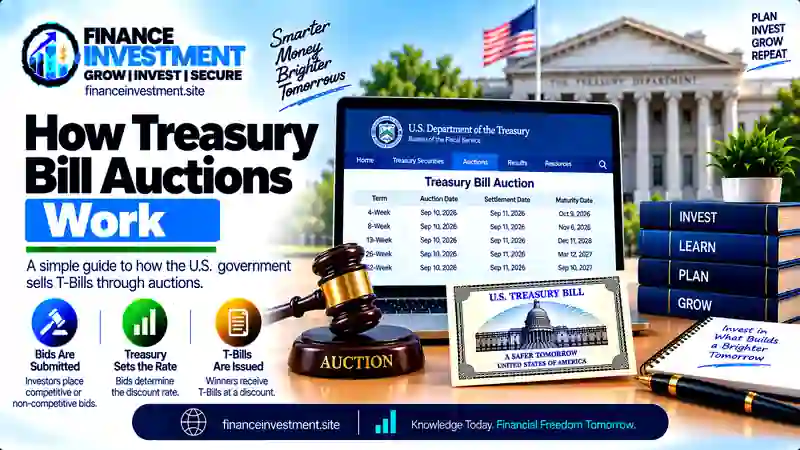
    How Treasury Bill Auctions WorkA Treasury bill auction is the process the U.S. Treasury uses to sell newly issued T-bills to investors. Instead of setting one fixed price in advance, the Treasury accepts bids and uses the auction results to determine the terms at which the bills are issued. That is why understanding how Treasury bill auctions work matters when you are deciding when and how to buy.

    The process has two main bidding methods: competitive and noncompetitive. Competitive bidders specify the rate they are willing to accept, while noncompetitive bidders agree to accept the auction result. The Treasury then processes the bids under its auction rules and announces the results, including the accepted rate and other important details.

    What You’ll Learn

    • How the Treasury bill auction process moves from announcement to settlement
    • How competitive and noncompetitive bids work
    • How auction results determine the rate and issue price of newly issued T-bills
    • How to read Treasury bill auction results before placing an order

    How Do Treasury Bill Auctions Work?

    The Treasury bill auction process begins when the U.S. Treasury announces a new bill and provides details such as the term, offering amount, auction date, and issue date. Investors then submit either competitive or noncompetitive bids through an eligible purchase channel. A noncompetitive bidder agrees to accept the rate determined by the auction, while a competitive bidder specifies the yield or rate they are willing to accept.

    The Treasury evaluates competitive bids according to its auction rules and accepts bids until the securities offered have been allocated. The published Treasury bill auction results show important figures such as the high rate, investment rate, price, and other auction details. Newly issued T-bills are sold at a discount to face value and are redeemed at face value at maturity.

    Key takeaway: With a noncompetitive bid, you are not choosing the auction rate yourself. You agree to accept the rate established by the auction, subject to the Treasury’s applicable rules.

    Treasury Bill Auctions at a Glance

    A Treasury bill auction follows a defined sequence. The U.S. Treasury first announces the new bill and its offering details. Investors then submit bids through an eligible purchase channel. Competitive bids include a specified rate or yield, while noncompetitive bidders agree to accept the rate established by the auction.

    Auction StageWhat Happens
    AnnouncementThe Treasury announces details such as the bill term, offering amount, auction date, and issue date.
    BiddingInvestors submit competitive or noncompetitive bids according to the applicable auction rules.
    Bid processingThe Treasury evaluates competitive bids and allocates the securities under its auction rules.
    Auction resultsThe published results can show the high rate, investment rate, price, and other auction statistics.
    SettlementSuccessful purchases are issued on the scheduled issue date under the terms of the auction.

    Quick Take: Think of a T-bill auction as a structured process: the Treasury announces the issue, investors bid, the bids are processed, auction results are published, and successful purchases are settled. The next sections explain what happens inside each step.

    Treasury Bill Auction Guide for Beginners

    How Treasury Bill Auctions WorkIf you are new to T-bills, the auction process may look complicated at first. The basic idea is straightforward: the Treasury announces a new bill, investors submit bids, and the Treasury processes those bids under its auction rules. The results then show the rates and price associated with that particular issue.


    Start With the Auction Announcement

    Before placing an order, review the applicable Treasury auction announcement. It provides important details such as the bill’s term, offering amount, CUSIP, auction date, issue date, and maturity date. It also states the applicable bidding deadlines and other terms for that auction.

    Know Which Bid You Are Using

    A noncompetitive bid does not require you to specify a discount rate. You agree to accept the rate determined through the auction, subject to the Treasury’s rules. A competitive bidder, by contrast, specifies the discount rate they are willing to accept for a Treasury bill. Competitive bidding has additional requirements and is generally more relevant to institutional or experienced market participants.

    1. Choose the bill and review its current auction announcement.
    2. Select an eligible purchase channel, such as TreasuryDirect or a brokerage.
    3. Submit the appropriate bid before the deadline stated for that auction.
    4. Review the published auction results and settlement details afterward.

    Beginner tip: If you are buying T-bills for the first time, focus on understanding noncompetitive bidding, the auction deadline, and the published results before learning the more technical competitive bidding process.

    How the Treasury Bill Auction Process Works

    The Treasury bill auction process follows a defined sequence. The Treasury announces the offering, investors submit bids, the bids are evaluated under the auction rules, and the results establish the terms for the newly issued bills.

    1. The Treasury Announces the Bill

    The Treasury publishes an offering announcement with details such as the bill’s term, offering amount, CUSIP, auction date, issue date, and maturity date. The announcement also provides the applicable bidding deadlines and other terms for that specific offering.

    2. Investors Submit Bids

    A noncompetitive bidder does not specify a discount rate and agrees to accept the rate determined by the auction, subject to the applicable rules. A competitive bidder specifies the discount rate they are willing to accept. TreasuryDirect accepts noncompetitive bids; competitive bids must be submitted through an eligible competitive bidding channel.

    3. Noncompetitive and Competitive Bids Are Processed

    After the applicable deadlines, the Treasury accepts timely noncompetitive bids according to its rules. It then evaluates competitive bids, starting with the lowest discount rates and moving upward until the required amount has been allocated. If necessary, bids at the highest accepted rate can be prorated.

    4. The High Rate and Other Results Are Published

    For a Treasury bill, the highest accepted competitive discount rate is reported as the high rate. Treasury auction results can also report the investment rate, price, bid amounts, accepted amounts, and other auction statistics. These figures describe the outcome of that particular auction.

    5. Successful Purchases Are Settled

    Successful purchases are issued on the scheduled issue date. Treasury bills are issued at a discount to face value and, when held to maturity, are redeemed at face value. The difference between the purchase price and the amount received at maturity represents the bill’s return before applicable taxes and other costs.

    Key Point: The auction connects investor bids with the final terms of a newly issued T-bill. For a noncompetitive bidder, the rate is not chosen manually; it is determined through the auction.

    Benefits and Drawbacks of Treasury Bill Auctions

    Buying a newly issued T-bill at auction has several practical features. At the same time, the auction process has rules and trade-offs that investors should understand before placing an order.

    Potential Benefits

    • You can purchase a newly issued Treasury bill at auction instead of buying an existing bill in the secondary market.
    • A noncompetitive bid simplifies rate selection because you agree to accept the rate determined by the auction.
    • T-bills have short maturities, which can make them relevant for investors planning around a specific short-term cash need.

    Potential Drawbacks

    • When you submit a noncompetitive bid, the auction-determined rate is not known in advance.
    • Competitive bidding requires you to specify a discount rate and can involve partial allocation or no allocation when the bid is not accepted under the auction rules.
    • If you sell a T-bill before maturity, you generally do so through the secondary market, where its market price may be above or below your original purchase price.

    Quick Take: Treasury bill auctions offer a defined process for purchasing newly issued bills, but the experience differs depending on the type of bid. Noncompetitive bidding focuses on accepting the auction result, while competitive bidding gives the bidder a specified rate to submit under the Treasury’s rules.

    Competitive vs. Noncompetitive Bids

    A major part of the Treasury bill bidding process is understanding the difference between competitive and noncompetitive bids. Both participate in the auction, but the bidder’s role and the way the award is determined are different.

    FeatureNoncompetitive BidCompetitive Bid
    Rate specified?No. The bidder accepts the rate determined by the auction.Yes. For T-bills, the bidder specifies a discount rate.
    How the award is determinedThe bid receives the applicable auction-determined rate under the Treasury’s rules.Bids are evaluated from the lowest discount rates upward until the offering is allocated.
    AllocationTimely noncompetitive bids are accepted according to the applicable auction rules and limits.Bids at the highest accepted discount rate may be prorated when the amount requested exceeds the amount available.
    TreasuryDirectNoncompetitive auction bidding is available.Competitive bidding is not available through TreasuryDirect.
    Rate uncertaintyThe auction-determined rate is not known when the bid is submitted.The bidder specifies the discount rate for the Treasury to evaluate.

    How Competitive Bids Affect the Auction

    After noncompetitive bids are accounted for under the auction rules, the Treasury evaluates competitive bids starting with the lowest discount rates. It continues upward until the amount needed to meet the offering has been allocated. When demand at the highest accepted discount rate is greater than the remaining amount available, bids at that rate can be prorated. The highest accepted discount rate becomes the high rate for the bill auction.

    Quick Take: A noncompetitive bid accepts the auction-determined rate. A competitive bid specifies a discount rate for evaluation, and its allocation depends on where that bid falls within the competitive bidding process.

    Costs, Risks, and Practical Tips

    A Treasury bill auction does not work like a traditional product purchase with a posted retail price. The final auction result determines the terms for the newly issued bill, so it is important to understand the potential costs, tax treatment, and risks before placing an order.

    Costs to Watch

    • Purchase costs: Check the terms of your purchase channel. TreasuryDirect and individual brokerages can have different policies for fees, commissions, transfers, and other services.
    • Taxes: Treasury bill income is generally subject to federal income tax but is exempt from state and local income taxes. Treasury obligations are reported on Form 1099-INT, generally in Box 3.
    • Early-sale costs: If you sell a T-bill before maturity, the market price may be different from what you originally paid. Brokerage charges or other transaction costs may also apply.

    Risks to Understand

    Holding a T-bill until maturity avoids the need to sell it at a market price before the scheduled maturity date, but it does not eliminate every consideration. Inflation can reduce the purchasing power of the return, and selling before maturity exposes you to changes in market prices and interest rates. There is also auction-rate uncertainty when using a noncompetitive bid because the final rate is not known when the bid is submitted.

    Practical Tips Before You Bid

    1. Read the current Treasury auction announcement instead of relying on an old auction date or deadline.
    2. Know whether you are submitting a competitive or noncompetitive bid.
    3. Compare the auction’s published investment rate with other available short-term options when evaluating the return.
    4. If you may need the money before maturity, understand how the secondary market could affect the price you receive.

    Quick Take: The auction determines the rate for a newly issued T-bill, but your overall result also depends on taxes, the purchase channel, your holding period, and what happens if you need to sell before maturity.

    Common Mistakes and a Real-Life Example

    Knowing how Treasury bill auctions work can prevent simple ordering mistakes. The most useful checks happen before the bid is submitted and again after the auction results are published.

    Common Auction Mistakes

    • Using an outdated auction deadline: Each offering has its own announcement and applicable submission deadlines.
    • Confusing the high rate with the investment rate: These are different auction figures and should not be treated as interchangeable.
    • Entering a competitive rate without understanding the rules: A competitive bidder specifies a discount rate, and the bid may not receive the requested allocation.
    • Ignoring the issue and maturity dates: The purchase should be considered alongside the date when the funds are scheduled to become available at maturity.

    Real-Life Example

    Consider Maria, who wants to place a $10,000 order for a newly issued T-bill. She reviews the current auction announcement and chooses a noncompetitive bid through an eligible purchase channel. Because she is using a noncompetitive bid, she does not specify a discount rate. Instead, she agrees to accept the rate established by the auction, subject to the applicable Treasury rules.

    Once the auction is completed, Maria can review the published Treasury bill auction results to see the high rate, investment rate, price, and other reported figures for that issue. Her purchase is settled according to the auction schedule. If she holds the T-bill until maturity, it is redeemed for its face value. If she sells before maturity, the market price at that time may be different from the amount she originally paid.

    Practical Lesson: Before submitting an auction order, verify the current offering, bid type, deadline, issue date, and maturity date. Afterward, use the published auction results to understand the actual terms of the new T-bill.

    Who Should Consider Buying at Auction?

    Buying a T-bill at auction may be relevant when your investment timeline lines up with the bill’s maturity date and you want a newly issued Treasury security. The auction process can also be useful to understand if you prefer to know the offering details, bidding rules, and settlement schedule before placing an order.

    Situations to Consider

    • You want to purchase a newly issued T-bill rather than an existing bill in the secondary market.
    • You can plan your cash needs around the bill’s scheduled maturity date.
    • You understand whether your purchase will use a competitive or noncompetitive bid.
    • You are comfortable reviewing the current auction announcement and the results published after the auction.

    When Timing Matters More

    If you may need access to the money before maturity, buying at auction does not remove the need to consider secondary-market conditions. Selling before maturity can expose you to a market price that is different from the amount originally paid.

    Quick Take: The key question is whether the auction’s bill term, maturity date, bidding method, and liquidity considerations fit your particular cash-flow needs.

    Treasury Bill Auction FAQs

    1. How do Treasury bill auctions work?

    The Treasury announces a new bill, investors submit competitive or noncompetitive bids, and the Treasury processes those bids under its auction rules. The published auction results then show the rates, price, and other details for that issue.

    2. What is a noncompetitive bid for a T-bill?

    A noncompetitive bidder does not specify a discount rate. Instead, the bidder agrees to accept the rate determined by the auction, subject to applicable Treasury rules.

    3. What is a competitive bid for a Treasury bill?

    A competitive bidder specifies the discount rate they are willing to accept. For Treasury bills, competitive bids are evaluated from the lowest discount rates upward until the offering is allocated under the applicable auction rules.

    4. What is the Treasury bill high rate?

    The high rate is the highest accepted competitive discount rate for a Treasury bill auction. Competitive bids at that rate may be prorated when the amount requested is greater than the amount available for allocation.

    5. Can I submit a competitive bid through TreasuryDirect?

    No. TreasuryDirect does not accept competitive bids. Competitive bids must be submitted through an eligible competitive bidding channel.

    6. When do I find out the T-bill auction rate?

    The Treasury publishes the final auction results after the auction. A noncompetitive bidder therefore does not know the auction-determined rate when submitting the bid.

    7. Do Treasury bills pay monthly interest?

    No. Treasury bills do not make periodic coupon interest payments. They are generally issued at a discount to face value and, when held to maturity, are redeemed at face value. The difference between the purchase price and face value represents the return before applicable taxes.

    8. Are Treasury bill auction earnings taxable?

    Generally, yes. Treasury bill interest is subject to federal income tax but is exempt from state and local income taxes. The IRS generally reports Treasury interest on Form 1099-INT in Box 3.

    Quick Take: The core auction concepts are the bid type, discount rate, high rate, auction results, and settlement. Understanding these terms makes Treasury bill auction results much easier to read.

    Final Takeaway

    The easiest way to understand how Treasury bill auctions work is to think of the auction as a structured process rather than a traditional bidding contest. The Treasury announces the issue, investors submit bids, the Treasury processes those bids under its rules, and the auction results are published afterward.

    The key distinction is between the two bid types. A noncompetitive bidder agrees to accept the rate established by the auction. A competitive bidder specifies a discount rate for the Treasury to evaluate. The resulting auction data can include the high rate, investment rate, price, and other statistics for that issue.

    From there, the practical details matter: check the bill’s maturity date, understand the purchase channel, consider the tax treatment, and know what could happen if you need to sell before maturity. Most importantly, use the current Treasury offering announcement and auction results for the specific bill you are considering.

    Remember: Auction dates, deadlines, offering amounts, rates, and other terms can vary by Treasury bill offering. Always review the information for the specific auction before submitting an order.

    Have a Money Question? Keep Exploring.

    Understanding the auction process is a useful starting point. You can continue by exploring how Treasury bills are purchased and how they fit into the broader Treasury market.

    📩 Get in Touch With FinanceInvestment


    Email FinanceInvestment

    Continue Your Research


    Treasury Bills Explained


    How to Buy Treasury Bills

  • Treasury Bill Price vs Face Value Explained: 2026 Guide

    Treasury Bill Price vs Face Value Explained: 2026 Guide

    Treasury Bill Price vs Face Value Explained

    SR
    Subhash Rukade
    Founder, FinanceInvestment
    Published: September 21, 2026 • Updated: September 21, 2026 • Reading Time: 10–12 min


    Treasury Bill Price vs Face Value: Why the Difference Matters

    Treasury Bill Price vs Face Value explained with T-bill pricing and maturity valueA Treasury bill can have a $1,000 face value but cost less than $1,000 when you buy it. That difference is a key part of how T-bills provide a return. Instead of receiving regular interest payments, you generally buy the bill at a discount and receive its face value when it matures.

    For example, suppose a $1,000 Treasury bill has a purchase price of $975. You pay $975 upfront. If you hold the bill until maturity, you receive $1,000. The $25 difference between your purchase price and the face value is the gross return built into that transaction, before considering taxes or any result from selling the bill before maturity.

    This is where beginners often get tripped up. Price, face value, discount rate and investment yield are connected, but they measure different things. Once you separate those numbers, a T-bill quote becomes much easier to read.

    In this guide, we’ll walk through the numbers step by step. We’ll also connect this topic with our complete Treasury Bills guide so you can see how pricing fits into the bigger picture.

    What You’ll Learn

    • What Treasury bill price and face value mean.
    • Why T-bills can be purchased below face value.
    • How the price difference becomes part of your return at maturity.
    • How price, discount rate and yield relate to each other.
    • How the purchase price affects your actual investment.
    • What can happen when you sell a T-bill before maturity.

    Quick Answer: How Is Treasury Bill Price Different From Face Value?

    A Treasury bill’s face value is the stated amount paid when the bill matures, while its purchase price is the amount you pay to acquire it. T-bills are generally issued at a price below their face value. The difference between those two amounts is the discount, which forms the basic return for an investor who holds the bill until maturity.

    Key Takeaways

    • The face value is the stated amount the Treasury bill is redeemed for at maturity.
    • The purchase price is the amount paid to acquire the bill.
    • For a T-bill issued at a discount, the purchase price is lower than its face value.
    • The difference between face value and purchase price is the discount amount.
    • T-bills do not make periodic coupon payments like Treasury notes and bonds.
    • The discount rate is a pricing measure and should not be treated as the same thing as the investor’s annualized return.

    BOTTOM LINE: Face value tells you the amount tied to the bill at maturity. Purchase price tells you what you pay upfront. When a T-bill is bought below face value and held to maturity, the difference between those amounts is the basic source of the return.

    Table of Contents

    Treasury Bill Price vs Face Value at a Glance

    The simplest way to read a Treasury bill is to separate its face value from its purchase price. For a newly issued T-bill sold at a discount, you pay less than the bill’s face value. If you hold it until maturity, the bill is redeemed for its stated face value. The difference between those amounts is the discount.

    Quick FactWhat It Means
    Face valueThe stated amount for which the T-bill is redeemed at maturity.
    Purchase priceThe amount an investor pays to acquire the T-bill.
    DiscountThe difference between the face value and the purchase price.
    MaturityThe date when the T-bill reaches the end of its stated term.

    QUICK TAKE: For example, if a hypothetical T-bill has a $10,000 face value and a $9,800 purchase price, the $200 difference is the discount. If the bill is held to maturity, the stated $10,000 face value is the maturity amount.

    Treasury Bill Price vs Face Value: A Complete Beginner Guide

    Treasury Bill Price vs Face ValueThe easiest way to understand a Treasury bill is to separate four numbers: face value, price per $100, purchase price, and discount amount. A newly issued T-bill is generally sold at a price below its face value. If you hold it until maturity, the bill is redeemed at its stated par amount. Treasury bills are short-term securities with maturities of one year or less and do not make periodic coupon payments.


    1. Start With Face Value

    Face value, also called par value, is the stated dollar amount of the T-bill. Suppose a bill has a $10,000 face value. If you hold that bill until maturity, the Treasury redeems it at its $10,000 par amount. You do not receive separate coupon payments during the bill’s term.

    2. Look at the Price Per $100

    Treasury bill pricing is expressed on a per-$100-of-face-value basis. For example, a price of $98.00 per $100 means an investor pays $98 for each $100 of face value. For a $10,000 bill, that works out to a $9,800 purchase price. Treasury’s rules use the price per $100 and the par amount to determine the total purchase price.

    3. Calculate the Discount Amount

    If the $10,000 bill costs $9,800, the discount amount is $200. That is simply the face value minus the purchase price. If you hold the bill until maturity, this difference represents the interest earned through the bill’s discounted purchase structure.

    4. Don’t Confuse Price With the Discount Rate

    The price tells you how much the bill costs. The discount rate expresses the price difference as an annualized rate using the bill’s face value and a 360-day convention. Treasury uses the discount rate to derive the price per $100. So a quoted discount rate and the resulting purchase price are connected, but they are not the same thing.

    BEGINNER TIP: When reading a T-bill quote, ask three questions first: What is the face value? What is the price per $100? How much will I actually pay? Once those numbers are clear, the discount and annualized rates become much easier to understand.

    How Treasury Bill Pricing Works

    Treasury bill pricing follows a simple chain: the discount rate helps determine the price per $100 of face value, and that price determines how much you actually pay. The face value does not change. What changes is the amount required upfront to buy the bill.

    Step 1: Convert the Discount Rate Into a Price

    Treasury’s formula for converting a T-bill discount rate into a price per $100 is:

    Price per $100 = 100 × [1 − (Discount Rate × Days to Maturity ÷ 360)]

    For example, using a hypothetical 5% discount rate and 91 days to maturity, the calculated price is approximately $98.736 per $100 of face value before applying the applicable auction-price rounding convention.

    Step 2: Calculate the Purchase Price

    Once the price per $100 is known, Treasury calculates the purchase price by dividing the bill’s face value by 100 and multiplying that amount by the price per $100. For a $10,000 face-value T-bill priced at $98.736 per $100, the approximate purchase price would be $9,873.60.

    Step 3: Find the Discount

    The discount is simply the difference between face value and purchase price. In this example, $10,000 minus $9,873.60 equals approximately $126.40. If the bill is held to maturity, that price-to-face-value difference is the basic return built into the T-bill’s discounted structure.

    Key point: The price tells you what you pay. Face value tells you the amount associated with maturity. The discount connects the two, while the quoted discount rate is the annualized rate calculated using Treasury’s 360-day convention.

    Treasury Bill Price vs Face Value: Benefits & Drawbacks

    The difference between a Treasury bill’s price and face value creates a straightforward way to understand how the bill’s return is built. Still, the price alone does not tell you everything about the investment. Maturity, taxes, market prices and your holding period can all affect the final result.

    Benefits of the T-Bill Pricing Structure

    • Simple purchase structure: Newly issued Treasury bills are generally bought below face value, with the discount built into the purchase price.
    • No periodic coupon payments: T-bills do not make regular interest payments during their term. The difference between the purchase amount and the amount received at maturity represents interest when held to maturity.
    • Easy price comparison: The price per $100 makes it easier to compare the upfront cost with the bill’s face value.
    • Predictable maturity amount: If you hold the bill until maturity, the Treasury pays the stated face amount, subject to applicable tax withholding or other account-specific considerations.

    Drawbacks to Consider

    • Price and yield are different: A lower purchase price increases the dollar discount, but it should not be confused with the annualized investment rate.
    • Early sale can change the result: If you sell a T-bill before maturity through a brokerage, its market price may be above or below your original purchase price.
    • Federal taxes apply: Treasury bill interest is subject to federal income tax, although it is generally exempt from state and local income taxes.
    • Inflation still matters: A positive T-bill return does not automatically mean your purchasing power increased after inflation.
    Quick Take: Face value shows the amount tied to maturity, while price shows your upfront cost. The difference can create interest when the bill is held to maturity, but investors should also consider annualized yield, taxes, inflation and the possibility of selling before maturity.

    Treasury Bill Price vs Face Value vs Yield

    Treasury bill price, face value, discount rate and investment rate are connected, but they are not interchangeable. Face value shows the bill’s stated amount at maturity. Price shows the amount paid upfront. The investment rate, also called the coupon-equivalent yield, expresses the annualized return based on the bill’s purchase price.

    TermWhat It MeansWhat It Tells You
    Face ValueThe bill’s stated par amountAmount associated with maturity
    Purchase PriceThe amount paid for the T-billYour upfront investment
    Discount RateAn annualized rate calculated using par valueThe discount quoted on a 360-day basis
    Investment RateAn annualized rate based on purchase priceA more useful measure for comparing the bill’s return with other investments

    Why the Discount Rate and Investment Rate Differ

    Consider a hypothetical T-bill with a $10,000 face value and a purchase price of $9,800. The $200 difference is the discount. However, that $200 is not automatically a 2% annual return because the bill has a specific time remaining until maturity. The investment rate accounts for the actual purchase price and the holding period. Treasury normally calculates this rate using a 365-day basis, or 366 days when applicable.

    Quick Take: Face value tells you the bill’s stated maturity amount. Price tells you what you pay. The discount rate describes the discount using par value, while the investment rate annualizes the return based on the price you actually paid.

    Treasury Bill Price vs Face Value: Costs, Risks & Expert Tips

    A Treasury bill does not work like a savings account that simply pays a stated interest rate. Your result depends on the price you pay, the amount tied to maturity, the time you hold the bill and the taxes that apply. Looking at these details before buying can prevent common misunderstandings.

    Costs to Check Before Buying

    • Purchase price: This is the actual amount committed upfront and should be compared with the bill’s face value.
    • Brokerage charges: If you buy through a broker, check the firm’s current pricing, spreads or other applicable charges. Costs can vary by provider.
    • Taxes: Treasury bill interest is subject to federal income tax but is exempt from state and local income taxes under federal tax rules.

    Risks to Understand

    • Early-sale price risk: If you sell before maturity, the market price may be different from the amount you originally paid. The result can therefore differ from simply holding the bill to maturity.
    • Reinvestment risk: When the bill matures, a new Treasury bill may offer a different rate, so the same return may not be available when you reinvest.
    • Inflation risk: A positive nominal return does not guarantee an increase in purchasing power after inflation.
    Expert Tip: Before buying, write down the face value, purchase price, maturity date and investment rate. Then compare the return with your actual money invested—not just the face value shown on the T-bill quote.

    Common Treasury Bill Pricing Mistakes & Real-Life Example

    Treasury bill pricing becomes much easier when you keep the key numbers separate. Beginners often make mistakes by treating face value, purchase price, discount rate and investment rate as if they were interchangeable.

    Common Mistakes to Avoid

    • Confusing face value with purchase price: A $10,000 face-value T-bill can cost less than $10,000 when it is issued at a discount.
    • Treating the discount rate as the actual return: Treasury’s discount rate and investment rate use different calculations and day-count conventions.
    • Ignoring the holding period: The dollar discount alone does not show the annualized return because the time until maturity also matters.
    • Assuming early sale equals maturity: Selling before maturity can produce a different result because the T-bill’s market price may change.

    Real-Life Example

    Suppose an investor buys a hypothetical Treasury bill with a $10,000 face value for $9,800 and holds it until maturity. The investor pays $9,800 upfront and receives the $10,000 face amount at maturity. The $200 difference is the interest income created by the discounted purchase price. It should not, however, be described as a 2% annual return because the investment rate also depends on the time to maturity and the purchase price.

    Beginner Tip: When reviewing a T-bill quote, check the face value, price per $100, purchase price and maturity date first. Then look at the discount rate or investment rate. This order makes it easier to understand what you are paying and how the quoted return is calculated.

    Who May Consider Treasury Bills?

    Treasury bills may fit investors looking for short-term U.S. government debt and a defined maturity date. Because newly issued T-bills are generally sold at a discount, investors can compare the purchase price with the amount received at maturity when evaluating a potential investment.

    T-Bills May Fit These Situations

    • Short-term goals: You have money that can remain invested until a known maturity date.
    • Defined maturity: You prefer a Treasury security with a specific date when the bill matures.
    • Price-based investing: You want to evaluate an investment using its purchase price, face value and annualized rate.
    • Federal Treasury exposure: You want a direct U.S. government debt security rather than a corporate or municipal obligation.
    • Tax considerations: Treasury bill interest is subject to federal income tax but exempt from state and local income taxes under federal tax rules.

    When to Compare Other Options

    A T-bill may not match every cash need. If you need unrestricted access to your money, want periodic interest payments, or expect to sell before maturity, compare the relevant features, costs and risks of other short-term investments before making a decision.

    Quick Take: The right fit depends on your time horizon, liquidity needs, tax situation and how you plan to hold the T-bill. The price-versus-face-value relationship is only one part of that decision.

    Frequently Asked Questions About Treasury Bill Price vs Face Value

    1. What is the difference between Treasury bill price and face value?

    Face value is the stated par amount of a Treasury bill. The purchase price is the amount you pay upfront. Treasury bills are generally issued at a discount, so the purchase price can be lower than the face value paid at maturity.

    2. Why are Treasury bills sold below face value?

    Treasury bills generally do not make periodic coupon payments. Instead, they are issued at a discount, and the difference between the discounted purchase price and the face value received at maturity represents interest income when the bill is held to maturity.

    3. Is the Treasury bill discount rate the same as the investment rate?

    No. Treasury calculates the discount rate using the bill’s par value and a 360-day convention. The investment rate, also called the coupon-equivalent yield, is calculated from the purchase price and the applicable annual day count. These rates therefore can differ even for the same T-bill.

    4. How do I calculate the discount on a T-bill?

    Subtract the purchase price from the face value. For example, a hypothetical $10,000 face-value T-bill purchased for $9,800 has a $200 discount. If held to maturity, that difference represents the bill’s interest income before considering applicable taxes.

    5. Can a Treasury bill’s market price change after I buy it?

    Yes. If you sell a T-bill before maturity through a brokerage, its market price can change as market conditions change. The amount you receive from an early sale can therefore differ from the amount you would receive by holding the bill until maturity.

    6. Are Treasury bill earnings taxable?

    Treasury bill interest is subject to federal income tax but is exempt from state and local income taxes under federal tax rules. Your individual tax situation may require additional considerations.

    Bottom Line: Face value, purchase price, discount rate and investment rate describe different parts of a Treasury bill. Keeping those figures separate makes T-bill quotes much easier to compare and understand.

    Final Verdict: Understanding Treasury Bill Price vs Face Value

    The difference between Treasury bill price and face value comes down to one simple idea: face value is the bill’s stated par amount, while the purchase price is what you pay upfront. When a T-bill is purchased at a discount and held to maturity, the difference between those amounts represents interest income.

    For a broader explanation of T-bill maturities, pricing, buying methods and how Treasury bills work, continue with our complete Treasury Bills guide. It provides a useful next step if you want to understand the bigger picture beyond price versus face value.

    For this specific topic, check the purchase price, face value, maturity date and applicable investment rate together. The discount rate is a separate measure and should not automatically be treated as the investment’s annualized return. If you sell before maturity, the market price can also affect the amount you receive.

    Bottom Line: Price tells you what you pay. Face value tells you the stated amount associated with maturity. Comparing both with the maturity period and investment rate gives you a clearer picture of a Treasury bill’s pricing and potential return.

    Have a Money Question? Keep Exploring.

    Understanding Treasury bills starts with knowing what you pay, what the bill is worth at maturity and how the stated rate is calculated. Keep exploring FinanceInvestment for practical guides that can help you understand different short-term investing topics.

    📩 Get in Touch With FinanceInvestment
    Have a finance question, topic suggestion or feedback?
    Email FinanceInvestment
  • Treasury Bill Discount Rate Explained: 2026 Guide

    Treasury Bill Discount Rate Explained: 2026 Guide

    Treasury Bill Discount Rate Explained

    SR
    Subhash Rukade
    Founder, FinanceInvestment


    Published:

    September 21, 2026


    •


    Updated:

    September 21, 2026


    •


    Reading Time:

    14 min

    What Is the Treasury Bill Discount Rate?

    Treasury Bill Discount Rate ExplainedThe Treasury Bill Discount Rate Explained guide starts with a number that can look confusing on a Treasury auction result. A T-bill is normally sold for less than its face value and redeemed at face value when it matures. The discount rate helps express that difference as an annualized rate using the bill’s par value and a 360-day convention.

    That distinction matters because the discount rate is not the same thing as the investment rate or the return you calculate from the price you actually pay. TreasuryDirect uses the investment rate for comparing a T-bill’s return with other investments.

    If you are new to Treasury bills, our

    Treasury Bills Explained

    guide covers the broader picture. This article goes one step further and focuses on how the discount rate is calculated, how it affects the purchase price, and how to read it alongside the investment rate.

    What You’ll Learn

    • What the Treasury bill discount rate actually measures.
    • How the discount rate connects to a T-bill’s purchase price.
    • Why the 360-day calculation matters.
    • How the discount rate differs from the investment rate and yield.
    • How to use these numbers when evaluating a Treasury bill purchase.

    Quick Answer: What Is a Treasury Bill Discount Rate?

    A Treasury bill discount rate is an annualized rate used to express the discount between a T-bill’s face value and its purchase price. Treasury calculates this discount using the bill’s par value, the number of days to maturity, and a 360-day year. Since the calculation is based on face value rather than the amount paid, the discount rate is not the same as the investment rate or the percentage return calculated from the purchase price.

    Key Takeaways

    • Treasury bills are generally sold below face value and redeemed at face value at maturity.
    • The discount-rate calculation uses a 360-day convention.
    • The discount amount is calculated from the bill’s par value, not its purchase price.
    • For the same face value and maturity period, a higher discount rate corresponds to a larger discount amount.
    • The Treasury’s investment rate uses the purchase price and a different day-count convention.
    • When comparing a T-bill with another short-term investment, consider the investment rate and purchase price rather than relying on the discount rate alone.

    BOTTOM LINE: The discount rate describes a T-bill’s discount relative to its face value. To understand the amount you pay and how the return compares with other investments, also look at the purchase price, maturity period, and Treasury’s investment rate.

    Table of Contents

    Treasury Bill Discount Rate at a Glance

    The Treasury bill discount rate expresses the annualized discount between a bill’s par value and its purchase price. Treasury uses the bill’s par value, the number of days to maturity, and a 360-day year for this calculation. That makes the discount rate useful for understanding T-bill pricing, but it is not the same measure as the investment rate.

    Quick FactWhat It Means
    Rate basisAn annualized discount rate calculated using a 360-day convention.
    Calculation baseThe bill’s par or face value, rather than the purchase price.
    Purchase priceA T-bill sold at a discount is purchased for less than its face value.
    At maturityThe bill is redeemed according to its stated maturity and face-value terms.
    Investment rateUses the purchase price and a different day-count basis to express the return.

    Who May Find This Useful?

    The discount rate is especially useful when you are reviewing Treasury auction results, checking T-bill pricing, or trying to understand why a bill’s purchase price is below its face value. It becomes even more useful when you pair it with the investment rate.

    QUICK TAKE: Think of the discount rate as a pricing measure based on face value. When you want to understand the return relative to the money invested, check the Treasury’s investment rate as well.

    Treasury Bill Discount Rate: A Beginner’s Guide

    Treasury Bill Discount Rate ExplainedThe easiest way to understand a Treasury bill discount rate is to start with the price. A T-bill has a stated face value, but it is generally purchased for less than that amount. The difference between the purchase price and the face value is the bill’s discount.


    1. Start With Face Value

    Imagine a Treasury bill with a $10,000 face value. If the bill is sold at a discount, you pay less than $10,000 when you buy it. At maturity, the bill is redeemed according to its stated terms. The difference between the amount paid and the amount received at maturity represents the discount-based return before applicable taxes.

    2. Understand What the Discount Rate Measures

    The discount rate annualizes the discount using the bill’s face value and a 360-day convention. The calculation also reflects the number of days until maturity. Because the rate is based on face value rather than the purchase price, it does not directly represent the percentage return on the money you invested.

    3. Connect the Rate to the Purchase Price

    A quoted discount rate helps determine how far the purchase price is below face value for a particular bill term. The rate alone does not tell you the complete return because the maturity period and purchase price also matter. This is why comparing T-bills solely by their discount rates can give you an incomplete picture.

    BEGINNER TIP: When reading a T-bill quote, look at the face value, purchase price, maturity period, discount rate, and investment rate together. That gives you a clearer view of the pricing and potential return than focusing on one percentage.

    How the Treasury Bill Discount Rate Works

    The calculation becomes easier when you connect three numbers: the bill’s face value, its purchase price, and the number of days until maturity. Treasury expresses the price difference as an annualized discount rate using the bill’s face value and a 360-day convention. The resulting percentage describes the discount relative to face value, rather than the return calculated from the cash you invested.

    Step 1: Find the Discount

    Start with the face value and subtract the purchase price. For example, if a $10,000 T-bill costs $9,800, the discount is $200. That $200 is the difference between the purchase price and the bill’s face value.

    Step 2: Apply the Discount Rate Formula

    For a Treasury bill, the discount rate can be expressed as:

    Discount Rate = [(Face Value − Purchase Price) ÷ Face Value] × (360 ÷ Days to Maturity)

    Using the $10,000 example, assume the purchase price is $9,800 and there are 90 days to maturity. The calculation is $200 ÷ $10,000 × 360 ÷ 90, which equals an 8% discount rate. This is a simplified illustration, not a current Treasury auction quote.

    Step 3: Understand the Effect of Time

    The number of days to maturity affects the annualized rate. A discount amount that stays the same can produce a different discount rate when the maturity period changes. That is why the bill’s term must be considered alongside its quoted rate.

    Step 4: Separate Discount Rate From Investment Rate

    The Treasury’s investment rate uses the purchase price and a different day-count basis. That makes it a more useful figure when comparing the T-bill’s return with other investments. The two rates describe the same security from different calculation perspectives, so they should not be treated as interchangeable.

    EXPERT TIP: When comparing a T-bill with a savings account, CD, or another short-term investment, do not compare the discount rate alone. Check the purchase price, maturity period, and investment rate so the comparison uses a more meaningful return measure.

    Benefits & Drawbacks of the Treasury Bill Discount Rate

    The Treasury bill discount rate is useful because it connects the bill’s face value, purchase price, and time to maturity. But it should not be treated as the complete measure of what an investor earns. Understanding both sides helps you read T-bill quotes without confusing a pricing measure with an investment return.

    Why the Discount Rate Is Useful

    • Explains T-bill pricing: It shows the annualized discount between the bill’s face value and its purchase price.
    • Helps interpret auction results: Treasury auction results can report discount rates, making it easier to understand how bills were priced.
    • Works with maturity: The calculation accounts for the number of days until the bill matures.
    • Useful for pricing calculations: The discount rate can help you understand how a quoted rate relates to the bill’s purchase price.

    Where the Discount Rate Can Be Misleading

    • It is not your percentage return on cash invested: The calculation uses face value as its base, while the investment rate uses the purchase price.
    • The day-count convention differs: The Treasury bill discount rate uses a 360-day basis, so it should not be treated as interchangeable with other annualized rates.
    • The percentage alone is incomplete: You also need to consider the purchase price and days to maturity to understand the economics of the bill.
    • It does not capture every investment consideration: An investor may also need to consider taxes, liquidity, and the possibility of a different price if the bill is sold before maturity.

    QUICK TAKE: Think of the discount rate primarily as a T-bill pricing measure. When comparing the investment itself, look beyond that percentage and check the purchase price, maturity, and investment rate as well.

    Treasury Bill Discount Rate vs. Investment Rate vs. Yield

    The Treasury bill discount rate, investment rate, and yield are related, but they are not interchangeable. The main difference is what each measure uses as its calculation base. The discount rate is based on face value, while the Treasury investment rate is based on the bill’s purchase price.

    MeasureCalculation BasisWhat It Shows
    Discount RateFace value and a 360-day conventionAnnualized discount used to express T-bill pricing
    Investment RatePurchase price and a 365/366-day conventionAnnualized return measure based on the amount invested
    YieldDepends on the specific yield convention being usedA general return measure; the calculation method should be checked before comparing it with another rate

    Why the Calculation Base Matters

    Imagine a Treasury bill with a $10,000 face value that you purchase for less than $10,000. The discount rate measures the discount relative to the $10,000 face value. The investment rate instead uses the purchase price, which represents the cash invested in the bill. Because the calculation bases and day-count conventions differ, the two percentages will normally not be the same.

    That distinction matters when comparing a T-bill with another short-term investment. A quoted percentage can look attractive simply because it uses a different calculation method. Always check what the rate represents before comparing it with a savings rate, CD rate, or another investment yield.

    QUICK TAKE: The discount rate helps explain T-bill pricing. The investment rate expresses the annualized return using the purchase price. “Yield” is a broader term, so check the calculation method before comparing one quoted yield with another rate.

    Costs, Risks & Expert Tips for Treasury Bill Investors

    The Treasury bill discount rate is not a fee. It is a way of expressing the discount between a bill’s face value and purchase price. Your overall investment result, however, can also depend on taxes, how you purchase the bill, and whether you hold it until maturity.

    Costs and Risks to Keep in Mind

    • Federal taxes: Income from Treasury bills is generally subject to federal income tax, while Treasury bill income is generally exempt from state and local income taxes.
    • Early-sale price risk: If you sell a T-bill before maturity through a bank or broker, its market price can differ from the amount you originally paid.
    • Transaction costs: TreasuryDirect does not charge a purchase commission for marketable Treasury securities, but a bank or broker may have its own fees or account-related charges.
    • Different rate conventions: A discount rate should not be compared directly with an APY or another quoted yield until you understand how each rate is calculated.

    EXPERT TIP

    When reviewing a T-bill quote, check the face value, purchase price, maturity date, discount rate, and investment rate together. This gives you a clearer picture than looking at the discount rate alone. Before placing an order, verify the latest Treasury auction announcement for the specific bill you are considering.

    Common Mistakes & Illustrative Example

    The Treasury bill discount rate can be confusing when you look at the percentage without checking the numbers behind it. The most common mistakes involve the calculation base, the maturity period, and the difference between the discount rate and the return on money invested.

    Mistake 1: Treating the Discount Rate as Your Actual Return

    The discount rate uses the bill’s face value as its calculation base. Your actual cash investment is the purchase price. Because those amounts are different, the discount rate should not automatically be treated as the percentage return earned on your invested cash.

    Mistake 2: Ignoring the Days to Maturity

    The discount rate is annualized using a 360-day convention. As a result, the number of days until maturity affects the quoted rate. The same dollar discount can produce different annualized discount rates when the maturity periods are different.

    Illustrative Example: A $10,000 Treasury Bill

    Suppose a hypothetical Treasury bill has a $10,000 face value, a $9,800 purchase price, and 90 days to maturity.

    The discount is $200. Using the Treasury bill discount-rate formula:

    Discount Rate = ($10,000 − $9,800) ÷ $10,000 × (360 ÷ 90) = 8%

    The 8% figure is the annualized discount rate, not an 8% return on the $9,800 purchase price. The example is purely illustrative and does not represent a current Treasury auction quote.

    SMART MOVE: When comparing T-bills, look at the face value, purchase price, days to maturity, discount rate, and investment rate together. That gives you a clearer picture than relying on one percentage alone.

    Who Should Pay Attention to the Treasury Bill Discount Rate?

    The Treasury bill discount rate is especially useful for anyone who wants to understand how a T-bill is priced. You do not need to calculate it every time you buy a bill, but knowing what the number represents can make auction results and purchase quotes much easier to read.

    Investors Reviewing Treasury Auctions

    If you follow Treasury auction results, the discount rate can help you understand the relationship between a bill’s face value and its purchase price.

    Beginners Learning T-Bill Pricing

    For beginners, the discount rate provides a useful starting point for understanding why a T-bill can be purchased for less than its face value. It also helps explain why the quoted discount rate is not automatically the same as the return on the cash invested.

    Investors Comparing Short-Term Options

    When comparing a T-bill with another short-term investment, understanding the discount rate can prevent an apples-to-oranges comparison. Check the purchase price, maturity, investment rate, and the calculation method behind any competing rate before comparing percentages.

    QUICK TAKE: You do not need to be an expert in Treasury pricing to understand the discount rate. Focus on what it measures, what calculation base it uses, and how it differs from the investment rate.

    Frequently Asked Questions About the Treasury Bill Discount Rate

    The discount rate becomes much easier to understand once you separate the bill’s face value, purchase price, maturity period, and investment rate. These common questions cover the points investors most often need to clarify.

    1. What is the Treasury bill discount rate?

    The Treasury bill discount rate is an annualized measure of the discount between a bill’s face value and its purchase price. Treasury calculates it using the bill’s par value, days to maturity, and a 360-day convention.

    2. How is the Treasury bill discount rate calculated?

    A basic Treasury bill discount-rate formula is: Discount Rate = [(Face Value − Purchase Price) ÷ Face Value] × (360 ÷ Days to Maturity). The result is an annualized discount rate rather than a direct percentage return on the cash invested.

    3. Why does the Treasury bill discount rate use 360 days?

    Treasury uses a 360-day basis for the discount-rate calculation. This convention annualizes the discount using 12 months of 30 days each. It is different from the 365-day or 366-day basis used for the Treasury bill investment rate.

    4. Is the Treasury bill discount rate the same as the investment rate?

    No. The discount rate is based on face value and a 360-day convention. The investment rate is based on the purchase price and uses a 365-day basis, or 366 days when applicable. Because the calculation bases differ, the two rates are not interchangeable.

    5. Does a higher Treasury bill discount rate always mean a higher return?

    Not necessarily when comparing different bills without considering their terms and calculation conventions. A higher discount rate indicates a larger annualized discount relative to face value, but investors should also compare purchase price, days to maturity, and the investment rate.

    6. Is Treasury bill discount income taxable?

    Treasury bill income is generally subject to federal income tax but is exempt from state and local income taxes. The IRS states that Treasury bill interest is reported on Form 1099-INT, generally in Box 3.

    7. Can I compare a Treasury bill discount rate directly with a CD APY?

    Not directly. A T-bill discount rate uses a different calculation basis and day-count convention from an APY. For a meaningful comparison, check the T-bill’s purchase price, maturity, and investment rate alongside the CD’s quoted APY and applicable terms.

    8. Where can I find the current Treasury bill discount rate?

    Current Treasury bill discount rates can be found in the U.S. Treasury’s auction announcements and auction results. Because rates change from auction to auction, use the latest Treasury information rather than relying on an older rate shown in an example.

    QUICK TAKE: The discount rate explains T-bill pricing, while the investment rate provides a return measure based on the purchase price. For comparisons, always check the calculation method instead of comparing percentages at face value.

    Final Takeaway: How to Read a Treasury Bill Discount Rate

    The Treasury bill discount rate is primarily a pricing measure. It expresses the annualized discount between a T-bill’s face value and purchase price using a 360-day convention. That makes it useful for understanding how Treasury bills are priced, but it does not by itself tell you the exact percentage return on the cash you invested.

    For a clearer picture, look at the face value, purchase price, maturity period, discount rate, and investment rate together. The investment rate uses the purchase price and a different day-count convention, which is why it should not be confused with the discount rate.

    THE BIG IDEA: Don’t judge a Treasury bill from its discount rate alone. Understanding the purchase price and the rate used to express the investment’s return gives you a more complete view of the opportunity.

    If you want to understand Treasury bills from the ground up, continue with our

    complete Treasury Bills guide
    .
    It covers how T-bills work, how they are purchased, and the key details investors should understand before buying.

    Have a Money Question? Keep Exploring.

    Understanding the Treasury bill discount rate is one step toward making sense of T-bill pricing. If you are researching your next move, keep learning about how Treasury bills are purchased and managed.

    📩 Get in Touch With FinanceInvestment

    Have a finance question or topic suggestion? Send us a message.


    Email FinanceInvestment