How to Buy T-Bills Through TreasuryDirect
How to Buy T-Bills Through TreasuryDirect
 How to Buy T-Bills Through TreasuryDirect is mainly a matter of knowing where to place the order, which bill to choose, and what happens at auction. TreasuryDirect lets you buy Treasury bills directly from the U.S. Treasury through your online account, without placing the order through a brokerage account.
The biggest difference from buying a stock or ETF is the auction process. TreasuryDirect accepts only noncompetitive bids. You enter the amount you want to purchase and agree to accept the discount rate determined at the auction. If your noncompetitive bid is accepted, you receive the full amount requested, subject to the applicable auction limits.
If you are new to Treasury bills, start with our
Treasury Bills Explained guide
.
This article focuses on the actual TreasuryDirect process, including account preparation, BuyDirect, auction timing, payment, maturity and reinvestment.
What You’ll Learn
- What you need before buying Treasury bills through TreasuryDirect.
- How the TreasuryDirect auction process works for individual investors.
- How to choose a T-bill term that fits your cash needs.
- What to enter when using the BuyDirect purchase screen.
- What happens after your T-bill is auctioned and issued.
- How maturity, reinvestment and common TreasuryDirect mistakes can affect your plan.
Quick Answer: How Do You Buy T-Bills Through TreasuryDirect?
To buy T-bills through TreasuryDirect, you first need an eligible TreasuryDirect account and a linked funding source. After signing in, use BuyDirect to select Treasury bills, choose an available term, enter the par amount, select the purchase and payment details, and review the order before submitting it. TreasuryDirect purchases use noncompetitive bidding, so you accept the discount rate established by the auction rather than entering your own rate.
Key Takeaways
- TreasuryDirect lets eligible investors buy Treasury bills directly from the U.S. Treasury.
- TreasuryDirect investors place noncompetitive bids rather than choosing a personal auction rate.
- T-bills are generally purchased below face value and pay their face value at maturity.
- Before submitting an order, review the bill term, par amount, purchase date, funding source and destination for redemption proceeds.
- When available for the selected security, TreasuryDirect can let you schedule the proceeds for reinvestment into a new security.
Auction dates, issue dates and other purchase details can vary by offering. Check the current TreasuryDirect information for the specific bill before placing your order.
Table of Contents
TreasuryDirect Buying at a Glance
Buying T-bills through TreasuryDirect follows a straightforward sequence. You use your TreasuryDirect account to select an available Treasury bill, enter the amount you want to purchase, review the offering details, and submit a noncompetitive order. The Treasury then processes the order through its scheduled auction.
| Buying Stage | What Happens |
|---|---|
| Account | Sign in to your TreasuryDirect account and make sure your payment information is ready. |
| T-Bill | Select Treasury bills and review the available term, auction date, issue date and maturity date. |
| Order | Enter the amount you want to purchase and submit a noncompetitive bid. |
| Auction | Treasury conducts the auction and determines the applicable discount rate. |
| Settlement | Payment is collected on the settlement date using an authorized TreasuryDirect payment method. |
| Maturity | At maturity, the bill pays its face value, with the proceeds handled according to your TreasuryDirect instructions. |
QUICK TAKE:
TreasuryDirect gives you direct access to Treasury auctions, but you do not choose the final auction rate. Your order is submitted as a noncompetitive bid, and the applicable auction result determines the discount rate. Always review the current auction announcement for the specific bill before submitting an order because bidding requirements and deadlines can vary by offering.
Complete Beginner Guide to Buying T-Bills Through TreasuryDirect
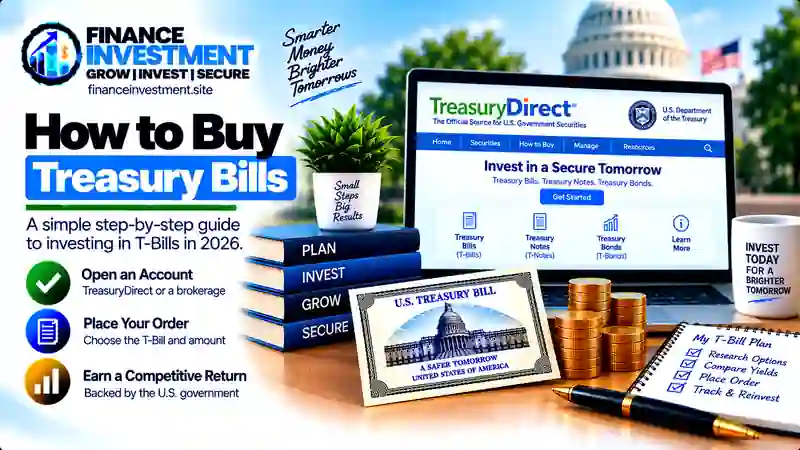 If you are new to TreasuryDirect, start by getting your account information ready. For an individual account, TreasuryDirect requires a valid taxpayer identification number, a U.S. address of record, a U.S. financial institution account that can accept ACH payments, and an email address. You must also meet TreasuryDirect’s eligibility requirements.
1. Prepare Your Account Information
Have your required identification and banking details available before starting the application. TreasuryDirect uses this information to establish and verify your account. Your bank account information is also important because TreasuryDirect uses ACH for eligible payments and receipts.
2. Open Your TreasuryDirect Account
Complete the online account application through the official TreasuryDirect website. Once your account is established, you can sign in and use the platform to buy, hold and manage eligible Treasury securities.
3. Decide How Much to Purchase
Choose an amount that fits your cash needs and the applicable purchase increments for the bill. Do not commit money that you may need for regular expenses before the bill matures.
4. Review the Specific T-Bill Offering
Before submitting an order, check the bill’s term, auction date, issue date, maturity date and applicable offering details. The auction announcement provides the requirements and deadlines for that particular offering, so avoid relying on an old auction schedule.
BEGINNER TIP:
Choose the maturity date based on when you expect to need the cash, not simply on the bill’s advertised yield. A higher yield may not fit your plans if the money is needed before maturity.
How Buying T-Bills Through TreasuryDirect Works
When you buy a T-bill through TreasuryDirect, you are participating in a U.S. Treasury auction for a new security. You select an available Treasury bill in BuyDirect, enter the amount you want to purchase, and submit a noncompetitive bid before the applicable deadline.
TreasuryDirect Uses Noncompetitive Bidding
TreasuryDirect does not allow competitive bidding. With a noncompetitive bid, you specify the dollar amount you want to purchase and agree to accept the discount rate determined by the auction. This means you do not enter a personal discount rate or try to outbid other investors.
How the Treasury Determines the Auction Result
The Treasury first accepts eligible noncompetitive bids according to the auction rules. It then evaluates competitive bids, starting with the lowest discount rates and moving higher until the public offering is filled. The highest accepted discount rate becomes the auction’s high rate, and accepted noncompetitive bids receive the corresponding auction price.
What Happens After the Auction?
After the auction, accepted purchases are issued on the scheduled issue date. Treasury bills generally do not make periodic interest payments. Instead, they are issued at a discount and pay their face value at maturity. The difference between the purchase price and the amount received at maturity represents the bill’s interest.
WHY THIS MATTERS:
TreasuryDirect keeps the investor’s auction decision simple: you choose the bill and purchase amount, while the Treasury auction determines the applicable discount rate and purchase price.
Benefits and Drawbacks of Buying T-Bills Through TreasuryDirect
TreasuryDirect gives investors a direct way to buy Treasury bills at auction and hold them in a TreasuryDirect account. That direct access can be convenient, but the platform also has rules that are important to understand before placing an order.
Benefits
- Buy Treasury bills directly through the U.S. Treasury.
- You do not need a brokerage account to make a TreasuryDirect purchase.
- Noncompetitive bidding lets you specify the purchase amount without entering your own auction discount rate.
- You can schedule eligible bill proceeds for reinvestment into another bill of the same term.
Drawbacks
- TreasuryDirect does not accept competitive bids.
- Newly purchased marketable securities generally must be held for 45 calendar days before they can be transferred or sold.
- A 4-week bill purchased through TreasuryDirect cannot be transferred because its term is shorter than the 45-day holding period.
- To sell a TreasuryDirect-held bill before maturity, you must transfer it to a bank, broker or dealer that can sell it in the secondary market.
QUICK TAKE:
TreasuryDirect can simplify direct Treasury purchases, but liquidity rules matter. If you may need to sell a newly purchased bill, understand the 45-day holding rule and the transfer process before committing your money.
Step-by-Step TreasuryDirect Buying Process
Once your TreasuryDirect account is ready, buying a T-bill involves a few straightforward steps. The BuyDirect area guides you through the purchase, while the specific auction announcement provides the applicable dates and deadlines for the bill you select.
Step 1: Sign In and Open BuyDirect
Sign in to your TreasuryDirect account and open BuyDirect. Select the option to purchase a marketable Treasury security and continue to the security selection screen.
Step 2: Select Treasury Bills
Choose Bills and select the available T-bill term you want to purchase. Review the auction date, issue date and maturity date before moving forward.
Step 3: Enter Your Purchase Details
Enter the par amount you want to purchase and provide the required purchase information. This can include the purchase date, registration, payment account and account where the maturity proceeds should be directed. TreasuryDirect purchases are submitted as noncompetitive bids.
Step 4: Review and Submit the Order
Review every detail before submitting the order. Check the T-bill term, amount, auction date, payment information and redemption instructions. After the auction, an accepted purchase is issued on the scheduled issue date at the applicable auction price.
IMPORTANT:
Auction deadlines are not something to guess or copy from an older article. Always check the current Treasury offering announcement for the specific T-bill before submitting your order.
Costs, Taxes, Risks and Expert Tips
One advantage of buying marketable Treasury securities through TreasuryDirect is the straightforward fee structure. TreasuryDirect states that it does not charge a purchase fee or commission. You still pay the purchase price of the security, and other costs may apply if you later use a bank or broker for a secondary-market transaction.
Taxes on T-Bill Income
T-bill interest is subject to federal income tax but is exempt from state and local income taxes. For Treasury bills, the difference between the discounted purchase price and the face value received at maturity is generally treated as interest income when the bill matures. Treasury obligations are reported on Form 1099-INT, generally in Box 3.
Risks to Keep in Mind
If you sell a T-bill before maturity, its market price may be higher or lower than what you paid. Interest-rate changes, market conditions and the remaining time to maturity can affect that price. TreasuryDirect also has transfer and holding rules that can affect access to the secondary market.
Practical Tips Before You Buy
- Check the maturity date before committing your cash.
- Compare the investment rate or yield when evaluating different T-bill terms.
- Keep your purchase and maturity records for tax reporting.
- Review the current Treasury auction announcement before submitting your order.
EXPERT TIP:
Look at the maturity date alongside the yield. A T-bill may offer a competitive yield, but the investment still needs to match when you expect to use the money.
Common Mistakes When Buying T-Bills Through TreasuryDirect
The TreasuryDirect purchase process is fairly structured, but small errors can still cause problems. A quick review before submitting the order can help you avoid mistakes involving the bill term, purchase amount, funding account or auction timing.
- Choosing the wrong maturity: A bill’s maturity date should match when you expect to need the money.
- Missing the auction deadline: Each Treasury offering has its own auction schedule and bidding deadline. Check the current offering announcement before submitting an order.
- Entering the wrong amount: Treasury marketable securities have a $100 minimum purchase amount and are purchased in $100 increments. Make sure the amount fits your cash plan.
- Not having enough funds: TreasuryDirect takes payment from the funding source specified for the purchase. Make sure sufficient funds are available before settlement.
- Ignoring early-sale rules: Newly purchased Treasury marketable securities generally must be held for at least 45 calendar days before they can be transferred or sold.
Real-Life Example: Buying a $10,000 T-Bill
Suppose an investor has $10,000 available and wants to purchase a Treasury bill through TreasuryDirect. The investor signs in, opens BuyDirect, selects an available bill, enters a $10,000 par amount, reviews the auction and maturity dates, and submits the noncompetitive order.
The investor does not enter a personal discount rate. Instead, the order accepts the discount rate determined at the auction. If the order is accepted, TreasuryDirect shows the auction price and the amount that must be paid. If the bill is held until maturity, the investor receives its $10,000 face value, with the difference between the purchase price and face value generally representing interest income.
QUICK CHECK:
Before submitting your order, verify the bill term, par amount, auction deadline, funding source and maturity date. These details matter more than simply choosing a bill based on its quoted return.
Who Should Consider TreasuryDirect?
TreasuryDirect is one way to buy Treasury bills directly from the U.S. Treasury. It can be relevant for investors who want to participate in Treasury auctions, manage securities through a TreasuryDirect account, and plan around specific maturity dates rather than treating T-bills like continuously traded investments.
TreasuryDirect May Be Relevant If You:
- Want to buy Treasury bills directly through the U.S. Treasury rather than placing the initial purchase through a brokerage account.
- Are comfortable using noncompetitive bidding instead of entering your own auction discount rate.
- Expect to hold the bill through maturity or understand the rules that apply if you later want to transfer and sell it.
- Want to use TreasuryDirect’s available reinvestment features for eligible Treasury bills.
- Prefer to manage auction purchases, maturity dates and Treasury holdings from one TreasuryDirect account.
When a Brokerage Account May Offer Different Features
A brokerage account provides access to the secondary market and may offer additional trading and portfolio-management tools. That can matter if you expect to sell Treasury bills before maturity or want to manage Treasury securities alongside stocks, bonds and ETFs. TreasuryDirect and brokerage accounts therefore provide different ways to manage Treasury investments.
Frequently Asked Questions About Buying T-Bills Through TreasuryDirect
1. Can I buy T-bills directly through TreasuryDirect?
Yes. Eligible TreasuryDirect account holders can use the BuyDirect function to submit noncompetitive bids for Treasury bills. The purchase is made through the Treasury’s auction process rather than by buying an existing bill from another investor.
2. Does TreasuryDirect let me choose the T-bill rate?
No. A TreasuryDirect purchase is a noncompetitive bid. You specify the dollar amount you want to purchase and agree to accept the discount rate determined by the auction.
3. What is the minimum amount needed to buy a T-bill?
The applicable minimum purchase amount and required increments are stated in the specific Treasury auction announcement. Treasury marketable securities are commonly offered in $100 minimum amounts and multiples of $100, but you should check the current offering before submitting an order.
4. Do T-bills pay monthly interest?
No. T-bills generally do not make periodic interest payments. They are generally issued at a discount and pay their face value at maturity. For a bill held to maturity, the difference between the discounted purchase price and face value is generally treated as interest income.
5. Can I sell a TreasuryDirect T-bill before maturity?
Yes, subject to TreasuryDirect’s transfer rules and the secondary-market process. A marketable security generally cannot be transferred for 45 calendar days after its issue date, or for the security’s term if that term is shorter. After the applicable restriction, the security can be transferred to a bank, broker or dealer for a secondary-market sale.
6. Are T-bill earnings taxable?
Yes. Interest from Treasury bills is generally subject to federal income tax but exempt from state and local income taxes. Treasury bill interest is generally reported on Form 1099-INT, Box 3.
7. Can I reinvest a matured T-bill through TreasuryDirect?
TreasuryDirect provides a reinvestment process for eligible maturing marketable securities. When the option is available, you can direct the proceeds of a maturing security toward a new Treasury purchase according to the applicable TreasuryDirect rules.
8. Is TreasuryDirect the only way to buy T-bills?
No. Treasury bills can also be purchased through banks and brokerage firms. Those providers may offer different features, including secondary-market access, trading tools and account services.
Final Verdict: Buying T-Bills Through TreasuryDirect
TreasuryDirect provides eligible investors with a direct way to participate in U.S. Treasury auctions without using a brokerage account for the initial purchase. For T-bills, the TreasuryDirect process uses noncompetitive bidding. You select the available bill and purchase amount, while the auction determines the applicable discount rate and purchase price.
Before buying, the key details to review are the bill’s term, auction date, issue date, maturity date, purchase amount and payment information. Your choice should also account for when you expect to need the money. If you may need to sell before maturity, review the applicable holding, transfer and secondary-market requirements first.
TreasuryDirect is one way to purchase Treasury bills. Banks and brokerage firms can provide other purchasing and secondary-market options. Comparing these routes can help you understand differences in access, trading features and how you manage a T-bill after purchase.
FINAL CHECK:
Before submitting a TreasuryDirect order, confirm the T-bill term, par amount, current auction deadline, payment information and maturity date. Then make sure the maturity timeline matches when you expect to use the cash.
Related Treasury Bill Resources
If you want to explore T-bills further, these FinanceInvestment guides cover Treasury bill basics, different maturities, pricing terms and purchase amounts. They can help you research a specific question before placing another TreasuryDirect order.
Treasury Bills Explained
— a broader guide to how Treasury bills work, their terms and key features.
13-Week Treasury Bills Explained
— a focused guide to the 13-week Treasury bill.
26-Week Treasury Bills Explained
— learn more about the 26-week Treasury bill and its maturity period.
Treasury Bill Yield vs. Interest Rate
— understand the terminology used when comparing Treasury bill returns.
How Much Can $10,000 Earn in Treasury Bills?
— explore an example based on a $10,000 Treasury bill investment.
Official Sources
For current TreasuryDirect account information, auction schedules and purchase rules, visit
TreasuryDirect
.
For federal tax treatment of Treasury securities, review
IRS Publication 550
.
For general investor education and information about investing in government securities, visit
Investor.gov
.
Have a Money Question? Keep Exploring.
Now that you know how to buy T-bills through TreasuryDirect, keep exploring Treasury bill terms, yields and maturity strategies before making your next purchase.
Leave a Reply