Author: subhashr325

  • Treasury Bills vs CDs: Safety, Taxes, Rates & Liquidity

    Treasury Bills vs CDs: Safety, Taxes, Rates & Liquidity

    Treasury Bills vs CDs

    Subhash Rukade
    Founder, FinanceInvestment
    Published: Sep 25, 2026
    Updated: Sep 25, 2026
    Reading Time: 10–12 min


    Treasury Bills vs CDs: What Should You Know?

    Treasury Bills vs CDsTreasury Bills vs CDs is a useful comparison when you have cash to put aside and want to earn a return without taking on the volatility of stocks. Both can serve short-term savings goals, but they work differently. A T-bill is a short-term U.S. Treasury security, while a CD is a time deposit offered by a bank or credit union.

    The real difference shows up when you look past the advertised rate. The maturity date, access to your money, taxes, insurance, and what happens if your plans change can all affect the outcome. T-bills have maturities of one year or less, while CDs can come with a much wider range of terms.

    What You’ll Learn

    • How Treasury bills and CDs work from purchase to maturity.
    • How U.S. government backing differs from FDIC or NCUA insurance.
    • What can happen when you need your money before maturity.
    • How federal and state taxes can affect your actual return.
    • Which rates, fees, terms, and access rules deserve attention.
    • How to match each option with a short-term financial goal.

    If T-bills are new to you, start with our Treasury Bills Explained guide. It covers the basics before we get into the practical differences between T-bills and CDs.

    Quick Answer: Treasury Bills vs CDs

    Treasury bills and CDs can both fit short-term savings goals, but they are built differently. A T-bill is a short-term U.S. Treasury security with a maturity of one year or less. A CD is a time deposit from a bank or credit union with a specific term and account rules.

    Key Takeaways

    • Different products: T-bills are Treasury securities; CDs are deposit products.
    • Protection differs: T-bills are backed by the U.S. government, while eligible CDs at FDIC-insured banks can receive FDIC insurance within applicable limits.
    • Maturity differs: T-bills mature within one year, while CDs can have terms ranging from short periods to several years.
    • Early access differs: A CD may impose an early-withdrawal penalty. A marketable T-bill can generally be sold before maturity, but its market price may be higher or lower than the purchase price.
    • Taxes matter: T-bill interest is generally subject to federal income tax but exempt from state and local income taxes. CD interest is generally taxable income.
    • Yield is only one factor: Compare the return with taxes, maturity, insurance, fees, access rules, and your cash timeline.

    BOTTOM LINE: Start with when you expect to need the money. Then compare the current T-bill yield or CD APY, applicable protection, tax treatment, fees, and the consequences of accessing the money early.

    Table of Contents

    Treasury Bills vs CDs at a Glance

    T-bills and CDs can both be used for money you expect to keep relatively stable, but they are structured differently. A T-bill is a marketable U.S. Treasury security with a maturity of one year or less. A CD is a time deposit with a specific term and institution-specific rules.

    BEST FOR

    T-bills may fit a defined cash timeline. CDs may fit savers who are comfortable committing money for a selected term.

    KEY NUMBERS

    T-bills mature in 1 year or less. Standard FDIC coverage is $250,000 per depositor, per insured bank, for each ownership category.

    FeatureTreasury BillsCDs
    ProductU.S. Treasury securityTime deposit at a bank or credit union
    MaturityOne year or lessSpecific term selected when opened
    ProtectionBacked by the U.S. government; not FDIC-insuredEligible bank CDs may receive FDIC insurance; eligible credit-union CDs may receive NCUA share insurance
    Early accessA marketable bill can generally be sold before maturity at the available market priceEarly withdrawal may involve a penalty or other product-specific restrictions
    ReturnFor a bill held to maturity, generally based on purchase price and maturity valueInterest is earned according to the CD’s stated terms

    QUICK TAKE: Don’t stop at the advertised return. Check the maturity, applicable insurance or government backing, taxes, access rules, and what happens if you need the money earlier than planned.

    Treasury Bills vs CDs: A Complete Beginner Guide
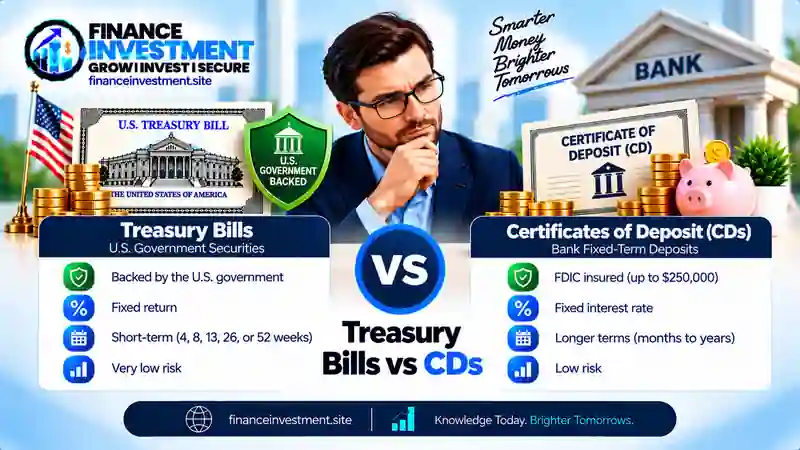
    Treasury Bills vs CDsIf you’re new to Treasury Bills vs CDs, start with the basic difference. A Treasury bill is a short-term U.S. government security. A CD is a time deposit offered by a bank or credit union. Both can be used for money you expect to keep relatively stable, but the way you earn and access that money is different.

    Treasury Bills in Simple Terms

    T-bills have maturities of one year or less. They are generally issued at a discount to face value, although an auction can result in a price at par. When a discounted bill reaches maturity, you receive its face value, with the difference between your purchase price and the amount received representing the interest earned.

    CDs in Simple Terms

    A certificate of deposit is a time deposit with a selected term. Traditional CDs commonly offer a fixed rate for that term, although the exact terms depend on the institution and CD type. Taking money out before maturity may trigger an early-withdrawal penalty, so the account’s disclosure matters before you open one.

    A SIMPLE WAY TO THINK ABOUT IT: A T-bill is a short-term Treasury security with a maturity date. A CD is a time deposit with a selected term. Once you understand that difference, compare the return, taxes, protection, and access rules.

    How Treasury Bills and CDs Work

    The practical difference becomes clearer when you follow the money from purchase to maturity. A T-bill is issued through a Treasury auction and has a defined maturity. A CD is opened with a bank or credit union for a selected term, with the institution’s terms controlling interest, maturity, and early access.

    How a Treasury Bill Works

    The Treasury sells bills through auctions. T-bills are issued at a discount and redeemed at their face value when they mature. For a discounted bill, the difference between the purchase price and the amount received at maturity is the interest earned. A marketable T-bill can generally be sold before maturity, but the sale price is determined by the market at that time.

    How a CD Works

    With a CD, you deposit money for a stated term and earn interest according to the CD’s terms. When the term ends, the deposit becomes available according to the institution’s maturity rules. If you need the money earlier, the CD agreement determines whether early withdrawal is permitted and what penalty or other restriction may apply.

    THE PRACTICAL DIFFERENCE: With a T-bill, getting out before maturity generally means selling a security at its current market price. With a CD, early access is governed by the deposit agreement and may involve a penalty.

    Treasury Bills vs CDs: Benefits and Drawbacks

    Neither product is automatically the right fit for every cash goal. The useful question is what you value most: a Treasury security with a defined maturity, or a time deposit with institution-specific terms.

    Treasury Bills: Pros and Cons

    PROS
    • Backed by the full faith and credit of the U.S. government.
    • Maturities of one year or less can fit short-term cash planning.
    • Interest is generally exempt from state and local income taxes.
    • Marketable T-bills can generally be sold before maturity.
    CONS
    • An early sale exposes you to the market price at that time.
    • Buying and managing Treasury securities may require more steps than opening a bank CD.
    • T-bills are securities, not FDIC-insured deposits.

    CDs: Pros and Cons

    PROS
    • Traditional CDs commonly provide a fixed rate for a defined term.
    • Different terms can accommodate different savings timelines.
    • Eligible bank CDs can receive FDIC insurance within applicable limits.
    • Eligible CDs at federally insured credit unions can receive NCUA share insurance.
    CONS
    • Early withdrawal may result in a penalty under the CD’s terms.
    • Your money may be less accessible during the selected term.
    • CD interest is generally subject to federal income tax and may also be subject to applicable state or local taxes.

    WHAT MATTERS MOST: A T-bill can be sold before maturity, but its market price can change. A traditional CD can keep its stated rate through the term, but early access may cost you through an early-withdrawal penalty. Your cash timeline should come first.

    Treasury Bills vs CDs: Detailed Comparison

    The headline return is only one piece of the puzzle. When comparing Treasury bills and CDs, look at how each product handles maturity, access, taxes, protection and what happens if your plans change.

    FeatureTreasury BillsCDs
    What you ownA short-term U.S. Treasury securityA time deposit with a bank or credit union
    MaturityOne year or lessThe term selected when the CD is opened
    ReturnFor a discounted bill held to maturity, the purchase price and maturity value determine the returnInterest is earned according to the CD’s stated terms
    ProtectionBacked by the U.S. government; not FDIC-insuredEligible bank CDs may receive FDIC insurance; eligible share certificates at federally insured credit unions may receive NCUA share insurance
    Early accessA marketable bill can generally be sold before maturity at the market price available thenEarly withdrawal depends on the CD agreement and may involve a penalty
    Federal taxInterest is generally subject to federal income taxInterest is generally taxable income
    State & local taxGenerally exempt from state and local income taxesMay be subject to applicable state and local income taxes
    Main trade-offDefined maturity with the ability to sell before maturity at the prevailing market priceDefined deposit term with early-access rules set by the CD

    HOW TO USE THIS TABLE: Start with your expected cash date. Then compare the current return, applicable protection, tax treatment and early-access rules. That gives you a more useful comparison than looking at the advertised rate alone.

    Costs, Risks and Expert Tips

    A good comparison goes beyond the advertised return. Before choosing a T-bill or CD, look at the cost of buying or exiting, the tax treatment, and what could happen if you need the money sooner than expected.

    Costs and Risks to Watch

    • T-bills: TreasuryDirect charges no purchase fee or commission. A broker may have its own charges or terms. Selling before maturity also means accepting the market price available at that time.
    • CDs: Check the specific CD agreement for early-withdrawal provisions, minimum deposit requirements, renewal terms, and any other conditions.
    • Taxes: Compare after-tax returns. T-bill interest is generally subject to federal income tax but exempt from state and local income taxes. CD interest is generally taxable income.
    • Protection: Confirm whether a CD is held at an FDIC-insured bank or through a federally insured credit union, and check the applicable insurance rules and limits.

    Expert Tips Before You Buy

    1. Start with the date you expect to need the money.
    2. Compare the current T-bill yield with the CD’s APY after considering taxes and applicable costs.
    3. Read the CD disclosure, especially the early-withdrawal and maturity sections.
    4. If buying a T-bill, decide whether you can hold it to maturity or accept the possibility of a different market price if you sell early.

    EXPERT TIP: Don’t compare the rate alone. A slightly higher return may not matter if the product’s maturity, taxes, fees, or early-access rules don’t fit your plans.

    Common Mistakes and a Real-Life Example

    The rate may grab your attention first, but the details can matter more. A few common mistakes can make a T-bill or CD less convenient than expected.

    Common Mistakes to Avoid

    • Looking only at the highest rate: Taxes, fees, maturity and access rules can change the practical value of a return.
    • Ignoring the maturity date: Make sure the T-bill maturity or CD term fits your expected cash date.
    • Confusing selling with withdrawing: A marketable T-bill can generally be sold before maturity at its market price, while a CD follows the withdrawal terms in its agreement.
    • Forgetting tax differences: T-bill interest is generally exempt from state and local income taxes, while CD interest may be subject to applicable state and local taxes.
    • Assuming every CD has identical protection: Check whether the deposit is at an FDIC-insured bank or whether the share certificate is at a federally insured credit union.

    Real-Life Example

    Suppose a couple has $25,000 set aside for a home improvement project they expect to fund in about six months. They could compare a T-bill with a maturity close to that date against a CD whose term fits their timeline.

    They would then compare the current return, taxes, applicable insurance, and early-access rules. If the project date moves, the consequences also matter: selling a T-bill before maturity means accepting its market price, while accessing a CD early depends on the CD’s terms and any applicable penalty.

    KEY LESSON: Choose the time frame first, then compare the return. Matching the product to your cash date can prevent an avoidable early-access problem.

    Who Should Choose Treasury Bills or CDs?

    Your plans for the money can help narrow the choice. Consider how long you can leave it untouched, whether you prefer a Treasury security or a deposit account, and how each product’s terms affect your return.

    Treasury Bills May Fit If:

    • Your spending date matches an available short-term T-bill maturity.
    • You want to hold a security backed by the U.S. government.
    • The state and local income tax treatment matters to you.
    • You can hold until maturity or accept market-price risk if you sell early.

    CDs May Fit If:

    • You want a deposit product with a term suited to your savings goal.
    • You prefer the predictable rate offered by a traditional fixed-rate CD.
    • You can meet the minimum deposit and early-withdrawal conditions.
    • You have confirmed applicable FDIC coverage for an eligible bank CD or NCUA coverage for an eligible credit-union share certificate.

    ONE MORE THING: If you might need this money without warning, neither product should be treated like an everyday spending account. Keep your immediate cash needs in mind before committing to a maturity date or deposit term.

    Frequently Asked Questions About Treasury Bills vs CDs

    1. How do Treasury bills and CDs differ?

    A T-bill is a short-term U.S. Treasury security, while a CD is a time deposit offered by a bank or credit union. Their maturity, access, tax treatment and protection work differently.

    2. Are Treasury bills FDIC-insured?

    No. Treasury bills are not FDIC-insured deposits. They are U.S. Treasury securities backed by the full faith and credit of the U.S. government.

    3. Are CDs FDIC-insured?

    An eligible CD at an FDIC-insured bank can receive FDIC coverage within applicable limits. A share certificate at a federally insured credit union may receive NCUA share insurance instead.

    4. Can you sell a Treasury bill before maturity?

    Yes. A marketable T-bill can generally be sold before maturity, but the amount received depends on its market price at the time of sale.

    5. Can you withdraw money from a CD early?

    That depends on the CD’s terms. A traditional CD may allow early withdrawal with a penalty, while certain CD types can have different access rules.

    6. Are Treasury bill earnings exempt from state taxes?

    Generally, yes. Interest from U.S. Treasury securities is generally exempt from state and local income taxes, while federal income tax generally applies.

    7. Do CDs and Treasury bills have the same tax treatment?

    No. T-bill interest generally receives state and local tax exemption. CD interest is generally taxable income and may also be subject to applicable state and local taxes.

    8. Which should you compare for short-term cash?

    Compare the specific T-bill and CD based on your cash date, current return, taxes, fees, access rules and applicable protection. There is no single comparison that fits every situation.

    REMEMBER: A T-bill is a Treasury security, while a CD is a deposit product. Their insurance, tax and early-access rules should be evaluated separately.


    Treasury Bills vs CDs: Final Comparison

    Treasury bills and CDs can both be used for short-term cash planning, but they work in different ways. A T-bill is a short-term U.S. Treasury security with a defined maturity. A CD is a time deposit with a term and conditions set by the financial institution.

    Before comparing them, look at when you need the money, the current return, applicable taxes, protection, and early-access rules. With a T-bill, consider the maturity date and the market price if you sell before maturity. With a CD, review the term, rate, maturity instructions, and early-withdrawal provisions.

    FINAL CHECK: A useful comparison goes beyond the headline rate. Review the cash timeline, access rules, tax treatment, applicable insurance or government backing, and any costs before making a decision.

    For a broader introduction to Treasury securities, read our Treasury Bills Explained guide. You can also compare another short-term cash option in our CD vs Money Market Account guide.

    Have a Money Question? Keep Exploring.

    Understanding the details can make short-term money decisions easier to compare. Keep exploring FinanceInvestment for practical guides on Treasury bills, CDs, and other personal finance topics.

    📩 Get in Touch With FinanceInvestment

    Have a money question or a topic you’d like us to cover?

    Email FinanceInvestment

    Continue Your Research
  • What Happens to T-Bills If a Brokerage Fails? | SIPC Guide

    What Happens to T-Bills If a Brokerage Fails? | SIPC Guide

    What Happens to T-Bills If a Brokerage Fails?

    Subhash Rukade
    Founder, FinanceInvestment
    Published: Sep 24, 2026
    Updated: Sep 24, 2026
    Reading Time: 11–13 min
    What happens to your Treasury bills when the brokerage holding them fails—and what SIPC protection can and cannot do.


    What Happens to T-Bills If a Brokerage Fails?

    What Happens to T-Bills If a Brokerage FailsWhat happens to T-bills if a brokerage fails? Your Treasury bills do not simply become worthless because the brokerage holding them fails. T-bills are securities held in a brokerage account, and when a SIPC-member brokerage fails, SIPC may help protect eligible customer securities and cash if customer property is missing, subject to applicable rules and limits.

    There is an important distinction, though. SIPC protection does not cover a drop in the market value of your T-bills. If interest rates change and the market price of a Treasury bill moves, that investment risk remains yours. SIPC protection is designed for situations involving a failed member brokerage and missing customer property, not ordinary investment losses.

    During a brokerage liquidation, customer accounts may sometimes be transferred to another brokerage, while a trustee works through customer claims and the firm’s records. The exact process depends on the circumstances of the failure.

    That makes one question especially useful for T-bill investors: what protection applies to the Treasury security itself, and what protection applies to the brokerage account holding it? Keeping those two issues separate makes the whole process much easier to understand.

    What You’ll Learn

    • What can happen to your T-bills when a brokerage fails.
    • How SIPC protection can apply to eligible Treasury securities.
    • Why brokerage failure is different from a decline in a T-bill’s market price.
    • What the standard $500,000 SIPC protection limit means, including the $250,000 cash limit.
    • How a trustee may handle customer accounts and missing property during a liquidation.
    • What investors should check before keeping T-bills at a brokerage.

    If you want to review the basics first, see our Treasury Bills Explained guide. It provides the foundation for understanding what you actually own before we look at brokerage failure.

    Quick Answer: What Happens to T-Bills If a Brokerage Fails?

    Your T-bills do not automatically become worthless if your brokerage fails. If the brokerage is a SIPC member and customer securities or cash are missing, SIPC may provide protection for eligible customer property, subject to applicable rules and limits. Treasury securities are among the securities that SIPC protection can cover.

    Key Takeaways

    • A brokerage failure is different from an investment loss. SIPC protection addresses certain missing customer securities and cash when a qualifying brokerage fails.
    • The brokerage must be a SIPC member. SIPC protection is available only under the conditions established by the Securities Investor Protection Act.
    • Treasury securities can qualify for SIPC protection. Investor.gov specifically lists Treasuries among the protected securities.
    • The standard SIPC limit is $500,000 per customer. This includes a maximum of $250,000 for claims involving cash. The limit does not mean every investor automatically receives $500,000.
    • SIPC does not cover market losses. If a T-bill’s market value falls because interest rates or other market conditions change, SIPC does not reimburse that decline.
    • A failed brokerage may not always require a full SIPC liquidation. In some cases, customer accounts can be transferred to another SIPC-member brokerage without a SIPC protection proceeding.

    BOTTOM LINE: SIPC protection is designed to address missing eligible customer securities and cash when a SIPC-member brokerage fails. It is not protection against changes in the market value of your T-bills.

    Table of Contents

    T-Bills and Brokerage Failure at a Glance

    When you hold Treasury bills through a brokerage, two things should be kept separate: the Treasury security you own and the brokerage relationship through which it is held. If the brokerage fails, the issue is generally whether customer property can be returned and, when eligible property is missing, whether SIPC protection applies.

    Quick FactWhat It Means
    What you holdA Treasury security recorded in your brokerage account
    If the brokerage failsCustomer accounts may be transferred, or a SIPC liquidation may occur if required
    SIPC limitUp to $500,000 per customer, including up to $250,000 for cash claims
    Market lossNot protected by SIPC
    Membership checkConfirm that the relevant brokerage and, where applicable, clearing firm are SIPC members

    Best For Investors Who Want to Understand the Protection Layers

    The simplest way to look at brokerage-held T-bills is to separate the investment from the account provider. The Treasury bill remains a Treasury security, while SIPC focuses on certain customer cash and securities held by a failed SIPC-member brokerage. Those are different layers of protection.

    QUICK TAKE: A brokerage failure does not by itself mean your T-bills have lost their value or Treasury status. The practical concern is whether the brokerage can account for and return customer property and, if eligible property is missing, whether SIPC protection applies.

    T-Bills at a Brokerage: Complete Beginner Guide

    What Happens to T-Bills If a Brokerage FailsBuying Treasury bills through a brokerage can look similar to buying a stock, but the investment itself is different. A T-bill is a short-term debt security issued by the U.S. Treasury. The brokerage provides the account and services used to purchase and hold that security.

    What You Actually Hold

    When you buy a T-bill through a brokerage, the Treasury—not the brokerage—is the issuer of the security. The brokerage account records your position and provides the custody and trading relationship. Securities can be held in different registration arrangements, including customer-name or street-name form, depending on the account structure.

    If you are new to T-bills, our guide to how Treasury bills work explains how the purchase price, maturity value, and return fit together.

    Why the Brokerage Still Matters

    Even though the Treasury issues the T-bill, the brokerage handles the account through which you hold it. If that brokerage fails, the key question is whether customer property can be accounted for and returned. If a SIPC-member brokerage fails and eligible customer securities or cash are missing, SIPC may provide protection for the resulting shortfall, subject to the applicable rules and limits.

    What SIPC Does—and Does Not—Cover

    SIPC can provide advances of up to $500,000 per customer, including up to $250,000 for cash claims, when the statutory requirements are met. The limit is designed to address a shortfall in eligible customer property; it does not mean every investor automatically receives $500,000.

    Just as important, SIPC does not protect against a decline in the market value of your T-bill. If you sell before maturity and the price is lower because interest rates or other market conditions have changed, that investment loss is not covered by SIPC.

    BEGINNER TIP: Think about the arrangement in two layers: the T-bill is the Treasury security, while the brokerage provides the account and custody relationship. A brokerage failure and a change in the T-bill’s market price are separate risks.

    How T-Bills Are Protected When a Brokerage Fails

    A brokerage failure does not automatically mean that investors must wait for a SIPC payout. U.S. rules require broker-dealers to segregate customer securities and cash from the firm’s own assets, with the goal of making customer property available for return if the firm fails. If a SIPC-member brokerage cannot meet its obligations, a customer-account transfer or SIPC liquidation may follow, depending on the circumstances.

    Step 1: Customer Property Is Identified

    The trustee reviews the brokerage’s books and records to determine what each customer is entitled to receive. Your account statements, trade confirmations, and other records can help establish the securities and cash connected with your account. This is why keeping accurate records and reviewing statements matters.

    Step 2: Accounts May Be Transferred

    When practical, a trustee may arrange for some or all customer accounts to be transferred to another SIPC-member brokerage. If your account is transferred, you may continue to hold your securities through the new firm rather than going through a lengthy liquidation process for the account itself. Even after a transfer, customers may still need to file a claim if the transfer does not make the account whole.

    Step 3: A Trustee Handles a Liquidation When Necessary

    If liquidation is required, a court-appointed trustee works to return customer property and process valid claims. Customer-name securities can be delivered to the customer in whose name they are registered, while other customer property may be pooled and distributed under the SIPA process.

    Step 4: SIPC Can Address a Shortfall

    If eligible customer property is missing, SIPC may provide an advance of up to $500,000 per customer, including up to $250,000 for cash claims, subject to the applicable rules. Treasury securities are among the securities SIPC protects. This protection addresses a shortfall caused by a qualifying brokerage failure; it does not protect against a decline in the market value of a T-bill.

    IMPORTANT DISTINCTION: There are two separate questions: Can the brokerage return your customer property? And, if eligible property is missing, does SIPC protection apply? Neither question changes the market value of the T-bills themselves.

    Benefits and Drawbacks of Brokerage T-Bills

    Holding Treasury bills through a brokerage can make them easier to manage alongside other investments. At the same time, the brokerage account introduces a separate layer of custody and account-related considerations. Knowing both sides can help you understand what you are actually relying on.

    ✓ Potential Benefits

    • One investment account: T-bills can be managed alongside stocks, bonds, ETFs, and other securities in the same brokerage account.
    • Convenient account records: Purchases, holdings, sales, and maturity information can appear within your regular brokerage records.
    • Access to the secondary market: A brokerage can provide a way to sell a T-bill before maturity, although the price you receive can change with market conditions.
    • SIPC protection may apply: If a SIPC-member brokerage fails and eligible customer securities or cash are missing, SIPC may provide protection for the resulting shortfall, subject to statutory limits and other requirements.

    △ Potential Drawbacks

    • SIPC does not cover market losses: If your T-bill declines in market value, SIPC does not reimburse that investment loss.
    • A brokerage failure can cause disruption: Accounts may need to be transferred, or a liquidation and claims process may be required when customer property is missing.
    • Trading costs can matter: Brokerage commissions, spreads, markups, markdowns, or other transaction costs may affect what you receive when buying or selling in the secondary market.
    • SIPC protection has conditions: The brokerage must be a SIPC member, and the protection applies to qualifying customer securities and cash under the rules of SIPA.

    PRACTICAL TAKE: A brokerage can make T-bills convenient to manage, but convenience is not the same as investment protection. Before buying, check the firm’s SIPC membership, understand its trading costs, and know whether you may need to sell the T-bill before maturity.

    SIPC vs. FDIC vs. Treasury Protection

    SIPC, FDIC insurance, and Treasury backing are not three versions of the same protection. They apply to different financial products and different situations. SIPC addresses certain missing customer securities and cash when a qualifying brokerage fails. FDIC insurance protects eligible deposits at FDIC-insured banks. Treasury backing refers to the U.S. government’s obligation on Treasury securities such as T-bills.

    Protection or BackingApplies ToWhat It Addresses
    SIPCEligible securities and qualifying cash held at a SIPC-member brokerageMissing customer property after a qualifying brokerage failure
    FDIC insuranceEligible deposits at an FDIC-insured bankCovered deposit losses when an insured bank fails
    Treasury backingU.S. Treasury securities such as T-billsThe U.S. government’s obligation to honor the security according to its terms

    What This Means for Brokerage-Held T-Bills

    Suppose you hold T-bills in a brokerage account and the brokerage later fails. The T-bills remain Treasury securities. If the brokerage is a SIPC member and eligible customer securities or cash are missing, SIPC may provide protection for the resulting customer-property shortfall. Treasury securities are specifically included among the securities SIPC protects. The standard SIPC limit is up to $500,000 per customer, including up to $250,000 for cash claims, subject to the applicable rules.

    FDIC insurance works differently. If a brokerage uses a bank sweep program, unused cash may be moved into a bank deposit that can receive FDIC insurance under applicable rules. That does not make your separately held T-bills FDIC insured.

    There is another important boundary: SIPC does not protect against a decline in the market value of a security. So if your T-bill’s market price falls because interest rates or other market conditions change, that investment loss is not a SIPC claim.

    EASY WAY TO REMEMBER: SIPC = certain brokerage-failure losses involving missing customer property. FDIC = eligible bank deposits. Treasury backing = the U.S. government’s obligation on Treasury securities.

    Limits, Risks and Practical Tips

    SIPC protection can be valuable when a brokerage fails, but it is not unlimited insurance. The standard protection is up to $500,000 per customer, including a maximum of $250,000 for cash claims. The amount actually available depends on the customer’s eligible claim, the customer-property shortfall, and the applicable SIPC rules.

    Know the Main Limits

    • SIPC is not market-loss insurance. If your T-bill falls in market value, SIPC does not reimburse that investment loss.
    • The brokerage must qualify for SIPC protection. SIPC protection applies when the relevant brokerage is a SIPC member and the other legal requirements are met.
    • Different account capacities can matter. Accounts held in separate capacities can receive separate SIPC limits, while accounts held in the same capacity at the same firm are generally combined for the protection limits.

    Practical Tips for T-Bill Investors

    1. Verify SIPC membership before keeping a large T-bill position at a brokerage.
    2. Save account statements and trade confirmations so you can document your holdings if a problem occurs.
    3. Understand your cash position. Uninvested cash, money market funds, and bank sweep deposits can receive different types of protection.
    4. Know your broker and clearing firm. Review which firms actually hold or clear your account and understand the account structure.
    5. Do not confuse SIPC protection with a guarantee of value. The purpose is to address certain missing customer securities and cash after a qualifying brokerage failure.

    PRACTICAL TAKE: Before buying T-bills through a brokerage, check three things: SIPC membership, account structure, and what happens to your uninvested cash. Those details help you understand the protection that may apply if the brokerage later fails.

    Common Mistakes and Real-Life Example

    Many T-bill investors focus on the Treasury security itself and overlook the brokerage relationship. That can create confusion if the brokerage later fails. Understanding the difference between returning customer property and covering a shortfall makes the process easier to follow.

    Common Mistakes to Avoid

    • Assuming SIPC works like FDIC insurance: SIPC addresses certain missing customer securities and cash after a qualifying brokerage failure. It does not protect against investment losses.
    • Assuming every brokerage account is automatically protected: The brokerage must be a SIPC member, and the customer and property must meet the applicable requirements.
    • Confusing T-bills with cash: A T-bill is a Treasury security. Uninvested brokerage cash can have different protection depending on how it is held.
    • Ignoring account records: Statements, trade confirmations, and other records can help establish what securities and cash are connected with your account.

    Real-Life Example: A $300,000 T-Bill Position

    Imagine an investor holds $300,000 of Treasury bills through a SIPC-member brokerage. The brokerage later fails, but its records and custody systems show that the investor owns those T-bills. If the securities can be located and returned, the investor generally receives the securities rather than a SIPC payment for their market value. Treasury securities are among the securities covered by SIPC protection.

    Now assume some eligible customer property is missing. SIPC may provide an advance toward the qualifying shortfall, subject to the applicable protection limits. The standard limit is up to $500,000 per customer, including up to $250,000 for cash claims. This does not mean an investor automatically receives $500,000.

    Finally, suppose the T-bills are worth less in the secondary market because interest rates changed. That is a separate investment risk. SIPC does not cover a decline in market value. The example shows why brokerage failure, missing customer property, and ordinary market-price changes should not be treated as the same event.

    KEY LESSON: If a brokerage fails, first determine whether your T-bills and other customer property can be returned. If eligible property is missing, then SIPC protection may address the qualifying shortfall, subject to its rules and limits.

    Who Should Consider Brokerage T-Bills?

    Brokerage-held T-bills may be relevant for investors who want to manage Treasury securities alongside stocks, bonds, ETFs, or other investments in one account. A brokerage can also provide access to Treasury purchases and, depending on the firm, a secondary market for selling before maturity.

    This Setup May Fit Investors Who Value

    • Account convenience: Keep T-bills and other investments together in one brokerage account.
    • Trading access: Use brokerage tools to buy or sell Treasury bills, including before maturity when secondary-market access is available.
    • Portfolio management: View Treasury holdings alongside the rest of the investment portfolio.
    • Brokerage-based custody: Hold eligible Treasury securities through a SIPC-member brokerage, where SIPC protection may apply if the firm fails and eligible customer property is missing.

    What to Check Before Buying

    Compare the brokerage’s SIPC membership, clearing arrangement, trading costs, account structure, and treatment of uninvested cash. Investor.gov recommends checking whether the brokerage and clearing firm are SIPC members.  If you prefer to hold Treasury securities directly rather than through a brokerage, compare that approach with your other Treasury bill options before making a decision.

    KEY POINT: Brokerage-held T-bills can offer account convenience, but SIPC protection is a separate issue. It addresses certain missing customer securities and cash after a qualifying brokerage failure; it does not protect against normal investment losses.

    Frequently Asked Questions

    1. What happens to T-bills if a brokerage fails?

    Your T-bills do not automatically become worthless if a brokerage fails. Customer accounts may be transferred to another SIPC-member brokerage, or a SIPC liquidation may occur if necessary. If eligible customer property is missing, SIPC may provide protection for a qualifying shortfall, subject to applicable rules and limits.

    2. Are Treasury bills protected by SIPC?

    Treasury securities are among the securities SIPC can protect when held through a qualifying SIPC-member brokerage. The protection is designed for certain missing customer securities and cash after a qualifying brokerage failure. It does not protect against a decline in the market value of the investment.

    3. What is the SIPC protection limit for T-bills?

    SIPC may provide protection of up to $500,000 per customer, including a maximum of $250,000 for cash claims. The limit is not an automatic payment. The amount available depends on the customer’s eligible claim, missing customer property, and the applicable SIPC rules.

    4. Does SIPC protect T-bills from losing value?

    No. SIPC does not protect against a decline in the market value of securities. If interest rates change and the secondary-market price of your T-bill falls, that investment loss is not covered by SIPC.

    5. Are T-bills FDIC insured when bought through a brokerage?

    No. T-bills are Treasury securities, not bank deposits, so FDIC deposit insurance does not apply to the T-bills themselves. A brokerage may separately offer a bank sweep program for uninvested cash. Eligible swept deposits may receive FDIC protection under applicable banking rules, but that protection is separate from the T-bills.

    6. Can my T-bill account be transferred if my broker fails?

    It may be. A closed SIPC-member brokerage may be able to transfer customer accounts to another SIPC-member brokerage without a SIPC protection proceeding. If SIPC initiates a liquidation, a trustee may also work to transfer customer accounts when possible. The exact process depends on the circumstances.

    7. What should I check before holding T-bills at a brokerage?

    Check whether the brokerage is a SIPC member, understand its clearing arrangement, review how uninvested cash is held, and keep your account statements and trade confirmations. Investor.gov recommends checking the brokerage firm and its clearing firm for SIPC membership.

    8. Is TreasuryDirect different from holding T-bills at a brokerage?

    Yes. TreasuryDirect and brokerage accounts are different ways to hold Treasury securities. A brokerage account involves a brokerage and custody relationship and may involve SIPC protection if the firm qualifies. TreasuryDirect is a separate Treasury account. Investors should compare the account structure, access, and features that matter to them before choosing where to hold T-bills.

    FAQ TAKEAWAY: Treasury backing, SIPC protection, and FDIC insurance are different concepts. Treasury backing relates to the Treasury security itself. SIPC addresses certain missing customer securities and cash when a qualifying brokerage fails. FDIC insurance applies to eligible bank deposits.


    Final Verdict: What Happens to T-Bills If a Brokerage Fails?

    What happens to T-bills if a brokerage fails? A brokerage failure does not automatically make your Treasury bills worthless. If the brokerage is a SIPC member, customer accounts may be transferred to another brokerage, or a SIPC liquidation may occur when necessary. If eligible customer property is missing, SIPC may provide an advance toward the qualifying shortfall, subject to applicable rules and limits.

    The key distinction is between brokerage-failure risk and investment risk. SIPC protection can address certain missing customer securities and cash when a qualifying brokerage fails, but it does not protect against a decline in the market value of your T-bills. The standard SIPC protection limit is up to $500,000 per customer, including up to $250,000 for cash claims.

    Before holding a large T-bill position at a brokerage, review the firm’s SIPC membership, clearing arrangement, account structure, and treatment of uninvested cash. Investor.gov recommends checking both the brokerage firm and its clearing firm for SIPC membership.

    BOTTOM LINE: A brokerage failure is mainly a custody and customer-property issue. If eligible T-bills are properly accounted for, they may be returned or transferred. If eligible customer property is missing, SIPC may address the qualifying shortfall. SIPC does not guarantee the market value of the investment.

    Have a Money Question? Keep Exploring.

    Knowing how your T-bills are held can help you understand the protection that may apply if a brokerage fails. Keep exploring practical Treasury bill and personal finance guides from FinanceInvestment.

    📩 Get in Touch With FinanceInvestment
    Have a question, suggestion, or topic you’d like us to cover?

    Email FinanceInvestment

    Continue Your Research