What Happens to a CD if a Bank Fails?
What happens to your CD when a bank fails? Learn how FDIC protection, CD maturity, accrued interest, and bank resolution can affect your money.
What Happens to a CD if a Bank Fails?
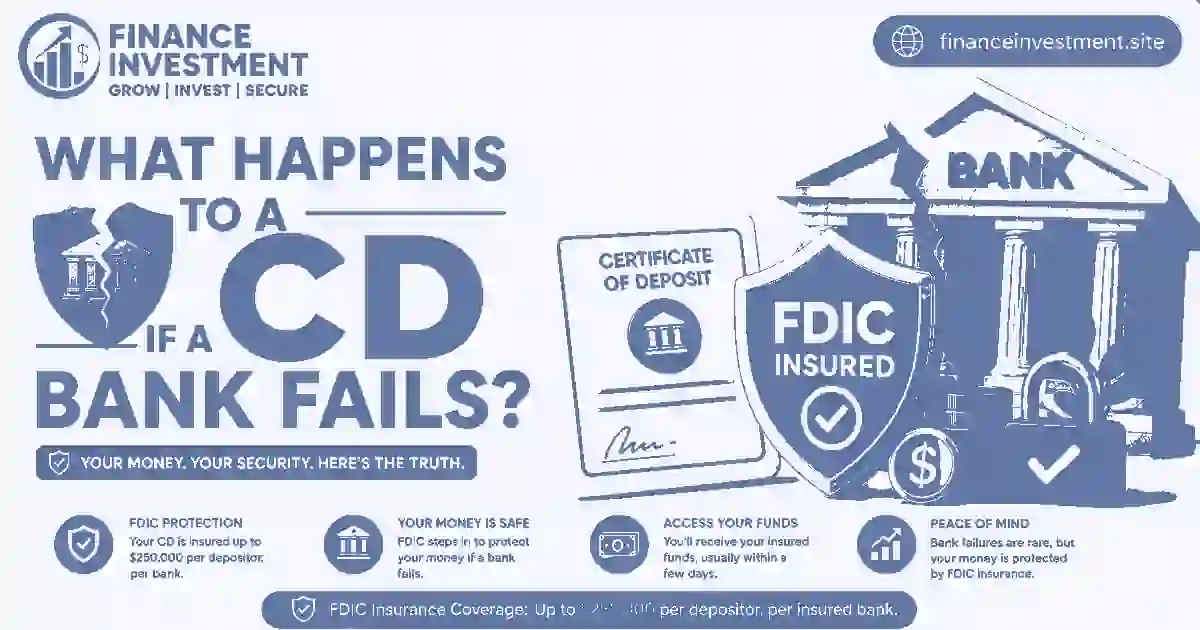 A bank failure can make a CD owner wonder whether the money is suddenly frozen, lost, or stuck until the original maturity date. For an eligible deposit at an FDIC-insured bank, however, a bank closing does not simply make the CD disappear. The FDIC steps into the process and works to protect insured deposits under the applicable rules.
What happens next depends on how the failed bank is resolved. In many cases, another bank assumes the failed institution’s deposits. If that happens, your CD may continue under the acquiring bank’s arrangements. If no acquiring institution takes over the deposits, the FDIC can pay insured depositors directly, subject to the applicable coverage limits.
For CD holders, the important details are the issuing bank, insurance coverage, account ownership, principal, accrued interest, and the CD’s terms. A bank failure does not automatically mean you lose the interest you have earned or the entire deposit. At the same time, a failed-bank resolution can affect how and when you access the money, particularly when a CD is transferred to another institution.
If you want the broader picture before diving into bank-failure scenarios, our CD Guide 2026 covers CD terms, rates, and strategies in one place.
What You’ll Learn
- What happens when an insured bank closes
- How the FDIC handles failed-bank deposits
- What can happen to your CD principal and accrued interest
- How CD maturity and access may be affected
- Why insurance limits and ownership still matter
- What CD holders should check after a bank failure
Quick Answer: What Happens to a CD if a Bank Fails?
An eligible, FDIC-insured CD does not simply disappear when the issuing bank fails. The FDIC generally resolves the failure by arranging for another bank to assume the insured deposits or, when there is no acquiring bank, by paying depositors directly up to the applicable insurance limit.
6 Key Takeaways
- Your insured balance remains protected: FDIC coverage includes principal and accrued interest through the bank’s failure date, subject to the applicable limit.
- Another bank may take over: In the most common resolution, a healthy bank assumes the failed bank’s insured deposits and customers become depositors of the acquiring institution.
- Your original CD terms may change: The acquiring bank is not required to keep the failed bank’s rates or account terms. Depositors may generally withdraw funds without an early-withdrawal penalty following the failure, subject to the applicable resolution terms.
- The FDIC may pay you directly: If no bank assumes the deposits, the FDIC can pay the insured balance directly.
- Amounts above insurance limits are different: Any uninsured portion is handled through the receivership process and is not guaranteed in the same way as insured deposits.
- Keep your records: Your CD statements, ownership information, and deposit records can help establish exactly what you own and how it should be treated.
Bottom line: A bank failure can change who services your CD and may affect its original terms, but an eligible insured deposit is protected within the applicable FDIC limits. The key is knowing how much of your CD is insured and understanding what happens under the bank’s specific resolution.
CD Bank Failure: At a Glance
A bank failure does not automatically mean a CD holder has to start over. The outcome depends mainly on the FDIC resolution process and the amount of the depositor’s eligible funds that falls within applicable insurance coverage.
| What to Check | What It Means for Your CD |
|---|---|
| FDIC-insured deposit | Eligible funds are protected up to the applicable insurance limit. |
| Principal + accrued interest | Both are considered when determining the insured balance, subject to coverage limits. |
| Acquiring bank | A healthy bank may assume the deposits and provide access to insured funds. |
| No acquiring bank | The FDIC may pay depositors directly up to the insured balance. |
| CD maturity | The treatment can depend on the resolution and the acquiring institution’s arrangements. |
| Amount above coverage | The uninsured portion is handled through the failed bank’s receivership and is not protected like an insured deposit. |
One detail is easy to miss: an acquiring bank is not required to preserve the failed bank’s original rates or account terms. The FDIC notes that depositors can generally withdraw funds without an early-withdrawal penalty following the failure, subject to the resolution arrangements.
For complicated deposit structures, the FDIC’s Electronic Deposit Insurance Estimator can help you review coverage across CDs and other eligible deposits at the same bank.
Complete Beginner Guide: What a Bank Failure Means for Your CD
A bank failure is the official closing of a bank because it can no longer meet its obligations. For a CD holder, that event changes who is responsible for the deposit, but it does not automatically turn an eligible insured CD into a loss.
The FDIC Has Two Different Jobs
It helps to separate two FDIC roles. As the insurer, the FDIC protects eligible deposits up to the applicable insurance limit. As the receiver, it takes control of the failed bank, handles its assets and settles claims, including claims involving deposits above the insured limit.
That distinction matters because insured and uninsured money do not receive the same treatment. FDIC insurance covers an eligible CD’s principal and interest accrued or due through the bank’s failure date, subject to the applicable coverage limit.
Where Your CD Fits Into the Process
If another bank takes over the failed institution’s deposits, your insured deposit can move to the acquiring bank. You become a customer of that institution, but the original deposit agreement does not simply carry over unchanged. The acquiring bank is not required to keep the failed bank’s rate or account terms. FDIC guidance also says depositors can generally withdraw insured funds without an early-withdrawal penalty after the failure, subject to the resolution arrangements.
If there is no acquiring bank for the deposits, the FDIC can pay depositors directly for their insured balance. Interest stops accruing on the failed bank’s accounts at the time of closing; if an acquiring bank takes over the deposits, that bank becomes responsible for establishing the post-failure interest treatment.
Why Your Other Deposits Still Matter
Insurance is calculated by depositor, insured bank, and ownership category. Your CD therefore cannot always be viewed separately from other deposits you hold at the same institution. Funds above the applicable insurance limit become part of the receivership claim rather than receiving the same guaranteed treatment as insured deposits.
Brokered CDs Need an Extra Check
A brokered CD can qualify for pass-through FDIC insurance when the underlying requirements are satisfied. The actual owner must own the funds, and the relevant ownership and agency information must be properly recorded. A brokerage platform itself is not the insurer.
Beginner tip: If you ever receive a bank-failure notice, keep your CD statements and ownership records handy. Check the FDIC’s instructions for that specific failure rather than assuming your original CD rate, maturity date, or access rules will remain unchanged.
How It Actually Works After a Bank Failure
The process usually moves quickly, but the exact steps depend on how the failed bank is resolved. Here is what a CD holder can generally expect.
1. The Bank Closes
When regulators close an insured bank, the FDIC immediately begins working on the deposit side of the failure. Its goal is to provide prompt access to insured deposits.
2. Another Bank May Take Over
The preferred and most common resolution is a purchase-and-assumption transaction. A healthy bank assumes the failed bank’s insured deposits. Your insured CD can then become a deposit at the acquiring institution, giving you access to the covered funds.
That does not guarantee the old CD rate will continue. The acquiring bank can establish different interest rates and terms. Depositors generally have the option to withdraw insured funds without an early-withdrawal penalty following the failure, subject to the specific resolution arrangements.
3. The FDIC May Pay You Directly
If no acquiring bank takes the deposits, the FDIC can pay the insured balance directly. Such payments generally begin within a few days of the bank closing, although accounts requiring additional documentation can take longer.
What Happens to Interest?
Interest is covered through the bank’s failure date, within the applicable insurance limit. Interest stops accruing at the failed bank when it closes. If another bank assumes the deposits, that bank becomes responsible for setting the post-failure interest treatment. If the FDIC pays the insured balance directly, interest does not continue beyond the failure date.
Illustrative example: Suppose Maria has an eligible $40,000 CD when her bank fails. If another bank assumes the deposit, Maria may receive access through the new institution, but the new bank could establish a different rate. If the FDIC instead pays her directly, the insured amount would be paid based on the applicable coverage rules, and interest would not continue after the failure date.
Benefits & Drawbacks of FDIC Protection
 FDIC protection gives CD owners an important safety net, but it does not mean every part of the original CD agreement survives a bank failure unchanged. The biggest benefit is protection of eligible deposits; the main tradeoff is that the resolution can alter how the CD is serviced.
✓ Benefits
- Eligible deposits are protected: Covered principal and accrued interest receive FDIC protection within the applicable limits.
- Access may return quickly: When another bank assumes the deposits, customers may regain access without waiting for the entire receivership to finish.
- No separate insurance purchase: Eligible deposits receive FDIC insurance automatically; you do not buy a separate policy for the CD.
- Less uncertainty about principal: Within the coverage limit, a qualifying deposit is treated differently from a market investment during a bank failure.
△ Drawbacks
- The rate may change: An acquiring bank does not necessarily have to preserve the failed bank’s original CD rate.
- Terms may be different: Servicing arrangements and account conditions can change after the transfer.
- Coverage has limits: Money above the applicable insurance limit is not protected in the same way as an insured deposit.
- Access can feel unfamiliar: Even when funds are protected, customers may need to follow new instructions or work with a different institution.
The important distinction is that deposit protection and contract continuity are not the same thing. FDIC insurance can protect an eligible balance, while the bank-failure resolution determines how that deposit is transferred or paid.
CD Bank-Failure Comparison: How Does Your Money Differ?
A CD is only one way to hold cash. The useful comparison here is how each option behaves when the institution behind it runs into trouble, not simply which one offers the highest yield.
| Option | Protection | Access | Return / Market Exposure |
|---|---|---|---|
| FDIC-insured CD | FDIC protection for eligible deposits within applicable limits | Usually restricted until maturity, although a bank failure can change access arrangements | Fixed CD rate; no daily market pricing |
| High-yield savings account | FDIC or NCUA protection when eligible | Generally more flexible | Rate can change; no stock-market exposure |
| Treasury securities | Backed by the U.S. government, not FDIC insurance | Can generally be sold before maturity, subject to market conditions | Known terms, but market prices can move before maturity |
| Money market deposit account | FDIC or NCUA protection when eligible | Typically more accessible than a CD | Rate can change; no stock-market exposure |
| Stocks and bonds | Not FDIC-insured | Generally tradable | Market prices can rise or fall |
For someone building a CD portfolio, the term can matter as much as the institution. You can compare 6-month CD rates or 1-year CD rates when shorter commitments are more useful. Longer timelines can be explored through the 3-year CD guide or 5-year CD guide.
The key difference is the type of protection involved. An eligible CD and savings account rely on federal deposit insurance when held at an insured institution. Treasury securities rely on the U.S. government’s backing, while stocks and bonds are market investments whose values can fluctuate.
Costs, Risks & Expert Tips After a Bank Failure
FDIC protection removes one major fear from an eligible CD, but it does not make every part of the experience predictable. A bank failure can create practical issues around rates, access, uninsured balances, and what you do with the money afterward.
Your CD Rate May Not Survive the Transfer
If another bank assumes the failed bank’s deposits, the acquiring institution does not necessarily have to keep the original CD rate. That can create a reinvestment risk: you may suddenly have money available at a time when comparable CD rates are lower than the rate you originally locked in. The FDIC explains that acquiring institutions may establish their own interest rates and terms.
Watch the Uninsured Portion
The biggest financial concern is usually the amount that falls outside applicable FDIC coverage. Deposits above the insurance limit become part of the failed bank’s receivership process rather than receiving the same protection as insured deposits. Recovery of an uninsured amount can depend on the value of the bank’s assets and the receivership process.
That is why a large CD balance deserves more attention than simply comparing APYs. Review your other deposits at the same bank and consider how ownership categories affect your total coverage.
Brokered CDs Need Extra Attention
If you purchased a CD through a brokerage or another platform, identify the actual issuing bank. Pass-through insurance can apply when the required ownership and recordkeeping conditions are satisfied, but the platform itself is not the FDIC insurer.
Practical Ways to Reduce Surprises
- Verify the issuing bank’s FDIC status before depositing.
- Keep your CD confirmation, statements, and ownership records.
- Review all deposits held at the same institution.
- Don’t assume a familiar financial platform means every CD is insured.
- Read bank-failure notices carefully if your institution closes.
- Keep some cash outside CDs so a resolution does not disrupt your entire cash reserve.
Expert Tip
Don’t build your CD strategy around the assumption that a bank failure will preserve your original rate. Treat FDIC insurance as protection for eligible deposits—not a promise that every original CD feature will remain unchanged. For larger balances, map your deposits by bank and ownership category before opening another certificate.
Common Mistakes + A Real-Life Example
A bank failure is stressful enough without discovering that a few assumptions about your CD were wrong. The most avoidable problems usually come from overlooking the details attached to the deposit.
Common Mistakes to Avoid
- Assuming FDIC insurance preserves every CD term: Insurance protects eligible deposits within applicable limits. It does not guarantee that an acquiring bank will keep the failed bank’s original rate or terms.
- Ignoring uninsured balances: If your deposits exceed the applicable coverage limit, the excess is handled through the receivership process and does not receive the same protection as the insured portion.
- Keeping too much cash at one institution: Several CDs and other deposits can count toward the same coverage calculation when they share the same ownership category.
- Not identifying the issuing bank: When a CD is purchased through a financial platform, check which bank actually issued it. The platform itself may not be the insured institution.
- Assuming your original rate will continue: A new bank that assumes deposits may establish different rates or terms.
- Skipping official notices: The FDIC or acquiring bank may provide important instructions about access, account servicing, and what happens next. Don’t treat those messages as routine paperwork.
Real-Life Example: David’s CD Strategy
David has $180,000 in a CD and $90,000 in an individual savings account at the same bank. He assumes both accounts are separately protected because they are different products. When the bank fails, he discovers that the ownership category matters more than the account names.
Illustrative calculation: $180,000 + $90,000 = $270,000. This example does not determine David’s actual insurance payout because the applicable ownership rules and accrued interest must also be reviewed. It simply shows why looking at each account separately can produce the wrong impression.
David also reads the acquiring bank’s notice instead of assuming his original CD rate will remain unchanged. That gives him a clearer picture of what happens next and what choices are available under the resolution.
Practical lesson: Don’t judge your protection by the CD’s APY or account name alone. Know the issuing bank, review your combined deposits, keep your records, and read the official resolution instructions if the institution ever fails.
Who Should Be Most Concerned About Bank Failure?
Bank failure is not something most CD savers need to worry about every day. The bigger issue is whether your deposit setup could leave you exposed if your institution runs into trouble.
Savers Who Should Pay Closer Attention
- People with large balances: If your eligible deposits may exceed applicable FDIC coverage limits, review the amount that could fall outside insurance.
- Savers using one institution for everything: Keeping CDs, savings, and other deposits at one bank can make the total coverage calculation more important.
- Brokered-CD holders: If you bought CDs through a brokerage or platform, identify the underlying issuing bank and understand how your ownership is recorded.
- People without liquid reserves: A bank resolution can create uncertainty around account access. Keeping separate emergency cash at an accessible institution can provide breathing room.
- Savers with complicated ownership: Trusts, joint accounts, business deposits, and other ownership arrangements can have different insurance rules. These situations deserve a closer review rather than a quick $250,000 calculation.
Who May Be Comfortable With a Straightforward Insured CD?
A saver with a manageable balance, a clearly identified FDIC-insured bank, a simple ownership structure, and separate liquid cash may have a much simpler setup to monitor.
Quick decision guide: Review your bank exposure more carefully when your balances are large, your ownership structure is complex, or your CD came through a broker. If your deposit structure is simple and your emergency money remains liquid elsewhere, an insured CD can be easier to manage.
Frequently Asked Questions About CDs and Bank Failures
What happens to a CD when a bank fails?
The FDIC generally arranges for another bank to assume insured deposits or pays depositors directly up to the applicable insured amount. Your CD does not simply disappear because the issuing bank closes.
Does FDIC insurance protect CD principal?
Yes, eligible CD principal is protected up to the applicable FDIC insurance limit. Coverage also includes qualifying accrued interest through the bank’s failure date.
What happens to accrued CD interest?
Interest accrued through the failure date is included when determining the insured balance, subject to the applicable coverage limit. Interest does not continue accruing at the failed bank after closure.
Does the original CD rate continue after a bank failure?
Not necessarily. An acquiring bank is not required to maintain the failed bank’s original rates or account terms.
Can I withdraw a CD after a bank failure?
If another bank assumes the deposit, depositors generally have the option to withdraw some or all insured funds without an early-withdrawal penalty, subject to the specific resolution arrangements.
What happens if my CD exceeds FDIC coverage?
The insured portion receives FDIC protection. Any uninsured amount becomes a claim against the failed bank’s receivership and is not guaranteed in the same way as an insured deposit. Recovery can depend on the assets available to the receivership.
What happens to a brokered CD when the issuing bank fails?
The treatment depends on the underlying issuing bank, ownership records, and whether the CD qualifies for applicable pass-through insurance. The brokerage platform itself is not the FDIC insurer.
What happens to a CD’s maturity date after a bank failure?
The original maturity date should not be assumed to remain unchanged. An acquiring institution can establish different terms, so CD holders should follow the official instructions provided during the bank-failure resolution.
Is a CD at a credit union protected by FDIC or NCUA insurance?
Eligible time deposits such as share certificates at federally insured credit unions are generally covered by NCUA share insurance rather than FDIC insurance. NCUA says eligible share accounts are insured up to applicable limits, including principal and posted dividends through the credit union’s closing date.
Illustrative: What if I have a $300,000 CD when my bank fails?
Illustrative example only: A $300,000 CD does not automatically receive $300,000 of standard FDIC coverage. The depositor’s ownership category, other deposits at the same bank, accrued interest, and applicable insurance rules would need to be reviewed to determine the protected amount.
Final Verdict: What Should CD Holders Expect?
If an FDIC-insured bank fails, an eligible CD does not simply vanish. The insured deposit is handled through the FDIC’s resolution process, which may involve transferring deposits to another bank or paying the insured amount directly. For most CD owners, the more important question is not whether the money exists, but how the failed bank’s resolution changes the way that money is handled.
Your total deposits, ownership category, and accrued interest matter when determining how much receives FDIC protection. That makes it important to look at your entire relationship with the bank rather than viewing one CD in isolation.
Also, don’t assume the original CD rate or maturity arrangement will remain untouched. An acquiring institution may establish different rates or terms. If that happens, your next decision may involve keeping the funds with the new bank or moving them elsewhere.
Practical takeaway: FDIC insurance can provide meaningful confidence for eligible CD deposits, but good CD planning starts before a failure occurs. Verify the issuing bank, understand your coverage, keep important records, and maintain enough liquid cash outside CDs for everyday needs.
For the bigger picture on choosing terms, rates, and CD strategies, explore our CD Guide 2026.
Stay Informed About Smarter CD Decisions
Want practical insights on CDs, savings, rates, and everyday money decisions? Join the FinanceInvestment newsletter for useful ideas without the financial jargon.
📧 subhashr325@gmail.com
Keep your CD strategy simple: understand the protection, know your limits, and choose terms that fit your cash needs.
“
Leave a Reply