Tag: CD Safety

  • What Happens to a CD if a Bank Fails? 2026 Guide

    What Happens to a CD if a Bank Fails? 2026 Guide

    FINANCEINVESTMENT • CD GUIDE 2026

    What Happens to a CD if a Bank Fails?

    SR
    Written by Subhash Rukade
    FinanceInvestment
    Updated August,24, 2026.
    About 10–15 min read

    What happens to your CD when a bank fails? Learn how FDIC protection, CD maturity, accrued interest, and bank resolution can affect your money.

    What Happens to a CD if a Bank Fails? 2026 Guide
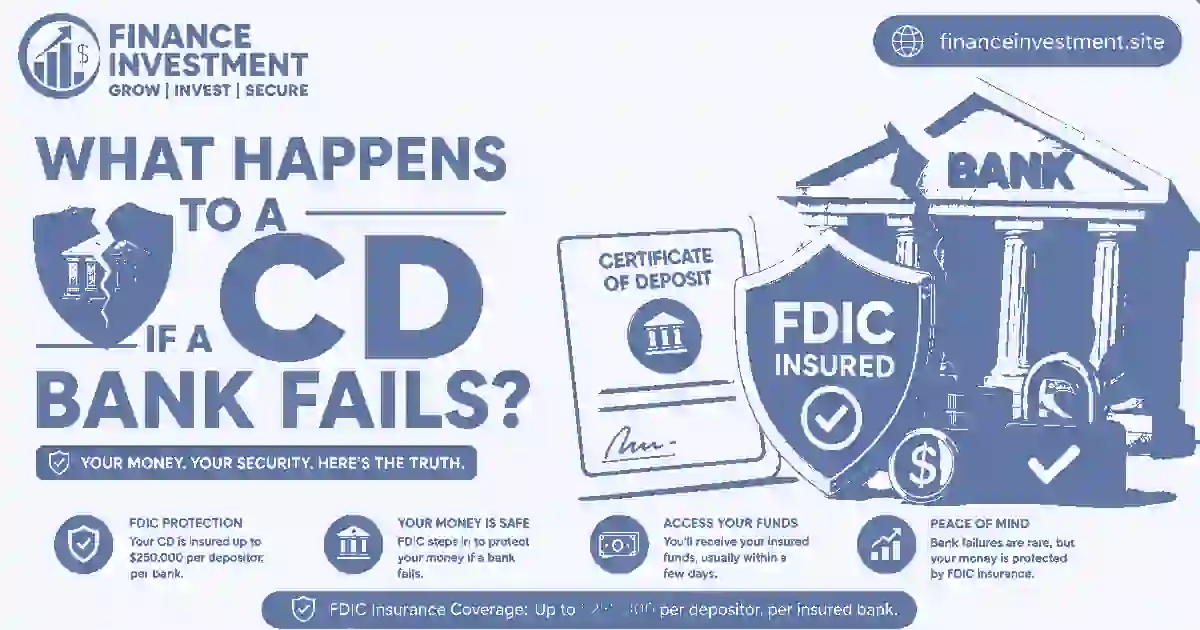
    What happens to a CD if a bank fails? Learn how FDIC protection works, what happens to your principal and interest, and what CD holders should expect.
    what-happens-to-a-cd-if-a-bank-fails
    What Happens to a CD if a Bank Fails
    CD if bank fails, what happens to CD when bank fails, bank failure CD, FDIC insured CD bank failure, CD deposit insurance, FDIC CD protection, what happens to CD interest, CD maturity after bank failure, failed bank CD, FDIC bank failure
    https://financeinvestment.site/what-happens-to-a-cd-if-a-bank-fails/
    Subhash Rukade
    August 23, 2026
    About 10–15 minutes

    What Happens to a CD if a Bank Fails?

    What Happens to a CD if a Bank FailsA bank failure can make a CD owner wonder whether the money is suddenly frozen, lost, or stuck until the original maturity date. For an eligible deposit at an FDIC-insured bank, however, a bank closing does not simply make the CD disappear. The FDIC steps into the process and works to protect insured deposits under the applicable rules.

    What happens next depends on how the failed bank is resolved. In many cases, another bank assumes the failed institution’s deposits. If that happens, your CD may continue under the acquiring bank’s arrangements. If no acquiring institution takes over the deposits, the FDIC can pay insured depositors directly, subject to the applicable coverage limits.

    For CD holders, the important details are the issuing bank, insurance coverage, account ownership, principal, accrued interest, and the CD’s terms. A bank failure does not automatically mean you lose the interest you have earned or the entire deposit. At the same time, a failed-bank resolution can affect how and when you access the money, particularly when a CD is transferred to another institution.

    If you want the broader picture before diving into bank-failure scenarios, our CD Guide 2026 covers CD terms, rates, and strategies in one place.

    What You’ll Learn

    • What happens when an insured bank closes
    • How the FDIC handles failed-bank deposits
    • What can happen to your CD principal and accrued interest
    • How CD maturity and access may be affected
    • Why insurance limits and ownership still matter
    • What CD holders should check after a bank failure

    Quick Answer: What Happens to a CD if a Bank Fails?

    An eligible, FDIC-insured CD does not simply disappear when the issuing bank fails. The FDIC generally resolves the failure by arranging for another bank to assume the insured deposits or, when there is no acquiring bank, by paying depositors directly up to the applicable insurance limit.

    6 Key Takeaways

    1. Your insured balance remains protected: FDIC coverage includes principal and accrued interest through the bank’s failure date, subject to the applicable limit.
    2. Another bank may take over: In the most common resolution, a healthy bank assumes the failed bank’s insured deposits and customers become depositors of the acquiring institution.
    3. Your original CD terms may change: The acquiring bank is not required to keep the failed bank’s rates or account terms. Depositors may generally withdraw funds without an early-withdrawal penalty following the failure, subject to the applicable resolution terms.
    4. The FDIC may pay you directly: If no bank assumes the deposits, the FDIC can pay the insured balance directly.
    5. Amounts above insurance limits are different: Any uninsured portion is handled through the receivership process and is not guaranteed in the same way as insured deposits.
    6. Keep your records: Your CD statements, ownership information, and deposit records can help establish exactly what you own and how it should be treated.

    Bottom line: A bank failure can change who services your CD and may affect its original terms, but an eligible insured deposit is protected within the applicable FDIC limits. The key is knowing how much of your CD is insured and understanding what happens under the bank’s specific resolution.

    CD Bank Failure: At a Glance

    A bank failure does not automatically mean a CD holder has to start over. The outcome depends mainly on the FDIC resolution process and the amount of the depositor’s eligible funds that falls within applicable insurance coverage.

    What to CheckWhat It Means for Your CD
    FDIC-insured depositEligible funds are protected up to the applicable insurance limit.
    Principal + accrued interestBoth are considered when determining the insured balance, subject to coverage limits.
    Acquiring bankA healthy bank may assume the deposits and provide access to insured funds.
    No acquiring bankThe FDIC may pay depositors directly up to the insured balance.
    CD maturityThe treatment can depend on the resolution and the acquiring institution’s arrangements.
    Amount above coverageThe uninsured portion is handled through the failed bank’s receivership and is not protected like an insured deposit.

    One detail is easy to miss: an acquiring bank is not required to preserve the failed bank’s original rates or account terms. The FDIC notes that depositors can generally withdraw funds without an early-withdrawal penalty following the failure, subject to the resolution arrangements.

    For complicated deposit structures, the FDIC’s Electronic Deposit Insurance Estimator can help you review coverage across CDs and other eligible deposits at the same bank.

    Complete Beginner Guide: What a Bank Failure Means for Your CD

    A bank failure is the official closing of a bank because it can no longer meet its obligations. For a CD holder, that event changes who is responsible for the deposit, but it does not automatically turn an eligible insured CD into a loss.

    The FDIC Has Two Different Jobs

    It helps to separate two FDIC roles. As the insurer, the FDIC protects eligible deposits up to the applicable insurance limit. As the receiver, it takes control of the failed bank, handles its assets and settles claims, including claims involving deposits above the insured limit.

    That distinction matters because insured and uninsured money do not receive the same treatment. FDIC insurance covers an eligible CD’s principal and interest accrued or due through the bank’s failure date, subject to the applicable coverage limit.

    Where Your CD Fits Into the Process

    If another bank takes over the failed institution’s deposits, your insured deposit can move to the acquiring bank. You become a customer of that institution, but the original deposit agreement does not simply carry over unchanged. The acquiring bank is not required to keep the failed bank’s rate or account terms. FDIC guidance also says depositors can generally withdraw insured funds without an early-withdrawal penalty after the failure, subject to the resolution arrangements.

    If there is no acquiring bank for the deposits, the FDIC can pay depositors directly for their insured balance. Interest stops accruing on the failed bank’s accounts at the time of closing; if an acquiring bank takes over the deposits, that bank becomes responsible for establishing the post-failure interest treatment.

    Why Your Other Deposits Still Matter

    Insurance is calculated by depositor, insured bank, and ownership category. Your CD therefore cannot always be viewed separately from other deposits you hold at the same institution. Funds above the applicable insurance limit become part of the receivership claim rather than receiving the same guaranteed treatment as insured deposits.

    Brokered CDs Need an Extra Check

    A brokered CD can qualify for pass-through FDIC insurance when the underlying requirements are satisfied. The actual owner must own the funds, and the relevant ownership and agency information must be properly recorded. A brokerage platform itself is not the insurer.

    Beginner tip: If you ever receive a bank-failure notice, keep your CD statements and ownership records handy. Check the FDIC’s instructions for that specific failure rather than assuming your original CD rate, maturity date, or access rules will remain unchanged.

    How It Actually Works After a Bank Failure

    The process usually moves quickly, but the exact steps depend on how the failed bank is resolved. Here is what a CD holder can generally expect.

    1. The Bank Closes

    When regulators close an insured bank, the FDIC immediately begins working on the deposit side of the failure. Its goal is to provide prompt access to insured deposits.

    2. Another Bank May Take Over

    The preferred and most common resolution is a purchase-and-assumption transaction. A healthy bank assumes the failed bank’s insured deposits. Your insured CD can then become a deposit at the acquiring institution, giving you access to the covered funds.

    That does not guarantee the old CD rate will continue. The acquiring bank can establish different interest rates and terms. Depositors generally have the option to withdraw insured funds without an early-withdrawal penalty following the failure, subject to the specific resolution arrangements.

    3. The FDIC May Pay You Directly

    If no acquiring bank takes the deposits, the FDIC can pay the insured balance directly. Such payments generally begin within a few days of the bank closing, although accounts requiring additional documentation can take longer.

    What Happens to Interest?

    Interest is covered through the bank’s failure date, within the applicable insurance limit. Interest stops accruing at the failed bank when it closes. If another bank assumes the deposits, that bank becomes responsible for setting the post-failure interest treatment. If the FDIC pays the insured balance directly, interest does not continue beyond the failure date.

    Illustrative example: Suppose Maria has an eligible $40,000 CD when her bank fails. If another bank assumes the deposit, Maria may receive access through the new institution, but the new bank could establish a different rate. If the FDIC instead pays her directly, the insured amount would be paid based on the applicable coverage rules, and interest would not continue after the failure date.

    Benefits & Drawbacks of FDIC Protection
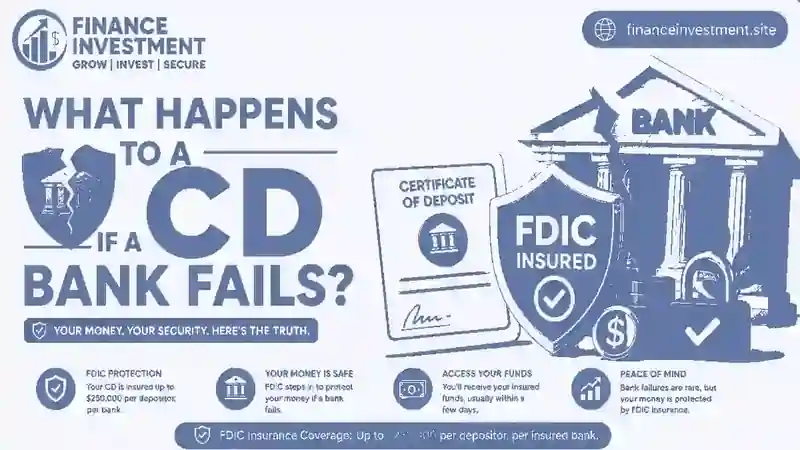
    What Happens to a CD if a Bank FailsFDIC protection gives CD owners an important safety net, but it does not mean every part of the original CD agreement survives a bank failure unchanged. The biggest benefit is protection of eligible deposits; the main tradeoff is that the resolution can alter how the CD is serviced.

    ✓ Benefits

    • Eligible deposits are protected: Covered principal and accrued interest receive FDIC protection within the applicable limits.
    • Access may return quickly: When another bank assumes the deposits, customers may regain access without waiting for the entire receivership to finish.
    • No separate insurance purchase: Eligible deposits receive FDIC insurance automatically; you do not buy a separate policy for the CD.
    • Less uncertainty about principal: Within the coverage limit, a qualifying deposit is treated differently from a market investment during a bank failure.

    △ Drawbacks

    • The rate may change: An acquiring bank does not necessarily have to preserve the failed bank’s original CD rate.
    • Terms may be different: Servicing arrangements and account conditions can change after the transfer.
    • Coverage has limits: Money above the applicable insurance limit is not protected in the same way as an insured deposit.
    • Access can feel unfamiliar: Even when funds are protected, customers may need to follow new instructions or work with a different institution.

    The important distinction is that deposit protection and contract continuity are not the same thing. FDIC insurance can protect an eligible balance, while the bank-failure resolution determines how that deposit is transferred or paid.

    CD Bank-Failure Comparison: How Does Your Money Differ?

    A CD is only one way to hold cash. The useful comparison here is how each option behaves when the institution behind it runs into trouble, not simply which one offers the highest yield.

    OptionProtectionAccessReturn / Market Exposure
    FDIC-insured CDFDIC protection for eligible deposits within applicable limitsUsually restricted until maturity, although a bank failure can change access arrangementsFixed CD rate; no daily market pricing
    High-yield savings accountFDIC or NCUA protection when eligibleGenerally more flexibleRate can change; no stock-market exposure
    Treasury securitiesBacked by the U.S. government, not FDIC insuranceCan generally be sold before maturity, subject to market conditionsKnown terms, but market prices can move before maturity
    Money market deposit accountFDIC or NCUA protection when eligibleTypically more accessible than a CDRate can change; no stock-market exposure
    Stocks and bondsNot FDIC-insuredGenerally tradableMarket prices can rise or fall

    For someone building a CD portfolio, the term can matter as much as the institution. You can compare 6-month CD rates or 1-year CD rates when shorter commitments are more useful. Longer timelines can be explored through the 3-year CD guide or 5-year CD guide.

    The key difference is the type of protection involved. An eligible CD and savings account rely on federal deposit insurance when held at an insured institution. Treasury securities rely on the U.S. government’s backing, while stocks and bonds are market investments whose values can fluctuate.

    Costs, Risks & Expert Tips After a Bank Failure

    FDIC protection removes one major fear from an eligible CD, but it does not make every part of the experience predictable. A bank failure can create practical issues around rates, access, uninsured balances, and what you do with the money afterward.

    Your CD Rate May Not Survive the Transfer

    If another bank assumes the failed bank’s deposits, the acquiring institution does not necessarily have to keep the original CD rate. That can create a reinvestment risk: you may suddenly have money available at a time when comparable CD rates are lower than the rate you originally locked in. The FDIC explains that acquiring institutions may establish their own interest rates and terms.

    Watch the Uninsured Portion

    The biggest financial concern is usually the amount that falls outside applicable FDIC coverage. Deposits above the insurance limit become part of the failed bank’s receivership process rather than receiving the same protection as insured deposits. Recovery of an uninsured amount can depend on the value of the bank’s assets and the receivership process.

    That is why a large CD balance deserves more attention than simply comparing APYs. Review your other deposits at the same bank and consider how ownership categories affect your total coverage.

    Brokered CDs Need Extra Attention

    If you purchased a CD through a brokerage or another platform, identify the actual issuing bank. Pass-through insurance can apply when the required ownership and recordkeeping conditions are satisfied, but the platform itself is not the FDIC insurer.

    Practical Ways to Reduce Surprises

    • Verify the issuing bank’s FDIC status before depositing.
    • Keep your CD confirmation, statements, and ownership records.
    • Review all deposits held at the same institution.
    • Don’t assume a familiar financial platform means every CD is insured.
    • Read bank-failure notices carefully if your institution closes.
    • Keep some cash outside CDs so a resolution does not disrupt your entire cash reserve.

    Expert Tip

    Don’t build your CD strategy around the assumption that a bank failure will preserve your original rate. Treat FDIC insurance as protection for eligible deposits—not a promise that every original CD feature will remain unchanged. For larger balances, map your deposits by bank and ownership category before opening another certificate.

    Common Mistakes + A Real-Life Example

    A bank failure is stressful enough without discovering that a few assumptions about your CD were wrong. The most avoidable problems usually come from overlooking the details attached to the deposit.

    Common Mistakes to Avoid

    • Assuming FDIC insurance preserves every CD term: Insurance protects eligible deposits within applicable limits. It does not guarantee that an acquiring bank will keep the failed bank’s original rate or terms.
    • Ignoring uninsured balances: If your deposits exceed the applicable coverage limit, the excess is handled through the receivership process and does not receive the same protection as the insured portion.
    • Keeping too much cash at one institution: Several CDs and other deposits can count toward the same coverage calculation when they share the same ownership category.
    • Not identifying the issuing bank: When a CD is purchased through a financial platform, check which bank actually issued it. The platform itself may not be the insured institution.
    • Assuming your original rate will continue: A new bank that assumes deposits may establish different rates or terms.
    • Skipping official notices: The FDIC or acquiring bank may provide important instructions about access, account servicing, and what happens next. Don’t treat those messages as routine paperwork.

    Real-Life Example: David’s CD Strategy

    David has $180,000 in a CD and $90,000 in an individual savings account at the same bank. He assumes both accounts are separately protected because they are different products. When the bank fails, he discovers that the ownership category matters more than the account names.

    Illustrative calculation: $180,000 + $90,000 = $270,000. This example does not determine David’s actual insurance payout because the applicable ownership rules and accrued interest must also be reviewed. It simply shows why looking at each account separately can produce the wrong impression.

    David also reads the acquiring bank’s notice instead of assuming his original CD rate will remain unchanged. That gives him a clearer picture of what happens next and what choices are available under the resolution.

    Practical lesson: Don’t judge your protection by the CD’s APY or account name alone. Know the issuing bank, review your combined deposits, keep your records, and read the official resolution instructions if the institution ever fails.

    Who Should Be Most Concerned About Bank Failure?

    Bank failure is not something most CD savers need to worry about every day. The bigger issue is whether your deposit setup could leave you exposed if your institution runs into trouble.

    Savers Who Should Pay Closer Attention

    • People with large balances: If your eligible deposits may exceed applicable FDIC coverage limits, review the amount that could fall outside insurance.
    • Savers using one institution for everything: Keeping CDs, savings, and other deposits at one bank can make the total coverage calculation more important.
    • Brokered-CD holders: If you bought CDs through a brokerage or platform, identify the underlying issuing bank and understand how your ownership is recorded.
    • People without liquid reserves: A bank resolution can create uncertainty around account access. Keeping separate emergency cash at an accessible institution can provide breathing room.
    • Savers with complicated ownership: Trusts, joint accounts, business deposits, and other ownership arrangements can have different insurance rules. These situations deserve a closer review rather than a quick $250,000 calculation.

    Who May Be Comfortable With a Straightforward Insured CD?

    A saver with a manageable balance, a clearly identified FDIC-insured bank, a simple ownership structure, and separate liquid cash may have a much simpler setup to monitor.

    Quick decision guide: Review your bank exposure more carefully when your balances are large, your ownership structure is complex, or your CD came through a broker. If your deposit structure is simple and your emergency money remains liquid elsewhere, an insured CD can be easier to manage.

    Frequently Asked Questions About CDs and Bank Failures

    What happens to a CD when a bank fails?

    The FDIC generally arranges for another bank to assume insured deposits or pays depositors directly up to the applicable insured amount. Your CD does not simply disappear because the issuing bank closes.

    Does FDIC insurance protect CD principal?

    Yes, eligible CD principal is protected up to the applicable FDIC insurance limit. Coverage also includes qualifying accrued interest through the bank’s failure date.

    What happens to accrued CD interest?

    Interest accrued through the failure date is included when determining the insured balance, subject to the applicable coverage limit. Interest does not continue accruing at the failed bank after closure.

    Does the original CD rate continue after a bank failure?

    Not necessarily. An acquiring bank is not required to maintain the failed bank’s original rates or account terms.

    Can I withdraw a CD after a bank failure?

    If another bank assumes the deposit, depositors generally have the option to withdraw some or all insured funds without an early-withdrawal penalty, subject to the specific resolution arrangements.

    What happens if my CD exceeds FDIC coverage?

    The insured portion receives FDIC protection. Any uninsured amount becomes a claim against the failed bank’s receivership and is not guaranteed in the same way as an insured deposit. Recovery can depend on the assets available to the receivership.

    What happens to a brokered CD when the issuing bank fails?

    The treatment depends on the underlying issuing bank, ownership records, and whether the CD qualifies for applicable pass-through insurance. The brokerage platform itself is not the FDIC insurer.

    What happens to a CD’s maturity date after a bank failure?

    The original maturity date should not be assumed to remain unchanged. An acquiring institution can establish different terms, so CD holders should follow the official instructions provided during the bank-failure resolution.

    Is a CD at a credit union protected by FDIC or NCUA insurance?

    Eligible time deposits such as share certificates at federally insured credit unions are generally covered by NCUA share insurance rather than FDIC insurance. NCUA says eligible share accounts are insured up to applicable limits, including principal and posted dividends through the credit union’s closing date.

    Illustrative: What if I have a $300,000 CD when my bank fails?

    Illustrative example only: A $300,000 CD does not automatically receive $300,000 of standard FDIC coverage. The depositor’s ownership category, other deposits at the same bank, accrued interest, and applicable insurance rules would need to be reviewed to determine the protected amount.

    Final Verdict: What Should CD Holders Expect?

    If an FDIC-insured bank fails, an eligible CD does not simply vanish. The insured deposit is handled through the FDIC’s resolution process, which may involve transferring deposits to another bank or paying the insured amount directly. For most CD owners, the more important question is not whether the money exists, but how the failed bank’s resolution changes the way that money is handled.

    Your total deposits, ownership category, and accrued interest matter when determining how much receives FDIC protection. That makes it important to look at your entire relationship with the bank rather than viewing one CD in isolation.

    Also, don’t assume the original CD rate or maturity arrangement will remain untouched. An acquiring institution may establish different rates or terms. If that happens, your next decision may involve keeping the funds with the new bank or moving them elsewhere.

    Practical takeaway: FDIC insurance can provide meaningful confidence for eligible CD deposits, but good CD planning starts before a failure occurs. Verify the issuing bank, understand your coverage, keep important records, and maintain enough liquid cash outside CDs for everyday needs.

    For the bigger picture on choosing terms, rates, and CD strategies, explore our CD Guide 2026.

    Stay Informed About Smarter CD Decisions

    Want practical insights on CDs, savings, rates, and everyday money decisions? Join the FinanceInvestment newsletter for useful ideas without the financial jargon.

    📧 subhashr325@gmail.com

    Keep your CD strategy simple: understand the protection, know your limits, and choose terms that fit your cash needs.

    “

  • Are CDs Safe for Your Money? Complete 2026 Guide

    Are CDs Safe for Your Money? Complete 2026 Guide

    FINANCEINVESTMENT • CD GUIDE 2026

    Are CDs Safe for Your Money?

    SR
    Written by Subhash Rukade
    FinanceInvestment
    Updated August, 23, 2026
    ~15 min read

    A practical guide to understanding CD safety, deposit insurance, potential risks, and what to check before putting your savings into a certificate of deposit.

    Are CDs Safe for Your Money? Complete 2026 Guide
    Are CDs safe for your money? Learn how FDIC and NCUA insurance works, what risks CDs carry, and how to evaluate CD safety before depositing your cash.
    are-cds-safe-for-your-money
    Are CDs Safe for Your Money
    are CDs safe, CD safety, CD insurance, FDIC insured CDs, NCUA insured CDs, certificate of deposit safety, CD risks
    https://financeinvestment.site/are-cds-safe-for-your-money/
    Subhash Rukade
    August 22, 2026
    About 15 minutes

    Are CDs Safe? Understanding What “Safe” Really Means

    Are CDs Safe for Your Money?A certificate of deposit can feel almost boring—and that is part of its appeal. You put money into the account, agree to leave it there for a set period, and earn interest along the way. But calling a CD “safe” does not mean the money is completely free from risk.

    For most savers, CD safety starts with where the money is held. A CD issued by an FDIC-insured bank can receive federal deposit insurance within applicable coverage limits. A CD from a federally insured credit union can receive NCUA share insurance under its applicable rules. That protection is designed to address the risk of the insured institution failing—not every possible way your money could lose purchasing power.

    That distinction matters. Your insured deposit can remain protected while inflation gradually reduces what those dollars can buy. You can also face other practical issues, such as an early-withdrawal penalty, an unsuitable term, or a rate that becomes less attractive after market conditions change.

    If you want the bigger picture on terms, rates, strategies, and CD basics, our Complete CD Guide 2026 is a useful place to continue.

    What You’ll Learn

    • What makes an insured CD different from a riskier investment
    • How FDIC and NCUA protection works
    • Which risks insurance does not cover
    • How inflation can affect your real return
    • What to check before putting savings into a CD

    Quick Answer: Are CDs Safe for Your Money?

    Yes, CDs can be a relatively low-risk place for savings when you use an FDIC-insured bank or federally insured credit union and stay within applicable insurance limits. But “safe” does not mean your money is protected from every financial risk.

    6 Things to Know About CD Safety

    1. Insurance matters: FDIC coverage applies to eligible deposits at insured banks; NCUA coverage applies to eligible shares at federally insured credit unions.
    2. Insurance has limits: Protection is subject to applicable coverage rules and ownership categories.
    3. Principal safety is different from purchasing power: Your insured dollars can still lose buying power when inflation outpaces your return.
    4. A CD is not a stock-market investment: Traditional CDs generally do not expose your deposit to daily market price swings like stocks or many bonds.
    5. Access can carry a cost: Taking money out before maturity may trigger the CD’s contractual withdrawal penalty.
    6. The institution matters: Confirm that the bank or credit union is actually covered by the appropriate federal insurance program before depositing your money.

    Bottom line: An insured CD can offer strong protection against institutional failure, but it is not a guarantee against inflation, limited liquidity, or every possible loss.

    At a Glance: How Safe Are CDs?

    CD safety comes down to more than the interest rate. The institution, insurance coverage, account structure, and purpose of your money all matter. A traditional CD can be a conservative savings tool, but it still has trade-offs.

    Safety CheckWhat It Means
    FDIC-insured bankEligible deposits receive FDIC protection within applicable limits and ownership categories.
    Federally insured credit unionEligible shares receive NCUA protection under applicable coverage rules.
    PrincipalA properly structured insured CD can protect eligible deposited funds against covered institutional failure.
    InflationInsurance does not protect the purchasing power of your dollars.
    LiquidityAccess before maturity may be restricted or may trigger a contractual penalty.
    Institution checkVerify the bank or credit union’s federal insurance status before depositing money.

    Best suited for: money with a known purpose, a defined time horizon, and no immediate need for access.

    Watch closely: insurance eligibility, applicable coverage limits, CD terms, withdrawal rules, maturity dates, and the difference between earning a positive return and preserving purchasing power.

    Complete Beginner Guide: Are CDs Really Safe?

    Are CDs Safe for Your MoneyA certificate of deposit is a bank or credit-union deposit account designed for money you can leave untouched for a set period. In exchange for that commitment, the institution pays interest according to the CD’s terms. That structure makes a traditional CD quite different from an investment whose value moves with the stock or bond market.

    Why Insured CDs Are Generally Low Risk

    The biggest safety feature is federal deposit or share insurance. When you use an FDIC-insured bank, eligible deposits are protected under FDIC rules if the insured bank fails, subject to applicable coverage limits and ownership categories. At a federally insured credit union, eligible shares receive NCUA protection under its coverage rules.

    This is important because the protection is tied to the institution and the type of account. Simply seeing the word “CD” does not automatically tell you whether a particular product has federal insurance.

    What Deposit Insurance Does—and Does Not—Cover

    Deposit insurance is designed to protect eligible deposits or shares against covered institutional failure. It does not guarantee that every financial decision involving a CD will produce a profit.

    For example, insurance does not protect you from inflation. If your CD earns 3% while prices rise faster, your account balance may increase while its purchasing power declines. Insurance also does not remove an early-withdrawal penalty or compensate you for choosing a term that does not fit your plans.

    CDs vs. Market-Based Investments

    A traditional insured CD generally does not fluctuate in market value every day like an individual stock. That makes it easier to plan around a known deposit and stated interest terms.

    However, lower market volatility does not make a CD suitable for every goal. A long-term investor may need growth that a fixed-rate deposit cannot provide, while someone saving for a near-term expense may value access more than a locked rate.

    Risks Beginners Should Understand

    • Inflation risk: Your return may not keep pace with rising prices.
    • Liquidity risk: Accessing funds early may be restricted or costly.
    • Reinvestment risk: A CD that matures may need to be renewed at a less attractive rate.
    • Coverage risk: Insurance rules and eligibility must be verified rather than assumed.
    • Term risk: A long maturity can become inconvenient if your plans change.

    What to Verify Before Opening

    Check the institution’s insurance status, ownership structure, CD term, APY, minimum deposit, early-withdrawal rules, maturity date, grace period, and automatic-renewal instructions. Also make sure the money is separate from your emergency reserve.

    That simple checklist gives you a much clearer picture of whether a particular CD is safe for your situation, rather than treating all CDs as identical.

    How CD Safety Actually Works

    CD safety becomes easier to understand when you follow the money through the life of the certificate. The important checkpoints are not complicated, but they should be handled before the deposit is made.

    From Funding to Maturity

    You open the CD, fund it, and the institution records the deposit under the account’s terms. During the agreed term, interest is credited according to the certificate’s stated schedule. If you leave the CD untouched, the account continues toward its maturity date without the need to sell an investment in a market.

    At maturity, the principal and any interest that remains in the account are generally available according to the CD’s terms. If automatic renewal applies, the institution may place the funds into another certificate unless you provide different instructions during the applicable grace period.

    What If the Institution Fails?

    This is where federal insurance becomes important. If an insured bank fails, the FDIC handles eligible insured deposits according to applicable rules. For a federally insured credit union, the NCUA provides the relevant share-insurance protection.

    The protection is not simply based on having a CD. The institution must be covered, the funds must qualify, and the amount must fall within the applicable coverage rules.

    Why Ownership Matters

    Insurance coverage can depend on how accounts are owned and how deposits are categorized. Someone with several accounts should not assume that adding up account balances automatically tells them how much protection applies. The applicable ownership category and institution matter.

    A Simple Safety Check

    Example: Imagine you are considering a CD for money earmarked for a future home repair. Before transferring the funds, confirm the institution’s federal insurance status, review the ownership of the account, check the CD disclosures, and make sure the deposit fits within applicable coverage rules. Those checks happen before the money is committed.

    That is the practical side of CD safety: verify the institution and account structure first, then consider the term, access rules, and purpose of the money.

    Benefits and Drawbacks of CD Safety

    The appeal of a CD is that several parts of the experience are easier to predict than with market-based investments. Still, safety has boundaries. A protected deposit can remain secure while other factors affect the value or usefulness of the money.

    Pros

    • Protection at insured institutions: Eligible deposits or shares can receive federal insurance subject to applicable rules.
    • Predictable return: A traditional fixed-rate CD can provide a known interest rate for its agreed term.
    • Less market-price movement: Unlike stocks, a traditional CD is not normally repriced every day based on market sentiment.
    • Helpful structure: A fixed maturity can make it easier to keep goal-based savings separate from everyday spending.

    Cons

    • Inflation can outpace the return: A growing account balance does not guarantee greater purchasing power.
    • Access is restricted: An early withdrawal may carry a contractual penalty or other limitations.
    • Future rates can change: When the CD matures, a new certificate may offer a less attractive rate.
    • Insurance is not unlimited: Coverage depends on eligibility, ownership category, institution, and applicable limits.

    The safest approach is to separate two questions: “Is my deposit protected?” and “Is this CD appropriate for my money?” The first is largely about insurance and account structure. The second also involves inflation, access, timing, and what you plan to do when the certificate matures.

    CD Safety Comparison: How Different Options Stack Up

    “Safe” can mean different things depending on what you are comparing. A bank CD, savings account, Treasury security, and stock can all serve different purposes. The useful question is whether the product’s protection, access, and return characteristics match the job you want the money to do.

    OptionProtectionAccessReturn CertaintyMarket Exposure
    Insured CDFDIC or NCUA protection when eligibleLimited before maturityGenerally fixed for the agreed termLow for a traditional fixed-rate CD
    High-yield savingsFDIC or NCUA protection when eligibleGenerally easier accessRate can changeLow
    Treasury securitiesBacked by the U.S. governmentVaries by security and whether sold before maturityDepends on the Treasury securityMarket price can matter before maturity
    Money market deposit accountFDIC or NCUA protection when eligibleGenerally more flexibleRate can changeLow
    Stocks & bondsNot protected like an insured bank depositGenerally sellable, but price variesNot guaranteedHigher market exposure

    If you’re comparing CD terms rather than products, our guides to the best 1-year CD rates, best 18-month CD rates, and best 5-year CD rates can help you compare different time commitments.

    For a broader view, our CD rates guide can help you look at available options without treating the highest advertised rate as the only measure of safety.

    CD Safety Risks and Expert Tips

    A CD can be a conservative place for cash, but the word “safe” should never end the analysis. The biggest risks often come from details surrounding the account rather than day-to-day market movements.

    Inflation Can Quietly Reduce Your Real Return

    Your account balance may rise every month while your purchasing power falls. If inflation runs higher than the return on your CD, the money buys less when the certificate matures. Investor.gov specifically identifies inflation as an important CD risk.

    Early Withdrawal and Reinvestment Risks

    Need the money before maturity? A traditional CD may impose an early-withdrawal penalty. At maturity, there is a different issue: the next available CD rate may be lower than the one you originally locked in. Automatic renewal can make this easy to overlook.

    Insurance Depends on the Details

    Do not assume that every dollar held at an institution receives unlimited protection. FDIC and NCUA coverage depends on the insured institution, eligible account, ownership category, and applicable coverage rules. The NCUA notes that accounts in different ownership categories can receive separate coverage when requirements are met.

    Be Careful With Callable and Brokered CDs

    A callable CD can give the issuing bank the right to end the certificate early, which can change your original plan. Brokered CDs can also involve secondary-market pricing, sales fees, call features, and more complicated ownership arrangements. The SEC recommends checking the issuer, insurance status, maturity date, fees, and call provisions before buying.

    Four Checks Before You Fund the CD

    • Verify the bank or credit union’s federal insurance status.
    • Review your total deposits at that institution and ownership category.
    • Read the maturity, withdrawal, renewal, and call provisions.
    • Keep emergency cash outside money you are committing to a CD.

    Expert Tip

    Don’t judge CD safety from the APY alone. Before transferring your money, verify who issued the CD, how it is insured, when it matures, and what can happen before maturity. Those four answers can reveal risks that a headline rate will never show.

    Common CD Safety Mistakes + A Real-Life Example

    CD safety problems usually start with assumptions. A saver sees a familiar product name, notices an attractive rate, and skips the details that determine how the money is actually protected.

    Mistakes to Avoid

    • Assuming every CD is insured: Verify that the issuing bank is FDIC-insured or the credit union has applicable federal NCUA insurance.
    • Ignoring coverage limits: Federal insurance is subject to applicable limits and ownership categories. Large balances deserve extra attention.
    • Confusing product types: A brokered CD can have features and risks that differ from a traditional CD opened directly with a bank.
    • Choosing by APY alone: A higher advertised rate does not automatically make one CD safer or more suitable.
    • Forgetting inflation: A positive account return can still translate into weaker purchasing power.
    • Overlooking callable features: With a callable CD, the issuer may have the right to end the CD before its scheduled maturity under the contract.

    Real-Life Example: Mark’s $80,000 CD

    Mark wants to keep $80,000 conservative for a future home purchase. He finds a CD offering a slightly higher APY than another option and is ready to open it immediately.

    Instead, he checks the issuing institution, confirms the applicable insurance arrangement, reviews how the account is owned, and reads the maturity and call provisions. He also compares the rate with the expected purchasing-power impact of inflation.

    Illustrative calculation: If a hypothetical $80,000 CD earned 4% for one year, a simple illustration would show about $3,200 in interest before taxes. That figure does not predict an actual offer or account result, and it does not account for inflation or compounding details.

    Mark’s extra research takes only a few minutes, but it gives him a clearer picture of what he is actually buying.

    Practical lesson: Treat CD safety as a checklist, not a label. Verify the institution, insurance, account structure, and product features before letting the APY influence your decision.

    Who Should Choose a CD?

    A CD can make sense when the goal is not maximum growth, but keeping a portion of your savings in a predictable, structured place. The strongest candidates usually know when they will need the money and can leave it alone until then.

    Good Fits for CDs

    • Conservative savers: People who value stability over exposure to daily market swings may appreciate the structure of an insured CD.
    • Goal-based savers: A known expense several months or years away can pair well with a CD whose maturity lines up with that timeline.
    • Families: Money reserved for a future tuition bill, home project, or other planned expense may benefit from a defined savings period.
    • Retirees: Those seeking predictable deposit returns may use CDs as one part of a broader cash-management strategy.
    • Savers with emergency reserves: Keeping separate liquid cash makes it easier to leave the CD untouched until maturity.

    Who May Want More Flexibility?

    A CD may be a poor fit for money needed for rent, medical bills, emergencies, or unpredictable near-term expenses. It may also be unsuitable for someone who expects to need unrestricted access to the entire balance.

    Quick decision guide: If the money has a clear future purpose, you have separate emergency cash, and you are comfortable with the CD’s restrictions, a CD may fit. If access matters more than rate certainty, keep that money flexible.

    Frequently Asked Questions About CD Safety

    Are CDs generally safe for your money?

    Traditional CDs at properly insured institutions are generally considered low-risk deposit products. Their safety depends on the institution, account eligibility, applicable insurance coverage, and the terms of the CD.

    What is the difference between FDIC and NCUA protection for CDs?

    FDIC insurance generally applies to eligible deposits at insured banks. NCUA insurance applies to eligible shares at federally insured credit unions. The two systems protect different types of institutions and accounts.

    What happens to an insured CD if a bank fails?

    If an FDIC-insured bank fails, eligible insured deposits are handled under FDIC rules. Coverage depends on applicable limits, ownership categories, and account eligibility.

    Does CD insurance protect against inflation?

    No. Deposit insurance protects eligible funds against covered institutional failure. It does not guarantee that the CD’s return will keep pace with inflation or preserve purchasing power.

    Can an early withdrawal make a CD less profitable?

    Yes. Depending on the contract, withdrawing before maturity may result in an early-withdrawal penalty or loss of some expected interest. Review the specific CD agreement before opening it.

    Are callable CDs as predictable as traditional CDs?

    Not necessarily. A callable CD can allow the issuer to redeem the certificate before its scheduled maturity under specified conditions. That can change how long your money remains invested at the original rate.

    Are brokered CDs as safe as bank CDs?

    A brokered CD may qualify for FDIC insurance when issued by an FDIC-insured bank and structured appropriately, but it can have additional features such as call provisions and secondary-market considerations. Read the offering details carefully.

    How can I check whether a CD is federally insured?

    Confirm the issuing bank’s FDIC insurance status or the credit union’s federal NCUA insurance status. Do not rely only on an advertisement or the name of a financial platform.

    Illustrative: How much could a CD earn?

    Illustrative example only: A hypothetical $10,000 CD earning 4% for one year would produce about $400 in simple annual interest before taxes. Actual earnings depend on the APY, compounding, term, and account agreement.

    Final Verdict: Are CDs Safe for Your Money?

    For many U.S. savers, an eligible CD at a properly insured institution can be a sensible way to hold money with a defined purpose. The strongest safety feature is not the CD label itself. It is the combination of an insured institution, eligible account structure, and coverage within applicable limits.

    Still, safety should not be confused with perfection. Your deposit may be protected from covered institutional failure while inflation reduces its purchasing power. A fixed term can also become inconvenient if you suddenly need the cash, and a renewal could put your money into a different rate environment.

    Before opening a certificate, verify the institution’s insurance status, read the withdrawal and renewal provisions, understand any call features, and decide whether you can comfortably leave the money untouched until maturity.

    If you want to compare CD terms, rates, strategies, and the basics in one place, explore our CD Guide 2026.

    The practical takeaway: Choose a CD because its protection, timing, and restrictions fit your money—not simply because it advertises a reassuring rate.

    FINANCEINVESTMENT • MONEY GUIDE

    Keep Making Smarter Money Decisions

    Want practical finance guides without the unnecessary noise? Send an email to

    subhashr325@gmail.com

    to stay connected with FinanceInvestment and hear about new savings, CD, and investing guides.

    Take your time, read the details, and choose financial products that fit the purpose of your money.