Domestic Wire Transfer vs. International Wire Transfer: Key Differences

Domestic Wire Transfer vs. International Wire Transfer: What’s the Difference?
Sending money to another U.S. bank is different from wiring funds to someone in another country. When comparing a domestic wire transfer vs. an international wire transfer, the important questions are how the payment travels, what it costs, how long it may take, and how much money reaches the recipient.
A domestic wire typically moves money between financial institutions within the United States. An international wire sends funds across borders and may involve currency conversion, intermediary banks, and additional recipient details. Processing times and fees depend on the banks, payment route, destination, currency, and submission time.
Before authorizing either transfer, check the total cost and verify the recipient’s payment instructions through a trusted source. For a broader look at your options, explore our guide to bank transfers and payments.
What You’ll Learn
- The main differences between domestic and international wires.
- What can affect delivery times and transfer fees.
- How exchange rates and intermediary charges may change the amount received.
- How to choose a suitable payment method and avoid common mistakes.
Quick Answer: Domestic vs. International Wire Transfers
Domestic wires transfer funds within the United States, while international wires send funds across national borders. International payments can involve exchange-rate costs, intermediary banks, and extra processing checks. The actual fees, delivery time, and recipient requirements depend on the banks, destination, currency, and payment route.
Key Takeaways
- Domestic wire fees and cutoff times vary by financial institution.
- International transfers may require SWIFT/BIC details or other destination-specific banking information.
- If currencies differ, the exchange rate can change the amount the recipient receives.
- Sending, receiving, and intermediary fees may affect the total cost.
- Banking hours, holidays, and compliance checks can affect delivery.
- Confirm recipient details and verify any changed payment instructions using a trusted contact method.
Bottom line: Before sending a wire, compare the total fees, expected arrival window, and amount the recipient should receive. Choose the transfer that fits your payment needs, rather than assuming one type is always faster or cheaper.
Domestic vs. International Wire Transfers at a Glance
Domestic wires send funds between financial institutions within the United States. International wires cross national borders and may involve foreign-currency conversion, intermediary banks, or additional payment checks.
Domestic Wire
Can suit U.S. payments when the recipient requires a wire, such as certain real-estate closings or business transactions.
International Wire
Can suit cross-border payments to family, businesses, or other recipients, subject to the provider’s supported destinations and requirements.
| Feature | Domestic Wire | International Wire |
|---|---|---|
| Delivery time | May be completed the same business day if submitted before the bank’s cutoff | Can take several business days, depending on the route and destination |
| Potential costs | Sending fee and possible receiving fee | Sending and receiving fees, possible intermediary charges, and currency-conversion costs |
| Bank details | Recipient information and required U.S. bank routing details | Recipient information plus required destination-specific bank identifiers, which may include SWIFT/BIC or an IBAN where applicable |
These are general comparisons, not guarantees. Actual delivery times and charges depend on the banks, cutoff times, holidays, destination, currency, and any required checks. Before authorizing a transfer, ask about the total cost and the estimated amount the recipient will receive.
Domestic and International Wire Transfer Basics 
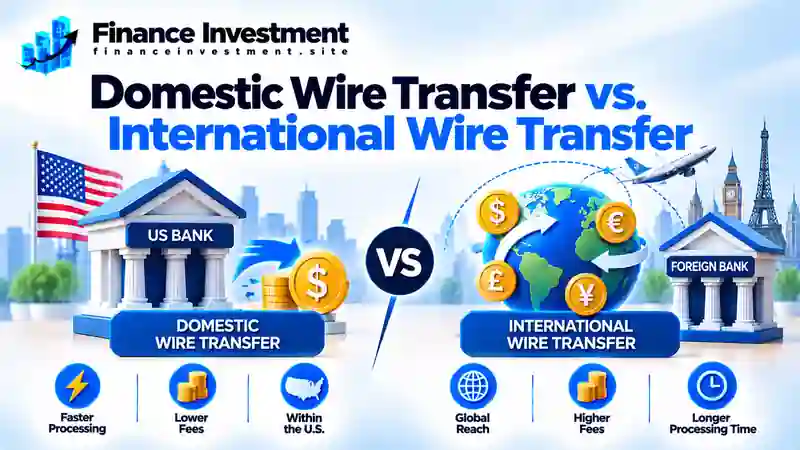
The payment route is one of the main differences between domestic and international wires. A domestic wire transfers funds between financial institutions within the United States. Depending on the institutions and transaction, it may be processed through a domestic wire system such as the Federal Reserve’s Fedwire Funds Service or another supported network.
What Happens With an International Wire?
An international wire sends money across national borders. The sending and receiving banks may use intermediary institutions to route the payment. Banks commonly use the SWIFT network to exchange payment instructions, but SWIFT is a financial messaging network—not a bank account or a currency-exchange service. If the payment involves different currencies, the exchange rate and any conversion markup can affect the amount the recipient receives.
What Information Might You Need?
- The recipient’s full name and account number or other required account identifier.
- The receiving bank’s required routing number or country-specific bank identifier.
- For some international transfers, a SWIFT/BIC code, an IBAN where applicable, or another local banking code.
- The transfer amount and currency, plus any additional information the bank requires for that destination.
Safety tip: Requirements vary by bank and destination. Obtain the instructions from your financial institution, then independently verify any new or changed payment details using a trusted phone number before authorizing the transfer.
How Domestic and International Wire Transfers Work
Both types start when the sender submits payment instructions, but the route and checks can differ. Here’s how a wire typically moves from the sender to the recipient.
- Provide the recipient’s details. Enter the required account information and bank identifiers. Confirm the details directly with the recipient or their financial institution.
- Review the payment terms. Check the amount, currency, applicable fees, exchange rate where relevant, and the bank’s estimated delivery window.
- Authorize the wire. Follow your bank’s authentication process. The bank may request additional identity or transaction checks.
- The sending bank reviews and releases it. The bank processes the instructions and routes the payment through an available wire system or supported payment arrangement.
- The payment travels to the receiving institution. A domestic wire generally follows a U.S. payment route. An international wire may pass through correspondent banks or involve currency conversion, depending on the service and destination.
- The receiving bank handles the funds. After any required checks, the receiving institution processes the payment and credits the recipient’s account under its procedures.
If a wire is delayed or sent incorrectly: Contact your bank promptly, provide the transaction reference if available, and ask it to investigate or request a recall. A recall may not succeed once the payment has been processed or the recipient has received the funds.
Benefits and Drawbacks of Domestic and International Wires
A wire can be a practical choice when a recipient requires one or when a payment needs to move directly between financial institutions. But fees, processing requirements, and the difficulty of reversing a completed payment deserve attention before you send money.
Advantages
- Useful for property closings and other payments when the recipient specifically requests a wire.
- Some domestic wires can be processed the same business day, subject to bank cutoff times and checks.
- Can support cross-border payments to destinations served by the provider.
Drawbacks
- Sending, receiving, intermediary, or currency-conversion charges may apply.
- International transfers may take longer because of routing, local banking hours, or additional checks.
- Incorrect details and scams can be costly to resolve; a recall may not recover the funds.
Expert tip: Ask whether the recipient actually requires a wire. For routine domestic payments, compare the fees, timing, and eligibility requirements of an ACH transfer versus a wire transfer before deciding.
Domestic vs. International Wire Transfer: Side-by-Side Comparison
The main difference is the destination, but the payment route, currency, and recipient’s banking requirements matter too. Compare these features before choosing a transfer method.
| Feature | Domestic Wire | International Wire |
|---|---|---|
| Destination | A recipient within the United States | A recipient in another country |
| Payment route | A supported domestic wire system, depending on the banks | A cross-border payment route; intermediary banks may be involved |
| Currency | Often U.S. dollars for U.S. bank payments | May be sent or received in U.S. dollars or another currency |
| Possible costs | Sending fee and possible receiving fee | Bank fees and, where applicable, intermediary or currency-conversion costs |
| Bank details | Recipient details and the required U.S. bank routing information | Recipient details and any bank identifiers required by the destination |
| Best fit | U.S. payments when a wire is required or appropriate | Cross-border payments when the provider supports the destination and the wire suits the recipient’s needs |
Before you send: Confirm the total cost, expected arrival window, exchange rate if applicable, and estimated amount the recipient will receive. For eligible domestic payments where a wire is not required, compare an ACH transfer with a wire transfer to see whether another option better fits your needs.
Fees, Risks, and Expert Tips for Wire Transfers
The transfer amount is not necessarily the total cost of sending a wire. Depending on the bank and payment route, you may face an outgoing fee, a receiving fee, or intermediary-bank charges. For an international wire involving currency conversion, the exchange rate offered by the provider may also include a markup that reduces the amount received.
Check the Full Cost Before Sending
Before authorizing the payment, ask your bank about applicable fees, the exchange rate, the estimated amount the recipient will receive, and the expected delivery window. Confirm the submission cutoff, too. A transfer sent after the cutoff or before a banking holiday may not be processed on the schedule you expect.
Protect Your Money Before You Authorize a Wire
- Verify the recipient’s name, account details, and required bank identifiers before submitting the transfer.
- If payment instructions change, confirm them using a trusted phone number you obtained independently—not the contact details in the unexpected message.
- Save your confirmation and transaction reference for follow-up.
- If you suspect fraud or notice an error, contact your bank immediately and ask whether a trace or recall is possible.
Expert tip: Wire transfers can be difficult to reverse once processed. A bank may attempt to recover the funds, but a recall does not guarantee that your money will be returned.
For more ways to protect your banking information, use our bank account security checklist.
Common Wire Transfer Mistakes and a Real-Life Example
A wire transfer can go wrong when payment details are inaccurate, costs are overlooked, or instructions are not independently verified. Avoid these common mistakes before authorizing a payment:
- Using the wrong payment method: Confirm that the recipient requires a wire and that your bank supports the destination and currency.
- Entering incorrect bank details: Check the recipient’s name, account number, routing information, and any required international banking identifiers.
- Overlooking the final amount: For international wires, check the exchange rate and ask about applicable receiving or intermediary fees.
- Accepting unexpected payment changes: Fraudsters may impersonate vendors, home sellers, or real estate professionals to redirect funds.
Real-Life Example: A Changed Closing Instruction
Imagine a U.S. homebuyer preparing to wire money for a property closing. An email arrives with new bank details shortly before the deadline. The buyer sends the payment without confirming the change, and the instructions turn out to be fraudulent. Before sending, the buyer could have called the title company using a previously verified phone number to confirm the correct account details.
If you notice an error or suspect fraud after sending a wire, contact your bank immediately. Provide the transaction reference and ask whether a trace or recall is possible. Acting quickly may help, but recovery is not guaranteed.
Who Should Choose a Domestic or International Wire Transfer?
A Domestic Wire May Suit You If…
You are sending money between U.S. bank accounts for a property closing, business transaction, or another payment where the recipient requires a wire. Confirm the recipient’s details, your bank’s cutoff time, applicable fees, and expected processing window before authorizing it.
An International Wire May Suit You If…
You need to send funds to a bank account in another country, such as paying an overseas supplier or supporting family abroad. Check whether your bank supports the destination, which recipient details are required, whether currency conversion applies, and how much the recipient is expected to receive.
Make the right choice: A wire may not be necessary for every payment. For routine transfers, compare eligible alternatives such as ACH or your bank’s international payment services. Choose based on the recipient’s requirements, total cost, supported destination, and delivery expectations.
Frequently Asked Questions
1. What is the difference between a domestic and an international wire transfer?
A domestic wire transfers funds within the United States. An international wire sends funds across national borders and may involve intermediary banks, currency conversion, or additional processing requirements.
2. How long does a domestic wire transfer take?
A domestic wire may be completed the same business day when submitted before the bank’s cutoff. Processing reviews, holidays, and bank policies can affect the actual arrival time.
3. How long does an international wire transfer take?
An international wire can take several business days or longer. Timing depends on the destination, participating banks, currency, local holidays, and any required compliance checks.
4. Are international wire transfers more expensive than domestic wires?
They can be. Depending on the payment route, costs may include sending and receiving fees, intermediary-bank charges, and an exchange-rate markup. Compare the total cost and expected amount received before authorizing the transfer.
5. Do all international wire transfers require a SWIFT code or IBAN?
No. Required details depend on the destination country, receiving bank, and payment route. Your bank can tell you whether a SWIFT/BIC, IBAN, local bank code, or other identifier is required.
6. Can I track a wire transfer?
Your bank may provide a status update or tracing service. Contact the sending bank with your transaction reference and ask whether it can investigate the payment.
7. Can I cancel or reverse a wire transfer?
Cancellation may be possible before a payment is processed, depending on the bank and transaction status. After processing, a recall may be attempted, but recovery is not guaranteed. Contact your bank immediately if you identify an error or suspect fraud.
8. Is a wire transfer safer than an ACH transfer?
Neither method is automatically safer for every situation. The appropriate choice depends on the payment purpose, timing, costs, and applicable protections. Read our ACH transfer vs. wire transfer guide to compare the options.
Final Verdict: Domestic vs. International Wire Transfers
The right choice in the domestic wire transfer vs. international wire transfer decision depends on the destination and the payment requirements. A domestic wire suits payments between U.S. bank accounts, while an international wire is designed for cross-border payments that may involve currency conversion or additional banks.
Before authorizing either transfer, confirm the recipient’s details, review the total cost, and check the expected delivery window. If you are making a routine domestic payment, consider ACH when it meets the recipient’s requirements and timing needs.
Bottom line: Choose a domestic wire for an appropriate U.S. payment or an international wire for a supported cross-border payment. Verify the instructions independently before sending, especially when payment details have recently changed.
Make Your Next Wire Transfer With Confidence
Understand your payment options, review the total cost, and verify recipient details before sending money. Explore more practical banking guidance from FinanceInvestment.
FinanceInvestment · Practical personal finance guidance for U.S. readers.
Leave a Reply