How to Avoid Checking Account Fees: Simple 2026 Guide
Updated August 10, 2026
9–11 Min Read
2026 Banking Guide
Checking account fees can be easy to overlook because many are small, occasional, or avoidable. This guide breaks down the charges that commonly catch people off guard and the practical habits that can help you keep more of your money.
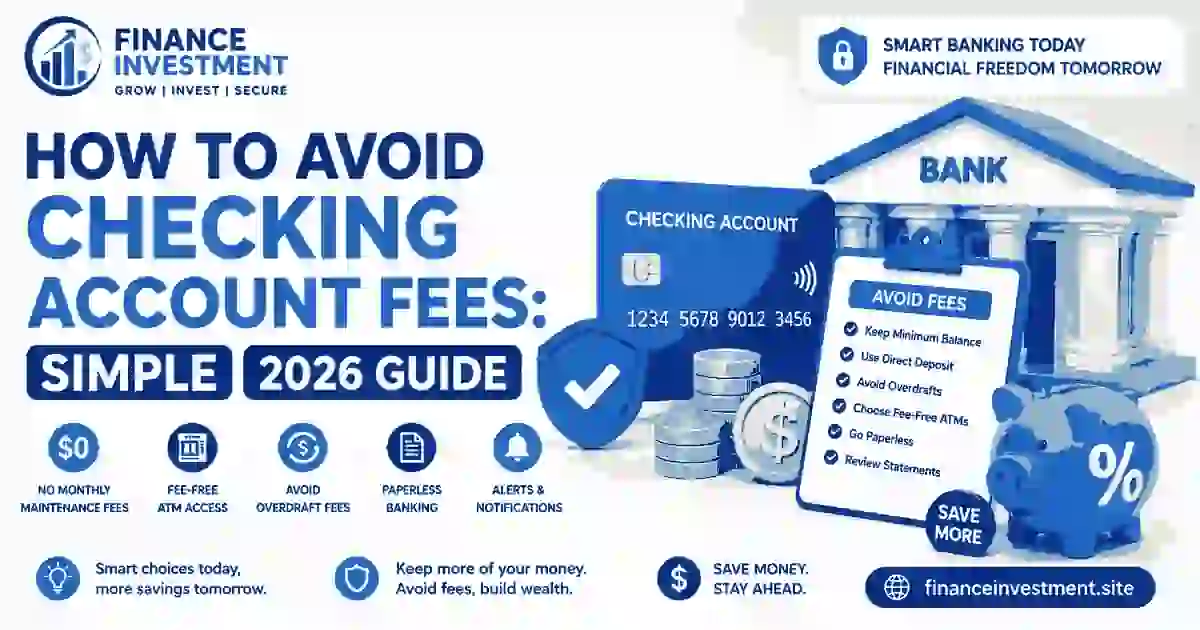 A checking account can look completely free while small charges quietly chip away at your balance. One month it may be a maintenance fee. Another month, an out-of-network ATM or an overdraft charge can do the damage. How to Avoid Checking Account Fees starts with knowing which charges your bank can apply and what triggers them.
Some fees appear even when you barely use the account. A bank may require direct deposit, a certain balance, or a specific number of transactions to waive a monthly charge. ATM fees can also show up simply because the nearest machine belongs to another network.
Common charges include monthly maintenance fees, ATM fees, overdraft fees, minimum-balance fees, out-of-network transaction charges, and paper-statement or other service fees. The good part is that many of these costs are avoidable.
Choosing the right account matters. So does keeping enough money available, using fee-waiver options, choosing in-network ATMs, and setting alerts before a balance gets too low. Our Checking Accounts USA 2026 guide can also help you compare the basics before settling on an account.
What You’ll Learn
You’ll see where checking account fees come from, which habits can prevent them, how different account setups compare, and which mistakes tend to cost the most. We’ll also look at practical examples and the situations where switching to another checking account may make sense.
Once the main fee traps are clear, the answer becomes much simpler: focus on the charges you can control first.
Quick Answer & Key Takeaways
The easiest way to avoid most checking account fees is to choose an account with low or no monthly charges and meet the bank’s requirements for keeping those fees waived. From there, everyday habits matter just as much.
Choose a checking account whose fee rules fit the way you actually bank, then use alerts, in-network ATMs, and careful balance management to avoid charges you don’t need to pay.
6 Key Takeaways
- Check monthly maintenance requirements: Know exactly when a recurring fee applies and how the bank waives it.
- Use in-network ATMs: This can help avoid unnecessary out-of-network charges.
- Keep enough money available: A small cash cushion can reduce the chance of overdraft-related costs.
- Understand minimum-balance rules: Know whether dropping below a required amount triggers a fee.
- Turn on alerts: Low-balance and transaction notifications can give you time to act.
- Review the fee schedule: Check charges before opening an account and periodically review them afterward.
How to Avoid Checking Account Fees becomes much easier when the account’s rules match your normal money habits. You don’t need to watch every transaction all day; you need a setup that makes avoidable charges less likely.
Bottom Line: Start with the fee schedule, then build a few simple habits around your balance, ATM use, and account alerts.
The rest of the guide breaks those choices down so you can quickly find the sections most useful to your own banking setup.
Table of Contents
- Section 5 — At a Glance
- Section 6 — Complete Beginner Guide
- Section 7 — How It Works
- Section 8 — Benefits & Drawbacks
- Section 9 — Comparison Table
- Section 10 — Costs, Risks & Expert Tips
- Section 11 — Common Mistakes + Real-Life Example
- Section 12 — Who Should Choose This?
- Section 13 — Frequently Asked Questions
- Section 14 — Final Verdict
- Section 15 — Related Resources
- Section 16 — Premium Call to Action
The quick snapshot below brings the most useful fee-avoidance points into one place.
At a Glance
A checking account can be inexpensive when its fee rules match your normal banking habits. The biggest savings often come from avoiding monthly charges, unnecessary ATM fees, and overdrafts.
People who check their bank’s fee rules, use convenient ATM networks, maintain the required balance, and turn on account alerts.
| Common Charge | Typical Trigger | Simple Move |
|---|---|---|
| Monthly fee | Account terms | Meet the waiver rule or choose a low-fee account |
| ATM fee | Out-of-network machine | Use an in-network ATM |
| Overdraft fee | Insufficient available funds | Use alerts and watch your available balance |
| Minimum-balance fee | Balance falls below requirement | Keep the required amount or choose another account |
How to Avoid Checking Account Fees is mostly about matching the account to the way you actually use your money. A little attention to the rules can prevent charges that add up over a year.
Now let’s look at the complete beginner approach, from choosing the account to building habits that keep avoidable charges away.
Complete Beginner Guide
 The easiest place to start is the account’s fee schedule. Don’t stop at the advertised monthly price. Look for the conditions that can trigger charges and the ways the bank allows you to avoid them. A checking account that costs $0 under one set of habits may become expensive under another.
Read the Rules Before Opening the Account
Check the monthly maintenance fee, waiver conditions, minimum balance, ATM charges, overdraft-related costs, and paper statement fees. Direct deposit may waive a monthly charge at some banks, while others may require a certain balance or qualifying activity. The details matter more than the word “free” in an advertisement.
Match the Account to Your Habits
Someone who receives a regular paycheck may find a direct-deposit waiver easy to maintain. Another person may prefer an account with no monthly requirement at all. Likewise, frequent ATM users should check the bank’s network before choosing an account.
Minimum-balance rules deserve extra attention. Keep enough money available when a fee depends on the balance, and remember that your available balance can differ from the amount shown in the account. Pending transactions can reduce what you can actually spend.
Use Alerts Instead of Guesswork
Turn on low-balance and transaction alerts through your bank’s app. These notifications can give you a useful warning before a payment leaves the account or the balance drops below a required level. Also review your account activity regularly so unfamiliar charges don’t sit unnoticed.
Compare Before You Switch
When comparing two accounts, place their fees and waiver rules side by side. Look beyond the monthly charge and check ATM access, overdraft policies, minimum balances, direct-deposit requirements, and statement costs. Our Types of Checking Accounts Explained guide can help you understand which account structure may fit your needs.
A Beginner Example
Sarah was paying a monthly fee because her old account required a balance she rarely maintained. Before switching, she compared two alternatives. One waived the fee with direct deposit; the other had no monthly fee but offered fewer convenient ATMs. Since Sarah already received her paycheck electronically, the first option fit her routine better.
For Sarah, How to Avoid Checking Account Fees wasn’t about finding the account with the longest list of features. It was about choosing rules she could realistically follow every month.
Once those rules are understood, the next step is seeing how everyday transactions can trigger—or prevent—different charges.
How It Works
Checking account fees usually appear because a specific rule was triggered. The bank may assess a monthly maintenance charge, apply an ATM fee after an out-of-network withdrawal, or charge for an overdraft when available funds aren’t enough for a transaction. Knowing when those events happen makes them much easier to prevent.
For example, a monthly fee may be waived when qualifying direct deposit arrives during the statement cycle. A different account might waive the charge when the balance stays above a required amount. The calculation can depend on the bank’s stated rules, so don’t assume every account measures balances the same way.
ATM use is another everyday trigger. Before withdrawing cash, check whether the machine belongs to your bank’s network. Also pay attention to your available balance, not just the current balance. Pending card purchases can reduce the amount available for a new payment and may contribute to an overdraft situation.
A Simple Month in Practice
Mark receives his paycheck by direct deposit, which satisfies his bank’s monthly fee-waiver requirement. He uses an in-network ATM, keeps enough available cash for scheduled payments, and turns on transaction alerts. He also chooses electronic statements instead of paying for paper copies. By following the account’s rules, several possible charges never appear.
Timing can make a difference. A purchase that is still pending may not be reflected in the way you expect, while a scheduled payment can arrive before your next paycheck. That is why alerts are useful: they give you a chance to notice changes before another transaction creates a problem.
How to Avoid Checking Account Fees becomes much more practical when you know which action triggers each charge. Instead of watching every penny, focus on the few account rules that actually affect you.
For many people, How to Avoid Checking Account Fees comes down to a handful of repeatable habits: meet the waiver requirement, use the right ATM, watch available funds, and choose electronic notifications.
Those habits can make everyday banking cheaper, but they also come with trade-offs worth considering before choosing a particular account.
Benefits & Drawbacks
Managing checking-account fees takes a little attention, but the payoff is straightforward: more of your money stays available for the things you actually need. Once you know your account’s rules, avoiding charges can become part of your normal routine rather than another monthly task.
✓ Pros
- More money stays available: Avoiding unnecessary charges leaves more room for bills, savings, or everyday spending.
- Costs become easier to predict: Knowing the account rules can prevent unexpected monthly charges.
- Better awareness: You know what balance, transaction, or service can trigger a fee.
- Easier budgeting: Fewer surprise charges make your monthly cash flow easier to plan.
- Fewer unpleasant surprises: Alerts and regular reviews can catch problems before they become costly.
△ Cons
- Some monitoring is required: You may need to watch your balance or transaction activity.
- Waiver rules can be inconvenient: A fee may depend on direct deposit, a minimum balance, or another condition.
- Low-fee accounts can involve trade-offs: A cheaper account might offer fewer branches, ATM locations, or other features.
A Fresh Example
Lisa rarely used cash, so ATM access was not important to her. Her old bank charged a monthly maintenance fee unless she maintained a relatively high balance. She switched to an account with no monthly maintenance charge and fewer branch locations. Since she handled most banking online, the trade-off worked in her favor.
For Lisa, How to Avoid Checking Account Fees meant choosing a setup that fit her habits instead of paying for features she didn’t use. The cheapest account on paper isn’t always the best one; the better choice is the account whose rules are realistic for your routine.
The next comparison makes those trade-offs easier to see side by side, especially when two accounts have very different fee structures.
Comparison Table
The right checking account is the one whose rules fit your normal banking habits. A low advertised fee means little if you regularly miss a waiver requirement or use ATMs outside the bank’s network.
| Feature | Fee-Based | Low-Fee | No-Monthly-Fee |
|---|---|---|---|
| Monthly maintenance | May apply regularly | Usually lower or waivable | $0 under stated terms |
| Waiver requirements | Often stricter | May require qualifying activity | Often minimal or none |
| Minimum balance | May be higher | May apply | Often $0, but check terms |
| ATM access | Depends on bank | Depends on network | Often strongest with online banks |
| Direct deposit | May reduce fees | May qualify for waivers | Usually not needed for monthly fee |
| Paper statements | May cost extra | Check account terms | Often electronic by default |
| Best use case | Customers using its extra features | People comfortable meeting a few rules | People seeking simple, low-cost banking |
How to Read This Table
Don’t choose an account from the monthly fee alone. Check the rules behind that number. An account with a small fee may still cost less overall if its ATM network, waiver conditions, and other charges fit your routine better.
Before switching accounts, you can also review our Online Banks vs. Traditional Banks guide to compare the broader banking experience.
The numbers are only part of the decision. The next step is looking at the charges that can still appear after you’ve chosen an account that seems inexpensive.
Costs, Risks & Expert Tips
A checking account can still cost you after you avoid the obvious monthly charge. Overdraft fees, out-of-network ATM charges, minimum-balance fees, paper statement costs, and returned-payment charges can quietly add up. Some banks also use fee-waiver rules that sound simple but are easy to miss during a busy month.
Pay attention to the difference between your current balance and available balance. A purchase that is still pending may reduce what you can safely spend even when the current balance looks higher. That small difference can matter when a bill is scheduled to leave the account.
💡 Expert Tip
Set low-balance and transaction alerts at levels that give you time to move money before a scheduled payment arrives. Also check your bank’s fee schedule whenever an account’s terms change rather than relying on what you remember from when you opened it.
⚠️ Warning
A fee waiver is only useful when you can meet its conditions consistently. If a bank requires direct deposit or a minimum balance and your circumstances change, a previously free account can start charging you.
A Small Timing Problem Can Become a Fee
Consider Daniel, who had $420 showing as his current balance. A $300 card purchase was still pending, and a $150 automatic payment was scheduled for the next morning. He assumed there was enough money because he was looking only at the larger balance. Checking the available balance and his pending activity would have shown the tighter margin.
How to Avoid Checking Account Fees is less about watching your account constantly and more about understanding the few rules that can actually cost you money. A short weekly review, sensible alerts, and a realistic cash cushion can cover most of the weak spots.
The bigger problems usually come from small habits that get overlooked. Next, we’ll look at the common mistakes that can turn an otherwise inexpensive checking account into a costly one.
Common Mistakes + Real-Life Example
Most checking account fees don’t come from one dramatic mistake. They usually follow a small oversight that could have been caught earlier. Assuming an account is free, ignoring fee-waiver conditions, or using an unfamiliar ATM can turn an ordinary month into an unnecessarily expensive one.
Avoid These Mistakes
- Assuming “free” means no fees: Read the complete fee schedule.
- Missing a waiver requirement: Set a reminder for direct-deposit or balance conditions.
- Using an expensive ATM: Check the bank’s network before withdrawing cash.
- Watching only the current balance: Review available funds and pending transactions.
- Ignoring paper-statement charges: Switch to electronic statements when appropriate.
- Missing fee changes: Read account notices instead of deleting them automatically.
- Overlooking small recurring charges: Review account activity for services you no longer need.
A Real-Life Example
Marcus opened a checking account that advertised no monthly fee when he first signed up. Months later, his employer changed the way his paycheck was deposited, so the account stopped meeting its direct-deposit requirement. Marcus didn’t notice the change until he saw a maintenance fee on his statement.
Instead of simply accepting the charge, he checked the account terms. He discovered that the fee could be avoided with a qualifying balance, but maintaining that balance didn’t fit his budget. He moved to an account with no monthly maintenance requirement and updated his automatic payments.
How to Avoid Checking Account Fees often comes down to reviewing whether the account still fits your circumstances. A rule that worked perfectly a year ago may not work after a job change, move, or shift in spending habits.
A quick monthly review can catch these changes before they become a pattern. How to Avoid Checking Account Fees is ultimately easier when the account’s requirements match your real life rather than an old routine.
That raises an important question: who benefits most from paying close attention to these rules, and who may be better served by a simpler account?
Who Should Choose This?
Avoiding unnecessary bank charges matters most when even a small monthly fee competes with money needed elsewhere. People on tight budgets, students, younger account holders, and retirees with predictable income can benefit from an account whose costs are easy to understand. Families may also gain by reducing charges across accounts used for recurring household expenses.
Freelancers with uneven income should pay close attention to minimum-balance requirements, while frequent ATM users should put the bank’s ATM network near the top of their checklist.
Look for rules you can follow without thinking about them every week.
A good fit is an account where the fee waiver, ATM access, balance requirements, and other conditions line up with your normal routine.
On the other hand, someone who dislikes tracking requirements or regularly falls below minimum balances may be better off with a straightforward account that has fewer conditions. Paying a modest fee can sometimes be less frustrating than constantly trying to qualify for a waiver.
Also, don’t choose an account solely because its monthly fee is $0. A fee-free account may have limited ATM access, fewer useful services, or other costs that don’t suit the way you bank. How to Avoid Checking Account Fees works best when the entire fee structure—not just one headline number—fits your needs.
With those differences in mind, the next section answers the questions people commonly ask before changing their checking-account setup.
Frequently Asked Questions
What checking account fees should I watch for?
Watch for monthly maintenance fees, ATM charges, overdraft costs, minimum-balance fees, paper statement fees, and returned-payment charges. The exact costs depend on the bank and account, so read the current fee schedule rather than relying on the account’s advertised monthly price.
How can I avoid monthly checking account fees?
Choose an account with no monthly maintenance fee or meet its waiver requirements. Some banks may waive the charge when you receive qualifying direct deposits, maintain a required balance, or meet other conditions. Pick rules that fit your normal income and spending pattern.
How can I avoid ATM fees?
Use ATMs within your bank’s network whenever possible. Before withdrawing cash, check your bank’s ATM locator or app. Some accounts also reimburse certain out-of-network charges, but limits and eligibility vary, so confirm the terms before depending on reimbursement.
Can direct deposit waive a checking account fee?
Yes, some banks use qualifying direct deposit as a fee-waiver condition. However, the definition of qualifying deposit and the required amount can differ by account. Check the bank’s current terms so you know what counts before assuming your paycheck will remove the charge.
What happens if I don’t meet a minimum-balance requirement?
You may be charged a monthly maintenance or minimum-balance fee. Some banks calculate the requirement using a daily balance, while others use a different method. Review the account agreement to understand exactly how the balance is measured and when the charge applies.
How can alerts help prevent overdraft fees?
Low-balance alerts can warn you before available funds become too low for an upcoming payment. Transaction alerts can also help you spot unexpected activity quickly. They aren’t a guarantee against fees, but they give you more time to review your balance and upcoming transactions.
Are free checking accounts really free?
Not always. An account may have no monthly maintenance fee while still charging for certain services, such as out-of-network ATM use, paper statements, or other transactions. Before opening an account, review the complete fee schedule. A $0 monthly fee is only one part of the cost.
How often should I review checking account fees?
Review them when you open an account, whenever the bank changes its terms, and at least once or twice a year as a practical habit. A quick review can also make sense after a job change, move, or change in how you use your account.
Should I switch banks to avoid checking account fees?
Possibly, especially when recurring charges outweigh the benefits of staying with your current bank. Compare the full fee structure, ATM access, account features, and switching requirements first. How to Avoid Checking Account Fees isn’t always about finding the cheapest headline price; it’s about finding terms you can comfortably maintain.
The answers above point to a simple theme: the right account depends on the costs you actually face, not just the fee printed in an advertisement. Next, we’ll bring those points together and look at when changing your banking setup makes sense.
Final Verdict
For many people, a checking account with no monthly maintenance fee is the simplest option. It removes one recurring charge without requiring you to remember a balance target or complete a particular activity every month. That can be especially useful when your income or spending changes from month to month.
A fee-waiver account can still be a good fit when its conditions are already part of your routine. For example, qualifying direct deposit may be easy to maintain if your paycheck arrives that way. Just make sure the account’s ATM access, minimum-balance rules, overdraft policies, and other charges work in your favor.
The Better Choice
Don’t judge an account by its advertised monthly fee alone. Look at the complete cost structure and ask whether the rules fit the way you actually use your money.
Our Checking Accounts USA 2026 guide can help you compare the wider checking-account landscape before making a change. Ultimately, How to Avoid Checking Account Fees comes down to choosing an account whose costs and requirements make sense for your everyday life.
With the main decision settled, the next section brings together useful checking-account resources for comparing options, understanding account types, and managing your banking more confidently.
Ready to Take Control of Your Checking Setup?
A few small banking changes can make your monthly money management much easier. Explore more checking-account guides, compare your options, and keep the account rules that matter most within easy reach.
Want useful banking and personal-finance ideas without the noise? Join the Finance Investment newsletter for new guides and practical money tips.
Have a fee-saving tip or a banking experience that could help another reader? Leave a comment, and share this guide with someone who could use it.