How Do Treasury Bills Work? A Complete Beginner Guide
How Do Treasury Bills Work? A Simple Starting Point for Beginners
 How do Treasury bills work? Treasury bills, or T-bills, are short-term debt securities issued by the U.S. government. They generally do not pay periodic coupon interest. Instead, newly issued T-bills are typically sold below their face value and pay the full face value at maturity when held to maturity.
For example, an investor might pay less than $1,000 for a T-bill with a $1,000 face value. At maturity, the investor receives $1,000. The difference between the purchase price and face value is the bill’s return before applicable taxes. The annualized investment yield is calculated separately, so the discount should not be treated as the T-bill’s annual interest rate.
How this guide fits with our main T-bill guide
This article focuses on the practical question of
how Treasury bills work.
For the broader picture—including rates, taxes, buying options, risks and comparisons—see our
complete Treasury Bills explained guide
.
The process follows a simple sequence: the Treasury announces an auction, investors purchase bills, the bills are issued at the auction price, and the investor receives face value at maturity. The details become more useful when you understand how the auction price affects yield and what can happen if you sell before maturity.
What You’ll Learn
How Treasury bill auctions and purchases work.
How face value, purchase price and the discount work together.
The difference between the discount rate and investment yield.
What happens when a T-bill reaches its maturity date.
How early selling, taxes and reinvestment can affect your outcome.
How Do Treasury Bills Work? Quick Answer
Treasury bills work by allowing investors to buy short-term U.S. government debt and receive the bill’s face value at maturity. Newly issued T-bills are generally sold at a discount to face value. The difference between the purchase price and face value is the investor’s return before applicable taxes. T-bills generally do not make periodic coupon payments.
Key Takeaways
- T-bills have short maturities of one year or less.
- Newly issued T-bills are generally sold at a discount or, in some offerings, at par.
- Purchase price, face value, discount rate and investment yield are related but different measures.
- When held to maturity, the Treasury pays the bill’s face value.
- T-bill interest is generally subject to federal income tax but exempt from state and local income taxes.
The basic idea is simple: you put money into a short-term Treasury security, and its return comes from the difference between what you pay and what you receive at maturity. Understanding that relationship makes the auction process, treasury bill yield, maturity and early-sale decisions much easier to understand.
Treasury Bills at a Glance
Treasury bills are short-term U.S. government securities. Their structure is straightforward: you buy a bill at an auction or through a brokerage, hold it until maturity, and generally receive its face value at maturity. The return comes from the difference between your purchase price and that face value.
QUICK TAKE: T-bills are not bank deposits, so they are not FDIC-insured. They are Treasury securities backed by the U.S. government’s obligations. TreasuryDirect offers direct purchases, while banks and brokers can provide other ways to buy them. If you hold a bill to maturity, the basic calculation is simple: purchase price compared with face value.
Treasury Bills: A Complete Beginner Guide
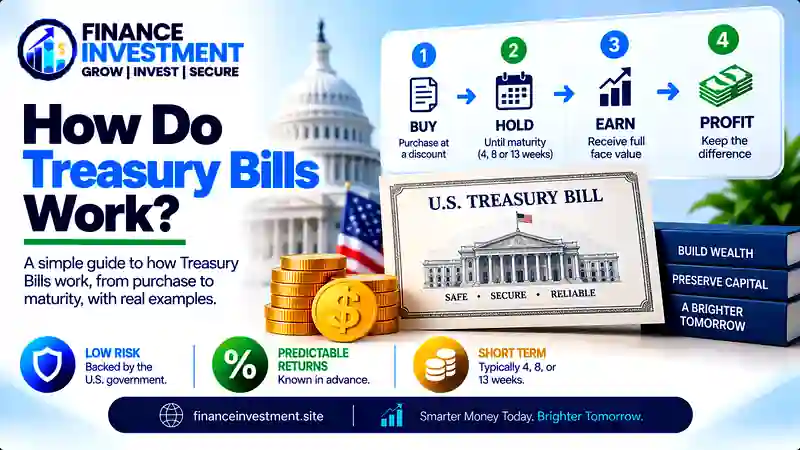 If you are new to Treasury bills, think of a T-bill as a short-term U.S. government security that you can buy for your portfolio. The Treasury issues these securities to borrow money for a limited period. When the bill matures, the Treasury pays its face value. The return generally comes from the difference between the price you paid and the amount received at maturity.
T-bills have maturities of one year or less. Regular Treasury bill terms include 4, 6, 8, 13, 17, 26 and 52 weeks. The Treasury may offer different terms depending on its borrowing schedule. The minimum purchase amount is generally $100, with additional amounts purchased in $100 increments.
The key difference from many bonds: T-bills generally do not make periodic coupon payments. Instead, newly issued bills are typically sold at a discount to face value. The difference between the purchase price and face value represents the gross return if you hold the bill to maturity.
What Happens to Your Money?
Suppose a T-bill has a $5,000 face value and you pay $4,900 at issuance. If you hold it until maturity, you receive $5,000. The $100 difference is your gross return before applicable taxes. This is an illustration, not a quoted market rate. Your actual purchase price depends on the auction result and the security’s term.
You can buy T-bills directly through TreasuryDirect or through a bank or brokerage. TreasuryDirect accepts noncompetitive bids for individual investors, while banks and brokers may provide both auction access and secondary-market trading. If you might sell before maturity, the market price can be different from what you originally paid.
How Treasury Bills Work Step by Step
The simplest way to understand how Treasury bills work is to follow a T-bill from its auction through maturity. The process is straightforward once you separate the auction, purchase price, yield and maturity.
1. Treasury announces the bill
The U.S. Treasury announces the bill’s term, auction date, issue date and other offering details. Investors can choose a maturity that matches their expected cash needs.
2. You place an order
When buying through TreasuryDirect, an individual investor generally uses a noncompetitive bid. You accept the yield determined at the auction instead of naming your own rate.
3. The auction sets the terms
Competitive bids submitted by eligible bidders help determine the auction result. Noncompetitive bidders receive the same rate as successful competitive bidders, subject to Treasury auction rules.
4. The bill is issued
For a newly issued discount T-bill, the amount paid is below the face value. The exact purchase price depends on the auction result and the bill’s term.
5. The bill reaches maturity
If you hold the T-bill until maturity, the Treasury pays its face value. The difference between your purchase price and that face value is the gross return before applicable taxes.
How Treasury Bill Yield Fits In
A treasury bill yield reflects the relationship between the purchase price, face value and time remaining to maturity. For example, if you pay $9,850 for a $10,000 face-value bill and hold it to maturity, your gross dollar return is $150. That $150 is not itself an annual yield. The quoted discount rate and investment yield use different calculations, so they should not be treated as interchangeable.
Once the bill matures, you can use the proceeds or reinvest them in another Treasury security. Reinvesting at maturity can create a simple short-term strategy, but the new bill’s yield may be different from the previous one.
Benefits and Drawbacks of Treasury Bills
Treasury bills can be useful when you want to keep money in a short-term U.S. government security, but they are not a replacement for every savings or investment option. The right choice depends on when you need the money, how much liquidity you want and whether you need regular income.
Benefits
- Direct obligations of the U.S. government.
- Short maturities can fit near-term financial goals.
- Interest is generally exempt from state and local income taxes.
- TreasuryDirect and brokerage accounts provide ways to purchase T-bills.
Drawbacks
- They generally do not provide periodic coupon payments.
- Selling before maturity can result in a different price than your purchase price.
- The yield available when you reinvest may be higher or lower.
- Inflation can reduce the purchasing power of your return.
QUICK TAKE: T-bills can be a strong fit for short-term money when preserving capital and knowing the maturity value matter more than long-term growth. They may be less suitable if you need instant access to cash or want regular interest payments.
Treasury Bills vs. Other Short-Term Options
Comparing T-bills with other places to keep short-term cash helps show where each option fits. The main differences are the type of account or security, access to your money, how the return is determined and how the investment is protected.
The protection is also different. T-bills are direct obligations of the U.S. Treasury and are not FDIC-insured deposits. Eligible deposits at FDIC-insured banks are generally covered within applicable FDIC limits. A CD may charge an early-withdrawal penalty, while a savings or money market account generally provides easier access but may have a variable rate. T-bills can also be sold before maturity through a brokerage, but their market price can change.
QUICK TAKE: T-bills can work well when you have a defined time horizon and want a Treasury security. Savings or money market accounts may be more convenient when immediate access matters, while CDs can suit money you are comfortable locking up for a stated term.
Treasury Bill Costs, Taxes, Risks and Tips
T-bills are relatively simple to buy and hold, but the headline yield is not the whole story. Your purchase method, taxes, liquidity needs and plans for the money can affect the overall result.
Costs and Taxes
- TreasuryDirect does not charge a fee to open an account or buy Treasury securities.
- A bank or broker may have its own fees, pricing or transaction terms.
- T-bill interest is generally subject to federal income tax but exempt from state and local income taxes.
Risks and Practical Tips
A T-bill held to maturity does not require you to sell at a changing market price. However, inflation can reduce the purchasing power of your return, and the yield available when you reinvest may be different. If you sell before maturity, the market price may be higher or lower than the price you originally paid.
Practical tip: Match the maturity date with your expected cash need. Then compare the investment yield, tax treatment, liquidity and any account costs before choosing a T-bill over a savings account, CD or another short-term option.
Common Treasury Bill Mistakes and a Real-Life Example
Understanding how Treasury bills work also means knowing the small details that can affect your decision. Beginners often focus only on the quoted rate and overlook the maturity date, purchase price or tax treatment.
4 Mistakes to Avoid
- Mixing up discount rate and investment yield: they use different calculations.
- Choosing the wrong maturity: a T-bill may mature later than you actually need the cash.
- Assuming the purchase price is guaranteed if you sell early: market prices can change before maturity.
- Ignoring federal taxes: T-bill interest is generally federally taxable, although it is exempt from state and local income taxes.
Real-Life Example
Imagine Sarah has $20,000 that she expects to need in about six months. She buys an illustrative six-month T-bill with a $20,000 face value for $19,600. If she holds it to maturity, she receives $20,000. Her gross return is therefore $400 before applicable taxes. The $19,600 purchase price is only an example; actual auction prices and yields vary.
Sarah’s key decision was matching the maturity with her expected cash need. If she sells before maturity instead, the market price could produce a different result. At maturity, she can use the proceeds or reinvest them in another T-bill at the yield available at that time.
Who Should Consider Treasury Bills?
Treasury bills may suit investors who have a defined short-term goal and want to hold a direct U.S. Treasury security. They can be useful when the maturity date matches a planned cash need, such as a future expense, or when an investor wants to spread money across several maturity dates.
T-bills may fit investors who:
- Want short-term exposure to U.S. government debt.
- Can leave the money invested until the chosen maturity date.
- Want to potentially benefit from the federal tax treatment of Treasury interest.
- Want to create a T-bill ladder with multiple maturity dates.
T-bills may be less convenient for someone who needs immediate access to cash or wants regular interest payments. The right choice depends on the purpose and timing of the money, rather than simply choosing the option with the highest quoted rate.
Frequently Asked Questions About Treasury Bills
1. How do Treasury bills work?
T-bills are short-term U.S. government securities. Newly issued bills are generally sold at a discount, and investors receive the face value at maturity when held to maturity.
2. What is the minimum amount to buy?
The minimum purchase is generally $100, with additional purchases generally made in $100 increments.
3. Do Treasury bills pay monthly interest?
No. T-bills generally do not make periodic coupon payments. The return is built into the purchase price, with payment of face value at maturity.
4. Can I sell a T-bill before maturity?
Yes. Marketable T-bills can be sold before maturity through a broker or dealer, but the market price can be higher or lower than your purchase price.
5. Are Treasury bills FDIC-insured?
No. T-bills are Treasury securities, not bank deposits. Their protection comes from being direct obligations of the U.S. government rather than from FDIC deposit insurance.
6. Are Treasury bill earnings taxable?
Yes. Interest from Treasury bills is generally subject to federal income tax but exempt from state and local income taxes.
7. Can I reinvest a maturing T-bill?
Yes. You can use the maturity proceeds for another investment or reinvest in another Treasury security. The new security’s yield may be different.
8. Where can I buy Treasury bills?
Individual investors can buy T-bills through TreasuryDirect or through a bank or brokerage account. Each route can have different features and terms.
Final Verdict: How Do Treasury Bills Work?
So, how do Treasury bills work? You buy a short-term U.S. Treasury security, generally at a price below its face value, and receive the face value when it matures. The difference between those amounts is the gross return when held to maturity. The investment yield is an annualized measure and should not be confused with the bill’s discount rate.
T-bills can be useful for money with a defined time horizon. They may appeal to investors seeking short-term Treasury exposure and relatively low credit risk. Treasury interest also generally receives favorable state and local tax treatment. However, T-bills are not FDIC-insured deposits, and selling before maturity can result in a market price that differs from your purchase price.
The key decision: Match the maturity with your expected cash need, compare the investment yield with suitable alternatives, and account for taxes and liquidity before buying. The goal is not simply to find the highest rate; it is to choose a maturity that fits the job your money needs to do.
For a broader look at Treasury bills, including rates, taxes, buying options and risks, see our
complete Treasury Bills guide.
Have a Money Question? Keep Exploring.
Treasury bills can be useful for short-term money, but the right choice depends on your timeline, liquidity needs, taxes and investment goals. Before you buy, make sure the maturity and expected return fit your plan.
📩 Get in Touch With FinanceInvestment
Have a finance question, topic suggestion or feedback? Send us a message.
Leave a Reply