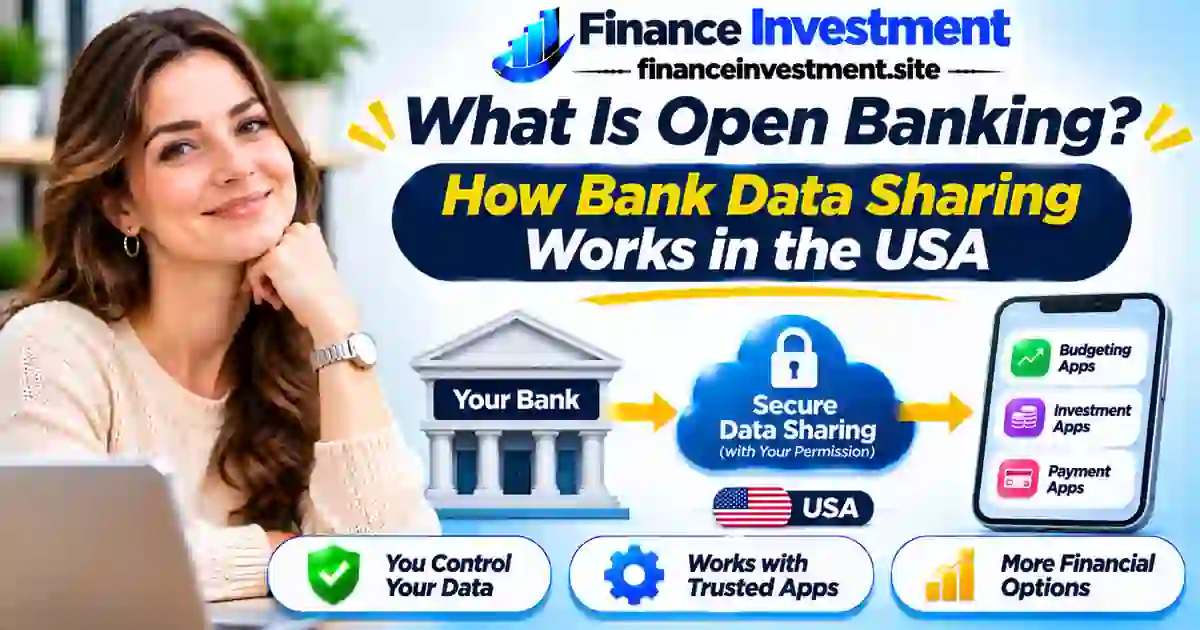
What Is Open Banking? How Bank Data Sharing Works in the USA (2026)
 When Your Bank Account Connects to Another Financial App
You download a budgeting app, connect your checking account and see your recent purchases without typing in every expense. That everyday convenience is an example of open banking.
For someone juggling a paycheck, household bills, credit cards and savings, having financial information in one place can make life easier. But connecting those accounts also means allowing another service to handle some of your private information.
What exactly does that service receive? Can it move your money? And what happens when you stop using it?
These are the questions worth asking before granting access. Understanding open banking helps you enjoy useful financial tools without sharing more information than necessary.
For additional background, explore our complete digital and online banking guide.
What You’ll Learn
- What open banking means for American consumers.
- How APIs and financial data aggregators work.
- Which account information applications may access.
- How to manage permissions and protect financial privacy.
- What the evolving U.S. regulatory framework means for consumers.
What Is Open Banking? Quick Answer
Open banking enables consumers to authorize third-party services to access selected financial account information electronically. It commonly uses application programming interfaces (APIs) to connect financial institutions, data aggregators and applications for services such as budgeting, account verification and consolidated financial dashboards.
7 Key Takeaways
- Authorized data sharing does not make your account public.
- API connections can reduce reliance on shared banking passwords.
- Information access and payment authorization are different permissions.
- Applications may collect and retain different categories of data.
- Connected account balances are not always updated instantly.
- Deleting an application may not revoke its access.
- U.S. open banking regulations remain subject to legal and regulatory developments.
Bottom Line: Connect an account because the service offers something useful, not simply because the connection is available.
Table of Contents
Open Banking at a Glance
APIs
Structured connections between financial systems.
Section 1033
Consumer financial data access provisions.
Consent
Understand and review account permissions.
Best For: Consumers managing multiple accounts, monitoring household expenses or using applications that require financial verification.
| Feature | What It Means |
|---|---|
| Purpose | Consumer-authorized financial data sharing |
| Common uses | Budgeting, account aggregation and verification |
| Account types | Supported checking, savings and credit card accounts |
| Consumer costs | Free or paid, depending on the service |
| Availability | Varies by institution, application and connection method |
7 Essential Facts About Open Banking in the USA
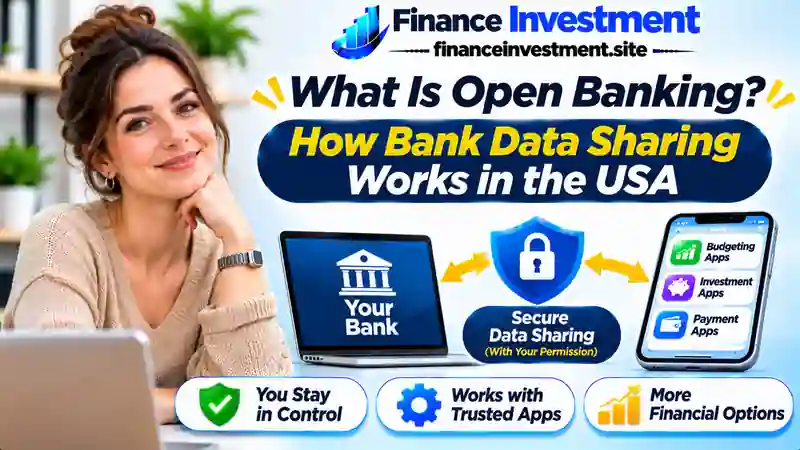
1. Your Financial Information Can Be Used Across Services
Checking account records reveal patterns in income, spending and recurring bills. With your authorization, a financial application may use selected information to create spending summaries or help verify income.
Your money can remain at the original financial institution while another service displays relevant information.
2. APIs Connect Different Financial Systems
An API is a structured interface that allows software systems to exchange information. Banking APIs can let an authorized service retrieve balances or transactions without storing your banking password.
Restricted access tokens, encryption and secure authentication can reduce certain risks, although they cannot eliminate every security threat.
3. Older Connection Methods Still Exist
Some financial applications use screen scraping, an approach that retrieves information through a banking interface and may involve access to customer login credentials.
Where available, prefer bank-hosted authorization that limits permissions and avoids giving an outside company your banking password.
4. Account Aggregation Makes Financial Information Easier to Review
Rather than switching between several banking applications, you may be able to view supported balances and transactions through one dashboard.
Our guide to managing multiple bank accounts explains how consolidated information can simplify everyday finances.
5. Not Every Application Needs the Same Information
A budgeting service might request transaction history. A lender may need income or cash-flow information. Other services may request account details to verify ownership or facilitate payments.
Read-only access does not itself authorize withdrawals. Review separate payment permissions before accepting any connection.
6. Credit Unions Can Participate
Participating credit unions may offer financial data connections through their technology partners. Compatibility varies, particularly when smaller institutions rely on different service providers.
Federal deposit and share insurance are separate from data sharing. Learn more in our FDIC and NCUA insurance guide.
7. A Connected Application Is Not Necessarily a Bank
A budgeting dashboard can display your balances without holding your deposits. Other fintech platforms may provide banking-related services through partner institutions.
Before transferring money to a financial platform, understand who actually holds the funds. Our online banks versus neobanks comparison explains this distinction.
How Does Open Banking Work?
A typical connection involves your financial institution, the application you want to use and, in some cases, a data aggregator that helps the systems communicate.
Step 1: Choose a Service You Trust
Verify the application developer, available security features, pricing and privacy policy before providing financial information.
Step 2: Select Your Financial Institution
Choose your bank or credit union. Where account-level selection is available, connect only the accounts necessary for your intended service.
Step 3: Review the Requested Permissions
Check the categories of information requested, the intended use, access duration and any companies involved in processing the information.
Step 4: Authenticate and Approve Access
With a bank-hosted API connection, you typically authenticate through your financial institution. An access token may then allow the service to retrieve permitted information.
Step 5: Review the Connected Accounts
Confirm that the displayed balances and transactions are accurate. Check the last refresh time before relying on that information.
Step 6: Manage Access Over Time
Periodically review connected services. Revoke unnecessary permissions and separately review the provider’s data deletion and subscription cancellation procedures.
How Financial Information Travels Between Services
Balances and account transaction records
Authentication and permitted access
Possibly involving a data aggregation provider
Uses authorized information to deliver the requested service
Illustrative data-sharing process. Actual authentication, intermediaries and technical arrangements vary.
Our guide to essential mobile banking app features covers additional security and account management tools.
Benefits and Drawbacks of Open Banking
✓ Potential Benefits
- Review supported financial accounts in one place.
- Spend less time manually recording purchases.
- Recognize recurring bills and spending patterns.
- Compare certain financial products more easily.
- Simplify some income verification processes.
- Access additional financial management tools.
✗ Potential Drawbacks
- Additional companies may process sensitive information.
- Connections can fail or show outdated balances.
- Paid features may introduce recurring expenses.
- Privacy and data retention policies can be complicated.
- Fraudsters may imitate legitimate account-linking requests.
The trade-off becomes easier to evaluate when you know exactly what a service adds to your financial routine. Another dashboard is not necessarily useful if your existing banking app already meets your needs.
Explore more in our digital banking pros and cons guide.
Open Banking vs. Conventional Online Banking
Online banking lets you access and manage financial services through websites or applications. Open banking describes authorized information sharing between financial systems. These are complementary approaches rather than competing types of bank accounts.
| Feature | Conventional Online Banking | Open Banking |
|---|---|---|
| Primary purpose | Manage banking services digitally | Share authorized financial information |
| Account visibility | Usually the institution’s accounts | May include multiple institutions |
| Technology | Banking websites and apps | APIs and other data connections |
| External access | Not required for basic account access | Involves authorized data connections |
| Common uses | Transfers, deposits and bill payments | Budgeting, aggregation and verification |
| Additional concerns | Account security and service availability | Permissions, data retention and third-party privacy |
Features may overlap. A bank’s own application may include open banking connections to other financial institutions.
Open Banking Costs, Security Risks and Consumer Rights
What Might a Connected Financial Service Cost?
Some applications include account connections for free. Others charge monthly subscriptions or offer additional features through paid plans.
For example, a $10 monthly subscription costs $120 over a full year. Consider whether the service provides enough practical value to justify that expense.
Understanding the CFPB Section 1033 Rule
Section 1033 of the Dodd-Frank Act provides a statutory basis for consumers to obtain certain financial information, subject to applicable regulations and exceptions.
The Consumer Financial Protection Bureau issued its Personal Financial Data Rights Rule in October 2024. The framework addresses access to covered financial information and the obligations of authorized third parties.
Regulatory Status — November 25, 2026: The CFPB’s compliance resource reports that a federal court stayed the rule’s compliance dates on October 29, 2025. The agency also began reconsidering parts of the rule in August 2025. Do not assume the original implementation dates or proposed changes represent currently enforceable requirements.
Review the official CFPB personal financial data rights rulemaking page and compliance updates for the latest regulatory developments.
Protect Your Financial Information
- Verify the service before approving an account connection.
- Use bank-hosted authorization when available.
- Enable multifactor authentication on supported accounts.
- Review data collection, use and retention policies.
- Monitor transactions through your financial institution.
- Never share login credentials or verification codes in response to unsolicited messages.
Deposit Insurance Is Not Data Breach Protection
FDIC deposit insurance and federal NCUA share insurance protect eligible funds against insured institution failure, subject to coverage rules. They do not cover losses simply because an application suffers a privacy breach.
Learn more about FDIC insurance and banking apps.
If you discover an unauthorized electronic transfer, notify your financial institution promptly. Applicable consumer protections and reporting deadlines may affect your rights. For eligible unresolved complaints, use the CFPB consumer complaint portal.
Expert Tip: Disconnecting an account, canceling a paid subscription and requesting deletion of retained data are three separate actions. Complete each applicable step when you stop using a financial service.
Common Open Banking Mistakes to Avoid
- Connecting unnecessary accounts: Limit access to information relevant to your financial goal.
- Trusting outdated balances: Check your institution’s available balance before making important payments.
- Overlooking renewal charges: Review subscription costs and cancellation dates.
- Ignoring payment permissions: Understand whether an application requests access beyond viewing information.
- Deleting an app without disconnecting: Review active account connections and previously collected information.
Practical Example: Can a Budgeting App Pay for Itself?
Consider Amanda and Michael, a hypothetical Ohio couple managing household expenses through several bank accounts.
They subscribe to a budgeting service costing $8 per month. After reviewing connected transaction records, they identify and cancel two unnecessary subscriptions costing $12 and $18 monthly.
$96
$360
$264
Calculation: ($12 + $18) × 12 − ($8 × 12) = $264.
Break-even point: The application needs to help the couple avoid at least $8 in monthly expenses to offset its subscription cost through savings alone.
The application does not generate money. It helps the couple identify expenses they can remove from their budget.
More ideas are available in our mobile banking budgeting and spending tools guide.
Hypothetical example. Assumes immediate cancellation, unchanged prices, a full year of avoided expenses and no replacement subscriptions or additional fees. Actual savings vary.
Who Should Consider Using Open Banking?
Beginners: A consolidated dashboard may help people understand their spending without maintaining several spreadsheets.
Families: Connected financial information can simplify household budgeting when account holders have appropriate authorization and understand the permissions involved.
Investors: Some applications also support brokerage and retirement account aggregation. These broader services do not necessarily fall within the same regulatory scope as covered banking data.
Retirees: Account summaries may help with monitoring retirement income, recurring bills and cash reserves.
Privacy-conscious consumers: Downloaded statements, spreadsheets and manual budgeting remain reasonable alternatives to ongoing external account access.
Before Connecting an Account, Ask Three Questions
- What financial task will this service help me complete?
- Does it request more information than that task requires?
- How can I withdraw access and manage retained information?
Frequently Asked Questions
What is open banking in simple terms?
Open banking allows consumers to authorize third-party financial services to access selected account information electronically. Typical uses include budgeting, account aggregation and financial verification.
Is open banking available in the USA?
Yes. Many U.S. financial institutions and technology companies support consumer-authorized financial data sharing. Compatibility depends on the institution, application and connection method.
Is open banking safe to use?
Encryption, restricted access permissions and secure authentication can reduce certain risks. However, phishing, third-party security weaknesses and inappropriate data use remain possible. Review the provider before connecting accounts.
Can open banking applications withdraw money from my account?
Read-only data access does not itself authorize withdrawals. Applications offering payments or transfers may require separate authorization. Carefully review all requested permissions before connecting an account.
Can I revoke open banking access?
Many institutions and applications provide controls for revoking account access. Revocation can prevent future authorized data collection through that connection, but previously retained information may require a separate deletion request.
Is open banking free?
Some applications provide account connections at no additional consumer charge. Others require subscriptions or paid features. Check the service’s pricing, renewal and cancellation terms.
What is the CFPB Section 1033 rule?
The CFPB issued its Personal Financial Data Rights Rule in October 2024 to implement Section 1033. The agency reports that the compliance dates were stayed by a federal court in October 2025 and has initiated reconsideration of the rule.
Do credit unions support open banking?
Some U.S. credit unions support authorized third-party financial data connections. Confirm application compatibility, available permissions and security controls with your credit union and service provider.
Final Verdict: Is Open Banking Worth Using?
Open banking can make financial information easier to understand and use without requiring you to move deposits to another institution.
Its value depends on the convenience offered, the information requested and the service’s security and privacy practices.
A useful approach is to begin with one financial task, connect only the accounts needed and review whether the service delivers meaningful results. If it does not, reconsider the connection rather than leaving unnecessary access active indefinitely.
For a broader understanding of modern financial services, explore our complete digital and online banking guide.
Related Resources
Continue Learning With FinanceInvestment
Official U.S. Consumer Protection Resources
Better Financial Decisions Begin With Knowing What You Share
Your account information can help you understand spending, organize bills and manage savings. Choose financial tools that make those tasks easier while respecting your privacy.
Take the next step with our guides to managing multiple bank accounts and building better budgeting habits.
Have a question about digital banking or interested in future newsletter updates? We’d be happy to hear from you.
✉ Get in Touch With FinanceInvestment
Disclaimer: FinanceInvestment provides educational information, not individualized financial or legal advice. Financial data sharing practices, application terms and regulatory requirements may change. Verify current information with official sources and your financial institution. Never send passwords, authentication codes or sensitive financial account information by email.
Leave a Reply