Treasury Bill Yield vs Interest Rate
Treasury Bill Yield vs Interest Rate: What’s the Difference?
 Treasury Bill Yield vs Interest Rate can be confusing because Treasury bills work differently from Treasury notes and bonds. A T-bill does not make periodic coupon payments. Instead, it is generally sold below its face value and pays its face value at maturity.
That is why Treasury bill results can show several related numbers, including the discount rate, purchase price, and investment rate. They describe the same investment from different angles, but they are calculated differently.
The difference matters when you compare T-bills with other short-term investments. A discount rate is based on the bill’s face value, while the investment rate is based on the price you actually pay. TreasuryDirect notes that the investment rate is the more useful measure for comparing a T-bill’s return with other investments.
If you are new to Treasury securities, our
Treasury Bills Explained
guide covers the basics. Here, we will focus on the numbers behind a T-bill’s return and show why yield, rate, and price should not be treated as the same thing.
What You’ll Learn
- What Treasury bill yield means
- How the discount rate differs from the investment rate
- Why the purchase price changes the way a T-bill return is expressed
- How yield and rate appear in Treasury auction results
- Which numbers to compare when evaluating T-bills
- Common mistakes investors make when comparing T-bill rates
Quick Answer: Treasury Bill Yield vs Interest Rate
For Treasury bills, the terms yield and interest rate need some context. Treasury’s current glossary uses “Interest Rate” for notes, bonds, and TIPS, while Treasury bills use a discount rate and an investment rate/yield. The discount rate is based on the bill’s face value and a 360-day convention. The investment rate is an annualized simple rate based on the purchase price and a 365-day year, or 366 days in a leap year.
Key Takeaways
- Treasury bills do not make periodic coupon payments like Treasury notes or bonds.
- A T-bill is generally sold at a discount to its face value and pays the face value at maturity.
- The discount rate is calculated using the bill’s face value and a 360-day basis.
- The investment rate/yield uses the purchase price to express an annualized return.
- These different calculation methods can produce different percentages for the same T-bill.
- The purchase price, maturity date, and rate should be considered together when comparing T-bills.
- The investment rate/yield can make a T-bill easier to compare with other short-term investments.
BOTTOM LINE:
A T-bill’s discount rate and investment rate/yield are not interchangeable numbers. Once you understand what each calculation measures, Treasury bill pricing and auction results become much easier to compare.
Treasury Bill Yield vs Interest Rate: At a Glance
Treasury bills are priced differently from coupon-paying Treasury securities. A T-bill is generally sold below its face value and pays its face value at maturity. Because of that structure, Treasury uses more than one rate measure to describe the bill’s return.
Quick Facts
- Security: Short-term U.S. Treasury security
- Pricing: Generally purchased below face value
- Return: The difference between the purchase price and face value at maturity
- Discount rate: Based on the bill’s par value using a 360-day convention
- Investment rate: Based on the purchase price using a 365-day basis, or 366 days when applicable
Best For
This distinction is especially useful when comparing a Treasury bill with another short-term investment. The discount rate describes the bill using its par value, while the investment rate uses the purchase price. TreasuryDirect identifies the investment rate as the measure that can be used to compare bill yields with other investments.
| Measure | What It Uses | Why It Matters |
|---|---|---|
| Discount Rate | Par value and a 360-day basis | Helps determine the T-bill’s purchase price |
| Investment Rate / Yield | Purchase price and a 365/366-day basis | Expresses the bill’s annualized return for comparison |
| Purchase Price | The price paid for the bill | Shows the actual amount invested relative to face value |
QUICK TAKE:
The discount rate and investment rate are different ways of expressing a T-bill’s economics. When comparing its return with another short-term investment, pay attention to the purchase price and investment rate rather than relying on the discount rate alone.
Complete Beginner Guide to Treasury Bill Yield vs Interest Rate
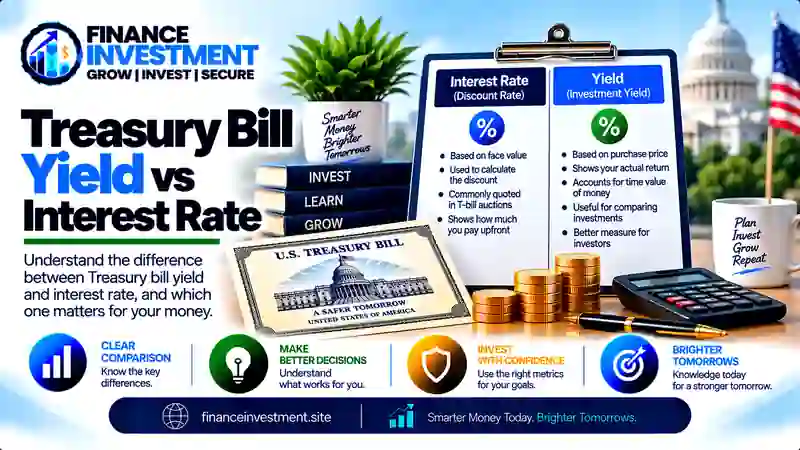 If you are new to Treasury bills, the first thing to understand is that a T-bill does not work like a savings account or a coupon-paying Treasury note. It is generally purchased for less than its face value and pays its face value when it reaches maturity.
Start With the Purchase Price
Suppose a Treasury bill has a $10,000 face value and a purchase price of $9,800. You pay $9,800 when you buy the bill. If you hold it until maturity, the Treasury pays the $10,000 face value. The $200 difference is the gross return from the price difference, before applicable taxes or costs.
This is the key to understanding T-bill returns. You do not receive separate monthly or quarterly coupon payments. Instead, the return is built into the difference between the amount you pay and the amount paid at maturity.
Understand the Discount Rate
The discount rate measures the discount using the bill’s par value and a 360-day convention. It is an important part of Treasury bill pricing, but it is not based on the actual amount you pay.
Then Look at the Investment Rate
The investment rate is based on the bill’s purchase price. Treasury calculates it using a 365-day basis, or 366 days when applicable. Because it uses the amount actually paid for the security, Treasury says the investment rate can be used to compare a T-bill’s return with other investments.
For a broader introduction, see our
guide to how Treasury bills work
.
Once the basic structure is clear, comparing a T-bill’s discount rate with its investment rate becomes much easier.
BEGINNER TIP:
When comparing T-bills, don’t rely on the discount rate alone. Check the purchase price and investment rate as well. Those numbers show how the quoted rate connects to the return on the money you actually invest.
How Treasury Bill Yield and Interest Rate Work
Understanding a Treasury bill yield becomes easier when you follow the process from the auction to the final maturity payment. Unlike coupon-paying Treasury securities, a T-bill generally earns its return through the difference between its purchase price and face value.
Step 1: Investors Bid at the Auction
Treasury bills are sold through auctions. Competitive bidders submit the discount rate they are willing to accept. Treasury evaluates those bids and accepts them from the lowest rate upward until there are enough bids to cover the offering amount.
A noncompetitive bidder does not specify a discount rate. Instead, the bidder agrees to accept the rate determined by the auction, subject to the applicable auction rules.
Step 2: The Discount Rate Connects to the Price
Once the auction determines the applicable rate, Treasury calculates the bill’s purchase price. The discount rate is based on the bill’s par value and the actual number of days until maturity, using a 360-day basis.
For the same face value and maturity:
A higher discount rate generally means a lower purchase price and a larger discount from face value.
Step 3: The Investment Rate Shows the Return Differently
Treasury also reports an investment rate, sometimes described as an equivalent coupon yield. Unlike the discount rate, it is based on the bill’s purchase price. Treasury calculates it using a 365-day basis, or 366 days when applicable.
This difference is important when comparing a T-bill with another short-term investment. TreasuryDirect specifically states that the discount rate should not be used for that comparison, while the investment rate can be used to compare bill yields with other investments.
Why “Interest Rate” Can Be Confusing
The phrase T-bill interest rate is common in everyday investing conversations, but Treasury uses more specific terminology. Its rules define an “interest rate” for notes and bonds, while Treasury bills are quoted using a discount rate and an investment rate.
So, when you see a Treasury bill auction result, look at the discount rate, purchase price, and investment rate together. Each number answers a different question about the same security.
Treasury Bill Yield vs Interest Rate: Benefits & Drawbacks
Knowing how a T-bill’s yield and rate are calculated is only part of the picture. You also need to consider how the security fits your cash needs, taxes, and investment time frame.
Benefits
- U.S. government obligation: Treasury bills are direct obligations of the U.S. government.
- Short-term structure: Regular Treasury bills have maturities of one year or less, making them suitable for investors managing short-term funds.
- Return paid at maturity: Instead of receiving periodic coupon payments, the investor generally receives the bill’s face value at maturity. The difference between the purchase price and face value represents the bill’s interest.
- State and local tax exemption: Treasury interest is subject to federal income tax but is exempt from state and local income taxes.
Drawbacks
- Inflation can reduce purchasing power: A positive T-bill return does not necessarily mean your money gained purchasing power after inflation.
- Early-sale price can change: If you sell a T-bill before maturity, its market price may be higher or lower than the amount you originally paid.
- No periodic income: Investors seeking regular monthly or quarterly interest payments will not receive them from a T-bill.
QUICK TAKE:
A Treasury bill can offer a straightforward short-term structure, but the quoted yield is not the only factor to consider. Look at taxes, inflation, your cash needs, and whether you plan to hold the bill until maturity.
Treasury Bill Yield vs Interest Rate Comparison
A Treasury bill’s discount rate and investment rate describe the same security from different calculation perspectives. The discount rate uses the bill’s par value, while the investment rate is based on the purchase price.
| Measure | Calculation Basis | Main Use |
|---|---|---|
| Discount Rate | Par value, actual days to maturity, and a 360-day basis | Used to quote the bill and calculate its purchase price |
| Investment Rate / Yield | Purchase price and a 365/366-day basis | Used to compare the bill’s return with other investments |
| Purchase Price | Amount paid for the bill | Shows the actual amount invested |
Which Number Should You Compare?
If you are comparing a T-bill with a savings account, CD, money market investment, or another short-term investment, focus on the investment rate. TreasuryDirect specifically states that the discount rate should not be used to compare a bill’s rate of return with other instruments, while the investment rate can be used for that comparison.
The investment rate is still an annualized measure. Your actual dollar return depends on factors such as the amount invested, purchase price, and time until maturity. Tax treatment can also affect how much of the return you ultimately keep.
QUICK TAKE:
Don’t treat the discount rate and investment rate as interchangeable. The discount rate helps describe T-bill pricing, while the investment rate is the more appropriate Treasury measure for comparing the bill’s return with other investments.
Treasury Bill Costs, Risks & Expert Tips
A Treasury bill can have a relatively simple return structure, but the quoted yield is not the only number that matters. Your purchase method, holding period, taxes, and plans for the money can all affect the result.
Costs to Watch
- Broker transaction costs: If you buy or sell a T-bill through a broker, check whether commissions, markups, or markdowns apply to the transaction.
- Taxes: Bill interest is subject to federal income tax but is exempt from state and local income taxes.
Risks to Understand
- Early-sale risk: If you sell before maturity, the market price may be different from the amount you originally paid. A broker transaction can also affect your net proceeds.
- Inflation risk: Inflation can reduce the purchasing power of your T-bill return.
- Reinvestment risk: When a T-bill matures, the rate available on a new bill may be higher or lower than the rate on your original investment.
EXPERT TIP:
Before buying, check the investment rate, purchase price, maturity date, and tax treatment. If you might need the money early, understand how your bank or broker handles secondary-market sales and what transaction costs may apply.
Common Treasury Bill Yield Mistakes & Real-Life Example
T-bill comparisons can become confusing when investors treat the quoted discount rate as if it were the same as the investment return. The calculation basis matters.
Common Mistakes
- Comparing the discount rate directly with a CD or savings yield:
The T-bill discount rate uses par value and a 360-day convention, so it is not the appropriate measure for comparing returns with other investments. - Ignoring the purchase price:
The amount paid for the bill is an important part of calculating its investment rate and understanding the actual dollar return. - Expecting periodic interest payments:
A T-bill does not make regular coupon payments during its term. Its interest is generally reflected in the difference between the purchase price and face value. - Forgetting the maturity period:
An annualized investment rate helps with comparisons, but your actual dollar result depends on the amount invested and the time until maturity.
Real-Life Example
Suppose an investor buys a hypothetical $10,000 face-value T-bill for $9,800 and holds it until maturity. The investor pays $9,800 upfront and receives $10,000 at maturity. The gross difference between the purchase price and face value is $200.
That $200 should not be confused with the T-bill’s quoted discount rate. The discount rate and investment rate use different calculation bases. The investment rate uses the purchase price and annualizes the bill’s return, making it the more appropriate Treasury measure when comparing the bill with another investment.
REAL-WORLD LESSON:
When evaluating a T-bill, look beyond the headline percentage. Check the purchase price, face value, maturity period, and investment rate before comparing it with another short-term investment.
Who Should Consider Treasury Bills?
Treasury bills may be worth considering for investors who have a short-term cash goal and want exposure to a U.S. government security. Treasury bills mature in a few days to 52 weeks, so the maturity date can be matched with a specific cash need.
T-Bills May Fit Investors Who:
- Have money they expect to use within a relatively short time frame.
- Prefer a Treasury security backed by the U.S. government’s full faith and credit.
- Are comfortable receiving the bill’s face value at maturity instead of periodic coupon payments.
- Want to compare a T-bill’s return with other short-term investments using its investment rate.
A T-bill may be less suitable for someone who needs regular income payments or may need to sell before maturity. An early sale can result in a market price that differs from the original purchase price.
THINK ABOUT YOUR TIMELINE:
Before comparing Treasury bill yields, consider when you need the money, whether you can hold the bill to maturity, and how its return compares with your other short-term options.
Frequently Asked Questions About Treasury Bill Yield vs Interest Rate
Is Treasury bill yield the same as the interest rate?
Not exactly. For Treasury bills, Treasury reports a discount rate and an investment rate, also described as an equivalent coupon yield. The discount rate is based on par value, while the investment rate is based on the bill’s purchase price.
Why is a T-bill sold at a discount?
A T-bill is generally issued for less than its face value. At maturity, Treasury pays the face value. The difference between the purchase price and face value represents the bill’s interest.
Which rate should I use to compare a T-bill with a CD?
The investment rate is the appropriate Treasury measure for comparing a bill’s return with other investments. TreasuryDirect specifically states that the discount rate should not be used for that comparison.
Does a Treasury bill pay monthly interest?
No. T-bills do not make periodic coupon payments. Instead, the investor generally pays a discounted purchase price and receives the bill’s face value at maturity. The difference represents the interest.
Is Treasury bill interest taxable?
Yes. Treasury bill interest is subject to federal income tax. Treasury interest is generally exempt from state and local income taxes.
Can I sell a T-bill before maturity?
Yes. A Treasury bill can generally be sold before maturity through a bank, broker, or dealer in the secondary market. The market price at the time of sale may be different from your original purchase price, so the amount you receive can vary.
Why can the Treasury bill yield and discount rate be different?
They use different calculation bases. The discount rate uses par value and a 360-day convention. The investment rate uses the purchase price and an annualized 365-day basis, or 366 days when applicable. As a result, the two percentages can differ for the same bill.
FAQ SUMMARY:
When reading a Treasury bill quote, identify whether the percentage is the discount rate or investment rate. The distinction matters because each measure uses a different calculation basis and serves a different purpose.
Final Takeaway: Treasury Bill Yield vs Interest Rate
The key to understanding a Treasury Bill Yield vs Interest Rate is recognizing that Treasury bills use different rate measures for different purposes. The discount rate is based on the bill’s par value and uses a 360-day convention, while the investment rate is based on the purchase price and uses a 365-day basis, or 366 days when applicable.
The discount rate helps determine the price of a T-bill. The investment rate, also called the equivalent coupon yield, expresses the bill’s annualized return using its purchase price. TreasuryDirect says this investment rate can be used when comparing a bill’s yield with other investments.
When reviewing a T-bill, therefore, consider the purchase price, face value, maturity date, discount rate, and investment rate together. Looking at these figures as a group gives you a clearer understanding of how the quoted rate connects with the actual investment.
FINAL TAKEAWAY:
The discount rate and investment rate are not interchangeable. If you are comparing a T-bill’s return with another investment, use the investment rate for that comparison rather than treating the discount rate as an equivalent yield.
Leave a Reply