What to Do When Your CD Matures in 2026
Your CD has reached maturity. Now you have a choice: take the money, renew the certificate, move it elsewhere, or use the opportunity to rethink your next savings move.
Your CD Maturity Date Is a Decision Window
 Knowing what to do when your CD matures starts with recognizing that the maturity date is not simply the finish line. It is the point when your money becomes available for a new decision. You may need the cash for an upcoming expense, want to renew the certificate, or decide that another savings option now fits better.
The first step is to check the maturity date and the grace period in your account agreement. That gives you a clear window to review your choices instead of allowing an automatic renewal to happen without a second look. The new CD rate may be different from the rate you originally received, and your own cash needs may have changed too.
If you are still learning how certificates work, the
CD Guide 2026
provides a broader look at CD terms, rates, safety, and common strategies. This guide takes the next step by focusing on the choices that become available when your certificate reaches maturity.
A little preparation can give you more control over where the principal and earned interest go next.
What You’ll Learn
- What normally happens when a CD reaches maturity
- How to compare withdrawal, renewal, and reinvestment choices
- How to prepare for the maturity and grace-period window
- When keeping the money outside another CD may make more sense
Quick Answer: What to Do When Your CD Matures
When a CD matures, first confirm exactly when the term ends and how long you have to give new instructions. Then decide whether you need the money, want another CD, or prefer a different place for the funds. Compare the available terms before allowing the account to renew.
6 Practical Maturity Moves
- Confirm the maturity date: Check your account documents so you know when the certificate ends.
- Review the grace period: Find out how long you have to withdraw or change the instructions after maturity.
- Decide whether you need the cash: Consider upcoming bills, planned purchases, and other near-term needs.
- Compare the new rate: Do not assume the renewal rate will match your previous CD rate.
- Choose what happens to the money: Decide whether to withdraw the principal, take the interest, reinvest part or all of the proceeds, or move the funds elsewhere.
- Prevent an unwanted renewal: Follow the institution’s instructions before the applicable deadline if you do not want another CD.
Bottom line: Treat CD maturity as an active money decision. A few minutes of review can help you avoid an unsuitable renewal and put the proceeds where they best fit your next goal.
CD Maturity Options at a Glance
Once the term ends, the important details are no longer about opening the CD. They are about what becomes available, what deadlines apply, and how much control you have over the proceeds. Use the table below as a quick reference before making your next move.
| Maturity Detail | What to Check | Possible Next Step |
|---|---|---|
| Maturity date | When the CD term ends | Review your instructions |
| Grace period | Deadline for changing or withdrawing funds | Act before the deadline |
| Principal | Amount becoming available | Withdraw or reinvest |
| Interest | How earned interest is handled | Keep, transfer, or reinvest |
| Renewal | New rate and term | Renew only if suitable |
| Liquidity | How soon you may need the money | Keep some funds accessible if needed |
Quick check: Have the maturity date, grace-period deadline, available balance, and next destination for the money written down before the CD reaches its final day.
Complete Beginner Guide to Handling a Matured CD
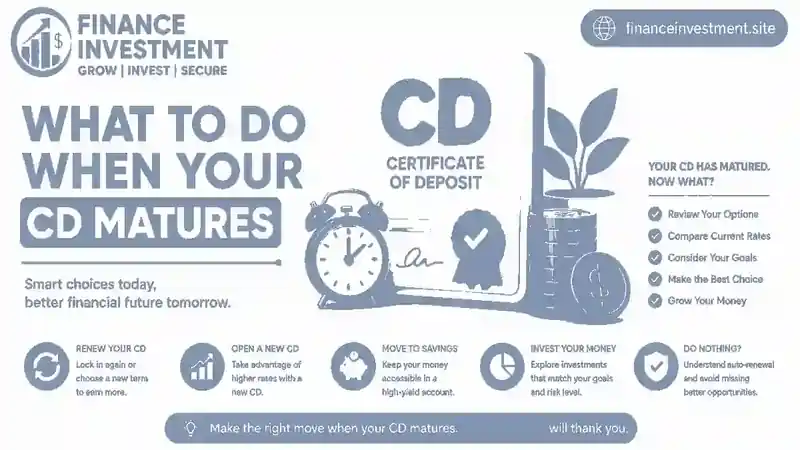 When your CD reaches maturity, you do not need to make the next decision blindly. A simple review of the account notice, available dates, and your current cash plans can help you move the money deliberately instead of reacting at the last minute.
1. Read the Maturity Notice
Start with the message or statement from your bank or credit union. Look for the maturity date, the amount becoming available, the renewal instructions, and any deadline for changing those instructions. If you are unsure about a term, contact the institution before the decision window closes.
2. Confirm the Grace Period
Find out whether the account provides a grace period after maturity and exactly when it ends. Do not assume every institution uses the same timeframe. Your account agreement controls the details.
3. Decide How Much Cash You Need
Look ahead at planned expenses, large purchases, taxes, or other known needs. You may not need to move the entire balance. If only part of the proceeds is needed, check whether the institution allows the remaining amount to be placed into a new CD under its available terms.
4. Compare the Renewal Offer
If another CD still fits, compare the offered rate and term with current alternatives. A renewal is a new commitment, so review it separately from the certificate that just ended. Our guide on
how to choose the right CD
can help you evaluate the available features.
5. Choose Withdrawal or Reinvestment
You can generally decide whether to take the proceeds, transfer them, or use them for another CD. If you want to keep earning interest, compare the new term before reinvesting rather than assuming the old arrangement should continue.
6. Record the Next Date
If you open another CD, save its maturity date and renewal deadline immediately. A calendar reminder can prevent the next maturity from becoming an unexpected decision.
How CD Maturity and Renewal Work
A CD maturity is the point when the agreed term ends. What happens next depends on the account agreement and the instructions you have provided. The original principal and any interest handled at maturity can become available for a new decision, but the exact timing and renewal process vary by institution.
What Happens When the Term Ends?
On the maturity date, the CD reaches the end of its stated term. If you have chosen not to renew it, the institution may move the proceeds according to your instructions. If automatic renewal applies and you take no action, the principal may be placed into a new CD under the institution’s renewal terms.
The interest treatment can vary as well. Some CDs keep credited interest in the certificate, while others pay interest to a linked account during the term. Check your account records to see whether the amount available at maturity includes the interest you expected.
The Grace Period
Some CDs provide a short period after maturity during which you can make changes without treating the transaction like an early withdrawal. The length and rules are institution-specific, so use your account agreement rather than assuming a standard period.
Illustrative Example: A $12,000 CD Reaches Maturity
Imagine a saver has a $12,000 CD that matures after one year. At maturity, the saver reviews the proceeds and sees that a planned $3,000 expense is coming up. Instead of renewing the entire amount, the saver uses the available funds for that expense and considers a new CD for the remaining $9,000. This is an illustrative example, not a prediction of any institution’s maturity procedure.
Withdrawal or Reinvestment?
Withdrawal gives you immediate control over the proceeds once the applicable maturity rules allow it. Reinvestment keeps the money working but starts a new rate-and-term decision. If you reinvest, the new CD’s rate is based on the offer available at that time rather than the rate on the original certificate.
Benefits and Drawbacks of Handling a Matured CD
Taking a moment to review a matured CD gives you more control over the money. You can line up the next move with your current plans instead of letting the previous account setup decide what happens next.
Pros
- More control: You can decide where the principal and earned interest go next.
- Better comparisons: Maturity gives you a natural point to review current CD rates and terms.
- Planned cash access: You can use the proceeds for an upcoming expense without breaking a new CD.
- Flexible reinvestment: You can renew all, part, or none of the proceeds when the available options suit your plans.
Cons
- Automatic renewal risk: Failing to act may result in another CD under the institution’s renewal terms.
- Missed deadlines: Waiting too long can limit the choices available during the maturity window.
- Changing rates: The new CD rate may be higher or lower than the rate you previously received.
- Reduced liquidity: Reinvesting the proceeds starts another period in which the money may be less accessible.
- Opportunity cost: A new CD may not be the best destination if your cash needs or alternatives have changed.
The main advantage is control, but that control requires attention. If you know when the CD matures and give yourself enough time to review the choices, the decision becomes much easier to manage.
CD Maturity Options Compared
Once a CD matures, the best choice depends on what the money needs to do next. Keeping everything in another CD is only one option. You can also take the proceeds, split the balance, or move the money to an account that gives you easier access.
| Option | Best Feature | Main Trade-Off | May Fit When |
|---|---|---|---|
| Renew the CD | Keeps the money in a fixed-term deposit | Starts another commitment | You do not need the funds soon |
| Withdraw all | Maximum control over the proceeds | Money may stop earning the CD rate | You have a near-term use for the funds |
| Partially reinvest | Balances growth and access | Requires a clear split between goals | Some cash is needed while some can stay invested |
| Move to another CD | Lets you compare a different institution or term | May require another fixed commitment | Another CD better matches your next timeline |
| Use a flexible savings account | Easier access to the money | The rate can change | Liquidity matters more than locking a rate |
If you decide to renew or move the proceeds into another certificate, compare the available terms rather than assuming the previous choice is still suitable. Our guides to
1-year CD rates
and
5-year CD rates
can help you compare different time horizons.
If you want several maturity dates instead of one, see our guide to
building a CD ladder.
Costs, Risks and Expert Tips After CD Maturity
A matured CD gives you more choices, but each choice can affect your future return and access to the money. Before moving the proceeds, pay attention to the details that are easiest to overlook.
Watch the Renewal Rate
The rate on a renewed CD may differ from the rate on your original certificate. Do not treat renewal as an automatic extension of the old deal. Compare the new offer with other available terms before committing the proceeds again.
Check for Tax Consequences
Interest from a CD held in a taxable account is generally taxable income. Moving the principal at maturity does not erase tax obligations associated with interest already earned. For more detail, see our guide to
how CD earnings are taxed.
Think About Insurance Coverage
If a large balance is being renewed or moved to another institution, review applicable deposit-insurance limits and the ownership category. Our guide to
FDIC insurance for CDs
explains the basics.
Do Not Ignore Opportunity Cost
Reinvesting everything into another CD can reduce flexibility if your plans change. On the other hand, moving all the money into a flexible account may mean giving up a potentially higher fixed return. Consider what the money is likely to do next before choosing either extreme.
Expert Tip
Before maturity, write down three numbers: the amount you expect to receive, the amount you actually need soon, and the amount you could leave untouched. That simple split can make the reinvestment decision much clearer.
Common CD Maturity Mistakes
A CD maturity can feel routine, especially if the account has been sitting untouched for a year or more. That is exactly when small oversights can lead to a decision you did not intend to make. A few simple checks can prevent most of these problems.
Mistakes to Avoid
- Allowing an unwanted automatic renewal: Assuming the CD will simply return the money can be risky if the account is set to renew automatically.
- Missing the grace-period deadline: Waiting until the last moment may leave little time to change the maturity instructions.
- Withdrawing without a destination: Moving the money out of a CD without knowing where it will go next can leave a large balance sitting idle.
- Renewing without comparing rates: A renewal offer deserves the same scrutiny as a brand-new CD.
- Moving the entire balance unnecessarily: You may need only part of the proceeds for an upcoming expense while the rest could remain invested.
- Forgetting taxes or insurance limits: Consider the tax treatment of earned interest and applicable deposit-insurance coverage when deciding where a larger balance should go.
Illustrative Example: Daniel Splits His Matured CD
Daniel has a $30,000 CD reaching maturity. He originally planned to renew the full amount, but a $7,000 home expense is now expected within several months. Instead of renewing everything, he considers keeping the $7,000 accessible and comparing CD options for the remaining $23,000. He also checks the new rate, renewal deadline, and applicable insurance coverage before making the move.
Illustrative lesson: A maturity decision can be divided around actual cash needs rather than treating the entire balance as one package.
Who Should Choose Each CD Maturity Option?
The best choice after maturity depends on what the money needs to do next. There is no requirement to renew the certificate simply because it worked well during the previous term.
Choose Withdrawal or Greater Liquidity If…
You have an upcoming purchase, planned bill, tax payment, or other known expense. Families with near-term goals may prefer having the proceeds readily available rather than starting another fixed term.
Consider Another CD If…
You do not expect to need the money soon and value a defined rate for another period. Savers with predictable timelines, including some retirees and conservative investors, may prefer another fixed-term certificate.
Consider Partial Reinvestment If…
You want some of the money available while the rest can remain committed. This can be useful for larger balances when immediate liquidity and continued interest earnings both matter.
Choose Flexibility If…
Your plans are uncertain or you may need access before another CD matures. A flexible savings option can make more sense when easy access matters more than locking in another fixed term.
Remember: automatic renewal is not a reason to renew. If the new term, rate, or access rules no longer fit your plans, moving the money can be the more sensible choice.
Frequently Asked Questions About CD Maturity
What happens when a CD matures?
The CD reaches the end of its agreed term. Depending on your instructions and the account agreement, the proceeds may be withdrawn, transferred, or renewed into another CD.
How long is a CD grace period?
There is no single grace-period length for every CD. The institution and account agreement determine the applicable window and what changes you can make during it.
Does a CD automatically renew at maturity?
Some CDs may renew automatically if you do not provide different instructions. Check your maturity notice and account agreement rather than assuming the proceeds will automatically be returned to you.
What happens to the principal when a CD matures?
The principal becomes available according to the maturity and account terms. You can generally follow the institution’s available instructions for withdrawal, transfer, or reinvestment.
What happens to the interest when a CD matures?
The treatment depends on how the CD handles interest. Interest may already have been paid during the term or remain part of the proceeds at maturity.
Can I withdraw money when my CD matures?
Generally, yes, subject to the account’s maturity and transaction procedures. The important point is to follow the institution’s instructions and applicable deadline.
Should I renew my CD when it matures?
Not automatically. Compare the new rate and term with your current cash needs and other available options before committing the proceeds again.
Are CD maturity proceeds taxable?
Moving your principal does not itself make it taxable income, but interest earned on a CD in a taxable account is generally subject to applicable federal income-tax rules.
Are matured CD funds still covered by deposit insurance?
Coverage depends on where the funds are held, the institution, and the applicable ownership category and insurance limits. Review the relevant FDIC or NCUA rules when moving a larger balance.
Illustrative: What should I do with a $20,000 matured CD?
Illustrative example only: If a $20,000 CD matures and the saver expects to need $5,000 soon, one possible approach is to keep that amount accessible and evaluate another CD or savings option for the remaining $15,000. The appropriate choice depends on the saver’s actual needs and available terms.
Final Verdict: What Should You Do When Your CD Matures?
When a CD matures, do not treat renewal as the default answer. Start by looking at what you need the money to accomplish next. If you have an upcoming expense, taking the proceeds or keeping part of them accessible may be more useful than locking everything away again.
If you do not need the funds soon, compare the renewal offer with other available CD terms before committing to another certificate. A new term means a new rate, a new maturity date, and another period of reduced access. For larger balances, also consider applicable deposit-insurance limits and whether spreading funds across institutions or ownership categories is appropriate.
Most importantly, do not assume that doing nothing means the money will simply return to your checking or savings account. Some CDs automatically renew under the institution’s rules. Check the maturity notice and act within the applicable window if you want a different outcome.
For a broader look at CD terms, rates, safety, and strategies, continue with our
CD Guide 2026
.
Practical takeaway: Let your next financial need—not automatic renewal—decide where the matured CD proceeds go.
Stay Ready for Your Next CD Decision
CD maturity does not have to catch you by surprise. Join the FinanceInvestment newsletter for practical guides on CDs, saving strategies, rates, and everyday money decisions.
📧 subhashr325@gmail.com
Leave a Reply