AI Credit Card Approval: How Banks Use AI to Approve Credit Cards in 2026
Author: Subhash Rukade
Published: June 14, 2026
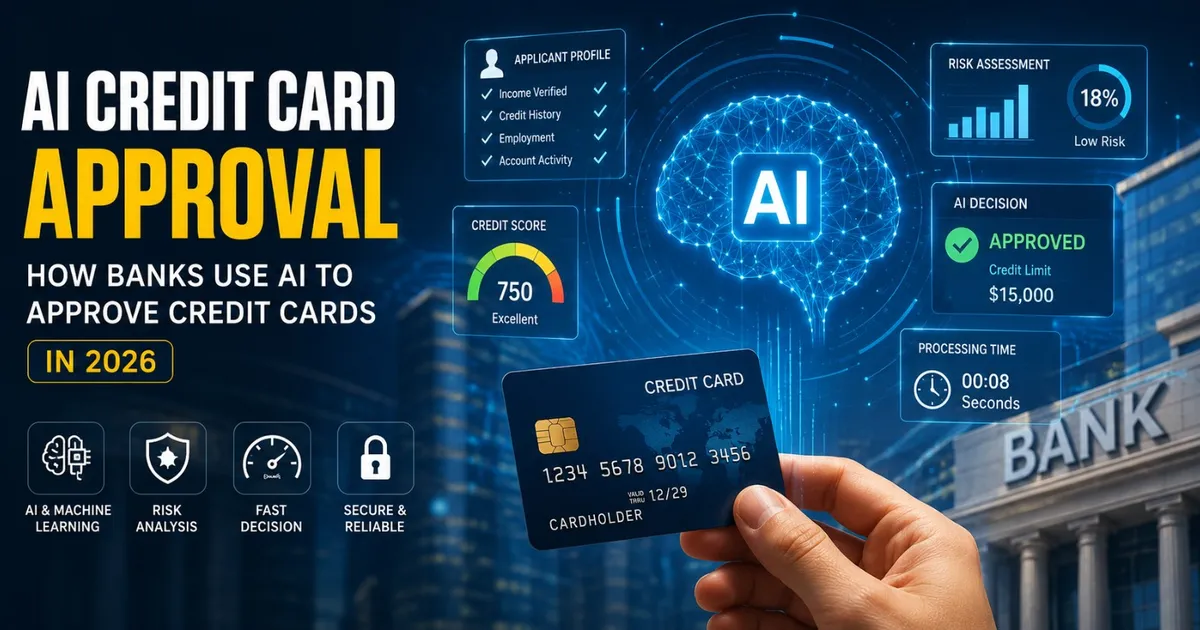
How Banks Use AI to Approve Credit Cards in 2026
AI Credit Card Approval systems are transforming the way banks evaluate applications in 2026. Instead of relying only on traditional credit scores and manual reviews, financial institutions now use artificial intelligence to analyze risk, verify information, and make approval decisions within minutes.
Modern AI models evaluate multiple factors, including credit history, income stability, spending behavior, payment patterns, debt levels, and banking activity. This allows banks to make faster and more accurate lending decisions while reducing fraud and financial risk.
As artificial intelligence becomes a larger part of personal finance, many consumers are curious about what happens behind the scenes when they apply for a new credit card.
To understand how AI is changing investing, banking, and financial planning, explore our
AI Investing Guide 2026.
In this guide, you’ll learn how banks use AI to approve credit cards, what data is analyzed, why approvals are becoming faster, and how consumers can improve their chances of getting approved in 2026.
Traditional vs AI Credit Card Approval
For decades, banks relied on traditional underwriting systems to approve or reject credit card applications. These systems primarily focused on credit scores, income verification, debt levels, and manual reviews performed by loan officers.
While traditional methods worked reasonably well, they often required more time and sometimes failed to capture a complete picture of an applicant’s financial behavior.
Today, AI Credit Card Approval systems are changing the process dramatically.
Artificial intelligence allows banks to analyze large amounts of financial information within seconds. Instead of reviewing only a few data points, AI evaluates hundreds of variables simultaneously to determine risk levels and approval eligibility.
How Traditional Credit Card Approval Worked
In the traditional process, banks generally reviewed:
- Credit score
- Credit history length
- Income information
- Existing debt obligations
- Past payment history
- Manual verification documents
This process could take several days and sometimes required additional paperwork before a final decision was made.
Although effective, traditional underwriting often depended heavily on historical credit data.
How AI Credit Card Approval Works
Modern AI systems go far beyond traditional scoring models.
Banks use machine learning algorithms to evaluate spending patterns, banking activity, debt management behavior, account stability, fraud indicators, and financial trends.
The system then calculates a risk score and recommends an approval decision within minutes.
Because AI can process significantly more information than a human reviewer, the approval process becomes faster and often more accurate.
Benefits for Banks
- Faster application processing
- Improved fraud detection
- Lower operational costs
- More accurate risk assessment
- Better customer experience
Benefits for Consumers
- Quicker approval decisions
- Less paperwork
- More personalized credit offers
- Improved access to credit
- Fairer evaluation methods
Traditional vs AI Credit Card Approval Comparison
| Factor | Traditional Approval | AI Credit Card Approval |
|---|---|---|
| Decision Speed | Hours to Days | Minutes or Seconds |
| Data Analysis | Limited Variables | Hundreds of Variables |
| Fraud Detection | Basic Checks | Advanced AI Monitoring |
| Personalization | Low | High |
| Operational Efficiency | Manual Review | Automated Processing |
Consumers looking for the best cards available today should also review our
Best Credit Cards 2026
guide before applying.
As AI continues evolving, banks are increasingly replacing slow manual reviews with intelligent systems that deliver faster, smarter, and more reliable credit decisions.
AI Technologies Used by Banks to Approve Credit Cards
Modern AI Credit Card Approval systems rely on several advanced technologies that help banks evaluate applications faster and more accurately than traditional underwriting methods.
Instead of looking at only a credit score, artificial intelligence analyzes hundreds of financial signals simultaneously. This allows banks to make smarter lending decisions while reducing fraud and financial risk.
Let’s examine the key technologies driving today’s AI lending systems.
Machine Learning
Machine learning is the foundation of most AI credit decisions.
Banks train machine learning models using millions of historical lending records. These systems learn which financial behaviors are associated with responsible borrowers and which patterns may indicate higher risk.
As new data becomes available, the models continuously improve their accuracy.
This means AI can adapt to changing economic conditions and consumer behavior much faster than traditional underwriting systems.
Predictive Analytics
Predictive analytics helps banks estimate the likelihood that an applicant will successfully manage future credit obligations.
Rather than focusing only on past financial behavior, AI evaluates trends and forecasts future risk.
This approach helps financial institutions make more informed lending decisions while expanding access to qualified applicants.
Behavioral Analysis
Modern AI systems analyze spending habits, payment behavior, banking activity, and account stability.
For example, consistent bill payments and responsible account management may strengthen an application, even when traditional credit history is limited.
Behavioral analysis provides a more complete picture of financial responsibility.
Alternative Data Sources
One reason AI Credit Card Approval systems are becoming more popular is their ability to evaluate alternative financial data.
Some AI models may consider factors such as banking activity, income consistency, savings behavior, and cash flow patterns.
This can help applicants with shorter credit histories demonstrate financial reliability.
Credit Risk Models
Banks use AI-powered risk models to assign a credit risk score to every application.
The lower the predicted risk, the greater the likelihood of approval.
These models evaluate hundreds of variables simultaneously, helping lenders make decisions with greater confidence.
Credit Utilization Calculator Example
Credit utilization is one of the most important factors in many approval decisions.
Simple Formula:
Credit Utilization = (Current Balance ÷ Total Credit Limit) × 100
Example:
- Total Credit Limit = $10,000
- Current Balance = $2,500
Calculation:
($2,500 ÷ $10,000) × 100 = 25%
A utilization rate below 30% is generally viewed more favorably by lenders and AI underwriting systems.
To learn how artificial intelligence is improving budgeting, investing, and financial planning, explore our
AI Personal Finance Guide 2026.
By combining machine learning, predictive analytics, behavioral analysis, and advanced risk models, AI lending platforms help banks approve qualified applicants faster while maintaining strong risk controls.
Real-World Case Study: How AI Approved a Credit Card Application
To better understand how AI Credit Card Approval works, let’s look at a realistic example that reflects how many modern banks evaluate applications in 2026.
Meet Michael, a 27-year-old software engineer from Texas. Although he had a stable income and strong savings habits, he had only recently started building his credit history.
Because of his limited credit profile, Michael worried that traditional lenders might reject his application.

The Application Process
Michael applied online for a rewards credit card offered by a major U.S. bank.
Within seconds, the bank’s AI lending system began analyzing his application.
Instead of relying only on a traditional credit score, the AI reviewed multiple financial indicators:
- Monthly income consistency
- Bank account activity
- Savings patterns
- Existing debt obligations
- Payment history
- Credit utilization levels
- Employment stability
How the AI Evaluated Risk
The applicant’s credit history was relatively short, which might have created challenges under older underwriting models.
However, the AI Credit Card Approval system identified several positive signals.
Michael maintained regular direct deposits, consistently paid bills on time, carried very little debt, and demonstrated responsible financial behavior.
The machine learning model recognized these patterns as indicators of a lower-risk borrower.
As a result, the system generated a favorable risk score.
The Approval Decision
After analyzing hundreds of variables, the AI recommended approval.
The bank automatically approved the application and provided a competitive credit limit based on the applicant’s overall financial profile.
The entire process took less than three minutes.
📊 Case Study Summary
- Applicant: Michael (Texas)
- Credit History: Limited
- Income Stability: Strong
- Debt Level: Low
- Credit Utilization: 18%
- AI Risk Assessment: Low Risk
- Decision: Approved
- Approval Time: Under 3 Minutes
This example demonstrates one of the biggest advantages of modern AI lending systems. Instead of focusing exclusively on credit scores, banks can evaluate a broader financial picture.
That approach may help qualified consumers gain access to credit even when their traditional credit history is relatively limited.
Investors and consumers preparing for uncertain economic conditions should also review our
Recession-Proof Investing 2026
guide.
As AI Credit Card Approval systems continue evolving, banks are becoming better at identifying responsible borrowers while reducing unnecessary rejections and improving customer experiences.
Common Mistakes That Reduce Credit Card Approval Chances
Even though modern AI Credit Card Approval systems are more advanced than traditional underwriting models, applicants can still make mistakes that reduce their chances of getting approved.
Artificial intelligence helps banks make smarter decisions, but the quality of those decisions still depends on the financial information available.
Understanding these common mistakes can help consumers improve approval odds and strengthen their overall financial profile.
1. High Credit Utilization
Credit utilization remains one of the most important factors evaluated during the approval process.
Many applicants carry balances that use a large percentage of their available credit limits.
High utilization may signal financial stress and increase perceived lending risk.
Most experts recommend keeping utilization below 30%, while levels under 10% are often viewed even more favorably.
2. Applying for Multiple Credit Cards at Once
Submitting several credit card applications within a short period can trigger multiple hard inquiries.
AI lending systems may interpret excessive applications as a sign that an applicant urgently needs credit.
This behavior can negatively affect approval decisions.
Instead, consumers should apply strategically and only when necessary.
3. Income Reporting Errors
Providing inaccurate income information is another common mistake.
Banks use income data to evaluate repayment capacity and overall financial stability.
Applicants should always provide accurate and verifiable information.
Even small reporting mistakes can delay or complicate the approval process.
4. Ignoring Credit Monitoring
Many consumers fail to monitor their credit reports regularly.
Errors, fraudulent activity, or outdated information may reduce approval chances without the applicant realizing it.
Regular monitoring helps identify potential issues before applying for new credit.
5. Carrying Excessive Debt
AI Credit Card Approval systems evaluate existing debt obligations carefully.
High debt levels may increase risk scores and reduce approval odds, even when credit scores appear strong.
Reducing debt before applying can improve the overall application profile.
📊 Factors That Influence AI Credit Card Approval
The chart below illustrates common factors considered by many AI lending systems.
Approval Influence Ranking:
- Payment History — 35%
- Credit Utilization — 30%
- Income Stability — 15%
- Credit History Length — 10%
- Existing Debt Levels — 10%
Consumers looking to strengthen their financial profiles should also review our
AI Credit Score Tools Guide,
which explains how artificial intelligence can help improve credit health and borrowing opportunities.
Avoiding these common mistakes can significantly improve approval odds and help applicants present a stronger financial profile to AI-powered lending systems.
How to Increase Your Credit Card Approval Chances in 2026
While banks continue improving AI Credit Card Approval systems, consumers can take several practical steps to improve their chances of getting approved.
The good news is that many of the factors evaluated by AI lending models are within your control.
By strengthening your financial profile before applying, you can significantly improve approval odds and potentially qualify for better credit card offers.
1. Improve Your Credit Score
Although AI evaluates more than just credit scores, your score still plays an important role in most lending decisions.
Paying bills on time, reducing outstanding balances, and avoiding unnecessary credit applications can help strengthen your credit profile.
Consistent positive behavior often produces the best long-term results.
2. Reduce Existing Debt
AI lending systems carefully evaluate current debt obligations.
Applicants carrying high levels of debt may appear riskier to lenders.
Reducing balances before applying can improve debt-to-income ratios and lower overall risk scores.
Even modest debt reduction can make a positive difference.
3. Monitor Credit Reports Regularly
Errors on credit reports can negatively impact approval decisions.
Reviewing reports regularly allows consumers to identify inaccurate information and dispute mistakes before submitting applications.
Many AI-powered financial tools now provide automated credit monitoring and alerts.
4. Use AI Financial Tools
Modern AI tools can help consumers track spending, manage debt, monitor credit utilization, and improve overall financial health.
These platforms often provide personalized recommendations that support stronger approval outcomes.
The same technologies driving AI Credit Card Approval are also helping consumers build healthier financial habits.
5. Practice Smart Borrowing Habits
Responsible borrowing remains one of the strongest signals evaluated by AI underwriting systems.
Making payments on time, maintaining low utilization, and avoiding excessive debt can demonstrate financial responsibility over time.
Banks reward applicants who consistently manage credit wisely.
Investors interested in strengthening their long-term financial future should also explore our
How to Build a Dividend Portfolio
guide.
For additional investing ideas, review our
Top Dividend Stocks USA 2026
and
SIP Investing Guide 2026.
Recommended Resources
📘
The Psychology of Money by Morgan Housel
📘
I Will Teach You To Be Rich by Ramit Sethi
📊
Experian Credit Monitoring Services
As AI lending technology continues evolving, consumers who maintain strong financial habits will remain in the best position to benefit from faster approvals, better offers, and improved access to credit.
Future of AI Credit Decisions in America
The future of AI Credit Card Approval is expected to be faster, smarter, and more personalized than ever before.
As artificial intelligence continues evolving, banks will gain access to more advanced tools that improve lending accuracy while helping consumers receive fairer and more customized credit decisions.
Many experts believe AI lending technology will play a major role in shaping the future of consumer finance throughout the next decade.
Open Banking and Better Financial Insights
One of the biggest trends influencing AI credit decisions is open banking.
With consumer permission, financial institutions can securely analyze broader financial information, including banking activity, savings habits, income patterns, and cash flow behavior.
This creates a more complete picture of financial health and may help qualified consumers gain access to credit even when traditional credit histories are limited.
Personalized Lending Decisions
Future AI systems will become increasingly personalized.
Instead of applying identical approval standards to every applicant, banks may tailor lending decisions based on individual financial behavior and risk profiles.
This approach can improve both customer experience and lending accuracy.
Responsible AI and Regulation
As AI lending expands, regulators are paying closer attention to transparency and fairness.
Financial institutions must ensure AI systems avoid bias and comply with consumer protection laws.
Organizations such as the
Consumer Financial Protection Bureau (CFPB),
the
Federal Reserve,
and the
U.S. Securities and Exchange Commission (SEC)
continue monitoring developments across the financial industry.
Frequently Asked Questions
1. How do banks use AI to approve credit cards?
Banks use AI to analyze credit history, income patterns, debt levels, spending behavior, fraud indicators, and other financial data to assess risk and make approval decisions.
2. Is AI Credit Card Approval faster than traditional underwriting?
Yes. AI systems can review hundreds of variables within seconds, allowing many applications to receive decisions almost instantly.
3. Can AI approve applicants with limited credit history?
In some cases, yes. AI may evaluate alternative financial signals such as income stability, banking activity, and savings behavior.
4. What factors matter most during AI credit decisions?
Payment history, credit utilization, debt levels, income stability, and overall financial behavior remain important factors.
5. Does AI replace human underwriters completely?
No. Many lenders still use human oversight for complex cases, compliance reviews, and final approval decisions.
6. How can consumers improve approval chances?
Maintaining strong credit habits, reducing debt, monitoring credit reports, and using AI financial tools can improve approval odds.
Conclusion
Artificial intelligence is transforming the credit card industry. Modern AI Credit Card Approval systems help banks evaluate risk more accurately, reduce fraud, improve efficiency, and provide faster lending decisions.
For consumers, these advancements can create better access to credit, more personalized offers, and a smoother application experience.
The same technologies shaping AI lending are also transforming investing, wealth management, retirement planning, and personal finance.
To explore these broader innovations, visit our
AI Investing Guide 2026.
📩 Join Our Free Finance Newsletter
Get investing insights, AI finance trends, credit card strategies, and wealth-building ideas delivered directly to your inbox.
Subscribe today and stay ahead of the future of finance.
About the Author
Subhash Rukade writes about investing, AI finance, credit management, and wealth-building strategies to help readers make smarter financial decisions in a rapidly changing economy.
🚀 Thank you for reading. Use technology wisely, build strong financial habits, and create a better financial future.
Leave a Reply