Tag: Short-Term Savings

  • How Much Money Do You Need to Open a CD? 2026 Guide

    How Much Money Do You Need to Open a CD? 2026 Guide

    FINANCEINVESTMENT • CD GUIDE 2026

    How Much Money Do You Need to Open a CD?

    SR
    Written by Subhash Rukade
    FinanceInvestment
    Updated August, 24, 2026.
    About 10–12 min read

    Find out how much you may need to open a certificate of deposit, why minimum deposits vary, and what to check before moving your savings into a CD.

    How Much Money Do You Need to Open a CD? 2026 Guide
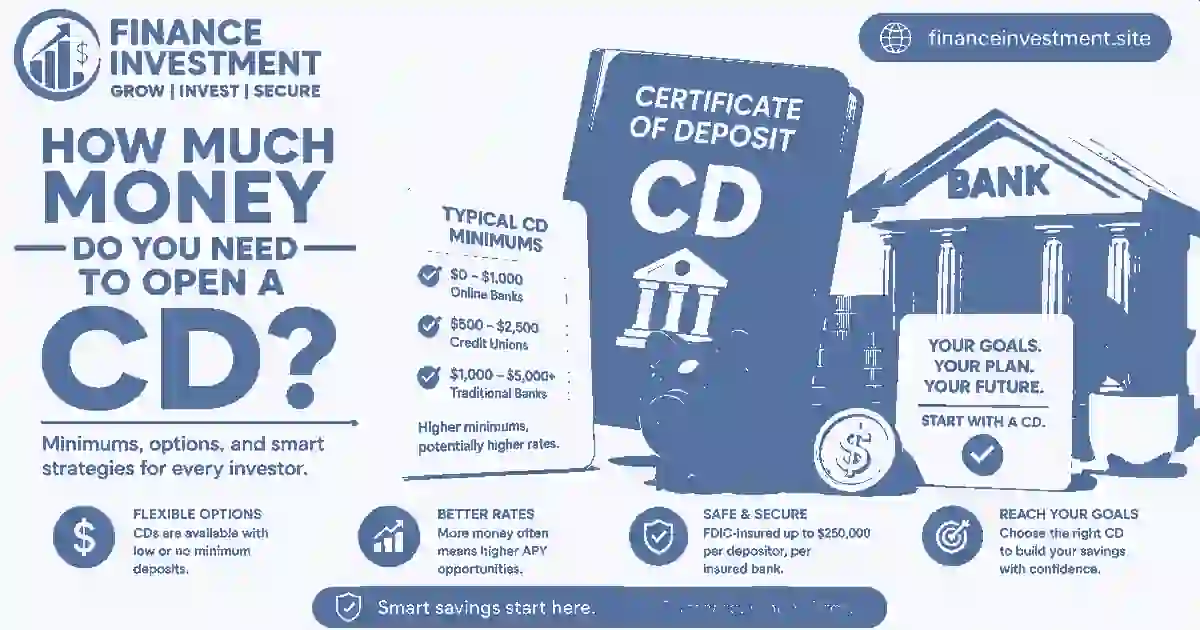
    How much money do you need to open a CD? Learn about CD minimum deposits, no-minimum CDs, opening requirements, and how to choose the right amount.
    how-much-money-do-you-need-to-open-a-cd
    How Much Money Do You Need to Open a CD
    minimum CD deposit,
    CD minimum deposit,
    how much to open a CD,
    CD opening requirements,
    minimum amount for a CD,
    CD deposit requirements,
    no-minimum CD,
    high-minimum CD,
    CD minimum balance,
    certificate of deposit minimum
    https://financeinvestment.site/how-much-money-do-you-need-to-open-a-cd/
    Subhash Rukade
    August 23, 2026
    About 10–12 minutes

    How Much Money Do You Need to Open a CD?

    How Much Money Do You Need to Open a CD?How much money do you need to open a CD? There is no single minimum that applies to every bank or credit union in the U.S. One CD might let you start with $0 or a very small amount, while another may ask for $500, $1,000, $2,500, or more. The amount depends on the financial institution, CD product, and sometimes the rate tier.

    That creates an important distinction: the minimum opening deposit is not necessarily the amount you should invest. A CD could accept $500, but that does not mean putting your entire emergency fund into it is a good idea. Your deposit should fit the goal, time frame, and cash you can comfortably leave untouched.

    APY matters, too, but it should not make the decision by itself. A slightly higher rate may come with a larger minimum deposit, longer term, or less flexibility. Meanwhile, a CD with a lower minimum could give you more room to build savings gradually.

    If you want the bigger picture before choosing a deposit amount, explore our CD Guide 2026.

    What You’ll Learn

    • How CD minimum deposits vary between institutions
    • What $0, $500, $1,000, and $2,500 minimums can mean
    • How to choose a deposit that fits your goal
    • Why liquidity matters before funding a CD
    • How minimum deposits can affect your CD choices

    Quick Answer: How Much Do You Need to Open a CD?

    There is no universal CD minimum. Depending on the institution and product, you may find CDs with no minimum opening deposit, while others require $500, $1,000, $2,500, or more. Always check the specific CD’s terms before transferring money.

    6 Key Takeaways

    1. Minimums vary: Banks and credit unions set their own opening requirements.
    2. No-minimum CDs exist: Some products let you start with a very small amount.
    3. $500 to $1,000 is common territory: Many mainstream CD products use a defined minimum, although requirements differ.
    4. Higher deposits can unlock different rates: Some institutions offer rate tiers based on how much you deposit.
    5. Don’t drain your cash to meet a minimum: Money needed for emergencies or near-term bills generally belongs somewhere accessible.
    6. APY isn’t the whole decision: Compare the minimum deposit, term, withdrawal rules, and potential earnings together.

    Bottom line: You may be able to open a CD with very little money, but the best starting amount is the one that meets the product’s minimum without putting your everyday financial cushion at risk.

    CD Minimum Deposits at a Glance

    The amount needed to open a CD can range from very little to several thousand dollars. What matters is not just the entry point, but whether the deposit level fits the CD’s rate, term, and your savings goal.

    Opening AmountPotential UseWhat to Watch
    $0–$500Good starting range for smaller savers or people testing a CD strategy.Check whether the rate is competitive and whether there are balance requirements.
    $1,000A practical starting point for a dedicated savings goal.Compare the interest earned with CDs requiring smaller or larger deposits.
    $2,500+Useful for larger goal-based savings when the money can remain locked.A higher minimum does not automatically mean a better APY.

    For perspective, a $500 CD earning 4% would generate far less interest in dollars than a $2,500 CD at the same rate. The difference comes from the principal, not a special tax or bonus. Actual earnings depend on the APY, term, compounding, and product rules.

    Complete Beginner Guide to CD Minimum Deposits
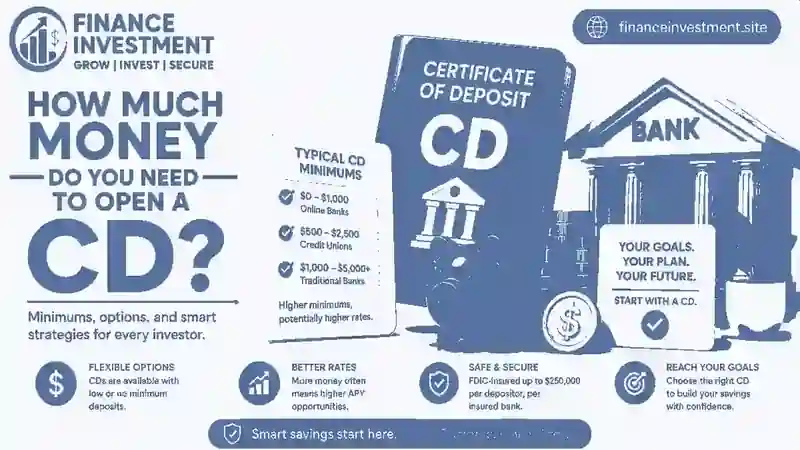
    How Much Money Do You Need to Open a CDA CD minimum deposit is simply the amount a financial institution requires you to place into that specific certificate when you open it. It is a product rule, not a universal industry standard. Two CDs offered by different institutions can have completely different entry requirements.

    Why Do CD Minimums Differ?

    Banks and credit unions design CDs for different types of savers. An online bank may offer a low-minimum CD to attract smaller deposits, while another institution may set a higher threshold for a particular rate or term. Credit unions can also have their own deposit requirements, along with membership rules.

    No-Minimum CDs

    Some CDs have no stated minimum deposit or allow a very small opening amount. That can be useful if you are building savings gradually. However, no minimum does not automatically mean the product offers the best rate, flexibility, or overall value.

    Minimum Deposit vs. Balance Requirement

    Do not confuse the amount needed to open a CD with a later balance requirement. A CD might require $1,000 to open but not impose a separate ongoing minimum because the certificate is designed to remain invested until maturity. Always read the product’s terms instead of assuming every savings-account rule applies to CDs.

    Rate Tiers and Promotional CDs

    Some institutions use balance tiers. For example, one APY may apply at $1,000 while a different rate is available at a higher deposit level. Promotional CDs may also have special minimums or eligibility requirements. A higher deposit should only be used if the extra return justifies tying up more cash.

    Banks, Credit Unions and Brokered CDs

    Traditional and online banks can have different minimums, while credit unions may combine CD requirements with membership eligibility. Brokered CDs work differently because they are purchased through a brokerage rather than directly from the issuing bank. Minimum purchase amounts can vary by offering.

    Before funding any CD, check the minimum deposit, APY, term, early-withdrawal rules, maturity instructions, insurance status, and whether the quoted rate applies to your entire deposit. That short checklist can prevent an attractive-looking CD from becoming the wrong fit.

    How Opening a CD Works From Start to Finish

    Once you have found a CD that fits your goal, the opening process is usually straightforward. The important part is confirming exactly what you are agreeing to before the money leaves your checking or savings account.

    1. Choose the CD and Confirm the Terms

    Start with the term, APY, opening deposit, and withdrawal rules. Check whether the advertised rate applies to the amount you plan to deposit. Also confirm whether the CD automatically renews when it reaches maturity.

    2. Open and Fund the Certificate

    After completing the application, you typically transfer or deposit the required amount. Once the CD is funded, the institution records the principal, APY, term, and maturity date. Keep the confirmation because these details are useful when you later compare the maturity offer.

    3. Let the CD Run Until Maturity

    Your deposit remains in the certificate according to its terms while interest accrues under the stated rate. Depositing more than the minimum generally means you have more principal earning interest. It does not necessarily mean the institution will give you a higher APY unless a separate rate tier applies.

    4. Decide What Happens at Maturity

    When the CD matures, you may be able to withdraw the principal and interest, move the money elsewhere, or renew the certificate. Some institutions provide a grace period for making that choice. If you take no action, automatic renewal may occur.

    Illustrative Example

    Imagine a CD requires $1,000 to open. You decide to deposit $3,000 because the money is earmarked for a future expense. If the CD’s APY applies to the full balance, all $3,000 can earn interest according to the product terms. The larger deposit increases potential earnings, but it also means more cash is committed until maturity.

    Benefits & Drawbacks of Different CD Minimums

    The amount required to open a CD can shape who can use the product and how much flexibility remains after the account is funded. A low minimum can make CDs easier to access, while a larger deposit may make sense for a clearly defined savings goal.

    ✓ Pros

    • Lower entry point: A small minimum can help new savers start without waiting years to build a large balance.
    • More choice: No-minimum or low-minimum CDs can open up products that may otherwise be out of reach.
    • More interest with more principal: When the APY is the same, a larger deposit generally produces more interest in dollar terms.
    • Potential rate tiers: Some products offer different APYs at higher deposit levels.

    △ Cons

    • More money gets locked away: Funding a CD with a large balance can leave less cash immediately available.
    • A higher minimum isn’t automatically better: A $2,500 minimum does not guarantee a superior APY.
    • Rate tiers can be misleading: A higher APY may require more money than you actually want to commit.
    • Small balances earn less: A low minimum makes opening easier, but the dollar return may remain modest.

    The sweet spot is usually the amount you can commit comfortably without sacrificing money needed for emergencies or upcoming expenses. A CD should serve the savings goal—not force the savings goal to fit the CD.

    CD Minimum Deposit Comparison

    The minimum deposit is only one piece of the decision. A CD with a lower entry point may be easier to access, while a larger certificate can generate more interest. The better comparison looks at the deposit requirement alongside APY, term, access, and the institution behind the product.

    CD TypeTypical Entry PointWhat to Compare
    No-minimum CDVery low or no stated minimumAPY, term, account requirements, and whether the low entry point comes with trade-offs.
    $500 CD$500Useful for smaller goal-based balances; compare earnings with lower-minimum alternatives.
    $1,000 CD$1,000A common benchmark for comparing rates, terms, and potential interest.
    $2,500+ CD$2,500 or moreCheck whether a higher balance actually earns a better APY.
    Brokered CDVaries by offeringIssuing bank, minimum purchase, maturity, liquidity, and brokerage terms.

    Online banks often compete with attractive rates and lower overhead, while traditional banks may emphasize branch access. Credit unions can offer competitive certificates but may have membership requirements. Brokered CDs add another layer because you purchase through a brokerage rather than directly from the issuing institution.

    If you are comparing the amount you can earn after choosing a deposit, see our guides to 1-year CD rates and 5-year CD rates for term-specific research.

    Costs, Risks & Expert Tips Before Funding a CD

    A CD’s minimum deposit can look harmless until it forces you to move money that had another job. The real cost of meeting a higher minimum is sometimes the flexibility you give up elsewhere.

    Watch the Opportunity Cost

    Suppose a CD requires $2,500 while another suitable option accepts $500. Putting the extra $2,000 into the first CD may produce more interest, but that money is no longer sitting in an easily accessible account. If you need it unexpectedly, an early withdrawal could reduce your return.

    Don’t Use Your Emergency Cushion to Reach a Minimum

    A CD is generally better suited to money with a known purpose and time horizon. Keep enough readily available cash for emergencies, upcoming bills, and expenses that cannot wait until maturity.

    Check Whether the Higher APY Is Worth the Extra Deposit

    A rate tier can make a larger deposit attractive, but calculate the actual dollar difference. A small APY improvement may not justify committing substantially more money. Compare the expected interest, term, and access rules together.

    Pay Extra Attention to Brokered CDs

    With a brokered CD, verify the actual issuing bank, maturity date, purchase amount, and how the investment can be sold before maturity. The brokerage platform is not necessarily the institution providing the deposit insurance.

    Verify the Institution Before You Fund It

    For a bank CD, confirm that the institution is FDIC-insured. For a credit-union certificate, check whether the credit union is federally insured through the NCUA. Also review the coverage structure if you already hold other deposits at the same institution.

    Premium Expert Tip

    Choose your deposit amount backward from your financial goal. First decide how much cash you can safely leave untouched. Then compare CDs that accept that amount. Don’t increase your deposit simply to qualify for a slightly better APY.

    Common CD Opening Mistakes + Real-Life Example

    The amount you need to open a CD is easy to find on an account page. The harder part is deciding whether that minimum fits your financial situation. A few common mistakes can turn a simple savings decision into an unnecessary constraint.

    Mistakes to Avoid

    • Assuming every CD has the same minimum: Requirements can vary by institution, term, and product.
    • Chasing the highest APY: A higher rate may require more money or a longer commitment.
    • Using emergency cash: Money you may need immediately should not be committed simply to satisfy a CD minimum.
    • Overfunding for a rate tier: Don’t move thousands of extra dollars just to qualify for a slightly better APY without checking the actual benefit.
    • Ignoring insurance status: Confirm whether the institution providing the CD is FDIC-insured or, for an eligible credit union, federally insured through the NCUA.
    • Missing brokered-CD details: If you buy through a brokerage, identify the actual issuing bank and understand the maturity and liquidity terms.

    Real-Life Example: Kevin Has $4,000 to Save

    Kevin has $4,000 set aside for a car purchase next year. He finds a CD requiring $2,500 with a slightly higher APY than another CD requiring $500. He considers putting the entire $4,000 into the higher-rate option.

    Illustrative calculation only: If the higher-rate CD earns an extra 0.25 percentage point on $4,000 for one year, the simple difference is about $10 before taxes. That modest gain may not justify giving up flexibility for money tied to a known near-term expense.

    Kevin instead considers how much he can safely commit and keeps the rest accessible. His decision is based on the job of the money, not just the largest APY on the screen.

    Practical lesson: A CD minimum is a gate, not a target. Meet the requirement with money that genuinely fits the CD’s time frame, and let the purpose of your savings guide the amount you deposit.

    Who Should Choose a CD Based on Their Available Cash?

    The right CD deposit depends less on a magic number and more on what the money is supposed to do. A modest balance can still have a useful role when the goal and maturity date are clear.

    Small Savers and Goal-Based Savers

    If you have $500 to $1,000 set aside for a future expense, a low-minimum CD can be a practical way to separate that money from everyday spending. It can work well for a planned purchase, tuition payment, holiday expenses, or another goal with a known time frame.

    Larger Balances, Families and Retirees

    People with larger cash reserves may use CDs to divide money across different maturity dates instead of committing everything at once. Families and retirees can use this approach for predictable future expenses while keeping other cash available for unexpected needs.

    When Flexible Savings May Be Better

    If you do not have a separate emergency reserve, a CD may not be the best place for money you could need tomorrow. The same is true for cash needed for rent, medical expenses, debt payments, or other near-term obligations.

    Quick Decision Guide

    Need the money soon? Keep it flexible. Have a separate emergency fund? A CD may fit. Have a larger balance? Consider spreading maturity dates rather than locking everything into one certificate.

    Frequently Asked Questions About Opening a CD

    What is the minimum amount to open a CD?

    There is no universal minimum. Some CDs have no stated minimum, while others may require $500, $1,000, $2,500, or more. Check the specific product terms before opening.

    Can you open a CD with $100?

    Yes, if the institution offers a CD with a $100-or-lower opening requirement. Minimums vary, so compare the product terms rather than assuming every CD accepts the same amount.

    Are there no-minimum CDs?

    Yes. Some institutions offer CDs without a stated minimum deposit. These can be useful for smaller savers, although a no-minimum CD is not automatically the highest-paying option.

    Is $500 enough to open a CD?

    It can be. If the CD’s required opening deposit is $500 or less, that amount may be enough. The APY, term, and withdrawal rules still matter.

    Is $1,000 enough to open a CD?

    For a CD requiring $1,000 or less, yes. A $1,000 deposit can also provide a useful starting point for a specific savings goal.

    Do banks and credit unions have different CD minimums?

    They can. Each institution sets its own product requirements. Credit unions may also have membership eligibility rules in addition to the certificate’s deposit requirement.

    Do higher deposits earn higher APYs?

    Sometimes. Certain CDs use balance tiers, but a larger deposit does not automatically qualify for a higher rate. Check the rate schedule for the specific certificate.

    Can you add money after opening a CD?

    Usually, a standard CD does not work like a savings account where you can freely add money throughout the term. Some specialized products may allow additional deposits, so read the account terms first.

    What are typical brokered CD minimums?

    Brokered CD purchase requirements vary by brokerage and offering. Check the minimum purchase amount, issuing bank, maturity date, and transaction terms before buying.

    Illustrative: How much can a $1,000 CD earn?

    Illustrative calculation only: A $1,000 CD earning a hypothetical 4% APY for one year would generate about $40 in interest before taxes. Actual earnings depend on the APY, term, compounding method, and CD terms.

    Final Verdict: How Much Money Should You Put Into a CD?

    There is no single amount you need to open a CD. The institution and specific certificate determine the minimum. Some products may accept a small deposit, while others require $500, $1,000, $2,500, or more.

    But the minimum is only the starting line. The amount you can deposit and the amount you should deposit are two different questions. If $500 or $1,000 meets the CD’s requirement and the money has a clear purpose and time frame, either amount can be a sensible starting point.

    Don’t stretch your budget just to qualify for a higher APY. Money needed for emergencies, bills, or near-term expenses should remain accessible. A slightly better rate is rarely worth creating a cash shortage.

    Before choosing a certificate, compare the minimum, APY, term, early-withdrawal rules, insurance status, and maturity options. Our CD Guide 2026 can help you put those pieces together.

    Practical takeaway: Start with the amount your financial plan can comfortably commit—not the largest deposit a CD will accept.

    FINANCEINVESTMENT

    Keep Building Your CD Strategy

    Want more practical guidance on CDs, rates, savings, and everyday investing? Send a note to join the FinanceInvestment newsletter and get useful money ideas without the noise.

    📧 subhashr325@gmail.com

    A thoughtful CD choice starts with the amount you can comfortably commit, not simply the largest balance a bank will accept.

  • Best 1-Year CD Rates in 2026: Compare Top 12-Month CDs

    Best 1-Year CD Rates in 2026: Compare Top 12-Month CDs

    Best 1-Year CD Rates in 2026


    Written by Subhash Rukade

    FinanceInvestment • Updated August 21, 2026 • About 13 min read
    SEO Title: Best 1-Year CD Rates in 2026: Compare Top 12-Month CDs
    Meta Description: Compare the best 1-year CD rates in 2026, including APY, minimum deposits, maturity dates, early-withdrawal penalties and practical savings strategies.
    Focus Keyword: Best 1-Year CD Rates in 2026
    Slug: best-1-year-cd-rates-in-2026
    Canonical: https://financeinvestment.site/best-1-year-cd-rates-in-2026/
    Featured Image ALT: Best 1-Year CD Rates in 2026

    Why a 1-Year CD Deserves a Closer Look in August 2026

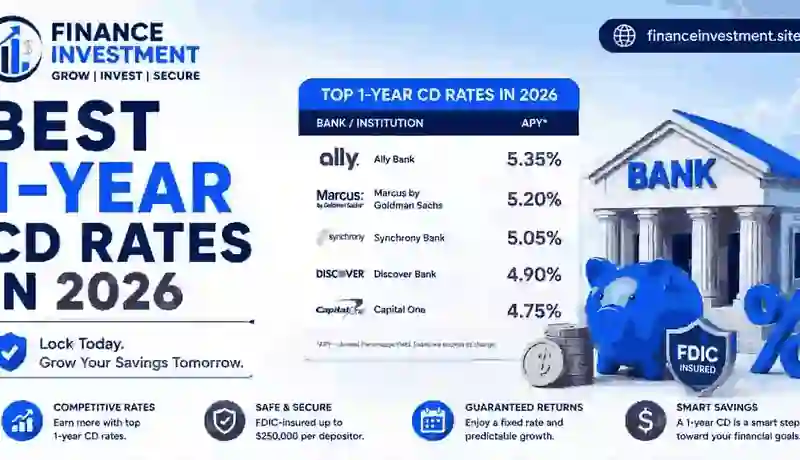
    Best 1-Year CD Rates in 2026The Best 1-Year CD Rates in 2026 are worth comparing carefully this August. Competitive offers are still well above the national average, with Bankrate listing a leading 1-year CD at 4.30% APY on August 20, while other published lists show similarly strong offers.

    The bigger question isn’t simply which bank posts the highest number. A 12-month commitment affects when you can access your money, what happens at maturity, and how much flexibility you have if rates change.

    Our
    Complete CD Guide for 2026

    covers the broader picture. This guide narrows the focus to one-year CDs and the decisions that matter most.

    What You’ll Learn

    You’ll learn how to compare 1-year CD APYs, minimum deposits, penalties, maturity rules and real-dollar earnings before deciding where your cash belongs.

    Quick answer: The Best 1-Year CD Rates in 2026 can work well when you want a fixed return and know you won’t need the money for about 12 months. As of August 20, competitive one-year offers are around 4.30% APY, although rates and eligibility vary. 0

    • Compare APY with the actual deposit requirement.
    • Check the early-withdrawal penalty before opening.
    • A lower APY can sometimes produce more total interest over a longer term.
    • Check whether the CD automatically renews at maturity.
    • Keep emergency money outside the CD.
    • Confirm FDIC or NCUA coverage before depositing.
    Bottom line: Don’t chase the biggest APY alone. Match the term, rate and access rules to your actual one-year goal.

    1-Year CD Rates at a Glance

    The Best 1-Year CD Rates in 2026 can offer a useful balance between a fixed return and a manageable one-year commitment. As of August 20, 2026, Bankrate reported a 2.03% national average for one-year CDs, while top offers were considerably higher.

    Best for: Money you can leave untouched for about 12 months.

    Key numbers: APY, minimum deposit, maturity date and withdrawal penalty.

    August 2026 SnapshotWhat It Means
    1-year national average: 2.03% APYTop offers can be much higher
    Term: 12 monthsLonger lock than a 6-month CD
    Compare APY + deposit + penaltyThe headline rate isn’t the whole deal

    How to Shop for a 1-Year CD as a Beginner

    Best 1-Year CD Rates in 2026When comparing the Best 1-Year CD Rates in 2026, start with the APY, then look beyond the headline number. On August 20, 2026, leading CD offers were still above 4%, while one-year rates varied by institution, deposit size and eligibility.


    APY Is Only the Starting Point

    APY lets you compare yields on the same annual basis. For example, $10,000 earning a hypothetical 4.30% APY for one year would produce about $430 before taxes, assuming the stated APY applies throughout the term. A higher rate is useful only if the account’s other conditions work for you.

    Check the Deposit and Maturity Rules

    A $500 minimum and a $5,000 minimum can make two seemingly similar offers very different for smaller savers. Also check the exact maturity date, interest payout method and renewal policy. FDIC guidance says banks must disclose early-withdrawal penalties and whether a time account renews automatically.

    A simple shopping test:

    Write down the APY, minimum deposit, estimated interest, maturity date and early-withdrawal penalty for each finalist. Then compare the complete package rather than choosing from the biggest rate alone.

    For the rate mechanics, see our

    guide to CD interest rates
    .
    You can also review

    how much a CD can earn

    before deciding how much cash to commit.

    How 1-Year CDs Work

    A one-year CD is a time deposit with a fixed maturity period. When you open one, you agree to leave the money deposited for the stated term in exchange for the disclosed APY. In August 2026, the highest reported one-year CD rate was about 4.33%, while the average was much lower, showing why shopping around matters.

    APY & Compounding

    APY expresses the annualized yield and accounts for compounding. The actual interest credited depends on the bank’s terms.

    12-Month Term

    Your deposit generally stays in the account until the maturity date unless the bank permits an early withdrawal under its stated rules.

    Maturity & Renewal

    At maturity, you can usually take the money out or renew the CD according to the institution’s disclosure and grace-period rules.

    For a simple August 2026 example, suppose you place $10,000 into a one-year CD at a hypothetical 4.30% APY. If the stated APY applies for the full term, the account would earn roughly $430 before taxes. That is an illustration, not a guaranteed payout; the bank’s actual compounding and interest-crediting terms control the result.

    The Best 1-Year CD Rates in 2026 can therefore look similar on a comparison page while producing different experiences because of minimum deposits, renewal policies and withdrawal penalties. Before opening an account, review the maturity and early-withdrawal terms carefully. You can also read our

    guide to how CDs work

    and

    CD interest-rate guide
    .

    Benefits and Drawbacks of a 1-Year CD

    A one-year CD sits in an interesting spot in August 2026. Competitive 1-year offers are around 4.30% APY, while shorter CDs can sometimes offer different yields. That makes the extra six months of commitment worth considering rather than assuming a longer term is automatically better.

    ✓ Pros

    • Locks a fixed yield for about 12 months.
    • Can provide more total interest than a shorter term.
    • Useful for money tied to a known future goal.
    • Creates a clear date for your next savings decision.

    ✕ Cons

    • Your money is less accessible before maturity.
    • Early withdrawal may reduce your earnings.
    • Rates could be more attractive elsewhere before maturity.
    • A high APY may come with a larger minimum deposit.
    The practical test:

    If you have a known 12-month goal and enough separate cash for emergencies, locking part of your savings can make sense. If you may need the money sooner, a high-yield savings account can offer more flexibility. Current top savings offers can also be competitive, so compare both before committing.

    1-Year CD Rate Comparison for August 2026

    The Best 1-Year CD Rates in 2026 are easier to judge when you compare the entire offer. On August 20, Bankrate reported a 2.03% national average for one-year CDs, while individual banks and credit unions were offering considerably more. ([bankrate.com](https://www.bankrate.com/banking/cds/current-cd-interest-rates/))

    TermIllustrative APY*Minimum DepositRate TypePractical Use
    12 monthsUp to about 4%+ on competitive offersVariesUsually fixedPlanned 1-year goals
    6 monthsCompare current offersVariesUsually fixedEarlier access
    18 monthsCompare separatelyVariesUsually fixedLonger-term cash

    *APYs are illustrative market ranges, not guaranteed offers. Rates and minimum deposits can change by institution and eligibility.

    For a broader list, see our

    Best CD Rates in 2026

    guide before choosing a specific account.

    Costs, Taxes, Risks & Expert Tips

    A strong APY doesn’t tell the whole story. With a one-year CD, consider the tax on interest, the cost of accessing your money early and what you might give up if better opportunities appear during the term. The FDIC notes that CD withdrawals before maturity can be subject to an early-withdrawal penalty.

    Expert Tip

    Suppose you put $25,000 into a CD at a hypothetical 4.30% APY. If that APY applies for the full year, the interest would be about $1,075 before taxes. Compare that after-tax result with what you could earn while keeping the money accessible.

    ⚠️ Warning Before You Lock In

    Bank CD interest is generally taxable interest income. Keep your year-end tax documents and account statements. If you withdraw early, check the bank’s exact penalty before acting; the penalty can reduce the return you expected. IRS guidance covers interest income reporting, while the account agreement controls the CD’s withdrawal terms.

    Common 1-Year CD Mistakes + A Real-Life Example

    One mistake is choosing a CD because its APY looks impressive without checking the minimum deposit, maturity date or withdrawal penalty. Another is putting all available cash into one term. In August 2026, competitive CD yields remain well above many national averages, making careful comparison especially important.

    Real-Life Example: David Has $30,000

    David has $30,000 that he expects to leave untouched for a year. He finds a 1-year CD advertising 4.30% APY, but the account requires a larger deposit than another option offering 4.15%. Instead of chasing the extra rate, he checks the penalty and maturity terms first. At 4.30% APY, $30,000 could earn about $1,290 before taxes over one year if the stated APY applies throughout.

    Practical Lesson

    The Best 1-Year CD Rates in 2026 should be judged as complete offers. Compare APY, minimum deposit, penalty and maturity date together. FDIC guidance also requires institutions to disclose applicable early-withdrawal penalties and renewal terms.

    Who Should Choose a 1-Year CD?

    Premium Best Fit

    The Best 1-Year CD Rates in 2026 may suit savers who have a clear 12-month timeline and don’t expect to touch the money before maturity. Current August offers remain competitive, with some one-year CDs around 4.30%–4.35% APY.

    • Goal-based savers: money earmarked for a known expense.
    • Retirees: surplus cash that doesn’t need immediate access.
    • Families: planned expenses roughly a year away.
    • Rate-sensitive savers: people willing to shop for a better fixed yield.
    • Surplus-cash holders: funds sitting idle in lower-yield accounts.

    Keep emergency savings separate. If liquidity is uncertain, a high-yield savings account may be a better fit because you retain easier access to the cash.

    Frequently Asked Questions About 1-Year CDs

    1. What are the best 1-year CD rates in August 2026?

    Competitive CD offers remain above 4% in August 2026, although the highest rate depends on the exact term, institution, deposit and eligibility. Current published comparisons show meaningful differences between banks.

    2. What APY should I look for?

    Compare the APY with the minimum deposit, penalty and maturity terms. A slightly lower yield can be worthwhile if the account has better conditions for your situation.

    3. How much money is needed to open a 1-year CD?

    Minimums vary by institution. Some accounts require only a few hundred dollars, while others require substantially more. Always check the current account disclosure.

    4. Can CD rates change after I open the account?

    A typical fixed-rate CD keeps its agreed rate through maturity. Rates offered on new CDs can change as market conditions and bank funding needs change.

    5. What happens when a 1-year CD matures?

    You generally receive the principal and interest according to the account terms. Some CDs automatically renew, so check the maturity notice and grace period before the deadline.

    6. Is interest from a CD taxable?

    Generally, yes. The IRS treats interest from certificates of deposit as taxable interest income, subject to the applicable tax rules.

    7. What happens if I withdraw money early?

    The institution may charge an early-withdrawal penalty. The amount depends on the account agreement, so review it before committing money you may need soon.

    8. Are 1-year CDs FDIC insured?

    A CD at an FDIC-insured bank is generally covered as an insured deposit, subject to applicable coverage limits and ownership rules. Confirm the institution’s insurance status before depositing.

    9. Are the best 1-year CD rates likely to change?

    Yes. Banks can change rates for new accounts. Current August data shows top CD yields still vary considerably by term and institution, so today’s leading offer may not remain available later.

    Bottom line:
    The Best 1-Year CD Rates in 2026 should be compared using APY, deposit requirements, maturity rules, penalties and insurance—not the headline rate alone.

    Final Verdict: Is a 1-Year CD Right for You?

    In August 2026, the Best 1-Year CD Rates in 2026 remain attractive for savers who value a predictable return and can leave their money untouched for 12 months. But a strong APY should never be the only reason to open an account.

    Choose, Compare, or Wait

    • Choose if your 12-month goal is clear and liquidity is not a concern.
    • Compare if another bank offers a better combination of APY, minimum deposit and penalty.
    • Wait if you may need the cash or want to keep flexibility for changing rates.

    For a broader look at CD strategies, visit our

    Complete CD Guide for 2026
    .
    The right account is the one that fits your timeline, cash needs and comfort with locking up money—not simply the highest number on a rate table.

    Related Resources

    Before opening a CD, these guides can help you compare rates, understand earnings and review the rules that matter.

    Official sources:
    Check the

    FDIC

    for deposit-insurance rules, the

    Federal Reserve

    for monetary-policy information, and the

    IRS

    for interest-income tax guidance.

    Make Your Next CD Decision With Confidence

    Get practical money guides by email, then explore our CD resources whenever you’re ready to compare rates, terms and savings strategies.

    Email:

    subhashr325@gmail.com

  • Best 6-Month CD Rates in 2026: Compare Top Short-Term CDs

    Best 6-Month CD Rates in 2026: Compare Top Short-Term CDs

    Best 6-Month CD Rates in 2026


    Written by Subhash Rukade

    FinanceInvestment • Updated August 21, 2026 • About 12 min read

    SEO Title: Best 6-Month CD Rates in 2026: Compare Top Short-Term CDs
    Meta Description: Compare the best 6-month CD rates in 2026, including APY, minimum deposits, early-withdrawal penalties, maturity rules and short-term savings alternatives.
    Focus Keyword: Best 6-Month CD Rates in 2026
    Slug: best-6-month-cd-rates-in-2026
    Canonical: https://financeinvestment.site/best-6-month-cd-rates-in-2026/
    Featured Image ALT: Best 6-Month CD Rates in 2026

    Why a 6-Month CD Can Be a Useful Middle Ground

    Best 6-Month CD Rates in 2026If you’re comparing the Best 6-Month CD Rates in 2026, August 2026 is an interesting point for short-term savers. Competitive CD offers remain attractive, but the headline APY is only one part of the decision. Your cash timeline, minimum deposit, withdrawal penalty, and what happens when the CD matures can matter just as much.

    A six-month term can suit someone who wants a fixed return without committing cash for a full year. It can also create a useful checkpoint if you expect your savings needs or available rates to change.

    What You’ll Learn

    You’ll learn how six-month CDs work, how to compare APYs, where penalties matter, when a shorter term may fit, and how to think about the money you will need when the CD matures.

    For the broader picture, see our

    Complete CD Guide for 2026
    .

    Quick answer: The Best 6-Month CD Rates in 2026 can be useful when you want a fixed return but don’t want to commit your cash for a full year. Compare the APY with your actual six-month goal before opening an account.

    • Compare APY, not just the advertised rate.
    • Check the minimum opening deposit.
    • Read the early-withdrawal penalty first.
    • Check whether the CD automatically renews.
    • Keep emergency cash outside the CD.
    • Compare six months with shorter and longer terms.
    Bottom line: A strong six-month APY matters, but the best choice is the one that matches when you need the money.

    6-Month CD Rates at a Glance

    The Best 6-Month CD Rates in 2026 can be attractive for savers who want a fixed return without a long commitment. As of August 2026, published market data showed a leading 6-month offer around 4.50% APY, although rates, terms and eligibility can change.

    Best for: Short-term goals, planned expenses and money you can leave untouched for six months.

    Key numbers: APY, deposit minimum, maturity date and early-withdrawal penalty.

    August 2026 SnapshotPractical Meaning
    6-month leader: about 4.50% APYCompetitive short-term yield
    Term: 6 monthsEarlier access than a 12-month CD
    Compare: APY + minimum + penaltyHeadline rate isn’t the whole deal

    How to Compare a 6-Month CD as a Beginner

    Best 6-Month CD Rates in 2026When shopping for the Best 6-Month CD Rates in 2026, don’t stop at the biggest APY on the screen. As of August 20, 2026, some published six-month offers were near 4.9%, while many competitive CDs were around 4% or higher. The exact offer can depend on the institution, membership rules, deposit size and eligibility.

    Start With the APY

    APY makes it easier to compare deposits because it reflects the annualized yield and compounding. But a six-month CD does not pay a full year’s worth of interest simply because its APY is quoted annually. For example, $10,000 at a hypothetical 4.50% APY would earn roughly $222 over six months before taxes, assuming the stated APY and compounding structure remain applicable.

    Then Check the Fine Print

    Look at the minimum deposit, maturity date, interest payout method and early-withdrawal penalty. FDIC guidance says account disclosures should explain the maturity date, penalty terms, compounding details and whether the CD renews automatically.

    A useful comparison:

    Put the APY, minimum deposit, estimated six-month earnings and penalty side by side. A slightly lower APY can be more useful if it has a smaller deposit requirement or better withdrawal terms.

    For the rate mechanics, read our

    guide to CD interest rates
    .
    For the broader product basics, see

    what a certificate of deposit is
    .

    How 6-Month CDs Work

    A six-month CD gives your deposit a fixed term and, with a fixed-rate CD, locks the agreed APY until maturity. In August 2026, six-month yields remain competitive: one current market snapshot lists a top six-month APY of 4.94%, although offers vary by bank, deposit size and eligibility.

    APY

    Shows the annualized yield, including compounding.

    Six-Month Term

    Your money generally stays in the CD until the maturity date.

    Maturity

    You can usually withdraw, renew or move the money during the bank’s stated grace period.

    For example, imagine opening a six-month CD in August 2026 at a hypothetical 4.50% APY. The APY is an annualized figure, so six months of earnings won’t equal 4.50% of your deposit. Your actual interest depends on the bank’s compounding and payout method. At maturity, check the renewal terms rather than letting the account roll over by accident. FDIC guidance recommends reviewing the CD’s disclosures, including maturity and withdrawal provisions.

    Learn more in our

    guide to how CDs work

    and our

    explanation of CD interest rates
    .

    Benefits and Drawbacks of 6-Month CDs

    The appeal of a six-month CD is simple: you can secure a fixed yield without tying up your money for years. In August 2026, short-term CDs remain among the more competitive terms, with some six-month offers around 4% or higher.

    ✓ Pros

    • Locks a fixed rate for the term.
    • Shorter commitment than a one-year CD.
    • Useful for money with a known near-term goal.
    • Can provide a clear maturity date for the next decision.

    ✕ Cons

    • Money is less accessible before maturity.
    • Early withdrawal can trigger a penalty.
    • Rates may be higher when the CD matures—or lower.
    • A higher APY elsewhere may require a larger deposit.
    Best use:

    A six-month CD can fit planned cash you won’t need immediately, but it shouldn’t replace an emergency fund or money you may need tomorrow.

    6-Month CD Rate Comparison for August 2026

    When comparing the Best 6-Month CD Rates in 2026, look at more than the APY. Current August data shows six-month offers reaching roughly 4.94% APY, while other competitive offers sit lower depending on the institution and eligibility.

    TermIllustrative APY*Minimum DepositRate TypePractical Use
    6 monthsUp to ~4.94%Varies by bankUsually fixedShort-term goals
    3 monthsOften lowerVariesUsually fixedVery near-term cash
    12 monthsCompare separatelyVariesUsually fixedLonger commitment

    *APYs are illustrative market figures, not guaranteed offers. Verify the current rate, minimum deposit and account terms directly before opening.

    Costs, Taxes, Risks & Expert Tips

    A six-month CD can look attractive at first glance, but the real return depends on taxes, withdrawal rules and the amount you actually deposit. In August 2026, leading CD yields remained competitive, with some published rates above 4%.

    Expert Tip

    Imagine depositing $20,000 at a hypothetical 4.50% APY. Six-month interest would be roughly $445 before taxes, depending on the bank’s compounding method. Compare that after-tax result with the return and access offered by a savings account.

    ⚠️ Warning Before Opening

    CD interest is generally taxable income under federal rules. If you withdraw early, the bank may impose a penalty, and the IRS has specific reporting rules for the interest and penalty. Check the account disclosure before committing your cash.

    Common 6-Month CD Mistakes + A Real-Life Example

    One common mistake is chasing the highest APY without checking the deposit requirement or early-withdrawal rules. Another is assuming every six-month offer is equally competitive. On August 20, 2026, published CD data showed rates as high as 4.94% across available terms, while recent six-month offers have varied by institution.

    Real-Life Example: Maria Has $18,000

    Maria expects to use $18,000 for a vehicle purchase in about eight months. She finds a six-month CD advertising 4.50% APY, but another account offers 4.25% with easier access. She chooses the six-month CD only for the portion she knows she won’t need before maturity and keeps the rest liquid for the purchase.

    Practical Lesson

    • Don’t compare APY alone.
    • Match the maturity date to your cash goal.
    • Check the penalty before depositing.
    • Don’t lock money needed for emergencies.

    Who Should Choose a 6-Month CD?

    A six-month CD can suit savers who have a clear reason for keeping their money untouched for half a year. Current August 2026 data shows six-month yields remain competitive, with some offers reaching 4.94% APY.

    Premium Best Fit

    • Goal-based savers: You have a known expense in roughly six months.
    • Retirees: You want predictable interest on part of your cash.
    • Families: You are setting aside money for a planned expense.
    • Rate-sensitive savers: You value today’s fixed yield.
    • Surplus-cash holders: You can leave the deposit untouched.

    Frequently Asked Questions About 6-Month CDs

    1. What are the best 6-month CD rates in August 2026?

    Published rates vary by bank, credit union, deposit size and eligibility. Recent August data shows six-month offers around 4% to 5%, with some special offers reaching 5%. Always verify the rate before opening.

    2. What APY should I look for on a six-month CD?

    There is no single target APY that fits everyone. Compare the advertised yield with the minimum deposit, penalty, maturity terms and available savings alternatives.

    3. Is a six-month CD better than a savings account?

    A CD can provide a fixed rate, while a savings account usually offers easier access but a variable APY. The better choice depends on whether certainty or liquidity matters more.

    4. How much money do I need to open a six-month CD?

    Minimums vary widely. Some accounts require only a small opening deposit, while promotional or specialty CDs may require thousands of dollars. Check the bank’s current terms.

    5. What happens when a six-month CD matures?

    Depending on the bank, the CD may renew automatically unless you withdraw or change instructions during the stated grace period. Check the maturity notice before the deadline.

    6. Is CD interest taxable?

    Generally, yes. The IRS says most taxable interest is reported as income when it becomes available to you.

    7. What happens if I withdraw a CD early?

    The bank may charge an early-withdrawal penalty or reduce the interest you receive. The exact rule depends on the account agreement.

    8. Are six-month CDs FDIC insured?

    A CD at an FDIC-insured bank is generally an insured deposit, subject to applicable coverage limits and ownership rules. Confirm the institution’s insurance status before depositing money.

    9. Are the best 6-month CD rates likely to change?

    Yes. Banks and credit unions can change the rates offered on new CDs as market conditions and their funding needs change. Once you open a typical fixed-rate CD, its agreed rate generally remains fixed through the term.

    Bottom line:
    The best 6-month CD rates in 2026 should be judged by the complete deal—not APY alone. Check the deposit requirement, maturity date, withdrawal penalty and insurance before opening.

    Final Verdict: Is a 6-Month CD Worth It?

    In August 2026, the Best 6-Month CD Rates in 2026 can make sense for money you expect to leave untouched for roughly half a year. Some published offers are near 5% APY, but the highest headline rate isn’t automatically the best choice for every saver.

    Choose, Compare, or Wait

    • Choose: when the APY fits your goal and you won’t need the cash early.
    • Compare: when another bank may offer a better combination of APY, minimum deposit and penalty.
    • Wait: when your cash needs are uncertain or liquidity matters more than a fixed return.

    Before opening an account, use our

    Complete CD Guide for 2026

    to review CD terms, safety and strategies. The strongest choice is the one that fits your timeline—not simply the number printed beside the APY.

    Related Resources

    Want to compare your options more carefully? These guides cover CD rates, earnings, APY and the rules that can affect your choice.

    Official resources:
    Review the

    FDIC

    for deposit-insurance information,

    Federal Reserve

    materials for monetary-policy information, and

    IRS Topic 403

    for taxable-interest guidance.

    Ready to Compare Your Options?

    Keep your rate shopping simple. Get practical finance guides by email, then explore our CD resources when you’re ready to compare terms, APYs and account details.

    Email:

    subhashr325@gmail.com