Treasury Bills vs CDs
Treasury Bills vs CDs: What Should You Know?
 Treasury Bills vs CDs is a useful comparison when you have cash to put aside and want to earn a return without taking on the volatility of stocks. Both can serve short-term savings goals, but they work differently. A T-bill is a short-term U.S. Treasury security, while a CD is a time deposit offered by a bank or credit union.
The real difference shows up when you look past the advertised rate. The maturity date, access to your money, taxes, insurance, and what happens if your plans change can all affect the outcome. T-bills have maturities of one year or less, while CDs can come with a much wider range of terms.
What You’ll Learn
- How Treasury bills and CDs work from purchase to maturity.
- How U.S. government backing differs from FDIC or NCUA insurance.
- What can happen when you need your money before maturity.
- How federal and state taxes can affect your actual return.
- Which rates, fees, terms, and access rules deserve attention.
- How to match each option with a short-term financial goal.
If T-bills are new to you, start with our Treasury Bills Explained guide. It covers the basics before we get into the practical differences between T-bills and CDs.
Quick Answer: Treasury Bills vs CDs
Treasury bills and CDs can both fit short-term savings goals, but they are built differently. A T-bill is a short-term U.S. Treasury security with a maturity of one year or less. A CD is a time deposit from a bank or credit union with a specific term and account rules.
Key Takeaways
- Different products: T-bills are Treasury securities; CDs are deposit products.
- Protection differs: T-bills are backed by the U.S. government, while eligible CDs at FDIC-insured banks can receive FDIC insurance within applicable limits.
- Maturity differs: T-bills mature within one year, while CDs can have terms ranging from short periods to several years.
- Early access differs: A CD may impose an early-withdrawal penalty. A marketable T-bill can generally be sold before maturity, but its market price may be higher or lower than the purchase price.
- Taxes matter: T-bill interest is generally subject to federal income tax but exempt from state and local income taxes. CD interest is generally taxable income.
- Yield is only one factor: Compare the return with taxes, maturity, insurance, fees, access rules, and your cash timeline.
BOTTOM LINE: Start with when you expect to need the money. Then compare the current T-bill yield or CD APY, applicable protection, tax treatment, fees, and the consequences of accessing the money early.
Table of Contents
Treasury Bills vs CDs at a Glance
T-bills and CDs can both be used for money you expect to keep relatively stable, but they are structured differently. A T-bill is a marketable U.S. Treasury security with a maturity of one year or less. A CD is a time deposit with a specific term and institution-specific rules.
T-bills may fit a defined cash timeline. CDs may fit savers who are comfortable committing money for a selected term.
T-bills mature in 1 year or less. Standard FDIC coverage is $250,000 per depositor, per insured bank, for each ownership category.
| Feature | Treasury Bills | CDs |
|---|---|---|
| Product | U.S. Treasury security | Time deposit at a bank or credit union |
| Maturity | One year or less | Specific term selected when opened |
| Protection | Backed by the U.S. government; not FDIC-insured | Eligible bank CDs may receive FDIC insurance; eligible credit-union CDs may receive NCUA share insurance |
| Early access | A marketable bill can generally be sold before maturity at the available market price | Early withdrawal may involve a penalty or other product-specific restrictions |
| Return | For a bill held to maturity, generally based on purchase price and maturity value | Interest is earned according to the CD’s stated terms |
QUICK TAKE: Don’t stop at the advertised return. Check the maturity, applicable insurance or government backing, taxes, access rules, and what happens if you need the money earlier than planned.
Treasury Bills vs CDs: A Complete Beginner Guide
 If you’re new to Treasury Bills vs CDs, start with the basic difference. A Treasury bill is a short-term U.S. government security. A CD is a time deposit offered by a bank or credit union. Both can be used for money you expect to keep relatively stable, but the way you earn and access that money is different.
Treasury Bills in Simple Terms
T-bills have maturities of one year or less. They are generally issued at a discount to face value, although an auction can result in a price at par. When a discounted bill reaches maturity, you receive its face value, with the difference between your purchase price and the amount received representing the interest earned.
CDs in Simple Terms
A certificate of deposit is a time deposit with a selected term. Traditional CDs commonly offer a fixed rate for that term, although the exact terms depend on the institution and CD type. Taking money out before maturity may trigger an early-withdrawal penalty, so the account’s disclosure matters before you open one.
A SIMPLE WAY TO THINK ABOUT IT: A T-bill is a short-term Treasury security with a maturity date. A CD is a time deposit with a selected term. Once you understand that difference, compare the return, taxes, protection, and access rules.
How Treasury Bills and CDs Work
The practical difference becomes clearer when you follow the money from purchase to maturity. A T-bill is issued through a Treasury auction and has a defined maturity. A CD is opened with a bank or credit union for a selected term, with the institution’s terms controlling interest, maturity, and early access.
How a Treasury Bill Works
The Treasury sells bills through auctions. T-bills are issued at a discount and redeemed at their face value when they mature. For a discounted bill, the difference between the purchase price and the amount received at maturity is the interest earned. A marketable T-bill can generally be sold before maturity, but the sale price is determined by the market at that time.
How a CD Works
With a CD, you deposit money for a stated term and earn interest according to the CD’s terms. When the term ends, the deposit becomes available according to the institution’s maturity rules. If you need the money earlier, the CD agreement determines whether early withdrawal is permitted and what penalty or other restriction may apply.
THE PRACTICAL DIFFERENCE: With a T-bill, getting out before maturity generally means selling a security at its current market price. With a CD, early access is governed by the deposit agreement and may involve a penalty.
Treasury Bills vs CDs: Benefits and Drawbacks
Neither product is automatically the right fit for every cash goal. The useful question is what you value most: a Treasury security with a defined maturity, or a time deposit with institution-specific terms.
Treasury Bills: Pros and Cons
- Backed by the full faith and credit of the U.S. government.
- Maturities of one year or less can fit short-term cash planning.
- Interest is generally exempt from state and local income taxes.
- Marketable T-bills can generally be sold before maturity.
- An early sale exposes you to the market price at that time.
- Buying and managing Treasury securities may require more steps than opening a bank CD.
- T-bills are securities, not FDIC-insured deposits.
CDs: Pros and Cons
- Traditional CDs commonly provide a fixed rate for a defined term.
- Different terms can accommodate different savings timelines.
- Eligible bank CDs can receive FDIC insurance within applicable limits.
- Eligible CDs at federally insured credit unions can receive NCUA share insurance.
- Early withdrawal may result in a penalty under the CD’s terms.
- Your money may be less accessible during the selected term.
- CD interest is generally subject to federal income tax and may also be subject to applicable state or local taxes.
WHAT MATTERS MOST: A T-bill can be sold before maturity, but its market price can change. A traditional CD can keep its stated rate through the term, but early access may cost you through an early-withdrawal penalty. Your cash timeline should come first.
Treasury Bills vs CDs: Detailed Comparison
The headline return is only one piece of the puzzle. When comparing Treasury bills and CDs, look at how each product handles maturity, access, taxes, protection and what happens if your plans change.
| Feature | Treasury Bills | CDs |
|---|---|---|
| What you own | A short-term U.S. Treasury security | A time deposit with a bank or credit union |
| Maturity | One year or less | The term selected when the CD is opened |
| Return | For a discounted bill held to maturity, the purchase price and maturity value determine the return | Interest is earned according to the CD’s stated terms |
| Protection | Backed by the U.S. government; not FDIC-insured | Eligible bank CDs may receive FDIC insurance; eligible share certificates at federally insured credit unions may receive NCUA share insurance |
| Early access | A marketable bill can generally be sold before maturity at the market price available then | Early withdrawal depends on the CD agreement and may involve a penalty |
| Federal tax | Interest is generally subject to federal income tax | Interest is generally taxable income |
| State & local tax | Generally exempt from state and local income taxes | May be subject to applicable state and local income taxes |
| Main trade-off | Defined maturity with the ability to sell before maturity at the prevailing market price | Defined deposit term with early-access rules set by the CD |
HOW TO USE THIS TABLE: Start with your expected cash date. Then compare the current return, applicable protection, tax treatment and early-access rules. That gives you a more useful comparison than looking at the advertised rate alone.
Costs, Risks and Expert Tips
A good comparison goes beyond the advertised return. Before choosing a T-bill or CD, look at the cost of buying or exiting, the tax treatment, and what could happen if you need the money sooner than expected.
Costs and Risks to Watch
- T-bills: TreasuryDirect charges no purchase fee or commission. A broker may have its own charges or terms. Selling before maturity also means accepting the market price available at that time.
- CDs: Check the specific CD agreement for early-withdrawal provisions, minimum deposit requirements, renewal terms, and any other conditions.
- Taxes: Compare after-tax returns. T-bill interest is generally subject to federal income tax but exempt from state and local income taxes. CD interest is generally taxable income.
- Protection: Confirm whether a CD is held at an FDIC-insured bank or through a federally insured credit union, and check the applicable insurance rules and limits.
Expert Tips Before You Buy
- Start with the date you expect to need the money.
- Compare the current T-bill yield with the CD’s APY after considering taxes and applicable costs.
- Read the CD disclosure, especially the early-withdrawal and maturity sections.
- If buying a T-bill, decide whether you can hold it to maturity or accept the possibility of a different market price if you sell early.
EXPERT TIP: Don’t compare the rate alone. A slightly higher return may not matter if the product’s maturity, taxes, fees, or early-access rules don’t fit your plans.
Common Mistakes and a Real-Life Example
The rate may grab your attention first, but the details can matter more. A few common mistakes can make a T-bill or CD less convenient than expected.
Common Mistakes to Avoid
- Looking only at the highest rate: Taxes, fees, maturity and access rules can change the practical value of a return.
- Ignoring the maturity date: Make sure the T-bill maturity or CD term fits your expected cash date.
- Confusing selling with withdrawing: A marketable T-bill can generally be sold before maturity at its market price, while a CD follows the withdrawal terms in its agreement.
- Forgetting tax differences: T-bill interest is generally exempt from state and local income taxes, while CD interest may be subject to applicable state and local taxes.
- Assuming every CD has identical protection: Check whether the deposit is at an FDIC-insured bank or whether the share certificate is at a federally insured credit union.
Real-Life Example
Suppose a couple has $25,000 set aside for a home improvement project they expect to fund in about six months. They could compare a T-bill with a maturity close to that date against a CD whose term fits their timeline.
They would then compare the current return, taxes, applicable insurance, and early-access rules. If the project date moves, the consequences also matter: selling a T-bill before maturity means accepting its market price, while accessing a CD early depends on the CD’s terms and any applicable penalty.
KEY LESSON: Choose the time frame first, then compare the return. Matching the product to your cash date can prevent an avoidable early-access problem.
Who Should Choose Treasury Bills or CDs?
Your plans for the money can help narrow the choice. Consider how long you can leave it untouched, whether you prefer a Treasury security or a deposit account, and how each product’s terms affect your return.
Treasury Bills May Fit If:
- Your spending date matches an available short-term T-bill maturity.
- You want to hold a security backed by the U.S. government.
- The state and local income tax treatment matters to you.
- You can hold until maturity or accept market-price risk if you sell early.
CDs May Fit If:
- You want a deposit product with a term suited to your savings goal.
- You prefer the predictable rate offered by a traditional fixed-rate CD.
- You can meet the minimum deposit and early-withdrawal conditions.
- You have confirmed applicable FDIC coverage for an eligible bank CD or NCUA coverage for an eligible credit-union share certificate.
ONE MORE THING: If you might need this money without warning, neither product should be treated like an everyday spending account. Keep your immediate cash needs in mind before committing to a maturity date or deposit term.
Frequently Asked Questions About Treasury Bills vs CDs
1. How do Treasury bills and CDs differ?
A T-bill is a short-term U.S. Treasury security, while a CD is a time deposit offered by a bank or credit union. Their maturity, access, tax treatment and protection work differently.
2. Are Treasury bills FDIC-insured?
No. Treasury bills are not FDIC-insured deposits. They are U.S. Treasury securities backed by the full faith and credit of the U.S. government.
3. Are CDs FDIC-insured?
An eligible CD at an FDIC-insured bank can receive FDIC coverage within applicable limits. A share certificate at a federally insured credit union may receive NCUA share insurance instead.
4. Can you sell a Treasury bill before maturity?
Yes. A marketable T-bill can generally be sold before maturity, but the amount received depends on its market price at the time of sale.
5. Can you withdraw money from a CD early?
That depends on the CD’s terms. A traditional CD may allow early withdrawal with a penalty, while certain CD types can have different access rules.
6. Are Treasury bill earnings exempt from state taxes?
Generally, yes. Interest from U.S. Treasury securities is generally exempt from state and local income taxes, while federal income tax generally applies.
7. Do CDs and Treasury bills have the same tax treatment?
No. T-bill interest generally receives state and local tax exemption. CD interest is generally taxable income and may also be subject to applicable state and local taxes.
8. Which should you compare for short-term cash?
Compare the specific T-bill and CD based on your cash date, current return, taxes, fees, access rules and applicable protection. There is no single comparison that fits every situation.
REMEMBER: A T-bill is a Treasury security, while a CD is a deposit product. Their insurance, tax and early-access rules should be evaluated separately.
Treasury Bills vs CDs: Final Comparison
Treasury bills and CDs can both be used for short-term cash planning, but they work in different ways. A T-bill is a short-term U.S. Treasury security with a defined maturity. A CD is a time deposit with a term and conditions set by the financial institution.
Before comparing them, look at when you need the money, the current return, applicable taxes, protection, and early-access rules. With a T-bill, consider the maturity date and the market price if you sell before maturity. With a CD, review the term, rate, maturity instructions, and early-withdrawal provisions.
FINAL CHECK: A useful comparison goes beyond the headline rate. Review the cash timeline, access rules, tax treatment, applicable insurance or government backing, and any costs before making a decision.
For a broader introduction to Treasury securities, read our Treasury Bills Explained guide. You can also compare another short-term cash option in our CD vs Money Market Account guide.
Have a Money Question? Keep Exploring.
Understanding the details can make short-term money decisions easier to compare. Keep exploring FinanceInvestment for practical guides on Treasury bills, CDs, and other personal finance topics.
Have a money question or a topic you’d like us to cover?
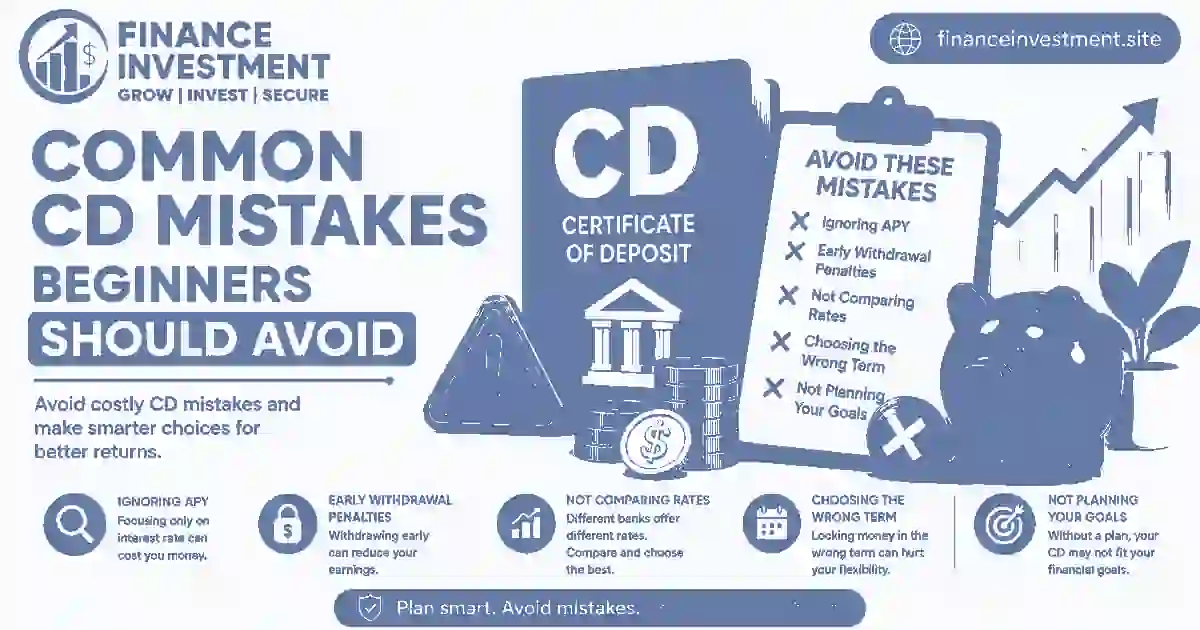
 Most beginner mistakes can be caught with a quick review before you deposit the money. Before funding a certificate, check the term, withdrawal rules, insurance status, renewal instructions, and tax treatment. These details can matter more than a small difference in APY.
 Think of CD interest as income, not as a discount on the amount you originally deposited. If you put $10,000 into a taxable CD and it earns interest, the interest can become part of your taxable income even though your original $10,000 is still sitting in the certificate.