Tag: CD Rates

  • Variable-Rate CDs Explained: How They Work, Rates & Risks

    Variable-Rate CDs Explained: How They Work, Rates & Risks

    SEO Title: Variable-Rate CDs Explained: How They Work, Rates & Risks

    Meta Description: Variable-Rate CDs explained in simple terms. Learn how changing CD rates work, how interest is calculated, the risks, benefits, FDIC insurance and when this type of CD may make sense.

    URL Slug: variable-rate-cds-explained-2026

    Focus Keyword: Variable-Rate CDs

    Secondary Keywords:
    Variable-Rate CD explained,
    what is a Variable-Rate CD,
    how Variable-Rate CDs work,
    variable CD rates,
    variable interest rate CD,
    adjustable-rate CD,
    CD rates that can change

    Canonical URL: https://financeinvestment.site/variable-rate-cds-explained-2026/

    Author Name: Subhash Rukade

    Last Updated: August 30, 2026

    Reading Time: 10 minutes

    Featured Image ALT Text: Variable-Rate CDs explained with changing interest rates and CD savings strategy

    Variable-Rate CDs Explained: How They Work, Rates & Risks

    SR

    WRITTEN BY
    Subhash Rukade
    Personal Finance Writer • Banking & CD Guides.


    Updated Aug. 31, 2026


    10 min read

    This guide focuses on how variable-rate CDs work, what can cause their rates to change,
    and the details worth checking before putting money into one.

    Variable-rate CDs explained with changing interest rates and CD savings strategyVariable-Rate CDs work a little differently from the fixed-rate CDs most savers know. Instead of locking the interest rate for the entire term, the rate on a variable-rate certificate of deposit can change according to the rules set by the financial institution. That can be useful when market rates are moving up, but it also means your future interest earnings are less predictable.

    That trade-off is the part worth understanding. A changing rate may give you an opportunity to benefit from higher rates without closing the CD, yet a rate decrease could work against you. The details can also differ from one institution to another, including how often the rate may change, whether there is a floor or cap, and how the adjustment is calculated.

    If you’re still getting familiar with CDs, our

    complete CD Guide 2026

    provides the broader picture before you compare variable-rate options.

    What You’ll Learn

    In this guide, you’ll see how variable-rate CDs operate, what can trigger a rate change, and how they compare with fixed-rate and other flexible savings choices. We’ll also cover potential advantages, rate-change risks, early-withdrawal rules, deposit insurance, fees, inflation and practical questions to ask before opening one.

    Quick Answer

    A variable-rate CD is a certificate of deposit whose interest rate can change during the term under rules set by the financial institution. It can make sense for savers who want some exposure to rising rates, but the trade-off is less certainty about future earnings than with a fixed-rate CD.

    Key Takeaways

    • The rate can change during the CD term, unlike a typical fixed-rate CD.
    • Higher market rates may benefit you, but falling rates can reduce future interest.
    • The bank’s rate-change formula and adjustment rules matter as much as the starting APY.
    • Check for rate floors, caps, minimum deposits and withdrawal restrictions.
    • Confirm applicable FDIC or NCUA insurance before depositing a large amount.
    • Compare the CD with savings accounts and other CD structures before committing your cash.

    Bottom Line

    The appeal of a variable-rate CD is flexibility in how the rate responds to changing conditions. The catch is that you give up some predictability. Look at the adjustment rules, not just today’s advertised APY, and make sure the term fits the date you’ll actually need the money.

    Variable-Rate CDs at a Glance

    A variable-rate CD can be useful when you want a defined savings term without committing to a rate that must stay unchanged. The key difference is simple: the interest rate may move during the term according to the account’s rules.

    RATE
    May change

    Based on the institution’s terms.
    TERM
    Fixed period

    You generally commit funds for a stated term.
    ACCESS
    Usually limited

    Withdrawal rules vary by account.
    INSURANCE
    May be insured

    Check FDIC or NCUA eligibility and limits.

    Best For

    Variable-rate CDs may appeal to savers who expect rates to rise and are comfortable trading some earnings certainty for the possibility of a higher rate later. They are less attractive when predictable returns or easy access to cash is the priority.

    Quick Comparison

    FeatureVariable-Rate CD
    Rate certaintyLower than a fixed-rate CD
    Upside potentialPossible if the rate rises
    LiquidityGenerally limited during the term

    Complete Beginner Guide to Variable-Rate CDs
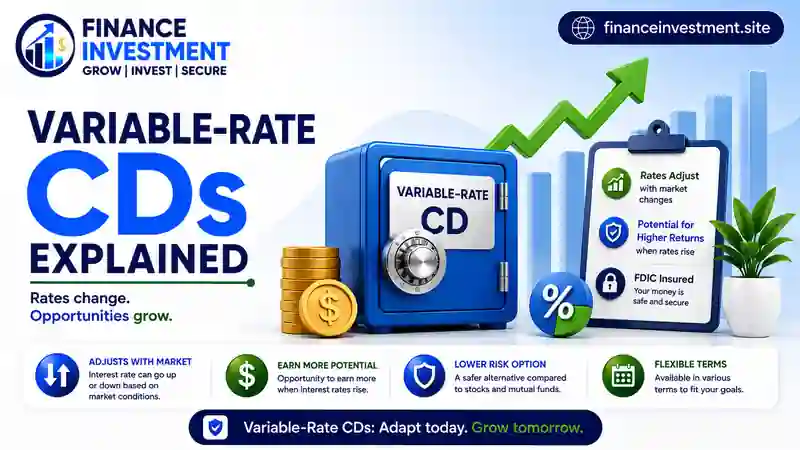
    variable-rate CDsIf you’ve used a regular certificate of deposit before, the main difference here is the interest rate. With a traditional fixed-rate CD, the rate is generally set when you open the account and remains unchanged through the term. A variable-rate CD can adjust during that period based on the terms of the account.

    That doesn’t mean the bank can simply change the rate whenever it wants without conditions. The account agreement should explain what can cause an adjustment, how often changes can occur and whether the rate has a minimum or maximum. Some products may tie changes to a particular benchmark, while others give the institution more discretion. Those details can make two variable-rate CDs look similar at first but behave quite differently.

    Why Would a Bank Offer One?

    Variable pricing gives a bank a way to offer a deposit product whose return can respond to changing interest-rate conditions. For a saver, that can create an opportunity when rates move higher. The downside is just as important: a lower rate can reduce the interest you earn later in the term.

    What Should Beginners Check?

    • Adjustment rules: Find out exactly when and why the rate can change.
    • Rate floor or ceiling: Check whether the account limits how far the rate can move.
    • Early withdrawal: Understand the penalty and any conditions for accessing your money early.
    • Minimum deposit: Confirm how much you need to open and maintain the CD.
    • Insurance: Verify applicable FDIC or NCUA coverage before depositing your savings.

    If you’re deciding between a variable-rate product and a more predictable option, comparing the account’s actual rules is more useful than looking at the starting APY alone. For broader background, you can also review our guide to

    standard CDs

    before making the comparison.

    How Variable-Rate CDs Work

    A variable-rate CD starts much like other CDs: you deposit money, choose a term and agree to the account’s conditions. The important difference is that the interest rate may change before the CD reaches maturity. The exact adjustment process comes from the bank’s disclosure, so don’t assume every variable-rate CD follows the same formula.

    Rate Adjustments and Benchmarks

    Some products may connect their rate to a benchmark or another stated measure. Others may allow the financial institution to adjust the rate under specified conditions. If a benchmark is involved, check whether the CD uses a fixed spread, a particular adjustment schedule or another calculation. The starting APY alone won’t tell you how the account could perform later.


    Practical check

    Before opening the account, look for the rate-change trigger, adjustment frequency, minimum rate and maximum rate. If any of these are unclear, ask the institution for the written terms.

    How Interest Is Earned

    Your earnings depend on the balance, the applicable rate and how long each rate applies. If the rate changes halfway through the term, the interest calculation reflects the applicable rates for their respective periods. For a refresher on the basics, see our guide to

    how CDs work
    .

    What Happens at Maturity?

    At maturity, the CD generally reaches the end of its agreed term and the institution follows the maturity instructions in the account agreement. Depending on the product, you may receive the balance and interest, renew the CD or move the money elsewhere. Check the maturity window and renewal terms ahead of time rather than letting the account renew automatically without reviewing the new rate.

    Benefits & Drawbacks of Variable-Rate CDs

    A variable-rate CD sits somewhere between predictable fixed-rate savings and more flexible deposit accounts. Its appeal comes from the possibility of earning more if the rate moves higher, but that possibility comes with less certainty.


    Pros
    • You may benefit if the CD’s rate rises.
    • It can provide a structured savings term.
    • It may suit savers who expect changing rates.
    • Eligible deposits may receive federal deposit insurance.


    Cons
    • The rate can fall, reducing future interest.
    • Returns are harder to predict than with fixed-rate CDs.
    • Early withdrawals may trigger penalties.
    • Terms can be more complicated than a standard CD.


    The trade-off in one sentence

    You give up some rate certainty in exchange for the chance to participate in higher rates later.

    Variable-Rate CDs vs. Other Savings Options

    A variable-rate CD can look attractive when rates are changing, but it is not automatically the best place for every dollar. The biggest differences come down to rate certainty, access to your money and how the account handles future rate changes.

    OptionRate behaviorAccessBest fit
    Variable-rate CDCan change under the account’s stated rulesUsually limited before maturitySavers comfortable with changing returns
    Standard CDGenerally fixed for the termUsually limited before maturitySavers who value predictable earnings
    Step-Up CDScheduled increases may applyUsually limited before maturitySavers seeking predetermined rate increases
    High-yield savings accountTypically variableGenerally easier accessEmergency funds and flexible savings
    Money market accountTypically variableGenerally more flexible than a CDCash that may need occasional access

    If certainty matters most, a

    standard CD

    may be easier to plan around. If access matters more, compare the CD with a

    high-yield savings account

    or

    money market account

    before committing your cash.

    Costs, Risks & Expert Tips for Variable-Rate CDs

    The starting APY is only one piece of the puzzle. With a variable-rate CD, the details behind future rate changes can have a bigger effect on your final earnings. A few minutes spent reading the account terms can help you avoid an unpleasant surprise later.

    Watch the Early-Withdrawal Rules

    A CD is designed for money you can leave alone for the agreed term. Taking funds out early may result in an early-withdrawal penalty, and the exact cost depends on the account. If there is a reasonable chance you’ll need the cash soon, compare the CD with a more accessible savings option first.

    Check the Deposit and Insurance Rules

    Look at the minimum opening deposit, any balance requirements and whether additional deposits are permitted. Also confirm that the institution and account qualify for applicable federal deposit insurance. Coverage limits can depend on ownership category and the amount held at the same insured institution.


    Expert tip: don’t judge the CD by its first rate

    Ask what happens if rates fall. A variable-rate CD can become less attractive when its rate declines, especially if you’re unable to move the money without paying a penalty.

    Don’t Ignore Inflation and Reinvestment Risk

    Even when your account earns interest, inflation can reduce what that money can buy. At maturity, you’ll also face reinvestment risk: the rates available for a new CD may be lower than the rate you were earning.

    A Simple Liquidity Check

    Keep money you may need for emergencies, bills or near-term purchases outside the CD when possible. Then use the CD for the portion of your savings that can remain untouched. This simple separation makes the withdrawal penalty less likely to become a problem and gives the variable rate room to work as intended.

    Common Mistakes With Variable-Rate CDs

    Variable-rate CDs can be useful, but a high opening APY can distract you from the details that matter over the full term. Here are some mistakes worth avoiding.

    Mistakes to Watch For

    • Chasing the opening rate: A strong starting APY does not guarantee the same return throughout the term.
    • Skipping the adjustment rules: Make sure you understand what can cause the rate to change and whether limits apply.
    • Forgetting withdrawal restrictions: Needing the money early could trigger a penalty or other account conditions.
    • Ignoring insurance: Confirm that your deposit is held at an appropriately insured institution and stay within applicable coverage limits.

    A Simple Example

    Imagine Maya has $15,000 that she does not expect to need for the next year. She finds a variable-rate CD with an attractive opening APY and deposits the money. Instead of focusing only on that first rate, she checks how adjustments work, whether the rate has a floor or ceiling, what an early withdrawal would cost and how the deposit is insured.

    During the term, the CD’s rate changes. Maya’s actual return therefore depends on the rates that apply during each period, rather than simply the rate shown when she opened the account. Her careful review does not eliminate market or rate risk, but it helps her understand what she is agreeing to. For more CD decision-making guidance, see our

    common CD mistakes guide
    .

    Who Should Choose a Variable-Rate CD?

    A variable-rate CD can make sense for someone who wants the structure of a CD but does not want to lock every dollar into one fixed rate. It may be especially interesting when you expect rates to change and are comfortable with some uncertainty in your future earnings.

    A Good Fit If You…

    • Can leave the money invested until maturity.
    • Accept that the rate may move lower.
    • Want a chance to benefit from higher rates.
    • Are willing to read the CD’s adjustment rules.

    Consider Another Option If You…

    • Need frequent access to the money.
    • Want a predictable return from day one.
    • Would be uncomfortable with rate changes.
    • Need an emergency fund rather than a term deposit.

    For a broader look at choosing among CD types, our

    guide to choosing the right CD

    can help you compare the trade-offs before committing your

    Frequently Asked Questions About Variable-Rate CDs

    1. Can the rate on a variable-rate CD change?

    Yes. Unlike a traditional fixed-rate CD, a variable-rate CD can allow the interest rate to change during the term. The account agreement should explain what triggers an adjustment, when it can happen, and whether limits apply.

    2. Can I add money to a variable-rate CD?

    It depends on the product. Some variable-rate CDs may allow additional deposits, while others accept only the initial deposit. Check the deposit window, contribution rules, and any minimum amount before opening the account.

    3. Are variable-rate CDs safe?

    A variable rate does not by itself make a CD unsafe. If the CD is an eligible deposit at an FDIC-insured bank, it can receive FDIC deposit insurance within applicable limits. That protection does not guarantee a particular interest rate or return.

    4. Are variable-rate CDs FDIC insured?

    A variable-rate CD issued by an FDIC-insured bank can generally qualify for FDIC deposit insurance, subject to ownership categories, coverage limits, and other applicable rules. Verify the institution’s insurance status before depositing money.

    5. Can I withdraw money from a variable-rate CD early?

    Often, early withdrawal can result in a penalty or other cost. The exact rule depends on the CD. Some products may offer limited withdrawal features, so review the early-withdrawal terms before committing money you might need soon.

    6. What happens when a variable-rate CD matures?

    At maturity, the bank generally handles the principal and earned interest according to the CD agreement. If the account automatically renews, there is usually a limited grace period when you may be able to withdraw the money or change the renewal instructions.

    7. Do variable-rate CDs require a minimum deposit?

    Minimum deposits vary by bank and CD. Some accounts may have low or no minimums, while others require a larger opening balance. Compare the minimum with the APY, term, and withdrawal rules rather than looking at the rate alone.

    8. Are variable-rate CDs good for short-term savings?

    They can make sense when you have a defined time horizon and can leave the money in place. For cash needed for an emergency, upcoming bill, or frequent spending, an accessible savings account may be more practical.

    9. Is the APY guaranteed on a variable-rate CD?

    No. If the CD allows rate adjustments, the APY can change during the term. Read the disclosure for the adjustment method, timing, minimum or maximum rates, and any other limits that could affect future earnings.

    Final Verdict: Is a Variable-Rate CD Worth Considering?

    A variable-rate CD can be a useful middle ground for savers who want a CD’s structured term while keeping some exposure to changing interest rates. The trade-off is simple: you give up some certainty in exchange for the possibility of benefiting when rates move higher.

    Before opening one, look beyond the advertised APY. Check how often the rate can change, what determines the adjustment, whether a minimum or maximum rate applies, the early-withdrawal penalty, deposit requirements, maturity rules and applicable deposit insurance. Those details can matter more than the opening rate.


    The key takeaway

    Don’t choose a variable-rate CD simply because its starting APY looks impressive. Choose it when the rate-adjustment rules, term, access restrictions and potential return fit the job your savings need to do.

    Rates and account terms can change, so review the current disclosure before opening any CD.
  • Callable CDs Explained: How They Work, Risks & Rates in 2026

    Callable CDs Explained: How They Work, Risks & Rates in 2026


    Callable CDs Explained: How They Work in 2026

    FINANCEINVESTMENT
    Callable CDs, Explained Clearly

    Written by Subhash Rukade

    Updated August 29, 2026

    A practical guide to understanding callable CDs, including
    call dates, interest rates, access, risks and the details
    worth checking before opening one.

    Callable CDs: A Higher Rate With an Important Catch

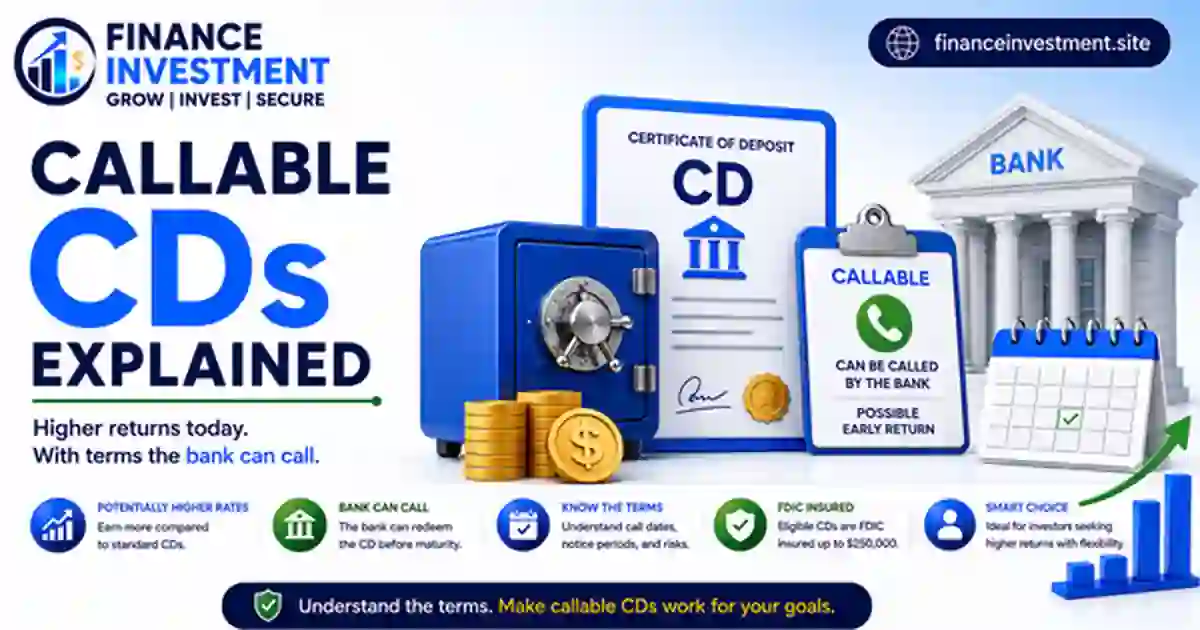
    Callable CDs Explained: callable certificate of deposit rates, call dates and risksA callable CD can look appealing when its advertised rate is higher than
    what you see on a comparable traditional CD. But there is a detail that
    deserves attention: the bank or credit union may have the right to end
    the CD before its stated maturity date. That feature can change how you
    think about the return you are actually getting.

    For example, imagine locking in a strong rate for several years. If market
    rates later fall, the issuer may decide to call the CD according to the
    terms of the account. You receive the amount specified under the contract,
    but you may then have to reinvest that money at lower rates. The attractive
    rate you saw at the beginning, therefore, is not always the same as the
    rate you can count on for the entire advertised term.

    If you are new to CDs, start with the broader

    CD Guide 2026

    before comparing more specialized CD types.

    What You’ll Learn

    This guide will show you how callable CDs work, what a call date means,
    why issuers may exercise the call option, and how callable CDs differ
    from standard CDs. You will also see the trade-offs involving rates,
    liquidity, taxes, insurance, reinvestment and maturity—so you can judge
    an offer by its full terms rather than its headline APY alone.

    Quick Answer: What Is a Callable CD?

    A callable CD is a certificate of deposit that can be
    ended early by the issuing bank or credit union under specific terms.
    In exchange for giving the issuer this flexibility, a callable CD may
    offer a more attractive rate than some comparable CDs. The important
    catch is that you cannot assume the advertised rate will remain in place
    for the entire stated term if the CD is called.

    Key Takeaways

    • Issuer controls the call: The bank decides whether to exercise its call option.
    • Rates are typically fixed: The stated rate generally stays fixed while the CD remains outstanding.
    • Call risk matters: A called CD can leave you looking for a new place to invest your money.
    • Protection may apply: Eligible deposits at an FDIC-insured bank or federally insured credit union can receive applicable deposit insurance.
    • Taxes still matter: CD interest is generally taxable income when required under federal tax rules.
    • Read the call terms: Check the call date, notice provisions, term and what happens if the issuer calls the CD.
    Bottom Line:
    A callable CD can offer a compelling rate, but the extra yield comes with
    issuer call risk. Look beyond APY and make sure the call provisions fit
    your time horizon and need for predictable income.

    Callable CDs at a Glance

    A callable CD combines a fixed deposit rate with an issuer’s right to
    redeem the CD before its stated maturity. That extra feature makes the
    call terms just as important as the advertised APY.

    Key FactWhat to Know
    RateUsually fixed while the CD remains outstanding.
    Call periodThe issuer can call the CD only according to its stated terms.
    MaturityThe original term may be longer than the period the CD actually stays open.
    AccessEarly access is governed by the contract; a callable CD is not the same as a no-penalty CD.
    ProtectionEligible deposits may receive FDIC or NCUA insurance within applicable limits.
    MinimumDeposit requirements vary by institution and product.
    TaxesInterest is generally taxable income for federal tax purposes.

    Best use: Callable CDs may suit savers who value a potentially
    higher fixed rate and can accept the possibility of having their money
    returned earlier than expected.

    Complete Beginner Guide to Callable CDs

    Callable CDsA callable CD is a type of certificate of deposit with one important


    difference from a basic CD: the financial institution may have the right
    to end the CD before its scheduled maturity date. The account still works
    around a deposit, an interest rate and a defined term, but the issuer gets
    an additional option that can affect how long your money stays invested.

    How the Basic Structure Works

    You start by depositing a specific amount, known as the principal.
    The bank then pays interest according to the rate and terms disclosed when
    you open the account. The APY shows the annualized return while
    accounting for the effect of compounding, making it more useful for comparing
    CD offers than a simple interest rate alone.

    The term tells you the scheduled length of the CD, such as
    one year, three years or five years. At maturity, the CD reaches
    the end of that scheduled term. With a callable CD, however, the issuer may
    be able to redeem it earlier if the contract allows a call during the
    specified call period.

    Callable CD vs. Standard CD

    A standard CD generally keeps your money invested until its stated maturity,
    unless you withdraw early under the account’s withdrawal rules. A callable
    CD adds issuer call risk: the institution can potentially return your
    principal and applicable interest before the original maturity date.
    That is why a higher advertised rate should be considered alongside the
    call schedule and other contract details.

    Where Ownership Fits In

    CDs can be held individually or jointly, depending on the institution and
    account structure. Eligible deposits at an FDIC-insured bank or federally
    insured credit union may receive applicable deposit insurance within legal
    limits. Callable CDs therefore sit closer to the cash-saving side of a
    portfolio than to higher-volatility investments, although the call feature
    creates a reinvestment consideration that ordinary savings accounts may not.

    For a broader foundation, see our

    guide to standard CDs

    How Callable CDs Work

    A callable CD follows a fairly simple path, but one extra feature can
    change the outcome: the issuing bank or credit union may have the right
    to redeem the CD before its scheduled maturity. Here is how the process
    typically unfolds.

    1. Choose the CD and Review the Call Terms

    Before opening the account, check the APY, deposit requirement, scheduled
    term and, most importantly, the call provisions. Look for the first
    possible call date, how often the issuer can call the CD and what you
    receive if the CD is redeemed.

    2. Fund the Account

    You deposit the required principal according to the institution’s rules.
    Once the CD is opened, the disclosed rate generally applies while the
    account remains outstanding under its terms.

    3. Interest Accrues

    The CD earns interest according to its stated rate and compounding
    schedule. Your actual earnings can depend on when interest is credited,
    whether it is paid out or added to the balance, and the product’s
    specific terms.

    4. The Issuer Reaches the Call Date

    Once the CD becomes callable, the issuer can exercise its call option
    if the contract permits it. This is controlled by the institution—not
    by the depositor. If the issuer does not call the CD, it can continue
    toward its original maturity.

    5. Called CD vs. CD That Reaches Maturity

    If the CD is called, the institution returns the amount specified under
    the contract, ending the deposit earlier than originally expected. You
    then have to decide where that money goes next. If the CD reaches
    maturity instead, you can follow the maturity instructions, such as
    withdrawing the funds, transferring them or allowing an eligible renewal.

    Practical point:
    A callable CD does not give you control over the timing of the exit.
    The call schedule tells you when the issuer gets that option, so keep
    your own cash needs separate from money committed to the CD.

    Benefits & Drawbacks of Callable CDs

    Callable CDs can be attractive when the rate is competitive, but the
    higher potential return comes with a trade-off. The key question is
    whether the added rate is worth giving the issuer more control over
    when the CD ends.

    ✓ Benefits

    • Potentially attractive rates: Some callable CDs may
      offer a higher rate to compensate savers for accepting the call feature.
    • Rate stability: While the CD remains outstanding,
      its stated rate generally does not fluctuate with daily market rates.
    • Deposit protection: Eligible deposits at an
      FDIC-insured bank or federally insured credit union may receive
      applicable insurance within coverage limits.
    • Defined structure: The CD provides a stated term,
      rate and contractual call provisions rather than leaving every detail
      open-ended.

    ⚠ Drawbacks

    • Call risk: The issuer may redeem the CD before its
      scheduled maturity when the contract allows it.
    • Reinvestment risk: If the CD is called after rates
      fall, comparable new deposits may offer less attractive returns.
    • Inflation risk: A fixed rate may lose purchasing power
      if inflation remains higher than the return.
    • Less certainty about timing: You may receive your
      money earlier than planned, which can disrupt a specific savings goal.

    Benefits & Drawbacks of Callable CDs

    A callable CD can be appealing when you want a fixed return and the
    offered rate is competitive. The trade-off is that the bank gets an
    option that a standard CD usually does not: it may be able to redeem
    the CD before the scheduled maturity date.

    Benefits of Callable CDs

    • Potentially higher rates:
      Some callable CDs offer a stronger APY than comparable products to
      compensate for the issuer’s call option.
    • Fixed-rate structure:
      The stated rate generally remains fixed while the CD stays outstanding
      under its terms.
    • Deposit protection:
      Eligible deposits may receive FDIC or NCUA insurance within applicable
      coverage limits.
    • Defined terms:
      The contract spells out the rate, scheduled maturity and circumstances
      under which the issuer can call the CD.

    Drawbacks to Consider

    • Call risk:
      The issuer may end the CD early when the contract permits it.
    • Reinvestment risk:
      If rates have fallen when your CD is called, a new CD may offer a
      lower return.
    • Inflation risk:
      A fixed return may not keep pace with rising prices.
    • Less control over timing:
      The money could come back before your original savings plan reaches
      its intended date.
    Key point:
    A higher APY can be useful, but it should be weighed against the possibility
    that the issuer ends the CD when market conditions make that attractive
    for the institution.

    Callable CDs Compared With Other Savings Options

    A callable CD is not automatically better than a regular CD or a savings
    account. Each option gives you a different mix of return, access and
    predictability. The biggest distinction is who controls the timing: with
    a callable CD, the issuer may have the right to end the deposit early.

    OptionRateAccessBest Use
    Callable CDUsually fixedContract-based; issuer may call earlySavers seeking a fixed return who accept call risk
    Standard CDUsually fixedLimited before maturityMoney with a defined time horizon
    High-Yield SavingsVariableGenerally easyEmergency funds and flexible savings
    Money Market AccountUsually variableMore flexible than a CDCash reserves needing convenient access

    Minimum deposits and fees vary by institution, so the advertised APY is
    only one part of the decision. Eligible deposits at an FDIC-insured bank
    or federally insured credit union can receive applicable deposit insurance
    within coverage limits. Interest earned from these deposit products is
    generally taxable income, although the exact tax treatment depends on the
    account and your circumstances.

    If you are deciding between a callable product and a conventional deposit,
    our

    Standard CDs Explained

    guide provides a useful starting point. For a more flexible comparison,
    see our guide to

    CDs vs. high-yield savings accounts
    .

    Quick takeaway:
    A callable CD can make sense for a rate-focused saver who accepts issuer
    call risk. A high-yield savings account or money market account may be
    more suitable when keeping funds readily accessible matters more.

    Costs, Risks & Expert Tips for Callable CDs

    The most important cost of a callable CD is not always a visible fee.
    The bigger concern can be what happens when the issuer exercises its
    call option. A good offer should be judged by its full terms, not just
    the headline APY.

    Costs and Risks to Check

    .  Call Risk-   bank’s decision to call a CD is not the same as a customer’s early
    withdrawal. When the issuer exercises its call right, the redemption
    follows the terms stated in the CD agreement. Your own withdrawal rights
    are a separate matter.

    • Reinvestment risk: If market rates have fallen when
      the CD is called, replacing it could mean accepting a lower yield.
    • Early-withdrawal rules: Do not assume that a callable
      CD gives you penalty-free access. Your own withdrawal rights are
      determined by the account agreement.
    • Inflation: A fixed return can lose purchasing power
      when inflation runs above the CD’s effective return.
    • Taxes: Interest from taxable CDs is generally subject
      to federal income tax, even when the money remains in the account.
    • Fees and minimums: Check the institution’s disclosure
      for account fees, minimum opening deposits and any conditions attached
      to the advertised rate.

    Practical Checks Before Opening One

    1. Find the exact first call date and full call schedule.
    2. Confirm what you receive if the issuer calls the CD.
    3. Verify that the institution is FDIC-insured or federally insured by NCUA, as applicable.
    4. Check your total deposits against applicable insurance limits.
    5. Keep money needed for near-term bills outside the CD.
    6. Decide in advance where the funds could go if the CD is called.

    Expert Tip

    Treat the call date as a planning date, not a guaranteed maturity date.
    If the money has a specific future job, keep enough flexibility elsewhere
    so an unexpected early redemption does not force a rushed reinvestment decision.

    Common Callable CD Mistakes and an Illustrative Example

    Illustrative Example — Not a Real Customer CaseSuppose a saver places $10,000 into a callable CD with a fixed rate.
    The issuer later calls the CD before its scheduled maturity. The saver
    receives the applicable principal and interest, but now has to decide
    where to place the money. If comparable CD rates have fallen, the next
    available rate may be lower.


    Common Mistakes to Avoid

    • Choosing by APY alone: A higher rate does not tell you
      when the issuer can call the CD or how long you may actually keep that rate.
    • Skipping the call schedule: The first callable date,
      notice provisions and redemption terms deserve a careful look.
    • Assuming every callable CD works the same way:
      Call periods, terms and redemption conditions can differ between products.
    • Overlooking insurance: Verify the institution and keep
      your deposits within applicable FDIC or NCUA coverage limits.
    • Forgetting taxes: Interest from a taxable CD can create
      income-tax consequences even if you leave the earnings in the account.
    • Ignoring liquidity: Money needed for an upcoming expense
      should not depend on whether a callable CD remains open.
    • Having no reinvestment plan: If the CD is called, rates
      available at that time may be lower than the rate you originally locked in.

    Who Should Consider a Callable CD?

    Callable CDs can make sense for savers who are comfortable trading some
    control over timing for a potentially attractive fixed rate. They may be
    worth considering when the money is not needed for everyday expenses and
    the account’s call terms are easy to understand.

    Who May Find Them Useful?

    • Beginners: Those learning about fixed-rate deposits and
      willing to read the contract carefully.
    • Families: Savers setting aside money for a known future
      goal who can handle an earlier return of funds.
    • Retirees: Investors seeking predictable interest from
      eligible deposit products, provided the call risk fits their income plan.
    • Larger-balance savers: People who can manage deposit
      insurance limits across institutions when necessary.
    • Conservative investors: Those who prioritize principal
      stability over market-based growth.

    When Another Option May Fit Better

    If you need frequent access to the money, a

    high-yield savings account

    may offer greater flexibility. A standard CD can be easier to plan around
    when you want a defined maturity without an issuer call feature. For a
    very short-term goal, keeping the money readily available may matter more
    than locking in a potentially higher rate.

    Frequently Asked Questions About Callable CDs

    What is a callable CD?

    A callable CD is a certificate of deposit that gives the issuing
    institution the right to redeem the CD before its scheduled maturity,
    subject to the contract’s call terms.

    Are callable CDs safe?

    They can provide principal stability when offered by an eligible
    insured institution, but the call feature creates reinvestment risk.
    They are not the same as investments whose market value fluctuates.

    Are callable CDs FDIC insured?

    An eligible callable CD issued by an FDIC-insured bank may be covered by
    FDIC deposit insurance within applicable limits.

    How does the call date work?

    The call date is the earliest date on which the issuer may exercise its
    redemption right if the contract permits it. It does not mean the CD
    will definitely be called.

    Is the rate on a callable CD fixed?

    Callable CDs commonly have a fixed stated rate while the CD remains
    outstanding, but the issuer’s call option can shorten the period during
    which you receive that rate.

    What happens if a callable CD is called early?

    The institution redeems the CD according to the contract, returning the
    applicable principal and interest. You then decide how to use or
    reinvest the funds.

    Do callable CDs have minimum deposits?

    Minimum opening deposits vary by bank, credit union and product. Always
    check the specific account disclosure rather than assuming every callable
    CD has the same requirement.

    Are callable CD earnings taxable?

    Interest from a taxable CD is generally included in income for federal
    tax purposes. Your actual tax treatment can depend on the account and
    your individual circumstances.

    Can I withdraw from a callable CD whenever I want?

    No. A callable CD’s issuer call feature is different from your own
    withdrawal rights. Any early withdrawal by you is governed by the
    account agreement and may involve a penalty.

    Are callable CDs good for short-term savings?

    They may not be ideal when you need dependable access to the money on a
    specific date. A flexible savings option can be easier to manage for
    short-term needs.

    Final Verdict: Are Callable CDs Worth Considering?

    Callable CDs can be a useful choice for savers who want a fixed rate and
    are comfortable with the possibility that the issuer may end the CD before
    its scheduled maturity. They can work particularly well when you have a
    defined savings goal but do not need to control the exact date your money
    comes back.

    Still, the highest APY should not automatically win. The first call date,
    call schedule and redemption terms can matter just as much as the quoted
    rate. If the CD is called after market rates have fallen, finding a
    comparable replacement may be difficult.

    Liquidity also deserves attention. Keep money needed for emergencies or
    near-term expenses somewhere easier to access. And remember that interest
    from taxable CDs can affect your federal tax bill, reducing your
    after-tax return.


    Bottom Line

    A callable CD is best viewed as a trade-off: potentially attractive fixed
    earnings in exchange for issuer call risk. For a broader look at CD types,
    strategies and choosing a product, explore our

    CD Guide 2026
    .

    Related Resources

    Want to go deeper before choosing a CD? These guides cover the practical
    questions that usually come next:

    For authoritative information, review

    FDIC deposit insurance
    ,

    Treasury.gov

    and the

    IRS

    for current federal guidance.

    FINANCEINVESTMENT

    Make Your Next CD Decision With Confidence

    Want more practical guidance on CDs, rates and savings strategies?
    Explore our

    CD Guide 2026

    and keep learning before you lock in your next deposit.
    You can also reach us at

    subhashr325@gmail.com
    .

  • No-Penalty CDs Explained: Rates, Rules & Benefits in 2026

    No-Penalty CDs Explained: Rates, Rules & Benefits in 2026

    No-Penalty CDs Explained: How They Work in 2026

    FINANCEINVESTMENT
    No-Penalty CDs, Explained Clearly

    Written by Subhash Rukade

    Updated August 29, 2026

    A practical U.S. guide to understanding no-penalty CDs,
    including rates, access rules, maturity, taxes and the
    trade-offs that matter before you deposit your money.

    FLEXIBLE SAVINGS

    What You’ll Learn” must always be an

    heading.

    A no-penalty CD can be appealing when you want a fixed rate but do not
    want your money completely tied up until the maturity date. That extra
    flexibility is the main reason savers consider one instead of a regular
    CD.

    No-penalty CDs explained for U.S. savers in 2026With a traditional CD, taking money out early can trigger an


    early-withdrawal penalty. A no-penalty CD removes that particular hurdle,
    although the account may come with a lower rate, different withdrawal
    rules, or other conditions. In other words, you are giving up some
    potential earnings in exchange for easier access.

    That trade-off matters if your plans could change. You might be saving for
    a home repair, an upcoming purchase, or simply want a cash reserve that
    earns more than a typical savings account while keeping an exit option.
    If you are new to CDs, our

    CD Guide 2026

    provides the broader picture before you compare specific CD types.

    What You’ll Learn

    This guide breaks down how no-penalty CDs work, where their flexibility
    comes from, what you may give up for that convenience, how protection and
    taxes work, and which situations may favor a no-penalty CD over a regular
    CD or a savings account.

    QUICK ANSWER

    A no-penalty CD is a certificate of deposit that lets
    you withdraw your money before maturity without the standard
    early-withdrawal penalty. In return, the rate or account terms may be
    less attractive than those of a comparable regular CD.

    Key Takeaways

    • Flexibility: Useful when your cash needs may change.
    • Rate certainty: The rate is generally fixed for the CD term.
    • Access: Withdrawal rules still vary by bank, including when and how much you can withdraw.
    • Protection: Eligible deposits at an FDIC-insured bank or NCUA-insured credit union can receive applicable federal deposit insurance.
    • Taxes: CD interest is generally taxable income unless a specific tax-advantaged structure applies.
    • Purpose matters: Money needed soon may benefit more from access than from chasing a slightly higher rate.

    Bottom Line

    A no-penalty CD can be a strong middle ground for savers who want a
    predictable return but do not want every dollar locked away. Check the
    withdrawal conditions and rate side by side before opening one.

    No-Penalty CDs at a Glance

    Here is the quick reference for the features that matter most when
    evaluating a no-penalty CD.

    FeatureWhat to Know
    Best useCash you want to earn a fixed return on while keeping an early-exit option.
    RateUsually fixed for the agreed term; compare APY rather than the rate alone.
    MaturityThe account reaches its scheduled end date, when the principal and applicable interest can be handled according to the bank’s terms.
    WithdrawalEarly withdrawals may avoid a penalty, but timing, notice and minimum-holding rules can apply.
    ProtectionEligible deposits may be covered by FDIC insurance at insured banks or NCUA insurance at federally insured credit unions, subject to coverage limits.
    Minimum depositDepends on the financial institution; some accounts require no minimum while others set a required opening amount.
    TaxesInterest is generally taxable income when applicable, so the after-tax return can differ from the advertised APY.
    Quick check:
    A CD at an FDIC-insured bank may be covered by FDIC deposit insurance, subject to applicable limits. Credit-union deposits may receive NCUA coverage when the institution and account qualify.

    No-Penalty CDs: A Complete Beginner Guide

    A certificate of deposit is a bank or credit-union deposit account in
    which you place money for an agreed period in exchange for interest.
    A no-penalty CD follows that basic structure, but its withdrawal rules
    are different from those of a conventional CD.

    How a No-Penalty CD Differs From a Standard CD

    With a standard CD, taking money out before maturity commonly triggers an
    early-withdrawal penalty. A no-penalty CD is designed to let you withdraw
    money before the scheduled maturity date without that specific penalty,
    although the institution may impose other conditions, such as a waiting
    period or requiring the account to be closed before releasing the funds.
    The exact rules vary by product.

    The CD Terms You Need to Know

    • Principal: The amount you initially deposit.
    • APY: The annualized return that accounts for
      compounding, making it useful for comparing CD offers.
    • Term: The agreed length of the CD, such as six months
      or one year.
    • Maturity: The date the agreed CD term ends.
    • Interest: The earnings paid or credited according to
      the institution’s terms.

    Where It Fits Among Savings Choices

    A no-penalty CD sits between a conventional CD and a highly accessible
    savings account. You may get a fixed rate for a defined term while giving
    up some of the everyday flexibility of a savings account. Other CD
    structures include standard, jumbo, callable and brokered CDs, each with
    different features. For a broader explanation of CD basics, see our

    CD Guide 2026
    .

    How No-Penalty CDs Work

    The process is fairly straightforward, but the withdrawal rules deserve
    extra attention. Here is what typically happens from the day you open
    the account until the CD reaches maturity.

    1. Choose the CD and Fund It

    Start by comparing the APY, term, minimum deposit, withdrawal rules and
    maturity options. Once you open the account, you deposit the amount
    required by the institution. That money becomes the principal used to
    calculate your interest.

    2. Let the Interest Accumulate

    The CD generally earns the stated fixed rate during its term. Interest
    may be credited monthly, quarterly, annually or at another interval,
    depending on the account agreement. The APY reflects the effect of
    compounding when applicable.

    3. Withdraw Before Maturity If the Rules Allow

    This is where a no-penalty CD differs from a conventional CD. If you
    need the money early, the account may allow a withdrawal without an
    early-withdrawal penalty. However, some institutions require the entire
    CD to be closed, impose a waiting period or set other conditions.
    Check the specific agreement rather than assuming every no-penalty CD
    works the same way.

    4. Reach Maturity and Decide What Comes Next

    If you leave the money untouched until maturity, the CD reaches its
    scheduled end date. The institution may return the principal and
    accumulated interest to another account, or automatically renew the CD
    if you have not given different instructions. Renewal can mean a new
    rate and a new term, so check the maturity notice before the deadline.
    If the money is no longer needed immediately, a

    matured CD reinvestment strategy

    can help you decide where it belongs next.

    The key distinction:
    Depending on the institution, exercising the no-penalty feature may require closing the entire CD rather than taking out only part of the balance.

    Benefits and Drawbacks of No-Penalty CDs

    The appeal of a no-penalty CD is the balance between a defined return and
    greater access to your cash. That flexibility can be useful, but it does
    not remove every limitation that comes with locking money into a CD.

    Benefits

    • Predictable earnings: A fixed APY can make future
      interest easier to estimate.
    • More flexibility: Eligible early withdrawals may
      avoid the early-withdrawal penalty charged by many standard CDs.
    • Deposit protection: Eligible deposits at an FDIC-insured
      bank or federally insured credit union may receive coverage within
      applicable limits.
    • Useful middle ground: It can suit savers who want
      more structure than a savings account without committing to a
      traditional CD’s penalty structure.

    Drawbacks

    • Lower rates may occur: The convenience of penalty-free
      access can come with a less competitive APY than some conventional CDs.
    • Inflation can reduce purchasing power: A fixed return
      may not keep pace with rising prices.
    • Reinvestment risk: When the CD ends, comparable rates
      may be lower.
    • Account restrictions remain: “No penalty” does not
      necessarily mean instant, partial or unlimited withdrawals. Product
      terms control the actual access.

    In short, the no-penalty feature is valuable only if the flexibility
    matches your cash needs. The rate, withdrawal rules and insurance status
    should be considered together rather than viewed separately.

    No-Penalty CDs Compared With Other Savings Options

    A no-penalty CD is not simply a standard CD with one feature changed.
    Its value becomes clearer when you compare how each account handles your
    rate, access to cash and overall flexibility.

    OptionRateAccessBest Use
    No-Penalty CDUsually fixedEarly access may be allowed without an early-withdrawal penalty, subject to account rulesDefined return with added flexibility
    Standard CDUsually fixedMore restricted before maturityMoney you can leave untouched
    High-Yield SavingsUsually variableGenerally easier accessEmergency and accessible savings
    Money Market AccountUsually variableGenerally flexible, subject to account termsCash reserves with convenient access

    If you want to compare a no-penalty CD with a conventional savings
    account in more detail, see our

    CD vs. high-yield savings account guide
    .
    For another useful comparison, our

    CD vs. money market account guide

    looks at access and account structure from a different angle.

    Taxes generally apply to interest earned on taxable deposit accounts, so
    the amount you keep can be lower than the advertised APY. Minimum deposits
    and fees also vary by institution. Check the account agreement rather
    than assuming every product has the same terms.

    Costs, Risks and Expert Tips for No-Penalty CDs

    “No-penalty” sounds simple, but it does not mean the account has no
    trade-offs. The details in the deposit agreement can affect how useful
    the CD is when your plans change.

    Check the Early-Withdrawal Rules

    Find out whether you can make a partial withdrawal or must close the
    entire CD. Some institutions also impose a waiting period after opening
    the account. A no-penalty CD can remove the traditional early-withdrawal
    charge, but it does not guarantee instant or unlimited access to your
    money.

    Watch Inflation and Reinvestment Risk

    A fixed APY gives you a clearer return, yet inflation can reduce what that
    money buys over time. There is also a second issue: when the CD matures,
    comparable rates may be lower. If you plan to roll the money into another
    CD, that future rate matters.

    Confirm Protection, Taxes and Fees

    Verify that the institution is FDIC-insured or federally insured by the
    NCUA, as applicable, and understand the coverage limits. Also consider
    how CD interest will affect your taxable income. Account fees, if any,
    should be included when comparing the real cost of keeping the deposit.

    Expert tip:
    Keep your emergency cash separate from money placed in a CD. Before
    opening one, write down the date you may need the funds, check the
    withdrawal conditions, confirm the insurance status,   Compare the advertised APY, then separately account for applicable taxes and any account fees when estimating what you may actually keep

    If you are unsure how much cash to commit, our guide on

    choosing the right CD

    can help you think through the amount, term and account features before
    making a decision.

    Common No-Penalty CD Mistakes to Avoid

    The biggest mistakes are often small details that only become important
    after the account is opened. A quick review beforehand can prevent an
    inconvenient surprise later.

    • Picking the highest APY automatically: A higher rate
      may not be worth it if the account has restrictive access rules or
      doesn’t match your timeline.
    • Skipping the withdrawal terms: “No penalty” does not
      necessarily mean partial withdrawals, immediate access or unlimited
      transactions.
    • Assuming every no-penalty CD is identical: Banks and
      credit unions can set different minimums, waiting periods and closing
      requirements.
    • Forgetting insurance and taxes: Confirm the institution’s
      applicable FDIC or NCUA coverage and remember that CD interest may be
      taxable.
    • Putting needed cash into the CD: Money earmarked for
      an upcoming bill may belong in a more accessible account.
    • Ignoring the maturity date: An automatic renewal can
      move your money into a new CD with different terms or a different rate.

    Illustrative Saver Example

    James has $15,000 that he may need within the next
    year. He finds a no-penalty CD with an attractive fixed APY and is
    initially ready to open it. Before depositing the money, he checks the
    withdrawal rules and discovers that the account requires the entire CD
    to be closed for an early withdrawal. He also reviews the insurance
    coverage, tax treatment and maturity instructions. Because he wants
    flexibility without moving all of his savings at once, he keeps part of
    the cash readily available and considers the CD only for the portion
    he can leave in place. This is an illustrative example, not
    personalized financial advice.

    Who Should Consider a No-Penalty CD?

    A no-penalty CD can make sense when you have cash with a fairly clear
    purpose but still want an exit option. The best candidates are usually
    savers who can separate money they may need soon from money they can
    leave untouched.

    • Beginners: A fixed rate and defined term can make
      interest easier to understand and plan around.
    • Families: Cash set aside for a known expense, such as
      a future bill or purchase, may benefit from a predictable return while
      retaining some flexibility.
    • Retirees: It can be useful for a portion of cash that
      is not needed immediately, particularly when predictable interest is
      important.
    • Larger-balance savers: Splitting cash across suitable
      insured accounts can provide structure without putting every dollar
      under the same withdrawal restrictions.
    • Conservative investors: A no-penalty CD may fit money
      intended for capital preservation rather than long-term market growth.

    It may be less suitable for an emergency fund that needs frequent access.
    A high-yield savings account can be more practical for readily available
    cash, while a standard CD may offer a better rate when you are confident
    you will not need the money before maturity. For broader cash-planning
    ideas, see our

    guide to protecting and growing your cash
    .

    Frequently Asked Questions About No-Penalty CDs

    What is a no-penalty CD?

    It is a CD that may allow you to withdraw your money before maturity
    without the early-withdrawal penalty charged by many standard CDs.
    Other account conditions can still apply.

    Are no-penalty CDs safe?

    Eligible deposits can receive FDIC insurance at insured banks or NCUA
    insurance at federally insured credit unions, subject to applicable
    coverage limits.

    Is CD interest taxable?

    Interest from a taxable CD is generally included in taxable income.
    Your individual tax situation determines the amount you owe.

    Can I withdraw money from a no-penalty CD early?

    Often yes, but the account may require the entire CD to be closed,
    impose a waiting period or apply other conditions.

    Does a no-penalty CD have a fixed rate?

    Most no-penalty CDs offer a fixed rate for the stated term, although
    the exact product terms vary by institution.

    Do no-penalty CDs have minimum deposits?

    Some do and some do not. Check the institution’s minimum-opening
    requirement before transferring your money.

    What happens when a no-penalty CD matures?

    The institution follows its maturity instructions, which may include
    returning the funds or automatically renewing the CD.

    Is a no-penalty CD good for short-term savings?

    It can work when you want a defined return but may need the money
    before maturity. A savings account may be better when frequent access
    is more important.

    Final Verdict: Is a No-Penalty CD Worth It?

    A no-penalty CD can be a useful middle ground for savers who want a
    predictable rate without giving up every option to access their money.
    Its biggest appeal is simple: you may be able to leave your cash earning
    a fixed return while keeping an early-exit route available.

    Still, the highest APY should not make the decision by itself. Look at
    the withdrawal rules, minimum deposit, maturity terms, insurance,
    potential taxes and how quickly you may need the cash. A no-penalty CD
    may suit a planned expense or short-term savings goal, while a

    high-yield savings account

    can be more convenient when regular access matters.

    The bottom line: Choose a no-penalty CD when its
    combination of fixed earnings, insurance and flexibility matches the
    job your money needs to do. For a broader look at CD terms and
    strategies, explore our

    CD Guide 2026
    .

    Related CD Resources

    Want to go deeper before choosing a no-penalty CD? These guides cover
    rates, account terms, early access, taxes and practical ways to organize
    your savings.

    Authoritative resources:
    Check the

    FDIC deposit-insurance resources

    for coverage information,

    Treasury.gov

    for U.S. Treasury information, and the

    IRS

    for federal tax guidance.

    FinanceInvestment

    Make Your Next CD Decision With Confidence

    Want more practical guidance on CDs, savings and smarter cash
    decisions? Join our newsletter at
    Get new guides by email at subhashr325@gmail.com and
    fresh ideas without the financial jargon. When you’re ready to explore
    the bigger picture, start with our

    CD Guide 2026
    .

    Looking for your next step? Browse our related CD and savings guides
    to compare rates, terms, access and strategies that may fit your goal.

  • Best CD Rates in 2026: Smart Guide to Finding Better Yields

    Best CD Rates in 2026: Smart Guide to Finding Better Yields

    Best CD Rates in 2026: Smart Guide to Finding Better Yields


    Written by Subhash Rukade

    FinanceInvestment • Updated August 20, 2026 • About 12 min read

    SEO Title: Best CD Rates in 2026: Smart Guide to Finding Better Yields
    Meta Description: Compare the best CD rates in 2026, understand APY, terms, minimum deposits, penalties and FDIC coverage before choosing a CD.
    Focus Keyword: Best CD Rates in 2026
    Slug: best-cd-rates-2026
    Canonical: https://financeinvestment.site/best-cd-rates-2026/
    Featured Image ALT: Best CD Rates in 2026

    How to Find a CD Rate Worth Locking In

    Best CD Rates in 2026Best CD Rates in 2026 are not simply the biggest percentages you see. Imagine a saver with $30,000 comparing three offers: one has a 4.30% APY for one year, another offers 4.25% for 18 months, and a third pays 4.00% but allows more flexible terms. Current rate lists show that competitive offers can vary meaningfully by term and institution. 0

    This guide focuses on what makes a CD offer genuinely attractive: APY, term, minimum deposit, withdrawal rules, maturity options and deposit insurance. Rates can change, so always verify the offer before opening an account.

    For the bigger picture, start with our

    complete CD guide for 2026
    .

    What You’ll Learn

    • How to compare CD APYs by term
    • What minimum deposits and penalties can change
    • How to judge online and traditional-bank offers
    • How to choose a CD that fits your timeline
    • of August 2026”

    Quick Answer: What Counts as a Good CD Rate in 2026?

    Best CD Rates in 2026 are generally competitive APYs paired with a term, minimum deposit, and withdrawal policy that fit your plans. As of August 2026, top offers are reaching about 4.50% APY, but the highest rate can depend on the specific term and deposit requirements. “Some competitive August 2026 offers are around 4.50% APY, depending on the term and institution.”

    • Compare APY rather than the headline interest rate alone.
    • Check the exact CD term before locking your money.
    • Some top offers require larger minimum deposits.
    • A short-term promotional rate may not be the best long-term fit.
    • Review early-withdrawal penalties before opening.
    • Confirm FDIC or NCUA insurance before depositing.
    • “verify before opening”

    Bottom line:
    A great CD offer is the one that combines a strong APY with terms you can comfortably live with.

    Table of Contents

    Best CD Rates in 2026: At a Glance

    The Best CD Rates in 2026 vary by term and institution. As of August 18, top advertised offers were reaching roughly 4.14%–4.55% APY, while national averages were much lower. 0

    Best for: Savers who can leave cash untouched until maturity.

    Key numbers: APY, term, minimum deposit, penalty and insurance coverage.

    Rate snapshot: Short-term CDs are currently among the strongest offers.

    TermCurrent Market PictureBest Use
    6–7 monthsSome top offers around 4.30%–4.50% APYShort-term cash
    1 yearCompetitive offers around 4%+ APYPlanned goals
    5 yearsRates vary widely by institutionLonger rate lock
    Rates shown are examples for comparison, not guaranteed offers.

    A Beginner’s Guide to Finding Better CD Rates in 2026

    Best CD Rates in 2026Best CD Rates in 2026 can look very different once you compare the details behind the advertised APY. Picture a saver with $30,000 ready to move from a regular savings account. One bank offers 4.10% APY for 12 months, another offers 4.30% for 7 months, and a third offers 4.25% for 18 months. Recent market listings show that some of the strongest offers are currently concentrated in shorter terms. 0

    Start With the APY

    APY is the easiest starting point because it lets you compare yields on a consistent annual basis. For example, $30,000 at a simple 4.10% annual rate represents about $1,230 over a year before taxes. Actual CD earnings can differ depending on compounding and the account’s terms.

    Then Check the Fine Print

    A strong rate may come with a minimum deposit, unusual maturity period, or early-withdrawal penalty. FDIC guidance also notes that APY helps consumers compare deposit products, but it does not account for early-withdrawal penalties. 1

    Before opening an account, read our

    guide to how CDs work

    and our

    CD earnings guide

    to see how the term and deposit size affect the potential return.

    Beginner rule:
    Don’t choose a CD because its APY is the highest. Choose an offer whose rate, maturity date, minimum deposit, and withdrawal rules all fit your situation.

    How to Compare CD Rates in 2026

    Best CD Rates in 2026 should be compared on more than APY. A rate that looks excellent may require $10,000 to open, lock your money for three years, or carry a sizable early-withdrawal penalty. Current listings show why the details matter: some competitive offers combine rates around 4.50% with substantial minimum deposits or longer terms. 0

    Use the Same Checklist for Every Offer

    Illustrative August 2026 examples — not guaranteed offers

    CheckWhy It MattersExample
    APYMeasures the annualized yield4.50%
    TermDetermines how long money is committed6 months vs. 3 years
    MinimumCan limit which offers you qualify for$500 vs. $10,000
    PenaltyCan reduce your return if you withdraw earlySeveral months of interest

    FDIC guidance recommends comparing APYs but also checking account restrictions and early-withdrawal penalties. 1 For a deeper explanation of APY, see our

    APY vs. interest rate guide
    .

    Benefits & Drawbacks of Chasing Higher CD Rates

    Best CD Rates in 2026 can give your cash a meaningful boost, especially when the money would otherwise sit in a low-yield account. Recent August offers have reached roughly 4.30% to 4.50% APY, but the strongest yield may come with a specific term or deposit requirement. 0

    ✓ Pros

    • Predictable return: A fixed-rate CD can lock in the agreed yield through maturity.
    • Better cash efficiency: A competitive APY can make idle savings work harder.
    • Clear target: You can match the maturity date with a planned expense.
    • Less market drama: The return isn’t tied to daily stock-price swings.

    − Cons

    • Money is less flexible: Early access can trigger a penalty.
    • Rate risk: A locked CD may look less attractive if new rates rise.
    • Minimum deposits: Some headline offers require substantial balances.
    • Opportunity cost: Another account may become more useful before maturity.

    The real trade-off:
    A higher APY is valuable only when you can comfortably accept the CD’s term and access rules.

    2026 CD Rate Comparison

    The Best CD Rates in 2026 depend heavily on the term and minimum deposit. Recent August listings show that some competitive offers are above 4% APY, while the strongest short-term offers can reach around 4.50% APY. 0

    TermIllustrative APYMinimum DepositRate TypePractical Use
    6 months~4.50%$2,000 exampleFixedShort-term cash
    1 year~4.30%$500 exampleFixedPlanned expenses
    2 years~4.30%$0–$10,000+FixedMedium-term savings
    5 years~4.35%–4.50%Varies by bankFixedLonger rate lock

    These figures are **market examples, not guaranteed offers**. Actual APYs, minimum deposits and available terms can change. For example, current listings show some 1-year CDs around 4.30% APY with a $500 minimum, while other offers require $1,500 or $10,000. 1

    Quick takeaway:
    Compare the complete offer, not just the highest APY shown in a rate table.

    Costs, Taxes, Risks & Expert Tips

    A high APY can look impressive, but your actual return depends on taxes, penalties and how long you keep the money deposited. For example, a $25,000 CD earning a hypothetical 4.50% APY for one year could generate roughly $1,125 before taxes. At a hypothetical 22% federal tax rate, that would leave about $877.50 before any state tax. CD interest is generally taxable income under IRS rules. 0

    💡 Expert Tip

    Compare the APY after checking the term, minimum deposit and early-withdrawal rules. A slightly lower rate can be more useful if it gives you a maturity date that matches your goal.

    ⚠️ Early-Withdrawal Warning

    Suppose that $25,000 CD earns $468 after six months, but you withdraw early and the bank charges a penalty equal to three months of interest. Part of the expected return could disappear. Penalties vary by institution, so read the account disclosure before opening the CD. 1

    Common CD Shopping Mistakes + A Real-Life Example

    Best CD Rates in 2026 can be tempting enough to make shoppers overlook the details. Common mistakes include chasing the highest APY, ignoring the minimum deposit, choosing a term that is too long, and failing to read the early-withdrawal rules. FDIC guidance specifically recommends comparing APYs while also checking account restrictions and withdrawal penalties. 0

    Real-Life Example: Lisa Chases 4.50%

    Lisa has $20,000 and finds a 6-month CD advertising 4.50% APY. She chooses it immediately, then notices another offer at 4.30% with a longer term that better matches when she expects to need the money. The higher headline rate looked attractive, but the shorter maturity wasn’t actually a problem-solver for her goal.

    Practical Lesson

    • Compare APY and term together.
    • Check the minimum deposit before applying.
    • Read the early-withdrawal penalty.
    • Check the maturity and renewal instructions.
    • Confirm FDIC or NCUA insurance before depositing.

    Who Should Choose These CDs?

    Best CD Rates in 2026 make the most sense for people who can leave their money untouched until maturity. CDs can suit planned expenses because the term and return are known in advance, but access is more limited than with a savings account. 0

    ✓ Premium Best Fit

    • Goal-based savers: You know when the money will be needed.
    • Retirees: You want predictable interest on part of your cash.
    • Families: You are saving for tuition, a home, or another planned expense.
    • Rate-sensitive savers: You are willing to compare APYs and terms.
    • Surplus-cash holders: Your emergency and near-term cash needs are already covered.

    Before depositing, confirm that the bank is FDIC-insured and check how your existing deposits affect coverage. Eligible CDs are covered under FDIC deposit insurance rules. 1

    Frequently Asked Questions About CD Rates

    Rates move, and so do the offers banks use to attract deposits. These nine questions cover the details worth checking before you commit your money. As of August 2026, competitive offers vary considerably by term, with some short-term and one-year CDs above 4% APY. 0

    1. What are the best CD rates in 2026?

    Competitive offers currently reach around 4% or more for some terms, but the top APY depends on the term, institution and deposit requirements. 1

    2. Is a higher CD APY always better?

    No. Compare the APY with the term, minimum deposit, early-withdrawal penalty and maturity date.

    3. Which CD term usually has the highest rate?

    It changes over time. In August 2026, several competitive offers are concentrated in shorter terms, although individual banks can price longer CDs differently. 2

    4. How much money do I need to open a CD?

    It depends on the institution. Some competitive CDs have no minimum, while others require hundreds or thousands of dollars. 3

    5. Are CD rates fixed after I open the account?

    A traditional fixed-rate CD generally keeps its agreed rate through maturity. New CD offers can change while your existing rate remains locked.

    6. Is CD interest taxable?

    Generally, yes. Interest from CDs is generally taxable income for federal tax purposes, subject to the applicable tax rules. 4

    7. Can an early-withdrawal penalty reduce my CD earnings?

    Yes. The penalty depends on the account agreement and can reduce the return you expected. Read the withdrawal terms before opening the CD.

    8. Are CDs protected by FDIC insurance?

    Eligible CDs at FDIC-insured banks generally receive deposit insurance within the applicable coverage limits and ownership rules. Verify the institution’s insurance status before depositing.

    9. Can CD rates change during 2026?

    Yes. Banks can change the rates offered on new CDs as market conditions and funding needs change. Once you open a typical fixed-rate CD, its agreed rate normally remains in place through maturity.

    The Best CD Rates in 2026 are worth comparing regularly, but a rate snapshot is only useful when the term and account rules fit your plans.

    Final Verdict: Choose the Rate That Fits Your Plan

    The Best CD Rates in 2026 are not necessarily the offers with the biggest number on the screen. A better choice balances APY, term length, minimum deposit, early-withdrawal rules and the date you expect to need your money.

    If you need the cash within six months, locking it away for five years simply to earn a slightly higher APY may create more problems than it solves. On the other hand, money earmarked for a future expense can benefit from a fixed rate when the maturity date lines up with your timeline.

    Practical rule: compare at least three offers, check the fine print, then lock the rate only when the term feels comfortable.

    Want the bigger picture? Read our

    complete CD guide for 2026

    before making your final choice.

    Related Resources

    Want to go deeper? These guides cover CD basics, earnings, APY comparisons, and related cash-management topics.

    Trusted sources:
    Check
    FDIC
    for deposit-insurance information,
    CFPB
    for CD-shopping guidance, and the
    IRS
    for interest-income tax rules.

    Make Your Next CD Choice With Confidence

    Get practical banking and investing guides from FinanceInvestment, with clear explanations you can use when comparing your options.

    Questions or suggestions?
    subhashr325@gmail.com

  • How Do CD Interest Rates Work? Smart 2026 Guide

    How Do CD Interest Rates Work? Smart 2026 Guide

    How Do CD Interest Rates Work? Smart 2026 Guide


    Written by Subhash Rukade

    FinanceInvestment • Updated August 20, 2026 • About 12 min read

    SEO Title: How Do CD Interest Rates Work? Smart 2026 Guide
    Meta Description: Learn how CD interest rates work, how APY, terms and market conditions affect your return, and how to compare CD offers in 2026.
    Focus Keyword: How Do CD Interest Rates Work
    Slug: how-do-cd-interest-rates-work
    Canonical: https://financeinvestment.site/how-do-cd-interest-rates-work/
    Featured Image ALT: How Do CD Interest Rates Work in 2026

    Why CD Rates Can Look So Different From One Bank to Another

    How Do CD Interest Rates Work in 2026How Do CD Interest Rates Work becomes easier to understand when you stop looking at the rate alone. Picture a saver with $25,000 who finds one bank offering 3.00% APY and another offering 4.10%. The difference is not just a bigger number on a comparison page—it can change the interest earned over the same term. In 2026, CD yields vary widely by institution and maturity, while broader market rates also influence the environment banks operate in. 0

    This guide breaks down what determines a CD rate, why APY matters, how term length affects offers, and what happens after you lock in a rate.

    For the bigger picture, start with our

    complete CD guide for 2026
    .

    What You’ll Learn

    • What determines a CD’s rate
    • How APY and compounding affect returns
    • Why banks offer different rates
    • How to compare CD offers without chasing the headline number

    Quick Answer: What Really Drives a CD Rate?

    How Do CD Interest Rates Work? Banks set offers based on factors such as market conditions, funding needs, competition, and the CD’s term. The APY then tells you the annualized yield you can compare across accounts.

    • Longer terms do not always have the highest APYs.
    • APY accounts for the effect of compounding.
    • A fixed CD rate generally stays in place through its term.
    • Two banks can price the same term very differently.
    • Rate shopping matters more when your deposit is large.
    • Early withdrawal rules can reduce the return you expected.

    Bottom line: Compare APY, term, access rules, and insurance—not just the biggest rate on the screen.

    Table of Contents

    CD Interest Rates at a Glance

    How Do CD Interest Rates Work depends on more than the advertised percentage. The term, APY, bank pricing, market conditions, and competition can all affect the offer you see.

    Quick Fact
    A CD rate is usually fixed for the agreed term.
    Best For
    Savers who can leave money untouched until maturity.
    Key Numbers
    APY, term, minimum deposit, penalty and maturity.
    Illustrative APYTermRate TypeMain Use
    3.75 %6 monthFixedShort-term cash
    4.25%1 yearFixedPlanned expense
    4.50%2 yearFixedMedium-term savings

    *Illustrative estimates using the stated APY. Actual CD earnings depend on the institution’s terms and interest-crediting method.

    A Beginner’s Guide to Understanding CD Rates

    How Do CD Interest Rates WorkHow Do CD Interest Rates Work becomes much clearer when you compare actual offers instead of staring at the percentage alone. Imagine Sarah has $20,000 she will not need for 18 months. One bank offers a 12-month CD at 4.00% APY, while another offers 18 months at 4.25%. The second rate looks better, but Sarah also has to keep her money locked up for six additional months.


    Start With APY, Then Check the Term

    APY gives you a standardized way to compare annual yields. For a simple one-year illustration, $20,000 at 4.00% APY could produce about $800 in interest. At 4.25%, the same deposit could produce about $850. The extra $50 may not justify choosing a longer term if Sarah expects to need the money sooner.

    Look Beyond the Headline Rate

    Check the minimum deposit, early-withdrawal penalty, interest-crediting schedule, maturity instructions, and whether the rate is fixed. Our

    guide to how CDs work

    explains what happens from opening the account through maturity.

    If you’re focused on the return itself, our

    CD earnings guide

    shows how deposit size and APY can change your potential interest.

    Beginner rule:
    Choose the rate and term together. A slightly higher APY is not necessarily a better deal if the maturity date does not fit your plans.

    How CD Interest Rates Actually Work

    How Do CD Interest Rates Work from the bank’s side? A bank generally considers market conditions, its need for deposits, competition, and the length of the CD when setting an offer. The rate you lock in is typically fixed for the agreed term, so later market changes do not normally change that CD’s rate.

    Rate vs. APY

    The stated interest rate tells you the rate used to calculate interest, while APY shows the annualized yield after taking compounding into account. That makes APY especially useful when comparing CDs with different compounding schedules.

    ItemWhat It Tells YouExample
    Interest rateStated rate used to calculate interest4.50%
    APYAnnualized yield including compounding4.60% APY

    Why the Term Matters

    A bank might offer different rates for six months, one year, and five years. However, longer does not automatically mean higher. Banks price each maturity according to their funding needs and market expectations. Before choosing, compare the complete offer rather than assuming the longest term wins.

    For a deeper explanation, see our

    APY vs. interest rate guide
    .

    Benefits & Drawbacks of CD Rates

    How Do CD Interest Rates Work can be a useful question when rates are moving in different directions. A fixed CD can protect the rate you locked in, but that same lock can become a disadvantage if better offers appear later.

    ✓ Pros

    • Rate certainty: A fixed-rate CD can keep your agreed rate through maturity.
    • Easy comparisons: APY makes different offers easier to evaluate.
    • Predictable planning: You can estimate interest before committing.
    • Less market exposure: Your CD rate is not tied to daily stock prices.

    − Cons

    • Rate lock: You could miss higher rates that appear later.
    • Limited access: Early withdrawals may trigger penalties.
    • Inflation risk: Your return may lose purchasing power over time.
    • Opportunity cost: Cash locked in a low-rate CD cannot easily move to a better offer.

    Rate-shopping tip:
    Compare today’s APY with the term and withdrawal rules. A slightly lower rate can make sense if the maturity date fits your plans better.

    CD Rate Comparison: Term, APY and Rate Certainty

    How Do CD Interest Rates Work becomes easier to judge when you put different terms side by side. The figures below are illustrative, not current bank offers. A higher APY can look attractive, but the right choice also depends on how long you can leave the money untouched.

    CD TermIllustrative APYRate CertaintyPractical Use
    6 months3.75%Fixed through maturityNear-term goals
    1 year4.25%Fixed through maturityPlanned expenses
    2 years4.50%Fixed through maturityMedium-term cash
    5 years4.00%Fixed through maturityLong-term rate lock

    The takeaway:
    Don’t assume the longest CD has the best rate. Compare the APY with your timeline and the flexibility you’ll give up.

    Costs, Taxes, Risks & Expert Tips

    How Do CD Interest Rates Work also means understanding what can reduce your actual return. Suppose you place $20,000 in a one-year CD at 4.50% APY. The simple annual estimate is about $900 in interest. If $900 were taxed at a hypothetical 22% federal rate, about $198 would go to federal taxes, leaving roughly $702 before any state tax.

    💡 Expert Tip

    Compare the APY after considering the CD’s term, early-withdrawal penalty, and maturity rules. A rate that looks excellent may not be useful if you need the money before the CD ends.

    ⚠️ Early-Withdrawal Warning

    If you close a CD before maturity, the institution may charge an early-withdrawal penalty based on its agreement. For example, a penalty equal to several months of interest could reduce the benefit of choosing a higher rate in the first place. Check the disclosure before opening the account.

    Common CD Rate Mistakes + Real-Life Example

    How Do CD Interest Rates Work is worth understanding before you chase the highest number on a comparison page. Common mistakes include comparing the advertised rate instead of APY, ignoring the term, overlooking the early-withdrawal penalty, and assuming every bank offers the same maturity options.

    Real-Life Example: Mark Finds a Better Rate

    Mark has $40,000 ready for a CD. He finds a 12-month offer at 4.10% APY and another at 4.35%. He immediately chooses the higher rate without checking the withdrawal terms. Three months later, he needs part of the money for a home repair. The penalty makes the supposedly better deal less attractive than he expected.

    Practical Lesson

    • Compare APY, not just the stated rate.
    • Check the maturity date before opening the account.
    • Read the early-withdrawal penalty.
    • Keep money needed for emergencies outside the CD.
    • Check whether the quoted rate has a minimum-deposit requirement.

    The best rate is only useful when the account’s rules fit your plans.

    Who Should Pay Attention to CD Rates?

    How Do CD Interest Rates Work matters most when you have cash that can stay untouched for a specific period. The right rate can improve the return, but the term still needs to match your plans.

    ✓ Premium Best Fit

    • Goal-based savers: You have a known future expense and date.
    • Retirees: You want a predictable return on part of your cash.
    • Families: You are saving for tuition, a home, or another planned purchase.
    • Rate-sensitive savers: You are willing to compare banks and terms carefully.
    • Surplus-cash holders: Your emergency fund and near-term needs are already covered.

    Frequently Asked Questions About CD Interest Rates

    How Do CD Interest Rates Work depends on several moving parts, including APY, term length, market conditions, and the bank’s pricing. These nine questions cover the details most savers should understand before choosing a CD.

    1. What determines a CD interest rate?

    Banks consider market conditions, funding needs, competition, and the CD’s maturity when pricing an offer.

    2. Is CD APY the same as the interest rate?

    Not exactly. The stated rate is used to calculate interest, while APY reflects the annualized yield with compounding included.

    3. Can a CD rate change after I open the account?

    A typical fixed-rate CD keeps its agreed rate until maturity. Market rates can change, but they normally do not change that existing CD’s rate.

    4. Do longer CDs always have higher rates?

    No. Banks can price different maturities differently, so a one-year CD may sometimes offer more than a longer-term option.

    5. Does compounding affect CD earnings?

    Yes. Interest that is credited and then earns additional interest can increase the effective annual yield. APY accounts for this effect.

    6. Is CD interest taxable?

    Interest from a regular taxable CD is generally taxable income. Your actual tax liability depends on your circumstances and applicable federal and state rules.

    7. Can an early-withdrawal penalty erase the benefit of a higher rate?

    It can reduce your return substantially. Check the institution’s penalty before choosing a CD solely because its APY is higher.

    8. Are CDs protected by FDIC insurance?

    Eligible CDs at FDIC-insured banks are generally covered up to the applicable insurance limit, subject to ownership-category rules and your other deposits at that bank.

    9. How should I compare CD rates?

    Compare APY, term, minimum deposit, withdrawal penalty, maturity rules, and insurance coverage rather than choosing by rate alone.

    Once you understand How Do CD Interest Rates Work, comparing offers becomes much easier because you can judge the full account instead of one headline number.

    Final Verdict: Choose the Rate That Fits Your Timeline

    How Do CD Interest Rates Work is ultimately a question about more than finding the biggest percentage. A strong CD choice balances APY, term length, access to your money, early-withdrawal rules, and the reason you’re saving.

    The Smart Rate-Checking Approach

    First decide when you’ll need the money. Then compare APYs for CDs that mature around that date. Finally, check the withdrawal penalty, minimum deposit, maturity instructions, and insurance coverage.

    If you want to take the next step, explore our

    complete 2026 CD guide

    for a broader look at CD strategies, terms, and choosing an account.

    Related Resources

    Keep learning with these practical FinanceInvestment guides and trusted U.S. sources before choosing a CD.

    Keep Making Smarter Money Decisions

    Get practical banking, saving, and investing guides from FinanceInvestment without the jargon or unnecessary noise.

    Questions or suggestions?
    subhashr325@gmail.com

  • How Much Can $100,000 Earn in a CD? Smart 2026 Earnings Guide

    How Much Can $100,000 Earn in a CD? Smart 2026 Earnings Guide


    FINANCEINVESTMENT • CD GUIDE 2026

    How Much Can $100,000 Earn in a CD?

    See how APY, term length, taxes, and access can shape the return on a large cash deposit.

    Written by
    Subhash Rukade
    Updated
    August 20, 2026
    Reading Time
    About 12 minutes

    What Could $100,000 in a CD Earn in 2026?

    How Much Can $100,000 Earn in a CD in 2026How Much Can $100,000 Earn in a CD depends on the APY, term, and CD agreement. Imagine Sarah has $100,000 from the sale of a home and does not expect to use most of it for the next year. Rather than choosing a CD based only on the headline rate, she compares the potential interest, maturity date, withdrawal rules, and deposit insurance before committing the money.

    At this balance, even a small rate difference can become significant. A 1-percentage-point difference represents roughly $1,000 of interest over one year before taxes, using a simple illustration. That makes rate shopping worthwhile, but access to the money matters just as much.

    For the bigger picture, explore our

    complete CD guide for 2026
    .

    What You’ll Learn

    You’ll see how APYs affect $100,000, how terms and compounding change the numbers, what taxes and early withdrawal penalties can cost, and why insurance coverage and CD laddering deserve attention with a large deposit.

    Quick Answer: What Could $100,000 Earn?

    How Much Can $100,000 Earn in a CD depends on the APY and term. At a 4.00% APY for one year, a $100,000 deposit could earn about $4,000 before taxes, assuming the stated APY applies for the full year.

    • A 0.50% APY difference can represent about $500 over one year.
    • A 1% rate difference can mean roughly $1,000 more or less in annual interest.
    • A longer CD can increase total earnings but reduces access to your cash.
    • Compounding can make the actual return differ from a simple interest estimate.
    • CD interest is generally taxable in a regular taxable account.
    • With $100,000, deposit-insurance rules deserve careful attention.

    Bottom line:
    With a six-figure deposit, comparing APYs carefully can make a meaningful difference, but liquidity and account safety should stay part of the decision.

    Table of Contents

    At a Glance: $100,000 CD Earnings

    How Much Can $100,000 Earn in a CD varies with the APY and term. With six figures invested, even a modest rate difference can noticeably change the interest earned.

    Quick Fact

    4% APY for one year could produce about $4,000.
    Best For

    Surplus cash with a known timeline.
    Key Numbers

    Deposit, APY, term, taxes, penalty and coverage.
    APYTermDepositEstimated Interest*Approx. Balance*
    3.00%1 year$100,000~$3,000~$103,000
    4.00%1 year$100,000~$4,000~$104,000
    5.00%1 year$100,000~$5,000~$105,000

    *Illustrative one-year estimates using the stated APY. Actual maturity values depend on the CD agreement and compounding method.

    A Beginner’s Guide to Putting $100,000 in a CD

    How Much Can $100,000 Earn in a CDHow Much Can $100,000 Earn in a CD becomes easier to judge when you separate the decision into three parts: the APY, the term, and your need for access. Imagine James receives $100,000 after selling a rental property. He expects to use about $30,000 for a renovation next year, while the remaining $70,000 can stay untouched longer. Instead of treating the entire balance the same way, he compares terms that match each goal.

    Start With the APY

    Suppose a one-year CD offers 4.25% APY. A simple estimate is $100,000 × 0.0425 = $4,250 in interest before taxes. At 4.75%, the same calculation gives about $4,750. That 0.50-percentage-point difference is roughly $500 over one year, assuming the stated APYs apply for the full term.

    Match the Term to Your Goal

    A six-month CD may work for money needed relatively soon. A longer CD can suit cash with a later purpose, but locking everything away can create problems if plans change. Before opening the account, review

    how CD terms and maturity work
    .

    It is also worth comparing the potential return with a savings account. Our

    CD earnings guide

    explains how deposit size and rates can change the numbers.

    A useful starting point:
    Keep money needed soon accessible, and consider CDs for the portion that truly fits the maturity schedule.

    How $100,000 CD Interest Is Calculated

    How Much Can $100,000 Earn in a CD depends on the APY, term, and how interest compounds. A quick multiplication can help you estimate the return, but APY is the better number to use when comparing CD offers because it reflects the annual yield after compounding.

    A Fresh $100,000 Example

    Suppose a one-year CD advertises a 4.60% APY. A simple estimate would be:

    $100,000 × 4.60% = approximately $4,600

    That suggests about $104,600 after one year before taxes. The actual maturity amount can differ slightly depending on the bank’s compounding and interest-crediting rules.

    MethodPurpose$100K Example
    Simple estimateDeposit × APY~$4,600
    APY-based resultAnnual yield including compoundingUse the stated APY

    For more detail, read our

    APY vs. interest rate guide
    .
    You can also see how compounding affects savings in our

    compound interest guide
    .

    Benefits & Drawbacks of a $100,000 CD

    A six-figure deposit changes the math. How Much Can $100,000 Earn in a CD can become a meaningful question when a small APY difference translates into hundreds or thousands of dollars. At the same time, putting this much cash into one account requires more attention to access, insurance, and taxes.

    ✓ Pros

    • Meaningful interest: At 4.50% APY, $100,000 could generate about $4,500 over one year before taxes.
    • Predictable planning: A fixed-rate CD can make future cash planning easier.
    • Less market exposure: Your return is not tied to daily stock-market swings.
    • Goal matching: A maturity date can fit a planned expense.

    − Cons

    • Access can be limited: Early withdrawals may trigger penalties.
    • Rate lock: You may miss a better rate after opening the CD.
    • Tax exposure: Interest can increase taxable income.
    • Insurance planning: A large deposit requires checking coverage across your accounts and ownership categories.

    The key trade-off:
    A strong rate can make $100,000 work harder, but flexibility and proper deposit-insurance planning become more important as the balance grows.

    $100,000 CD Earnings Comparison

    With How Much Can $100,000 Earn in a CD, the rate difference becomes much easier to see in dollars. The figures below are illustrative APY-based estimates using annual compounding. They are not current bank offers.

    DepositAPYTermEstimated Interest*Ending Balance*
    $100,0003.50%1 year$3,500$103,500
    $100,0004.00%1 year$4,000$104,000
    $100,0004.50%2 years$9,202.50$109,202.50
    $100,0005.00%3 years$15,762.50$115,762.50

    *Calculated as $100,000 × (1 + APY)years. Actual CD maturity values depend on the institution’s terms and interest-crediting rules.

    What stands out:
    A higher APY can add thousands of dollars over several years, but locking up $100,000 longer also reduces flexibility.

    Costs, Taxes, Risks & Expert Tips

    How Much Can $100,000 Earn in a CD should be judged after considering taxes, access, and possible penalties—not just the advertised APY. For example, if a CD earns $4,500 in interest and you face a hypothetical 22% federal tax rate, about $990 could go toward federal taxes, leaving roughly $3,510 before any state tax.

    💡 Expert Tip

    Before depositing $100,000, compare the APY with the early-withdrawal penalty, maturity rules, and insurance coverage. A slightly lower rate may be worthwhile if it gives you better flexibility.

    ⚠️ Early-Withdrawal Warning

    Suppose you open a CD with $100,000 and later need the cash before maturity. The institution may charge an early-withdrawal penalty based on its agreement. That cost can reduce the interest you expected and, depending on the terms, may affect your principal.

    Common $100,000 CD Mistakes + Real-Life Example

    How Much Can $100,000 Earn in a CD can look impressive when you see the interest figure, but the wrong account can create unnecessary problems. Common mistakes include locking up every dollar, ignoring the early-withdrawal penalty, overlooking deposit-insurance limits, and choosing a rate without checking the maturity date.

    Real-Life Example: Linda’s Inheritance

    Linda receives a $100,000 inheritance. She finds a two-year CD offering a strong APY and deposits the entire amount. Six months later, her daughter needs help with a home purchase, and Linda wants to provide $20,000. The CD’s early-withdrawal rules make accessing the money more expensive than she expected.

    The Practical Lesson

    • Don’t lock up money you may need soon.
    • Compare insurance coverage before concentrating a large balance.
    • Check the penalty before opening the CD.
    • Consider splitting the money across different maturity dates.

    With a six-figure deposit, planning the timing can matter just as much as chasing the highest rate.

    Who Should Consider a $100,000 CD?

    How Much Can $100,000 Earn in a CD matters most when the money has a clear purpose and you can leave it untouched for the selected term. A large balance can generate meaningful interest, but flexibility still matters.

    ✓ Premium Best Fit

    • Goal-based savers: You have a known expense with a future date.
    • Retirees: Part of your cash needs a predictable return without stock-market exposure.
    • Families: You are setting aside money for tuition, a home purchase, or another planned cost.
    • Inheritance recipients: You want time to decide what to do with newly received cash.
    • Surplus-cash holders: Your emergency reserve and near-term needs are already covered.

    Frequently Asked Questions About a $100,000 CD

    How Much Can $100,000 Earn in a CD depends on the APY, term, compounding method, and account rules. These questions cover the details worth checking before placing a large cash balance into a CD.

    1. How much can $100,000 earn in a CD?

    At a 4% APY for one year, $100,000 could earn about $4,000 before taxes, assuming the stated APY applies for the full year.

    2. How much would $100,000 earn at 5% APY?

    A one-year illustration at 5% APY produces about $5,000 in interest before taxes. The actual maturity value follows the CD’s stated terms.

    3. Does APY include CD compounding?

    Yes. APY is intended to reflect the annual yield while accounting for compounding. Always review the institution’s disclosure for the exact interest-crediting rules.

    4. Is interest from a $100,000 CD taxable?

    Interest from a regular taxable CD is generally included in taxable income. Your actual tax bill depends on your federal, state, and personal tax situation.

    5. What if I need the $100,000 before maturity?

    You may be able to withdraw the funds early, but the bank or credit union can apply an early-withdrawal penalty according to the account agreement.

    6. What happens when a $100,000 CD matures?

    At maturity, you generally receive the principal plus earned interest, or the CD may renew if you do not provide different instructions during the institution’s grace period.

    7. Is a $100,000 CD fully covered by FDIC insurance?

    Generally, yes, if it is held at an FDIC-insured bank in an eligible ownership category and your total deposits in that category remain within the applicable insurance limit. Other accounts at the same bank can affect your coverage.

    8. Should I put the entire $100,000 into one CD?

    Not always. A CD ladder or multiple maturity dates can provide more flexibility, while spreading deposits across institutions may help with insurance planning when appropriate.

    9. Is a higher APY always better for $100,000?

    No. Compare the APY with the term, penalty, maturity rules, liquidity needs, and deposit-insurance coverage before choosing an account.

    Once you understand How Much Can $100,000 Earn in a CD, look beyond the headline rate and compare the complete account terms.

    Final Verdict: Is a $100,000 CD Worth It?

    How Much Can $100,000 Earn in a CD can be a meaningful question when a large cash balance is sitting on the sidelines. At 4% APY, a one-year CD could generate about $4,000 before taxes. At 5%, that rises to about $5,000. The difference is large enough to make rate shopping worthwhile.

    Still, the highest rate should not be the only deciding factor. If the money has a known future purpose, choose a term that fits the date you expect to need it. If you may need access sooner, keeping some cash outside the CD can prevent an unnecessary early-withdrawal penalty.

    For a six-figure deposit: compare APY, term, taxes, withdrawal rules, maturity instructions, and deposit-insurance coverage before committing the full amount.

    For a broader look at CD strategies, rates, terms, and account choices, read our

    complete CD guide for 2026
    .

    Related Resources

    If you’re deciding what to do with a large cash balance, these guides can help you compare CD options, understand interest, and weigh alternatives.

    Make Your Next Money Move With Confidence

    Get practical CD insights, savings ideas, and easy-to-follow money guides from FinanceInvestment delivered straight to your inbox.

    Questions or suggestions?
    subhashr325@gmail.com