How Treasury Bill Auctions Work
 A Treasury bill auction is the process the U.S. Treasury uses to sell newly issued T-bills to investors. Instead of setting one fixed price in advance, the Treasury accepts bids and uses the auction results to determine the terms at which the bills are issued. That is why understanding how Treasury bill auctions work matters when you are deciding when and how to buy.
The process has two main bidding methods: competitive and noncompetitive. Competitive bidders specify the rate they are willing to accept, while noncompetitive bidders agree to accept the auction result. The Treasury then processes the bids under its auction rules and announces the results, including the accepted rate and other important details.
What You’ll Learn
- How the Treasury bill auction process moves from announcement to settlement
- How competitive and noncompetitive bids work
- How auction results determine the rate and issue price of newly issued T-bills
- How to read Treasury bill auction results before placing an order
How Do Treasury Bill Auctions Work?
The Treasury bill auction process begins when the U.S. Treasury announces a new bill and provides details such as the term, offering amount, auction date, and issue date. Investors then submit either competitive or noncompetitive bids through an eligible purchase channel. A noncompetitive bidder agrees to accept the rate determined by the auction, while a competitive bidder specifies the yield or rate they are willing to accept.
The Treasury evaluates competitive bids according to its auction rules and accepts bids until the securities offered have been allocated. The published Treasury bill auction results show important figures such as the high rate, investment rate, price, and other auction details. Newly issued T-bills are sold at a discount to face value and are redeemed at face value at maturity.
Key takeaway: With a noncompetitive bid, you are not choosing the auction rate yourself. You agree to accept the rate established by the auction, subject to the Treasury’s applicable rules.
Treasury Bill Auctions at a Glance
A Treasury bill auction follows a defined sequence. The U.S. Treasury first announces the new bill and its offering details. Investors then submit bids through an eligible purchase channel. Competitive bids include a specified rate or yield, while noncompetitive bidders agree to accept the rate established by the auction.
| Auction Stage | What Happens |
|---|---|
| Announcement | The Treasury announces details such as the bill term, offering amount, auction date, and issue date. |
| Bidding | Investors submit competitive or noncompetitive bids according to the applicable auction rules. |
| Bid processing | The Treasury evaluates competitive bids and allocates the securities under its auction rules. |
| Auction results | The published results can show the high rate, investment rate, price, and other auction statistics. |
| Settlement | Successful purchases are issued on the scheduled issue date under the terms of the auction. |
Quick Take: Think of a T-bill auction as a structured process: the Treasury announces the issue, investors bid, the bids are processed, auction results are published, and successful purchases are settled. The next sections explain what happens inside each step.
Treasury Bill Auction Guide for Beginners
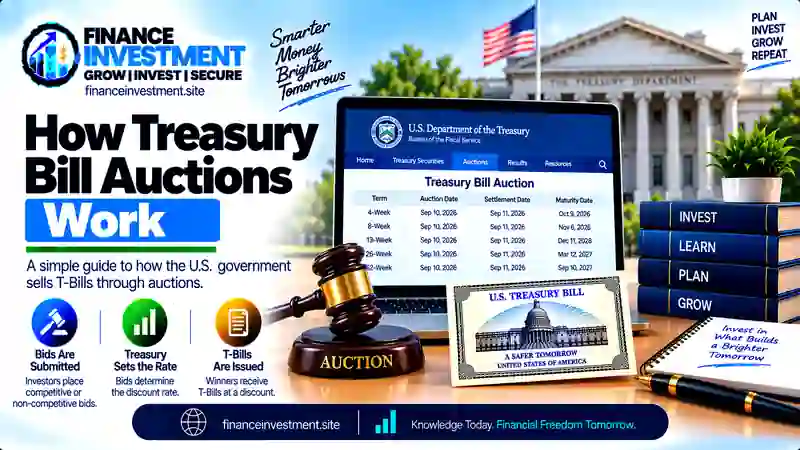 If you are new to T-bills, the auction process may look complicated at first. The basic idea is straightforward: the Treasury announces a new bill, investors submit bids, and the Treasury processes those bids under its auction rules. The results then show the rates and price associated with that particular issue.
Start With the Auction Announcement
Before placing an order, review the applicable Treasury auction announcement. It provides important details such as the bill’s term, offering amount, CUSIP, auction date, issue date, and maturity date. It also states the applicable bidding deadlines and other terms for that auction.
Know Which Bid You Are Using
A noncompetitive bid does not require you to specify a discount rate. You agree to accept the rate determined through the auction, subject to the Treasury’s rules. A competitive bidder, by contrast, specifies the discount rate they are willing to accept for a Treasury bill. Competitive bidding has additional requirements and is generally more relevant to institutional or experienced market participants.
- Choose the bill and review its current auction announcement.
- Select an eligible purchase channel, such as TreasuryDirect or a brokerage.
- Submit the appropriate bid before the deadline stated for that auction.
- Review the published auction results and settlement details afterward.
Beginner tip: If you are buying T-bills for the first time, focus on understanding noncompetitive bidding, the auction deadline, and the published results before learning the more technical competitive bidding process.
How the Treasury Bill Auction Process Works
The Treasury bill auction process follows a defined sequence. The Treasury announces the offering, investors submit bids, the bids are evaluated under the auction rules, and the results establish the terms for the newly issued bills.
1. The Treasury Announces the Bill
The Treasury publishes an offering announcement with details such as the bill’s term, offering amount, CUSIP, auction date, issue date, and maturity date. The announcement also provides the applicable bidding deadlines and other terms for that specific offering.
2. Investors Submit Bids
A noncompetitive bidder does not specify a discount rate and agrees to accept the rate determined by the auction, subject to the applicable rules. A competitive bidder specifies the discount rate they are willing to accept. TreasuryDirect accepts noncompetitive bids; competitive bids must be submitted through an eligible competitive bidding channel.
3. Noncompetitive and Competitive Bids Are Processed
After the applicable deadlines, the Treasury accepts timely noncompetitive bids according to its rules. It then evaluates competitive bids, starting with the lowest discount rates and moving upward until the required amount has been allocated. If necessary, bids at the highest accepted rate can be prorated.
4. The High Rate and Other Results Are Published
For a Treasury bill, the highest accepted competitive discount rate is reported as the high rate. Treasury auction results can also report the investment rate, price, bid amounts, accepted amounts, and other auction statistics. These figures describe the outcome of that particular auction.
5. Successful Purchases Are Settled
Successful purchases are issued on the scheduled issue date. Treasury bills are issued at a discount to face value and, when held to maturity, are redeemed at face value. The difference between the purchase price and the amount received at maturity represents the bill’s return before applicable taxes and other costs.
Key Point: The auction connects investor bids with the final terms of a newly issued T-bill. For a noncompetitive bidder, the rate is not chosen manually; it is determined through the auction.
Benefits and Drawbacks of Treasury Bill Auctions
Buying a newly issued T-bill at auction has several practical features. At the same time, the auction process has rules and trade-offs that investors should understand before placing an order.
Potential Benefits
- You can purchase a newly issued Treasury bill at auction instead of buying an existing bill in the secondary market.
- A noncompetitive bid simplifies rate selection because you agree to accept the rate determined by the auction.
- T-bills have short maturities, which can make them relevant for investors planning around a specific short-term cash need.
Potential Drawbacks
- When you submit a noncompetitive bid, the auction-determined rate is not known in advance.
- Competitive bidding requires you to specify a discount rate and can involve partial allocation or no allocation when the bid is not accepted under the auction rules.
- If you sell a T-bill before maturity, you generally do so through the secondary market, where its market price may be above or below your original purchase price.
Quick Take: Treasury bill auctions offer a defined process for purchasing newly issued bills, but the experience differs depending on the type of bid. Noncompetitive bidding focuses on accepting the auction result, while competitive bidding gives the bidder a specified rate to submit under the Treasury’s rules.
Competitive vs. Noncompetitive Bids
A major part of the Treasury bill bidding process is understanding the difference between competitive and noncompetitive bids. Both participate in the auction, but the bidder’s role and the way the award is determined are different.
| Feature | Noncompetitive Bid | Competitive Bid |
|---|---|---|
| Rate specified? | No. The bidder accepts the rate determined by the auction. | Yes. For T-bills, the bidder specifies a discount rate. |
| How the award is determined | The bid receives the applicable auction-determined rate under the Treasury’s rules. | Bids are evaluated from the lowest discount rates upward until the offering is allocated. |
| Allocation | Timely noncompetitive bids are accepted according to the applicable auction rules and limits. | Bids at the highest accepted discount rate may be prorated when the amount requested exceeds the amount available. |
| TreasuryDirect | Noncompetitive auction bidding is available. | Competitive bidding is not available through TreasuryDirect. |
| Rate uncertainty | The auction-determined rate is not known when the bid is submitted. | The bidder specifies the discount rate for the Treasury to evaluate. |
How Competitive Bids Affect the Auction
After noncompetitive bids are accounted for under the auction rules, the Treasury evaluates competitive bids starting with the lowest discount rates. It continues upward until the amount needed to meet the offering has been allocated. When demand at the highest accepted discount rate is greater than the remaining amount available, bids at that rate can be prorated. The highest accepted discount rate becomes the high rate for the bill auction.
Quick Take: A noncompetitive bid accepts the auction-determined rate. A competitive bid specifies a discount rate for evaluation, and its allocation depends on where that bid falls within the competitive bidding process.
Costs, Risks, and Practical Tips
A Treasury bill auction does not work like a traditional product purchase with a posted retail price. The final auction result determines the terms for the newly issued bill, so it is important to understand the potential costs, tax treatment, and risks before placing an order.
Costs to Watch
- Purchase costs: Check the terms of your purchase channel. TreasuryDirect and individual brokerages can have different policies for fees, commissions, transfers, and other services.
- Taxes: Treasury bill income is generally subject to federal income tax but is exempt from state and local income taxes. Treasury obligations are reported on Form 1099-INT, generally in Box 3.
- Early-sale costs: If you sell a T-bill before maturity, the market price may be different from what you originally paid. Brokerage charges or other transaction costs may also apply.
Risks to Understand
Holding a T-bill until maturity avoids the need to sell it at a market price before the scheduled maturity date, but it does not eliminate every consideration. Inflation can reduce the purchasing power of the return, and selling before maturity exposes you to changes in market prices and interest rates. There is also auction-rate uncertainty when using a noncompetitive bid because the final rate is not known when the bid is submitted.
Practical Tips Before You Bid
- Read the current Treasury auction announcement instead of relying on an old auction date or deadline.
- Know whether you are submitting a competitive or noncompetitive bid.
- Compare the auction’s published investment rate with other available short-term options when evaluating the return.
- If you may need the money before maturity, understand how the secondary market could affect the price you receive.
Quick Take: The auction determines the rate for a newly issued T-bill, but your overall result also depends on taxes, the purchase channel, your holding period, and what happens if you need to sell before maturity.
Common Mistakes and a Real-Life Example
Knowing how Treasury bill auctions work can prevent simple ordering mistakes. The most useful checks happen before the bid is submitted and again after the auction results are published.
Common Auction Mistakes
- Using an outdated auction deadline: Each offering has its own announcement and applicable submission deadlines.
- Confusing the high rate with the investment rate: These are different auction figures and should not be treated as interchangeable.
- Entering a competitive rate without understanding the rules: A competitive bidder specifies a discount rate, and the bid may not receive the requested allocation.
- Ignoring the issue and maturity dates: The purchase should be considered alongside the date when the funds are scheduled to become available at maturity.
Real-Life Example
Consider Maria, who wants to place a $10,000 order for a newly issued T-bill. She reviews the current auction announcement and chooses a noncompetitive bid through an eligible purchase channel. Because she is using a noncompetitive bid, she does not specify a discount rate. Instead, she agrees to accept the rate established by the auction, subject to the applicable Treasury rules.
Once the auction is completed, Maria can review the published Treasury bill auction results to see the high rate, investment rate, price, and other reported figures for that issue. Her purchase is settled according to the auction schedule. If she holds the T-bill until maturity, it is redeemed for its face value. If she sells before maturity, the market price at that time may be different from the amount she originally paid.
Practical Lesson: Before submitting an auction order, verify the current offering, bid type, deadline, issue date, and maturity date. Afterward, use the published auction results to understand the actual terms of the new T-bill.
Who Should Consider Buying at Auction?
Buying a T-bill at auction may be relevant when your investment timeline lines up with the bill’s maturity date and you want a newly issued Treasury security. The auction process can also be useful to understand if you prefer to know the offering details, bidding rules, and settlement schedule before placing an order.
Situations to Consider
- You want to purchase a newly issued T-bill rather than an existing bill in the secondary market.
- You can plan your cash needs around the bill’s scheduled maturity date.
- You understand whether your purchase will use a competitive or noncompetitive bid.
- You are comfortable reviewing the current auction announcement and the results published after the auction.
When Timing Matters More
If you may need access to the money before maturity, buying at auction does not remove the need to consider secondary-market conditions. Selling before maturity can expose you to a market price that is different from the amount originally paid.
Quick Take: The key question is whether the auction’s bill term, maturity date, bidding method, and liquidity considerations fit your particular cash-flow needs.
Treasury Bill Auction FAQs
1. How do Treasury bill auctions work?
The Treasury announces a new bill, investors submit competitive or noncompetitive bids, and the Treasury processes those bids under its auction rules. The published auction results then show the rates, price, and other details for that issue.
2. What is a noncompetitive bid for a T-bill?
A noncompetitive bidder does not specify a discount rate. Instead, the bidder agrees to accept the rate determined by the auction, subject to applicable Treasury rules.
3. What is a competitive bid for a Treasury bill?
A competitive bidder specifies the discount rate they are willing to accept. For Treasury bills, competitive bids are evaluated from the lowest discount rates upward until the offering is allocated under the applicable auction rules.
4. What is the Treasury bill high rate?
The high rate is the highest accepted competitive discount rate for a Treasury bill auction. Competitive bids at that rate may be prorated when the amount requested is greater than the amount available for allocation.
5. Can I submit a competitive bid through TreasuryDirect?
No. TreasuryDirect does not accept competitive bids. Competitive bids must be submitted through an eligible competitive bidding channel.
6. When do I find out the T-bill auction rate?
The Treasury publishes the final auction results after the auction. A noncompetitive bidder therefore does not know the auction-determined rate when submitting the bid.
7. Do Treasury bills pay monthly interest?
No. Treasury bills do not make periodic coupon interest payments. They are generally issued at a discount to face value and, when held to maturity, are redeemed at face value. The difference between the purchase price and face value represents the return before applicable taxes.
8. Are Treasury bill auction earnings taxable?
Generally, yes. Treasury bill interest is subject to federal income tax but is exempt from state and local income taxes. The IRS generally reports Treasury interest on Form 1099-INT in Box 3.
Quick Take: The core auction concepts are the bid type, discount rate, high rate, auction results, and settlement. Understanding these terms makes Treasury bill auction results much easier to read.
Final Takeaway
The easiest way to understand how Treasury bill auctions work is to think of the auction as a structured process rather than a traditional bidding contest. The Treasury announces the issue, investors submit bids, the Treasury processes those bids under its rules, and the auction results are published afterward.
The key distinction is between the two bid types. A noncompetitive bidder agrees to accept the rate established by the auction. A competitive bidder specifies a discount rate for the Treasury to evaluate. The resulting auction data can include the high rate, investment rate, price, and other statistics for that issue.
From there, the practical details matter: check the bill’s maturity date, understand the purchase channel, consider the tax treatment, and know what could happen if you need to sell before maturity. Most importantly, use the current Treasury offering announcement and auction results for the specific bill you are considering.
Remember: Auction dates, deadlines, offering amounts, rates, and other terms can vary by Treasury bill offering. Always review the information for the specific auction before submitting an order.
Have a Money Question? Keep Exploring.
Understanding the auction process is a useful starting point. You can continue by exploring how Treasury bills are purchased and how they fit into the broader Treasury market.
📩 Get in Touch With FinanceInvestment
Leave a Reply