Best 5-Year CD Rates in 2026
Why a 5-Year CD Is a Bigger Decision
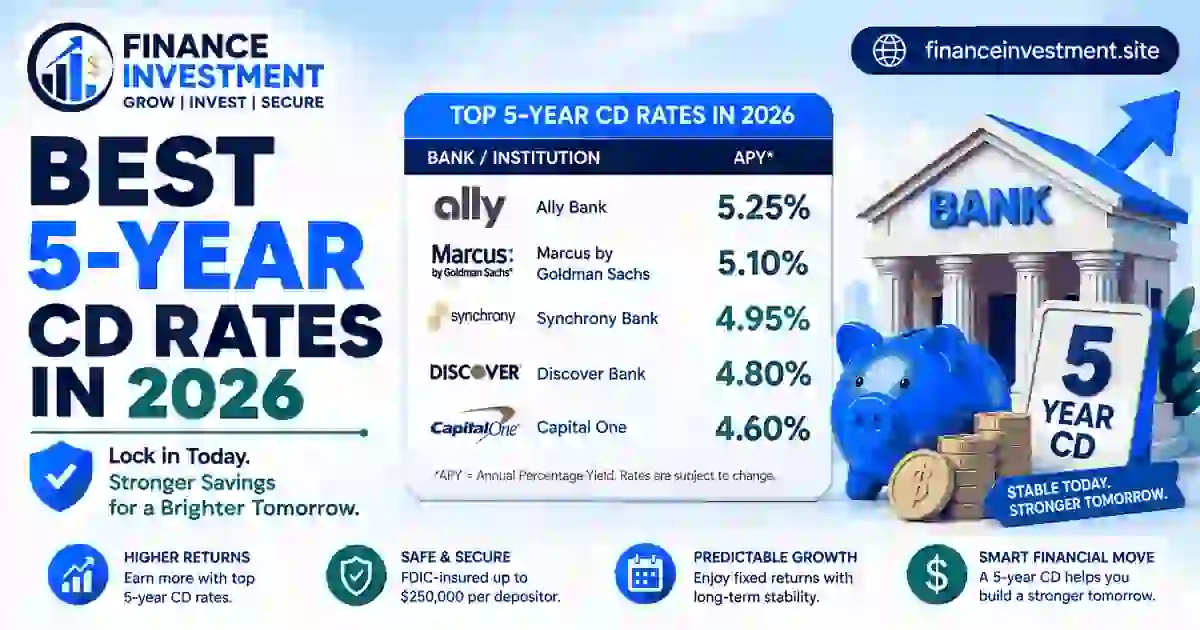 Best 5-Year CD Rates in 2026 can look appealing when you want to lock in a return and leave the money alone. But a 60-month CD asks for something that shorter certificates do not: patience. Five years is long enough for your plans, expenses, and the interest-rate environment to change several times.
That longer lock can work in your favor if deposit rates fall after you open the account. Your fixed rate may continue through maturity while newer CDs offer less. The other side of the deal is just as important. If rates climb substantially, your money may remain tied to the original rate unless the CD’s terms give you another option.
That is why choosing a five-year certificate should start with your timeline, not just the headline APY. If the money has a specific long-term purpose and you are comfortable leaving it untouched, the longer term may fit. If you expect to need flexibility, a shorter CD or liquid savings option deserves a closer look.
For a broader explanation of certificates, terms, strategies, and alternatives, you can explore our Complete CD Guide 2026.
What You’ll Learn
- How 60-month CDs work from opening to maturity
- What to compare beyond the advertised APY
- How rate changes can affect a five-year decision
- Early-withdrawal costs, inflation, and other risks
- When a 5-year CD may fit your financial plan
Quick Answer: Are 5-Year CDs Worth Considering in 2026?
Short answer: A 5-year CD can be attractive when you value a long fixed-rate period and are confident you will not need the money for 60 months. Bankrate’s survey showed a 1.75% national average APY for five-year CDs as of August 20, 2026, while its tracked top CD offers reached 4.50%. Individual five-year offers vary, so the headline average is only a starting point.
6 Key Takeaways
- Five years is a serious commitment: Only use money that does not have a likely near-term job.
- The rate can work in your favor: A fixed rate stays in place even if newly offered CD rates fall.
- Rising rates create opportunity cost: A higher-rate environment could make an older five-year CD less competitive.
- Early access can be expensive: Check the exact early-withdrawal penalty before opening the account.
- Insurance matters: Eligible deposits at FDIC-insured banks and eligible shares at federally insured credit unions receive coverage within applicable limits.
- The right saver needs patience: A five-year CD can fit long-range goals, but someone expecting to need the cash sooner may prefer a shorter term or more liquid account.
Bottom line: The best 5-year CD is not simply the one with the biggest APY. Look at the rate, penalty, minimum deposit, insurance, and what you expect interest rates and your own cash needs to look like over the next five years.
At a Glance: 60-Month CDs in 2026
A five-year CD is built for money you can leave untouched for a long stretch. The term is 60 months, so the details deserve more attention than the headline APY alone. Bankrate’s latest national survey lists the five-year CD average at 1.75% APY as of August 20, 2026. Some individual offers are considerably higher, which makes shopping around especially important.
60 months
1.75% APY as of Aug. 20, 2026
Generally limited before maturity
FDIC or NCUA when eligible
Who Might Consider One?
A 5-year CD may fit someone saving for a distant goal, building a conservative portion of a larger portfolio, or seeking a fixed rate without having to reinvest every year. It is less suitable for cash that may be needed on short notice.
Numbers Worth Comparing
| Factor | What to Check |
|---|---|
| APY | Compare the actual 60-month offer with other institutions. |
| Minimum deposit | Check the amount required to open the certificate. |
| Early-withdrawal penalty | Find out what accessing the money early could cost. |
| Maturity rules | Review the maturity date, grace period, and renewal instructions. |
| Insurance | Confirm applicable FDIC or NCUA coverage and limits. |
Rate note: The 1.75% figure is a national average, not a recommendation or a guaranteed offer. Bankrate’s current listings show individual five-year CDs with APYs well above that average, so compare actual products before choosing one.
Complete Beginner Guide to 60-Month CDs
 A 60-month CD is a time deposit that keeps your money in the account for five years. You deposit money at a bank or credit union, accept the account’s stated terms, and generally leave the funds there until the certificate reaches maturity. In exchange, a fixed-rate CD can give you a defined return over a much longer period than shorter certificates.
How the Five-Year Term Works
The clock starts when the certificate is opened and funded. From that point, the account follows the rate, interest-crediting schedule, withdrawal rules, and other terms in its agreement. The five-year period can be useful for a distant financial goal, but it also means you have fewer opportunities to move the money into a new certificate if market conditions change.
That makes the maturity date especially important. A 60-month CD is not simply a place to park cash; it is a commitment with a specific finish line.
APY and Compounding
APY, or annual percentage yield, helps you compare the earning potential of different deposit accounts because it reflects the effect of compounding. The actual way interest is credited can vary by institution, so check whether earnings are paid monthly, quarterly, annually, or according to another schedule.
For a basic explanation of the mechanics behind CD rates, see our guide to how CD interest rates work.
Minimum Deposits Can Vary
There is no single minimum deposit requirement for every 5-year CD. One institution may accept a relatively small opening deposit, while another may require a larger amount. Don’t stretch your budget just to qualify for a particular offer. The deposit should fit comfortably within the amount you have available for long-term savings.
FDIC and NCUA Protection
Eligible CDs at FDIC-insured banks are covered by FDIC deposit insurance. The standard coverage limit is $250,000 per depositor, per insured bank, for each ownership category. CDs are among the deposit products covered by FDIC insurance.
At a federally insured credit union, a CD may be called a share certificate. The NCUA’s Share Insurance Fund covers eligible share deposits, including share certificates, generally up to $250,000 within the applicable coverage rules.
What Beginners Should Check First
- Verify the APY and how long it remains fixed.
- Check the minimum opening deposit.
- Read the early-withdrawal penalty carefully.
- Confirm the institution’s FDIC or NCUA insurance status.
- Record the maturity date and grace-period rules.
- Find out whether the CD automatically renews after maturity.
That last step can save you from an unwanted rollover. When a five-year CD matures, the next rate may be very different from the rate you originally accepted. Give yourself enough time to review the maturity notice and decide whether to withdraw, move, or reinvest the money.
How a 5-Year CD Works From Day 1 to Maturity
Once the certificate is funded, the process is mostly hands-off. What matters is knowing what happens during each stage and keeping track of the date when your five-year commitment ends.
Opening and Funding
You choose the institution, review the certificate agreement, and transfer the amount you want to deposit. Before confirming the transaction, save the APY, maturity date, early-withdrawal terms, and renewal instructions.
Years 1 Through 5
During the 60-month period, interest is credited according to the account’s terms. With a fixed-rate certificate, the agreed rate generally remains unchanged for the original term. You do not need to make monthly contributions to keep the CD active.
The important difference is what happens outside the account. Deposit rates can move higher or lower while your certificate continues following its original agreement. That makes the five-year timeline useful for planning, but it can also limit your ability to react to new opportunities.
At Maturity
After 60 months, the certificate reaches maturity. Depending on the institution, you may withdraw the money, transfer it elsewhere, or renew it into another CD. A grace period may give you a short window to make that choice before automatic renewal takes effect.
A Simple Five-Year Timeline
| Time | What Happens |
|---|---|
| Day 1 | Deposit the money and confirm the rate and maturity date. |
| Year 1 | The CD continues under its original terms while interest is credited. |
| Years 2–4 | The certificate continues toward maturity; changing market rates do not normally change its fixed rate. |
| Year 5 | Review the maturity notice and decide whether to withdraw or reinvest. |
| Grace period | If provided, use the window to give instructions before automatic renewal. |
A good habit is to set a reminder several weeks before maturity. That gives you time to compare current CD options rather than allowing the certificate to renew automatically without reviewing the new terms.
Benefits and Drawbacks of a 5-Year CD
A five-year certificate changes the balance between certainty and freedom. The longer term gives a fixed-rate CD more time to deliver the return you agreed to, but it also leaves less room to change direction if your finances or the rate environment shifts.
Pros
- Long rate protection: A competitive fixed rate can remain in place for the entire 60-month term, even if new deposit rates decline.
- Predictable interest: The defined rate and maturity date can make long-range cash planning easier.
- Potentially attractive yield: Some institutions offer competitive long-term CD rates, although the highest rate is not always attached to the longest term.
- Less reinvestment work: You do not have to decide every year whether to renew another certificate.
Cons
- Five-year opportunity cost: If rates rise substantially, newer CDs could become more attractive while your money remains locked at the original rate.
- Limited liquidity: Accessing the funds before maturity may come with restrictions or a penalty.
- Early-withdrawal cost: The penalty can reduce your interest earnings and may make an early exit less appealing.
- Inflation risk: Your account balance can grow while inflation reduces the purchasing power of that future money.
The Five-Year Difference
The biggest advantage of a 60-month CD is also its biggest limitation: time. A rate that looks attractive today has five years to prove whether it was a good choice. If rates decline, the longer lock can look valuable. If rates climb, the same decision can leave you wishing you had more flexibility.
5-Year CD vs. Other Savings Options
A 60-month CD sits at the long end of the usual CD range. Comparing it with shorter certificates and a high-yield savings account can show whether the extra years actually fit your plans.
| Option | Term | Liquidity | Useful For |
|---|---|---|---|
| 6-Month CD | 6 months | Generally higher | Near-term goals and frequent rate reviews |
| 1-Year CD | 12 months | Moderate | Goals roughly a year away |
| 2-Year CD | 24 months | Lower | Medium-term savings goals |
| 3-Year CD | 36 months | Generally lower | Longer planned expenses |
| 5-Year CD | 60 months | Generally lowest | Long-range goals and extended rate protection |
| High-Yield Savings | No fixed term | Generally highest | Accessible savings and changing needs |
Choosing the Term That Matches Your Timeline
If five years feels too long, compare the best 6-month CD rates in 2026 or the best 1-year CD rates in 2026. You can also review the best CD rates in 2026 to compare terms side by side.
For readers considering a middle ground, the 2026 CD rate forecast can provide useful context when thinking about how much rate flexibility you want to keep.
Costs, Risks and Expert Tips for a 5-Year CD
A five-year CD deserves a closer look at the fine print because a small disadvantage can matter for a long time. The rate may be fixed, but your financial circumstances and the broader rate environment can change during those 60 months.
Early-Withdrawal Costs
Most traditional CDs charge a penalty when you take money out before maturity. The amount varies by institution and product, so don’t assume every five-year CD uses the same formula. Some penalties can consume a substantial amount of interest, making an early exit costly. 0
When comparing offers, look for the exact penalty period, whether the penalty can reach your principal, and whether any special withdrawal provisions apply.
Inflation and Purchasing Power
A fixed balance can still lose purchasing power. If inflation runs above your CD’s effective return for an extended period, the dollars you receive at maturity may buy less than they do today. Bankrate has also noted that inflation has been putting pressure on the real value of CD returns in 2026.
The Five-Year Opportunity Cost
The longer term creates another risk: rates could rise after you lock in. New CDs might become more attractive, but your existing certificate would generally continue under its original terms. That’s the price of having rate certainty for five years.
Automatic Renewal
Don’t let maturity sneak up on you. A CD may renew automatically if you don’t give instructions during the applicable grace period. Set a calendar reminder well before maturity so you can compare the new rate with other options.
Consider a CD Ladder
A ladder can spread money across different maturity dates rather than placing the entire amount into one five-year certificate. For example, you could divide savings among one-, two-, three-, four-, and five-year CDs. As each certificate matures, you regain access to a portion of the money while maintaining exposure to longer-term rates.
Expert Tip
Don’t compare five-year CDs by APY alone. Write down the APY, minimum deposit, early-withdrawal penalty, maturity date, renewal terms, and insurance coverage side by side. A slightly lower rate with better terms can be more useful than a headline rate that comes with restrictions you don’t want.
Common 5-Year CD Mistakes + A Real-Life Example
A five-year CD can look simple on the surface, but the longest terms leave more room for a small decision to become a costly one. Here are the mistakes worth catching before you deposit your money.
Chasing the APY Without Reading the Terms
A slightly higher rate can grab your attention, but check the minimum deposit, withdrawal penalty, compounding details, and renewal policy before choosing the account. A higher APY is not automatically the better deal.
Putting Emergency Money Into a 5-Year CD
Money you may need for an unexpected expense should not normally depend on a five-year maturity date. Keep short-term cash accessible instead of relying on an early CD withdrawal that could reduce your earnings.
Ignoring What Could Happen to Rates
Locking in a rate means accepting today’s terms for a long period. If market rates rise substantially later, you may have limited options without paying the applicable early-withdrawal cost.
Forgetting Maturity and Taxes
Mark the maturity date on your calendar. Also remember that CD interest can create taxable income even when you leave the earnings inside the account. Your individual tax treatment can vary.
A Simple 5-Year Example
Suppose Maria deposits $25,000 into a five-year CD earning an illustrative 4.00% APY. If the APY remained unchanged and the earnings compounded as assumed, the balance would be approximately $30,416 after five years.
This is an illustrative calculation, not a current CD offer. Actual earnings depend on the institution’s APY, compounding method, account terms, and taxes.
The practical lesson: A five-year CD works best when the money can stay committed for the full term and the account’s terms still look attractive after you read the fine print.
Who Should Choose a 5-Year CD?
A 5-year CD is most useful when the timing of your goal matches the length of the certificate. The decision becomes easier when you know roughly when the money will be needed and have other cash available for unexpected expenses.
Who May Find It Useful?
- Savers with a five-year goal: If the money has a known purpose several years away, a fixed-rate CD can give that portion of your savings a defined timeline.
- Families planning ahead: Money earmarked for a distant education expense, major purchase, or other planned cost may have enough time to remain committed.
- Retirees seeking predictable returns: A CD can provide a known rate for a defined period, although it should be considered alongside the rest of a retirement cash and income strategy.
- Conservative savers: Someone who values deposit protection and a fixed return may prefer a CD over taking additional market risk with money reserved for a specific goal.
- People with liquid reserves: Having accessible savings elsewhere makes it easier to leave the certificate untouched until maturity.
Who Should Think Twice?
A five-year term may be a poor fit if you expect to need the money soon, want to take advantage of potentially higher rates later, or would struggle to cover an unexpected expense without touching the CD.
Quick Decision Guide
Choose a 5-year CD: Your goal is five years away, the rate is competitive, and you have separate liquid savings.
Look at shorter terms: Your plans may change, you need flexibility, or you expect to need the money before maturity.
Frequently Asked Questions About 5-Year CDs
What is the five-year CD rate environment in 2026?
Bankrate reported a 1.75% national average APY for five-year CDs as of August 20, 2026. Individual offers can be much higher, so compare actual 60-month certificates rather than using the national average as an expected return.
What happens if CD rates rise after I open a 5-year CD?
With a typical fixed-rate CD, your original rate stays in effect through the term. If new five-year certificates start paying more, you generally cannot switch without following the account’s withdrawal rules.
What if CD rates fall after I lock in my rate?
A fixed rate can become more valuable if newly available CDs begin paying less. Your certificate generally continues earning the agreed rate until maturity, subject to its original terms.
How does inflation affect a 5-year CD?
Inflation can reduce the purchasing power of your future balance. A CD can increase your dollar balance while still producing a smaller gain in real purchasing power if inflation remains elevated.
Can I withdraw money from a 5-year CD early?
Many traditional CDs allow early withdrawal subject to a penalty, although the exact rules vary by institution. Read the penalty terms before opening the certificate so you know the potential cost of accessing the money early.
What happens when a 5-year CD reaches maturity?
At maturity, you can generally withdraw the funds, move them elsewhere, or renew the certificate, depending on the institution’s rules. A grace period may provide a limited window to give instructions before automatic renewal.
Can a 5-year CD be part of a CD ladder?
Yes. A ladder can spread money across certificates with different maturity dates, giving you periodic access to part of your savings while still using longer-term CDs for another portion.
Are 5-year CDs insured?
Eligible CDs at FDIC-insured banks receive FDIC deposit insurance within applicable limits. At federally insured credit unions, eligible share certificates receive NCUA share insurance, generally up to $250,000 per member-owner within the applicable ownership category.
Is interest from a 5-year CD taxable?
CD interest can generally create taxable income. Your actual tax treatment depends on the account and your circumstances, so consider the tax impact when estimating your after-tax return.
How much could a 5-year CD earn on $20,000?
Illustrative example: At a hypothetical 4.00% APY compounded annually, $20,000 would grow to about $24,333 after five years. This is only an illustration, not a current rate or guaranteed result; actual earnings depend on the CD’s APY, compounding method, terms, and taxes.
Final Verdict: Is a 5-Year CD Right for You?
A 5-year CD can be a sensible choice when the rate is competitive and you have a clear reason to keep the money invested for 60 months. The appeal is not simply the APY. You are also buying a fixed rate that can remain unchanged while the broader deposit market moves around you.
But five years is long enough for the financial landscape to look very different. If rates rise substantially, you may miss better opportunities elsewhere. If your circumstances change, accessing the money early could also reduce the benefit of the original deal.
For that reason, look beyond the advertised rate. Compare the APY, withdrawal penalty, minimum deposit, renewal policy, insurance coverage, and the role the money plays in your overall savings plan.
A 5-year CD may suit a long-range saver who values certainty more than frequent access. Someone who expects changing cash needs or wants to react quickly to future rates may prefer shorter CDs or a savings account.
If you want to compare terms, strategies, and alternatives before making that choice, visit our Complete CD Guide 2026.
The useful question is not “Is this the highest APY?” It is “Would I still be comfortable with this decision if rates, prices, or my plans changed during the next five years?”
Keep Your CD Research Moving
Want more practical guides on CDs, savings, and smarter ways to manage your cash? Send a note to subhashr325@gmail.com to stay connected with FinanceInvestment.
A five-year CD is a long decision. Take your time, compare the terms, and choose an option that still feels comfortable after the headline rate fades from view.
Leave a Reply