Online Checking Accounts vs Traditional Banks: Which Is Better in 2026?
Choosing Where to Keep Your Checking Account
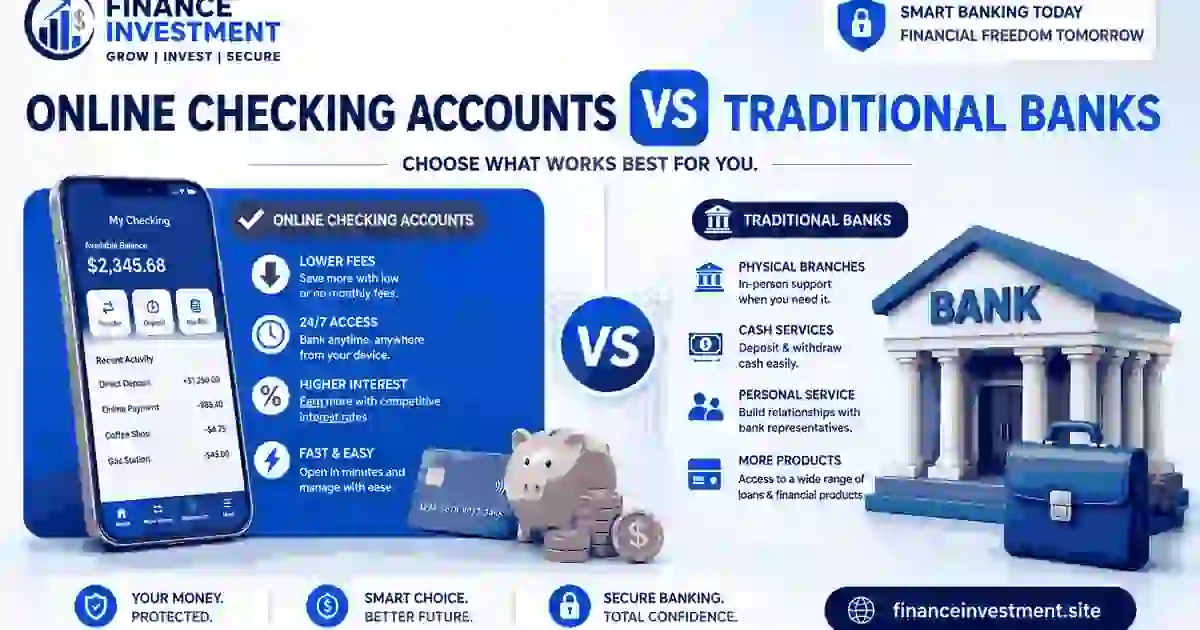 When Marcus needed a new checking account, he had two very different options. One bank offered a branch five minutes from his home. Another let him open an account from his phone, with no trip to a branch. “That simple choice is what makes the two banking models worth comparing.” Online Checking Accounts vs Traditional Banks: do you value digital convenience more, or having a physical place to visit?
Online banks often focus on mobile apps, lower fees, and remote account management. Traditional banks usually offer branches, in-person service, and established ATM networks. Both can provide everyday services such as direct deposit, debit cards, bill payments, and account transfers. The better fit depends on how you actually use your bank.
Someone who rarely visits a branch may care more about a strong app and low fees. A person who deposits cash regularly may put greater value on nearby locations and ATMs. Families, students, and retirees can have different priorities too. Our Checking Accounts USA 2026 guide covers the wider checking-account picture.
What You’ll Learn
You’ll compare fees, branches, ATM access, mobile banking, security, benefits, drawbacks, and everyday usability. We’ll also look at the differences side by side and answer common questions before the final verdict.
Quick Answer & Key Takeaways
Online Checking Accounts vs Traditional Banks mainly comes down to how you prefer to access and manage your money. Online accounts usually put more emphasis on digital service and fewer branch-related costs, while traditional banks offer physical locations alongside digital tools.
6 Key Takeaways
- Fees: Online accounts may have fewer monthly fees, but always check the account terms.
- Branch access: Traditional banks have physical locations; online banks generally do not.
- ATM access: Network size and reimbursement policies can make a real difference.
- Mobile banking: Online banks tend to make app-based account management central to the experience.
- Customer service: Online support may use phone, chat, or secure messaging, while traditional banks can add face-to-face help.
- Best fit: Your cash-deposit needs, travel habits, technology comfort, and preference for branches should guide the choice.
Bottom Line: The better account is the one that fits the way you actually bank, not simply the one with the most features.
“The next sections break down the details you’ll actually deal with when using either type of bank.”
Table of Contents
Start with the quick facts below, then explore the areas that matter most to your banking needs.
At a Glance
Online banks usually lean heavily on apps and remote service. Traditional banks add physical branches and in-person support, often alongside similar digital tools.
Online Checking Accounts vs Traditional Banks depends on your priorities. Online accounts can suit digital-first users, while traditional banks can help people who value branches, cash services, or face-to-face assistance.
| Feature | Online Bank | Traditional Bank |
|---|---|---|
| Monthly fees | Often lower | Varies by account |
| Branch access | Usually unavailable | Available |
| ATM access | Network dependent | Usually branch-linked |
| Mobile banking | Core service | Usually available |
| Cash deposits | May be limited | Usually easier |
| Customer support | Phone, chat, online | Online, phone, branch |
“The real difference shows up when you start using the account for everyday tasks.”
Complete Beginner Guide
 Opening a checking account is fairly straightforward, whether you choose an online bank or a traditional bank. With Online Checking Accounts vs Traditional Banks, the biggest difference usually appears in how you open the account and how you get help afterward.
For an online account, you normally complete an application through the bank’s website or app. A traditional bank may let you apply online too, but you can also visit a branch. Either way, expect to provide information such as your name, address, date of birth, Social Security number, and a government-issued ID. The bank may verify your identity before approving the account.
Once approved, you’ll need to fund the account if the bank requires an opening deposit. You can then set up direct deposit, activate your debit card, and connect the account to other financial services. For more background, see How Does a Checking Account Work?.
Daily management can look different. An online bank may handle nearly everything through its app, including transfers, alerts, mobile check deposits, and transaction reviews. A traditional bank gives you those digital tools while adding the option to speak with someone at a branch.
A Beginner Example
Sophie works from home and rarely carries cash. She opens an online checking account, sets up direct deposit, and uses the bank’s app to pay bills and monitor spending. Her brother, who regularly deposits cash from a side business, chooses a traditional bank because having a nearby branch is more useful to him.
ATM access deserves a closer look, too. Online banks may rely on partner ATM networks or reimburse certain fees, while traditional banks often have their own machines. Cash deposits can also be easier at a branch, although some online banks provide alternative deposit options.
Neither setup is difficult to manage once the account is established. “Where things feel different is in the way you handle those everyday requests.”
How It Works
With Online Checking Accounts vs Traditional Banks, the money can move through much of the same banking infrastructure even when your interaction with the bank looks completely different. A debit card purchase, for example, sends a request through the card network before the bank decides whether to approve it.
An ACH transfer follows a different route between financial institutions. Direct deposit sends eligible income into the account, while an ATM withdrawal involves the machine, its network, and your bank. In each case, the bank checks the account and processes the request before the transaction is finalized.
App or Branch?
An online customer might request a transfer from a mobile app. A traditional-bank customer could make a similar request through an app, website, phone call, or branch. The delivery channel changes, but the underlying account still has to process the transaction.
Timing is not always identical. Weekends, holidays, cutoff times, payment networks, and the type of transaction can affect when money becomes available. A transaction may also show as authorized before it appears as fully posted.
A Monthly Example
Ethan receives his paycheck by direct deposit on Friday morning. Later that day, he uses his debit card for groceries. The deposit and card purchase appear in the same account, but they follow different processing paths. His bank’s app shows the activity as each transaction moves through its respective system.
For Online Checking Accounts vs Traditional Banks, the visible difference is often the way you interact with the bank. One customer may handle nearly everything from a phone, while another may occasionally walk into a branch for help.
Those small differences can become noticeable when you use the account week after week. and the trade-offs that come with them.
Benefits & Drawbacks
The better banking setup depends on what you need most. Online Checking Accounts vs Traditional Banks can look very different when you factor in cash, branches, technology, and how often you want personal help.
Pros
- Potentially lower monthly fees
- Strong digital banking tools
- Physical branches with traditional banks
- Broader in-person support
- Convenient ATM access
- Easier cash deposits at many branches
Cons
- Online banks may have limited or no branches
- Some accounts still charge fees
- ATM availability can vary
- Cash deposits may be harder with online banks
- Digital access depends on technology
- Traditional branches have location and hour limits
A frequent traveler who handles almost everything from a phone may appreciate an online bank. Someone who deposits cash, needs a cashier’s check, or prefers face-to-face assistance may feel more comfortable with a traditional bank.
A Different Example
Laura runs a small home-based business and deposits cash several times a month. She likes mobile banking, but having a nearby branch saves her time when those deposits pile up. An online account might offer useful features, yet the branch is more valuable for the way she handles money.
Neither model wins every situation. What matters most is whether the account fits the way you already handle money
Comparison Table
The table puts the main differences in one place. For a broader look at account structures, see Types of Checking Accounts Explained.
| Factor | Online Checking | Traditional Bank | Hybrid Approach | Credit Union |
|---|---|---|---|---|
| Monthly fees | Often competitive | Varies by account | Depends on accounts used | Often competitive |
| Branch access | Usually limited | Strong | Available through selected bank | Available at member locations |
| ATM access | Network dependent | Usually broad | Depends on providers | Network dependent |
| Mobile banking | Core feature | Usually strong | Can combine apps | Usually available |
| Cash deposits | May be limited | Usually convenient | Depends on provider | Often available |
| Customer service | Phone/chat/online | Online + branch | Varies | Online + branch |
| Technology | Usually app-focused | Digital + physical | Mixed experience | Digital + physical |
| Convenience | High for digital users | Strong for local customers | Flexible | Good for members |
| Security | Digital controls matter | Digital + branch controls | Depends on providers | Digital + branch controls |
| Best use | Digital-first banking | Branch + digital needs | People wanting flexibility | Members wanting local service |
| Main limitation | Limited physical service | Fees or branch dependence | Managing multiple providers | Membership requirements may apply |
How to Read This Table
Don’t judge an account by one row. A low-fee account may be less useful if you regularly need cash deposits, while a branch-based account may be worth considering if in-person help matters to you.
The numbers are only part of the decision. Fees, account policies, and the way you handle money can change the real cost of each option.
Costs, Risks & Expert Tips
The price of a checking account is not always visible when you open it. Online Checking Accounts vs Traditional Banks can involve monthly maintenance charges, overdraft fees, ATM costs, or minimum-balance requirements. Online accounts may also make cash deposits less convenient.
Security deserves equal attention. Fake banking pages, phishing messages, stolen passwords, and unauthorized transactions can affect either type of account. Online banks can also experience app or service outages. Traditional banks have digital systems too, although a branch may provide another way to get help when technology is unavailable.
Check whether the institution is FDIC-insured if it is a bank. Credit unions generally use NCUA federal share insurance instead. Coverage rules and limits matter more than whether an account looks modern or familiar.
Expert Tip
Before opening an account, check the fee schedule, ATM policy, minimum balance, cash-deposit options, fraud alerts, and customer-service hours. Those details can uncover charges or restrictions that aren’t obvious at first glance.
Warning
Never enter banking credentials through a link in an unexpected text or email. Open the official bank app or type the bank’s known website address yourself.
Nina chose an online account for its low-cost setup, but later discovered that depositing cash required an extra step. She kept the account because it worked well for her other needs, while changing how she handled cash.
Common Mistakes + Real-Life Example
Choosing between Online Checking Accounts vs Traditional Banks gets easier when you avoid a few simple oversights. The account that looks attractive at first may not fit your actual routine.
Avoid These Mistakes
- 1. Skipping the fee schedule — Check monthly, overdraft, and other possible charges first.
- 2. Ignoring ATM access — Find nearby machines and review any reimbursement policy.
- 3. Forgetting about cash deposits — Make sure your chosen bank gives you a practical way to deposit cash.
- 4. Assuming every online bank works alike — Compare features instead of judging by the bank’s name.
- 5. Missing minimum-balance rules — Know what balance you need to avoid charges.
- 6. Reusing weak passwords — Use a strong, unique password and enable available security features.
- 7. Ignoring account alerts — Turn on notifications for purchases, transfers, and unusual activity.
- 8. Delaying questions about unfamiliar activity — Review the transaction and contact the institution promptly if something looks wrong.
A Real-Life Example
Andre opened an online checking account because he liked managing money from his phone. A few weeks later, he realized the closest fee-free ATM was much farther away than expected. He also occasionally received cash from freelance work. Instead of closing the account immediately, Andre compared ATM options and cash-deposit alternatives, then decided whether the savings were worth the extra effort.
Andre’s situation is a good reminder that a low-cost account isn’t automatically the easiest one to live with. Online Checking Accounts vs Traditional Banks should be judged against your own banking habits. A small inconvenience can matter more than a feature that looks impressive on a comparison page.
Once those everyday issues are clear, it becomes easier to decide which type of bank actually fits your routine.
Who Should Choose This?
For Online Checking Accounts vs Traditional Banks, the right fit often comes down to your daily routine. People who manage nearly everything through an app may enjoy an online account. Someone who deposits cash often or wants face-to-face help may prefer a bank with nearby branches.
Best Fit
- Online checking: A good match for digital-first users, travelers, students, and people who rarely need cash or branch visits.
- Traditional banking: Useful for families, retirees, and frequent cash users who value local branches and personal service.
- Both: Some people keep a traditional account for cash and branch needs while using an online account for everyday digital banking.
If you are uncomfortable managing money through an app, regularly need specialized branch services, or simply prefer another banking arrangement, a mixed setup can give you more flexibility. What matters is whether the account makes your normal banking routine easier rather than adding extra work.
The questions below cover the points people often want to settle before opening an account.
Frequently Asked Questions
What is the difference between an online checking account and a traditional bank?
The main difference is how you access banking services. An online checking account is built primarily around digital tools, while a traditional bank usually combines online services with physical branches.
Are online checking accounts cheaper?
They can be cheaper, but not always. Some online banks offer fewer monthly fees, while others may charge for specific services. Always check the current fee schedule before opening an account.
Do online banks have ATMs?
Yes. Many online banks provide access through ATM networks or partner machines. The available locations, withdrawal limits, and fee-reimbursement rules vary by bank.
Can I deposit cash into an online checking account?
Sometimes. Certain online banks support cash deposits through participating retail locations or other services, while others may not accept cash deposits directly. Check the bank’s deposit options first.
Are online banks safe?
Yes, an online bank can be safe when it uses appropriate security measures and has applicable federal deposit insurance. Customers should also use strong passwords, multifactor authentication, and account alerts.
Is a traditional bank better for customer service?
Not necessarily. Traditional banks can offer face-to-face assistance, while online banks may provide phone, chat, and secure messaging. The better experience depends on how you prefer to get help.
Can I have both online and traditional bank accounts?
Yes. Keeping both can be useful when you want the digital features of an online account while retaining branch access for cash deposits or other in-person needs.
Which is better for students and beginners?
Either can work well. Students who are comfortable using apps may prefer online banking, while beginners who want in-person guidance may appreciate a nearby branch.
Which type of bank is better for frequent travelers?
An online bank may suit frequent travelers who manage money mainly through a phone, but ATM availability and foreign transaction policies still matter. A traditional bank can also work well if its ATM network is convenient in the places you visit.
Before you decide: Before choosing, compare the account’s actual fees, ATM access, deposit options, and support channels rather than relying on the bank’s category alone.
Final Verdict
Online Checking Accounts vs Traditional Banks comes down to how you actually use your account. An online bank can be a strong fit if you handle most tasks through your phone, care about keeping fees low, and rarely need a branch. A traditional bank may make more sense if you deposit cash, use ATMs regularly, or prefer talking with someone in person.
Look beyond the account label. Check monthly fees, ATM access, cash-deposit options, mobile banking tools, customer service, and security features. Your travel habits and the places where you normally bank can matter just as much.
A Simple Way to Decide
If you rarely visit a branch, start by comparing online accounts. If cash deposits and face-to-face help are part of your routine, put local banks on the shortlist. You can also keep both types when each solves a different problem.
For the bigger picture, our Checking Accounts USA 2026 guide covers the wider range of checking-account choices and features.
A good account should make everyday banking feel simple, not add another chore to your week. The resources below can help you compare the details more closely.
Ready to Take Control of Your Checking Setup?
A good checking account should fit into your routine without making simple banking feel complicated. Keep comparing the details that matter to you, whether that means branches, apps, ATMs, or everyday fees.
Want more practical banking guides? Join the newsletter for new articles. If you’ve had a good or frustrating experience with online or traditional banking, share it in the comments. It may help another reader make a better choice.
Leave a Reply