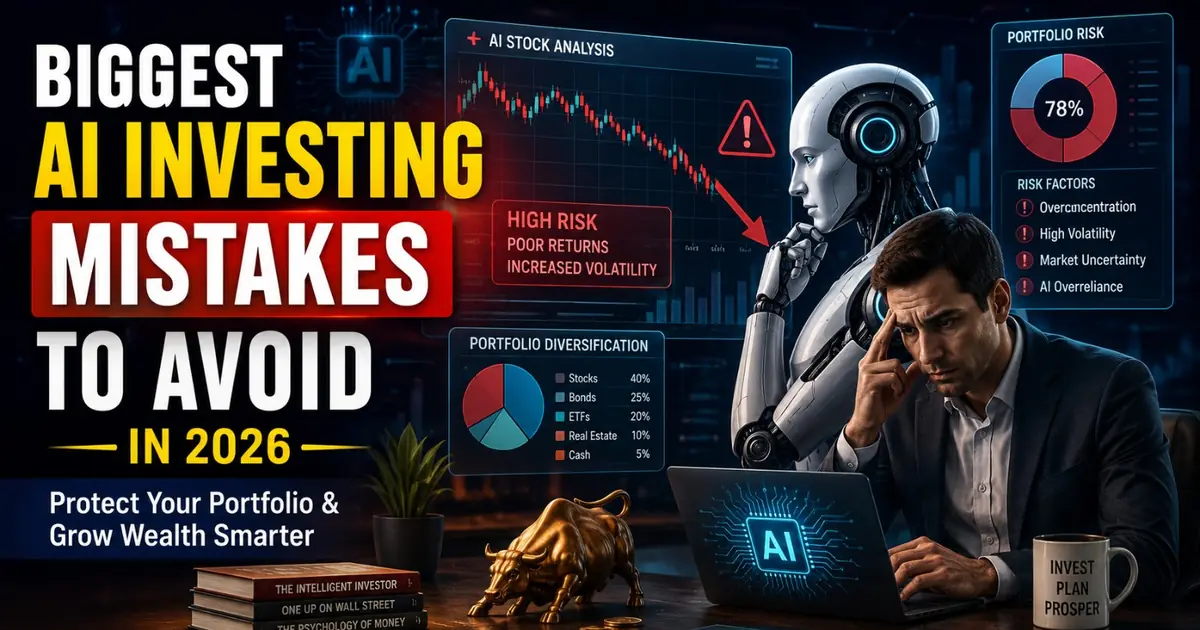
Biggest AI Investing Mistakes to Avoid in 2026: Protect Your Portfolio and Invest Smarter
Author: Subhash Rukade
Published: June 17, 2026
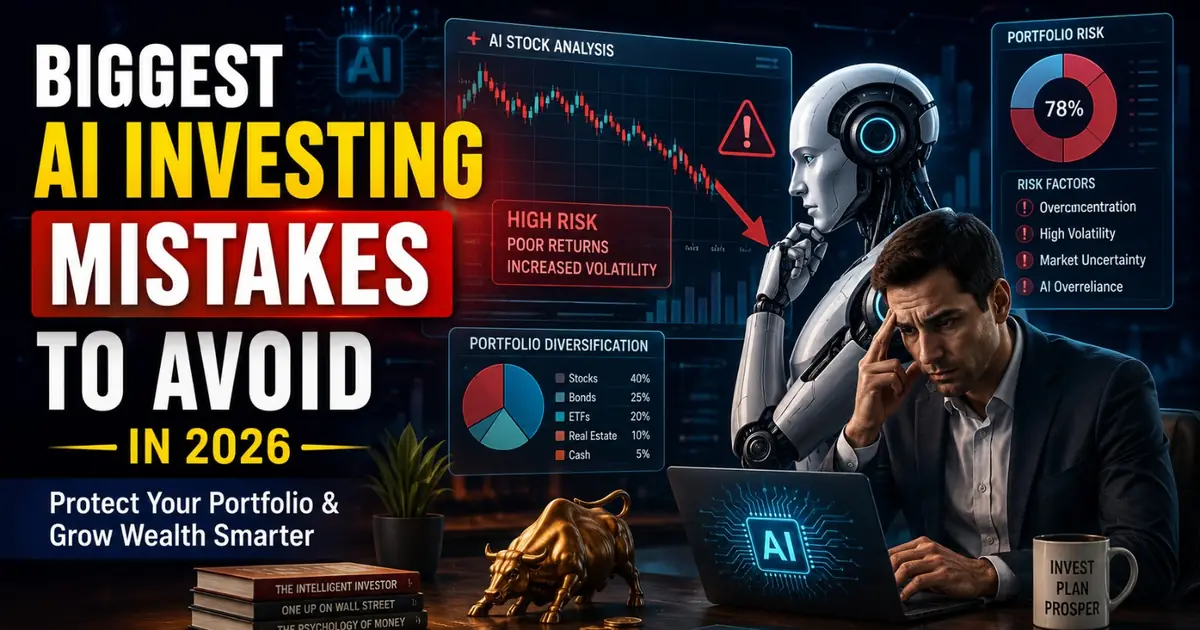
Why AI Investing Mistakes Matter More Than Ever in 2026
Biggest AI Investing Mistakes to Avoid has become an important topic for investors as artificial intelligence continues transforming the way people manage money. AI-powered investing platforms can analyze huge amounts of data, automate portfolio management, identify trends, and provide personalized recommendations within seconds.
Because of these capabilities, millions of Americans are now using AI tools to support retirement planning, wealth building, passive income strategies, and long-term investing goals.
However, despite all the benefits, artificial intelligence is not perfect.
Many investors assume that AI can predict markets accurately or eliminate investment risk completely. Unfortunately, that belief often leads to costly mistakes.
Artificial intelligence can improve decision-making, but it cannot guarantee profits. Markets remain influenced by economic events, geopolitical developments, interest rates, investor behavior, and unexpected risks that even the most advanced algorithms cannot fully predict.
As AI investing becomes more mainstream in 2026, investors must learn how to use these tools wisely.
The goal should never be replacing common sense with automation.
Instead, successful investors use AI as a powerful assistant that helps improve research, portfolio management, and risk analysis while maintaining human oversight.
If you’re new to this rapidly growing trend, we strongly recommend reading our
AI Investing Guide 2026,
which provides a complete overview of how artificial intelligence is changing investing and wealth management.
In this guide, we’ll explore the biggest AI investing mistakes to avoid, explain why these mistakes occur, and provide practical strategies that can help investors protect their portfolios while taking advantage of AI-powered financial tools.
Avoiding a few common mistakes today could make a significant difference in your long-term financial success tomorrow.
Mistake #1: Blindly Trusting AI Recommendations
One of the Biggest AI Investing Mistakes to Avoid is assuming that artificial intelligence is always correct.
Many investors are impressed by AI’s ability to analyze markets, process data, and generate investment recommendations within seconds. While these capabilities are powerful, they can create a false sense of confidence.
AI is a tool—not a crystal ball.
No algorithm can predict the future with complete accuracy.
Financial markets are influenced by countless factors, including economic conditions, interest rates, political events, corporate earnings, consumer behavior, and unexpected global developments.
Even the most advanced AI systems can only make decisions based on available data.
When unusual market conditions occur, AI models may struggle because they rely heavily on historical patterns.
Why Blind Trust Can Be Dangerous
Some investors assume that if an AI platform recommends a stock, ETF, or investment strategy, it must be the best option available.
This mindset can lead to poor diversification, excessive risk-taking, and emotional disappointment when investments fail to perform as expected.
Successful investing still requires critical thinking.
Investors should evaluate recommendations, understand risks, and ensure investment choices align with their financial goals.
Human Oversight Still Matters
The most successful investors use AI as a decision-support tool rather than a decision-maker.
Artificial intelligence can identify opportunities, but human judgment remains important when evaluating financial goals, risk tolerance, and market uncertainty.
Investors interested in improving overall money management should also review our
AI Personal Finance 2026
guide.
Building a strong financial foundation often starts with choosing the right financial products. Readers may also benefit from our
Best Credit Cards 2026
resource.
📊 Comparison Table: Smart AI Use vs Risky AI Use
| Smart AI Use | Risky AI Use |
|---|---|
| Researching investment ideas | Buying assets without research |
| Portfolio monitoring | Ignoring portfolio risks |
| Using AI alongside human judgment | Trusting AI blindly |
| Diversifying investments | Concentrating in a few assets |
| Long-term planning | Chasing short-term predictions |
The key lesson is simple.
AI can improve investing decisions, but investors should never surrender responsibility for their financial future. Combining AI insights with sound judgment remains one of the best ways to reduce risk and build long-term wealth.
Mistake #2: Ignoring Diversification and Overloading on AI Stocks
Another one of the Biggest AI Investing Mistakes to Avoid in 2026 is failing to diversify properly.
As artificial intelligence continues dominating headlines, many investors are pouring large portions of their portfolios into AI-related stocks and technology companies.
While some AI businesses have delivered impressive growth, concentrating too much money in a single sector can significantly increase risk.
History has repeatedly shown that even the most promising industries experience corrections, volatility, and unexpected setbacks.
Investors who place all their money into one trend often expose themselves to unnecessary financial risk.
Why Diversification Still Matters
Diversification remains one of the most effective risk-management strategies available to investors.
Instead of relying on one industry, diversified portfolios spread investments across multiple asset classes, sectors, and income sources.
This approach helps reduce the impact of poor performance in any single investment.
AI can identify opportunities, but it should not replace the fundamental principle of diversification.
The Danger of AI Stock Hype
Many investors assume every company associated with artificial intelligence will become a long-term winner.
However, strong marketing, media attention, and investor excitement do not always translate into sustainable profits.
Some companies benefit from temporary hype cycles while others struggle to convert innovation into long-term earnings growth.
Investors should evaluate business fundamentals, revenue growth, profitability, competitive advantages, and valuation before making investment decisions.
Building a Balanced Portfolio
A diversified portfolio may include growth stocks, dividend stocks, index funds, bonds, cash reserves, and alternative investments depending on individual goals.
Investors interested in creating reliable income streams should review our
How to Build a Dividend Portfolio
guide.
Readers seeking strong dividend opportunities may also benefit from our
Top Dividend Stocks USA 2026
resource.
📘 Recommended Finance Book
The Intelligent Investor by Benjamin Graham
This classic investing book emphasizes diversification, risk management, and disciplined decision-making—principles that remain just as important in the AI investing era.
The most successful investors understand that AI can improve research and portfolio management, but diversification remains essential for protecting wealth and reducing long-term risk.
In the next section, we’ll examine another costly mistake: chasing AI hype instead of focusing on business fundamentals.
Mistake #3: Chasing AI Hype Instead of Business Fundamentals
One of the most expensive examples of the Biggest AI Investing Mistakes to Avoid is chasing hype instead of focusing on investment fundamentals.
Artificial intelligence has become one of the hottest themes in financial markets. As a result, investors often rush into AI-related stocks simply because they are trending on social media, appearing in news headlines, or receiving attention from analysts.
Unfortunately, hype and long-term value are not always the same thing.
Many investors become excited about a company’s AI potential without fully understanding its financial health, revenue growth, profitability, debt levels, or competitive position.
History shows that popular trends can create market bubbles.
When expectations become unrealistic, stock prices may rise much faster than business performance. Eventually, reality catches up, and investors who bought at inflated valuations often suffer significant losses.
Why Fundamentals Matter
Successful investing focuses on businesses, not headlines.
Before investing in any AI-related company, investors should examine:
- Revenue growth
- Profitability trends
- Cash flow strength
- Competitive advantages
- Debt levels
- Valuation metrics
A company with strong fundamentals is often better positioned for long-term success than one receiving attention solely because of AI-related news.
The Fear of Missing Out (FOMO)
FOMO is one of the biggest drivers of poor investment decisions.
When investors see stocks rising rapidly, they often fear being left behind.
This emotional response can lead to buying investments at inflated prices without conducting proper research.
AI investing should be driven by analysis and strategy—not excitement and speculation.

📊 Real-World Example
Consider an investor who purchased several AI-related stocks during a period of intense market enthusiasm.
Instead of reviewing financial statements and valuation metrics, the investor relied primarily on social media recommendations and AI-generated stock rankings.
When market sentiment changed, several of those stocks experienced sharp declines.
Meanwhile, diversified investors who focused on quality businesses and long-term fundamentals were better positioned to manage volatility.
The lesson is clear.
Artificial intelligence can improve research and investment analysis, but it should never replace fundamental investing principles.
Investors who focus on business quality, reasonable valuations, and long-term wealth creation are far more likely to achieve sustainable success than those who chase every new trend.
Mistake #4 and #5: Ignoring Fees and Investing Without a Plan
Some of the Biggest AI Investing Mistakes to Avoid have nothing to do with technology itself.
In many cases, investors lose money because they overlook basic investing principles. Two of the most common mistakes are ignoring investment costs and investing without a clear financial plan.
Even the most advanced AI platform cannot overcome these weaknesses.
Mistake #4: Ignoring Fees and Hidden Costs
Many investors focus entirely on potential returns while paying little attention to fees.
Although AI investing platforms are often less expensive than traditional financial advisors, costs still matter.
Management fees, fund expense ratios, trading costs, subscription fees, and platform charges can reduce long-term returns.
A seemingly small annual fee can compound into thousands of dollars over decades.
Before selecting any AI investing platform, investors should understand exactly what they are paying and what services are included.
Lower costs allow more capital to remain invested and benefit from long-term compounding.
Mistake #5: Investing Without a Clear Plan
Another major mistake is investing without specific goals.
Many investors buy stocks, ETFs, or AI-generated recommendations without determining why they are investing in the first place.
Successful investing begins with a plan.
Whether the objective is retirement, passive income, financial independence, wealth building, or education savings, every investment decision should support a larger financial strategy.
Investors who follow structured investment plans often make better long-term decisions than those reacting to short-term market movements.
Readers looking to build consistent investing habits should review our
SIP Investing Guide 2026.
Protecting wealth during economic uncertainty is equally important. Our
Recession-Proof Investing 2026
guide offers additional strategies for risk management.
📘 Recommended Finance Book
The Psychology of Money by Morgan Housel
This bestselling book explains why behavior, patience, and long-term planning often have a greater impact on investment success than market predictions.
AI can help automate investing decisions, but it cannot define personal goals or create discipline. Investors who understand costs, establish clear objectives, and maintain consistent strategies are far more likely to build lasting wealth over time.
Biggest AI Investing Mistakes to Avoid #1: Blindly Trusting AI Recommendations
Practical AI Investing Strategies for 2026
Avoiding the Biggest AI Investing Mistakes to Avoid is only part of the equation. Investors must also follow proven strategies that help balance risk, improve returns, and support long-term wealth creation.
Artificial intelligence can be a powerful investing assistant when used correctly. The key is combining AI tools with sound investing principles.
1. Use AI for Research, Not Blind Decisions
AI platforms can quickly analyze market data, identify trends, and evaluate thousands of securities.
However, investors should treat AI recommendations as starting points for research rather than automatic buy signals.
Combining AI insights with personal analysis can lead to more informed decisions.
2. Follow a Diversified Investment Strategy
Diversification remains one of the most effective ways to manage risk.
Instead of concentrating investments in a single AI stock or technology sector, investors should spread assets across multiple industries and investment types.
A balanced portfolio can help reduce volatility during market downturns.
3. Rebalance Portfolios Regularly
Market movements can gradually shift portfolio allocations away from intended targets.
Many AI platforms offer automated rebalancing features that help maintain appropriate asset allocations.
Regular portfolio reviews can improve risk management and long-term consistency.
4. Combine AI With Human Judgment
One of the strongest investing approaches in 2026 is the hybrid model.
AI handles data analysis, portfolio monitoring, and automation while investors apply experience, goals, and personal judgment.
This combination helps reduce emotional decision-making while maintaining flexibility.
💰 Investment Growth Calculator Example
Suppose an investor contributes $500 per month to a diversified portfolio earning an average annual return of 8%.
| Years Invested | Estimated Portfolio Value |
|---|---|
| 10 Years | ~$91,000 |
| 20 Years | ~$295,000 |
| 30 Years | ~$745,000 |
This example highlights the power of consistency and compounding rather than relying on short-term predictions.
📊 Comparison Table: Smart AI Investor vs Risky AI Investor
| Smart AI Investor | Risky AI Investor |
|---|---|
| Diversifies investments | Concentrates in hype stocks |
| Reviews recommendations | Follows AI blindly |
| Focuses on long-term goals | Chases short-term gains |
| Controls risk | Ignores portfolio balance |
| Uses AI + human judgment | Depends entirely on automation |
📘 Recommended Finance Book
The Simple Path to Wealth by JL Collins
This popular investing book focuses on simplicity, diversification, and long-term wealth creation—principles that remain essential regardless of how advanced AI investing becomes.
The most successful investors use AI to enhance their strategies, not replace them. Technology works best when paired with discipline, patience, and a clear investment plan.
The Future of AI Investing (2026–2030)
The future of Biggest AI Investing Mistakes to Avoid is closely connected to how artificial intelligence continues evolving over the next several years.
AI investing platforms are becoming more advanced, more personalized, and more accessible to everyday investors. However, future success will depend not only on technology but also on how investors use these tools responsibly.
The investors who understand both the opportunities and limitations of AI are likely to have a significant advantage.
Smarter AI Investing Tools
By 2030, AI platforms may be capable of providing highly personalized investment recommendations based on income, spending patterns, tax situations, retirement goals, and risk tolerance.
These systems could help investors make faster and more informed financial decisions while reducing administrative work.
Greater Transparency and Regulation
As artificial intelligence becomes more involved in investment management, regulators are expected to increase oversight.
Investors will likely demand greater transparency regarding how algorithms make recommendations and manage portfolios.
Trust, security, and accountability will become increasingly important.
The Rise of Hybrid Investing
Many experts believe the future belongs to hybrid investing.
Instead of choosing between technology and human expertise, investors may combine both approaches.
AI can analyze data and automate portfolio management while humans provide judgment, emotional discipline, and long-term planning.
Frequently Asked Questions
1. Is AI investing safe?
AI investing can be safe when used through reputable platforms and combined with proper diversification and risk management.
2. Can AI predict stock market movements?
No system can predict markets perfectly. AI analyzes data and probabilities but cannot eliminate uncertainty.
3. What is the biggest AI investing mistake?
Blindly trusting AI recommendations without conducting personal research is one of the most common mistakes.
4. Should I invest only in AI stocks?
Most financial experts recommend diversification rather than concentrating investments in a single sector.
5. Can beginners use AI investing tools?
Yes. Many platforms are designed specifically for beginner investors and offer automated portfolio management.
6. What is the future of AI investing?
The future will likely include more personalized investment strategies, stronger regulation, and greater integration between AI tools and human advisors.
Final Thoughts on the Biggest AI Investing Mistakes to Avoid
Understanding the Biggest AI Investing Mistakes to Avoid can help investors make better decisions and reduce unnecessary risks.
Many investors enter the market without recognizing the Biggest AI Investing Mistakes to Avoid. As a result, they may follow AI recommendations blindly, ignore diversification, or chase market hype.
The smartest investors learn from the Biggest AI Investing Mistakes to Avoid before those mistakes damage their portfolios.
Whether you are a beginner or experienced investor, avoiding the Biggest AI Investing Mistakes to Avoid should be a priority in 2026.
By focusing on diversification, risk management, long-term planning, and proper research, investors can avoid the Biggest AI Investing Mistakes to Avoid and build wealth more confidently.
Remember that AI is a tool. It is not a guarantee of success. Investors who understand the Biggest AI Investing Mistakes to Avoid are often better prepared for market volatility and long-term investing challenges.
The future of investing will include more artificial intelligence, but the ability to recognize the Biggest AI Investing Mistakes to Avoid will remain an important skill for every investor.
Conclusion
Understanding the Biggest AI Investing Mistakes to Avoid can help investors protect their portfolios, reduce risk, and make smarter financial decisions.
Artificial intelligence offers powerful tools for portfolio management, market analysis, and wealth building. However, successful investing still depends on diversification, patience, discipline, and long-term planning.
The most effective investors use AI as a valuable assistant rather than a replacement for critical thinking.
If you want a complete understanding of how artificial intelligence is changing investing, be sure to explore our
AI Investing Guide 2026.
By combining smart technology with proven investing principles, investors can position themselves for long-term success in an increasingly AI-driven financial world.
Trusted Financial Resources
- U.S. Securities and Exchange Commission (SEC)
- Financial Industry Regulatory Authority (FINRA)
- Federal Reserve
📩 Join Our Free AI Investing Newsletter
Get AI investing insights, portfolio strategies, wealth-building ideas, retirement planning tips, and market updates delivered directly to your inbox.
Subscribe today and stay ahead of the future of investing.
👨💼 About the Author
Subhash Rukade writes about AI investing, personal finance, passive income, dividend investing, and wealth-building strategies. His mission is to help readers make informed financial decisions through practical and easy-to-understand financial education.
🚀 Great investing isn’t about avoiding every mistake. It’s about learning from mistakes early and staying committed to long-term financial success.
Leave a Reply