Treasury Bill Auction Dates Explained
When Are Treasury Bills Auctioned?
 Knowing Treasury Bill Auction Dates Explained can make the buying process much easier. If you are planning to purchase a T-bill, you may see three different dates: the announcement date, the auction date, and the issue date. Each one has a different purpose, so confusing them can lead to missed deadlines or poor planning.
Treasury bills follow recurring auction patterns based on their maturity terms, but the exact dates can change because of holidays, Treasury funding needs, or other scheduling changes. That is why the current official Treasury schedule should always be checked before placing an order.
If you are new to T-bills, you can first review our
Treasury Bills Explained guide
for the basics. This article then takes the next step by focusing specifically on the auction calendar and the dates you need to watch.
What You’ll Learn
- How the Treasury bill auction calendar is organized
- What announcement, auction, and issue dates mean
- How 4-, 8-, 13-, 17-, 26-, and 52-week bills fit into the schedule
- How to find the latest official Treasury auction dates
- How to plan a T-bill purchase without relying on an outdated calendar
Quick Answer: When Are Treasury Bills Auctioned?
Regular Treasury bills follow recurring auction patterns. The 4-, 6-, 8-, 13-, 17-, and 26-week bills are generally offered weekly, while the 52-week bill is generally offered every four weeks. The exact date for a particular offering should be confirmed through the current Treasury schedule and offering announcement before you place an order.
Key Takeaways
- The announcement date is when Treasury publishes the offering details for a specific bill.
- The auction date is when Treasury conducts the auction and determines the price and applicable auction rate.
- The issue date is when the newly auctioned Treasury bill is issued and settlement occurs.
- Regular auction patterns help with planning, but holidays and other Treasury scheduling changes can shift individual dates.
- For an actual purchase, check the current official Treasury offering information instead of relying only on a general calendar.
Table of Contents
Treasury Bill Auction Dates at a Glance
Treasury bills follow recurring auction patterns based on their maturity terms. That makes the general calendar useful for planning, but it should not be treated as a list of guaranteed dates. The specific offering announcement is the better source when you are preparing to buy a particular T-bill.
| Bill Term | Typical Frequency | Usual Auction Day |
|---|---|---|
| 4-week | Weekly | Thursday |
| 6-week | Weekly | Tuesday |
| 8-week | Weekly | Thursday |
| 13-week | Weekly | Monday |
| 17-week | Weekly | Wednesday |
| 26-week | Weekly | Monday |
| 52-week | Every 4 weeks | Tuesday |
QUICK TAKE: The days shown above are the Treasury’s usual auction pattern for regular bills. They are not a substitute for the current offering announcement. Holidays and other special circumstances can change the timing, so check TreasuryDirect for the specific auction you plan to purchase.
Treasury Bill Auction Dates: A Beginner’s Guide
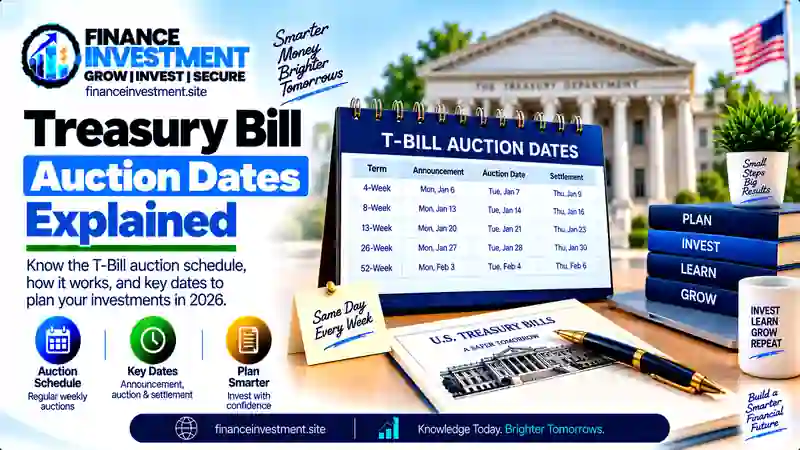 For a first-time buyer, a Treasury bill auction calendar can seem confusing because several dates appear for the same offering. The easiest way to read it is to separate the process into three stages: the announcement, the auction, and the issue. Each date marks a different step.
1. Identify the Bill Term
Regular Treasury bills currently include 4-, 6-, 8-, 13-, 17-, 26-, and 52-week terms. The 4-, 6-, 8-, 13-, 17-, and 26-week bills generally follow weekly auction patterns, while the 52-week bill generally follows a four-week cycle.
2. Check the Specific Offering
Once you know the bill term you want, find the specific offering on TreasuryDirect. The official offering announcement provides the dates and terms for that particular auction. This matters because a general recurring schedule can change for holidays or other special circumstances.
3. Plan Around the Auction
If you are buying through TreasuryDirect, review the purchase instructions and deadline shown for the offering. If you are using a brokerage, check that firm’s order deadline because it may differ from Treasury’s schedule. Give yourself enough time to complete the order before the applicable cutoff.
BEGINNER TIP: Treat the recurring calendar as a planning tool, not as a guaranteed list of dates. Before placing an order, verify the specific offering, auction date, issue date, and applicable purchase deadline.
How Treasury Bill Auction Dates Work
A Treasury bill auction follows a sequence that starts with an offering announcement and ends with the bill’s issue and settlement. The recurring calendar helps you anticipate an auction, while the specific offering announcement provides the dates and terms for that particular bill.
Step 1: Treasury Announces the Offering
Treasury first publishes an official offering announcement. It identifies the security and provides details such as the auction date, issue date, maturity date, offering amount, and bidding information. When you need the exact details for an upcoming T-bill, this specific announcement is more useful than a general calendar pattern.
Step 2: Investors Submit Bids
Treasury auctions can include both noncompetitive and competitive bids. A noncompetitive bidder agrees to accept the auction result and, under the applicable rules, receives the amount requested if the bid qualifies. A competitive bidder specifies the discount rate they are willing to accept. Depending on the auction result, a competitive bid can be accepted in full, accepted in part, or rejected.
Step 3: Treasury Conducts the Auction
Treasury evaluates competitive bids according to the rates submitted and accepts bids until the offering is filled under the auction rules. Treasury bills are sold through a single-price auction, meaning successful competitive and noncompetitive bidders receive the same purchase price for that offering.
Step 4: The Bill Is Issued and Settled
On the issue date, the newly auctioned bill is issued and the transaction is settled. The security then appears in the investor’s TreasuryDirect or brokerage account, depending on where it was purchased. An investor who later wants to sell before maturity must use the applicable secondary market rather than the original auction.
EXPERT TIP: Use the recurring auction schedule for planning, but use the specific offering announcement as your final reference. That is where you confirm the dates and terms for the T-bill you intend to purchase.
Benefits and Drawbacks of Following the Treasury Bill Auction Calendar
A Treasury bill auction calendar can make short-term investing easier to organize. It gives you a framework for planning potential purchases and maturity dates. Still, a schedule is only a planning tool and does not determine the final terms of an individual auction.
Potential Benefits
- Helps you anticipate when regular T-bill offerings may be auctioned.
- Makes it easier to coordinate purchases with expected cash needs.
- Can help with planning a short-term Treasury ladder.
- Gives you a starting point for researching a specific upcoming offering.
Potential Drawbacks
- A recurring schedule does not guarantee the exact date of every offering.
- Holidays and other Treasury scheduling changes can affect the timing.
- The calendar cannot tell you the final auction rate or purchase price in advance.
- Selling before maturity means using the secondary market, where the price can differ from your original purchase price.
WHAT TO REMEMBER: Use the auction calendar to plan ahead, but use the individual Treasury offering announcement to confirm the dates and terms for a specific T-bill. The schedule helps you prepare; it does not replace the official offering details.
Treasury Bill Auction Schedule Comparison
The table below compares the regular Treasury bill terms, their usual auction frequency, and the normal timing between auction and issue. These patterns are useful for planning, but an individual offering can follow a different date because of holidays or other Treasury scheduling changes.
| Bill Term | Usual Frequency | Usual Auction Day | Usual Issue Timing |
|---|---|---|---|
| 4-week | Weekly | Thursday | Following Tuesday |
| 6-week | Weekly | Tuesday | Thursday |
| 8-week | Weekly | Thursday | Following Tuesday |
| 13-week | Weekly | Monday | Thursday after auction |
| 17-week | Weekly | Wednesday | Following Tuesday |
| 26-week | Weekly | Monday | Thursday after auction |
| 52-week | Every 4 weeks | Tuesday | Thursday |
HOW TO USE THIS TABLE: Choose the bill term that fits your time horizon, then use its usual auction pattern as a planning reference. Before placing an order, confirm the exact auction and issue dates in the current Treasury offering announcement.
Costs, Risks & Expert Tips for Treasury Bill Auctions
Knowing the auction date is only one part of planning a T-bill purchase. You should also check the purchase method, applicable costs, tax treatment, and what could happen if you need your money before maturity.
Costs and Taxes to Check
- TreasuryDirect does not charge a purchase commission for Treasury marketable securities. A brokerage may have its own fees, commissions, or transaction rules.
- Treasury bill income is generally subject to federal income tax but is exempt from state and local income taxes.
- If you sell before maturity, your brokerage’s applicable transaction costs and the secondary-market price can affect the amount you receive.
Timing and Market Risks
The recurring auction schedule should be treated as a planning guide, not a guarantee of every individual date. Treasury can change auction timing because of holidays or other special circumstances. Also, buying at auction does not mean you can later sell at the same price. A bill sold before maturity is subject to the secondary market, where prices can move.
EXPERT TIP: Before placing an order, verify the specific offering’s auction date, issue date, maturity date, and applicable purchase deadline. Then check your platform’s instructions. The recurring calendar helps you plan, but the individual offering should be your final reference.
Common Treasury Bill Auction Date Mistakes
Most auction-date mistakes happen when investors rely on a familiar calendar pattern without checking the specific offering. A few simple checks can make the process much easier to manage.
Mistakes to Avoid
- Confusing the announcement and auction dates.
The announcement provides the offering details, while the auction is when Treasury conducts the sale. - Treating the usual weekday as a guaranteed date.
Regular patterns can change because of holidays or other Treasury scheduling circumstances. - Forgetting the issue date.
The bill’s issue and settlement occur after the auction according to the offering schedule. - Not checking the applicable purchase deadline.
TreasuryDirect and brokerage platforms can have different ordering instructions or cutoffs.
Real-Life Example: Planning a T-Bill Purchase
Suppose Maria wants to invest $10,000 in a 13-week Treasury bill. She starts by looking at the regular auction pattern, which gives her a general idea of when an offering may occur. She does not stop there. Maria checks the specific Treasury offering announcement before placing her order.
She verifies the auction date, issue date, maturity date, and applicable purchase instructions. If she is using a brokerage, she also checks that firm’s order deadline. Because she confirms the individual offering instead of relying only on the recurring calendar, Maria has a clearer timeline for her $10,000 purchase.
SMART HABIT: Use the calendar to plan ahead, then verify the individual offering before you buy. Check the auction date, issue date, maturity date, and applicable purchase instructions in that order.
Who Should Use the Treasury Bill Auction Calendar?
The Treasury bill auction calendar is most useful for investors who want to organize purchases around upcoming offerings. It can also help when you are matching new purchases with expected cash needs or planning when existing bills may mature.
Who May Find It Useful?
- First-time T-bill buyers who want to understand when regular offerings are normally auctioned.
- Short-term cash planners who want to coordinate a purchase with a future cash need.
- Treasury ladder planners who are scheduling purchases across different bill maturities.
- Existing Treasury investors who want a recurring reference for upcoming offerings.
KEEP IN MIND: The calendar is a planning reference, not a substitute for the official offering announcement. Before purchasing, check the specific auction date, issue date, maturity date, and applicable purchase instructions for the bill you are considering.
Frequently Asked Questions About Treasury Bill Auction Dates
1. How often are Treasury bills auctioned?
The 4-, 6-, 8-, 13-, 17-, and 26-week Treasury bills are generally offered weekly. The 52-week bill is generally offered every four weeks.
2. What is the difference between an announcement date and an auction date?
The announcement date is when Treasury publishes the offering details. The auction date is when Treasury conducts the auction and determines the auction results and applicable price.
3. What is the Treasury bill issue date?
The issue date is when the newly auctioned Treasury bill is issued and settlement takes place according to the offering terms. It is generally separate from the auction date.
4. Where can I find current Treasury bill auction dates?
TreasuryDirect’s current auction information and individual offering announcements are the best places to check upcoming dates. Use the general schedule for planning, then verify the specific offering before placing an order.
5. Are Treasury bill auction dates always the same?
No. Regular Treasury bills follow recurring patterns, but holidays and other Treasury scheduling circumstances can change the date of an individual offering.
6. Can I buy a Treasury bill on the auction date?
If you are buying through TreasuryDirect, you generally must submit a noncompetitive bid before the applicable auction deadline. A brokerage may set its own order cutoff, so check the broker’s instructions rather than assuming you can place an order at any time on auction day.
7. What happens after a Treasury bill auction?
Treasury publishes the auction results. For accepted purchases, the transaction then proceeds to the issue and settlement date listed for that offering. The bill can generally be held until maturity or sold earlier through the applicable secondary market.
8. Should I rely only on a Treasury bill auction calendar?
No. The calendar is useful for planning, but the specific offering announcement should be your final reference for the auction date, issue date, maturity date, and applicable purchase instructions.
Final Takeaway: How to Use Treasury Bill Auction Dates
Treasury bill auction dates become much easier to follow when you separate the three main stages of an offering. The recurring schedule helps you plan ahead, while the specific Treasury offering announcement gives you the dates and terms for the bill you actually want to purchase.
The announcement date is when Treasury publishes the offering details. The auction date is when Treasury conducts the auction. The issue date is when the newly auctioned bill is issued and settled.
Regular Treasury bills follow recurring auction patterns, but individual dates can change because of holidays or other scheduling circumstances. That makes the current offering announcement more important than relying on a calendar pattern alone.
THE SIMPLE RULE: Use the recurring calendar for planning, check the official offering announcement for confirmation, and follow your TreasuryDirect or brokerage purchase instructions before the applicable deadline.
Have a Money Question? Keep Exploring.
Want to learn more about Treasury bills, auction timing, or short-term investing? Continue exploring FinanceInvestment for practical guides designed to help you understand your options and plan with more confidence.
📩 Get in Touch With FinanceInvestment
Have a question or feedback about this guide? Send us an email.
Continue Your Research
|