Tag: Machine Learning

  • How AI Detects Credit Card Fraud in Real Time: 2026 Guide

    How AI Detects Credit Card Fraud in Real Time: 2026 Guide


    How AI Detects Credit Card Fraud in Real Time: 2026 Guide

    Published: June 13, 2026

    AI Credit Card Fraud

    Why AI Credit Card Fraud Detection Matters More Than Ever

    Credit card fraud continues to be one of the fastest-growing financial crimes in the United States. As digital payments become more common, criminals are developing increasingly sophisticated methods to steal card information and perform unauthorized transactions.

    AI Credit Card Fraud detection has become one of the most important banking security technologies in 2026. Banks use artificial intelligence to identify suspicious transactions, prevent fraud losses, and protect cardholders in real time.

    For consumers, a single fraudulent transaction can create stress, financial disruption, and countless hours spent resolving account issues. For banks and credit card companies, fraud costs billions of dollars every year.

    This is where AI Credit Card Fraud detection is changing the game.

    Traditional fraud detection systems relied heavily on predefined rules. For example, a transaction above a certain amount or a purchase made in another country might trigger an alert. While these systems provided some protection, they often struggled to keep up with modern fraud techniques.

    Artificial intelligence offers a much smarter solution.

    Today’s AI systems can analyze millions of transactions in real time, identify suspicious behavior patterns, and detect potential fraud within seconds. Instead of relying only on fixed rules, AI continuously learns from new data and adapts to emerging threats.

    This ability to learn and improve makes AI one of the most powerful tools available for protecting consumers and financial institutions.

    Many of the same technologies transforming fraud prevention are also changing investing, budgeting, and personal finance. Investors interested in these innovations should explore our
    AI Investing & Personal Finance Guide 2026.

    Banks, payment processors, and credit card networks now use advanced AI systems to monitor spending patterns, evaluate risk levels, and stop suspicious transactions before they cause significant financial damage.

    The result is faster fraud detection, stronger security, fewer false alarms, and improved protection for consumers.

    In this guide, you’ll learn exactly how AI detects credit card fraud in real time, the technologies behind these systems, real-world examples, practical security tips, and what the future of AI-powered fraud prevention may look like.

    How AI Fraud Detection Works Behind the Scenes

    To understand why AI Credit Card Fraud prevention has become so effective, it’s important to see what happens every time a credit card transaction is processed.

    When a customer swipes a card, taps a smartphone, or makes an online purchase, AI systems immediately begin analyzing dozens of data points before approving the transaction.

    This entire process often takes less than a second.

    Unlike traditional fraud detection systems that depend mainly on fixed rules, artificial intelligence evaluates behavior patterns, spending history, device information, geographic location, transaction amounts, and thousands of other variables simultaneously.

    Machine Learning Learns Normal Behavior

    The foundation of modern Credit Card Fraud Detection is machine learning.

    Machine learning algorithms study historical transaction data and learn what normal customer behavior looks like.

    For example, if a customer typically shops within Texas, spends between $20 and $300 per transaction, and rarely makes international purchases, AI recognizes these patterns.

    When activity suddenly changes, the system becomes more alert.

    Real-Time Transaction Monitoring

    Every transaction generates a digital footprint.

    AI banking security systems continuously monitor these transactions in real time.

    The software compares new purchases against previous spending habits and evaluates whether the transaction appears legitimate.

    If something unusual occurs, the transaction may receive a higher fraud risk score.

    Behavioral Analysis

    One of the most powerful features of AI fraud detection is behavioral analysis.

    Instead of looking only at transaction amounts, AI studies how customers normally behave.

    It can analyze purchasing frequency, merchant preferences, login habits, device usage, and geographic movement patterns.

    Because every consumer has unique financial habits, AI creates highly personalized risk assessments.

    Risk Scoring Systems

    Modern AI systems assign a risk score to every transaction.

    Low-risk purchases proceed normally, while higher-risk transactions may trigger additional verification requests.

    In some situations, banks may temporarily block suspicious transactions until customers confirm their identity.

    Pattern Recognition at Massive Scale

    AI excels at identifying fraud patterns that human analysts might miss.

    As fraudsters develop new techniques, machine learning models continuously update and improve. This adaptive capability allows banks to respond quickly to emerging threats.

    Many of the same AI technologies used in fraud prevention are also transforming budgeting and financial management. To learn more, visit our
    AI Personal Finance Guide 2026.

    The combination of machine learning, behavioral analysis, risk scoring, and real-time monitoring is why AI Credit Card Fraud systems are now considered one of the strongest defenses against modern financial crime.

    AI Technologies Used to Stop Credit Card Fraud

    The effectiveness of AI Credit Card Fraud prevention comes from several advanced technologies working together behind the scenes. These systems analyze millions of transactions every day and help financial institutions detect suspicious activity before fraud causes significant damage.

    Unlike traditional fraud detection systems that depend heavily on static rules, artificial intelligence continuously learns and adapts to new threats.

    Machine Learning Models

    Machine learning serves as the foundation of modern Credit Card Fraud Detection.

    These models are trained using enormous datasets containing both legitimate and fraudulent transactions.

    Over time, the algorithms learn to identify patterns that often indicate fraud.

    As criminals change tactics, machine learning models continue updating themselves, making fraud detection increasingly accurate.

    Neural Networks

    Many financial institutions now use neural networks to improve AI banking security.

    Neural networks mimic certain aspects of human decision-making by processing large amounts of information simultaneously.

    These systems can identify subtle fraud indicators that traditional rule-based software might overlook.

    This helps reduce financial losses while improving customer protection.

    Predictive Analytics

    Predictive analytics allows AI systems to anticipate fraud risks before fraudulent transactions are completed.

    Instead of reacting after fraud occurs, AI evaluates current transaction behavior and predicts whether a purchase may be suspicious.

    This proactive approach has become one of the most valuable components of modern fraud prevention.

    Device Fingerprinting

    Another important technology is device fingerprinting.

    AI systems analyze information about the device being used for a transaction, including browser settings, operating systems, IP addresses, and device characteristics.

    If a transaction suddenly originates from an unfamiliar device, the risk score may increase.

    Geolocation Monitoring

    AI also monitors geographic activity.

    For example, if a customer makes a purchase in Florida and another transaction appears from another country minutes later, the system immediately recognizes the inconsistency.

    Geolocation analysis helps banks detect impossible travel patterns and suspicious activity in real time.

    Consumers interested in choosing secure credit card options should also review our
    Best Credit Cards 2026
    guide.

    Traditional Fraud Detection vs AI Fraud Detection

    FeatureTraditional DetectionAI Fraud Detection
    Learning AbilityFixed RulesContinuous Learning
    Detection SpeedSlowerReal-Time
    AccuracyModerateHigh
    AdaptabilityLimitedDynamic
    Fraud PreventionReactivePredictive

    These advanced technologies explain why AI Credit Card Fraud systems have become one of the most effective tools available for protecting consumers, banks, and payment networks from financial crime.

    Real-World Example: How AI Stops Credit Card Fraud in Seconds

    To understand how AI Credit Card Fraud detection works in practice, let’s look at a realistic example involving a typical American credit card user.

    Imagine John, a 42-year-old professional from Chicago, who regularly uses his credit card for groceries, fuel, online shopping, and travel bookings.

    Over several years, his bank’s AI system has learned his normal spending behavior. It understands the stores he visits, the average amount he spends, the devices he uses, and even the locations where transactions usually occur.

    One evening, John is at home watching television when a criminal attempts to use his stolen card information to make a $2,800 online purchase from another country.

    The transaction reaches the bank’s payment network within seconds.

    Step 1: AI Analyzes the Transaction

    As soon as the purchase request appears, the AI fraud detection system begins evaluating dozens of risk factors.

    • Purchase location
    • Device information
    • Transaction amount
    • Merchant category
    • Historical spending patterns
    • Recent account activity
    • Geographic behavior

    The AI immediately notices that the purchase location is thousands of miles away from John’s normal activity.

    It also detects that the device being used has never been associated with his account.

    Step 2: Risk Score Calculation

    Modern Credit Card Fraud Detection systems assign a fraud probability score to every transaction.

    Because multiple risk indicators are present, the AI calculates a high-risk score for the transaction.

    The amount is unusually large compared to John’s typical purchases, and the location does not match his normal behavior.

    Within milliseconds, the transaction is flagged for further review.

    Step 3: Real-Time Fraud Prevention

    Instead of waiting for a customer complaint, the AI system acts immediately.

    The payment request is temporarily blocked while additional verification takes place.

    John instantly receives a fraud alert through his banking app and text message.

    The notification asks whether he attempted the purchase.

    He selects “No.”

    The transaction is permanently declined, and a fraud investigation begins automatically.

    Step 4: Continuous Learning

    One of the biggest advantages of AI Credit Card Fraud systems is continuous learning.

    After the fraud attempt is confirmed, the transaction becomes part of the system’s training data.

    This helps the AI identify similar fraud patterns in the future and improve detection accuracy across millions of accounts.

    Many of the same machine learning technologies used in fraud prevention are also helping investors make smarter financial decisions. Readers interested in AI-driven financial innovation should revisit our
    AI Investing & Personal Finance Guide 2026.

    This real-world example shows why artificial intelligence has become such a powerful tool in modern banking security. By analyzing data instantly, assigning risk scores, and taking action within seconds, AI helps protect consumers from financial losses before fraud can cause significant damage.

    Common Mistakes and Limitations of AI Fraud Detection

    While AI Credit Card Fraud detection has dramatically improved banking security, no system is perfect. Artificial intelligence can identify suspicious transactions faster than humans, but there are still challenges and limitations that both consumers and financial institutions must understand.

    Knowing these limitations helps cardholders use credit cards more safely and respond appropriately when fraud alerts occur.

    1. False Positive Alerts

    One of the most common issues with modern Credit Card Fraud Detection systems is false positives.

    Sometimes legitimate transactions are mistakenly flagged as suspicious.

    For example, if a customer travels to a new city, makes an unusually large purchase, or shops at an unfamiliar retailer, AI may temporarily block the transaction.

    Although this can be frustrating, these alerts are designed to protect consumers from unauthorized activity.

    2. Identity Theft Remains a Risk

    Even the most advanced AI banking security systems cannot completely eliminate identity theft.

    If criminals gain access to personal information through phishing attacks, data breaches, or stolen credentials, they may still attempt fraudulent activities.

    This is why strong passwords, multi-factor authentication, and secure online behavior remain important.

    3. Overreliance on Automation

    Many consumers assume their bank’s AI system will catch every fraudulent transaction.

    While AI significantly improves fraud detection accuracy, customers should continue monitoring account activity regularly.

    Reviewing statements and transaction histories remains an important part of financial security.

    4. Data Privacy Concerns

    AI systems require large amounts of transaction data to function effectively.

    Some consumers worry about how personal financial information is collected, stored, and analyzed.

    Financial institutions must balance fraud prevention efforts with privacy protections and regulatory compliance.

    5. User Errors Create Security Risks

    Many fraud cases still result from simple mistakes.

    Sharing card information through unsecured websites, clicking suspicious links, or responding to scam emails can expose sensitive financial data.

    Even the best AI Credit Card Fraud systems work most effectively when consumers follow good security practices.

    Investors and consumers concerned about protecting their finances during uncertain economic conditions should also review our
    Recession-Proof Investing 2026
    guide.

    For additional consumer protection information, trusted resources such as the
    Consumer Financial Protection Bureau (CFPB)
    and the
    Federal Trade Commission (FTC)
    provide valuable guidance on fraud prevention and financial security.

    Ultimately, the most effective protection comes from combining AI-powered fraud detection with responsible financial habits, account monitoring, and consumer awareness.

    Practical Ways to Protect Your Credit Cards Using AI and Smart Security Habits

    While banks invest heavily in AI Credit Card Fraud detection systems, consumers also play an important role in protecting their financial accounts. The good news is that modern technology provides several tools that make fraud prevention easier than ever.

    By combining AI-powered security features with responsible financial habits, cardholders can significantly reduce the risk of becoming fraud victims.

    Enable Real-Time Banking Alerts

    One of the simplest ways to improve financial security is enabling transaction alerts through your bank or credit card provider.

    Most major financial institutions now use AI banking security systems that send instant notifications whenever purchases are made.

    If unauthorized activity occurs, customers can react immediately rather than discovering fraud weeks later.

    Monitor Transactions Regularly

    Even though modern Credit Card Fraud Detection systems are highly effective, reviewing account activity remains important.

    Checking recent transactions weekly can help identify suspicious activity before significant financial losses occur.

    Many banking apps now use AI to automatically highlight unusual purchases for customer review.

    Use Mobile Security Apps

    Many financial institutions offer mobile applications with built-in security features.

    These apps often include fraud alerts, biometric authentication, transaction tracking, spending analysis, and account monitoring tools.

    AI continuously evaluates account activity and helps identify potential threats in real time.

    Create Strong Passwords and Enable Multi-Factor Authentication

    Strong account security begins with strong login credentials.

    Consumers should avoid simple passwords and enable multi-factor authentication whenever available.

    This additional security layer makes it much harder for criminals to access financial accounts.

    Review Credit Reports

    Identity theft often appears on credit reports before victims realize fraud has occurred.

    Regularly reviewing credit reports can help detect unauthorized accounts, suspicious inquiries, and other warning signs.

    Maintaining strong financial awareness remains an important part of AI Credit Card Fraud prevention.

    Human Monitoring vs AI Fraud Monitoring

    FeatureHuman MonitoringAI Fraud Monitoring
    SpeedManual ReviewsReal-Time Analysis
    Data ProcessingLimitedMillions of Transactions
    Pattern RecognitionModerateAdvanced
    AvailabilityBusiness Hours24/7 Monitoring
    ScalabilityLimitedExtremely High

    Investors interested in building long-term wealth while maintaining strong financial habits should also explore our
    Top Dividend Stocks USA 2026
    guide.

    Another highly recommended personal finance resource is
    The Simple Path to Wealth by JL Collins.
    The book offers practical lessons on wealth building, investing, and long-term financial success.

    Combining AI-powered monitoring with smart personal security practices provides one of the strongest defenses against modern credit card fraud.

    Future of AI Credit Card Security

    The future of AI Credit Card Fraud detection looks incredibly promising. As cybercriminals develop more sophisticated attack methods, financial institutions are investing heavily in artificial intelligence to stay ahead of emerging threats.

    Banks are moving beyond traditional fraud detection and adopting predictive security systems that can identify suspicious behavior before fraud occurs.

    These next-generation technologies will help reduce financial losses while improving customer protection and convenience.

    Biometric Authentication

    Future AI banking security systems are expected to rely more heavily on biometric verification.

    Fingerprint recognition, facial recognition, voice authentication, and behavioral biometrics can provide additional layers of security that are difficult for criminals to bypass.

    Predictive Fraud Prevention

    Instead of simply reacting to suspicious transactions, future AI systems will focus on predicting fraud risks before transactions are completed.

    This proactive approach may significantly reduce fraud attempts and improve overall payment security.

    Smarter AI Banking Security

    As machine learning models continue improving, banks will be able to identify increasingly complex fraud patterns while reducing false positive alerts.

    This means legitimate transactions will experience fewer interruptions while suspicious activity receives faster attention.

    Frequently Asked Questions

    1. How does AI detect credit card fraud in real time?

    AI analyzes transaction data, spending patterns, device information, and customer behavior to identify suspicious activity within seconds.

    2. Is AI fraud detection more effective than traditional systems?

    Yes. AI can process significantly more data, learn from new threats, and adapt faster than traditional rule-based systems.

    3. Can AI stop every fraudulent transaction?

    No. While AI greatly improves security, no system can eliminate fraud completely.

    4. Why do legitimate purchases sometimes get declined?

    AI systems occasionally flag unusual transactions as suspicious. These false positives occur when activity differs from normal spending behavior.

    5. Do consumers still need to monitor their accounts?

    Absolutely. AI improves protection, but regular account monitoring remains an important security practice.

    6. What is the future of AI banking security?

    Future systems will likely include predictive fraud prevention, biometric authentication, and even more advanced machine learning models.

    Conclusion: How AI Detects Credit Card Fraud in Real Time

    Artificial intelligence has transformed the way banks, payment processors, and financial institutions protect consumers from fraud.

    By combining machine learning, behavioral analysis, predictive analytics, and real-time monitoring, AI Credit Card Fraud systems can identify suspicious activity faster and more accurately than ever before.

    Although no security solution is perfect, AI continues to strengthen financial protection while making digital payments safer for millions of Americans.

    To learn more about how artificial intelligence is transforming investing, personal finance, and wealth management, visit our
    AI Investing & Personal Finance Guide 2026.

    Investors focused on long-term financial growth should also explore our
    How to Build a Dividend Portfolio
    guide.

    📩 Join Our Free Finance Newsletter

    Get AI finance insights, investing tips, credit card security updates, and wealth-building strategies delivered directly to your inbox.

    Subscribe today and stay one step ahead of financial threats and opportunities!

    📘 Recommended Reading:

    I Will Teach You To Be Rich by Ramit Sethi


    About the Author

    Subhash Rukade writes about AI, investing, personal finance, and financial security to help readers make smarter money decisions.

    🚀 Thank you for reading. Stay secure, stay informed, and keep building a stronger financial future!
  • How AI Analyzes Stocks in Seconds: The Future of Smart Investing in 2026

    How AI Analyzes Stocks in Seconds: The Future of Smart Investing in 2026


    How AI Analyzes Stocks in Seconds: The Future of Smart Investing in 2026

    Published: June 11, 2026

    Author: Subhash Rukade

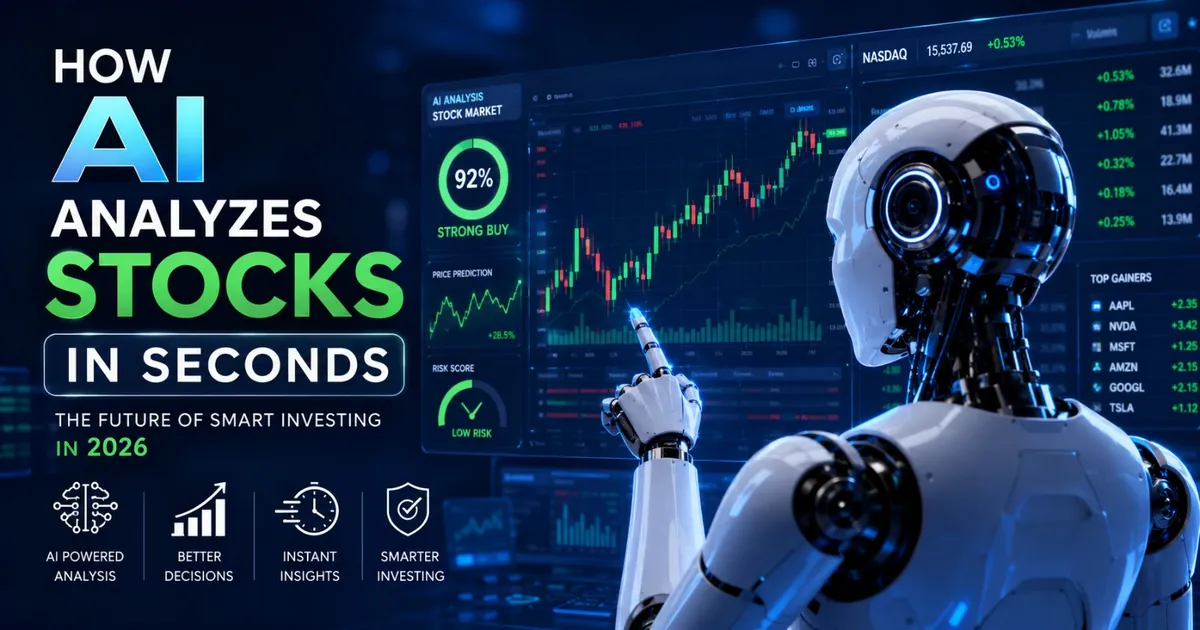
    How AI Analyzes Stocks in Seconds

    Introduction: How AI Analyzes Stocks in Seconds

    Stock investing has always depended on one critical skill: analyzing information faster and more accurately than the competition. For decades, investors spent hours reviewing company financial statements, earnings reports, analyst recommendations, economic indicators, and market news before making investment decisions.

    Today, that process is changing dramatically. Thanks to artificial intelligence, investors can now evaluate enormous amounts of financial information in just a few seconds. This transformation has sparked growing interest in understanding exactly How AI Analyzes Stocks in Seconds and why so many investors are embracing AI-powered investing tools in 2026.

    Artificial intelligence can process millions of data points almost instantly. Instead of manually reviewing hundreds of reports, AI systems can scan company fundamentals, compare historical performance, analyze market sentiment, identify patterns, and generate investment insights within moments.

    This speed gives investors access to information that would previously have required teams of analysts and significant research resources. As a result, AI-powered investing is no longer limited to hedge funds and institutional investors. Everyday Americans now have access to advanced stock analysis tools through investment platforms, robo-advisors, and AI-driven research applications.

    However, understanding how AI analyzes stocks in seconds requires more than simply recognizing its speed. Investors must also understand the technology behind these systems, their strengths, and their limitations.

    When used correctly, AI can help investors identify opportunities, manage risk, improve portfolio decisions, and save valuable research time. When misunderstood, it can create unrealistic expectations and poor investment decisions.

    Investors who want to understand the broader impact of artificial intelligence on investing and wealth creation should also explore our
    AI Investing & Personal Finance Guide 2026.
    This comprehensive resource explains how AI is transforming stock investing, retirement planning, budgeting, and financial management across America.

    In this guide, we’ll break down exactly how AI analyzes stocks in seconds, the technologies behind these systems, and how investors can use AI-powered tools to make smarter financial decisions in 2026 and beyond.

    What Happens When AI Analyzes a Stock?

    To understand How AI Analyzes Stocks in Seconds, it’s important to look at what happens behind the scenes. While traditional investors often spend hours researching a company, artificial intelligence can perform many of these tasks almost instantly.

    AI stock analysis systems collect information from multiple sources, process the data, identify patterns, and generate investment insights within seconds. This ability allows investors to evaluate opportunities much faster than traditional research methods.

    Step 1: Collecting Massive Amounts of Data

    The first stage of AI stock analysis involves gathering information. Modern AI systems pull data from company financial statements, earnings reports, stock prices, analyst ratings, economic indicators, market news, and even social media discussions.

    Instead of reviewing one report at a time, artificial intelligence can process thousands of documents simultaneously.

    This creates a much broader view of a company’s financial health and market position.

    Step 2: Analyzing Financial Statements

    One of the most important tasks in AI stock analysis is reviewing company financial statements.

    AI examines revenue growth, earnings trends, profit margins, debt levels, cash flow, and other key metrics. It compares current performance with historical results and industry benchmarks.

    This helps investors quickly identify financially strong companies and potential warning signs.

    Step 3: Reviewing Earnings Reports

    Earnings reports contain valuable information about a company’s future outlook. Artificial intelligence uses natural language processing to read management commentary and identify important trends.

    AI can detect positive signals such as improving profitability or negative indicators such as slowing growth.

    This process helps investors understand how companies are performing without reading lengthy reports manually.

    Step 4: Market Sentiment Analysis

    Another reason How AI Analyzes Stocks in Seconds has become such a popular topic is sentiment analysis.

    AI systems scan financial news, analyst reports, and investor discussions to measure market sentiment.

    By identifying shifts in investor confidence, AI can provide additional context beyond traditional financial metrics.

    Step 5: Generating Risk Scores and Insights

    After processing all available information, AI assigns risk scores and investment ratings based on its analysis.

    These insights help investors evaluate opportunities more efficiently and focus on companies that match their goals.

    Investors interested in learning how artificial intelligence impacts budgeting, saving, investing, and financial planning should also explore our
    AI Personal Finance Guide 2026.

    Ultimately, AI does not replace research entirely. Instead, it accelerates the research process, helping investors analyze more information and make better-informed decisions in less time.

    Key AI Technologies Behind Stock Analysis

    The reason How AI Analyzes Stocks in Seconds is possible today comes down to several advanced technologies working together. Artificial intelligence is not a single tool. Instead, it combines machine learning, natural language processing, predictive analytics, and pattern recognition to evaluate stocks faster than any human investor could.

    Understanding these technologies helps investors appreciate how modern AI stock analysis systems generate insights and investment recommendations.

    Machine Learning: Learning From Market Data

    Machine learning is the foundation of most AI investing tools. These systems are trained using massive amounts of historical financial data.

    By studying past stock performance, earnings trends, market cycles, and economic conditions, machine learning models learn to identify patterns associated with successful investments.

    As new information becomes available, the algorithms continuously update their analysis and improve their forecasting capabilities.

    This is one reason why AI stock analysis tools become more effective over time.

    Natural Language Processing (NLP)

    Financial information is not limited to numbers. Every day, companies release earnings reports, regulatory filings, press releases, and management commentary.

    Natural Language Processing allows artificial intelligence to read and understand written content.

    AI can quickly scan thousands of pages of financial documents and identify important information that may affect stock prices.

    For example, the system may detect changes in management guidance, revenue expectations, or business risks.

    Predictive Analytics

    Predictive analytics uses historical patterns and statistical models to estimate possible future outcomes.

    Although no system can predict stock prices with complete accuracy, predictive analytics helps investors evaluate probabilities and identify potential opportunities.

    This technology is a major reason why AI investing has become increasingly popular among both professional and retail investors.

    Pattern Recognition

    Artificial intelligence excels at recognizing patterns that humans may overlook.

    AI systems can compare current market conditions with thousands of historical examples and identify similarities that may signal investment opportunities or risks.

    This capability allows investors to analyze more information and respond more quickly to changing market conditions.

    AI Technology vs Investment Use

    AI TechnologyInvestment Use
    Machine LearningStock Screening and Forecasting
    Natural Language ProcessingEarnings Report Analysis
    Predictive AnalyticsRisk Assessment
    Pattern RecognitionTrend Identification
    Data MiningOpportunity Discovery

    Investors who want to build long-term wealth while reducing emotional decision-making should also explore our
    Complete SIP Investing Guide 2026.

    Together, these technologies explain how AI analyzes stocks in seconds and why artificial intelligence is becoming one of the most powerful tools available to investors in 2026.

    Real-World Example: How AI Evaluates a Stock in Seconds

    Learning the technology behind How AI Analyzes Stocks in Seconds is helpful, but seeing a real-world example makes the process much easier to understand. Let’s examine how a modern AI investing platform might evaluate a stock in 2026.

    Imagine an investor wants to analyze a large technology company before deciding whether to invest. Traditionally, this process might require several hours of research. An AI-powered stock analysis system can often complete much of this work in seconds.

    How AI Analyzes Stocks in Seconds Real World Example

    Step 1: Reviewing Company Fundamentals

    The AI system begins by examining the company’s financial statements. It analyzes revenue growth, earnings performance, operating margins, cash flow, debt levels, and return on equity.

    Instead of manually calculating financial ratios, artificial intelligence performs these tasks automatically and compares results against competitors and industry averages.

    This allows investors to quickly understand whether the business is financially healthy.

    Step 2: Measuring Growth Potential

    Next, the AI evaluates future growth opportunities. It reviews analyst forecasts, earnings expectations, industry trends, and historical growth rates.

    Machine learning algorithms compare the company to thousands of similar businesses and identify factors associated with long-term success.

    This helps investors determine whether future growth may justify the current stock price.

    Step 3: Assessing Risk Factors

    No investment is risk-free. AI systems therefore analyze risk indicators such as debt levels, earnings volatility, competitive pressures, and market conditions.

    The software may generate a risk score that helps investors understand potential challenges before investing.

    Step 4: Analyzing Market Sentiment

    Artificial intelligence also scans financial news, earnings call transcripts, analyst reports, and investor discussions.

    By evaluating sentiment, AI can determine whether market participants are becoming more optimistic or more concerned about the company’s future.

    This additional layer of analysis provides valuable context beyond financial statements alone.

    Investors looking to strengthen their income-generating portfolios can also review our
    How to Build a Dividend Portfolio
    guide.

    For a broader understanding of how artificial intelligence is transforming investing, retirement planning, and wealth building, explore our
    AI Investing & Personal Finance Guide 2026.

    A highly recommended investing resource is
    The Psychology of Money by Morgan Housel.
    The book provides timeless lessons about investing behavior, decision-making, and long-term wealth creation.

    This example shows why AI stock analysis has become so valuable. By combining financial analysis, risk evaluation, sentiment monitoring, and predictive modeling, AI can help investors evaluate opportunities in seconds instead of hours.

    Common Mistakes Investors Make With AI Stock Analysis

    As more investors learn How AI Analyzes Stocks in Seconds, many begin relying heavily on artificial intelligence to guide their investment decisions. While AI stock analysis can be extremely useful, it is not perfect. Investors who misunderstand its capabilities often make mistakes that can negatively impact their portfolios.

    The most successful investors use AI as a research assistant rather than a replacement for sound judgment. Understanding the limitations of AI can help investors avoid costly errors and make better long-term decisions.

    1. Blindly Trusting AI Recommendations

    One of the biggest mistakes investors make is assuming that AI always knows the correct answer.

    Artificial intelligence can analyze huge amounts of information and identify patterns, but it cannot predict the future with certainty.

    Unexpected events such as economic recessions, geopolitical conflicts, natural disasters, and government policy changes can dramatically affect stock prices.

    Investors should always review AI-generated recommendations and understand the reasoning behind them before investing.

    2. Ignoring Company Fundamentals

    Some investors focus entirely on AI ratings while ignoring basic business fundamentals.

    Even if an AI system identifies a stock as attractive, investors should still understand the company’s business model, financial strength, competitive position, and long-term growth potential.

    Strong investing decisions typically combine AI analysis with traditional research.

    3. Chasing Short-Term Predictions

    Many beginners become obsessed with short-term market forecasts. They constantly buy and sell based on every new AI signal.

    This behavior often leads to unnecessary trading costs, poor timing decisions, and emotional investing.

    Long-term investing generally produces better results than attempting to predict daily market movements.

    4. Overtrading and Portfolio Changes

    AI systems generate a continuous flow of information. Some investors react to every recommendation and frequently adjust their portfolios.

    Excessive trading can increase taxes, transaction costs, and overall portfolio risk.

    Successful investors focus on long-term goals rather than constantly chasing new opportunities.

    5. Ignoring Market Risk

    No AI system can eliminate investment risk. Markets will always experience volatility, corrections, and economic uncertainty.

    Investors looking to strengthen portfolio resilience should explore our
    Recession-Proof Investing 2026
    guide.

    Use Trusted Financial Sources

    Before making important financial decisions, investors should rely on trusted resources such as the
    SEC,
    Investor.gov,
    and official company filings.

    These sources provide reliable information that complements AI-generated insights.

    The most effective approach combines AI stock analysis, fundamental research, diversification, and patience. Artificial intelligence can improve decision-making, but successful investing still requires discipline and a long-term perspective.

    Practical AI Investing Tips for Beginners

    After learning How AI Analyzes Stocks in Seconds, many investors become excited about the possibilities of artificial intelligence. However, the real advantage comes from knowing how to use AI effectively rather than simply relying on technology to make every decision.

    The most successful investors in 2026 use artificial intelligence to improve research, reduce emotional decision-making, and strengthen long-term investing strategies. They combine AI insights with sound financial principles instead of treating AI as a shortcut to instant wealth.

    Combine AI With Human Judgment

    Artificial intelligence can analyze enormous amounts of data, but it cannot fully replace human experience, intuition, and strategic thinking.

    AI may identify a promising stock based on financial metrics, but investors should still evaluate factors such as company leadership, competitive advantages, industry trends, and long-term business potential.

    The best investment decisions often combine AI analysis with human judgment.

    Stay Diversified

    Diversification remains one of the most important investing principles regardless of technological advancements.

    Even the most advanced AI systems can make mistakes or encounter unexpected market events.

    By spreading investments across different sectors, industries, and asset classes, investors reduce their exposure to any single investment or prediction error.

    A diversified portfolio provides stability during periods of market volatility and economic uncertainty.

    Focus on Long-Term Wealth Building

    Many investors become distracted by short-term market fluctuations and AI-generated predictions.

    While AI can provide useful insights, long-term investing remains one of the most effective ways to build wealth.

    Investors who consistently contribute to diversified portfolios often achieve better results than those who constantly chase short-term opportunities.

    Use AI for Risk Management

    One of the most valuable uses of AI stock analysis is risk monitoring. AI systems can identify unusual market conditions, changes in company fundamentals, and emerging risks much faster than manual research.

    This allows investors to stay informed and make proactive decisions when necessary.

    AI Analysis vs Human Analysis

    FactorAI AnalysisHuman Analysis
    SpeedExcellentLimited
    Data ProcessingExcellentModerate
    Business JudgmentLimitedExcellent
    Strategic ThinkingModerateExcellent
    Emotional DisciplineExcellentVariable

    Investors looking for additional income opportunities can also explore our
    Top Dividend Stocks USA 2026
    guide.

    For a deeper understanding of how artificial intelligence is reshaping investing and wealth creation, revisit our
    AI Investing & Personal Finance Guide 2026.

    Another excellent investing resource is
    The Simple Path to Wealth by JL Collins.
    This book teaches timeless principles of diversification, financial independence, and long-term investing.

    Ultimately, AI is most powerful when used as a tool to support thoughtful investing decisions rather than replace them. Investors who combine technology with patience and discipline may gain a significant advantage in the years ahead.

    Frequently Asked Questions About AI Stock Analysis

    1. How Does AI Analyze Stocks in Seconds?

    AI analyzes stocks in seconds by processing massive amounts of financial data simultaneously. It reviews earnings reports, financial statements, market sentiment, analyst ratings, stock performance, and economic indicators much faster than a human investor can.

    2. Is AI Stock Analysis Accurate?

    AI stock analysis can be highly effective at identifying patterns and evaluating risks. However, no system is perfect. Investors should use AI insights alongside their own research and long-term investing strategy.

    3. Can AI Predict Future Stock Prices?

    AI can estimate probabilities and identify trends, but it cannot guarantee future stock prices. Markets are influenced by economic events, investor behavior, government policies, and unexpected developments.

    4. Is AI Better Than Traditional Stock Research?

    AI excels at speed and data processing, while traditional research helps investors understand business quality and long-term strategy. The best results often come from combining both approaches.

    5. What Types of Investors Benefit Most From AI?

    Beginners, long-term investors, and busy professionals can all benefit from AI-powered research tools because they simplify analysis and reduce the time required to evaluate investments.

    6. Will AI Replace Human Investors?

    Most experts believe AI will enhance investing rather than replace investors completely. Human judgment, strategic thinking, and experience remain valuable parts of successful investing.

    Conclusion: How AI Analyzes Stocks in Seconds

    The rise of artificial intelligence is transforming how investors evaluate opportunities, manage risk, and build wealth. As we’ve explored throughout this guide, understanding How AI Analyzes Stocks in Seconds helps investors appreciate the power and potential of modern investing technology.

    AI can review financial statements, analyze earnings reports, monitor market sentiment, identify patterns, and generate investment insights in a fraction of the time required by traditional research methods.

    For investors, this creates exciting opportunities. Better information, faster analysis, and improved risk management can lead to more informed financial decisions.

    However, successful investing still depends on diversification, patience, discipline, and long-term thinking. Artificial intelligence works best as a powerful assistant rather than a replacement for sound judgment.

    Investors who combine AI-powered tools with proven investing principles may gain a significant advantage in navigating increasingly complex financial markets.

    If you’d like to learn more about the future of AI investing, wealth building, retirement planning, and personal finance, explore our
    AI Investing & Personal Finance Guide 2026.

    You can also improve your overall financial strategy by reviewing our
    Best Credit Cards 2026
    guide for additional money-management insights.

    📩 Join Our Free Investor Newsletter

    Get AI investing insights, stock market analysis, retirement strategies, dividend opportunities, and personal finance tips delivered directly to your inbox.

    Stay informed. Invest smarter. Build wealth confidently.

    Subscribe today and stay ahead of the future of investing.

    For investors looking to strengthen their financial knowledge, consider reading
    I Will Teach You To Be Rich by Ramit Sethi.
    This bestselling personal finance book provides practical advice on investing, saving, budgeting, and building long-term wealth.


    👨‍💼 About the Author

    Subhash Rukade is the founder of FinanceInvestment.site, where he publishes practical, research-driven content focused on AI investing, stock market investing, retirement planning, dividend income, personal finance, and long-term wealth building.

    His mission is to simplify complex financial topics and help everyday investors make smarter decisions with confidence.

    • 🤖 AI Investing & Financial Technology
    • 📈 Stock Market Investing
    • 💰 Dividend Income Strategies
    • 🏦 Retirement Planning
    • 💳 Credit Cards & Banking
    • 🛡️ Recession-Proof Investing
    • 🚀 Wealth Building & Financial Independence

    🌐 Website:

    FinanceInvestment.site

    Thank you for reading How AI Analyzes Stocks in Seconds.
    Here’s to smarter investing, better decisions, and a stronger financial future. 🚀

  • AI Stock Pickers vs Human Investors in 2026: Who Makes Better Investment Decisions?

    AI Stock Pickers vs Human Investors in 2026: Who Makes Better Investment Decisions?


    AI Stock Pickers vs Human Investors in 2026: Who Makes Better Investment Decisions?

    Published: June 11, 2026

    Author: Subhash Rukade

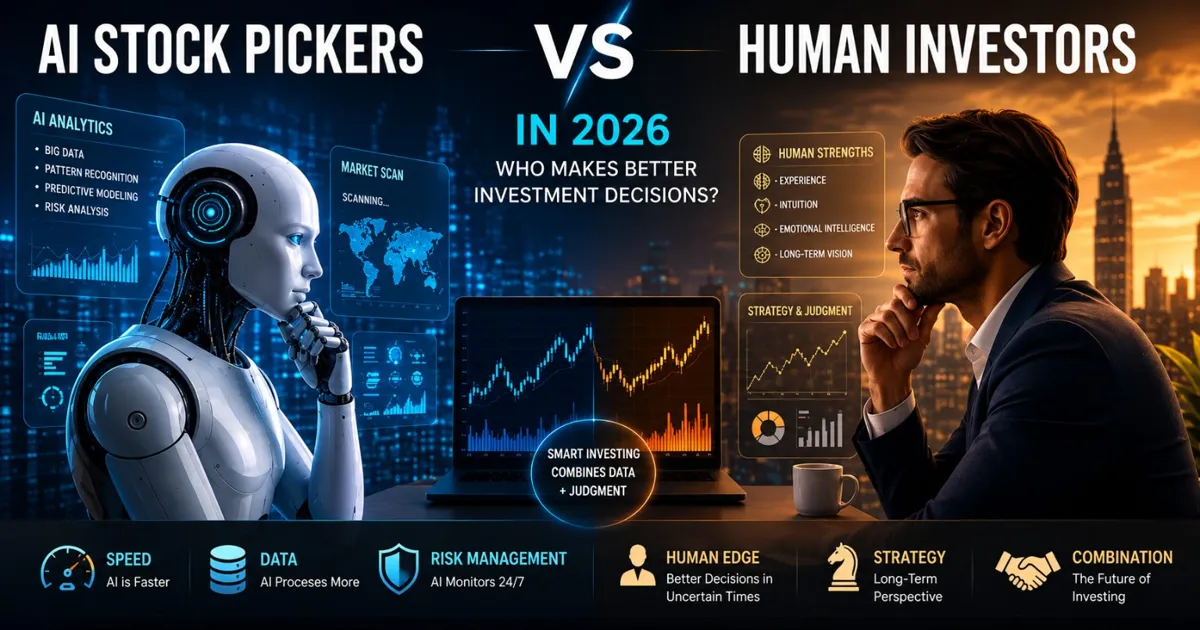
    AI Stock Pickers vs Human Investors in 2026

    Introduction: AI Stock Pickers vs Human Investors in 2026

    Artificial intelligence is transforming nearly every industry, and investing is no exception. In 2026, investors have access to powerful AI-powered tools capable of analyzing thousands of stocks, processing massive datasets, and identifying market trends within seconds. As a result, one of the biggest questions in modern finance is whether AI Stock Pickers can outperform Human Investors.

    For decades, successful investing depended largely on research, experience, and judgment. Investors spent countless hours reviewing company reports, studying balance sheets, following economic trends, and evaluating business leadership. Today, AI systems can perform many of those tasks automatically and at a speed humans simply cannot match.

    This rapid evolution has sparked a fascinating debate. Are AI Stock Pickers becoming better at identifying winning investments? Or do Human Investors still possess advantages that technology cannot replicate?

    Supporters of AI Investing argue that machines eliminate emotional decision-making and can analyze far more information than any individual investor. Meanwhile, advocates of human investing believe that experience, intuition, and strategic thinking remain critical when navigating unpredictable markets.

    The truth is that both approaches have strengths and weaknesses. Understanding these differences can help investors make smarter decisions and potentially improve long-term investment performance.

    As artificial intelligence continues to reshape wealth management, investors are increasingly combining technology with traditional investing principles. If you’re interested in the broader impact of artificial intelligence on investing, retirement planning, and personal finance, explore our
    AI Investing & Personal Finance Guide 2026.

    In this guide, we’ll compare AI Stock Pickers and Human Investors across several important areas, including stock analysis, risk management, portfolio construction, market psychology, and long-term investing success.

    By the end, you’ll have a clearer understanding of where artificial intelligence excels, where human judgment still matters, and how investors can potentially combine both approaches for better results in 2026 and beyond.

    How AI Stock Pickers Work in 2026

    To understand the debate around AI Stock Pickers vs Human Investors in 2026, it’s important to first understand how AI Stock Pickers actually work. While traditional investors often spend hours researching companies and analyzing financial statements, artificial intelligence can process enormous amounts of information within seconds.

    Modern AI Stock Pickers use machine learning, predictive analytics, natural language processing, and big data analysis to evaluate investment opportunities. Instead of relying solely on human research, these systems continuously scan financial markets and identify patterns that may influence future stock performance.

    This ability to process large datasets quickly is one reason why AI Investing has become increasingly popular among both retail and professional investors.

    Machine Learning and Stock Analysis

    Machine learning is the foundation of most AI Stock Pickers. These systems study historical stock prices, earnings reports, economic indicators, valuation metrics, and market behavior.

    Over time, the algorithms learn from this data and improve their ability to recognize trends and relationships. As new information becomes available, the system updates its analysis and adjusts predictions accordingly.

    Unlike traditional investing methods that depend heavily on manual research, AI systems can monitor thousands of companies simultaneously.

    Big Data Gives AI a Unique Advantage

    One of the biggest strengths of AI Stock Pickers is access to vast amounts of information. AI tools can analyze earnings reports, analyst ratings, news articles, social media sentiment, economic reports, and market data all at once.

    A human investor might review a handful of companies each day. AI systems can evaluate thousands within minutes.

    This allows investors to uncover opportunities that might otherwise remain hidden.

    A Real-World Example

    Imagine an AI Stock Picker analyzing technology companies. The system reviews revenue growth, profit margins, analyst expectations, insider transactions, economic conditions, and market sentiment simultaneously.

    If several positive indicators align, the system may identify a stock as a potential opportunity before many individual investors notice the trend.

    This speed and efficiency explain why AI-powered investing platforms continue to attract attention in 2026.

    Benefits of AI Stock Pickers

    • Analyze large amounts of data quickly
    • Reduce emotional decision-making
    • Monitor markets 24/7
    • Identify hidden patterns
    • Improve research efficiency

    Investors interested in the broader impact of artificial intelligence on money management can also explore our
    AI Personal Finance Guide 2026.

    While AI Stock Pickers offer impressive analytical capabilities, investing success involves more than processing data. Human judgment, experience, and strategic thinking still play important roles in financial decision-making.

    Next Section: Discover the unique strengths of Human Investors, why experience still matters, and how emotional intelligence can influence investment success in ways AI cannot always replicate.

    The Strengths of Human Investors in 2026

    While artificial intelligence has transformed investing, the debate around AI Stock Pickers vs Human Investors in 2026 remains far from settled. AI systems offer speed and data-processing power, but Human Investors continue to possess strengths that technology struggles to replicate.

    Successful investing is not only about analyzing numbers. It also involves understanding business quality, leadership, competitive advantages, market psychology, and long-term economic trends. These are areas where experienced investors often excel.

    Experience and Investment Judgment

    One of the biggest advantages Human Investors have is experience. Investors who have lived through multiple market cycles often develop a deeper understanding of how markets behave during periods of optimism, fear, inflation, recessions, and economic recovery.

    While AI Stock Pickers rely heavily on historical data, experienced investors can apply lessons learned from real-world situations that may not fit neatly into a dataset.

    This judgment can be especially valuable during unusual market environments where historical patterns become less reliable.

    Understanding Business Quality

    Human Investors often evaluate factors that are difficult to measure with algorithms alone. These include leadership quality, company culture, brand strength, innovation potential, and competitive advantages.

    For example, a skilled investor may recognize a company’s long-term potential even when short-term financial metrics appear average. This type of qualitative analysis remains one of the strongest advantages of human decision-making.

    Long-Term Investing Mindset

    Many successful investors focus on owning great businesses for years or even decades. Human Investors often excel at developing long-term conviction and maintaining a strategic perspective during market volatility.

    Investors who practice disciplined investing can benefit from strategies such as regular contributions and long-term compounding. To learn more about this approach, explore our
    Complete SIP Investing Guide 2026.

    AI Stock Pickers vs Human Investors Comparison

    FactorAI Stock PickersHuman Investors
    Data ProcessingExcellentLimited
    SpeedVery FastSlower
    Emotional ControlExcellentCan Vary
    Business JudgmentLimitedStrong
    Strategic ThinkingModerateStrong

    The comparison shows that Human Investors continue to bring valuable strengths to the investing process. While AI Stock Pickers excel at analyzing data, humans often perform better when evaluating qualitative factors and long-term business opportunities.

    Where AI Stock Pickers Beat Human Investors in 2026

    The debate around AI Stock Pickers vs Human Investors in 2026 becomes particularly interesting when examining areas where artificial intelligence clearly holds an advantage. While Human Investors bring experience and judgment to the table, AI Stock Pickers excel in speed, efficiency, and large-scale data analysis.

    Financial markets generate enormous amounts of information every day. Earnings reports, economic data, analyst ratings, news articles, and market sentiment can influence stock prices within minutes. Processing all of this information manually is nearly impossible.

    This is where AI Stock Pickers shine.

    AI Stock Pickers vs Human Investors in 2026 Analysis

    Unmatched Speed and Efficiency

    One of the biggest advantages of AI Stock Pickers is speed. Artificial intelligence can evaluate thousands of stocks simultaneously while continuously monitoring market activity.

    A human investor may spend several hours researching a handful of companies. An AI-powered system can analyze thousands of securities in a matter of seconds.

    This allows investors to identify opportunities faster and respond more quickly to changing market conditions.

    Pattern Recognition at Scale

    AI Stock Pickers are exceptionally good at recognizing patterns hidden within large datasets. These systems analyze historical stock prices, earnings trends, valuation metrics, trading volume, and economic indicators simultaneously.

    As a result, AI can identify relationships that may be difficult for humans to detect.

    This capability helps investors uncover opportunities that might otherwise go unnoticed.

    Continuous Risk Monitoring

    Unlike Human Investors, AI systems never need rest. AI Stock Pickers can monitor portfolios and markets around the clock.

    If risks increase or market conditions change significantly, AI tools can immediately alert investors and provide updated analysis.

    This real-time monitoring helps improve risk management and portfolio oversight.

    Data-Driven Decision Making

    Another major advantage is the absence of emotional bias. Human Investors can sometimes make decisions based on fear, greed, or market hype.

    AI Stock Pickers rely on data rather than emotions. This helps maintain consistency and reduces impulsive decision-making.

    A Valuable Resource for Investors

    Investors interested in improving their understanding of behavior and decision-making should consider reading
    The Psychology of Money by Morgan Housel.

    The book explains why investor behavior often matters more than technical knowledge when building long-term wealth.

    While AI Stock Pickers clearly outperform Human Investors in speed, data analysis, and market monitoring, investing success still requires more than algorithms alone.

    Where Human Investors Still Beat AI Stock Pickers in 2026

    Although artificial intelligence has made tremendous progress, the debate around AI Stock Pickers vs Human Investors in 2026 is far from over. While AI Stock Pickers dominate in speed and data analysis, Human Investors continue to possess strengths that remain difficult for machines to replicate.

    Financial markets are influenced by more than numbers. Business leadership, consumer behavior, economic uncertainty, innovation, and unexpected global events often play major roles in investment outcomes. These are areas where Human Investors can still hold a significant advantage.

    Understanding Market Psychology

    One area where Human Investors often outperform AI Stock Pickers is market psychology. Markets are driven by human emotions such as fear, greed, optimism, and uncertainty.

    While AI systems can analyze sentiment data, they may struggle to fully understand the emotional factors that influence investor behavior during major market events.

    Experienced investors often recognize when markets are becoming overly optimistic or excessively fearful, creating opportunities that algorithms may not immediately identify.

    Evaluating Business Quality

    Successful long-term investing frequently involves identifying exceptional businesses before they become widely recognized.

    Human Investors can assess factors such as leadership quality, innovation potential, company culture, competitive advantages, and strategic vision. These qualitative characteristics are often difficult to measure through data alone.

    A skilled investor may recognize opportunities that do not yet appear in traditional financial metrics.

    Managing Black Swan Events

    Black swan events are rare and unexpected situations that dramatically affect financial markets. Examples include major geopolitical conflicts, pandemics, financial crises, or sudden regulatory changes.

    Because AI Stock Pickers rely heavily on historical data, they may struggle when facing situations that have few historical comparisons.

    Human Investors can often adapt more effectively by applying judgment, experience, and strategic thinking during uncertain conditions.

    Strategic Thinking and Long-Term Vision

    Investing success often requires looking years into the future. Human Investors are generally better at evaluating long-term business trends, industry disruptions, and economic shifts that may not be fully reflected in current data.

    Investors preparing for uncertain market environments can strengthen their strategies through our
    Recession-Proof Investing 2026
    guide.

    Trusting Reliable Financial Information

    Regardless of whether you prefer AI Stock Pickers or Human Investors, it’s important to rely on trustworthy financial resources. Investors can access educational materials through the
    SEC
    and
    Investor.gov.

    These resources provide valuable information on investing, risk management, and financial planning.

    The reality is that AI Stock Pickers and Human Investors each bring unique strengths. The most successful investors in 2026 are increasingly combining technology with human judgment rather than relying entirely on one approach.

    Practical Investing Strategies: Combining AI Stock Pickers and Human Investors

    After comparing the strengths of both sides in the AI Stock Pickers vs Human Investors in 2026 debate, many investors reach an important conclusion: the best approach may not be choosing one over the other. Instead, successful investors are increasingly combining AI-powered tools with human judgment to create stronger investment strategies.

    Artificial intelligence can process massive amounts of information quickly, while Human Investors provide strategic thinking, business evaluation, and long-term perspective. Together, these strengths can complement each other and improve investment decision-making.

    Use AI for Research and Screening

    One of the smartest ways to use AI Stock Pickers is during the research phase. AI systems can scan thousands of stocks, identify trends, evaluate valuation metrics, and highlight potential opportunities.

    Instead of spending hours searching for investment ideas, investors can use AI to narrow the field and focus on the most promising candidates.

    This creates a more efficient research process while saving valuable time.

    Use Human Judgment Before Investing

    Even when AI identifies a potential investment, Human Investors should still evaluate the business carefully. Factors such as leadership quality, competitive advantages, long-term growth potential, and industry trends often require human analysis.

    Combining AI-generated insights with thoughtful evaluation can lead to more informed decisions.

    Diversification Remains Essential

    Regardless of whether you use AI Stock Pickers or Human Investors, diversification remains one of the most effective risk-management tools available.

    A diversified portfolio spreads risk across multiple sectors, industries, and asset classes, reducing the impact of any single investment performing poorly.

    Many investors also combine growth investments with dividend-producing assets. If you’re interested in building a dividend-focused portfolio, explore our
    How to Build a Dividend Portfolio
    guide.

    Focus on Long-Term Wealth Building

    The most successful investors understand that wealth is rarely built overnight. Consistency, patience, and disciplined investing often matter more than short-term market predictions.

    Investors seeking quality dividend opportunities can also review our
    Top Dividend Stocks USA 2026
    guide.

    Best Uses for AI vs Human Investors

    TaskAI Stock PickersHuman Investors
    Market ScreeningExcellentModerate
    Data AnalysisExcellentGood
    Business EvaluationLimitedExcellent
    Long-Term StrategyGoodExcellent

    Investors interested in the broader impact of artificial intelligence on investing should also explore our
    AI Investing & Personal Finance Guide 2026.

    For many investors in 2026, the future isn’t AI versus humans. It’s AI and humans working together to make smarter financial decisions and build long-term wealth more effectively.

    Frequently Asked Questions About AI Stock Pickers vs Human Investors in 2026

    1. Can AI Stock Pickers outperform Human Investors?

    In some situations, yes. AI Stock Pickers can analyze thousands of stocks, process massive amounts of data, and identify patterns much faster than humans. However, Human Investors often perform better when evaluating business quality, leadership, and long-term strategic opportunities.

    2. Are AI Stock Pickers suitable for beginners?

    Yes. Many AI-powered investing platforms are designed to help beginners screen stocks, analyze portfolios, and make more informed decisions. However, investors should still understand basic investing principles before relying entirely on technology.

    3. Do professional investors use AI?

    Absolutely. Hedge funds, asset managers, and institutional investors increasingly use artificial intelligence for research, risk management, portfolio monitoring, and investment screening.

    4. Can AI predict stock market crashes?

    No system can predict every market crash. However, AI Stock Pickers can identify warning signs, unusual market behavior, and potential risks earlier than traditional research methods in many cases.

    5. What is the biggest advantage of Human Investors?

    Human Investors excel at strategic thinking, understanding business quality, evaluating leadership teams, and adapting to unexpected events that may not exist in historical datasets.

    6. What is the future of AI Investing?

    The future will likely involve collaboration between AI and human investors. Artificial intelligence will continue improving research and analysis, while humans provide judgment, creativity, and long-term vision.

    Conclusion: AI Stock Pickers vs Human Investors in 2026

    After examining both sides of the debate, one thing becomes clear: there is no single winner in the comparison between AI Stock Pickers vs Human Investors in 2026.

    AI Stock Pickers excel at processing data, identifying patterns, monitoring markets, and eliminating emotional bias. Human Investors excel at strategic thinking, understanding business quality, evaluating leadership, and navigating uncertainty.

    Rather than viewing these approaches as competitors, investors may achieve better results by combining both strengths. AI can improve research efficiency and risk management, while human judgment helps guide long-term investment decisions.

    As artificial intelligence continues transforming financial markets, investors who understand how to leverage both technology and experience may gain a significant advantage.

    For a deeper understanding of how artificial intelligence is reshaping wealth building, retirement planning, portfolio management, and personal finance, explore our
    AI Investing & Personal Finance Guide 2026.

    You can also strengthen your overall financial strategy by reading our
    Best Credit Cards 2026
    guide for additional money-management insights.

    📩 Join Our Free Investor Newsletter

    Get AI investing insights, stock market updates, portfolio strategies, dividend opportunities, and personal finance tips delivered directly to your inbox.

    Stay informed. Invest smarter. Build wealth with confidence.

    Subscribe today and stay ahead of the future of investing.

    For investors looking to improve their money management and investing skills, consider reading
    I Will Teach You To Be Rich by Ramit Sethi.
    This bestselling book offers practical advice on investing, saving, and long-term wealth building.


    👨‍💼 About the Author

    Subhash Rukade is the founder of FinanceInvestment.site, where he publishes practical, research-driven content focused on investing, personal finance, retirement planning, AI-powered finance, and wealth building.

    His mission is to make complex financial topics easy to understand so everyday investors can make smarter decisions and build long-term financial confidence.

    • 📈 Stock Market Investing
    • 🤖 AI Investing & Financial Technology
    • 💰 Dividend Income Strategies
    • 🏦 Retirement Planning
    • 💳 Credit Cards & Banking
    • 🛡️ Recession-Proof Investing
    • 🚀 Financial Independence

    🌐 Website:

    FinanceInvestment.site

    Thank you for reading AI Stock Pickers vs Human Investors in 2026.
    Here’s to smarter investing, better decisions, and a stronger financial future. 🚀