How to Compare CD Rates Before Opening a CD in 2026
A CD can advertise an attractive APY, but the rate alone does not tell you whether the certificate is a good fit. Comparing the term, deposit requirements, withdrawal rules, interest payments, and maturity date can help you see the full picture before you commit your money.
Comparing CD Rates Is About More Than the Biggest APY
 When you compare CD rates before opening a CD, the highest APY can grab your attention first. But a rate is only one piece of the deal. Two certificates can advertise different APYs while having very different terms, minimum deposits, withdrawal rules, and maturity dates.
The term matters because it determines how long your money may remain committed. A slightly higher APY may not be useful if the CD matures after you expect to need the funds. Likewise, a low minimum deposit can make one certificate easier to use, while another may require a larger balance to qualify for its advertised offer.
Interest-payment details deserve a closer look, too. Find out whether interest is compounded, credited to the CD, or paid elsewhere. Then check the early-withdrawal rules so you understand the potential cost of accessing your money ahead of schedule.
For a broader foundation on certificates of deposit, visit our
CD Guide 2026
.
This article builds on those basics by showing you how to compare competing CD offers before putting your money into one.
What You’ll Learn
- How to compare APYs without ignoring the fine print
- Why CD terms and maturity dates matter
- How minimum deposits can affect your choices
- What to check in interest-payment and withdrawal rules
- How to compare the overall value of competing CD offers
Quick Answer: How to Compare CD Rates
A useful CD comparison comes down to six checks. Start with the advertised APY, then make sure the term, deposit requirement, interest rules, withdrawal conditions, and maturity date fit the way you plan to use the money.
6 Checks Before Opening a CD
- Check the APY: Compare the annual percentage yield across similar CD terms rather than comparing unrelated maturities.
- Match the term: Choose a length that works with when you expect to need the money again.
- Verify the minimum deposit: Make sure the balance required for the advertised offer fits your available funds.
- Read the interest-payment rules: Find out when interest is credited and whether it stays in the CD or is paid to another account.
- Examine early-withdrawal terms: Understand the potential penalty before assuming the money will be easy to access.
- Confirm the maturity date: Know exactly when the CD ends and what instructions or renewal choices apply afterward.
Bottom line: Compare CDs on the complete package, not just the number printed beside the APY.
CD Rate Comparison at a Glance
Before choosing between CD offers, put the important terms side by side. This makes it easier to spot a deal that looks attractive at first but has a requirement or restriction that does not suit your plans.
| Factor | What to Compare | Question to Ask |
|---|---|---|
| APY | Annual percentage yield | Is the rate competitive for this term? |
| Term | Length of the CD | Can I leave the money untouched that long? |
| Minimum deposit | Amount required to open or earn the advertised rate | Does my deposit qualify? |
| Interest payout | How and when interest is credited or paid | Where will my interest go? |
| Early withdrawal | Penalty and access rules | What could access cost me? |
| Maturity date | Date the fixed term ends | Will the date fit my financial calendar? |
| Deposit insurance | Applicable FDIC or NCUA coverage | Is the institution federally insured? |
Quick check: A CD offer is easier to judge when its rate, restrictions, requirements, and timeline are viewed together.
Complete Beginner Guide to Comparing CD Rates
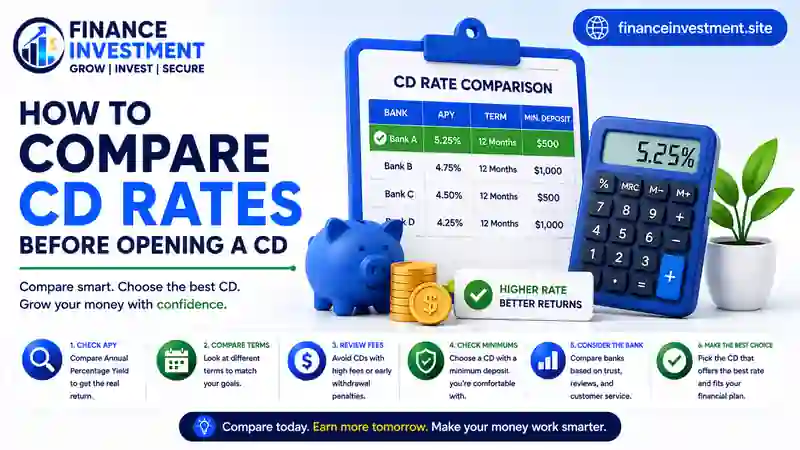 Comparing CDs becomes much easier when you treat it like shopping for a financial product rather than chasing one impressive number. The process below gives you a consistent way to evaluate offers without getting distracted by headline rates.
1. Set the Amount You Plan to Deposit
Start with the actual amount you can comfortably place in a CD. Your deposit determines which offers you qualify for and whether minimum-balance requirements are relevant. Keep money needed for emergencies or near-term expenses outside the certificate.
2. Choose Your Target Term
Decide roughly how long you can leave the money untouched before comparing rates. Looking at a six-month CD beside a five-year CD simply because one has a higher APY can give you a misleading result. If you are unsure about the timeline, our guide on
how long to keep money in a CD
can help.
3. Collect Comparable Offers
Gather several CDs with similar terms and deposit requirements. Include banks and credit unions that meet your needs rather than limiting your search to the institution you already use. Our
CD rates in 2026
resource can provide another starting point for rate research.
4. Check the APY and Requirements
Record the APY alongside the minimum deposit, account eligibility, promotional conditions, and any restrictions attached to the offer. Make sure the advertised rate actually applies to your deposit amount and chosen term.
5. Read the Account Terms
Look for early-withdrawal penalties, interest-payment arrangements, automatic-renewal provisions, and maturity instructions. These details can matter long after the initial rate comparison is finished. For more on withdrawal costs, see our guide to
CD early withdrawal.
6. Make a Side-by-Side Choice
Put your final candidates next to each other and ask which offer gives you the best overall fit for the money, timeline, and access you want. Then save the product terms before opening the account so you have a record of what you agreed to.
Beginner Tip
Compare like with like. Once the term and deposit amount are similar, APY differences become much more meaningful.
How CD Rate Comparison Affects Your Potential Earnings
Once you compare CDs with similar terms, the next step is understanding what the quoted APY could mean for your actual deposit. The amount you invest, the APY, the length of the CD, and the way the account compounds all influence the result. The maturity date then tells you when the agreed term ends and when you can review your next move.
For example, a $10,000 deposit earning 4.00% APY for one year would produce about $400 in interest if the stated APY applies for the full year. A comparable $10,000 CD at 4.25% APY would produce about $425 over the same one-year period, before taxes and assuming the advertised APY applies.
Illustrative Example: Same Deposit, Different APY
| Hypothetical CD | Deposit | APY | 1-Year Interest* |
|---|---|---|---|
| Offer A | $10,000 | 4.00% | About $400 |
| Offer B | $10,000 | 4.25% | About $425 |
*Illustrative figures only. Actual earnings depend on the CD’s stated APY, term, compounding and account terms. Taxes are not included.
The difference becomes more noticeable as the deposit grows, but the rate should still be viewed alongside the term. A higher APY attached to a much longer CD may not be the better fit if you expect to use the money sooner. Likewise, a shorter CD may mature earlier, giving you another opportunity to compare available offers.
This is why the maturity date belongs in the comparison. It connects today’s rate decision with tomorrow’s cash needs. Your goal is not simply to predict the biggest interest number; it is to understand what the CD can reasonably earn while fitting the period you are prepared to leave the money invested.
Benefits and Drawbacks of Comparing CD Rates
A careful CD comparison can do more than help you find a competitive return. It can also reveal whether the account fits your timeline and how easily you can live with its restrictions. Still, comparing offers takes a little extra attention, and a higher rate can sometimes come with a trade-off.
Pros
- Can help you identify a more competitive APY.
- Makes differences in terms and account conditions easier to spot.
- Can improve the expected return on money you do not need immediately.
- Encourages a more deliberate choice instead of opening the first CD you see.
- Can help match maturity dates with future financial goals.
Cons
- Rates can change, so today’s comparison may not remain current.
- A higher APY may require a longer commitment.
- Early access can reduce the interest you keep.
- Promotional offers may have eligibility or balance requirements.
- Comparing several institutions takes more time than choosing a familiar account.
A Useful Way to Think About It
The goal is not to spend hours hunting for a tiny rate difference. It is to find an offer where the return, commitment and account rules make sense together. That makes the comparison useful rather than simply competitive.
CD Rate Comparison Methods Compared
There is no single way to shop for a CD. Your starting point can change depending on whether your priority is return, timing, access, or how you want to spread your savings. The table below shows how each approach works and when it can be useful.
| Approach | Main Focus | Works Well When | Watch For |
|---|---|---|---|
| APY-first | Highest competitive return | You can comfortably commit the money for the required term | Longer terms or special requirements |
| Term-first | When you need the money | Your future cash date is already known | A shorter term may have a different rate |
| Institution comparison | Bank or credit union offers | You are willing to shop beyond your current provider | Eligibility and account requirements |
| Goal-based | Specific financial objective | The money has a known purpose and timeline | A tempting rate that does not match the goal |
| CD ladder | Multiple maturity dates | You want recurring access points | More accounts to track |
| Flexible-cash approach | Access and liquidity | You may need the money sooner than expected | Potentially lower return than a locked CD |
If several maturity dates appeal to you, learn
how to build a CD ladder.
If you are deciding between a fixed certificate and more accessible savings, our guide to
using CDs for short-term savings
can help you think through the trade-off.
Practical takeaway: Start with the factor that matters most to your situation, then use the other criteria to narrow the field.
Costs, Risks and Expert Tips Before Opening a CD
A CD can look straightforward on the surface, yet the details behind an advertised rate can change the value of the offer. Before moving money, take a few minutes to look for conditions that may matter after the account is opened.
Watch for Promotional Rates
Some offers may be designed to attract new deposits or may have eligibility requirements. Confirm who qualifies, what balance is needed, how long the stated offer applies, and what happens when the CD reaches maturity. Do not assume a promotional rate automatically applies to every deposit.
Consider the Cost of Locking In
Market rates can change after you open a CD. If rates rise, a longer certificate may leave you committed to the earlier rate. If rates fall, however, locking in a competitive fixed rate may look more useful. There is no way to know the future path with certainty, so the term should fit your timeline rather than depend entirely on a rate prediction.
Read the Fine Print Around Access
Early withdrawal can result in a penalty or reduced interest. Check the exact rules before opening the account, especially if the money might be needed unexpectedly. Also verify whether the advertised APY requires a particular minimum balance.
Do Not Ignore Taxes or Insurance
CD interest held in a taxable account can create taxable income. A large deposit also deserves an insurance check. Confirm whether the bank is FDIC-insured or the credit union is federally insured by the NCUA, and consider your total balances under the applicable ownership category.
Expert Tip: Save the Terms
Before clicking “Open,” save or print the offer details. Keep the APY, term, minimum deposit, early-withdrawal policy, maturity instructions, and renewal terms with your financial records. A screenshot of the headline rate is not enough.
Common Mistakes When Comparing CD Rates
A rate comparison can go wrong even when the math looks simple. Most problems happen when savers compare offers that are not truly equivalent or focus on the headline number while overlooking the conditions attached to it.
- Comparing different terms as if they were equal: A five-year CD and a six-month CD serve different timelines, even if one advertises a higher APY.
- Ignoring deposit requirements: Check whether your balance qualifies for the advertised rate and whether a minimum deposit applies.
- Overlooking promotional conditions: A special offer may have eligibility, funding, or other account requirements that affect who can receive it.
- Forgetting maturity timing: A good rate can become inconvenient if the CD ends when you are likely to need the money elsewhere.
- Looking only at the rate: Compare the expected interest on your actual deposit and term rather than assuming a small APY difference will create a major gain.
- Opening too many CDs without checking coverage: Multiple certificates at the same institution can count toward applicable deposit-insurance limits.
Illustrative Example: Elena Compares Two Offers
Elena has $25,000 to place in a CD. One offer advertises a hypothetical 4.25% APY for one year, while another advertises 4.50% for five years. The second rate looks better, but Elena expects to use the money for a home-related expense in about 18 months. She chooses to compare one-year and shorter-term options instead of treating the five-year rate as the obvious winner.
Illustrative lesson: The most attractive rate on the screen is not necessarily the most useful rate for the money.
Who Should Compare CD Rates This Way?
A detailed CD comparison is especially useful when the amount of money or length of the commitment makes small differences meaningful. It can also help people who want a predictable return without taking on the price swings associated with many market investments.
Savers Who May Benefit Most
Beginners can use a structured comparison to learn what they are actually agreeing to before locking away savings. Larger-balance savers may benefit because even a modest rate difference can affect the interest earned over time, while deposit-insurance limits deserve closer attention.
Retirees may want to coordinate CD maturities with future cash needs. Families saving for a known expense can compare terms around the date they expect to use the money. Conservative investors and rate-sensitive savers may also appreciate the ability to compare fixed-return choices across institutions.
When a Detailed Comparison May Not Be Worth It
Spending hours chasing a tiny rate difference may not add much value if the deposit is small or the difference in expected interest is minimal. More importantly, money needed for an emergency or near-term bill should not be locked away simply to earn a higher rate. In those situations, liquidity can matter more than squeezing out the last few dollars of interest.
Frequently Asked Questions About Comparing CD Rates
How should I compare CD rates before opening an account?
Compare CDs with similar terms first, then look at APY, minimum deposit, interest rules, early-withdrawal provisions, maturity date, and insurance coverage. This gives you a more useful comparison than looking at the advertised rate alone.
Is APY the same as the interest rate on a CD?
No. The interest rate is the stated rate paid on the deposit, while APY reflects the effect of compounding over a year. When comparing deposit products, APY is generally the more useful figure for comparing potential annual earnings.
Does the CD term affect the rate I receive?
Yes. Financial institutions can offer different rates for different terms. Compare CDs within the same or similar maturity period before deciding that one offer is better.
Why does the minimum deposit matter when comparing CDs?
Some CDs require a minimum opening deposit, and certain offers may require a particular balance to receive the advertised rate. Make sure your available funds qualify for the offer you are evaluating.
Should I trust a promotional CD rate?
A promotional rate can be attractive, but check eligibility, deposit requirements, term, availability and renewal conditions. The headline APY should be considered alongside the complete account terms.
How do early-withdrawal penalties affect a CD comparison?
An early-withdrawal penalty can reduce the interest you keep if you access the money before maturity. If there is a reasonable chance you will need the funds early, examine this rule before choosing a higher-rate CD.
Why should I compare CD maturity dates?
The maturity date determines when the fixed term ends and when the money becomes available under the account’s terms. A CD with an attractive APY may be inconvenient if its maturity date does not fit your financial plans.
Are CDs covered by deposit insurance?
CDs at FDIC-insured banks are generally covered as deposits within applicable limits. The standard FDIC insurance amount is $250,000 per depositor, per insured bank, for each ownership category. 0
Is CD interest taxable?
Generally, interest from CDs held in taxable accounts is taxable under federal income-tax rules. The IRS explains that CD interest generally must be included in income when received or when you are entitled to receive it, subject to applicable rules. 1
Illustrative: Which CD could earn more on a $25,000 deposit?
Illustrative example only: Suppose one hypothetical one-year CD offers 4.00% APY and another offers 4.25% APY for the same one-year term and deposit. Ignoring taxes and assuming the stated APYs apply, the second offer would produce roughly $62.50 more over one year on $25,000. Actual earnings depend on the institution’s terms and compounding.
Final Verdict: Compare the Whole CD Offer
The best way to compare CD rates before opening a CD is to look beyond the headline APY. A strong offer should make sense for the amount you are depositing, the time you can leave the money untouched, and the date when you expect to need it again.
Start with comparable terms, then consider the minimum deposit, interest-payment rules, early-withdrawal provisions, maturity date and applicable deposit-insurance coverage. These details can make two seemingly similar CDs quite different once your money is committed.
The highest APY can be worthwhile when the term and conditions fit your plans. But if it requires a longer commitment than you can comfortably handle, a slightly lower rate with a better timeline may be the more practical choice.
If you want to strengthen your understanding before making a decision, explore our
CD Guide 2026
.
It brings together CD basics, strategies, safety considerations and related guidance in one place.
Bottom line: Choose the CD that gives your money a useful return without creating a term, access or account condition you will regret later.
Compare Smarter Before You Lock In Your Money
CD rates change, and the details behind an offer matter. Get practical FinanceInvestment updates on CD rates, savings strategies, and smarter ways to make your cash work harder.
📧 subhashr325@gmail.com