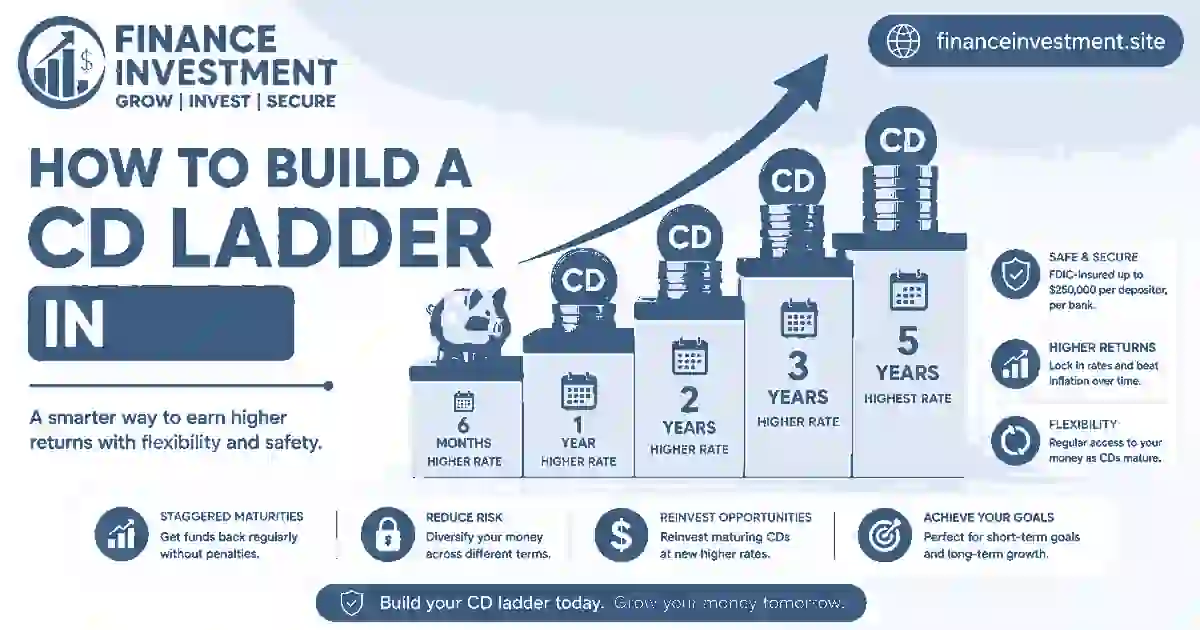
Tag: CD Laddering

  • How to Build a CD Ladder in 2026: Step-by-Step Guide

    How to Build a CD Ladder in 2026: Step-by-Step Guide

    FINANCEINVESTMENT • CD GUIDE 2026

    How to Build a CD Ladder in 2026

    SR
    Written by Subhash Rukade
    FinanceInvestment
    Updated August 25, 2026
    About 10–12 min read

    A practical guide to organizing CDs around different maturity dates, cash needs, and future reinvestment decisions.

    How to Build a CD Ladder in 2026: Beginner’s Guide
    Learn how to build a CD ladder in 2026, including how to choose CD terms, divide your money, plan maturity dates, manage liquidity, and reinvest.
    how-to-build-a-cd-ladder-in-2026
    How to Build a CD Ladder in 2026
    how to build a CD ladder,
    CD ladder strategy,
    CD ladder for beginners,
    CD ladder example,
    CD laddering,
    CD maturity schedule,
    CD maturity dates,
    CD ladder terms,
    CD reinvestment strategy,
    how CD ladders work
    https://financeinvestment.site/how-to-build-a-cd-ladder-in-2026/
    Subhash Rukade
    August 25, 2026
    About 10–12 minutes

    Start With Your Cash Calendar

    How to Build a CD Ladder in 2026How to Build a CD Ladder in 2026 is easier when you start with your cash calendar instead of a rate table. A CD ladder spreads one pool of money across certificates with different maturity dates, giving portions of the balance a chance to become available at different times.

    Think about what your money may need to do over the next few years. You might have a home project, tuition payment, planned purchase, or another expense on the horizon. Those dates can help determine which CD terms make sense. The goal is to create a schedule that works with your plans rather than forcing your plans around the certificates.

    Before opening anything, decide how much cash can genuinely stay untouched. Emergency savings and money needed for regular expenses belong somewhere more accessible. The amount left for the ladder can then be divided into practical pieces, with each piece assigned a term that creates a useful maturity date.

    You do not need a complicated formula to get started. A simple ladder can give you several opportunities to review your cash, compare available rates, and decide what to do when each certificate matures. If you want to refresh the basics first, our

    CD Guide 2026

    explains CD terms, rates, features, and other details worth understanding before you choose a certificate.

    What You’ll Learn

    • How to decide how much money belongs in a CD ladder
    • How to select terms that create useful maturity dates
    • How to divide a larger deposit into manageable amounts
    • How to handle each CD when it matures
    • How to keep emergency and near-term cash outside the ladder

    Quick Answer: How Do You Build a CD Ladder?

    Build a CD ladder by choosing the amount you want to commit, dividing it among several CDs, and selecting different terms so the certificates mature at separate points. When a CD matures, review your plans and current rates before deciding whether to use, move, or reinvest the money.

    6 Key Takeaways

    1. Set a workable amount: Commit only money that does not need to remain immediately available.
    2. Pick a manageable number of CDs: More rungs can create more maturity dates, but they also require more tracking.
    3. Space maturity dates: Choose terms that create useful opportunities to access or reposition portions of the balance.
    4. Keep liquid savings separate: Emergency reserves should not depend on a CD reaching maturity.
    5. Review each maturity: A maturing certificate gives you a chance to reassess the money’s next job.
    6. Check renewal instructions: Review the bank’s terms before an automatic renewal locks the money into another period.

    Bottom line: A useful ladder is built around practical maturity dates, not a target number of CDs. Keep the structure simple enough to manage and flexible enough to review as each certificate matures.

    CD Ladder at a Glance

    A ladder can be built with a few certificates or a larger set of rungs. The useful size depends on your balance, expected cash needs, and how much account tracking you want to handle. Terms can range from several months to several years, depending on how far into the future you want to spread your maturities.

    Planning AreaPractical RangeWhat to Watch
    Ladder sizeA few to several CDsKeep tracking manageable
    TermsAbout 6 months to 5 yearsMatch terms to future cash needs
    Maturity spacingMonthly, quarterly, annual, or goal-basedChoose dates that are actually useful
    LiquidityKeep emergency cash outsideAvoid relying on early withdrawals
    ReinvestmentReview each maturityCompare current rates and goals

    Quick view: A smaller ladder may be easier to maintain, while additional rungs can create more frequent maturity points. Neither is automatically better; the schedule should earn its place in your plan.

    How to Build a CD Ladder Step by Step
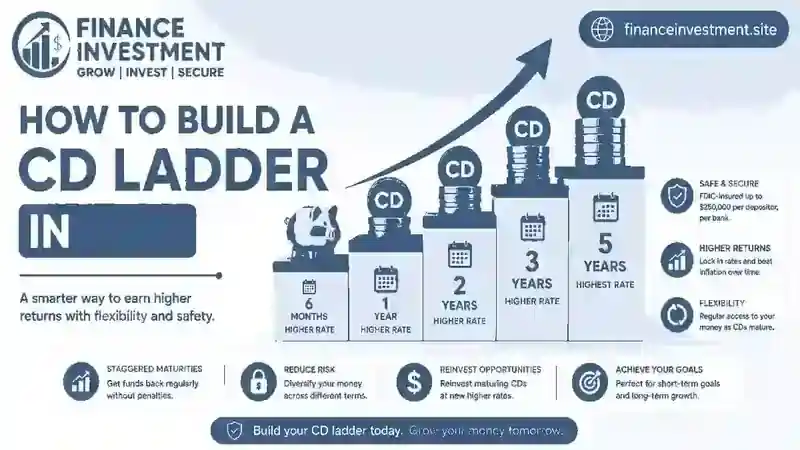
    how to build a CD ladder in 2026Once you know which money is available for longer-term saving, the next job is turning that balance into actual certificates. The process is straightforward: decide how much to commit, choose the number of CDs, select terms, divide the money, and set reminders for every maturity.

    1. Decide How Much You Can Commit

    Start with money that is not earmarked for rent, regular bills, or unexpected expenses. Keep your emergency reserve in an account that you can access without waiting for a certificate to mature. The amount left over becomes the pool for your ladder.

    2. Choose the Number of Rungs

    Think about how often you would realistically want a portion of the balance to become available. A few certificates may be enough for a simple plan. If you use more, make sure each additional maturity date serves a clear purpose rather than adding complexity for its own sake.

    3. Select Terms Around Your Goals

    Now work backward from your expected cash needs. If you expect to need money next year, a shorter certificate may fit that portion. Money intended for a later goal can potentially use a longer term. You can compare different options with our guide on
    how to choose the right CD.

    4. Divide the Money

    Suppose you have $20,000 available. You could place $5,000 into each of four CDs with different terms. Equal amounts keep the structure simple, but unequal amounts can make sense when one future expense is larger than another.

    5. Set Your Maturity Targets

    Record every maturity date, APY, balance, early-withdrawal terms, and renewal instruction. Set reminders before each certificate reaches maturity so you have time to decide whether the money should be used, moved, or reinvested.

    Beginner Tip

    Do not force every dollar into the ladder. A separate cash reserve gives you breathing room when an unexpected expense arrives.

    How a CD Ladder Works After Funding

    Once the certificates are funded, the main job shifts from building the ladder to watching how the maturity dates move through time. Each CD follows its own account agreement, while the staggered schedule gives you separate points to review your cash.

    During Each CD Term

    A certificate generally earns interest according to the APY and terms agreed to when you open it. The account may compound interest or pay it according to the institution’s rules. Keep the original disclosures because they show the interest schedule, maturity date, early-withdrawal terms, and other conditions that apply to that specific CD.

    As one certificate approaches maturity, check the bank’s renewal window. You may decide to take the money for a planned expense, move it to another account, or place it into a new CD. The next term does not have to match the previous one. Your choice can reflect current rates and what you expect to need the money for next.

    Illustrative Example: A $30,000 Ladder

    Imagine Jordan has $30,000 set aside for medium- and longer-term goals. The money is divided among several CDs that mature at different times. When the first certificate matures, Jordan needs $6,000 for a planned home expense, so that portion is withdrawn. The remaining funds can stay invested through the other certificates.

    At the next maturity, suppose Jordan no longer needs the cash. After checking the available rates, that amount can be placed into a new CD with a term that extends the ladder. This creates a rolling process: one certificate reaches maturity, a decision is made, and the rest of the ladder continues unchanged.

    Practical check: Review each maturity before the renewal deadline. That small habit gives you time to compare the new rate, term, and your current cash needs.

    Benefits and Drawbacks of a CD Ladder

    A ladder can make a large cash balance easier to organize by giving different portions of the money their own maturity dates. That structure can be useful, but it does not remove the trade-offs that come with putting money into CDs.

    Pros

    • Planned access: Staggered maturities can create regular opportunities to use or reposition part of your savings.
    • Rate diversification: Your entire balance does not have to be committed at one rate or on one opening date.
    • Reinvestment flexibility: Each maturity gives you a chance to review available rates and your plans.
    • Saving discipline: Fixed terms can make it easier to leave money untouched for longer-term goals.

    Cons

    • Reduced liquidity: Money in a CD generally is not as accessible as cash held in a checking or savings account.
    • Early-withdrawal penalties: Taking funds out before maturity may reduce your return under the CD’s terms.
    • Changing rates: New CD rates may rise or fall while your existing certificates remain locked at their agreed rates.
    • Inflation: A fixed return may not fully preserve purchasing power if prices rise faster than the CD’s return.
    • More tracking: Multiple certificates mean more maturity dates, renewal decisions, and account details to monitor.

    Worth remembering: A ladder works best when its structure solves a real planning problem. If managing several maturity dates adds more work than value, a simpler CD or flexible savings account may be a better fit.

    CD Ladder Designs Compared

    The number of rungs changes how often money becomes available and how much information you need to track. A smaller structure can be easier to manage, while additional certificates can create more maturity points. The goal is to give each rung a useful job rather than adding CDs simply to make the ladder larger.

    DesignMaturity SpreadFlexibilityTrackingMay Suit
    3-rungThree planned datesBasicLowSimple goals and smaller balances
    4-rungFour staggered datesModerateModerateBalanced planning
    5-rungFive maturity pointsHigherHigherLarger balances or several goals
    Longer-term ladderMay extend several yearsGoal-dependentModerate to highLonger-term savings goals

    Your terms do not have to follow a rigid formula. For example, someone expecting a need within a year could include a
    6-month CD
    alongside a
    1-year CD.
    A longer goal might justify reviewing
    2-year CD options
    or
    3-year CD options.
    Compare the maturity dates alongside the rates rather than treating the highest APY as the automatic winner.

    CD Ladder Costs, Risks and Expert Tips

    The biggest risks in a CD ladder often appear after the accounts are opened. A certificate can look attractive at the time of purchase, yet its rules may become inconvenient if your cash needs change or market conditions move in another direction.

    Watch the Cost of Early Access

    Most traditional CDs can charge an early-withdrawal penalty when money is taken out before maturity. The amount and calculation depend on the account agreement. If you expect a possible near-term expense, compare the cost of keeping that money liquid with the return you expect from the CD.
    Learn how CD early withdrawals work
    before committing funds.

    Consider What You Give Up

    A fixed rate can become less attractive if newly available CD rates rise. That is an opportunity cost rather than a direct fee. Inflation can create another concern because the purchasing power of a fixed return may decline over time.

    Check Taxes and Deposit Insurance

    Interest earned by CDs in a regular taxable account is generally taxable interest income. Also verify that your deposits remain within applicable insurance limits. Bank deposits may qualify for FDIC coverage, while qualifying federally insured credit-union share accounts may receive NCUA coverage. Coverage depends on factors such as the institution, ownership category, and total eligible deposits or shares.

    Review Before Every Renewal

    Do not treat automatic renewal as a final decision. Before maturity, check the new APY, term, penalty, and your current plans. A CD that made sense last year may not deserve another term today.

    Expert Tip

    Keep a one-page CD record with each balance, APY, maturity date, withdrawal penalty, insurance status, and renewal instruction. Review it before opening a new CD and again before every maturity.

    Common CD Ladder Mistakes to Avoid

    A ladder can be perfectly sound on paper and still become frustrating if the setup does not match how you actually use your money. Most avoidable problems come from making the structure more complicated than necessary or ignoring what happens after the first CD matures.

    Mistakes That Can Create Problems

    • Opening too many CDs: Extra rungs can create more maturity dates without adding meaningful value.
    • Chasing the highest APY: A higher rate is not necessarily better if its maturity date clashes with a known cash need.
    • Creating awkward maturity dates: A schedule that looks neat on paper may be inconvenient if several certificates mature around the wrong time.
    • Unequal allocations without a purpose: Different deposit amounts can make sense for different goals, but random amounts can make future planning harder.
    • Forgetting renewal dates: Missing a maturity window can lead to an automatic renewal you did not intend.
    • Putting emergency cash into CDs: Money needed for an unexpected expense should remain readily accessible rather than depending on a maturity date.

    Illustrative Example: Marcus Simplifies His Ladder

    Marcus has $24,000 available for longer-term savings. He initially opens six CDs because he wants frequent maturity dates. After a few months, he realizes that tracking six accounts is unnecessary and that most of his expected expenses occur only twice a year. He simplifies the structure and keeps his emergency reserve separate.

    The lesson: A ladder should reduce friction around your savings. If the number of certificates makes the plan harder to follow without providing useful access, fewer rungs may be the smarter choice.

    Who Should Build a CD Ladder?

    A ladder can be a good fit when your savings have several future uses and you are comfortable leaving each portion untouched until its maturity. It is less about having a large balance and more about having a reason to spread your money across different time periods.

    It May Make Sense If You:

    • Are buying CDs for the first time: Staggering maturities can make a large commitment feel more manageable.
    • Have planned family expenses: Maturity dates can be matched with tuition, home projects, or other known costs.
    • Are retired: A staggered schedule can create planned opportunities to review or use portions of savings.
    • Hold a larger cash balance: Multiple certificates can help organize money across different time horizons.
    • Prefer predictable returns: Fixed CD terms may appeal to conservative savers who value knowing the agreed rate.
    • Can leave the money untouched: The strategy works best when early access is unlikely.

    Keep it simple when appropriate: If you have one clear maturity goal, a single CD may be enough. If you need frequent access or your plans are still changing, a flexible savings account may be more practical.

    Frequently Asked Questions About CD Ladders

    What is a CD ladder?

    A CD ladder spreads money across multiple certificates with different maturity dates. As each certificate matures, you can use the funds, move them, or consider reinvesting them.

    How many CDs should I use in a ladder?

    There is no fixed number. Use enough certificates to create useful maturity dates without making the account structure difficult to track.

    Do CD ladders have minimum deposit requirements?

    Each bank or credit union sets its own minimum. Check the requirements for every certificate before dividing your money so the planned amounts qualify.

    How should I choose CD maturity dates?

    Look at when you may need portions of the money and choose terms that create practical dates. A maturity schedule should fit your plans rather than simply follow a standard formula.

    What happens when a CD in the ladder matures?

    You can generally take the money, transfer it, or reinvest it after reviewing your current needs and available rates. Check the renewal instructions before maturity.

    Can a CD ladder provide immediate access to my money?

    No. A ladder creates planned access points, but it does not provide the same on-demand access as a checking or savings account. Keep emergency cash separate.

    Can CD rates change while my ladder is running?

    Yes. Rates offered on new CDs can change while existing certificates continue under their agreed terms. Each maturity gives you an opportunity to review the current choices.

    Are CD ladders covered by FDIC or NCUA insurance?

    Eligible bank deposits may qualify for FDIC insurance, while qualifying federally insured credit-union share accounts may receive NCUA coverage. Applicable limits and ownership categories matter.

    Are CD ladder earnings taxable?

    Interest from CDs held in a regular taxable account is generally taxable interest income. Tax treatment may differ when CDs are held through certain tax-advantaged accounts.

    Illustrative: How could a $50,000 balance be divided into a CD ladder?

    Illustrative example only: A saver might divide $50,000 among four or five CDs, using different amounts and maturity dates to match expected cash needs. The actual allocation should reflect available rates, account minimums, liquidity needs, and applicable insurance limits.

    Final Verdict: Is a CD Ladder Right for You?

    A CD ladder can be a smart way to organize money when you have several future cash needs and do not want the entire balance tied to one maturity date. It gives you planned opportunities to review portions of your savings instead of making one large commitment.

    The key is to build around your expected cash needs rather than chasing the highest APY. A certificate with a slightly better rate may not be useful if its maturity date arrives at the wrong time. Look at the timing first, then compare rates and account terms.

    Keep emergency savings, upcoming bills, and money that may be needed unexpectedly outside the ladder. If you want a broader refresher on CD terms, rates, safety, and account features, read our

    CD Guide 2026
    .

    Practical takeaway: Choose the maturity schedule first, then choose the CDs that fit it.

    Build Your Next CD Ladder With Confidence

    Your CD ladder does not need to be complicated. Keep the maturity dates useful, leave emergency cash accessible, and review each certificate before it renews. For more practical guides on CDs, saving, and investing, join the FinanceInvestment newsletter.

    📧 subhashr325@gmail.com
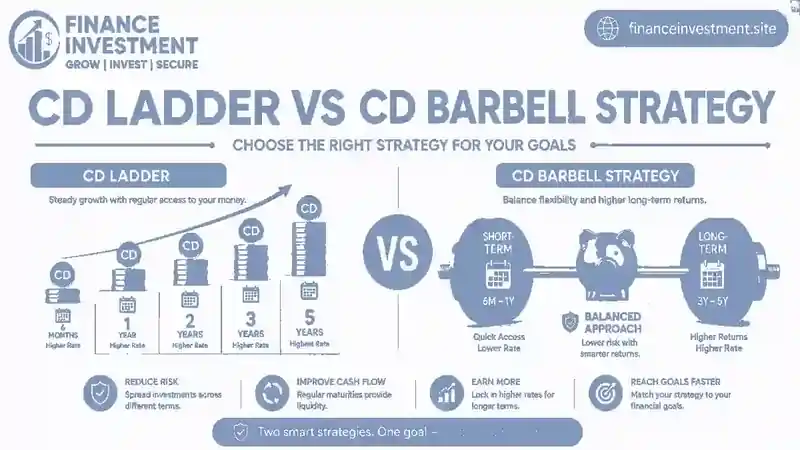
  • CD Ladder vs CD Barbell Strategy: Which Is Better in 2026?

    CD Ladder vs CD Barbell Strategy: Which Is Better in 2026?

    FINANCEINVESTMENT • CD STRATEGIES 2026

    CD Ladder vs CD Barbell Strategy: Which One Fits Your Goals?

    SR
    Written by Subhash Rukade
    FinanceInvestment
    Updated August 25, 2026
    About 10–12 min read

    Compare two practical ways to spread CD maturities, balance liquidity, and manage rate risk without making your cash strategy unnecessarily complicated.

    CD Ladder vs CD Barbell Strategy: Which Is Better in 2026?
    CD Ladder vs CD Barbell Strategy explained for 2026. Compare maturity schedules, liquidity, rate risk, flexibility, and which strategy may fit your goals.
    cd-ladder-vs-cd-barbell-strategy
    CD Ladder vs CD Barbell Strategy
    CD ladder strategy,
    CD barbell strategy,
    CD ladder vs barbell,
    ladder vs barbell CDs,
    CD laddering,
    barbell CD strategy,
    CD investment strategy,
    CD maturity strategy,
    CD liquidity strategy,
    CD rate risk
    https://financeinvestment.site/cd-ladder-vs-cd-barbell-strategy/
    Subhash Rukade
    August 24, 2026
    About 10–12 minutes

    CD Ladder vs CD Barbell Strategy: Start With Your Cash Timeline

    CD Ladder vs CD Barbell StrategyWhen people compare a CD Ladder vs CD Barbell Strategy, they often start by asking which one earns more. That can miss the bigger issue. The more useful question is when you expect to need the money again. A strategy that works beautifully for someone with several upcoming expenses may feel restrictive to someone who mainly wants access to cash at the short and long ends of the timeline.

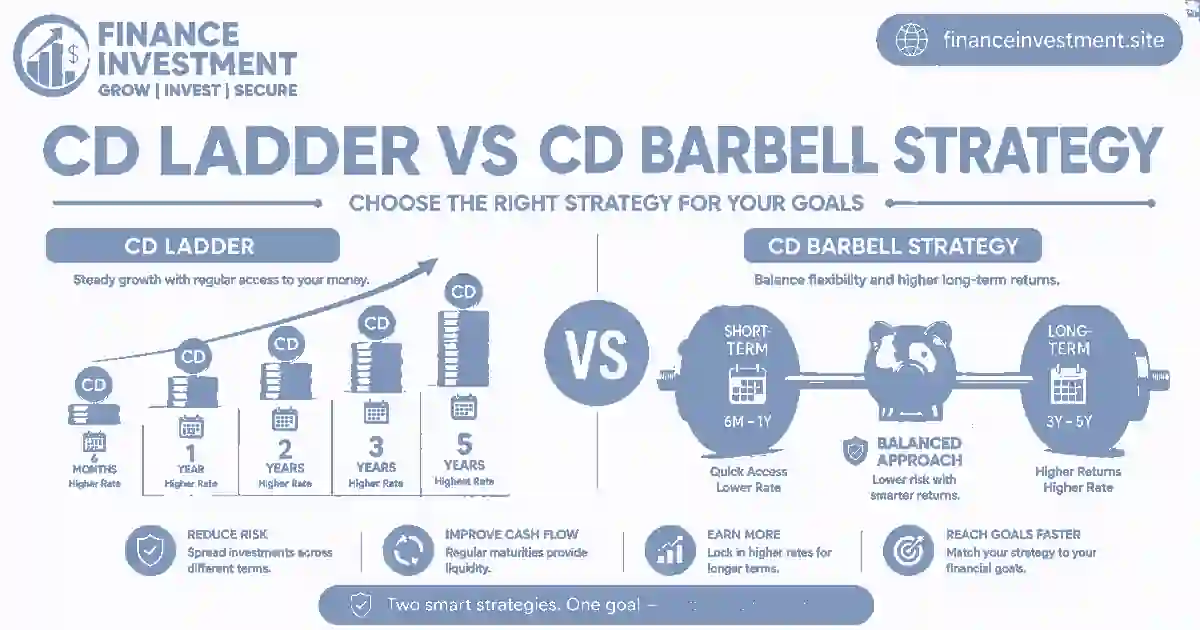
    A CD ladder spreads money across several maturity dates. That creates a steady stream of opportunities to reassess or use funds. A barbell takes a different route. It typically places money toward shorter and longer maturities while leaving less in the middle.

    Neither structure automatically wins. Your expected cash needs, comfort with locking money away, views on future rates, and desire for regular access can point you toward one design over the other. The goal is to build a schedule that makes sense for your money instead of forcing your money into a preset formula.

    If you want to refresh the basics before comparing these strategies, our

    CD Guide 2026

    explains CD basics, terms, rates, and the details worth checking before you choose an account.

    What You’ll Learn

    • How CD ladders and barbells are structured
    • Where each strategy can fit different cash needs
    • How maturity timing affects liquidity
    • The trade-offs involving rates and reinvestment
    • How to choose a structure without overcomplicating your savings plan

    Quick Answer: CD Ladder or CD Barbell?

    A CD ladder generally spreads money across multiple maturity dates, while a CD barbell concentrates more of the money in shorter and longer terms, with less in the middle. A ladder can offer more regular access points; a barbell can keep some cash relatively near-term while committing another portion for longer.

    6 Key Takeaways

    1. Ladder: Several CDs mature at different points.
    2. Barbell: Money is concentrated toward short and long maturities.
    3. Liquidity: A ladder can create more frequent maturity dates.
    4. Rate exposure: A barbell can give you both shorter-term flexibility and longer-term rate certainty.
    5. Cash needs matter: Upcoming expenses can influence which structure makes more sense.
    6. There is no universal winner: The better setup is the one that matches your timeline and comfort with locked-up money.

    Bottom line: A ladder is useful when you want several planned maturity dates. A barbell may fit better when you want a short-term pool alongside a longer commitment.

    CD Ladder vs CD Barbell: At a Glance

    The two structures differ mainly in where your maturity dates sit. A ladder usually creates a sequence of scheduled maturities, while a barbell places more weight at the short and long ends. That difference can affect how often you can access cash and how much of the portfolio is committed for longer periods.

    FeatureCD LadderCD Barbell
    Typical structureSeveral staggered maturitiesShort and long maturities
    Liquidity patternMore frequent maturity pointsMore concentrated access
    Rate exposureSpread across maturitiesShort and long rate exposure
    May suitSavers wanting scheduled access pointsSavers comfortable pairing near-term access with longer commitments

    Quick read: A ladder emphasizes a sequence of maturity dates. A barbell emphasizes separation between the short and long ends. The real difference is how each structure distributes your maturity dates and future decisions.

    How to Build a CD Ladder or Barbell From Scratch

    Building either strategy starts with the same basic question: how much money can you commit without needing it unexpectedly? Once that amount is clear, the structure becomes easier to design. Keep your emergency reserve and near-term spending money outside the CDs first. The remaining cash can then be divided according to your timeline.

    Building a CD Ladder

    A simple ladder divides your deposit among certificates with different maturity dates. For example, someone with $20,000 might place $5,000 into four CDs with staggered terms. As each certificate matures, the owner can use the money or reinvest it into a new longer-term CD.

    The exact terms do not have to follow one fixed formula. You might use six-month, one-year, 18-month, and two-year certificates, depending on available rates and when you expect to need the cash. Pick maturity dates that match real expenses or review points instead of filling every available term.

    Building a CD Barbell

    A barbell uses two ends of the maturity spectrum. One portion can sit in shorter CDs for relatively earlier access, while another portion can use longer certificates for a longer rate commitment. There is no universal percentage split. Your spending needs and tolerance for locking money away should guide the allocation.

    Plan the Reinvestment Before Maturity

    Decide in advance what you might do when a certificate matures. If you need the cash, move it to the account where you will spend it. If you still have a long-term need, consider reinvesting after checking current rates. Avoid automatic renewal simply because it is convenient.

    Practical Tip

    Keep a simple maturity calendar. Knowing which CD matures next can be more useful than trying to remember every account detail.

    How a CD Ladder and Barbell Work Over Time

    CD Ladder vs CD Barbell StrategyThe main difference becomes clearer once the certificates are actually in place. You are not simply choosing several CDs; you are creating a schedule for when portions of your money become available and when you will decide what to do next.

    How a CD Ladder Moves

    Imagine you divide $24,000 into four $6,000 CDs. You could choose terms that mature at different points, such as six months, one year, 18 months, and two years. When the first CD matures, you can take the money for a planned expense or reinvest it into a new certificate. The other CDs continue following their original schedules.

    You can compare the current CD market, check whether your original goal has changed, and decide whether that slice of money still belongs in another CD. That gives the strategy a built-in review point instead of requiring you to commit the entire balance at one time.

    How a CD Barbell Moves

    Now consider a $24,000 barbell. You might place $8,000 in shorter-term CDs and $16,000 in a longer-term certificate. The short side can provide an earlier opportunity to access or reposition part of the money, while the longer side remains committed for a longer period.

    The two sides do not have to be equal. A saver expecting a major expense soon might give more weight to the short end. Someone comfortable leaving most of the money untouched could place more toward the longer end.

    Illustrative example: Mark expects to need some cash within a year but wants another portion working for several years. A barbell may give him two distinct time horizons, while a ladder would spread those maturities more evenly.

    In both structures, the important work happens when a CD matures. That is when you reassess the rate, timing, and purpose of that portion of the money rather than automatically repeating the old decision.

    Benefits and Drawbacks of CD Ladders and Barbells

    The appeal of these strategies comes from giving each portion of your cash a different place on the calendar. That can make a large balance easier to organize, but the structure also creates trade-offs you should understand before committing the money.

    ✓ Pros

    • Planned access: A ladder can create regular maturity dates, giving you more opportunities to use or reposition cash.
    • Rate diversification: Different maturity dates can reduce the need to commit the entire balance at one rate.
    • Reinvestment choices: Each maturity gives you a chance to compare current rates before putting the money back to work.
    • Flexible structure: A barbell can pair shorter commitments with longer ones instead of spreading money evenly.

    ⚠ Cons

    • Timing risk: A maturity date may not arrive when you actually need the money.
    • Concentration: A barbell can leave a larger share committed at one end of the maturity range.
    • Inflation risk: Fixed CD returns may lose purchasing power when prices rise faster than the account’s return.
    • Reinvestment risk: A maturing CD may need to be renewed when available rates are lower.

    That timing control is useful only if your cash outside the CDs is large enough to handle unexpected expenses.

    CD Ladder vs CD Barbell: Side-by-Side Comparison

    Once you move beyond the basic definitions, the choice comes down to how much control you want over maturity dates and where you want your rate exposure. A ladder spreads decisions across time, while a barbell creates a sharper split between shorter and longer commitments.

    FactorCD LadderCD Barbell
    StructureMoney is divided across several maturity dates.Money is concentrated around shorter and longer terms.
    LiquidityCan create more frequent maturityAccess is generally concentrated in the shorter-term portion.
    Maturity spreadBroad and staggered.Focused at two ends.
    ReinvestmentDecisions occur more regularly.Fewer, more concentrated decisions.
    ComplexityCan require tracking several CDs.Can be simpler to maintain.
    May suitSavers who value recurring maturity dates.Savers who want a short-term pool alongside longer commitments.

    The strategy can also be adjusted around the available products. For example, you could review
    6-month CD rates
    for the shorter side and compare them with
    5-year CD rates
    for a longer commitment. If you are unsure which term fits your cash needs, our guide on
    choosing the right CD
    can help frame the decision.

    Neither structure guarantees a better return. The useful comparison is how well each one fits your expected cash flow, tolerance for locked-up funds, and willingness to revisit rates over time.

    Costs, Risks and Expert Tips for CD Ladders and Barbells

    A well-planned CD structure can make your cash easier to manage, but it cannot remove the normal risks of certificates. The biggest issues usually appear when your circumstances change, rates move, or a maturity date arrives at an inconvenient time.

    Risks to Check Before Funding

    Early withdrawal penalties can reduce your interest if you need money before a CD matures. That matters in both strategies, especially if the amount at a particular maturity is smaller than the expense you eventually face.

    Opportunity cost matters when rates change. A long-term CD can keep earning its agreed rate while newer certificates become more attractive. On the other hand, short-term CDs may mature when available rates are lower. Inflation can also reduce the purchasing power of a fixed return.

    Insurance and taxes deserve a separate check. Check that eligible deposits are within applicable FDIC or NCUA coverage limits, including the relevant ownership category and institution. particularly when several CDs are held at the same institution. Interest from taxable CDs can also affect your tax bill and after-tax return.

    Expert Checks Before You Build or Renew

    Premium Expert Tip

    Write down every CD’s balance, APY, maturity date, penalty, ownership category, and renewal instructions. Then review the schedule as a whole. Several CDs can end up maturing close together, while a barbell can leave a large share of the balance tied to the long end.

    Before renewing, compare the new rate with current offers and ask whether the original cash plan still applies. Also check whether you still need the same balance at each maturity. A strategy should be adjusted when your financial timeline changes.

    Finally, keep emergency cash outside the certificates. A ladder or barbell works best when you are not forced to break a CD simply because an unexpected bill arrives.

    Common CD Ladder and Barbell Mistakes

    The trouble usually starts with the details: too many CDs, poorly spaced maturities, or money that should never have been locked up. The most common errors are usually not about picking a particular bank. They come from building a schedule that does not match the way the money will actually be used.

    Mistakes to Watch For

    • Making the structure too complicated: A ladder with too many small certificates can become difficult to track. If the added complexity does not create useful maturity dates, simplify it.
    • Clustering maturities: Several CDs that mature within the same narrow period may leave you with less flexibility than expected.
    • Using emergency cash: Money that may be needed immediately should not depend on a CD reaching maturity.
    • Ignoring renewal dates: A certificate can automatically renew according to its terms if you do not act during the applicable window.
    • Chasing rates: Moving money repeatedly for a slightly higher APY can add unnecessary work and may leave the maturity schedule disconnected from your goals.

    Illustrative Example: David Simplifies His Ladder

    David initially creates six small CDs because he wants frequent maturity dates. After reviewing the accounts, he realizes two mature within the same month and several balances are too small to make the extra tracking worthwhile. He consolidates his plan around fewer, more useful maturity points while keeping his emergency savings separate.

    Illustrative lesson: A useful CD strategy does not need to be complicated. The schedule should make your cash easier to manage, not create another chore.

    Before adding another certificate, look at the entire schedule rather than evaluating the new CD by itself. That simple habit can reveal gaps, clusters, and unnecessary commitments.

    Who Should Choose a CD Ladder or Barbell?

    A CD ladder may appeal to savers who want several planned points when money becomes available. It can work well for families with expenses spread across the year, retirees who want periodic access to part of their cash, or investors who prefer making smaller reinvestment decisions over time.

    A ladder tends to make sense for savers who want several planned maturity dates. keeping part of the money relatively accessible while committing another portion for a longer period. It can be useful when near-term liquidity and longer-term rate certainty both matter.

    Neither structure is necessary for every saver. If the balance is modest or the goal has one clear date, a single CD may be easier to manage. And if you may need the money without warning, a flexible savings account can be a better home for that cash.

    Quick Decision Guide

    • Want recurring maturity dates? Consider a ladder.
    • Need short and long commitments? Consider a barbell.
    • Have one clear cash date? A single CD may be enough.
    • Need immediate access? Keep the money flexible.

    Frequently Asked Questions About CD Ladders and Barbells

    What is the main difference between a CD ladder and a CD barbell?

    A ladder distributes money across a series of maturity dates, while a barbell puts greater weight on shorter and longer terms. The choice mainly changes how your cash becomes available over time.

    How many CDs do I need to build a CD ladder?

    There is no fixed number. A few certificates can create useful maturity dates, while a larger balance may support more steps. Keep the structure simple enough to track.

    Does a CD ladder provide more liquidity than a barbell?

    A ladder can create more maturity points, but that does not mean the money is available on demand. A CD generally remains subject to its terms until maturity.

    Which strategy has more rate risk?

    Both have rate exposure in different ways. A ladder spreads renewal decisions across time, while a barbell can leave more money committed at the long end.

    What happens when a CD in a ladder matures?

    You can generally use the money, move it elsewhere, or reinvest it after reviewing current rates and your financial needs.

    Can I change a CD ladder after I build it?

    Yes. As certificates mature, you can change the next term or amount rather than rebuilding the entire structure from scratch.

    Do CD ladders and barbells require a minimum deposit?

    Each bank or credit union sets its own CD minimums. Building a strategy with several certificates may require enough money to meet those minimums comfortably.

    Are CDs in a ladder or barbell federally insured?

    Eligible bank CDs may receive FDIC insurance, while qualifying credit-union share certificates may receive NCUA federal share insurance. Coverage limits and ownership categories apply.

    Are CD ladder and barbell earnings taxable?

    Interest from CDs held in a regular taxable account is generally taxable interest income. Your actual tax treatment depends on your circumstances and account type.

    Illustrative: Which strategy could fit a $30,000 balance?

    Illustrative comparison only: A saver could divide $30,000 among several maturity dates for a ladder or place more toward short and long terms for a barbell. The better structure depends on when the saver expects to need the money, not simply the balance size.

    Final Verdict: Which CD Strategy Makes More Sense?

    Choose a ladder if your main priority is having several planned maturity dates. Choose a barbell if your money has two different time horizons and you want a shorter-term portion alongside longer-term CDs. A ladder makes more sense when you want several maturity dates and prefer to spread your cash decisions across time. A barbell can be useful when you have two clear priorities: keeping one portion relatively near-term while giving another portion a longer runway.

    The key is to build around your expected cash needs rather than choosing a structure simply because it looks attractive on a rate table. A higher APY can lose its appeal if the money becomes unavailable when you need it, or if a maturity schedule creates more management work than you want.

    If you want to review CD basics, terms, safety considerations, and rate factors before choosing a structure, see our

    CD Guide 2026
    .

    Practical takeaway: Map out when you may need the money first. Then choose the CD structure that gives those dollars the right maturity dates.

    Build a CD Strategy That Fits Your Timeline

    A useful CD strategy starts with your cash needs, not with a complicated formula. Start with when you may need the money, then choose a structure that makes those dates easier to manage. For practical finance guides and new money insights, join our newsletter.

    📧 subhashr325@gmail.com