Tag: CD Ladder

  • When Is the Best Time to Open a CD? Smart 2026 Guide

    When Is the Best Time to Open a CD? Smart 2026 Guide

    FINANCEINVESTMENT • CD TIMING GUIDE • 2026

    When Is the Best Time to Open a CD? Smart Timing Guide for 2026

    SR
    Written by Subhash Rukade
    FinanceInvestment

    Updated August 27, 2026

    About 10–12 min read

    The best time to open a CD is not always the day you see the highest advertised rate. Your cash needs, the term you can comfortably lock in, current rates, and what you expect to do with the money at maturity all matter.

    When Is the Best Time to Open a CD? Smart Timing Guide for 2026

    Find out when the best time to open a CD may be in 2026. Learn how rates, timing, CD terms, cash needs, rate locks, and CD ladders can shape your decision.
    when-is-the-best-time-to-open-a-cd
    best time to open a CD
    best time to open a CD in 2026,
    when to open a CD,
    when should I open a CD,
    CD timing,
    best time to lock in a CD rate,
    CD rates 2026,
    when to buy a CD,
    CD rate timing,
    should I open a CD now,
    CD ladder timing
    https://financeinvestment.site/when-is-the-best-time-to-open-a-cd/
    Subhash Rukade
    August 26, 2026
    About 10–12 minutes

    When Is the Best Time to Open a CD?

    When Is the Best Time to Open a CD? Smart Timing Guide for 2026The best time to open a CD is rarely determined by one perfect interest-rate moment. A better decision comes from looking at two things together: what CD rates are doing and when you expect to need your money. If you have cash you will not need for a defined period and you find a rate that fits your goals, opening a CD now can make sense rather than waiting indefinitely for something better.

    Waiting can be reasonable when you have an important expense approaching, need easy access to the money, or are not comfortable with the available terms. But waiting for the exact top of the rate cycle is difficult because nobody knows future rates with certainty.

    That is where a CD ladder can help. Instead of putting everything into one maturity date, you can spread deposits across different terms. As each CD matures, you get another opportunity to reassess rates and your cash needs. Our

    CD Guide 2026

    provides a broader look at how CDs can fit into a savings strategy.

    What You’ll Learn

    • When opening a CD now may make sense
    • When waiting may be the better choice
    • How your personal cash timeline affects CD timing
    • Why chasing the highest possible rate can backfire
    • How CD ladders can reduce the pressure to predict future rates

    Quick Answer: When Should You Open a CD?

    There is no single calendar date that guarantees the best CD rate. A practical decision starts with your own timeline, then weighs the rates and terms currently available.

    6-Step CD Timing Test

    1. Check your cash timeline: Make sure the money can remain untouched for the period you are considering.
    2. Review current rates: Look at several comparable CD offers instead of relying on one advertised rate.
    3. Choose your lock-in period: Decide whether a short, medium or longer term fits your plans.
    4. Compare the APYs: Once the terms are comparable, see whether the available return justifies locking up the funds.
    5. Consider staggered maturities: A CD ladder can give you multiple opportunities to reassess rates rather than making one large timing decision.
    6. Decide without chasing a perfect peak: If the rate and term already work for you, waiting solely for a higher future rate can leave the money earning less in the meantime.

    Bottom line: The best time to open a CD is often when the rate is reasonable and the term fits your financial timeline—not when you can somehow predict the exact market peak.

    CD Timing at a Glance

    Good CD timing starts with the relationship between the rate available today and the job your money needs to perform. This quick snapshot helps you judge the timing without trying to forecast every move in interest rates.

    Timing FactorWhat to Look AtTiming Signal
    Rate environmentAvailable CD APYsA competitive rate may support opening now
    Cash timelineWhen you may need the moneyNear-term needs favor flexibility
    CD termLength of commitmentChoose a term you can comfortably hold
    Rate lockFixed rate for the selected termUseful when today’s rate fits your expectations
    Maturity dateWhen the CD endsBest when it lines up with a future goal
    LiquidityHow much cash must stay accessibleHigher liquidity needs may argue against a long CD
    Ladder potentialMultiple maturity datesUseful when you want several future decision points
    Goal fitPurpose of the moneyA clear goal can make the timing decision easier

    Quick perspective: A CD can be well-timed even when rates are not at their absolute peak if the term, rate lock and maturity date fit your plan.

    Complete Beginner Guide: Should You Open a CD Now?

    best time to open a CDYou do not need to predict the next move in interest rates to make a sensible CD decision. A better approach is to work from your own financial timeline and then see how today’s available offers fit it.

    1. Start With Your Cash Needs

    First, separate money you may need soon from money that can stay untouched. Emergency savings and cash for upcoming bills generally need easier access. Only consider a CD for funds you can reasonably leave committed for the selected term.

    2. Check the Rates Available Today

    Look at current offers for the terms you could actually use. You can review our
    CD rates in 2026
    resource as one starting point. The goal is not to find a mythical perfect rate; it is to understand what is realistically available when you are making the decision.

    3. Choose a Term You Can Live With

    A higher APY may come with a longer commitment. If you know you will need the money in a year, locking it away for several years simply because the rate looks attractive may create a bigger problem later. Our guide to
    choosing the right CD
    can help you think through the term.

    4. Decide Whether the Rate Lock Is Worth Taking

    A fixed CD rate gives you certainty for the agreed term. That can be valuable if the current offer already meets your expectations. On the other hand, keeping all your cash uncommitted because rates might rise can mean giving up today’s known return.

    5. Plan the Maturity Date Before Opening

    Picture the date when the CD will mature. If it lands near a known expense, another investment decision, or a period when you expect to need cash, that timing deserves attention.

    6. Consider Staggering the Money

    You do not have to make one all-or-nothing timing call. A
    CD ladder
    can spread money across different maturity dates, giving you recurring opportunities to access funds and reconsider available rates.

    Beginner Tip

    If today’s CD fits your timeline and you are comfortable with the return, you do not need to wait for a perfect market moment. If it does not fit, waiting—or splitting the money—can be the smarter move.

    How CD Timing Works After You Open the Account

    When you open a fixed-rate CD, the institution generally locks in the stated rate for the selected term. Your deposit then remains in the certificate until maturity, subject to the account’s withdrawal rules. The important point is that the rate you receive is tied to the CD you open—not to whatever rates become available later.

    If market rates rise after you open the CD, your existing certificate normally keeps its agreed rate. You gain certainty, but you also give up the chance to move that money immediately into a newly available higher-rate CD. If rates fall, the same rate lock can work in your favor because your existing CD continues earning under its original terms.

    The term determines how long this trade-off lasts. A shorter CD gives you an earlier maturity date and another opportunity to reassess. A longer CD can provide a longer period of rate certainty, but your money remains committed for more time.

    Illustrative Example: Open Now vs. Wait

    Illustrative only: Imagine you have $20,000 available. A hypothetical one-year CD offers 4.25% APY today. If you open it, the account would earn roughly $850 over a year if the stated APY applies and the money remains under the CD’s terms.

    Now suppose you wait three months hoping for a better rate. A hypothetical offer later reaches 4.50%, but your money earned no CD interest during those three months. The higher future APY does not automatically mean waiting produced a better overall result. The outcome depends on how long the money remained uninvested and the rates actually available.

    Lesson: Waiting can work when rates improve enough to compensate for the return you gave up, but that result cannot be known in advance.

    This is why CD timing is partly about accepting a known return versus making a bet on future rates. A CD ladder can reduce the size of that bet by creating several maturity dates instead of requiring one large timing decision.

    Benefits and Drawbacks of Opening a CD at the Right Time

    Opening a CD when the rate and your timeline line up can turn idle cash into a predictable return. The trade-off is that the decision also fixes your rate and limits access for the selected term.

    Pros

    • Rate certainty: A fixed-rate CD can lock in the agreed return for its term.
    • Predictable earnings: You can estimate the interest under the CD’s stated terms.
    • Disciplined saving: Limited access can make it easier to leave designated savings untouched.
    • Protection from falling rates: A later decline in available rates does not normally change the locked rate.

    Cons

    • Missed upside: Rates could rise after you open the CD.
    • Reduced liquidity: Getting money out early may involve restrictions or penalties.
    • Inflation risk: The purchasing power of the return can change while your money is locked.
    • Opportunity cost: The money may have earned more elsewhere or served another financial goal.

    A Practical Perspective

    You do not need perfect timing for a CD to be useful. If the rate provides reasonable value, the term fits your plans, and you can accept the reduced access, locking in a known return can be more practical than waiting indefinitely for a better offer.

    Best CD Timing Scenarios Compared

    The right timing strategy can look different depending on how certain you are about your future cash needs and how much rate uncertainty you are comfortable accepting. These approaches offer different ways to balance today’s return with tomorrow’s flexibility.

    StrategyBest FitMain AdvantageMain Trade-Off
    Open nowYou like today’s rate and can commitLocks in a known returnFuture rates could be higher
    WaitYou have flexibility and expect conditions to improveKeeps the option to choose laterFuture rates may fall instead
    Short-term CDYou want an earlier decision pointMoney reaches maturity soonerRates may differ from longer terms
    Longer-term CDYou value longer rate certaintyLocks the rate for a longer periodLess flexibility if plans change
    CD ladderYou want several maturity datesReduces reliance on one timing decisionRequires more planning and tracking
    Keep cash flexibleYou may need the money soonEasy access to fundsPotentially lower return

    If you want several opportunities to reassess your money, explore
    how to build a CD ladder.
    For money with a shorter timeline, our guide to
    using CDs for short-term savings
    can help you evaluate the commitment.

    If your priority is deciding whether today’s rate is worth locking in, you can also review
    whether to lock in a CD rate now.

    Simple rule: The more flexibility you need, the less attractive a long lock-in may be. The more certain you are about the timeline, the easier it can be to use a fixed CD strategically.

    Costs, Risks & Expert Tips Before Opening a CD

    CD timing becomes harder when the decision is treated like a bet on where interest rates are heading. Forecasts can provide context, but they cannot tell you exactly what rates will do next. The bigger question is what you give up by waiting, locking in now, or choosing a term that later proves inconvenient.

    Watch the Cost of Waiting

    If your money sits in a lower-yield account while you wait for a better CD rate, the extra interest from a future offer must first make up for what you missed. A higher APY later is not automatically a better outcome.

    Understand Rate and Liquidity Risk

    If rates rise after you open a fixed-rate CD, your existing rate normally stays unchanged. If rates fall, that lock can become valuable. Either way, withdrawing early may trigger a penalty or other restrictions, so check the account terms before committing.

    Remember Taxes and Inflation

    CD interest is generally taxable income for federal tax purposes, which means the amount you keep can be lower than the headline earnings. Inflation also matters because a fixed return does not guarantee that your purchasing power will rise.

    Check Deposit Insurance and Account Limits

    Confirm that the institution is properly insured and consider how your total deposits are distributed across accounts and ownership categories. The standard FDIC coverage limit is generally $250,000 per depositor, per insured bank, per ownership category. Credit-union deposits use NCUA share insurance instead.

    Expert Tip

    Before locking in a CD, write down three numbers: the amount you are depositing, the maturity date, and the amount of accessible cash you will still have afterward. If those three numbers work together, the timing decision becomes much easier.

    Common CD Timing Mistakes to Avoid

    Trying to choose the perfect day to open a CD can create more uncertainty than it solves. A few common mistakes can turn an otherwise useful savings decision into an awkward one later.

    • Waiting for the perfect rate: Rates can move in either direction, so holding cash indefinitely for a higher offer may mean giving up interest today.
    • Following forecasts blindly: Rate predictions are estimates, not guarantees. Your financial timeline should carry more weight than a confident-sounding forecast.
    • Locking up money needed soon: A CD may be a poor fit for an upcoming tuition payment, home expense, emergency reserve, or other known need.
    • Ignoring early-withdrawal terms: Check the penalty and account rules before assuming you can access the money cheaply if plans change.
    • Overlooking taxes or insurance: Consider the after-tax return and verify applicable deposit insurance, especially when holding larger balances.
    • Choosing the wrong maturity date: A CD that matures at an inconvenient time can make a simple savings plan harder to manage.

    Illustrative Example: Maria’s Timing Decision

    Illustrative only: Maria has $15,000 that she expects to use for a home renovation in about 14 months. She considers a longer CD because its advertised APY is attractive, but the maturity date would fall well after her planned expense. Instead of chasing the higher rate, she chooses a shorter term that better matches her timeline and keeps other savings accessible.

    Her choice does not guarantee the highest possible return. It simply avoids making a rate decision that conflicts with a known financial goal.

    Who Should Open a CD?

    A CD can make sense for people who have money with a defined purpose and do not need immediate access to it. The timing becomes especially useful when a predictable return matters more than keeping every dollar fully flexible.

    People Who May Benefit

    • Beginners: A fixed rate and defined maturity date can make the savings plan easy to understand.
    • Retirees: CDs can provide predictable interest for money that is not needed immediately, although liquidity needs should come first.
    • Families: A CD may work for a known future expense, such as a planned education or large purchase.
    • Conservative savers: Those who prefer predictable returns may appreciate knowing the agreed rate for the CD term.
    • Goal-focused savers: A CD can fit well when the maturity date lines up with a future financial milestone.

    When Another Choice May Be Better

    A CD may not be appropriate if you expect to need the money soon, have not built an accessible emergency reserve, or are uncomfortable with early-withdrawal restrictions. In those situations, keeping more money in a flexible savings account can be more practical. Waiting can also make sense if the available CD terms do not fit your timeline and you have a reasonable alternative for holding the cash in the meantime.

    Key idea: A CD works best when its rate, term and maturity date fit the job you have assigned to the money.

    Frequently Asked Questions About the Best Time to Open a CD

    What is the best time to open a CD?

    The best time is usually when the available rate and term fit your financial timeline. You do not need to predict the exact market peak.

    Should I wait for CD rates to rise?

    Waiting can make sense when you have flexibility, but rates can also fall. Consider the interest you may give up while waiting.

    What happens when I lock in a CD rate?

    A fixed-rate CD generally keeps its stated rate for the agreed term, even if market rates later move higher or lower.

    Should I choose a short-term or long-term CD?

    Choose a term based on when you can comfortably use the money again. A longer term can provide extended rate certainty, while a shorter term gives you an earlier maturity date.

    Can CD rates rise after I open a CD?

    Yes. If market rates rise, your existing fixed-rate CD generally remains at its original rate until maturity.

    Can a CD ladder help with timing?

    Yes. A ladder spreads money across different maturity dates, giving you recurring opportunities to reassess rates and cash needs.

    Can I withdraw money from a CD before maturity?

    Some CDs permit early withdrawal subject to the account’s rules and a possible penalty. Check the terms before opening the account.

    Is CD interest taxable?

    CD interest is generally taxable income for federal tax purposes, although your specific tax situation can differ.

    Are CDs covered by deposit insurance?

    CDs at FDIC-insured banks generally receive FDIC deposit insurance within applicable limits. Qualifying federally insured credit-union accounts receive NCUA share insurance.

    Is opening a CD now always better than waiting?”

    Illustrative only: Suppose $10,000 can earn 4.25% APY today. Waiting for a higher rate could help if rates rise enough, but the money may earn less while you wait. The better choice depends on the eventual rate, waiting period and your cash needs.


    Final Verdict: Should You Open a CD Now or Wait?

    There is no reliable way to know the exact day when CD rates will reach their highest point. That makes waiting for a perfect rate a risky strategy on its own. A better decision is to ask whether today’s available rate is attractive enough for your goals and whether you can comfortably leave the money committed for the selected term.

    Opening a CD now can make sense when you have cash you will not need soon, the rate is competitive, and the maturity date fits your plans. Locking in can also provide useful certainty if you are concerned that rates could move lower.

    Waiting may be reasonable when you have an upcoming expense, need greater flexibility, or have a strong reason to keep the money available. A CD ladder can offer another path by spreading maturity dates instead of forcing one large timing decision.

    For a broader look at CD terms, strategies and safety considerations, explore our

    CD Guide 2026
    .

    Bottom line: You do not need perfect market timing. You need a CD rate, term and maturity date that make sense for your money today.

    FINANCEINVESTMENT • SMART CD GUIDANCE

    Make Your Next CD Decision With Confidence

    CD rates will change, but your savings goals do not have to wait for a perfect market moment. Get practical FinanceInvestment guidance on CDs, rates, savings strategies and smarter ways to plan your cash.

    📧 subhashr325@gmail.com
  • How to Reinvest a Matured CD in 2026: A Complete Guide

    How to Reinvest a Matured CD in 2026: A Complete Guide

    FINANCEINVESTMENT • CD REINVESTMENT GUIDE • 2026

    How to Reinvest a Matured CD in 2026

    SR
    Written by Subhash Rukade
    FinanceInvestment
    Updated August 26, 2026
    About 10–12 min read

    Your CD has matured. Now comes the useful part: deciding what the principal and earned interest should do next. Reinvesting can keep your money working, but the next term should fit your rate expectations, cash needs, and timeline.

    How to Reinvest a Matured CD in 2026
    Learn how to reinvest a matured CD, compare rates and terms, decide between full or partial reinvestment, and balance returns with liquidity.
    how-to-reinvest-a-matured-cd
    how to reinvest a matured CD
    reinvest a matured CD,
    matured CD reinvestment,
    what to do with a matured CD,
    CD reinvestment options,
    reinvest CD principal and interest,
    CD maturity reinvestment,
    reinvesting CD interest,
    how to reinvest CD money,
    partial CD reinvestment,
    CD reinvestment strategy
    Informational / Commercial / Transactional
    USA
    Beginners, Investors, Families & Retirees
    https://financeinvestment.site/how-to-reinvest-a-matured-cd/
    Subhash Rukade
    August 25, 2026
    About 10–12 minutes

    A Matured CD Gives You a New Money Decision

    how to reinvest a matured CDKnowing how to reinvest a matured CD starts with one simple idea: maturity gives your money a fresh assignment. The original CD term is over, so you can decide whether the principal, earned interest, or both should go into another certificate.

    That does not mean you have to put the entire balance back into a new CD. You might need part of the money for a home repair, tuition, a family expense, or an upcoming purchase. Keeping some cash accessible while reinvesting the rest can sometimes make more sense than locking everything away again.

    The next choice also deserves more than a quick look at the advertised rate. Consider the new CD’s APY, term, interest-payment rules, maturity date, and how easily you could access the money if plans change. A shorter term may fit an upcoming goal, while a longer term could suit money you will not need for years.

    If you want to review the basics before choosing your next move, our

    CD Guide 2026

    explains CD terms, rates, safety, and strategies. This guide goes one step further by focusing on what to do with the money after the original CD has matured.

    What You’ll Learn

    • How principal and interest can be handled after maturity
    • When full or partial reinvestment may make sense
    • How to compare a new CD before committing funds
    • How term length can affect your next maturity date
    • How to balance potential returns with access to cash

    Quick Answer: How to Reinvest a Matured CD

    Reinvesting a matured CD means deciding where the available balance should go next instead of treating the old CD as an automatic template for the new one. A simple review can help you choose a term and amount that fit your plans.

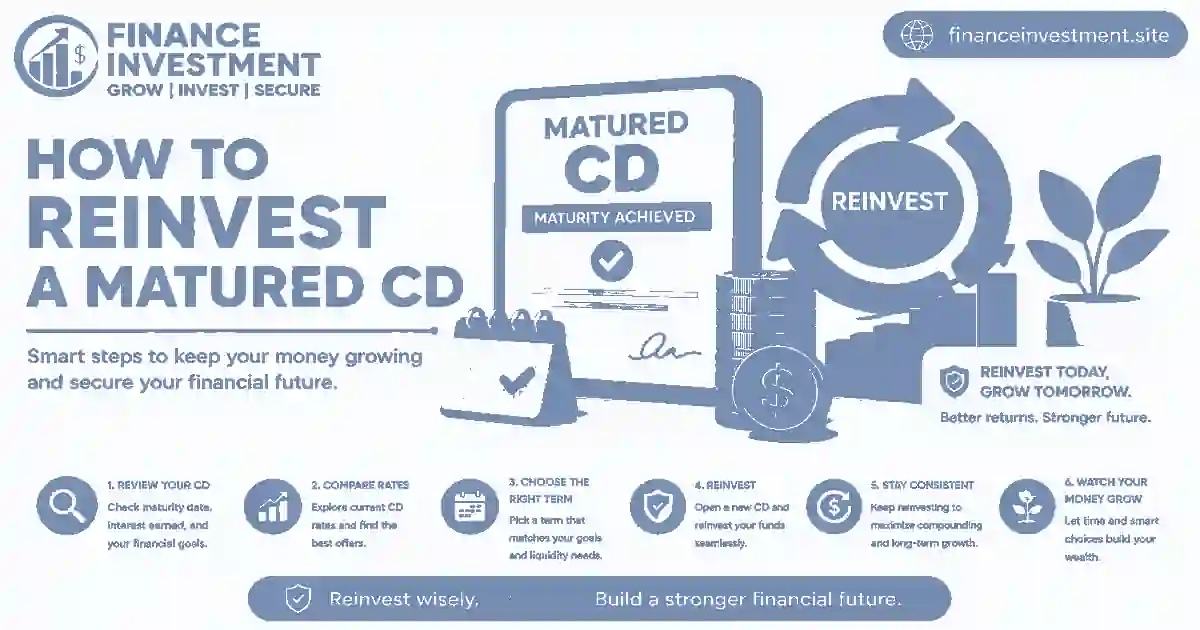
    6 Practical Steps

    1. Check the matured balance: Confirm the principal, credited interest, and total amount available for your next decision.
    2. Separate near-term cash needs: Set aside money you expect to use soon instead of automatically committing the entire balance.
    3. Compare current APYs: Look beyond your previous CD and compare current offers from suitable banks or credit unions.
    4. Choose the new term: Match the CD length with when you expect to need the money again.
    5. Decide how much to reinvest: You can reinvest all, part, or none of the matured funds depending on your goals.
    6. Confirm the new maturity details: Record the new APY, term, maturity date, interest rules, and account destination.

    Bottom line: Reinvestment works best when the new CD is chosen for today’s goals rather than simply copied from yesterday’s certificate.

    Matured CD Reinvestment at a Glance

    Once a CD reaches maturity, the useful question is not simply how much money is available. You also need to understand what portion came from the original deposit, what was earned, and how much you want committed again. This snapshot keeps the main numbers together before you choose the next home for the funds.

    FactorWhat to CheckWhy It Matters
    Matured balanceTotal funds availableSets the amount you can allocate
    PrincipalOriginal depositShows the core amount being redeployed
    InterestEarned amount creditedCan increase the amount available for reinvestment
    New APYCurrent offerDetermines potential earnings under the new CD
    TermLength of the new CDDetermines how long funds may remain committed
    LiquidityHow much cash should remain accessibleHelps avoid locking up money needed soon
    Reinvestment amountFull or partial balanceLets the strategy match your cash needs
    Next maturity dateEnd date of the new termHelps you plan the next financial decision

    Complete Beginner Guide to Reinvesting a Matured CD

    how to reinvest a matured CDReinvesting a matured CD does not require a complicated strategy. The goal is to make the next deposit fit your life today, rather than simply repeating the old certificate. A few deliberate checks can make the decision much clearer.
    1. Confirm the Final Amount

    Start with the actual amount available after maturity. Check the original principal, credited interest, and any amount that was paid separately during the previous term. Your account statement should show what is available to move or reinvest.

    2. Keep Money You Expect to Use

    Before opening another CD, think about expenses coming within the next several months. An emergency reserve, tuition payment, home project, or planned purchase may deserve cash access. Do not put money into a fixed term simply because the balance is already sitting there.

    3. Compare New CD Offers

    Look at current APYs, minimum deposits, terms, interest-payment choices, and early-withdrawal rules. Your previous CD’s rate is not a useful benchmark by itself. Our guide on
    CD rates in 2026
    can be a starting point when comparing available offers.

    4. Pick a Term That Fits Your Calendar

    Think about when you may need the money again. A shorter certificate can bring the next decision closer, while a longer one may work for funds you can leave untouched for a longer period. For help comparing terms, see our guide on
    choosing the right CD.

    5. Choose Full or Partial Reinvestment

    You do not have to reinvest every dollar. For example, you could keep enough for an upcoming expense and place the remaining balance into a new certificate. This can provide a middle ground between earning a fixed return and maintaining accessible cash.

    6. Record the New Maturity Date

    Once the new CD is opened, save its APY, term, maturity date, and renewal instructions. Put the next maturity date on your calendar well in advance so the next decision does not arrive unexpectedly.

    Beginner Tip

    Treat the matured balance as fresh money. Recheck your goals and today’s choices instead of assuming the old CD’s strategy still fits.

    How CD Reinvestment Works After Maturity

    When a CD matures, the original term is finished and the available proceeds can be given a new purpose. The amount available may include the original principal and interest that was credited under the CD’s terms. From there, you decide how much stays accessible and how much goes into another certificate.

    From Maturity to a New CD

    Think of the process as a simple chain: old CD → maturity → available proceeds → cash allocation → new CD → new maturity date. If you reinvest the entire balance, the full eligible amount goes into the new certificate. If you reinvest only part, the remainder can stay outside the CD for an intended expense, emergency reserve, or another financial purpose.

    Full Versus Partial Reinvestment

    Full reinvestment keeps more money working under the new CD’s terms. Partial reinvestment creates a middle ground: some funds can continue earning a fixed return while another portion remains available. Neither approach is automatically better; the useful choice depends on when you expect to need the money.

    Illustrative Example: $32,500 Matured CD

    Imagine Daniel has $32,500 available when his CD matures. He expects to spend $7,500 within the next year, so he keeps that portion accessible and considers placing the remaining $25,000 into a new CD. The new certificate has its own APY, term, and maturity date. This example is illustrative only; actual earnings depend on the selected CD and its terms.

    The important change is that the new CD should be evaluated on its own merits. The fact that the money previously earned interest in a CD does not mean the same term or amount must be used again. Reinvestment is a new decision with a new timeline.

    Benefits and Drawbacks of Reinvesting a Matured CD

    Reinvesting can keep a matured balance working instead of leaving it idle, but the trade-off is that another CD creates another period of limited access. The decision is strongest when the expected benefit fits the time you can comfortably leave the money alone.

    ✓ Pros

    • Continued interest: Eligible funds can keep earning under the new CD’s terms.
    • Compounding potential: Reinvesting earned interest can increase the amount working over future terms.
    • Predictable returns: A fixed CD can provide clearer expectations than accounts with variable rates.
    • Disciplined saving: Another fixed term can reduce the temptation to spend money set aside for longer-term goals.

    ✕ Cons

    • Limited liquidity: Accessing funds before the new maturity can be restricted or costly.
    • Rate risk: A long-term commitment can look less attractive if market rates later rise.
    • Taxes: Interest earned in a taxable account can create tax obligations.
    • Inflation: A fixed return may not keep pace with rising prices after taxes and inflation are considered.
    • Opportunity cost: Money placed in another CD cannot simultaneously be used for a different opportunity or financial need.

    Reinvestment is therefore less about keeping every dollar locked up and more about deciding which dollars can afford to stay committed. A partial approach can sometimes preserve flexibility while keeping a portion of the matured balance earning a fixed return.

    CD Reinvestment Strategies Compared

    A matured balance does not have to follow one path. You can match the structure of the new money arrangement to your timeline, rather than choosing a strategy simply because it worked for the previous CD.

    StrategyHow It WorksBest FitMain Trade-Off
    Full reinvestmentPlaces the eligible matured balance into a new CD.Money not needed soonLess accessible cash
    Partial reinvestmentSplits the balance between a new CD and accessible funds.Mixed cash needsSmaller amount earns the CD return
    Short-term CDUses a shorter fixed term before the next maturity.Nearer-term goalsMay offer less time for interest to accumulate
    Long-term CDCommits funds for a longer period.Longer-range savingsGreater commitment
    CD ladderDivides money among CDs with different maturity dates.Staggered accessMore accounts to track
    Flexible savingsKeeps some or all funds outside a fixed CD.Frequent or uncertain cash needsRate can change

    If staggered access sounds useful, see our guide to
    building a CD ladder.
    For a different way to structure staggered maturities, you can also compare a
    CD ladder and CD barbell strategy.

    If you are unsure how long to commit the money, our guide to
    how long to keep money in a CD
    can help you think through the timeline before choosing the next certificate.

    Costs, Risks and Expert Tips for CD Reinvestment

    Reinvesting a matured CD can feel straightforward because the money is already in a familiar savings vehicle. Still, the new decision creates its own risks. The rate, timing, access rules and size of the deposit can all change the outcome.

    Watch What Happens to Rates

    A competitive rate today may not look as attractive later if market rates move higher. A long term can provide certainty, but it can also limit your ability to benefit from future offers. On the other hand, waiting for a better rate can leave the money earning less while you wait. The trade-off is worth considering before committing.

    Understand Early-Withdrawal Costs

    A new CD can restrict access before maturity. If you unexpectedly need the money, an early-withdrawal penalty may reduce the interest you keep. Review the account’s withdrawal rules rather than assuming the new certificate will have the same conditions as the old one. Our guide to
    CD early-withdrawal rules
    explains the issue in more detail.

    Account for Taxes and Inflation

    Interest from a CD held in a taxable account can create taxable income. At the same time, inflation can reduce what your future dollars can buy. A higher quoted return does not automatically mean a higher improvement in purchasing power after taxes and inflation.

    Check Insurance and Concentration

    If the matured balance is large, review applicable FDIC or NCUA deposit-insurance coverage before adding the money to an existing account at the same institution. Concentrating too much cash under one ownership category can create coverage issues when balances exceed applicable limits.

    Expert Tip

    Before funding the new CD, write down five details: APY, term, maturity date, withdrawal rules and where the money will be held. If any one of them is unclear, pause before transferring the matured balance.

    Common CD Reinvestment Mistakes

    A matured CD can make reinvesting feel routine, but small oversights can leave you with the wrong amount, term, or timing. These mistakes are easy to avoid when you treat the new CD as a fresh financial decision.

    • Reinvesting everything: Putting the full balance back into a CD can leave too little cash for an expense you already know is coming.
    • Chasing the highest rate: A higher APY may not be worth choosing a term that extends beyond when you expect to need the money.
    • Overlooking interest-payment rules: Check whether interest stays in the CD, is paid to another account, or follows another schedule.
    • Ignoring insurance coverage: A larger matured balance may require a closer look at applicable FDIC or NCUA coverage limits.
    • Choosing the wrong maturity date: A CD that ends after an important financial deadline may create an inconvenient cash-access problem.
    • Forgetting the new terms: Save the APY, term, maturity date, and renewal instructions instead of relying on memory.

    Illustrative Example: Mark Splits His Matured Balance

    Mark receives $40,000 when his CD matures. He is tempted by a higher-rate two-year CD and considers putting the entire amount into it. Instead, he realizes he expects a $10,000 family expense next year. He keeps that portion accessible and considers placing the remaining $30,000 into a new CD. He also records the new maturity date so the certificate does not surprise him later.

    Illustrative lesson: A strong reinvestment decision considers the calendar as carefully as the rate.

    Who Should Reinvest a Matured CD?

    Reinvesting can be a sensible choice when the money has a clear job and you are comfortable committing it for another fixed period. The best candidate is not necessarily the person chasing the highest rate; it is someone whose timeline matches the new CD.

    People Who May Benefit From Reinvestment

    Beginners may appreciate the structure of a fixed-term account when they have already set aside an emergency reserve. Larger-balance savers may use several CDs or institutions to organize cash while paying attention to applicable deposit-insurance limits.

    Retirees with predictable income needs may reinvest money that will not be required during the new term. Families can do the same with funds earmarked for a later expense. Conservative savers who value a defined return may also find a new CD useful for money with a known time horizon.

    When Reinvestment May Not Fit

    Keeping the matured balance liquid may make more sense if an expense is approaching, an emergency reserve needs replenishing, or you expect rates or your financial plans to change soon. A flexible savings account or another financial option may be preferable when access matters more than locking in a fixed return.

    The key question is simple: Can this money comfortably stay committed until the new maturity date? If the answer is uncertain, consider keeping at least part of it accessible.

    Frequently Asked Questions About Reinvesting a Matured CD

    What happens to my principal when a CD matures?

    The original principal becomes available according to the CD’s maturity terms. You can generally direct eligible funds toward a new CD, another account, or a planned expense.

    Can I reinvest both my CD principal and interest?

    Yes, if the interest has been credited to the amount available for reinvestment. Check how your original CD handled interest payments before calculating the new deposit.

    Should I reinvest the entire matured CD?

    Not necessarily. Full reinvestment may suit money you will not need soon, while partial reinvestment can leave some funds accessible.

    How do I choose the APY for a new CD?

    Compare the current APY with the term, withdrawal rules, minimum deposit, and other account conditions. A higher rate is not automatically better if the term does not fit your plans.

    What CD term should I choose after maturity?

    Choose a term based on when you expect to need the money again. A shorter term may offer an earlier access point, while a longer term can keep funds committed for more time.

    Can I reinvest part of a matured CD and keep the rest in cash?

    Often, yes. If the institution permits it, you can divide the matured proceeds between a new CD and an accessible account.

    Are taxes due on CD interest when I reinvest it?

    Reinvesting interest does not necessarily make it tax-free. Interest from a CD held in a taxable account can generally be subject to applicable federal income-tax rules.

    Can I withdraw money from my new CD before maturity?

    Access depends on the CD’s terms. An early withdrawal may be permitted but can result in a penalty or reduced interest, so review the account agreement first.

    Can a CD ladder be used when reinvesting a matured CD?

    Yes. Instead of placing the entire balance into one maturity date, you can divide funds among CDs with different terms so portions mature at different times.

    Illustrative: How much could a $20,000 matured CD earn after reinvestment?

    Illustrative example only: If $20,000 were placed into a hypothetical new CD at a stated 4% APY for one year, the ending balance would be about $20,800, assuming the APY and account terms produced that result. Actual earnings depend on the specific CD.

    Is my reinvested CD covered by FDIC or NCUA insurance?

    Coverage depends on whether the institution is an FDIC-insured bank or a federally insured credit union and whether your deposits remain within applicable coverage limits and ownership categories. Check the institution and your total balances before placing a large matured balance into a new CD.


    Final Verdict: How to Reinvest a Matured CD

    Reinvesting a matured CD can be a straightforward way to keep money working, but the new certificate should earn its place rather than inherit the old CD’s terms by default. Start with what you need the money to do next.

    If the full balance is unlikely to be needed during the next term, reinvesting most or all of it may fit. If you have an upcoming expense or want more flexibility, keeping part of the proceeds accessible while reinvesting the remainder can create a better balance.

    Evaluate the new CD independently. Compare its APY, term, interest rules, early-withdrawal provisions, maturity date, and applicable deposit-insurance coverage. The previous CD’s rate or term should not automatically determine the next one.

    For a broader look at CD basics, rates, safety, and strategies, visit our

    CD Guide 2026
    .
    It can help you put the reinvestment decision into the larger picture of your savings plan.

    Bottom line: Reinvest the amount you can comfortably leave committed, and let your current goals—not the old CD—set the terms for what comes next.

    FINANCEINVESTMENT • SMART CD GUIDANCE

    Make Your Next CD Decision With Confidence

    Your CD maturity date can be the start of a better savings decision. Get practical FinanceInvestment updates on CDs, rates, saving strategies, and smarter ways to manage your money.

    📧 subhashr325@gmail.com

  • How to Maximize CD Interest Earnings in 2026

    How to Maximize CD Interest Earnings in 2026

    FINANCEINVESTMENT • CD EARNINGS • 2026

    How to Maximize CD Interest Earnings in 2026

    SR
    Written by Subhash Rukade
    FinanceInvestment
    Updated August 26, 2026
    About 10–12 min read

    A practical guide to comparing CD yields, understanding interest growth, choosing suitable terms, and making smarter decisions when your certificate matures.

    How to Maximize CD Interest Earnings in 2026
    Learn how to maximize CD interest earnings in 2026 by comparing APYs, choosing suitable terms, understanding compounding, and planning reinvestment.
    how-to-maximize-cd-interest-earnings
    how to maximize CD interest earnings
    maximize CD interest,
    maximize CD earnings,
    earn more interest on CDs,
    CD interest earnings,
    CD APY strategy,
    CD interest rate strategy,
    CD reinvestment strategy,
    CD ladder strategy,
    maximize certificate of deposit returns,
    how CD interest works
    https://financeinvestment.site/how-to-maximize-cd-interest-earnings/
    Subhash Rukade
    August 25, 2026
    About 10–12 minutes

    How Much Can Your CD Really Earn?

    How to Maximize CD Interest Earnings in 2026A certificate of deposit can look simple on the surface: deposit money, leave it for a set period, and collect interest. The harder part is figuring out which choices actually improve the amount you keep. A slightly higher APY may help, but the result also depends on your balance, term, interest treatment, and what happens when the certificate matures.

    For example, putting more money into a competitive CD can increase the interest dollars earned, while choosing a term that is too long can create a problem if you need the cash early. Compounding can also matter when earned interest stays invested, while an interest payout to another account may change how the balance grows.

    Maturity creates another decision point. Instead of automatically renewing, you can compare the new rate, review your cash needs, and decide whether another CD still makes sense. That second decision can affect the earning potential of your savings just as much as the original deposit.

    If you want the broader foundation first, our

    CD Guide 2026

    covers the basics. This guide focuses specifically on the choices that can help you get more value from a CD without turning the process into a guessing game.

    What You’ll Learn

    • Which CD features can have the biggest effect on interest earned
    • How to compare APYs without overlooking account terms
    • Why deposit size, compounding, and interest payouts matter
    • How maturity and reinvestment decisions can affect future earnings

    Quick Answer: Six Ways to Improve Your CD Earnings

    To get more from a CD, focus on the details that affect the dollars you actually keep. Compare APYs on similar products, avoid unnecessary cash commitments, understand how interest is credited, and make a plan for what happens when the certificate ends.

    6 Actionable Moves

    1. Compare like-for-like APYs: Check certificates with similar terms, balances, and conditions before choosing a rate.
    2. Use the right deposit: Put enough money to meet your goal, but keep cash you may need outside the CD.
    3. Choose the term deliberately: Do not extend the maturity simply because a longer certificate advertises a better yield.
    4. Read the interest rules: Confirm whether interest compounds, how often it is credited, and where payouts go.
    5. Protect the return: Understand the early-withdrawal penalty before funding the account.
    6. Review maturity: Compare the new rates and your cash needs before renewing or moving the proceeds.

    Bottom line: Strong CD results come from making several good decisions together, not from selecting one impressive rate and ignoring the rest of the account terms.

    CD Interest Earnings at a Glance

    Before comparing individual CDs, it helps to see what each account feature controls. Some factors affect the yield itself, while others determine how much flexibility you have and what happens to the money after interest is credited.

    FactorWhat It ControlsCheck Before Opening
    APYAnnualized yieldRate, conditions, and term
    Deposit sizeInterest dollars earnedMinimums and coverage
    TermRate-lock periodMaturity date
    CompoundingGrowth of retained interestFrequency and terms
    Interest payoutWhere earned interest goesCD or linked account
    Maturity & reinvestmentYour next earning periodNew rate and term

    Use this as a pre-funding checklist: every row should make sense for the money you are putting into the certificate. That makes the comparison more useful than looking at the rate alone.

    Complete Beginner Guide to Maximizing CD Earnings

    how to maximize CD interest earningsIf you are opening your first CD, start with the money itself rather than the advertised rate. Decide what the funds are for, when you might need them, and how much can remain untouched. That gives you a practical limit for the CD before you begin comparing offers.
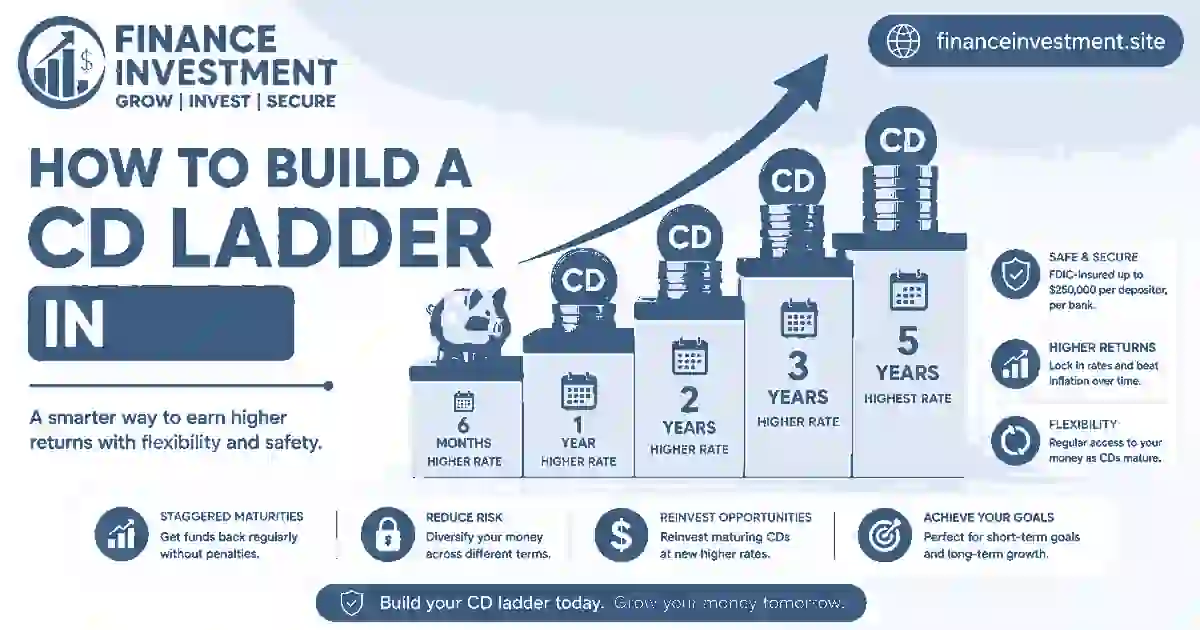
    1. Decide How Much You Can Commit

    Separate emergency savings and near-term expenses from money that can stay invested. Then check the CD’s minimum deposit and any balance requirements. If you want a quick reference, our guide on
    how much money you need to open a CD
    covers common funding considerations.

    2. Compare Offers on Equal Terms

    Compare CDs with similar maturities rather than placing a six-month offer beside a five-year offer and judging only the APYs. Check whether the rate is promotional, whether a minimum balance applies, and whether the product has unusual conditions. Current offers can be explored through our
    CD rates guide for 2026.

    3. Pick a Term You Can Live With

    Choose the maturity based on when the money is likely to be useful again. A higher yield is less helpful if you have to break the certificate early. For a broader comparison of terms and features, see
    how to choose the right CD.

    4. Read the Fine Print

    Check how interest is calculated and credited, whether it compounds inside the CD, and where payouts are sent. Then read the early-withdrawal penalty and any minimum-balance requirements. Do not assume every CD uses the same rules.

    5. Prepare for Maturity Before You Fund

    Save the maturity date and renewal deadline immediately. Before the CD ends, compare the new rate, your current cash needs, and alternative terms. This gives you time to decide rather than letting an automatic renewal make the choice for you.

    How CD Interest Earnings Build Over Time

    Once a CD is funded, the account follows the rate and terms agreed to when it was opened. During the certificate’s term, interest is credited according to the institution’s schedule. Depending on the product, that interest may remain in the CD, be added to the balance, or be paid to another account.

    What Happens During the Term?

    A fixed-rate CD generally keeps its agreed rate for the stated term, even if the institution changes the rates offered to new customers. That gives you a defined earning period. If interest stays invested, the balance can grow as additional interest is credited under the account’s compounding rules.

    Illustrative Example: A $16,000 CD

    Suppose a saver places $16,000 into a one-year CD with a hypothetical 4.25% APY. If the money remains in the account for the full year, a simple APY-based illustration would put the interest at about $680. This is an example, not a quote or guarantee; the actual result depends on the CD’s terms and interest-crediting method.

    What Happens at Maturity?

    When the maturity date arrives, the institution follows the account agreement for returning the principal and applicable interest. You may have the option to withdraw the proceeds, transfer them, or place them into a new CD.

    If you reinvest, the new certificate generally uses the rate and term available at that time. That means the original CD’s rate does not automatically determine your next return. Reviewing the available choices before maturity can help you decide whether another CD still fits your plans.

    In practical terms, earning interest is only one part of the process. The maturity decision determines what happens to the money next and can influence future interest growth.

    Benefits and Drawbacks of Maximizing CD Earnings

    Getting more interest from a CD can be useful when the money has a clear purpose and does not need frequent access. Still, a higher potential return comes with trade-offs that are worth weighing before you lock in the funds.

    Pros

    • Predictable returns: A fixed-rate CD can provide a defined yield for the agreed term.
    • Compounding potential: When interest remains invested, it may contribute to future growth under the CD’s terms.
    • Saving discipline: A maturity date can make it easier to leave money untouched.
    • Reinvestment choices: Each maturity creates an opportunity to review new rates and decide what to do next.

    Cons

    • Less liquidity: Your money is generally less accessible until maturity.
    • Early-withdrawal costs: Taking funds out early may trigger a penalty under the account agreement.
    • Inflation risk: Your return may not fully offset rising prices.
    • Taxes: Interest from a taxable CD can reduce your after-tax return.
    • Opportunity cost: A locked rate may look less attractive if better opportunities appear later.

    The trade-off is straightforward: a CD can reward patience, but the money needs to stay committed long enough for that strategy to make sense. If access matters more than squeezing out the highest possible yield, a more flexible account may be worth considering.

    CD Interest-Earning Strategies Compared

    There is no single setup that guarantees the highest return. One saver may value a strong rate on one certificate, while another may prefer several maturities or a larger deposit. The table below shows what each approach is designed to accomplish and where its main trade-off appears.

    StrategyPotential BenefitMain Trade-OffUseful When
    High-APY single CDTargets a competitive yield with a simple structureOne maturity and one locked rateThe money has one clear purpose and timeline
    Longer-term CDKeeps the agreed rate in place for a longer periodLess flexibility if circumstances changeFunds are unlikely to be needed soon
    CD ladderCreates multiple maturity and reinvestment pointsMore accounts and dates to trackCash needs are spread across different dates
    Reinvestment strategyLets each maturity be reassessed using current optionsFuture rates are uncertainYou are willing to review the account at maturity
    Larger depositCan generate more interest dollars at the same yieldMore savings becomes committedThe extra funds are not needed for near-term expenses

    Term length can change the balance between yield and flexibility. If you are comparing specific options, review our guides to
    6-month CD rates,
    1-year CD rates,
    and
    5-year CD rates
    to see how different time horizons can change the decision.

    For a staggered approach, our guide to
    building a CD ladder
    explains how separate maturities can be organized around future cash needs.

    Costs, Risks and Expert Tips

    A CD can offer a predictable return, but the advertised APY is only one part of the decision. Costs, taxes, changing rates, and the way you handle maturity can all affect how much of that return you ultimately keep.

    Watch the Cost of Early Access

    Taking money out before maturity may trigger an early-withdrawal penalty. The amount depends on the CD agreement and can reduce the interest you expected to earn. If access could become necessary, review the penalty before committing the funds. Our guide to
    CD early withdrawal
    explains this risk in more detail.

    Consider What You Give Up

    A locked rate can become less attractive if newly available CDs offer higher yields. That is the opportunity cost of committing your money today. Inflation creates another concern: even when the account earns interest, rising prices can reduce the purchasing power of the money over time.

    Check Taxes and Insurance

    Interest from a CD in a taxable account is generally taxable income. Your after-tax return may therefore be lower than the advertised APY. Also verify that your deposits are within the applicable FDIC or NCUA insurance limits for the institution and ownership category.

    Review the Renewal Decision

    Do not let an automatic renewal make the next investment decision for you. Before maturity, check the new rate, available terms, your cash needs, and whether another option offers a better fit.

    Expert Tip

    Keep a simple maturity calendar. A reminder a few weeks before each CD ends gives you time to compare rates and decide what to do without rushing.

    Common CD Interest-Earning Mistakes

    Maximizing CD earnings is not just about finding a competitive rate. Small details can change the result, especially when a CD is treated as a set-it-and-forget-it account. These mistakes are easy to avoid once you know where they tend to appear.

    Mistakes to Watch For

    • Choosing by APY alone: A higher yield may come with a longer term, larger minimum deposit, or less convenient withdrawal rules.
    • Ignoring interest-payment rules: If interest is paid to another account instead of remaining in the CD, it may not compound within the certificate.
    • Putting too much cash into CDs: A strong return does not help if you have to withdraw the money early to cover an unexpected expense.
    • Missing the renewal date: Automatic renewal can move your money into a new term before you have compared current rates.
    • Forgetting taxes: Interest earned in a taxable account can create a tax liability, reducing the amount you keep.
    • Repeating the same strategy automatically: A maturity is a new decision point. The rate and your financial needs may have changed.

    Illustrative Example: Marcus Reconsiders a Renewal

    Marcus places $20,000 into a CD and expects to renew it automatically at maturity. Before the renewal date, he checks the new rate and realizes the available term no longer matches when he expects to use the money. He also reviews how the interest will be paid and considers the tax impact before making his next decision.

    Illustrative lesson: A maturity date is more than an ending point. It is an opportunity to reassess the rate, cash timing, and future use of the money.

    Who Should Focus on Maximizing CD Earnings?

    Maximizing CD earnings makes the most sense when the money has a defined job, a realistic timeline, and enough flexibility elsewhere in your finances. The goal is not to chase every last fraction of a percentage point; it is to make a suitable amount of cash work efficiently.

    Who May Benefit Most?

    • Beginners: Comparing a few CDs can help first-time buyers understand how rates, terms, and account rules affect the outcome.
    • Larger-balance savers: A small rate difference can produce a more noticeable difference in interest dollars when the principal is substantial.
    • Retirees: Money with a defined future use may benefit from a predictable return when daily access is not required.
    • Families: Savings earmarked for a known future expense may have enough time to remain in a fixed-term account.
    • Conservative savers: A fixed-rate CD can provide a defined return without relying on stock-market price movements.
    • People with predictable cash needs: A clear timeline makes it easier to choose a maturity that fits the purpose of the money.

    When the highest yield may not win: If you need frequent access, have an uncertain timeline, or would have to sacrifice your emergency reserve for a higher APY, a flexible savings account may be a better fit.

    Frequently Asked Questions About Maximizing CD Interest

    Does a higher APY always mean more CD interest?

    No. APY is important, but the deposit amount, term, account conditions, and how long the money stays invested also affect the result.

    Does compounding increase CD earnings?

    It can. When earned interest remains in the CD and compounds under its terms, that interest can become part of the balance used to generate future earnings.

    Does a larger deposit earn more CD interest?

    Generally, yes. Assuming the same APY and term, a larger principal can produce more interest dollars. Deposit requirements and applicable insurance limits should still be considered.

    Is a longer CD term better for maximizing interest?

    Not automatically. A longer term may offer an attractive rate, but it also keeps the money committed for longer. The useful term is the one that matches your cash timeline.

    Can interest payouts affect CD growth?

    Yes. If interest is left in the certificate, it may compound according to the account rules. If it is paid elsewhere, that amount may no longer contribute to the CD balance.

    Are CD interest earnings taxable?

    Interest from a CD held in a regular taxable account is generally taxable income. Your actual tax treatment depends on your circumstances and how the account is held.

    Can an early withdrawal reduce CD earnings?

    Yes. An early-withdrawal penalty can reduce the return you receive. The penalty and its calculation are determined by the CD agreement.

    Can reinvesting a matured CD increase future earnings?

    It can provide another opportunity to earn interest, but the new CD will generally have the rate and term available at that time. Future rates are not guaranteed.

    Can a CD ladder help improve interest earnings?

    A ladder can create several maturity points, giving you repeated opportunities to review rates and reinvest. It does not guarantee a higher return than every single-CD strategy.

    Illustrative: How much could a $25,000 CD earn?

    Illustrative example only: At a hypothetical 4% APY for one year, $25,000 would produce about $1,000 in interest over the year if the funds remain invested for the full term. Actual earnings depend on the CD’s APY and account terms.

    Final Verdict: How to Maximize CD Interest Earnings

    Maximizing CD earnings is less about finding one perfect certificate and more about making the money, term, and account rules work together. A competitive yield matters, but so do the amount you deposit, the time you can leave it untouched, and the way interest is credited.

    Before opening a CD, check the minimum deposit, maturity date, interest-payment method, compounding terms, early-withdrawal penalty, renewal instructions, and applicable deposit-insurance coverage. These details help you judge the return in the context of how you actually plan to use the money.

    When maturity arrives, treat it as a fresh decision rather than an automatic next step. Review current rates, available terms, your upcoming cash needs, and whether keeping the proceeds in a CD still makes sense. Reinvesting can continue the earning cycle, while moving the money elsewhere may provide better flexibility.

    For a broader overview of CD features, safety, terms, and strategies, explore our

    CD Guide 2026
    .

    Practical takeaway: Choose the CD that gives your money a useful return without creating a cash-access problem later.

    FINANCEINVESTMENT • SMARTER SAVING

    Make Your Next CD Decision With More Confidence

    Want more practical guidance on CDs, saving strategies, and everyday money decisions? Join the FinanceInvestment newsletter for useful updates and new guides delivered to your inbox.

    📧 subhashr325@gmail.com

  • How to Build a CD Ladder in 2026: Step-by-Step Guide

    How to Build a CD Ladder in 2026: Step-by-Step Guide

    FINANCEINVESTMENT • CD GUIDE 2026

    How to Build a CD Ladder in 2026

    SR
    Written by Subhash Rukade
    FinanceInvestment
    Updated August 25, 2026
    About 10–12 min read

    A practical guide to organizing CDs around different maturity dates, cash needs, and future reinvestment decisions.

    How to Build a CD Ladder in 2026: Beginner’s Guide
    Learn how to build a CD ladder in 2026, including how to choose CD terms, divide your money, plan maturity dates, manage liquidity, and reinvest.
    how-to-build-a-cd-ladder-in-2026
    How to Build a CD Ladder in 2026
    how to build a CD ladder,
    CD ladder strategy,
    CD ladder for beginners,
    CD ladder example,
    CD laddering,
    CD maturity schedule,
    CD maturity dates,
    CD ladder terms,
    CD reinvestment strategy,
    how CD ladders work
    https://financeinvestment.site/how-to-build-a-cd-ladder-in-2026/
    Subhash Rukade
    August 25, 2026
    About 10–12 minutes

    Start With Your Cash Calendar

    How to Build a CD Ladder in 2026How to Build a CD Ladder in 2026 is easier when you start with your cash calendar instead of a rate table. A CD ladder spreads one pool of money across certificates with different maturity dates, giving portions of the balance a chance to become available at different times.

    Think about what your money may need to do over the next few years. You might have a home project, tuition payment, planned purchase, or another expense on the horizon. Those dates can help determine which CD terms make sense. The goal is to create a schedule that works with your plans rather than forcing your plans around the certificates.

    Before opening anything, decide how much cash can genuinely stay untouched. Emergency savings and money needed for regular expenses belong somewhere more accessible. The amount left for the ladder can then be divided into practical pieces, with each piece assigned a term that creates a useful maturity date.

    You do not need a complicated formula to get started. A simple ladder can give you several opportunities to review your cash, compare available rates, and decide what to do when each certificate matures. If you want to refresh the basics first, our

    CD Guide 2026

    explains CD terms, rates, features, and other details worth understanding before you choose a certificate.

    What You’ll Learn

    • How to decide how much money belongs in a CD ladder
    • How to select terms that create useful maturity dates
    • How to divide a larger deposit into manageable amounts
    • How to handle each CD when it matures
    • How to keep emergency and near-term cash outside the ladder

    Quick Answer: How Do You Build a CD Ladder?

    Build a CD ladder by choosing the amount you want to commit, dividing it among several CDs, and selecting different terms so the certificates mature at separate points. When a CD matures, review your plans and current rates before deciding whether to use, move, or reinvest the money.

    6 Key Takeaways

    1. Set a workable amount: Commit only money that does not need to remain immediately available.
    2. Pick a manageable number of CDs: More rungs can create more maturity dates, but they also require more tracking.
    3. Space maturity dates: Choose terms that create useful opportunities to access or reposition portions of the balance.
    4. Keep liquid savings separate: Emergency reserves should not depend on a CD reaching maturity.
    5. Review each maturity: A maturing certificate gives you a chance to reassess the money’s next job.
    6. Check renewal instructions: Review the bank’s terms before an automatic renewal locks the money into another period.

    Bottom line: A useful ladder is built around practical maturity dates, not a target number of CDs. Keep the structure simple enough to manage and flexible enough to review as each certificate matures.

    CD Ladder at a Glance

    A ladder can be built with a few certificates or a larger set of rungs. The useful size depends on your balance, expected cash needs, and how much account tracking you want to handle. Terms can range from several months to several years, depending on how far into the future you want to spread your maturities.

    Planning AreaPractical RangeWhat to Watch
    Ladder sizeA few to several CDsKeep tracking manageable
    TermsAbout 6 months to 5 yearsMatch terms to future cash needs
    Maturity spacingMonthly, quarterly, annual, or goal-basedChoose dates that are actually useful
    LiquidityKeep emergency cash outsideAvoid relying on early withdrawals
    ReinvestmentReview each maturityCompare current rates and goals

    Quick view: A smaller ladder may be easier to maintain, while additional rungs can create more frequent maturity points. Neither is automatically better; the schedule should earn its place in your plan.

    How to Build a CD Ladder Step by Step

    how to build a CD ladder in 2026Once you know which money is available for longer-term saving, the next job is turning that balance into actual certificates. The process is straightforward: decide how much to commit, choose the number of CDs, select terms, divide the money, and set reminders for every maturity.
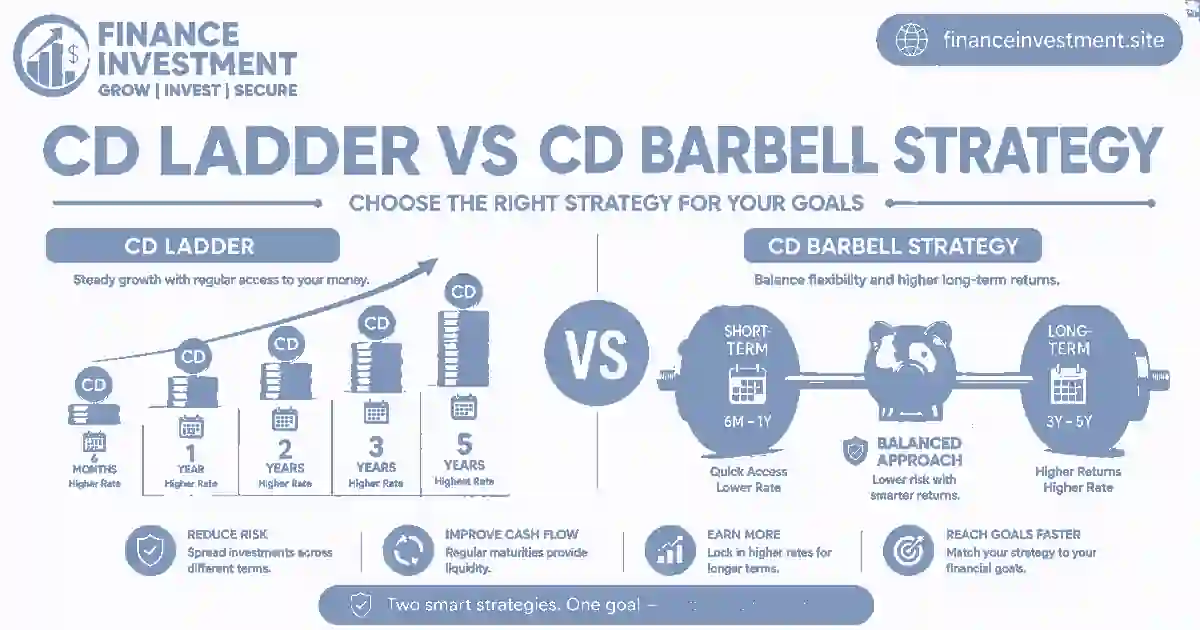
    1. Decide How Much You Can Commit

    Start with money that is not earmarked for rent, regular bills, or unexpected expenses. Keep your emergency reserve in an account that you can access without waiting for a certificate to mature. The amount left over becomes the pool for your ladder.

    2. Choose the Number of Rungs

    Think about how often you would realistically want a portion of the balance to become available. A few certificates may be enough for a simple plan. If you use more, make sure each additional maturity date serves a clear purpose rather than adding complexity for its own sake.

    3. Select Terms Around Your Goals

    Now work backward from your expected cash needs. If you expect to need money next year, a shorter certificate may fit that portion. Money intended for a later goal can potentially use a longer term. You can compare different options with our guide on
    how to choose the right CD.

    4. Divide the Money

    Suppose you have $20,000 available. You could place $5,000 into each of four CDs with different terms. Equal amounts keep the structure simple, but unequal amounts can make sense when one future expense is larger than another.

    5. Set Your Maturity Targets

    Record every maturity date, APY, balance, early-withdrawal terms, and renewal instruction. Set reminders before each certificate reaches maturity so you have time to decide whether the money should be used, moved, or reinvested.

    Beginner Tip

    Do not force every dollar into the ladder. A separate cash reserve gives you breathing room when an unexpected expense arrives.

    How a CD Ladder Works After Funding

    Once the certificates are funded, the main job shifts from building the ladder to watching how the maturity dates move through time. Each CD follows its own account agreement, while the staggered schedule gives you separate points to review your cash.

    During Each CD Term

    A certificate generally earns interest according to the APY and terms agreed to when you open it. The account may compound interest or pay it according to the institution’s rules. Keep the original disclosures because they show the interest schedule, maturity date, early-withdrawal terms, and other conditions that apply to that specific CD.

    As one certificate approaches maturity, check the bank’s renewal window. You may decide to take the money for a planned expense, move it to another account, or place it into a new CD. The next term does not have to match the previous one. Your choice can reflect current rates and what you expect to need the money for next.

    Illustrative Example: A $30,000 Ladder

    Imagine Jordan has $30,000 set aside for medium- and longer-term goals. The money is divided among several CDs that mature at different times. When the first certificate matures, Jordan needs $6,000 for a planned home expense, so that portion is withdrawn. The remaining funds can stay invested through the other certificates.

    At the next maturity, suppose Jordan no longer needs the cash. After checking the available rates, that amount can be placed into a new CD with a term that extends the ladder. This creates a rolling process: one certificate reaches maturity, a decision is made, and the rest of the ladder continues unchanged.

    Practical check: Review each maturity before the renewal deadline. That small habit gives you time to compare the new rate, term, and your current cash needs.

    Benefits and Drawbacks of a CD Ladder

    A ladder can make a large cash balance easier to organize by giving different portions of the money their own maturity dates. That structure can be useful, but it does not remove the trade-offs that come with putting money into CDs.

    Pros

    • Planned access: Staggered maturities can create regular opportunities to use or reposition part of your savings.
    • Rate diversification: Your entire balance does not have to be committed at one rate or on one opening date.
    • Reinvestment flexibility: Each maturity gives you a chance to review available rates and your plans.
    • Saving discipline: Fixed terms can make it easier to leave money untouched for longer-term goals.

    Cons

    • Reduced liquidity: Money in a CD generally is not as accessible as cash held in a checking or savings account.
    • Early-withdrawal penalties: Taking funds out before maturity may reduce your return under the CD’s terms.
    • Changing rates: New CD rates may rise or fall while your existing certificates remain locked at their agreed rates.
    • Inflation: A fixed return may not fully preserve purchasing power if prices rise faster than the CD’s return.
    • More tracking: Multiple certificates mean more maturity dates, renewal decisions, and account details to monitor.

    Worth remembering: A ladder works best when its structure solves a real planning problem. If managing several maturity dates adds more work than value, a simpler CD or flexible savings account may be a better fit.

    CD Ladder Designs Compared

    The number of rungs changes how often money becomes available and how much information you need to track. A smaller structure can be easier to manage, while additional certificates can create more maturity points. The goal is to give each rung a useful job rather than adding CDs simply to make the ladder larger.

    DesignMaturity SpreadFlexibilityTrackingMay Suit
    3-rungThree planned datesBasicLowSimple goals and smaller balances
    4-rungFour staggered datesModerateModerateBalanced planning
    5-rungFive maturity pointsHigherHigherLarger balances or several goals
    Longer-term ladderMay extend several yearsGoal-dependentModerate to highLonger-term savings goals

    Your terms do not have to follow a rigid formula. For example, someone expecting a need within a year could include a
    6-month CD
    alongside a
    1-year CD.
    A longer goal might justify reviewing
    2-year CD options
    or
    3-year CD options.
    Compare the maturity dates alongside the rates rather than treating the highest APY as the automatic winner.

    CD Ladder Costs, Risks and Expert Tips

    The biggest risks in a CD ladder often appear after the accounts are opened. A certificate can look attractive at the time of purchase, yet its rules may become inconvenient if your cash needs change or market conditions move in another direction.

    Watch the Cost of Early Access

    Most traditional CDs can charge an early-withdrawal penalty when money is taken out before maturity. The amount and calculation depend on the account agreement. If you expect a possible near-term expense, compare the cost of keeping that money liquid with the return you expect from the CD.
    Learn how CD early withdrawals work
    before committing funds.

    Consider What You Give Up

    A fixed rate can become less attractive if newly available CD rates rise. That is an opportunity cost rather than a direct fee. Inflation can create another concern because the purchasing power of a fixed return may decline over time.

    Check Taxes and Deposit Insurance

    Interest earned by CDs in a regular taxable account is generally taxable interest income. Also verify that your deposits remain within applicable insurance limits. Bank deposits may qualify for FDIC coverage, while qualifying federally insured credit-union share accounts may receive NCUA coverage. Coverage depends on factors such as the institution, ownership category, and total eligible deposits or shares.

    Review Before Every Renewal

    Do not treat automatic renewal as a final decision. Before maturity, check the new APY, term, penalty, and your current plans. A CD that made sense last year may not deserve another term today.

    Expert Tip

    Keep a one-page CD record with each balance, APY, maturity date, withdrawal penalty, insurance status, and renewal instruction. Review it before opening a new CD and again before every maturity.

    Common CD Ladder Mistakes to Avoid

    A ladder can be perfectly sound on paper and still become frustrating if the setup does not match how you actually use your money. Most avoidable problems come from making the structure more complicated than necessary or ignoring what happens after the first CD matures.

    Mistakes That Can Create Problems

    • Opening too many CDs: Extra rungs can create more maturity dates without adding meaningful value.
    • Chasing the highest APY: A higher rate is not necessarily better if its maturity date clashes with a known cash need.
    • Creating awkward maturity dates: A schedule that looks neat on paper may be inconvenient if several certificates mature around the wrong time.
    • Unequal allocations without a purpose: Different deposit amounts can make sense for different goals, but random amounts can make future planning harder.
    • Forgetting renewal dates: Missing a maturity window can lead to an automatic renewal you did not intend.
    • Putting emergency cash into CDs: Money needed for an unexpected expense should remain readily accessible rather than depending on a maturity date.

    Illustrative Example: Marcus Simplifies His Ladder

    Marcus has $24,000 available for longer-term savings. He initially opens six CDs because he wants frequent maturity dates. After a few months, he realizes that tracking six accounts is unnecessary and that most of his expected expenses occur only twice a year. He simplifies the structure and keeps his emergency reserve separate.

    The lesson: A ladder should reduce friction around your savings. If the number of certificates makes the plan harder to follow without providing useful access, fewer rungs may be the smarter choice.

    Who Should Build a CD Ladder?

    A ladder can be a good fit when your savings have several future uses and you are comfortable leaving each portion untouched until its maturity. It is less about having a large balance and more about having a reason to spread your money across different time periods.

    It May Make Sense If You:

    • Are buying CDs for the first time: Staggering maturities can make a large commitment feel more manageable.
    • Have planned family expenses: Maturity dates can be matched with tuition, home projects, or other known costs.
    • Are retired: A staggered schedule can create planned opportunities to review or use portions of savings.
    • Hold a larger cash balance: Multiple certificates can help organize money across different time horizons.
    • Prefer predictable returns: Fixed CD terms may appeal to conservative savers who value knowing the agreed rate.
    • Can leave the money untouched: The strategy works best when early access is unlikely.

    Keep it simple when appropriate: If you have one clear maturity goal, a single CD may be enough. If you need frequent access or your plans are still changing, a flexible savings account may be more practical.

    Frequently Asked Questions About CD Ladders

    What is a CD ladder?

    A CD ladder spreads money across multiple certificates with different maturity dates. As each certificate matures, you can use the funds, move them, or consider reinvesting them.

    How many CDs should I use in a ladder?

    There is no fixed number. Use enough certificates to create useful maturity dates without making the account structure difficult to track.

    Do CD ladders have minimum deposit requirements?

    Each bank or credit union sets its own minimum. Check the requirements for every certificate before dividing your money so the planned amounts qualify.

    How should I choose CD maturity dates?

    Look at when you may need portions of the money and choose terms that create practical dates. A maturity schedule should fit your plans rather than simply follow a standard formula.

    What happens when a CD in the ladder matures?

    You can generally take the money, transfer it, or reinvest it after reviewing your current needs and available rates. Check the renewal instructions before maturity.

    Can a CD ladder provide immediate access to my money?

    No. A ladder creates planned access points, but it does not provide the same on-demand access as a checking or savings account. Keep emergency cash separate.

    Can CD rates change while my ladder is running?

    Yes. Rates offered on new CDs can change while existing certificates continue under their agreed terms. Each maturity gives you an opportunity to review the current choices.

    Are CD ladders covered by FDIC or NCUA insurance?

    Eligible bank deposits may qualify for FDIC insurance, while qualifying federally insured credit-union share accounts may receive NCUA coverage. Applicable limits and ownership categories matter.

    Are CD ladder earnings taxable?

    Interest from CDs held in a regular taxable account is generally taxable interest income. Tax treatment may differ when CDs are held through certain tax-advantaged accounts.

    Illustrative: How could a $50,000 balance be divided into a CD ladder?

    Illustrative example only: A saver might divide $50,000 among four or five CDs, using different amounts and maturity dates to match expected cash needs. The actual allocation should reflect available rates, account minimums, liquidity needs, and applicable insurance limits.

    Final Verdict: Is a CD Ladder Right for You?

    A CD ladder can be a smart way to organize money when you have several future cash needs and do not want the entire balance tied to one maturity date. It gives you planned opportunities to review portions of your savings instead of making one large commitment.

    The key is to build around your expected cash needs rather than chasing the highest APY. A certificate with a slightly better rate may not be useful if its maturity date arrives at the wrong time. Look at the timing first, then compare rates and account terms.

    Keep emergency savings, upcoming bills, and money that may be needed unexpectedly outside the ladder. If you want a broader refresher on CD terms, rates, safety, and account features, read our

    CD Guide 2026
    .

    Practical takeaway: Choose the maturity schedule first, then choose the CDs that fit it.

    Build Your Next CD Ladder With Confidence

    Your CD ladder does not need to be complicated. Keep the maturity dates useful, leave emergency cash accessible, and review each certificate before it renews. For more practical guides on CDs, saving, and investing, join the FinanceInvestment newsletter.

    📧 subhashr325@gmail.com

  • CD Ladder vs CD Barbell Strategy: Which Is Better in 2026?

    CD Ladder vs CD Barbell Strategy: Which Is Better in 2026?

    FINANCEINVESTMENT • CD STRATEGIES 2026

    CD Ladder vs CD Barbell Strategy: Which One Fits Your Goals?

    SR
    Written by Subhash Rukade
    FinanceInvestment
    Updated August 25, 2026
    About 10–12 min read

    Compare two practical ways to spread CD maturities, balance liquidity, and manage rate risk without making your cash strategy unnecessarily complicated.

    CD Ladder vs CD Barbell Strategy: Which Is Better in 2026?
    CD Ladder vs CD Barbell Strategy explained for 2026. Compare maturity schedules, liquidity, rate risk, flexibility, and which strategy may fit your goals.
    cd-ladder-vs-cd-barbell-strategy
    CD Ladder vs CD Barbell Strategy
    CD ladder strategy,
    CD barbell strategy,
    CD ladder vs barbell,
    ladder vs barbell CDs,
    CD laddering,
    barbell CD strategy,
    CD investment strategy,
    CD maturity strategy,
    CD liquidity strategy,
    CD rate risk
    https://financeinvestment.site/cd-ladder-vs-cd-barbell-strategy/
    Subhash Rukade
    August 24, 2026
    About 10–12 minutes

    CD Ladder vs CD Barbell Strategy: Start With Your Cash Timeline

    CD Ladder vs CD Barbell StrategyWhen people compare a CD Ladder vs CD Barbell Strategy, they often start by asking which one earns more. That can miss the bigger issue. The more useful question is when you expect to need the money again. A strategy that works beautifully for someone with several upcoming expenses may feel restrictive to someone who mainly wants access to cash at the short and long ends of the timeline.

    A CD ladder spreads money across several maturity dates. That creates a steady stream of opportunities to reassess or use funds. A barbell takes a different route. It typically places money toward shorter and longer maturities while leaving less in the middle.

    Neither structure automatically wins. Your expected cash needs, comfort with locking money away, views on future rates, and desire for regular access can point you toward one design over the other. The goal is to build a schedule that makes sense for your money instead of forcing your money into a preset formula.

    If you want to refresh the basics before comparing these strategies, our

    CD Guide 2026

    explains CD basics, terms, rates, and the details worth checking before you choose an account.

    What You’ll Learn

    • How CD ladders and barbells are structured
    • Where each strategy can fit different cash needs
    • How maturity timing affects liquidity
    • The trade-offs involving rates and reinvestment
    • How to choose a structure without overcomplicating your savings plan

    Quick Answer: CD Ladder or CD Barbell?

    A CD ladder generally spreads money across multiple maturity dates, while a CD barbell concentrates more of the money in shorter and longer terms, with less in the middle. A ladder can offer more regular access points; a barbell can keep some cash relatively near-term while committing another portion for longer.

    6 Key Takeaways

    1. Ladder: Several CDs mature at different points.
    2. Barbell: Money is concentrated toward short and long maturities.
    3. Liquidity: A ladder can create more frequent maturity dates.
    4. Rate exposure: A barbell can give you both shorter-term flexibility and longer-term rate certainty.
    5. Cash needs matter: Upcoming expenses can influence which structure makes more sense.
    6. There is no universal winner: The better setup is the one that matches your timeline and comfort with locked-up money.

    Bottom line: A ladder is useful when you want several planned maturity dates. A barbell may fit better when you want a short-term pool alongside a longer commitment.

    CD Ladder vs CD Barbell: At a Glance

    The two structures differ mainly in where your maturity dates sit. A ladder usually creates a sequence of scheduled maturities, while a barbell places more weight at the short and long ends. That difference can affect how often you can access cash and how much of the portfolio is committed for longer periods.

    FeatureCD LadderCD Barbell
    Typical structureSeveral staggered maturitiesShort and long maturities
    Liquidity patternMore frequent maturity pointsMore concentrated access
    Rate exposureSpread across maturitiesShort and long rate exposure
    May suitSavers wanting scheduled access pointsSavers comfortable pairing near-term access with longer commitments

    Quick read: A ladder emphasizes a sequence of maturity dates. A barbell emphasizes separation between the short and long ends. The real difference is how each structure distributes your maturity dates and future decisions.

    How to Build a CD Ladder or Barbell From Scratch

    Building either strategy starts with the same basic question: how much money can you commit without needing it unexpectedly? Once that amount is clear, the structure becomes easier to design. Keep your emergency reserve and near-term spending money outside the CDs first. The remaining cash can then be divided according to your timeline.

    Building a CD Ladder

    A simple ladder divides your deposit among certificates with different maturity dates. For example, someone with $20,000 might place $5,000 into four CDs with staggered terms. As each certificate matures, the owner can use the money or reinvest it into a new longer-term CD.

    The exact terms do not have to follow one fixed formula. You might use six-month, one-year, 18-month, and two-year certificates, depending on available rates and when you expect to need the cash. Pick maturity dates that match real expenses or review points instead of filling every available term.

    Building a CD Barbell

    A barbell uses two ends of the maturity spectrum. One portion can sit in shorter CDs for relatively earlier access, while another portion can use longer certificates for a longer rate commitment. There is no universal percentage split. Your spending needs and tolerance for locking money away should guide the allocation.

    Plan the Reinvestment Before Maturity

    Decide in advance what you might do when a certificate matures. If you need the cash, move it to the account where you will spend it. If you still have a long-term need, consider reinvesting after checking current rates. Avoid automatic renewal simply because it is convenient.

    Practical Tip

    Keep a simple maturity calendar. Knowing which CD matures next can be more useful than trying to remember every account detail.

    How a CD Ladder and Barbell Work Over Time

    CD Ladder vs CD Barbell StrategyThe main difference becomes clearer once the certificates are actually in place. You are not simply choosing several CDs; you are creating a schedule for when portions of your money become available and when you will decide what to do next.
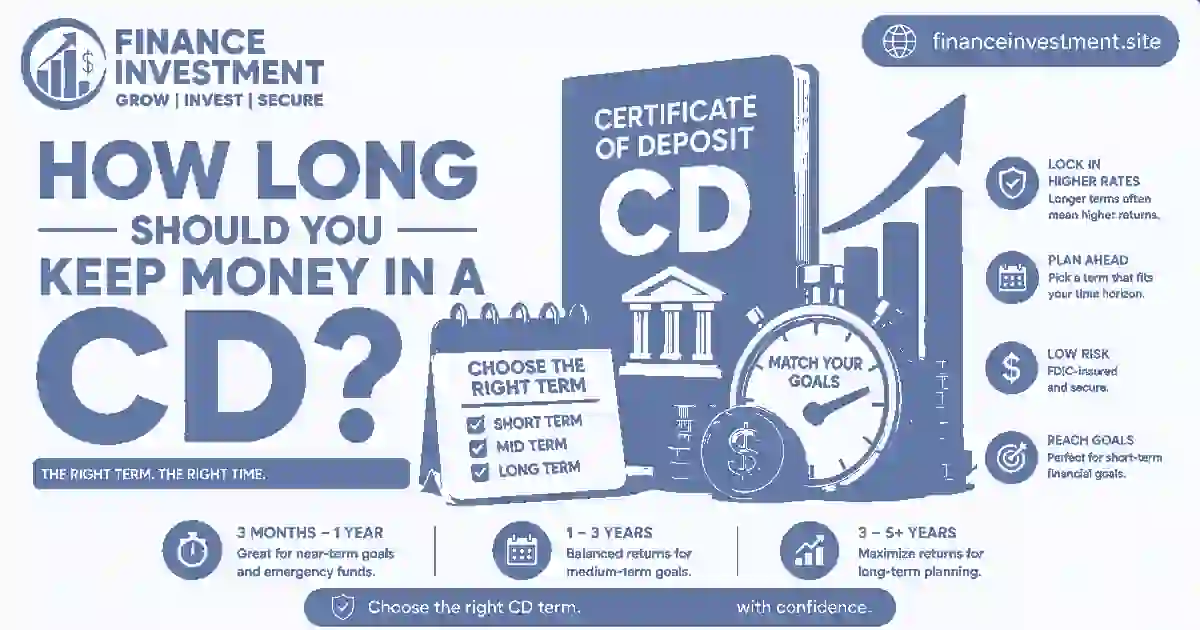
    How a CD Ladder Moves

    Imagine you divide $24,000 into four $6,000 CDs. You could choose terms that mature at different points, such as six months, one year, 18 months, and two years. When the first CD matures, you can take the money for a planned expense or reinvest it into a new certificate. The other CDs continue following their original schedules.

    You can compare the current CD market, check whether your original goal has changed, and decide whether that slice of money still belongs in another CD. That gives the strategy a built-in review point instead of requiring you to commit the entire balance at one time.

    How a CD Barbell Moves

    Now consider a $24,000 barbell. You might place $8,000 in shorter-term CDs and $16,000 in a longer-term certificate. The short side can provide an earlier opportunity to access or reposition part of the money, while the longer side remains committed for a longer period.

    The two sides do not have to be equal. A saver expecting a major expense soon might give more weight to the short end. Someone comfortable leaving most of the money untouched could place more toward the longer end.

    Illustrative example: Mark expects to need some cash within a year but wants another portion working for several years. A barbell may give him two distinct time horizons, while a ladder would spread those maturities more evenly.

    In both structures, the important work happens when a CD matures. That is when you reassess the rate, timing, and purpose of that portion of the money rather than automatically repeating the old decision.

    Benefits and Drawbacks of CD Ladders and Barbells

    The appeal of these strategies comes from giving each portion of your cash a different place on the calendar. That can make a large balance easier to organize, but the structure also creates trade-offs you should understand before committing the money.

    ✓ Pros

    • Planned access: A ladder can create regular maturity dates, giving you more opportunities to use or reposition cash.
    • Rate diversification: Different maturity dates can reduce the need to commit the entire balance at one rate.
    • Reinvestment choices: Each maturity gives you a chance to compare current rates before putting the money back to work.
    • Flexible structure: A barbell can pair shorter commitments with longer ones instead of spreading money evenly.

    ⚠ Cons

    • Timing risk: A maturity date may not arrive when you actually need the money.
    • Concentration: A barbell can leave a larger share committed at one end of the maturity range.
    • Inflation risk: Fixed CD returns may lose purchasing power when prices rise faster than the account’s return.
    • Reinvestment risk: A maturing CD may need to be renewed when available rates are lower.

    That timing control is useful only if your cash outside the CDs is large enough to handle unexpected expenses.

    CD Ladder vs CD Barbell: Side-by-Side Comparison

    Once you move beyond the basic definitions, the choice comes down to how much control you want over maturity dates and where you want your rate exposure. A ladder spreads decisions across time, while a barbell creates a sharper split between shorter and longer commitments.

    FactorCD LadderCD Barbell
    StructureMoney is divided across several maturity dates.Money is concentrated around shorter and longer terms.
    LiquidityCan create more frequent maturityAccess is generally concentrated in the shorter-term portion.
    Maturity spreadBroad and staggered.Focused at two ends.
    ReinvestmentDecisions occur more regularly.Fewer, more concentrated decisions.
    ComplexityCan require tracking several CDs.Can be simpler to maintain.
    May suitSavers who value recurring maturity dates.Savers who want a short-term pool alongside longer commitments.

    The strategy can also be adjusted around the available products. For example, you could review
    6-month CD rates
    for the shorter side and compare them with
    5-year CD rates
    for a longer commitment. If you are unsure which term fits your cash needs, our guide on
    choosing the right CD
    can help frame the decision.

    Neither structure guarantees a better return. The useful comparison is how well each one fits your expected cash flow, tolerance for locked-up funds, and willingness to revisit rates over time.

    Costs, Risks and Expert Tips for CD Ladders and Barbells

    A well-planned CD structure can make your cash easier to manage, but it cannot remove the normal risks of certificates. The biggest issues usually appear when your circumstances change, rates move, or a maturity date arrives at an inconvenient time.

    Risks to Check Before Funding

    Early withdrawal penalties can reduce your interest if you need money before a CD matures. That matters in both strategies, especially if the amount at a particular maturity is smaller than the expense you eventually face.

    Opportunity cost matters when rates change. A long-term CD can keep earning its agreed rate while newer certificates become more attractive. On the other hand, short-term CDs may mature when available rates are lower. Inflation can also reduce the purchasing power of a fixed return.

    Insurance and taxes deserve a separate check. Check that eligible deposits are within applicable FDIC or NCUA coverage limits, including the relevant ownership category and institution. particularly when several CDs are held at the same institution. Interest from taxable CDs can also affect your tax bill and after-tax return.

    Expert Checks Before You Build or Renew

    Premium Expert Tip

    Write down every CD’s balance, APY, maturity date, penalty, ownership category, and renewal instructions. Then review the schedule as a whole. Several CDs can end up maturing close together, while a barbell can leave a large share of the balance tied to the long end.

    Before renewing, compare the new rate with current offers and ask whether the original cash plan still applies. Also check whether you still need the same balance at each maturity. A strategy should be adjusted when your financial timeline changes.

    Finally, keep emergency cash outside the certificates. A ladder or barbell works best when you are not forced to break a CD simply because an unexpected bill arrives.

    Common CD Ladder and Barbell Mistakes

    The trouble usually starts with the details: too many CDs, poorly spaced maturities, or money that should never have been locked up. The most common errors are usually not about picking a particular bank. They come from building a schedule that does not match the way the money will actually be used.

    Mistakes to Watch For

    • Making the structure too complicated: A ladder with too many small certificates can become difficult to track. If the added complexity does not create useful maturity dates, simplify it.
    • Clustering maturities: Several CDs that mature within the same narrow period may leave you with less flexibility than expected.
    • Using emergency cash: Money that may be needed immediately should not depend on a CD reaching maturity.
    • Ignoring renewal dates: A certificate can automatically renew according to its terms if you do not act during the applicable window.
    • Chasing rates: Moving money repeatedly for a slightly higher APY can add unnecessary work and may leave the maturity schedule disconnected from your goals.

    Illustrative Example: David Simplifies His Ladder

    David initially creates six small CDs because he wants frequent maturity dates. After reviewing the accounts, he realizes two mature within the same month and several balances are too small to make the extra tracking worthwhile. He consolidates his plan around fewer, more useful maturity points while keeping his emergency savings separate.

    Illustrative lesson: A useful CD strategy does not need to be complicated. The schedule should make your cash easier to manage, not create another chore.

    Before adding another certificate, look at the entire schedule rather than evaluating the new CD by itself. That simple habit can reveal gaps, clusters, and unnecessary commitments.

    Who Should Choose a CD Ladder or Barbell?

    A CD ladder may appeal to savers who want several planned points when money becomes available. It can work well for families with expenses spread across the year, retirees who want periodic access to part of their cash, or investors who prefer making smaller reinvestment decisions over time.

    A ladder tends to make sense for savers who want several planned maturity dates. keeping part of the money relatively accessible while committing another portion for a longer period. It can be useful when near-term liquidity and longer-term rate certainty both matter.

    Neither structure is necessary for every saver. If the balance is modest or the goal has one clear date, a single CD may be easier to manage. And if you may need the money without warning, a flexible savings account can be a better home for that cash.

    Quick Decision Guide

    • Want recurring maturity dates? Consider a ladder.
    • Need short and long commitments? Consider a barbell.
    • Have one clear cash date? A single CD may be enough.
    • Need immediate access? Keep the money flexible.

    Frequently Asked Questions About CD Ladders and Barbells

    What is the main difference between a CD ladder and a CD barbell?

    A ladder distributes money across a series of maturity dates, while a barbell puts greater weight on shorter and longer terms. The choice mainly changes how your cash becomes available over time.

    How many CDs do I need to build a CD ladder?

    There is no fixed number. A few certificates can create useful maturity dates, while a larger balance may support more steps. Keep the structure simple enough to track.

    Does a CD ladder provide more liquidity than a barbell?

    A ladder can create more maturity points, but that does not mean the money is available on demand. A CD generally remains subject to its terms until maturity.

    Which strategy has more rate risk?

    Both have rate exposure in different ways. A ladder spreads renewal decisions across time, while a barbell can leave more money committed at the long end.

    What happens when a CD in a ladder matures?

    You can generally use the money, move it elsewhere, or reinvest it after reviewing current rates and your financial needs.

    Can I change a CD ladder after I build it?

    Yes. As certificates mature, you can change the next term or amount rather than rebuilding the entire structure from scratch.

    Do CD ladders and barbells require a minimum deposit?

    Each bank or credit union sets its own CD minimums. Building a strategy with several certificates may require enough money to meet those minimums comfortably.

    Are CDs in a ladder or barbell federally insured?

    Eligible bank CDs may receive FDIC insurance, while qualifying credit-union share certificates may receive NCUA federal share insurance. Coverage limits and ownership categories apply.

    Are CD ladder and barbell earnings taxable?

    Interest from CDs held in a regular taxable account is generally taxable interest income. Your actual tax treatment depends on your circumstances and account type.

    Illustrative: Which strategy could fit a $30,000 balance?

    Illustrative comparison only: A saver could divide $30,000 among several maturity dates for a ladder or place more toward short and long terms for a barbell. The better structure depends on when the saver expects to need the money, not simply the balance size.

    Final Verdict: Which CD Strategy Makes More Sense?

    Choose a ladder if your main priority is having several planned maturity dates. Choose a barbell if your money has two different time horizons and you want a shorter-term portion alongside longer-term CDs. A ladder makes more sense when you want several maturity dates and prefer to spread your cash decisions across time. A barbell can be useful when you have two clear priorities: keeping one portion relatively near-term while giving another portion a longer runway.

    The key is to build around your expected cash needs rather than choosing a structure simply because it looks attractive on a rate table. A higher APY can lose its appeal if the money becomes unavailable when you need it, or if a maturity schedule creates more management work than you want.

    If you want to review CD basics, terms, safety considerations, and rate factors before choosing a structure, see our

    CD Guide 2026
    .

    Practical takeaway: Map out when you may need the money first. Then choose the CD structure that gives those dollars the right maturity dates.

    Build a CD Strategy That Fits Your Timeline

    A useful CD strategy starts with your cash needs, not with a complicated formula. Start with when you may need the money, then choose a structure that makes those dates easier to manage. For practical finance guides and new money insights, join our newsletter.

    📧 subhashr325@gmail.com

  • How Long Should You Keep Money in a CD? Smart 2026 Guide

    How Long Should You Keep Money in a CD? Smart 2026 Guide

    FINANCEINVESTMENT • CD GUIDE 2026

    How Long Should You Keep Money in a CD?

    SR
    Written by Subhash Rukade
    FinanceInvestment
    Updated August, 25, 2026.
    About 10–12 min read

    A practical guide to choosing a CD term, understanding maturity dates, and deciding how long your money should stay locked in.

    How Long Should You Keep Money in a CD? Smart Guide for 2026
    How long should you keep money in a CD? Learn how to choose the right CD term, match maturity dates to your goals, and balance returns with flexibility.
    how-long-should-you-keep-money-in-a-cd
    How Long Should You Keep Money in a CD
    how long to keep money in a CD,
    CD term length,
    CD maturity,
    how long should a CD be,
    CD investment term,
    6-month CD,
    1-year CD,
    2-year CD,
    5-year CD,
    when to renew a CD,
    CD maturity date
    https://financeinvestment.site/how-long-should-you-keep-money-in-a-cd/
    Subhash Rukade
    August 24, 2026
    About 10–12 minutes

    How Long Should You Keep Money in a CD?

    How Long Should You Keep Money in a CD?How long should you keep money in a CD? The answer is not simply “until the rate stops looking attractive.” A better question is: When will this money need a new job? If the cash is being saved for a future purchase, tuition bill, home project, or another known purpose, the CD term should fit the date when that money becomes useful again.

    A six-month CD can make sense for a near-term expense. A one-year certificate may suit a goal farther away. Longer terms can work when you have no plans for the money for several years. The important part is leaving enough room between the CD’s maturity date and the point when you actually need the funds.

    Rate certainty is another reason people choose longer certificates. A fixed-rate CD can keep the agreed rate in place during the term, even if market rates change. But that certainty comes with less flexibility. If your plans change, accessing the money early may involve a penalty.

    Before choosing a term, it helps to understand the broader CD landscape. Our CD Guide 2026 can help you compare terms, rates, maturity rules, and other factors.

    What You’ll Learn

    • How to match a CD term with your financial timeline
    • When shorter or longer CDs may make sense
    • Why maturity timing matters as much as APY
    • How rate certainty can affect your decision
    • When keeping money flexible may be smarter

    Quick Answer: How Long Should You Keep Money in a CD?

    Usually, keep money in a CD for as long as you can comfortably leave it untouched. A 6-month or 1-year CD may fit a near-term goal, while a 2-, 3-, or 5-year CD can make more sense for money you will not need for several years. The best term balances the maturity date, rate certainty, and your need for access to the cash.

    6 Key Takeaways

    1. Match the term to your goal: Choose a maturity date that fits when you expect to need the money.
    2. Shorter terms offer more flexibility: They can reduce the time your cash stays committed.
    3. Longer terms can lock in a rate: This may be useful when you are comfortable leaving the money untouched.
    4. Liquidity still matters: A CD may charge an early-withdrawal penalty if you need the money before maturity.
    5. Do not chase APY alone: A slightly higher rate may not be worth a term that does not fit your plans.
    6. Have a maturity plan: Decide in advance whether you will withdraw, move, or renew the money when the CD ends.

    Bottom line: The ideal CD term is the one that keeps your money earning a predictable return without putting an important future expense out of reach.

    At a Glance: Choosing a CD Term

    Think of a CD term as a calendar commitment, not just an interest-rate choice. The closer your spending date, the more carefully you should protect access to the money. A longer certificate can provide rate certainty, but it also keeps your cash committed for more time.

    CD TermOften SuitsLiquidityRate Certainty
    6 monthsNear-term plansHigherShorter lock-in
    1 yearPlanned expensesModerateOne-year certainty
    2–3 yearsMedium-term goalsLowerLonger certainty
    5 yearsLong-range cash needsLowestLongest certainty

    These are planning ranges, not rules. A CD should not replace emergency cash or money you may need unexpectedly. Also check the institution’s early-withdrawal terms and whether the certificate automatically renews at maturity.

    Complete Beginner Guide to Choosing a CD Term

    A CD term is simply the length of time your money is committed to the certificate before its scheduled maturity date. Choosing one is easier when you start with the purpose of the money rather than the rate on the screen. How long should you keep money in a CD? Start by asking when you expect to need the cash and how much flexibility you want until then.

    Start With the Date, Not the Rate

    Suppose you are setting aside money for a home project next summer. A certificate that matures after the project begins could create an unnecessary problem. Instead, work backward from the spending date and leave some breathing room. This gives you time to review the maturity notice and decide what to do next.

    The same idea applies to money you expect to leave untouched for several years. If you have no planned use for the funds, a longer certificate may provide useful rate certainty. However, committing for longer also means giving up some access to the cash during the term.

    Understand What Happens at Maturity

    When a CD reaches maturity, the principal and applicable interest become available according to the institution’s terms. Some CDs automatically renew if you do nothing during the specified grace period. Others give you a window to withdraw or move the money. Check these rules before opening the certificate rather than discovering them later.

    Keep Liquidity in the Picture

    Money needed for emergencies should generally remain readily accessible rather than being locked into a CD. For planned cash, however, a certificate can create a useful boundary between money you intend to spend and money you are deliberately leaving alone.

    If you are unsure about the commitment, consider a shorter term or a CD ladder instead of putting the entire balance into one long certificate. For more background on the mechanics, see our guide to how CDs work.

    How a CD Term Works From Opening to Maturity

    How Long Should You Keep Money in a CDOnce you choose a CD, the term creates a simple timeline for your money. You deposit the agreed amount, accept the stated rate and maturity date, and generally leave the funds in place until the certificate ends. The important part is knowing what happens at each stage so the maturity date does not catch you by surprise.

    1. Choose the Term and Maturity Date

    Look beyond the number of months. Check the exact maturity date shown by the bank or credit union. If you expect to use the money for a specific expense, make sure the certificate matures before you need to pay the bill.

    2. Fund the CD

    After opening the certificate, you transfer or deposit the amount required by the institution. The account then earns interest according to its stated terms. Some CDs compound interest, while others may offer different interest-payment options.

    3. Monitor the Timeline

    You usually do not need to manage the CD every day. Still, mark the maturity date on your calendar. Review the renewal instructions, grace period, and available choices before the certificate ends.

    4. Decide What Happens Next

    At maturity, you may be able to withdraw the money, transfer it to another account, or renew it into a new CD. The new certificate may have a different APY and term, so automatic renewal should not be treated as a decision you have already made.

    Illustrative example: Jordan places $8,000 into a 12-month CD because the money is earmarked for a planned expense the following year. About a month before maturity, Jordan reviews the renewal rate and decides whether the funds should be used, moved to savings, or placed into another certificate.

    Benefits and Drawbacks of Keeping Money in a CD

    Knowing how long should you keep money in a CD also means weighing what you gain from a fixed term against what you give up in flexibility. A CD can be useful when the money has a clear purpose, but it is not designed for every type of cash.

    ✓ Pros

    • Predictable return: A fixed-rate CD can provide a known rate for the agreed term.
    • Useful discipline: Limited access can make it easier to leave goal-specific money alone.
    • Rate certainty: You generally keep the agreed rate during the CD term even if market rates move.
    • Potentially stronger earnings: Some CDs may offer higher yields than readily accessible cash accounts.

    ⚠ Cons

    • Early-withdrawal risk: Taking money out before maturity may result in a penalty.
    • Less flexibility: Your cash is less accessible than money kept in a checking or savings account.
    • Inflation risk: Rising prices can reduce the purchasing power of a fixed return.
    • Reinvestment risk: When the CD matures, available rates may be lower than the rate you previously earned.

    CD Term Comparison: 6 Months to 5 Years

    Different CD terms solve different cash-planning problems. Instead of asking only which certificate pays the highest APY, consider how long you can leave the money untouched and how comfortable you are waiting for maturity.

    TermMay FitFlexibilityCommitment
    6 monthsNear-term cash needsHigherShort
    1 yearAnnual goalsModerateMedium
    18 monthsMedium-term plansModerate-lowLonger
    2 yearsPlanned medium-term expensesLowerLong
    3 yearsLonger-range goalsLowerLong
    5 yearsMoney with no near-term useLowestLongest

    If you are considering a shorter commitment, compare current options in our
    6-month CD guide.
    For a longer horizon, our
    3-year CD guide
    and
    5-year CD guide
    can help you explore those terms.

    Ultimately, how long should you keep money in a CD comes down to the relationship between your expected cash needs and the value of locking in a rate for longer.

    Costs, Risks and Expert Tips Before You Extend a CD

    A CD can look straightforward when you open it, but the decision becomes more important as the maturity date approaches. Before deciding how long should you keep money in a CD, review what could happen if your plans, rates, or cash needs change.

    Watch the Cost of Giving Up Flexibility

    An early withdrawal can trigger a penalty, depending on the certificate’s terms. That penalty is only one part of the cost. You may also miss better opportunities elsewhere if market rates rise while your money remains locked at an older rate.

    Inflation matters too. A fixed return can look attractive today but buy less in the future if prices rise faster than your earnings. Taxes can also reduce the amount you ultimately keep in a taxable account. Review the tax treatment before comparing the CD with another cash option.

    Think About What Happens After Maturity

    Reinvestment risk appears when a CD matures and new certificates offer lower rates. One way to reduce this timing problem is a CD ladder. Instead of putting everything into one certificate, you spread money across different maturity dates. That can create regular opportunities to reassess rates and cash needs.

    Expert Tip

    About a month before maturity, check four things: your upcoming cash needs, the new CD rates available, your savings alternatives, and the renewal terms. Then compare the after-tax return and flexibility—not just the headline APY.

    If the money still has no immediate purpose, renewing may be reasonable. If your plans have changed, moving the funds to a more accessible account could be the better move. The goal is not to keep a CD for a particular number of years; it is to keep the money committed only while the arrangement still fits your plan.

    Common CD-Term Mistakes and a Real-Life Example

    Many CD problems do not start when the certificate is opened. They appear later, when the saver needs the money, sees a better rate elsewhere, or discovers that the account renewed automatically. A few simple checks can prevent an attractive rate from becoming an awkward financial decision.

    Mistakes Worth Avoiding

    • Choosing only by APY: A higher rate is not helpful if the maturity date conflicts with an upcoming expense.
    • Ignoring the maturity date: Put the date on your calendar so you have time to review your options.
    • Using emergency cash: Money needed for unexpected bills generally needs easier access than a standard CD provides.
    • Overlooking automatic renewal: A CD may renew under the institution’s stated terms if you do not act during its grace period.
    • Skipping the penalty details: Check the early-withdrawal rules before committing money you might need early.

    Illustrative Example: Marcus Plans Ahead

    Marcus has $12,000 that he expects to use for a planned home renovation in about 14 months. He finds a 24-month CD with a slightly higher APY than a 12-month option. Instead of focusing only on the rate, he checks the maturity dates and realizes that the longer certificate would extend well beyond his planned spending date.

    Illustrative lesson: Marcus chooses a term that better fits his timeline and keeps his emergency reserve separate. The numbers and outcome are hypothetical; they are included only to demonstrate the decision process.

    The practical takeaway is simple: when deciding how long should you keep money in a CD, check the purpose, maturity date, access rules, and renewal terms before you look at the final APY.

    Who Should Choose a Longer CD Term?

    A CD can be a good fit for people who know when they will need their money and can leave it untouched until then. The key is having a clear reason for the commitment, rather than choosing a term simply because it offers an attractive rate.

    People Who May Benefit

    • Goal-based savers: Useful for money set aside for a known future expense.
    • Conservative investors: A fixed-rate CD can provide a predictable return during its term.
    • Families with planned expenses: A maturity date can line up with tuition, a vehicle purchase, or another scheduled cost.
    • Retirees: CDs may suit cash that is not needed immediately and is being held for a known future need.
    • Savers with emergency reserves: Having separate accessible cash makes it easier to leave the CD untouched.

    If you may need the money unexpectedly, a flexible savings account may be more appropriate. When asking how long should you keep money in a CD, the strongest signal is not your comfort with the term alone—it is whether you can genuinely leave the funds committed without disrupting your plans.

    Frequently Asked Questions About CD Terms

    How long should you keep money in a CD?

    Keep it for a term that ends before you need the money. Shorter certificates may suit near-term goals, while longer terms can fit cash you can leave untouched for several years.

    What happens when a CD reaches maturity?

    At maturity, the bank or credit union generally makes the principal and applicable interest available according to the account terms. You may be able to withdraw the money, transfer it, or renew the CD.

    Is a 5-year CD too long?

    Not necessarily. A 5-year term can make sense for money you are confident you will not need during that period. It may be less suitable for a planned expense that arrives sooner.

    Can I withdraw money from a CD before maturity?

    Usually, you can request an early withdrawal, but a standard CD may charge an early-withdrawal penalty. Check the certificate’s terms before opening it.

    Should I renew my CD when it matures?

    Not automatically. Compare the new APY, your upcoming cash needs, available savings options, and the new term before deciding whether to renew.

    Are shorter CDs better than longer CDs?

    Neither is automatically better. A shorter term can provide earlier access to your money, while a longer term can provide more time with a fixed rate.

    Can a CD ladder help with different maturity dates?

    Yes. A CD ladder spreads money across certificates with different maturity dates. This can create more regular opportunities to access funds or reassess available rates.

    Are CD earnings taxable?

    Interest from a CD held in a regular taxable account is generally taxable as interest income. Tax treatment can differ when a CD is held inside a tax-advantaged account.

    Illustrative: How much could a $10,000 CD earn?

    Illustrative calculation only: At a hypothetical 4% APY for one year, $10,000 would earn approximately $400 if the stated APY and compounding assumptions applied. Actual earnings depend on the CD’s terms, rate, and compounding method.

    Final Verdict: Choose the CD Term That Fits Your Timeline

    There is no universal answer to how long you should keep money in a CD. The better approach is to start with the date when you expect the money to become useful. A 6-month or 1-year certificate may work well for a nearer-term goal, while a 2-, 3-, or 5-year term can suit money that has a longer runway.

    The biggest mistake is choosing a term simply because its APY looks attractive. A higher rate can lose some of its appeal if you need the cash early and face a penalty or have to give up another opportunity. Maturity planning gives you a clearer way to make the decision.

    If you want to compare CD terms, rates, and key features in one place, explore our

    CD Guide 2026
    .

    Practical takeaway: Pick the shortest term that comfortably meets your goal, or choose a longer term only when you are confident the money can stay untouched.

    Make Your Next CD Decision With Confidence

    CD terms are easier to choose when your money has a clear purpose and timeline. If you enjoy practical guides on saving, CDs, and smarter money decisions, join our newsletter for useful updates without the noise.

    📧 subhashr325@gmail.com

    “