How to Maximize CD Interest Earnings in 2026
A practical guide to comparing CD yields, understanding interest growth, choosing suitable terms, and making smarter decisions when your certificate matures.
How Much Can Your CD Really Earn?
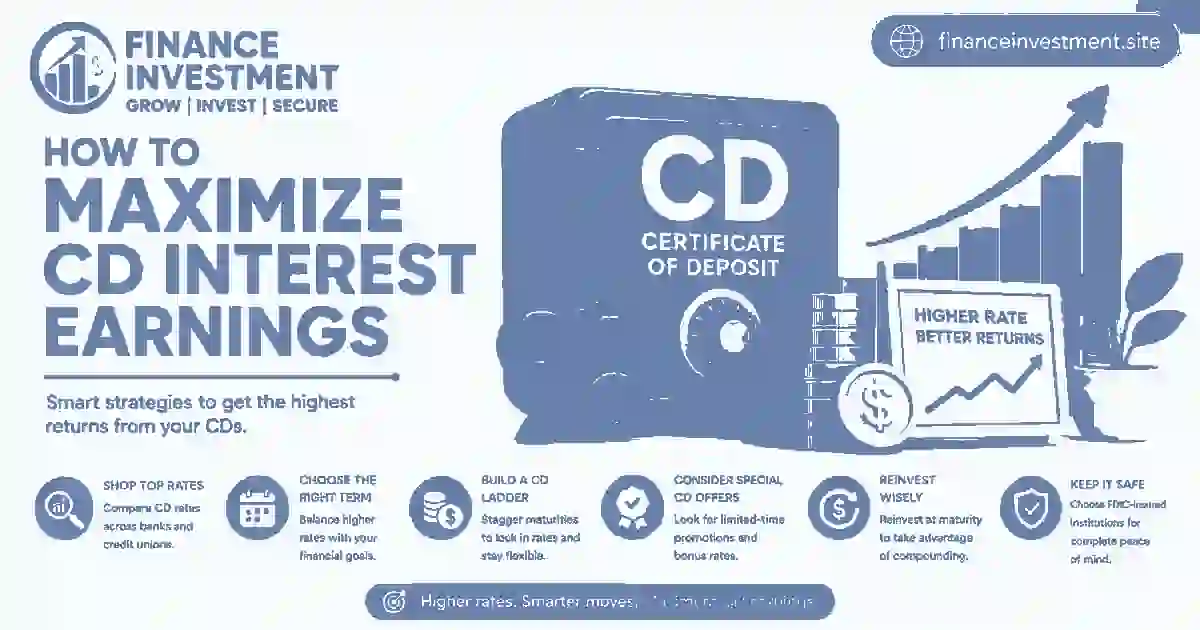 A certificate of deposit can look simple on the surface: deposit money, leave it for a set period, and collect interest. The harder part is figuring out which choices actually improve the amount you keep. A slightly higher APY may help, but the result also depends on your balance, term, interest treatment, and what happens when the certificate matures.
For example, putting more money into a competitive CD can increase the interest dollars earned, while choosing a term that is too long can create a problem if you need the cash early. Compounding can also matter when earned interest stays invested, while an interest payout to another account may change how the balance grows.
Maturity creates another decision point. Instead of automatically renewing, you can compare the new rate, review your cash needs, and decide whether another CD still makes sense. That second decision can affect the earning potential of your savings just as much as the original deposit.
If you want the broader foundation first, our
CD Guide 2026
covers the basics. This guide focuses specifically on the choices that can help you get more value from a CD without turning the process into a guessing game.
What You’ll Learn
- Which CD features can have the biggest effect on interest earned
- How to compare APYs without overlooking account terms
- Why deposit size, compounding, and interest payouts matter
- How maturity and reinvestment decisions can affect future earnings
Quick Answer: Six Ways to Improve Your CD Earnings
To get more from a CD, focus on the details that affect the dollars you actually keep. Compare APYs on similar products, avoid unnecessary cash commitments, understand how interest is credited, and make a plan for what happens when the certificate ends.
6 Actionable Moves
- Compare like-for-like APYs: Check certificates with similar terms, balances, and conditions before choosing a rate.
- Use the right deposit: Put enough money to meet your goal, but keep cash you may need outside the CD.
- Choose the term deliberately: Do not extend the maturity simply because a longer certificate advertises a better yield.
- Read the interest rules: Confirm whether interest compounds, how often it is credited, and where payouts go.
- Protect the return: Understand the early-withdrawal penalty before funding the account.
- Review maturity: Compare the new rates and your cash needs before renewing or moving the proceeds.
Bottom line: Strong CD results come from making several good decisions together, not from selecting one impressive rate and ignoring the rest of the account terms.
CD Interest Earnings at a Glance
Before comparing individual CDs, it helps to see what each account feature controls. Some factors affect the yield itself, while others determine how much flexibility you have and what happens to the money after interest is credited.
| Factor | What It Controls | Check Before Opening |
|---|---|---|
| APY | Annualized yield | Rate, conditions, and term |
| Deposit size | Interest dollars earned | Minimums and coverage |
| Term | Rate-lock period | Maturity date |
| Compounding | Growth of retained interest | Frequency and terms |
| Interest payout | Where earned interest goes | CD or linked account |
| Maturity & reinvestment | Your next earning period | New rate and term |
Use this as a pre-funding checklist: every row should make sense for the money you are putting into the certificate. That makes the comparison more useful than looking at the rate alone.
Complete Beginner Guide to Maximizing CD Earnings
 If you are opening your first CD, start with the money itself rather than the advertised rate. Decide what the funds are for, when you might need them, and how much can remain untouched. That gives you a practical limit for the CD before you begin comparing offers.
1. Decide How Much You Can Commit
Separate emergency savings and near-term expenses from money that can stay invested. Then check the CD’s minimum deposit and any balance requirements. If you want a quick reference, our guide on
how much money you need to open a CD
covers common funding considerations.
2. Compare Offers on Equal Terms
Compare CDs with similar maturities rather than placing a six-month offer beside a five-year offer and judging only the APYs. Check whether the rate is promotional, whether a minimum balance applies, and whether the product has unusual conditions. Current offers can be explored through our
CD rates guide for 2026.
3. Pick a Term You Can Live With
Choose the maturity based on when the money is likely to be useful again. A higher yield is less helpful if you have to break the certificate early. For a broader comparison of terms and features, see
how to choose the right CD.
4. Read the Fine Print
Check how interest is calculated and credited, whether it compounds inside the CD, and where payouts are sent. Then read the early-withdrawal penalty and any minimum-balance requirements. Do not assume every CD uses the same rules.
5. Prepare for Maturity Before You Fund
Save the maturity date and renewal deadline immediately. Before the CD ends, compare the new rate, your current cash needs, and alternative terms. This gives you time to decide rather than letting an automatic renewal make the choice for you.
How CD Interest Earnings Build Over Time
Once a CD is funded, the account follows the rate and terms agreed to when it was opened. During the certificate’s term, interest is credited according to the institution’s schedule. Depending on the product, that interest may remain in the CD, be added to the balance, or be paid to another account.
What Happens During the Term?
A fixed-rate CD generally keeps its agreed rate for the stated term, even if the institution changes the rates offered to new customers. That gives you a defined earning period. If interest stays invested, the balance can grow as additional interest is credited under the account’s compounding rules.
Illustrative Example: A $16,000 CD
Suppose a saver places $16,000 into a one-year CD with a hypothetical 4.25% APY. If the money remains in the account for the full year, a simple APY-based illustration would put the interest at about $680. This is an example, not a quote or guarantee; the actual result depends on the CD’s terms and interest-crediting method.
What Happens at Maturity?
When the maturity date arrives, the institution follows the account agreement for returning the principal and applicable interest. You may have the option to withdraw the proceeds, transfer them, or place them into a new CD.
If you reinvest, the new certificate generally uses the rate and term available at that time. That means the original CD’s rate does not automatically determine your next return. Reviewing the available choices before maturity can help you decide whether another CD still fits your plans.
In practical terms, earning interest is only one part of the process. The maturity decision determines what happens to the money next and can influence future interest growth.
Benefits and Drawbacks of Maximizing CD Earnings
Getting more interest from a CD can be useful when the money has a clear purpose and does not need frequent access. Still, a higher potential return comes with trade-offs that are worth weighing before you lock in the funds.
Pros
- Predictable returns: A fixed-rate CD can provide a defined yield for the agreed term.
- Compounding potential: When interest remains invested, it may contribute to future growth under the CD’s terms.
- Saving discipline: A maturity date can make it easier to leave money untouched.
- Reinvestment choices: Each maturity creates an opportunity to review new rates and decide what to do next.
Cons
- Less liquidity: Your money is generally less accessible until maturity.
- Early-withdrawal costs: Taking funds out early may trigger a penalty under the account agreement.
- Inflation risk: Your return may not fully offset rising prices.
- Taxes: Interest from a taxable CD can reduce your after-tax return.
- Opportunity cost: A locked rate may look less attractive if better opportunities appear later.
The trade-off is straightforward: a CD can reward patience, but the money needs to stay committed long enough for that strategy to make sense. If access matters more than squeezing out the highest possible yield, a more flexible account may be worth considering.
CD Interest-Earning Strategies Compared
There is no single setup that guarantees the highest return. One saver may value a strong rate on one certificate, while another may prefer several maturities or a larger deposit. The table below shows what each approach is designed to accomplish and where its main trade-off appears.
| Strategy | Potential Benefit | Main Trade-Off | Useful When |
|---|---|---|---|
| High-APY single CD | Targets a competitive yield with a simple structure | One maturity and one locked rate | The money has one clear purpose and timeline |
| Longer-term CD | Keeps the agreed rate in place for a longer period | Less flexibility if circumstances change | Funds are unlikely to be needed soon |
| CD ladder | Creates multiple maturity and reinvestment points | More accounts and dates to track | Cash needs are spread across different dates |
| Reinvestment strategy | Lets each maturity be reassessed using current options | Future rates are uncertain | You are willing to review the account at maturity |
| Larger deposit | Can generate more interest dollars at the same yield | More savings becomes committed | The extra funds are not needed for near-term expenses |
Term length can change the balance between yield and flexibility. If you are comparing specific options, review our guides to
6-month CD rates,
1-year CD rates,
and
5-year CD rates
to see how different time horizons can change the decision.
For a staggered approach, our guide to
building a CD ladder
explains how separate maturities can be organized around future cash needs.
Costs, Risks and Expert Tips
A CD can offer a predictable return, but the advertised APY is only one part of the decision. Costs, taxes, changing rates, and the way you handle maturity can all affect how much of that return you ultimately keep.
Watch the Cost of Early Access
Taking money out before maturity may trigger an early-withdrawal penalty. The amount depends on the CD agreement and can reduce the interest you expected to earn. If access could become necessary, review the penalty before committing the funds. Our guide to
CD early withdrawal
explains this risk in more detail.
Consider What You Give Up
A locked rate can become less attractive if newly available CDs offer higher yields. That is the opportunity cost of committing your money today. Inflation creates another concern: even when the account earns interest, rising prices can reduce the purchasing power of the money over time.
Check Taxes and Insurance
Interest from a CD in a taxable account is generally taxable income. Your after-tax return may therefore be lower than the advertised APY. Also verify that your deposits are within the applicable FDIC or NCUA insurance limits for the institution and ownership category.
Review the Renewal Decision
Do not let an automatic renewal make the next investment decision for you. Before maturity, check the new rate, available terms, your cash needs, and whether another option offers a better fit.
Expert Tip
Keep a simple maturity calendar. A reminder a few weeks before each CD ends gives you time to compare rates and decide what to do without rushing.
Common CD Interest-Earning Mistakes
Maximizing CD earnings is not just about finding a competitive rate. Small details can change the result, especially when a CD is treated as a set-it-and-forget-it account. These mistakes are easy to avoid once you know where they tend to appear.
Mistakes to Watch For
- Choosing by APY alone: A higher yield may come with a longer term, larger minimum deposit, or less convenient withdrawal rules.
- Ignoring interest-payment rules: If interest is paid to another account instead of remaining in the CD, it may not compound within the certificate.
- Putting too much cash into CDs: A strong return does not help if you have to withdraw the money early to cover an unexpected expense.
- Missing the renewal date: Automatic renewal can move your money into a new term before you have compared current rates.
- Forgetting taxes: Interest earned in a taxable account can create a tax liability, reducing the amount you keep.
- Repeating the same strategy automatically: A maturity is a new decision point. The rate and your financial needs may have changed.
Illustrative Example: Marcus Reconsiders a Renewal
Marcus places $20,000 into a CD and expects to renew it automatically at maturity. Before the renewal date, he checks the new rate and realizes the available term no longer matches when he expects to use the money. He also reviews how the interest will be paid and considers the tax impact before making his next decision.
Illustrative lesson: A maturity date is more than an ending point. It is an opportunity to reassess the rate, cash timing, and future use of the money.
Who Should Focus on Maximizing CD Earnings?
Maximizing CD earnings makes the most sense when the money has a defined job, a realistic timeline, and enough flexibility elsewhere in your finances. The goal is not to chase every last fraction of a percentage point; it is to make a suitable amount of cash work efficiently.
Who May Benefit Most?
- Beginners: Comparing a few CDs can help first-time buyers understand how rates, terms, and account rules affect the outcome.
- Larger-balance savers: A small rate difference can produce a more noticeable difference in interest dollars when the principal is substantial.
- Retirees: Money with a defined future use may benefit from a predictable return when daily access is not required.
- Families: Savings earmarked for a known future expense may have enough time to remain in a fixed-term account.
- Conservative savers: A fixed-rate CD can provide a defined return without relying on stock-market price movements.
- People with predictable cash needs: A clear timeline makes it easier to choose a maturity that fits the purpose of the money.
When the highest yield may not win: If you need frequent access, have an uncertain timeline, or would have to sacrifice your emergency reserve for a higher APY, a flexible savings account may be a better fit.
Frequently Asked Questions About Maximizing CD Interest
Does a higher APY always mean more CD interest?
No. APY is important, but the deposit amount, term, account conditions, and how long the money stays invested also affect the result.
Does compounding increase CD earnings?
It can. When earned interest remains in the CD and compounds under its terms, that interest can become part of the balance used to generate future earnings.
Does a larger deposit earn more CD interest?
Generally, yes. Assuming the same APY and term, a larger principal can produce more interest dollars. Deposit requirements and applicable insurance limits should still be considered.
Is a longer CD term better for maximizing interest?
Not automatically. A longer term may offer an attractive rate, but it also keeps the money committed for longer. The useful term is the one that matches your cash timeline.
Can interest payouts affect CD growth?
Yes. If interest is left in the certificate, it may compound according to the account rules. If it is paid elsewhere, that amount may no longer contribute to the CD balance.
Are CD interest earnings taxable?
Interest from a CD held in a regular taxable account is generally taxable income. Your actual tax treatment depends on your circumstances and how the account is held.
Can an early withdrawal reduce CD earnings?
Yes. An early-withdrawal penalty can reduce the return you receive. The penalty and its calculation are determined by the CD agreement.
Can reinvesting a matured CD increase future earnings?
It can provide another opportunity to earn interest, but the new CD will generally have the rate and term available at that time. Future rates are not guaranteed.
Can a CD ladder help improve interest earnings?
A ladder can create several maturity points, giving you repeated opportunities to review rates and reinvest. It does not guarantee a higher return than every single-CD strategy.
Illustrative: How much could a $25,000 CD earn?
Illustrative example only: At a hypothetical 4% APY for one year, $25,000 would produce about $1,000 in interest over the year if the funds remain invested for the full term. Actual earnings depend on the CD’s APY and account terms.
Final Verdict: How to Maximize CD Interest Earnings
Maximizing CD earnings is less about finding one perfect certificate and more about making the money, term, and account rules work together. A competitive yield matters, but so do the amount you deposit, the time you can leave it untouched, and the way interest is credited.
Before opening a CD, check the minimum deposit, maturity date, interest-payment method, compounding terms, early-withdrawal penalty, renewal instructions, and applicable deposit-insurance coverage. These details help you judge the return in the context of how you actually plan to use the money.
When maturity arrives, treat it as a fresh decision rather than an automatic next step. Review current rates, available terms, your upcoming cash needs, and whether keeping the proceeds in a CD still makes sense. Reinvesting can continue the earning cycle, while moving the money elsewhere may provide better flexibility.
For a broader overview of CD features, safety, terms, and strategies, explore our
CD Guide 2026
.
Practical takeaway: Choose the CD that gives your money a useful return without creating a cash-access problem later.
Make Your Next CD Decision With More Confidence
Want more practical guidance on CDs, saving strategies, and everyday money decisions? Join the FinanceInvestment newsletter for useful updates and new guides delivered to your inbox.
📧 subhashr325@gmail.com