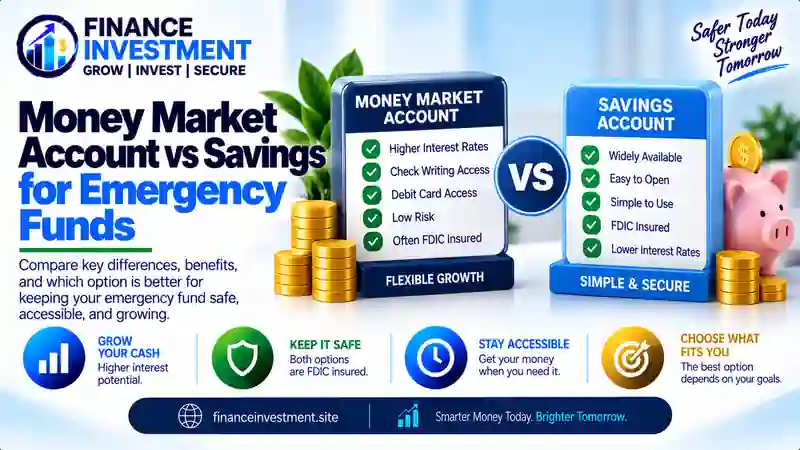
Money Market Account vs Savings for Emergency Funds: Which Is Better?
 Choosing between a money market account vs savings for emergency funds is really a question about what you need your emergency cash to do when life takes an unexpected turn. A broken-down car, urgent home repair, or sudden gap in income can make quick access more valuable than chasing a slightly higher return.
Both account types can give your emergency savings a separate home while earning interest, but they are not identical. A money market account may provide features such as check-writing or debit-card access, depending on the institution. A savings account may offer a simpler setup. Fees, APYs, minimum balances, and transaction rules can also differ.
This guide looks beyond the account label. We’ll compare how each option handles access, earnings, costs, insurance, and real-world emergencies so you can see which setup fits the way you expect to use your cash. For broader background, you can also explore our
complete money market accounts guide
.
What You’ll Learn
- How money market and savings accounts differ when holding emergency cash.
- Which access features can matter when an unexpected expense arrives.
- How APYs, fees, minimum balances, and account rules can affect your choice.
- How FDIC or other applicable deposit insurance can protect eligible deposits.
- Common mistakes that can make an emergency fund harder to use when needed.
Key Takeaways
- Emergency savings should be easy to access when an unexpected expense appears.
- A money market account may include check-writing or debit-card access, depending on the institution.
- A savings account can provide a simple way to keep emergency money separate from everyday spending.
- APYs, minimum balances, fees, and transaction conditions can differ significantly between accounts.
- Eligible deposits at an FDIC-insured bank may qualify for FDIC insurance within applicable limits.
- The advertised rate is only one part of the decision; access and account terms matter too.
For emergency savings, the better account is usually the one that gives you dependable access, reasonable costs, and suitable terms without adding features you don’t need.
Table of Contents
Money Market Account vs. Savings for Emergency Funds: At a Glance
Emergency savings has one job: being there when an unexpected expense appears. You may need the money immediately, months from now, or not at all for a long stretch. Because the timing is uncertain, access, account costs, earnings, and deposit protection all deserve attention when comparing an MMA with a savings account.
Savers who want emergency cash kept separate from everyday spending while still earning interest.
APY, minimum balances, monthly fees, transaction rules, and the ways you can move money when an emergency occurs.
Rates can change and vary by institution and account.
Access methods and transaction conditions depend on the account.
Eligible bank deposits may receive FDIC coverage within applicable limits.
| Factor | Money Market Account | Savings Account |
|---|---|---|
| Access | May offer checks, a debit card, transfers, or other access methods, depending on the account. | Generally designed for saving, with access methods and transaction conditions set by the institution. |
| Earnings | Earns interest at an APY that can change. | Earns interest at an APY that can change. |
| Emergency-Fund Fit | Can suit savers who value its available access features and can meet its account requirements. | Can suit savers who prefer a straightforward place to keep emergency cash. |
| Deposit Protection | Eligible deposits at an FDIC-insured bank may be covered within applicable limits. | Eligible deposits at an FDIC-insured bank may be covered within applicable limits. |
Complete Beginner Guide to Choosing an Emergency-Fund Account
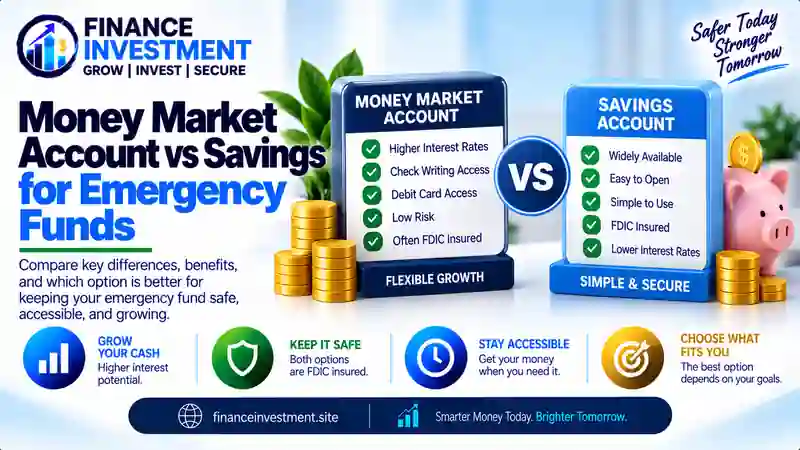 Before comparing account names, decide what you need from your emergency fund. This money may sit untouched for months, yet you could suddenly need it for a car repair, urgent home expense, or period without a paycheck. Your account should therefore make the money reasonably accessible without making everyday spending too easy.
Three Questions to Ask
- How quickly might I need the money?
Look for an account with access methods that work during an actual emergency. - What will it cost me to keep the account?
Check the APY alongside minimum-balance requirements, monthly fees, and other conditions. - Will the account’s features help or get in the way?
An MMA may offer checks or debit-card access, depending on the institution, while a savings account may provide a simpler setup.
Once you know your priorities, compare actual account terms rather than relying on the product label. If you want a basic explanation of MMAs before making that comparison, read our
guide to what a money market account is
.
Choose the account you can understand and access when you need it. A higher rate is useful, but it should not come at the expense of terms that make your emergency fund difficult or costly to use.
How Emergency-Fund Accounts Work
Think of an emergency fund as money kept on standby. You deposit it into an account designed to hold cash, the institution pays interest according to its current terms, and you leave the balance there until an unexpected expense comes along. Unlike a retirement investment account, the priority here is having usable cash available when your regular budget cannot cover the bill.
A money market account may give you more ways to reach that cash, such as checks or a debit card, depending on the institution. A savings account may rely more heavily on electronic transfers or other withdrawal methods. Neither setup is automatically better. What matters is whether the available access method works when you actually need the funds, and whether the account’s transaction conditions fit your emergency plan.
A Simple Emergency-Fund Flow
- Deposit: Put money aside specifically for unexpected expenses.
- Leave it ready: Let the balance earn interest while you do not need to use it.
- Draw from it: Use the funds when a genuine emergency occurs, following the account’s withdrawal and transaction rules.
One distinction is worth keeping clear: a money market deposit account is a bank or credit-union deposit product, while a money market mutual fund is an investment product. Their protections and structures are different. Our
money market account vs. money market fund guide
explains the distinction in more detail.
Benefits & Drawbacks for Emergency Funds
An emergency-fund account has one job: keep unexpected-expense money available without making it unnecessarily expensive to hold. Both savings accounts and money market accounts can serve that purpose, but their features can create different advantages and trade-offs.
- Interest on idle cash: You can earn interest while the money waits for an actual emergency.
- Useful access options: Some money market accounts may offer checks or debit cards, giving you another way to reach funds when needed.
- Dedicated cash reserve: Keeping emergency money separate from everyday spending can make the balance easier to protect and track.
- Account requirements: Some money market accounts may have minimum-balance requirements or fees that a simpler savings account may not have.
- Variable earnings: Deposit-account APYs can change, so the return you receive today may be different later.
- Access rules vary: Withdrawal methods, transaction limits, and other conditions depend on the financial institution and account.
For emergency savings, the strongest option is not necessarily the account with the most features. Look for a combination of dependable access, reasonable costs, and terms you can comfortably maintain over time.
Money Market Account vs. Savings Comparison
For an emergency fund, the useful comparison is not simply which account pays more. Look at how you can reach the money, what you must maintain, and how the account fits your spending habits. Both money market and savings accounts can hold emergency cash, but individual account terms can make the experience quite different.
| Factor | Money Market Account | Savings Account |
|---|---|---|
| Access | May include check-writing or debit-card access, depending on the institution and account. | Access methods vary and may include electronic transfers, withdrawals, or other institution-specific options. |
| Interest | APY varies by institution and can change over time. | APY varies by institution and can change over time. |
| Fees & Minimums | Some accounts may have minimum-balance requirements or fees tied to account conditions. | Requirements vary; some savings accounts may have low or no minimum-balance requirements. |
| Emergency Readiness | Useful when its available access methods match the types of expenses you may need to cover. | Useful when you want a straightforward place to keep emergency savings separate from daily cash. |
| Spending Separation | More direct access can be convenient, but may make the funds easier to reach for non-emergency spending. | Keeping the reserve in a dedicated savings account can create more separation from everyday purchases. |
The biggest practical difference is often access rather than interest. An MMA can make sense when its additional access features solve a real need. A savings account may be preferable when you want a simpler home for the reserve. In either case, compare the specific account’s APY, fees, minimums, and access rules before making the choice.
Costs, Risks & Expert Tips
An emergency fund needs to remain useful even when you are not thinking about it. That means looking past the advertised rate and checking the costs, account conditions, and access details that could affect the money when you finally need it.
Costs and Risks to Check
- Monthly fees: Check whether the account charges a recurring fee and whether specific conditions can waive it.
- Balance requirements: A minimum balance can become inconvenient if your emergency reserve is still relatively small.
- Changing APY: The interest rate on a deposit account can change, so treat the current rate as changeable rather than permanent.
- Access limitations: Review withdrawal methods, transaction rules, transfer timing, and other conditions before relying on the account for urgent expenses.
Expert Tips for a Stronger Setup
- Know the withdrawal process: Understand how you would access the money before an emergency occurs, including any transfer or transaction conditions.
- Compare the full cost: Look at fees and balance requirements alongside the APY rather than judging an account by its rate alone.
- Verify deposit insurance: For a bank or credit-union deposit account, confirm that the institution and account are covered by applicable FDIC or NCUA insurance and understand the coverage limits.
Common Mistakes When Choosing an Emergency-Fund Account
Even a well-funded emergency reserve can become less useful when the account is chosen without thinking about real-life behavior. Some mistakes are easy to overlook at opening but become noticeable when you need the money quickly.
Mistakes to Avoid
- Choosing by APY alone: A higher advertised rate may not compensate for fees, minimum-balance requirements, or access conditions.
- Not checking how withdrawals work: An account can look convenient until you discover that its available access method does not match the way you need to pay an unexpected bill.
- Mixing emergency money with everyday spending: Easy access is useful during a genuine emergency, but keeping the reserve too close to routine spending can make it easier to dip into unnecessarily.
A Simple Example
Imagine Maya has $12,000 reserved for unexpected expenses. She selects an account because its advertised APY looks attractive, but she does not review the minimum-balance requirement. Months later, her balance falls below that threshold after using part of the fund for a $2,400 car repair, and the account terms trigger a fee.
The numbers are illustrative. The lesson is simple: an emergency fund should be evaluated as a complete setup, including its costs, access methods, and rules—not just the interest rate shown when you open the account.
Who Should Choose a Money Market Account or Savings?
By this point, the differences are easier to see. The final choice comes down to which account structure fits the way you plan to keep, protect, and access your emergency reserve.
Choose a Money Market Account If…
You expect that having multiple ways to access your emergency cash could be useful, and you are comfortable with the account’s minimum-balance requirements, fees, and other conditions.
Choose a Savings Account If…
You want a simpler home for your emergency reserve and prefer to keep those funds clearly separated from everyday spending. Compare the specific account’s APY, fees, minimums, and access rules.
Put the account terms side by side and choose the one that gives you the access you need without unnecessary costs or complexity. For more background, see our
complete money market accounts guide
.
Frequently Asked Questions
Are money market accounts good for emergency funds?
Yes. A money market deposit account can be suitable when its access features, costs, and account requirements fit your emergency-fund needs.
Is a savings account better than a money market account for an emergency fund?
Not necessarily. A savings account may suit someone who wants a simple, separate cash reserve, while an MMA may appeal to someone who values additional access options. Compare the specific account terms.
Can you use a money market account as an emergency fund?
Yes. A money market deposit account can hold emergency savings, provided you understand its withdrawal methods, fees, minimums, and other conditions.
How much should you keep in an emergency fund?
Three to six months of essential expenses is a common guideline, but the appropriate amount depends on income stability, household obligations, and other personal circumstances.
Are money market accounts FDIC insured?
Eligible deposits in a money market deposit account at an FDIC-insured bank can qualify for FDIC insurance within applicable limits. A money market mutual fund is different and is not an FDIC-insured deposit.
Are savings accounts FDIC insured?
Eligible deposits at an FDIC-insured bank can qualify for FDIC insurance within applicable limits. Coverage depends on the ownership category and other FDIC rules.
Are money market account earnings taxable?
Interest earned from a money market deposit account is generally taxable for federal income-tax purposes. Tax treatment can differ for money market mutual funds and other products, so personal tax advice should come from a qualified tax professional.
Can a money market account lose money?
A money market deposit account is generally designed to preserve your deposited cash, and eligible deposits at an insured institution receive applicable deposit-insurance protection, subject to coverage rules and limits. A money market mutual fund is an investment and can lose value.
Related Resources
If you want to dig deeper, these resources cover the account features that matter most when building an emergency reserve. Start with the FinanceInvestment guides for practical comparisons, then use the official resources to verify insurance and account-protection details.
What Is a Money Market Account?
Money Market Account Fees Explained
Money Market Account Minimum Balances
Official Resources
FDIC deposit-insurance information
— useful for understanding coverage and applicable limits.
NCUA share-insurance information
— helpful when your emergency savings are held at a federally insured credit union.
NerdWallet’s money market account guide
— provides additional context on account features and considerations.
Leave a Reply