
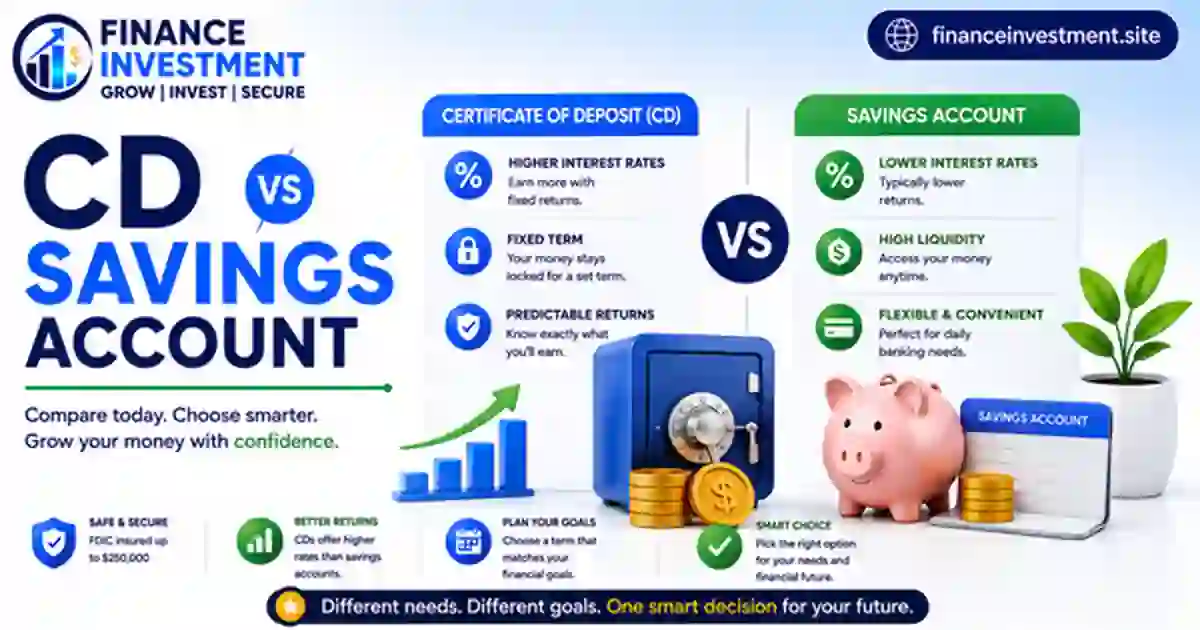
 Choosing between a CD vs Savings Account is about more than chasing the highest APY. The better option depends on how soon you may need the money, how important rate certainty is, and what job that cash is meant to do.
A CD can work well for money with a clear destination and a known timeline. You typically lock in a rate for a set term, giving you a clearer picture of what the deposit can earn. The catch is access. Taking money out before maturity may result in an early-withdrawal penalty, so a CD is not ideal for cash you might suddenly need.
A savings account gives you more room to move. You can generally add money, make withdrawals and keep funds available for expenses or unexpected needs. The trade-off is that the interest rate can change, so today’s APY may not be tomorrow’s APY.
That makes the decision personal. Money set aside for an emergency may deserve flexibility, while funds reserved for a future purchase could be better suited to a fixed-term account. If you want a broader foundation before comparing options, our
CD Guide 2026
covers how certificates of deposit work and what to consider before opening one.
What You’ll Learn
This guide breaks down the practical differences between CDs and savings accounts, including rate certainty, access, account terms, withdrawal rules and the role each can play in a larger cash plan. You’ll also see how to think about the choice based on your timeline rather than an APY headline alone.
Quick answer: Choose a CD when you can leave the money untouched for a set period and value a locked rate. Choose a savings account when access matters more and you want to keep adding or moving money as your needs change.
Key Takeaways
- Need quick access? A savings account is usually the more practical place for money you may need without warning.
- Want a locked rate? A CD can provide more certainty for a deposit you can leave untouched until maturity.
- Know your timeline. A short-term goal and a multi-year goal do not necessarily call for the same account.
- Compare APYs carefully. A higher advertised rate may not be worth it if the account’s restrictions conflict with your plans.
- Check the rules. Look at minimum deposits, withdrawal conditions, fees and how the account handles maturity or rate changes.
- Think about the job of the money. Emergency cash needs flexibility; money reserved for a known future expense may tolerate a fixed term.
Bottom line: The strongest choice is not necessarily the account with the biggest APY. It is the one whose rules fit your cash, your timeline and your need for access.
CD vs Savings Account: At a Glance
The biggest difference is how each account handles your money after you deposit it. A CD is built around a fixed term and rate, while a savings account keeps the balance more accessible. The details below give you a quick view of the features that can matter before you choose.
| Feature | CD | Savings Account |
|---|---|---|
| APY behavior | Usually fixed for the term | Usually variable |
| Rate lock | Yes, typically | No |
| Term | Set maturity date | No fixed term |
| Access | More restricted | Generally easier |
| Best use | Money with a known timeline | Accessible savings and cash reserves |
Complete Beginner Guide to Choosing a CD or Savings Account
 If you’re new to saving, start with the money itself rather than the account name. Ask what the cash is for, when you might need it, and how much access you want. Those three answers can narrow the choice quickly.
1. Give the money a job
Separate emergency savings from money you are deliberately setting aside for a future expense. An emergency fund generally benefits from easy access. Cash for a planned home project, tuition bill or other known expense may have a clearer timeline and could be considered for a CD.
2. Decide how much access you need
A savings account is designed to keep your cash available while still earning interest. A CD asks you to commit the deposit for a specified term. If an unexpected withdrawal would create a problem, locking up the entire balance may not be a good fit.
3. Compare the actual account terms
Look beyond the advertised APY. Check the minimum opening deposit, ongoing balance requirements, withdrawal rules, fees and how interest is credited. For CDs, pay particular attention to the early-withdrawal penalty and maturity date.
4. Match the timeline
A CD term should fit the date when you expect to need the money. A mismatch can turn a seemingly attractive rate into an inconvenience. If your timeline is uncertain, keeping some or all of the cash in a savings account can provide more breathing room.
5. Don’t feel forced to choose only one
You can divide your savings. Keep near-term cash accessible and use a CD for money with a firm future purpose. For larger balances, several CDs with different maturity dates can also spread out when money becomes available. Our guide on building a CD ladder in 2026 explains that approach in more detail.
How CDs and Savings Accounts Work
The two accounts can both earn interest on your cash, but the way that return behaves is different. A CD generally trades flexibility for a fixed rate and a defined maturity date. A savings account keeps the money available while its rate can move over time.
How a CD earns interest
When you open a CD, you deposit money for a chosen term, such as six months, one year or several years. The bank normally sets the APY when you open the account. Interest may compound according to the account’s terms, while the rate itself generally remains unchanged until maturity.
How a savings account earns interest
A savings account does not have a fixed maturity date. You can usually add money as your balance grows, and the bank calculates interest according to its stated method. Because the rate is generally variable, your future earnings can increase or decrease when the bank changes its APY.
What happens when rates change?
Suppose you place money into a hypothetical CD at a 4.00% APY. If comparable CD rates later rise to 4.50%, your existing CD generally keeps its original rate until maturity. If rates fall to 3.50%, you still have the benefit of the 4.00% rate for the agreed term.
Illustrative example — $10,000 deposit
Assume a one-year CD earns a hypothetical 4.00% APY, while a savings account starts at a hypothetical 4.00% APY but later falls to 3.25%. The CD keeps its agreed rate through maturity. The savings account’s return changes with its rate. These figures are illustrative only and do not represent current offers.
At maturity, the CD typically stops earning under its original term and you can withdraw the funds, move them elsewhere or renew according to the bank’s options. A savings account has no comparable maturity event, which is one reason it can be useful for money that needs to remain available.
Benefits & Drawbacks of CDs and Savings Accounts
Both accounts can be useful places for cash, but they solve different problems. A CD is built around commitment, while a savings account gives you more freedom to move with your needs.
CD Pros
- A fixed rate can make future earnings easier to estimate.
- A defined term can encourage you to leave long-term savings untouched.
- You are protected from a rate decrease during the CD term.
- Different terms can be combined to create a staggered savings plan.
CD Cons
- Early access can result in an early-withdrawal penalty.
- Your money may earn less if rates rise after you lock in.
- The deposit cannot usually be topped up like a regular savings balance.
- A longer term can create an opportunity cost if your plans change.
Savings Account Pros
- Cash is generally easier to access for planned or unexpected needs.
- You can usually add money whenever you want.
- There is no fixed maturity date to manage.
- Useful for emergency reserves and short-term goals.
Savings Account Cons
- The APY can fall, reducing future interest earnings.
- Some accounts require a minimum balance to earn the advertised rate.
- Fees can reduce the return if account requirements are not met.
- Keeping everything liquid may make it easier to spend money intended for longer-term goals.
A useful distinction: a CD’s main strength is certainty; a savings account’s main strength is access. The better fit depends on which of those matters more for the money you are setting aside.
CD vs Savings Account Compared
The practical difference comes down to what happens after you put the money in. A CD gives you a defined term and usually a fixed rate, while a savings account leaves the balance more accessible and lets the interest rate change. Here is the side-by-side view.
| Feature | CD | Savings Account |
|---|---|---|
| APY | Usually fixed for the selected term | Usually variable |
| Rate certainty | High during the term | Can change |
| Term | Fixed maturity date | No fixed maturity |
| Liquidity | More limited | Generally easier access |
| Minimum balance | Depends on the CD | Depends on the account |
| Withdrawals | May trigger an early-withdrawal penalty | Generally more flexible |
| Fees | Often low, but terms vary | May have maintenance or balance-related fees |
| Taxes | Interest generally taxable | Interest generally taxable |
| Insurance | Generally FDIC/NCUA insured when eligible | Generally FDIC/NCUA insured when eligible |
| Best use | Money with a defined timeline | Accessible savings and cash reserves |
If you want to understand how a CD fits into a broader savings plan, see our CD Guide 2026. And if you’re deciding between different cash accounts, our guide to CD vs. high-yield savings accounts offers another useful comparison.
Costs, Risks & Expert Tips
The advertised rate is only one part of the decision. Small account details can have a bigger effect than a slightly higher APY, especially when the money is needed sooner than expected.
Watch the cost of getting your money early
With a CD, taking money out before maturity may trigger an early-withdrawal penalty. The amount and calculation method vary by institution and product. Read the penalty terms before depositing funds, particularly if there is any chance you will need the money before the scheduled maturity date.
Check the fine print on savings accounts
A savings account can offer easier access, but some products require a minimum balance to avoid fees or qualify for a stated APY. Also check whether the advertised rate applies to your entire balance and whether the institution can change the rate.
Think about what happens after taxes and inflation
Interest earned in a taxable account may create a federal income-tax liability. Meanwhile, inflation can reduce the purchasing power of money even when the account balance is growing. A higher nominal rate does not automatically mean a higher real return.
Expert Tip
Before moving a large balance, confirm the institution’s deposit-insurance status and your coverage limits. FDIC insurance generally covers eligible deposits at FDIC-insured banks, while NCUA share insurance applies to eligible deposits at federally insured credit unions. Coverage depends on ownership category and other factors, so do not assume that every account or every dollar is automatically protected.
A final check before you deposit
Confirm the APY, minimum deposit or balance, fees, withdrawal rules, rate terms, maturity instructions and insurance coverage. For a CD, also note the exact maturity date and what happens if you do nothing when the term ends. Those details can matter more than a small difference between two advertised rates.
Common Mistakes When Choosing a CD or Savings Account
A good rate can catch your attention, but it should not be the only thing you check. The wrong account can become frustrating when its rules do not match the way you actually use your money.
- Choosing only by APY: A higher advertised rate may not compensate for restrictions, fees or a balance requirement.
- Ignoring CD penalties: Needing cash early can turn a seemingly attractive CD into an expensive choice.
- Missing savings requirements: Check whether a minimum balance is needed to avoid fees or receive the advertised rate.
- Overlooking fees: Even modest account charges can reduce the interest you keep.
- Confusing a CD with a money market fund: A bank or credit-union deposit account is different from an investment product such as a money market mutual fund.
- Forgetting insurance coverage: Verify whether the institution is FDIC- or NCUA-insured and understand applicable coverage limits.
- Putting emergency cash in a restrictive account: Money you may need immediately should not be locked away simply to chase a higher rate.
Illustrative Saver Example
Hypothetical: Maria has $15,000 that she expects to use for a car purchase in about 18 months. She finds a CD offering a higher APY than her savings account, but the CD’s early-withdrawal penalty could reduce her earnings if the purchase happens sooner. Instead of putting the entire $15,000 into the CD, she could keep the portion needed sooner accessible and consider a CD only for money she can comfortably leave untouched. This example is illustrative, not a recommendation or a current rate quote.
Who Should Choose a CD or Savings Account?
Neither account is automatically better. The better fit depends on how steady your plans are and how easily you may need the cash.
A CD may suit you if…
You are a beginner who wants a straightforward way to set aside money, a retiree who values predictable interest, or a family saving toward a known expense. Conservative savers may also appreciate knowing the CD’s rate for the agreed term. It can be especially useful when the money has a clear purpose and you do not expect to need it early.
A savings account may suit you if…
You are building an emergency fund, handling expenses that could arise unexpectedly, or regularly adding to your balance. Families and savers with changing cash needs may prefer the easier access and lack of a fixed maturity date.
Consider another option if you need greater flexibility, expect to invest the money for long-term growth, or have a different goal that a deposit account does not address. Keeping part of your cash liquid while using a CD for a defined goal can also be a practical middle ground.
Frequently Asked Questions About CDs vs Savings Accounts
What is the best time to open a CD?
The best time is usually when the rate, term and maturity date fit your goal and you can leave the money untouched. No one can know the highest future CD rate with certainty.
Should I wait for higher CD rates?
Waiting may help if rates rise, but they could also fall. If today’s rate works for your timeline, locking part of your savings can reduce the risk of missing it.
When does a CD rate become locked?
For a standard fixed-rate CD, the rate is generally set when you open and fund the account. Check the bank’s terms because products can differ.
What CD term should I choose?
Choose a term that matches when you expect to need the money. A shorter term can offer more flexibility, while a longer term may provide longer rate certainty.
What happens to a CD if interest rates rise or fall?
A fixed-rate CD generally keeps its agreed rate through the term. If market rates rise, you may miss newer higher offers; if rates fall, your existing rate can become more attractive.
Is a CD ladder a good alternative to one CD?
A CD ladder can spread money across different maturity dates. This can provide regular opportunities to access funds or reinvest without putting the entire balance into one term.
Can I withdraw money from a CD early?
Many CDs allow early withdrawal subject to a penalty. The amount varies by institution and product, so review the withdrawal terms before opening the account.
Are CD and savings account earnings taxable?
Interest from taxable deposit accounts is generally included in taxable income. Your actual tax treatment depends on your circumstances, so review IRS guidance or consult a qualified tax professional.
Are CDs and savings accounts insured?
Eligible deposits at FDIC-insured banks are generally covered within applicable limits. Eligible deposits at federally insured credit unions generally receive NCUA share insurance. Coverage depends on the institution, ownership category and applicable limits.
What is an illustrative example of CD timing?
Illustrative only: Suppose you have $20,000 that you will not need for one year and find a CD with a fixed 4.00% APY. Locking it could provide rate certainty, while waiting could help only if a better suitable rate becomes available. This example is not a current rate quote or personal recommendation.
Final Verdict: CD vs Savings Account
So, should you choose a CD or a savings account? There is no single winner for every saver. A CD can make more sense when you have money with a clear timeline, do not expect to need it early, and want a rate that stays fixed for the agreed term. A savings account can be the better home for emergency funds, upcoming expenses or cash that needs to remain accessible.
The highest APY should not make the decision by itself. A slightly better rate may lose its appeal if the account has restrictive access, a costly penalty or requirements that do not fit your situation.
If a CD fits your timeline today, you do not necessarily need to wait for an unknown future rate. If your plans are uncertain, keeping the money liquid can be worth more than locking in a higher return.
Want a broader look at CD terms, rates, maturity dates and strategies? Continue with our
CD Guide 2026
.
Make Your Next Savings Move With More Confidence
Get practical finance guides, CD insights and savings ideas delivered to your inbox. Email
subhashr325@gmail.com to stay connected with FinanceInvestment.
Leave a Reply