Category: AI Investing

  • AI Credit Score Tools: Best 2026 Guide to Credit Improvement

    AI Credit Score Tools: Best 2026 Guide to Credit Improvement


    AI-Powered Credit Score Improvement Tools: Best 2026 Guide

    Author. Subhash Rukade

    Published: June 13, 2026
    AI Credit Score Tools

    AI-Powered Credit Score Improvement Tools: Why They Matter in 2026

    Your credit score affects more than just loan approvals. It influences mortgage rates, car financing costs, credit card offers, insurance premiums, and sometimes even employment opportunities.

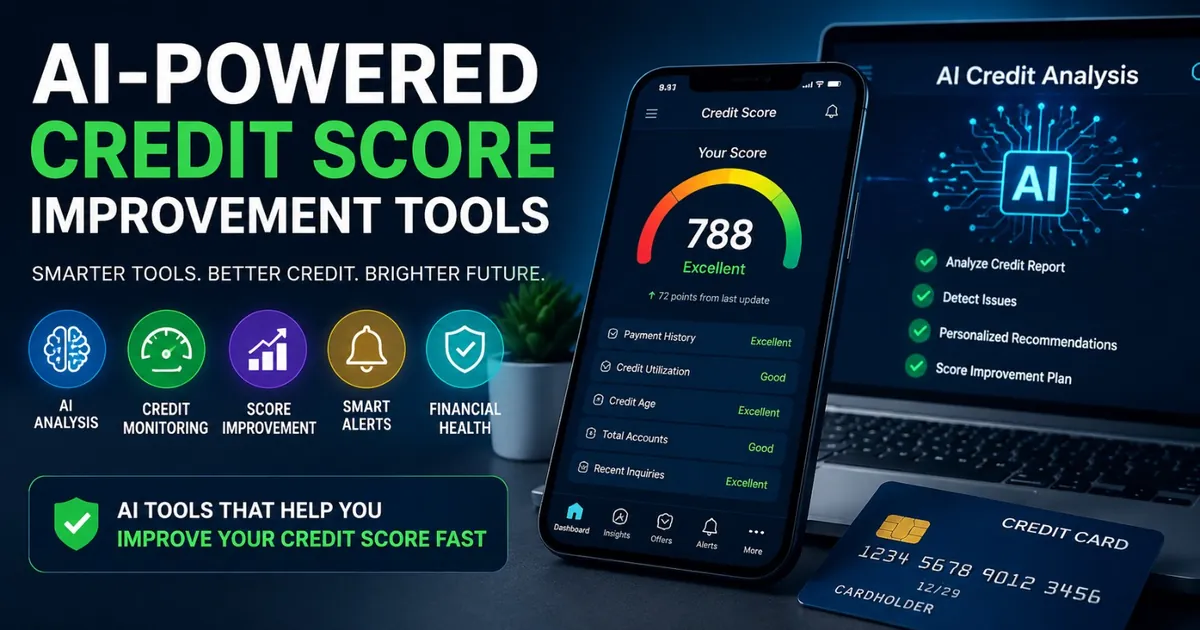
    AI Credit Score Tools are helping Americans improve credit health, track credit reports, and make smarter financial decisions in 2026.

    In 2026, maintaining a strong credit score has become more important than ever for Americans who want financial flexibility and long-term wealth-building opportunities.

    Traditionally, improving a credit score required manually tracking payments, reviewing credit reports, monitoring debt balances, and understanding complex credit-scoring rules.

    Today, artificial intelligence is making that process significantly easier.

    AI-Powered Credit Score Improvement Tools are transforming the way consumers manage their financial health. These intelligent platforms analyze spending habits, monitor credit activity, identify risks, and provide personalized recommendations designed to help users improve their scores faster.

    Instead of guessing what actions might increase a credit score, consumers can now receive data-driven insights tailored specifically to their financial situation.

    For example, AI tools can notify users when credit utilization becomes too high, recommend the best time to pay down balances, identify errors on credit reports, and even predict how certain financial decisions may affect future scores.

    These capabilities help consumers make smarter financial choices while avoiding costly mistakes.

    Many of the same technologies improving credit management are also transforming investing and wealth-building strategies. Readers interested in the broader impact of artificial intelligence on personal finance should explore our
    AI Investing & Personal Finance Guide 2026.

    One reason AI Credit Score Tools have gained popularity is their ability to simplify complex financial information. Instead of reviewing hundreds of data points manually, users receive clear recommendations that are easy to understand and act upon.

    As competition among lenders continues increasing, maintaining a strong credit profile can unlock lower borrowing costs and create more opportunities to build wealth.

    In this guide, you’ll discover how AI-Powered Credit Score Improvement Tools work, the technologies behind them, practical strategies for improving your score, common mistakes to avoid, and future trends shaping credit management in America.

    How AI Credit Score Tools Work

    Modern AI-Powered Credit Score Improvement Tools do much more than simply display a credit score. These platforms continuously analyze financial data and provide personalized recommendations that help consumers make smarter decisions.

    Instead of manually reviewing credit reports and financial statements, users can rely on artificial intelligence to identify opportunities for Credit Score Improvement.

    The goal is simple: help consumers build stronger credit profiles while reducing financial mistakes.

    Credit Monitoring in Real Time

    One of the most valuable features of AI Credit Score Tools is real-time credit monitoring.

    AI systems continuously track changes across credit reports. If a new account appears, a hard inquiry is added, or a balance changes significantly, users receive immediate alerts.

    This helps consumers identify potential issues before they negatively affect their credit scores.

    Early detection is especially important when dealing with identity theft or reporting errors.

    Spending Pattern Analysis

    Artificial intelligence can analyze spending behavior and identify patterns that may impact credit health.

    For example, AI tools can detect when credit card balances are increasing too quickly or when spending habits may cause credit utilization ratios to rise above recommended levels.

    Since credit utilization plays a major role in most scoring models, these insights can be extremely valuable.

    Debt Tracking and Optimization

    Many consumers struggle to decide which debts should be paid first.

    AI-powered systems evaluate balances, interest rates, payment histories, and credit utilization levels to suggest the most effective repayment strategies.

    Some tools even estimate how specific debt payments may influence future credit scores.

    Smart Payment Reminders

    Payment history remains one of the most important factors in credit scoring.

    Missing even a single payment can significantly impact a score.

    AI systems help reduce this risk by sending personalized reminders before due dates and identifying accounts that may require immediate attention.

    These automated alerts help consumers maintain positive payment histories and avoid costly penalties.

    Personalized Recommendations

    Unlike traditional financial apps, AI Credit Score Tools provide recommendations tailored to individual financial situations.

    The system may suggest reducing utilization on a specific card, disputing a reporting error, paying down a balance before a statement closing date, or avoiding unnecessary credit applications.

    Because these recommendations are based on personal financial data, they are often far more effective than generic advice.

    Consumers interested in broader AI-driven financial strategies should also explore our
    AI Personal Finance Guide 2026.

    By combining credit monitoring, spending analysis, debt management, and personalized coaching, AI-Powered Credit Score Improvement Tools are helping Americans take greater control of their financial future.

    AI Technologies Behind Credit Score Improvement

    The success of modern AI-Powered Credit Score Improvement Tools comes from advanced technologies that analyze financial behavior, identify risks, and provide highly personalized recommendations.

    Unlike traditional credit monitoring services that mainly report information, AI actively helps consumers make better financial decisions.

    These technologies work together to support faster and smarter Credit Score Improvement.

    Machine Learning Learns Your Financial Habits

    Machine learning is the foundation of most AI Credit Score Tools.

    The technology studies spending patterns, payment history, credit utilization, account balances, and borrowing behavior.

    Over time, the system learns how users manage credit and identifies behaviors that may positively or negatively affect future scores.

    Because machine learning continuously updates itself, recommendations become more accurate as additional financial data becomes available.

    Predictive Analytics Forecasts Future Scores

    One of the most powerful features of AI is predictive analytics.

    Instead of only showing current credit scores, AI systems estimate how future actions may influence credit performance.

    For example, an AI platform might predict how paying off a credit card balance, reducing utilization, or avoiding new credit inquiries could impact a score over the next several months.

    This forward-looking approach helps consumers make more informed financial decisions.

    Behavioral Analysis Identifies Hidden Risks

    AI also uses behavioral analysis to evaluate financial habits.

    The system can identify recurring behaviors that may hurt credit health, such as consistently carrying high balances or making payments close to due dates.

    By recognizing these patterns early, AI tools can recommend corrective actions before significant damage occurs.

    Personalized Financial Recommendations

    Every consumer has a unique financial situation.

    This is why AI-Powered Credit Score Improvement Tools generate personalized recommendations rather than offering generic advice.

    The system evaluates individual credit profiles and suggests actions based on each user’s specific goals and challenges.

    These tailored recommendations often produce better results than one-size-fits-all financial guidance.

    Credit Risk Assessment

    AI systems continuously assess credit risk by analyzing multiple factors simultaneously.

    This helps consumers understand which financial behaviors are helping their scores and which actions may increase risk.

    The result is a clearer path toward long-term financial stability.

    Traditional Credit Monitoring vs AI Credit Score Tools

    FeatureTraditional MonitoringAI Credit Score Tools
    Credit TrackingBasic UpdatesReal-Time Monitoring
    RecommendationsGeneric AdvicePersonalized Guidance
    Future Score ForecastsNoYes
    Risk DetectionLimitedAdvanced Analysis
    AutomationLowHigh

    Consumers seeking better borrowing opportunities should also review our
    Best Credit Cards 2026
    guide to find products that support responsible credit building.

    These advanced technologies explain why AI Credit Score Tools are becoming an essential part of modern personal finance management.

    Real-World Example of AI Improving a Credit Score

    To understand how AI-Powered Credit Score Improvement Tools work in practice, let’s look at a realistic example.

    Meet Sarah, a 32-year-old marketing professional from Texas. She had a credit score of 645 and wanted to improve it before applying for a mortgage.

    Like many Americans, Sarah paid her bills regularly but struggled with high credit card balances and inconsistent budgeting habits.

    Although she knew her credit score needed improvement, she wasn’t sure which actions would have the greatest impact.

    AI Credit Score Improvement Example

    Step 1: Connecting Financial Accounts

    Sarah connected her credit cards, bank accounts, and credit monitoring service to an AI-powered credit management platform.

    Within minutes, the system analyzed payment history, utilization ratios, account age, debt balances, and recent credit activity.

    The AI identified several opportunities for immediate Credit Score Improvement.

    Step 2: Reducing Credit Utilization

    The platform discovered that Sarah was using nearly 75% of her available credit limits.

    Because credit utilization is a major factor in most credit scoring models, the AI recommended paying down specific balances first.

    Instead of spreading payments across multiple cards, the system identified the accounts that would provide the greatest score improvement.

    Step 3: Optimizing Payment Timing

    Many consumers don’t realize that when they make payments can matter almost as much as how much they pay.

    The AI suggested making payments before statement closing dates rather than waiting until due dates.

    This helped lower reported balances and improved utilization ratios appearing on credit reports.

    Step 4: Ongoing Monitoring and Alerts

    One of the biggest benefits of AI Credit Score Tools is continuous monitoring.

    Whenever Sarah’s balances increased or unusual activity appeared on her accounts, the system sent alerts and updated recommendations.

    This allowed her to maintain progress and avoid setbacks.

    Many of the same technologies helping consumers improve credit scores are also transforming investing and financial planning. Readers interested in these broader innovations should revisit our
    AI Investing & Personal Finance Guide 2026.

    After approximately twelve months of following AI recommendations, Sarah’s credit score increased from 645 to over 740.

    This improvement helped her qualify for more favorable mortgage terms and potentially save thousands of dollars over the life of her loan.

    For additional insights on building better financial habits, consider reading
    The Psychology of Money by Morgan Housel.
    The book provides valuable lessons about behavior, decision-making, and long-term financial success.

    Sarah’s experience demonstrates how AI-Powered Credit Score Improvement Tools can help consumers make smarter financial decisions and achieve meaningful results over time.

    Common Mistakes When Using AI Credit Score Tools

    While AI-Powered Credit Score Improvement Tools can provide valuable guidance, success still depends on how consumers use the information. Artificial intelligence can identify opportunities for improvement, but it cannot make financial decisions on your behalf.

    Many people expect immediate results after installing an AI credit app. However, improving a credit score usually requires consistency, patience, and responsible financial behavior.

    Understanding common mistakes can help consumers get the most value from modern AI Credit Score Tools.

    Ignoring AI Recommendations

    One of the most common mistakes is simply ignoring the recommendations generated by the platform.

    AI systems analyze financial data and identify actions that may improve credit health. If users fail to act on these recommendations, the benefits of the technology become limited.

    The best results occur when consumers actively follow personalized guidance.

    Maintaining High Credit Utilization

    Credit utilization remains one of the most important factors affecting credit scores.

    Many consumers continue carrying high balances even after AI tools identify utilization problems.

    A credit utilization ratio above 30% may negatively impact scores, while lower utilization levels generally support stronger credit profiles.

    Reducing balances remains one of the fastest paths to meaningful Credit Score Improvement.

    Missing Payments

    Even with automated reminders and alerts, some consumers still miss payment deadlines.

    Payment history plays a major role in most credit scoring models.

    A single late payment can remain on a credit report for years and may significantly reduce a score.

    Using automatic payments and AI reminders can help avoid this costly mistake.

    Applying for Too Much Credit

    Some consumers mistakenly believe opening multiple credit accounts will improve their scores quickly.

    In reality, excessive credit applications can generate multiple hard inquiries and increase perceived borrowing risk.

    AI-powered platforms often warn users when new applications could negatively affect credit health.

    Expecting Instant Results

    Perhaps the biggest mistake is expecting overnight success.

    Even the best AI-Powered Credit Score Improvement Tools cannot instantly repair years of poor financial habits.

    Building strong credit requires time, discipline, and consistent positive behavior.

    Consumers focused on protecting their finances during uncertain economic conditions should also explore our
    Recession-Proof Investing 2026
    guide.

    For additional consumer education, trusted resources such as the
    Consumer Financial Protection Bureau (CFPB)
    and the
    Federal Trade Commission (FTC)
    offer valuable information about credit management and financial protection.

    The most successful users combine AI-powered insights with responsible financial habits, creating a stronger foundation for long-term credit health and financial stability.

    Practical Tips to Improve Your Credit Score Faster

    While AI-Powered Credit Score Improvement Tools can provide valuable insights, the best results come from combining technology with smart financial habits. Consumers who consistently follow proven credit-building strategies often see the greatest long-term improvements.

    The good news is that many of these actions are simple to implement and can have a meaningful impact on credit health over time.

    Keep Credit Utilization Low

    One of the fastest ways to improve a credit score is reducing credit utilization.

    Credit utilization measures how much available credit you are currently using.

    Most financial experts recommend keeping utilization below 30%, while lower levels may provide even stronger benefits.

    Modern AI Credit Score Tools continuously monitor utilization ratios and notify users when balances become too high.

    Make Every Payment on Time

    Payment history remains one of the most important factors in credit scoring.

    Even a single missed payment can negatively affect a score.

    AI-powered financial apps help users stay organized by providing payment reminders, due-date alerts, and automated notifications.

    Consistent on-time payments create a strong credit foundation.

    Monitor Your Credit Reports

    Errors on credit reports can sometimes reduce scores unnecessarily.

    Consumers should review credit reports regularly and dispute inaccurate information when necessary.

    Many AI-Powered Credit Score Improvement Tools automatically monitor reports and notify users when significant changes occur.

    Early detection can prevent small issues from becoming larger problems.

    Use AI Alerts and Automation

    One of the biggest advantages of AI technology is automation.

    AI systems can track balances, monitor spending patterns, detect unusual activity, and provide personalized recommendations.

    These automated insights help consumers stay proactive rather than reactive.

    Build Positive Credit History

    Credit improvement is not only about avoiding mistakes.

    Building a long history of responsible credit use is equally important.

    Maintaining older accounts, managing balances responsibly, and making consistent payments can strengthen credit profiles over time.

    Manual Credit Improvement vs AI Credit Improvement

    FeatureManual ApproachAI Credit Score Tools
    Credit MonitoringPeriodic ReviewsReal-Time Alerts
    Debt AnalysisManual CalculationsAutomated Insights
    Payment TrackingSelf-MonitoringSmart Reminders
    RecommendationsGeneric AdvicePersonalized Guidance
    EfficiencyTime-ConsumingHighly Efficient

    Investors interested in strengthening their overall financial future should also explore our
    Top Dividend Stocks USA 2026
    guide for long-term wealth-building ideas.

    Another excellent personal finance resource is
    The Simple Path to Wealth by JL Collins.
    The book offers practical lessons on investing, financial independence, and long-term money management.

    When combined with responsible financial habits, AI-Powered Credit Score Improvement Tools can help consumers make smarter decisions and achieve stronger credit profiles over time.

    Future of AI Credit Score Improvement

    The future of AI-Powered Credit Score Improvement Tools looks incredibly promising. As artificial intelligence continues evolving, consumers will gain access to smarter financial insights, faster recommendations, and more personalized credit-building strategies.

    Instead of simply monitoring credit reports, future AI platforms will act like digital financial coaches that help users make better decisions every day.

    Predictive Credit Coaching

    One of the biggest trends expected in the coming years is predictive credit coaching.

    AI systems will not only analyze current credit data but also forecast future score changes based on financial behavior.

    Consumers will receive personalized guidance before problems occur, helping them avoid actions that may negatively impact their credit profiles.

    AI Financial Assistants

    Many experts believe AI assistants will become a standard part of personal finance management.

    These assistants may automatically track spending, monitor debt levels, recommend payment strategies, and help consumers improve financial habits.

    This level of automation could make credit management easier than ever before.

    Open Banking and Personalized Credit Strategies

    As open banking expands across the financial industry, AI tools will gain access to richer financial data.

    This will allow platforms to generate highly personalized recommendations tailored to each consumer’s goals, income, debt profile, and spending patterns.

    The result will be more effective and accurate credit improvement strategies.

    Frequently Asked Questions

    1. Do AI Credit Score Tools really work?

    Yes. Many AI-powered platforms help consumers identify opportunities to improve payment history, lower utilization, and manage debt more effectively.

    2. Can AI increase my credit score instantly?

    No. Credit improvement takes time. AI provides guidance, but long-term results depend on consistent financial habits.

    3. Are AI Credit Score Tools safe?

    Most reputable platforms use strong encryption and security measures to protect financial data.

    4. What is the biggest benefit of AI-powered credit monitoring?

    The biggest advantage is personalized recommendations based on individual financial behavior.

    5. Can AI help detect errors on credit reports?

    Yes. Many tools monitor credit reports and alert users when unusual changes or potential errors appear.

    6. Who should use AI-Powered Credit Score Improvement Tools?

    Anyone looking to improve credit health, qualify for better loan terms, or strengthen their overall financial profile can benefit.

    Conclusion

    Strong credit remains one of the most valuable financial assets Americans can build. Better credit scores often lead to lower borrowing costs, improved financial opportunities, and greater long-term wealth-building potential.

    By combining technology, automation, and personalized insights, AI-Powered Credit Score Improvement Tools are helping consumers make smarter financial decisions and improve credit health more efficiently than ever before.

    To learn more about how artificial intelligence is transforming investing, wealth building, and personal finance, revisit our
    AI Investing & Personal Finance Guide 2026.

    Investors focused on long-term financial growth should also explore our
    How to Build a Dividend Portfolio
    guide.

    📩 Join Our Free Finance Newsletter

    Get AI finance insights, credit-building strategies, investing tips, and wealth-building ideas delivered directly to your inbox.

    Subscribe today and take control of your financial future!

    📘 Recommended Reading:

    I Will Teach You To Be Rich by Ramit Sethi


    About the Author

    Subhash Rukade writes about AI, investing, credit management, and personal finance to help readers make smarter money decisions and build long-term wealth.

    🚀 Thank you for reading. Build stronger credit, make smarter financial decisions, and create a brighter financial future!


  • How AI Detects Credit Card Fraud in Real Time: 2026 Guide

    How AI Detects Credit Card Fraud in Real Time: 2026 Guide


    How AI Detects Credit Card Fraud in Real Time: 2026 Guide

    Published: June 13, 2026

    AI Credit Card Fraud

    Why AI Credit Card Fraud Detection Matters More Than Ever

    Credit card fraud continues to be one of the fastest-growing financial crimes in the United States. As digital payments become more common, criminals are developing increasingly sophisticated methods to steal card information and perform unauthorized transactions.

    AI Credit Card Fraud detection has become one of the most important banking security technologies in 2026. Banks use artificial intelligence to identify suspicious transactions, prevent fraud losses, and protect cardholders in real time.

    For consumers, a single fraudulent transaction can create stress, financial disruption, and countless hours spent resolving account issues. For banks and credit card companies, fraud costs billions of dollars every year.

    This is where AI Credit Card Fraud detection is changing the game.

    Traditional fraud detection systems relied heavily on predefined rules. For example, a transaction above a certain amount or a purchase made in another country might trigger an alert. While these systems provided some protection, they often struggled to keep up with modern fraud techniques.

    Artificial intelligence offers a much smarter solution.

    Today’s AI systems can analyze millions of transactions in real time, identify suspicious behavior patterns, and detect potential fraud within seconds. Instead of relying only on fixed rules, AI continuously learns from new data and adapts to emerging threats.

    This ability to learn and improve makes AI one of the most powerful tools available for protecting consumers and financial institutions.

    Many of the same technologies transforming fraud prevention are also changing investing, budgeting, and personal finance. Investors interested in these innovations should explore our
    AI Investing & Personal Finance Guide 2026.

    Banks, payment processors, and credit card networks now use advanced AI systems to monitor spending patterns, evaluate risk levels, and stop suspicious transactions before they cause significant financial damage.

    The result is faster fraud detection, stronger security, fewer false alarms, and improved protection for consumers.

    In this guide, you’ll learn exactly how AI detects credit card fraud in real time, the technologies behind these systems, real-world examples, practical security tips, and what the future of AI-powered fraud prevention may look like.

    How AI Fraud Detection Works Behind the Scenes

    To understand why AI Credit Card Fraud prevention has become so effective, it’s important to see what happens every time a credit card transaction is processed.

    When a customer swipes a card, taps a smartphone, or makes an online purchase, AI systems immediately begin analyzing dozens of data points before approving the transaction.

    This entire process often takes less than a second.

    Unlike traditional fraud detection systems that depend mainly on fixed rules, artificial intelligence evaluates behavior patterns, spending history, device information, geographic location, transaction amounts, and thousands of other variables simultaneously.

    Machine Learning Learns Normal Behavior

    The foundation of modern Credit Card Fraud Detection is machine learning.

    Machine learning algorithms study historical transaction data and learn what normal customer behavior looks like.

    For example, if a customer typically shops within Texas, spends between $20 and $300 per transaction, and rarely makes international purchases, AI recognizes these patterns.

    When activity suddenly changes, the system becomes more alert.

    Real-Time Transaction Monitoring

    Every transaction generates a digital footprint.

    AI banking security systems continuously monitor these transactions in real time.

    The software compares new purchases against previous spending habits and evaluates whether the transaction appears legitimate.

    If something unusual occurs, the transaction may receive a higher fraud risk score.

    Behavioral Analysis

    One of the most powerful features of AI fraud detection is behavioral analysis.

    Instead of looking only at transaction amounts, AI studies how customers normally behave.

    It can analyze purchasing frequency, merchant preferences, login habits, device usage, and geographic movement patterns.

    Because every consumer has unique financial habits, AI creates highly personalized risk assessments.

    Risk Scoring Systems

    Modern AI systems assign a risk score to every transaction.

    Low-risk purchases proceed normally, while higher-risk transactions may trigger additional verification requests.

    In some situations, banks may temporarily block suspicious transactions until customers confirm their identity.

    Pattern Recognition at Massive Scale

    AI excels at identifying fraud patterns that human analysts might miss.

    As fraudsters develop new techniques, machine learning models continuously update and improve. This adaptive capability allows banks to respond quickly to emerging threats.

    Many of the same AI technologies used in fraud prevention are also transforming budgeting and financial management. To learn more, visit our
    AI Personal Finance Guide 2026.

    The combination of machine learning, behavioral analysis, risk scoring, and real-time monitoring is why AI Credit Card Fraud systems are now considered one of the strongest defenses against modern financial crime.

    AI Technologies Used to Stop Credit Card Fraud

    The effectiveness of AI Credit Card Fraud prevention comes from several advanced technologies working together behind the scenes. These systems analyze millions of transactions every day and help financial institutions detect suspicious activity before fraud causes significant damage.

    Unlike traditional fraud detection systems that depend heavily on static rules, artificial intelligence continuously learns and adapts to new threats.

    Machine Learning Models

    Machine learning serves as the foundation of modern Credit Card Fraud Detection.

    These models are trained using enormous datasets containing both legitimate and fraudulent transactions.

    Over time, the algorithms learn to identify patterns that often indicate fraud.

    As criminals change tactics, machine learning models continue updating themselves, making fraud detection increasingly accurate.

    Neural Networks

    Many financial institutions now use neural networks to improve AI banking security.

    Neural networks mimic certain aspects of human decision-making by processing large amounts of information simultaneously.

    These systems can identify subtle fraud indicators that traditional rule-based software might overlook.

    This helps reduce financial losses while improving customer protection.

    Predictive Analytics

    Predictive analytics allows AI systems to anticipate fraud risks before fraudulent transactions are completed.

    Instead of reacting after fraud occurs, AI evaluates current transaction behavior and predicts whether a purchase may be suspicious.

    This proactive approach has become one of the most valuable components of modern fraud prevention.

    Device Fingerprinting

    Another important technology is device fingerprinting.

    AI systems analyze information about the device being used for a transaction, including browser settings, operating systems, IP addresses, and device characteristics.

    If a transaction suddenly originates from an unfamiliar device, the risk score may increase.

    Geolocation Monitoring

    AI also monitors geographic activity.

    For example, if a customer makes a purchase in Florida and another transaction appears from another country minutes later, the system immediately recognizes the inconsistency.

    Geolocation analysis helps banks detect impossible travel patterns and suspicious activity in real time.

    Consumers interested in choosing secure credit card options should also review our
    Best Credit Cards 2026
    guide.

    Traditional Fraud Detection vs AI Fraud Detection

    FeatureTraditional DetectionAI Fraud Detection
    Learning AbilityFixed RulesContinuous Learning
    Detection SpeedSlowerReal-Time
    AccuracyModerateHigh
    AdaptabilityLimitedDynamic
    Fraud PreventionReactivePredictive

    These advanced technologies explain why AI Credit Card Fraud systems have become one of the most effective tools available for protecting consumers, banks, and payment networks from financial crime.

    Real-World Example: How AI Stops Credit Card Fraud in Seconds

    To understand how AI Credit Card Fraud detection works in practice, let’s look at a realistic example involving a typical American credit card user.

    Imagine John, a 42-year-old professional from Chicago, who regularly uses his credit card for groceries, fuel, online shopping, and travel bookings.

    Over several years, his bank’s AI system has learned his normal spending behavior. It understands the stores he visits, the average amount he spends, the devices he uses, and even the locations where transactions usually occur.

    One evening, John is at home watching television when a criminal attempts to use his stolen card information to make a $2,800 online purchase from another country.

    The transaction reaches the bank’s payment network within seconds.

    Step 1: AI Analyzes the Transaction

    As soon as the purchase request appears, the AI fraud detection system begins evaluating dozens of risk factors.

    • Purchase location
    • Device information
    • Transaction amount
    • Merchant category
    • Historical spending patterns
    • Recent account activity
    • Geographic behavior

    The AI immediately notices that the purchase location is thousands of miles away from John’s normal activity.

    It also detects that the device being used has never been associated with his account.

    Step 2: Risk Score Calculation

    Modern Credit Card Fraud Detection systems assign a fraud probability score to every transaction.

    Because multiple risk indicators are present, the AI calculates a high-risk score for the transaction.

    The amount is unusually large compared to John’s typical purchases, and the location does not match his normal behavior.

    Within milliseconds, the transaction is flagged for further review.

    Step 3: Real-Time Fraud Prevention

    Instead of waiting for a customer complaint, the AI system acts immediately.

    The payment request is temporarily blocked while additional verification takes place.

    John instantly receives a fraud alert through his banking app and text message.

    The notification asks whether he attempted the purchase.

    He selects “No.”

    The transaction is permanently declined, and a fraud investigation begins automatically.

    Step 4: Continuous Learning

    One of the biggest advantages of AI Credit Card Fraud systems is continuous learning.

    After the fraud attempt is confirmed, the transaction becomes part of the system’s training data.

    This helps the AI identify similar fraud patterns in the future and improve detection accuracy across millions of accounts.

    Many of the same machine learning technologies used in fraud prevention are also helping investors make smarter financial decisions. Readers interested in AI-driven financial innovation should revisit our
    AI Investing & Personal Finance Guide 2026.

    This real-world example shows why artificial intelligence has become such a powerful tool in modern banking security. By analyzing data instantly, assigning risk scores, and taking action within seconds, AI helps protect consumers from financial losses before fraud can cause significant damage.

    Common Mistakes and Limitations of AI Fraud Detection

    While AI Credit Card Fraud detection has dramatically improved banking security, no system is perfect. Artificial intelligence can identify suspicious transactions faster than humans, but there are still challenges and limitations that both consumers and financial institutions must understand.

    Knowing these limitations helps cardholders use credit cards more safely and respond appropriately when fraud alerts occur.

    1. False Positive Alerts

    One of the most common issues with modern Credit Card Fraud Detection systems is false positives.

    Sometimes legitimate transactions are mistakenly flagged as suspicious.

    For example, if a customer travels to a new city, makes an unusually large purchase, or shops at an unfamiliar retailer, AI may temporarily block the transaction.

    Although this can be frustrating, these alerts are designed to protect consumers from unauthorized activity.

    2. Identity Theft Remains a Risk

    Even the most advanced AI banking security systems cannot completely eliminate identity theft.

    If criminals gain access to personal information through phishing attacks, data breaches, or stolen credentials, they may still attempt fraudulent activities.

    This is why strong passwords, multi-factor authentication, and secure online behavior remain important.

    3. Overreliance on Automation

    Many consumers assume their bank’s AI system will catch every fraudulent transaction.

    While AI significantly improves fraud detection accuracy, customers should continue monitoring account activity regularly.

    Reviewing statements and transaction histories remains an important part of financial security.

    4. Data Privacy Concerns

    AI systems require large amounts of transaction data to function effectively.

    Some consumers worry about how personal financial information is collected, stored, and analyzed.

    Financial institutions must balance fraud prevention efforts with privacy protections and regulatory compliance.

    5. User Errors Create Security Risks

    Many fraud cases still result from simple mistakes.

    Sharing card information through unsecured websites, clicking suspicious links, or responding to scam emails can expose sensitive financial data.

    Even the best AI Credit Card Fraud systems work most effectively when consumers follow good security practices.

    Investors and consumers concerned about protecting their finances during uncertain economic conditions should also review our
    Recession-Proof Investing 2026
    guide.

    For additional consumer protection information, trusted resources such as the
    Consumer Financial Protection Bureau (CFPB)
    and the
    Federal Trade Commission (FTC)
    provide valuable guidance on fraud prevention and financial security.

    Ultimately, the most effective protection comes from combining AI-powered fraud detection with responsible financial habits, account monitoring, and consumer awareness.

    Practical Ways to Protect Your Credit Cards Using AI and Smart Security Habits

    While banks invest heavily in AI Credit Card Fraud detection systems, consumers also play an important role in protecting their financial accounts. The good news is that modern technology provides several tools that make fraud prevention easier than ever.

    By combining AI-powered security features with responsible financial habits, cardholders can significantly reduce the risk of becoming fraud victims.

    Enable Real-Time Banking Alerts

    One of the simplest ways to improve financial security is enabling transaction alerts through your bank or credit card provider.

    Most major financial institutions now use AI banking security systems that send instant notifications whenever purchases are made.

    If unauthorized activity occurs, customers can react immediately rather than discovering fraud weeks later.

    Monitor Transactions Regularly

    Even though modern Credit Card Fraud Detection systems are highly effective, reviewing account activity remains important.

    Checking recent transactions weekly can help identify suspicious activity before significant financial losses occur.

    Many banking apps now use AI to automatically highlight unusual purchases for customer review.

    Use Mobile Security Apps

    Many financial institutions offer mobile applications with built-in security features.

    These apps often include fraud alerts, biometric authentication, transaction tracking, spending analysis, and account monitoring tools.

    AI continuously evaluates account activity and helps identify potential threats in real time.

    Create Strong Passwords and Enable Multi-Factor Authentication

    Strong account security begins with strong login credentials.

    Consumers should avoid simple passwords and enable multi-factor authentication whenever available.

    This additional security layer makes it much harder for criminals to access financial accounts.

    Review Credit Reports

    Identity theft often appears on credit reports before victims realize fraud has occurred.

    Regularly reviewing credit reports can help detect unauthorized accounts, suspicious inquiries, and other warning signs.

    Maintaining strong financial awareness remains an important part of AI Credit Card Fraud prevention.

    Human Monitoring vs AI Fraud Monitoring

    FeatureHuman MonitoringAI Fraud Monitoring
    SpeedManual ReviewsReal-Time Analysis
    Data ProcessingLimitedMillions of Transactions
    Pattern RecognitionModerateAdvanced
    AvailabilityBusiness Hours24/7 Monitoring
    ScalabilityLimitedExtremely High

    Investors interested in building long-term wealth while maintaining strong financial habits should also explore our
    Top Dividend Stocks USA 2026
    guide.

    Another highly recommended personal finance resource is
    The Simple Path to Wealth by JL Collins.
    The book offers practical lessons on wealth building, investing, and long-term financial success.

    Combining AI-powered monitoring with smart personal security practices provides one of the strongest defenses against modern credit card fraud.

    Future of AI Credit Card Security

    The future of AI Credit Card Fraud detection looks incredibly promising. As cybercriminals develop more sophisticated attack methods, financial institutions are investing heavily in artificial intelligence to stay ahead of emerging threats.

    Banks are moving beyond traditional fraud detection and adopting predictive security systems that can identify suspicious behavior before fraud occurs.

    These next-generation technologies will help reduce financial losses while improving customer protection and convenience.

    Biometric Authentication

    Future AI banking security systems are expected to rely more heavily on biometric verification.

    Fingerprint recognition, facial recognition, voice authentication, and behavioral biometrics can provide additional layers of security that are difficult for criminals to bypass.

    Predictive Fraud Prevention

    Instead of simply reacting to suspicious transactions, future AI systems will focus on predicting fraud risks before transactions are completed.

    This proactive approach may significantly reduce fraud attempts and improve overall payment security.

    Smarter AI Banking Security

    As machine learning models continue improving, banks will be able to identify increasingly complex fraud patterns while reducing false positive alerts.

    This means legitimate transactions will experience fewer interruptions while suspicious activity receives faster attention.

    Frequently Asked Questions

    1. How does AI detect credit card fraud in real time?

    AI analyzes transaction data, spending patterns, device information, and customer behavior to identify suspicious activity within seconds.

    2. Is AI fraud detection more effective than traditional systems?

    Yes. AI can process significantly more data, learn from new threats, and adapt faster than traditional rule-based systems.

    3. Can AI stop every fraudulent transaction?

    No. While AI greatly improves security, no system can eliminate fraud completely.

    4. Why do legitimate purchases sometimes get declined?

    AI systems occasionally flag unusual transactions as suspicious. These false positives occur when activity differs from normal spending behavior.

    5. Do consumers still need to monitor their accounts?

    Absolutely. AI improves protection, but regular account monitoring remains an important security practice.

    6. What is the future of AI banking security?

    Future systems will likely include predictive fraud prevention, biometric authentication, and even more advanced machine learning models.

    Conclusion: How AI Detects Credit Card Fraud in Real Time

    Artificial intelligence has transformed the way banks, payment processors, and financial institutions protect consumers from fraud.

    By combining machine learning, behavioral analysis, predictive analytics, and real-time monitoring, AI Credit Card Fraud systems can identify suspicious activity faster and more accurately than ever before.

    Although no security solution is perfect, AI continues to strengthen financial protection while making digital payments safer for millions of Americans.

    To learn more about how artificial intelligence is transforming investing, personal finance, and wealth management, visit our
    AI Investing & Personal Finance Guide 2026.

    Investors focused on long-term financial growth should also explore our
    How to Build a Dividend Portfolio
    guide.

    📩 Join Our Free Finance Newsletter

    Get AI finance insights, investing tips, credit card security updates, and wealth-building strategies delivered directly to your inbox.

    Subscribe today and stay one step ahead of financial threats and opportunities!

    📘 Recommended Reading:

    I Will Teach You To Be Rich by Ramit Sethi


    About the Author

    Subhash Rukade writes about AI, investing, personal finance, and financial security to help readers make smarter money decisions.

    🚀 Thank you for reading. Stay secure, stay informed, and keep building a stronger financial future!

  • Can AI Help Americans Retire Richer? Smart 2026 Guide

    Can AI Help Americans Retire Richer? Smart 2026 Guide


    Can AI Help Americans Retire Richer? Smart 2026 Guide

    Published: June 13, 2026

    alt="Can AI Help Americans Retire Richer in 2026"Why More Americans Are Asking If AI Can Help Them Retire Richer

    Retirement planning has changed dramatically over the last decade. Rising living costs, market uncertainty, healthcare expenses, and longer life expectancy have made retirement preparation more challenging than ever before.

    AI Retire Richer is becoming a major trend in 2026 as Americans use artificial intelligence to improve investing decisions, grow retirement savings, and build long-term wealth.

    Many Americans worry about whether their current savings will be enough to support the lifestyle they want in retirement. As a result, investors are searching for smarter ways to build wealth and improve long-term financial security.

    This growing demand for better financial planning has fueled interest in artificial intelligence. Today, AI is no longer limited to technology companies. It is becoming an important tool for retirement planning, investing, budgeting, and wealth management.

    The question many investors are asking in 2026 is simple: Can AI Help Americans Retire Richer?

    The answer may surprise you.

    AI-powered financial tools can analyze spending habits, evaluate investment portfolios, forecast retirement income, identify savings opportunities, and provide personalized recommendations within seconds.

    Instead of relying on generic retirement calculators or guesswork, investors can use AI to create data-driven retirement plans based on their individual goals and financial situations.

    Many modern AI platforms can also model thousands of future scenarios. These simulations help investors understand how different saving rates, market conditions, and retirement ages may affect their long-term wealth.

    This allows Americans to make more informed decisions while reducing some of the uncertainty that often comes with retirement planning.

    The rise of AI retirement planning is part of a larger transformation happening across investing and personal finance. Investors who want a broader understanding of this trend should also read our
    AI Investing & Personal Finance Guide 2026.

    While AI cannot guarantee investment success or eliminate market risk, it can help investors make smarter financial decisions. Over time, these better decisions may lead to higher savings, stronger portfolios, and potentially greater retirement wealth.

    In this guide, we will explore how AI is helping Americans build more retirement wealth, the strategies investors are using today, common mistakes to avoid, and what the future of AI retirement planning may look like.

    How AI Helps Build More Retirement Wealth

    To understand Can AI Help Americans Retire Richer, it is important to look at how artificial intelligence actually works in retirement planning.

    Traditional retirement planning often relies on basic calculators, manual spreadsheets, and general assumptions. While these methods can provide useful estimates, they often fail to account for changing market conditions, inflation, spending habits, and individual financial goals.

    AI takes a different approach.

    Modern AI systems analyze large amounts of financial data and create personalized retirement strategies designed around each investor’s unique situation.

    AI Retirement Wealth Forecasting

    One of the most valuable benefits of AI retirement planning is wealth forecasting.

    AI platforms evaluate income, savings, investment accounts, retirement contributions, debt obligations, and future expenses to estimate how wealth may grow over time.

    Instead of showing a single retirement outcome, many systems generate multiple scenarios based on different market environments.

    This allows investors to see how changes in savings rates or investment performance could affect retirement wealth decades into the future.

    Retirement Income Projections

    Many Americans worry about running out of money during retirement.

    AI helps reduce this uncertainty by creating detailed retirement income projections.

    These projections can include income from 401(k) plans, IRAs, brokerage accounts, dividend portfolios, pensions, rental properties, and Social Security benefits.

    As a result, investors gain a clearer understanding of how much monthly income they may have after leaving the workforce.

    Savings Optimization

    Another reason why AI Retire Richer strategies are becoming popular is savings optimization.

    AI budgeting tools can identify spending patterns that may be slowing wealth accumulation.

    For example, the software may highlight recurring expenses, subscription costs, or unnecessary purchases that could be redirected toward retirement investments.

    Even small adjustments can have a significant impact when compounded over many years.

    Financial Independence Planning

    Many investors pursuing financial freedom want to know exactly how much money they need before retirement becomes possible.

    AI systems can estimate a personalized financial independence target based on expected lifestyle costs, inflation assumptions, healthcare expenses, and retirement duration.

    This gives investors a measurable goal and helps keep retirement planning on track.

    Investors looking to strengthen their overall money management strategy should also explore our
    AI Personal Finance Guide 2026.

    Ultimately, the reason more investors are asking Can AI Help Americans Retire Richer is simple. AI provides deeper insights, more accurate forecasting, and smarter planning tools that can help Americans make better financial decisions throughout their wealth-building journey.

    Best AI Strategies to Help Americans Retire Richer

    If you’re wondering Can AI Help Americans Retire Richer, the answer often depends on how effectively AI is used. Artificial intelligence cannot create wealth overnight, but it can help investors make smarter decisions that improve long-term financial outcomes.

    Many successful investors are now using AI-powered tools to automate routine tasks, optimize portfolios, reduce costs, and improve retirement planning. Over time, these improvements can potentially lead to greater retirement wealth.

    1. Automated Investing

    One of the most popular AI Retire Richer strategies is automated investing.

    AI-driven platforms can automatically invest contributions, rebalance portfolios, and maintain target asset allocations without requiring constant manual adjustments.

    This helps investors stay disciplined during market volatility and avoid emotional decisions that may hurt long-term performance.

    2. AI Portfolio Rebalancing

    Market movements can gradually shift portfolio allocations away from their intended targets.

    AI monitoring tools continuously analyze investment portfolios and recommend adjustments when needed.

    Maintaining proper diversification can help manage risk while supporting long-term retirement growth.

    3. Tax Optimization

    Taxes can significantly impact retirement wealth over several decades.

    Many AI platforms identify opportunities for tax-efficient investing, tax-loss harvesting, and retirement account optimization.

    Keeping more money invested can increase the power of compounding over time.

    4. Dividend Investing

    Dividend-paying investments remain a popular strategy among retirement-focused investors.

    AI tools can evaluate dividend sustainability, payout growth, company fundamentals, and valuation metrics to help investors identify quality income-producing assets.

    These investments may provide both portfolio growth and future retirement income.

    5. Budget Automation

    Building retirement wealth starts with controlling expenses.

    AI budgeting software can identify spending patterns, track financial goals, and recommend ways to increase monthly savings.

    Higher savings rates often play a major role in helping investors retire richer.

    Investors looking to strengthen their long-term investing discipline should also review our
    Complete SIP Investing Guide 2026.

    Traditional Retirement Planning vs AI Retirement Planning

    FeatureTraditional PlanningAI Retirement Planning
    Portfolio MonitoringManual ReviewsContinuous Analysis
    Retirement ForecastingBasic EstimatesAdvanced Simulations
    Expense TrackingLimitedAutomated Insights
    Tax PlanningManualAI-Assisted
    Decision SpeedSlowerReal-Time Recommendations

    The reason more investors continue asking Can AI Help Americans Retire Richer is that these tools make financial planning more efficient, more personalized, and easier to manage over the long term.

    Real-World Example: Can AI Help Americans Retire Richer?

    One of the best ways to understand Can AI Help Americans Retire Richer is by looking at a real-world example. While AI cannot guarantee investment success, it can help investors make smarter financial decisions that improve long-term retirement outcomes.

    Consider Michael, a 45-year-old engineer from Texas. He earns approximately $120,000 per year, contributes regularly to his 401(k), owns a taxable investment account, and hopes to retire by age 60.

    Although Michael had been investing consistently for years, he wasn’t sure whether his current strategy would provide enough wealth to support the retirement lifestyle he envisioned.

    AI Retirement Wealth Building Example

    Step 1: AI Reviews His Financial Situation

    Michael connected his retirement accounts, brokerage accounts, monthly expenses, savings goals, and investment portfolio to an AI-powered retirement planning platform.

    The system analyzed thousands of data points, including expected market returns, inflation assumptions, retirement age targets, tax considerations, and future healthcare costs.

    Within minutes, AI generated a personalized retirement wealth forecast.

    Step 2: Identifying Hidden Opportunities

    The analysis revealed that Michael was holding too much cash and maintaining a portfolio that was more conservative than necessary for his retirement timeline.

    The AI system also identified opportunities to increase annual retirement contributions and improve diversification.

    These adjustments had the potential to significantly increase long-term portfolio growth.

    Step 3: Improving Retirement Income Potential

    The platform recommended adding more dividend-producing investments and optimizing tax-efficient retirement accounts.

    Investors interested in building future income streams should also review our
    How to Build a Dividend Portfolio
    guide.

    After implementing several recommendations, Michael’s projected retirement portfolio value increased substantially over the next fifteen years.

    Step 4: Continuous Monitoring

    One of the biggest advantages of AI Retire Richer strategies is ongoing monitoring.

    As Michael’s income, expenses, and investments changed, the AI platform automatically updated projections and suggested new adjustments.

    For a broader understanding of how artificial intelligence is transforming investing and retirement planning, revisit our
    AI Investing & Personal Finance Guide 2026.

    A highly recommended personal finance book is
    The Psychology of Money by Morgan Housel.
    The book provides valuable lessons about investing behavior, wealth building, and long-term financial success.

    Michael’s experience demonstrates why so many investors continue asking Can AI Help Americans Retire Richer. By improving decision-making, identifying opportunities, and providing ongoing financial guidance, AI can become a powerful tool for building greater retirement wealth.

    Common Mistakes Investors Make When Using AI for Retirement Planning

    While artificial intelligence offers powerful financial planning capabilities, investors should remember that AI is a tool—not a guarantee of success. Understanding the limitations of technology is just as important as understanding its benefits.

    Many investors asking Can AI Help Americans Retire Richer make mistakes that reduce the effectiveness of AI-powered retirement strategies. Fortunately, most of these mistakes can be avoided with proper planning and realistic expectations.

    1. Blindly Trusting AI Forecasts

    One of the most common mistakes is assuming AI predictions are always correct.

    AI systems analyze historical data, financial trends, and mathematical models. However, they cannot predict future market crashes, economic recessions, geopolitical events, or personal life changes with complete accuracy.

    Investors should use AI recommendations as guidance rather than absolute guarantees.

    2. Expecting Unrealistic Investment Returns

    Some investors enter aggressive assumptions into retirement planning software and expect exceptionally high portfolio growth every year.

    While strong returns are possible, relying on unrealistic expectations can create retirement plans that are difficult to achieve.

    Successful AI Retire Richer strategies are built on reasonable assumptions and long-term discipline.

    3. Ignoring Inflation

    Inflation remains one of the biggest risks to retirement wealth.

    A retirement portfolio that looks large today may provide much less purchasing power twenty or thirty years from now.

    Although most AI platforms account for inflation, investors should regularly review assumptions and adjust projections when necessary.

    4. Poor Diversification

    Many investors become overly concentrated in a small number of stocks, sectors, or investment themes.

    Even the most advanced AI system cannot eliminate the risks associated with poor diversification.

    A balanced portfolio remains essential for preserving and growing retirement wealth over time.

    5. Failing to Update Financial Plans

    Retirement planning should evolve as life changes.

    Income increases, family responsibilities, investment goals, and retirement timelines often change over the years.

    Investors should review AI retirement forecasts regularly to ensure projections remain accurate and relevant.

    Investors concerned about market volatility and economic uncertainty should also explore our
    Recession-Proof Investing 2026
    guide.

    For additional investor education, trusted resources such as the
    SEC
    and
    Investor.gov
    provide valuable information on retirement planning, investing, and financial risk management.

    The investors who benefit most from AI retirement planning combine technology with common sense, diversification, realistic expectations, and consistent long-term investing habits.

    Practical Ways to Use AI to Retire Richer

    Understanding Can AI Help Americans Retire Richer is important, but knowing how to apply AI effectively is what truly matters. Artificial intelligence can provide powerful insights, yet long-term wealth building still requires discipline, consistency, and smart financial habits.

    The most successful investors use AI as a financial partner that helps optimize decisions, monitor progress, and identify opportunities to improve retirement outcomes.

    Increase Your Savings Rate

    One of the fastest ways to improve retirement wealth is increasing the amount of money invested each year.

    AI budgeting tools can analyze spending patterns and identify expenses that may be limiting wealth accumulation.

    Many investors are surprised by how much money can be redirected toward retirement accounts after reviewing AI-generated spending reports.

    Even small increases in annual savings can produce significant results when compounded over several decades.

    Build Multiple Passive Income Streams

    Many wealthy retirees rely on more than one income source.

    AI can help investors evaluate opportunities in dividend stocks, interest-producing assets, retirement accounts, and other income-generating investments.

    Diversified income streams may improve financial security and reduce dependence on a single source of retirement income.

    Use AI to Improve Dividend Investing

    Dividend investing remains a popular strategy for investors seeking retirement income.

    AI systems can evaluate dividend growth history, payout ratios, earnings stability, and valuation metrics to help identify quality dividend opportunities.

    Investors searching for potential income-producing investments should also review our
    Top Dividend Stocks USA 2026
    guide.

    Review Retirement Plans Every Year

    Financial plans should evolve as circumstances change.

    Income levels, market conditions, inflation expectations, and retirement goals can all change over time.

    AI retirement planning platforms make it easier to update projections and monitor progress toward long-term objectives.

    Monitor Portfolios Continuously

    One major advantage of AI Retire Richer strategies is continuous portfolio monitoring.

    AI tools can detect allocation drift, identify concentration risks, and recommend adjustments that help maintain diversification and long-term growth potential.

    Human Retirement Planning vs AI Retirement Planning

    FeatureHuman Planning OnlyAI Retirement Planning
    Portfolio MonitoringPeriodic ReviewsContinuous Analysis
    Retirement ForecastingBasic EstimatesAdvanced Simulations
    Expense TrackingManualAutomated Insights
    Decision SupportExperience BasedData Driven
    Scenario AnalysisLimitedMultiple Outcomes

    Another highly recommended resource for investors pursuing financial independence is
    The Simple Path to Wealth by JL Collins.
    The book offers practical lessons on investing, wealth building, and achieving long-term financial freedom.

    Ultimately, the answer to Can AI Help Americans Retire Richer depends on how effectively investors combine AI-powered insights with disciplined saving, diversified investing, and consistent long-term planning.

    Future of AI Retirement Planning in America

    The future of retirement planning is becoming increasingly data-driven. As artificial intelligence continues to evolve, investors will gain access to more advanced forecasting tools, personalized recommendations, and real-time financial insights.

    Future AI platforms may automatically adjust portfolios, identify tax-saving opportunities, forecast retirement income more accurately, and provide customized wealth-building strategies based on changing financial conditions.

    For investors asking Can AI Help Americans Retire Richer, the answer may become even stronger as AI technology continues to improve throughout the coming years.

    Frequently Asked Questions

    1. Can AI really help Americans retire richer?

    Yes. AI can improve investing decisions, optimize savings strategies, monitor portfolios, and create more accurate retirement forecasts.

    2. Is AI retirement planning suitable for beginners?

    Absolutely. Many AI-powered tools are designed specifically to help beginners understand retirement planning and wealth building.

    3. Can AI replace a financial advisor?

    Not completely. AI provides data-driven insights, while human advisors provide personal guidance, experience, and emotional support.

    4. Does AI help with retirement income planning?

    Yes. AI can estimate retirement income from investments, retirement accounts, dividends, and Social Security benefits.

    5. What is the biggest benefit of AI retirement planning?

    The biggest benefit is personalization. AI creates retirement strategies based on an investor’s specific goals and financial situation.

    6. What is the biggest risk of relying on AI?

    The biggest risk is assuming forecasts are guaranteed. Investors should always combine AI recommendations with personal judgment.

    Conclusion: Can AI Help Americans Retire Richer?

    After examining today’s technology, retirement planning tools, and investing strategies, it becomes clear that AI has the potential to help investors build greater wealth over time.

    While artificial intelligence cannot eliminate risk or guarantee investment success, it can improve decision-making, strengthen retirement planning, optimize portfolios, and help investors stay focused on long-term goals.

    For many Americans, the combination of disciplined investing and AI-powered financial planning may create a stronger path toward financial freedom and a more comfortable retirement.

    To learn more about how artificial intelligence is transforming investing, wealth building, and personal finance, revisit our
    AI Investing & Personal Finance Guide 2026.

    You can also improve your overall financial strategy by exploring our
    Best Credit Cards 2026
    guide.

    📩 Join Our Free Investor Newsletter

    Get AI investing insights, retirement planning tips, dividend investing ideas, and wealth-building strategies delivered directly to your inbox.

    Subscribe today and stay ahead of your financial future!

    📘 Recommended Reading:

    I Will Teach You To Be Rich by Ramit Sethi


    About the Author

    Subhash Rukade writes about AI investing, retirement planning, wealth building, and personal finance to help investors make smarter money decisions.

    🚀 Thank you for reading. Wishing you a richer retirement and a stronger financial future!

  • AI Strategies for Early Retirement: Smart 2026 Guide

    AI Strategies for Early Retirement: Smart 2026 Guide


    AI Strategies for Early Retirement: Smart 2026 Guide

    Published: June 13, 2026

    Author: Subhash Rukade

    alt="AI Strategies for Early Retirement in 2026"

    Why More Americans Are Using AI for Early Retirement

    For decades, retirement was viewed as something people achieved in their mid-60s. However, a growing number of Americans are now pursuing financial independence much earlier. Some aim to retire in their 50s, while others hope to leave full-time work in their 40s.

    AI Early Retirement is becoming one of the most popular financial trends in 2026. Americans are using artificial intelligence to optimize investments, reduce expenses, increase savings, and reach financial independence earlier than ever before.

    This trend has been fueled by the FIRE movement, which stands for Financial Independence, Retire Early. The goal is simple: save aggressively, invest wisely, and build enough wealth to generate sustainable income before traditional retirement age.

    While the concept sounds attractive, reaching early retirement requires careful planning. Investors must estimate future expenses, forecast retirement income, manage inflation risk, and ensure their investment portfolio can support decades of retirement.

    That is where artificial intelligence is making a significant difference.

    Modern AI tools can analyze spending patterns, investment performance, retirement accounts, income growth, and long-term financial goals in seconds. Instead of relying on rough estimates, investors can make decisions based on data-driven projections.

    Many AI platforms can simulate thousands of financial scenarios and identify the strategies most likely to accelerate financial independence. These insights help investors avoid costly mistakes and stay focused on long-term goals.

    The rise of AI retirement planning is part of a much larger transformation happening across personal finance. Investors who want a broader understanding of how artificial intelligence is changing investing, budgeting, and wealth building should explore our
    AI Investing & Personal Finance Guide 2026.

    One of the biggest advantages of AI Early Retirement planning is personalization. Instead of following generic retirement advice, investors receive recommendations tailored to their income, savings rate, investment portfolio, risk tolerance, and retirement timeline.

    In this guide, we will explore the best AI strategies for early retirement, practical ways to accelerate financial independence, common mistakes to avoid, and how American investors can use technology to retire with greater confidence in 2026.

    How AI Helps Investors Retire Earlier

    One of the biggest challenges of achieving financial independence is knowing whether you’re actually on track. Many investors save consistently but struggle to answer an important question: “How much money do I need to retire early?”

    This is where AI Strategies for Early Retirement become incredibly valuable. Artificial intelligence can process large amounts of financial information and create personalized retirement projections that help investors make smarter decisions.

    Instead of relying on rough estimates, AI helps investors build data-driven plans for reaching financial independence sooner.

    Calculating Your Financial Independence Number

    Every early retirement plan starts with a target number.

    This number represents the amount of money required to support your lifestyle without relying on traditional employment income.

    AI retirement tools analyze current expenses, expected inflation, healthcare costs, investment returns, and future spending needs to calculate a personalized financial independence target.

    This helps investors understand exactly how much wealth they need before leaving the workforce.

    Retirement Income Forecasting

    One of the most useful features of AI Early Retirement planning is retirement income forecasting.

    AI can estimate how much income investors may generate from retirement accounts, investment portfolios, dividend stocks, rental income, and Social Security benefits.

    Instead of showing a single estimate, many AI platforms generate multiple retirement scenarios based on different market conditions.

    This provides a more realistic view of future financial outcomes.

    Expense and Lifestyle Projections

    Retiring early means planning for decades of future expenses.

    AI systems analyze spending patterns and project how inflation may affect purchasing power over time.

    These projections help investors avoid underestimating retirement costs and ensure that savings goals remain realistic.

    Goal Tracking and Savings Optimization

    Another major advantage of AI Strategies for Early Retirement is continuous goal tracking.

    AI platforms monitor savings rates, investment performance, and retirement progress in real time.

    If investors fall behind their targets, the system can recommend specific adjustments such as increasing contributions, reducing expenses, or changing investment allocations.

    Investors interested in learning how artificial intelligence improves budgeting, saving, and financial planning should also explore our
    AI Personal Finance Guide 2026.

    By combining retirement forecasting, expense analysis, savings optimization, and goal tracking, AI gives investors a clearer roadmap toward financial independence. For Americans pursuing early retirement in 2026, these tools can provide valuable insights that make long-term planning more effective and less stressful.

    Best AI Strategies for Early Retirement

    Successfully achieving financial independence requires more than simply saving money. Investors need efficient systems that help maximize returns, control spending, reduce mistakes, and keep retirement goals on track. This is where AI Strategies for Early Retirement can make a meaningful difference.

    Artificial intelligence is helping investors automate financial decisions, optimize portfolios, and identify opportunities that may accelerate wealth building. While AI cannot replace disciplined investing, it can improve decision-making and reduce many common planning errors.

    Automated Investing

    One of the most popular AI Early Retirement strategies is automated investing.

    AI-powered investment platforms continuously monitor portfolios and automatically rebalance investments when allocations drift from target levels.

    This helps investors maintain diversification without constantly managing their accounts.

    Automation also reduces emotional investing, which often leads to poor long-term results.

    AI Portfolio Analysis

    Many investors unknowingly take on unnecessary risks or maintain portfolios that are not aligned with their retirement goals.

    AI systems can analyze portfolio performance, identify weaknesses, measure risk exposure, and recommend improvements.

    These insights help investors create stronger portfolios that support long-term financial independence.

    Tax Optimization

    Taxes can significantly affect investment returns over time.

    Advanced AI platforms help investors identify tax-efficient strategies such as asset location planning, tax-loss harvesting, and retirement account optimization.

    Reducing taxes allows more money to remain invested and compound over time.

    Budget Automation and Savings Acceleration

    Early retirement depends heavily on maintaining a high savings rate.

    AI budgeting tools analyze spending patterns and identify areas where investors can reduce unnecessary expenses.

    Many systems also automate savings transfers and investment contributions, making wealth building more consistent.

    Investors who want to strengthen long-term investing habits should also review our
    Complete SIP Investing Guide 2026.

    Traditional Retirement Planning vs AI Early Retirement Planning

    FeatureTraditional PlanningAI Early Retirement Planning
    Portfolio MonitoringManualAutomated
    Goal TrackingPeriodic ReviewsReal-Time Tracking
    Expense AnalysisLimitedAdvanced
    Retirement ForecastingBasic EstimatesDynamic Projections
    Decision SpeedSlowInstant Insights

    By combining automation, portfolio analysis, tax optimization, and savings management, AI Early Retirement strategies can help investors reach financial independence more efficiently. While technology cannot guarantee success, it can provide powerful tools that support smarter long-term planning.

    Real-World Example: Using AI Strategies for Early Retirement

    The benefits of AI Strategies for Early Retirement become easier to understand when we look at a practical example. While artificial intelligence cannot guarantee early retirement, it can help investors make better financial decisions and identify opportunities that might otherwise be overlooked.

    Consider David, a 38-year-old software engineer from Colorado. He earns $125,000 annually, contributes to a 401(k), invests in index funds, and dreams of retiring before age 55.

    Like many Americans pursuing financial independence, David had a solid income and a strong savings habit. However, he wasn’t sure whether his current strategy would allow him to retire early.

    AI Early Retirement Planning Example

    Step 1: AI Reviews Financial Data

    David connected his retirement accounts, brokerage accounts, monthly expenses, and savings goals to an AI-powered financial planning platform.

    The system analyzed thousands of financial data points, including investment returns, inflation assumptions, tax projections, healthcare costs, and expected retirement spending.

    Within minutes, the AI created a personalized financial independence forecast.

    Step 2: Identifying Retirement Gaps

    Although David believed he was on track, the AI discovered several issues.

    His retirement portfolio was slightly too conservative for his age, and his projected retirement expenses were underestimated.

    The AI also identified unnecessary monthly spending that was slowing his wealth-building progress.

    Step 3: Personalized Recommendations

    The platform recommended increasing investment contributions, improving portfolio diversification, and allocating part of his investments toward income-producing assets.

    Investors interested in creating future passive income streams should also explore our
    How to Build a Dividend Portfolio
    guide.

    After implementing these recommendations, David’s projected financial independence date moved forward by nearly five years.

    Step 4: Ongoing Monitoring

    One of the biggest advantages of AI Early Retirement planning is continuous monitoring.

    As David’s income increased and market conditions changed, the AI updated forecasts automatically and provided new recommendations when needed.

    For a broader understanding of how artificial intelligence is transforming investing and financial planning, revisit our
    AI Investing & Personal Finance Guide 2026.

    A highly recommended personal finance book is
    The Psychology of Money by Morgan Housel.
    The book offers timeless lessons about wealth building, investing behavior, and long-term financial success.

    David’s experience shows how AI Strategies for Early Retirement can help investors make smarter decisions, improve portfolio performance, and potentially reach financial independence years sooner than expected.

    Common Mistakes Investors Make When Using AI for Early Retirement

    While AI Strategies for Early Retirement can help investors accelerate financial independence, technology alone cannot guarantee success. Artificial intelligence is a powerful planning tool, but its effectiveness depends on how investors use it.

    Many people assume that AI will automatically solve every retirement challenge. In reality, poor assumptions and bad financial habits can still lead to disappointing results.

    Understanding these common mistakes can help investors build stronger retirement plans and avoid costly setbacks.

    1. Relying Too Much on AI

    One of the biggest mistakes investors make is treating AI recommendations as guarantees.

    Artificial intelligence can analyze data and identify patterns, but it cannot predict future market returns, economic conditions, or personal life events with complete certainty.

    Investors should use AI as a decision-support tool rather than blindly following every recommendation.

    2. Expecting Unrealistic Investment Returns

    Many investors assume their portfolios will generate exceptionally high returns every year.

    This can lead to retirement projections that look impressive on paper but are difficult to achieve in reality.

    Successful AI Early Retirement planning requires realistic assumptions about long-term market performance.

    Conservative estimates often create more dependable retirement plans.

    3. Ignoring Inflation

    Inflation remains one of the biggest threats to early retirement.

    A portfolio that appears large today may provide significantly less purchasing power decades from now.

    Although AI systems typically account for inflation, investors should review those assumptions regularly to ensure projections remain realistic.

    4. Underestimating Healthcare Costs

    Healthcare expenses are frequently overlooked when planning for financial independence.

    Retiring early may require years of private health insurance coverage before Medicare eligibility begins.

    Failing to account for these costs can create serious retirement income shortfalls.

    5. Lack of Diversification

    Some investors concentrate too heavily in a single stock, sector, or investment strategy.

    Even the best AI Strategies for Early Retirement cannot eliminate the risks associated with poor diversification.

    Maintaining a balanced portfolio remains essential for long-term financial security.

    Investors concerned about market uncertainty should also explore our
    Recession-Proof Investing 2026
    guide.

    For additional investor education, trusted resources such as the
    SEC
    and
    Investor.gov
    provide valuable information about retirement planning, investing, and risk management.

    The most successful investors combine AI-powered insights with realistic expectations, diversification, ongoing education, and disciplined financial decision-making.

    Practical Tips for Achieving Early Retirement With AI

    Understanding AI Strategies for Early Retirement is only the first step. The real advantage comes from applying these strategies consistently over time. While artificial intelligence can provide powerful insights, investors still need strong financial habits to achieve long-term success.

    The most successful early retirees combine AI-driven planning with disciplined saving, smart investing, and regular financial reviews.

    Increase Your Savings Rate

    One of the fastest ways to accelerate financial independence is increasing your savings rate.

    AI budgeting platforms can analyze spending patterns and identify areas where money may be wasted each month.

    Even small expense reductions can add thousands of dollars to investment accounts over time.

    Many investors pursuing AI Early Retirement goals aim to save 20%, 30%, or even 50% of their income whenever possible.

    Build Multiple Passive Income Streams

    Early retirement becomes easier when investors generate income from multiple sources.

    AI tools can help evaluate opportunities such as dividend investing, rental income, interest income, and other cash-flow-producing assets.

    Diversified income streams reduce dependence on a single source of revenue and improve long-term financial security.

    Focus on Dividend Investing

    Dividend-paying investments remain popular among investors seeking financial independence.

    AI systems can analyze dividend sustainability, payout growth, valuation metrics, and portfolio allocation to help investors build stronger income-producing portfolios.

    Investors looking for potential income opportunities should also explore our
    Top Dividend Stocks USA 2026
    guide.

    Review Retirement Plans Annually

    Financial independence planning is not a one-time event.

    Income levels, expenses, market conditions, and retirement goals change over time.

    Investors should review AI retirement forecasts at least once each year and make adjustments when necessary.

    Regular reviews help ensure retirement plans remain aligned with long-term objectives.

    Optimize Your Investment Portfolio

    AI portfolio analysis tools can identify excessive risk, poor diversification, and underperforming investments.

    These insights help investors improve portfolio efficiency and potentially accelerate wealth accumulation.

    AI Early Retirement Planning vs Traditional Planning

    FeatureTraditional PlanningAI Early Retirement Planning
    Goal TrackingManual ReviewsReal-Time Monitoring
    Portfolio AnalysisPeriodicContinuous
    Retirement ForecastingBasic EstimatesAdvanced Modeling
    Expense AnalysisLimitedDetailed Insights
    Decision SupportHuman Judgment OnlyData + AI Insights

    Another highly recommended resource is
    The Simple Path to Wealth by JL Collins.
    The book provides practical lessons on financial independence, investing, and long-term wealth building.

    By combining disciplined saving, passive income generation, dividend investing, and AI-powered planning tools, investors can create a stronger path toward early retirement and long-term financial freedom.

    Future Trends in AI Early Retirement Planning

    The future of AI Strategies for Early Retirement looks incredibly promising. As artificial intelligence becomes more advanced, investors will gain access to smarter forecasting tools, personalized financial recommendations, and real-time retirement planning insights.

    Future AI systems may automatically adjust investment portfolios, identify tax-saving opportunities, forecast retirement income more accurately, and help investors stay on track toward financial independence.

    For Americans pursuing early retirement in 2026 and beyond, AI is likely to become an essential part of long-term wealth-building strategies.

    Frequently Asked Questions

    1. Can AI Really Help Investors Retire Earlier?

    Yes. AI can improve retirement planning by optimizing savings, investments, budgeting, and long-term forecasting.

    2. Is AI Early Retirement Planning Suitable for Beginners?

    Absolutely. Many AI-powered financial tools are designed to help beginners build stronger retirement plans.

    3. Does AI Replace Financial Advisors?

    No. AI provides data-driven insights, while human advisors provide personal guidance and experience.

    4. What Is the Biggest Benefit of AI Early Retirement Planning?

    The biggest benefit is personalized planning based on an investor’s financial situation and retirement goals.

    5. Can AI Predict Future Market Returns?

    No. AI can analyze probabilities and trends, but it cannot predict future market performance with certainty.

    6. What Is the Best AI Strategy for Early Retirement?

    Combining automated investing, portfolio optimization, budgeting tools, and disciplined saving habits typically produces the best results.

    Conclusion: AI Strategies for Early Retirement

    Achieving financial independence requires planning, discipline, and smart decision-making. Fortunately, AI Strategies for Early Retirement are giving investors powerful new tools to reach their goals faster.

    From retirement forecasting and portfolio optimization to budgeting and wealth-building insights, AI can help investors make more informed financial decisions and potentially accelerate their path to financial freedom.

    To continue learning about AI investing, retirement planning, and personal finance, revisit our
    AI Investing & Personal Finance Guide 2026.

    You can also strengthen your overall financial strategy by reviewing our
    Best Credit Cards 2026
    guide.

    📩 Join Our Free Investor Newsletter

    Get AI investing insights, retirement planning strategies, dividend investing ideas, and wealth-building tips delivered directly to your inbox.

    Subscribe today and stay ahead of your financial future!

    📘 Recommended Reading:

    I Will Teach You To Be Rich by Ramit Sethi


    About the Author

    Subhash Rukade writes about AI investing, retirement planning, and personal finance to help investors build wealth and achieve financial freedom.

    🚀 Thank you for reading. Here’s to your journey toward early retirement and financial independence!

  • Using AI to Estimate Retirement Income: Complete 2026 Guide

    Using AI to Estimate Retirement Income: Complete 2026 Guide


    Using AI to Estimate Retirement Income: Complete 2026 Guide

    Published: June 12, 2026

    Author: Subhash Rukade

    alt="Using AI to Estimate Retirement Income in 2026"

    Using AI to Estimate Retirement Income

    Retirement planning has always been one of the biggest financial challenges for American investors. Most people know they need to save for retirement, but determining how much income those savings will generate in the future is often difficult.

    Factors such as inflation, market performance, Social Security benefits, healthcare expenses, taxes, and life expectancy can significantly impact retirement income. Even small changes in these variables can alter long-term retirement projections.

    This uncertainty has led many investors to explore new financial planning technologies. One of the fastest-growing trends in 2026 is Using AI to Estimate Retirement Income.

    Artificial intelligence is helping investors create more accurate retirement income forecasts by analyzing thousands of data points in seconds. Instead of relying on simple retirement calculators, AI-powered tools evaluate income growth, savings rates, investment performance, spending habits, and economic trends to generate personalized retirement projections.

    Many investors appreciate that AI can model multiple retirement scenarios. For example, it can show how retiring early, increasing retirement contributions, delaying Social Security benefits, or adjusting investment allocations may affect future retirement income.

    The rise of AI retirement planning is part of a much larger transformation occurring throughout personal finance. Investors interested in understanding how artificial intelligence is reshaping investing, wealth building, and retirement planning should explore our
    AI Investing & Personal Finance Guide 2026.

    While AI cannot predict the future with complete certainty, it can help investors make smarter decisions based on data-driven insights. The goal is not to eliminate uncertainty but to reduce guesswork and improve retirement planning confidence.

    In this guide, we’ll explore how AI estimates retirement income, its benefits and limitations, common mistakes investors make, and practical strategies for building a more secure retirement plan in 2026.

    How AI Estimates Retirement Income

    To understand the value of Using AI to Estimate Retirement Income, it’s important to know how these systems actually work. Unlike traditional retirement calculators that rely on a few fixed assumptions, AI-powered retirement planning tools analyze multiple financial variables simultaneously.

    Artificial intelligence can process large amounts of financial data in seconds and generate personalized retirement income forecasts based on an investor’s unique situation.

    This allows investors to make more informed decisions and adjust retirement strategies before problems arise.

    Analyzing Personal Financial Data

    Every AI retirement income forecast begins with data collection.

    The system typically reviews age, current income, retirement account balances, monthly contributions, investment allocations, savings rates, and expected retirement age.

    Some advanced AI platforms can also connect directly to financial accounts, providing real-time updates and more accurate projections.

    The better the information provided, the more reliable the retirement income estimate becomes.

    Social Security Income Forecasting

    For many Americans, Social Security represents an important source of retirement income.

    AI retirement planning tools can estimate future Social Security benefits by analyzing earnings history, retirement age assumptions, and current government guidelines.

    The system can also compare different claiming strategies to determine how delaying benefits may affect total retirement income.

    Portfolio Growth Projections

    Investment portfolios often play the largest role in retirement income planning.

    AI systems evaluate investment allocations, expected returns, contribution levels, dividend income, and historical market trends to forecast future portfolio growth.

    These projections help investors understand how current investment decisions may impact retirement income decades from now.

    Inflation and Spending Analysis

    One of the biggest challenges in retirement planning is inflation.

    The cost of living will likely be much higher in twenty or thirty years than it is today.

    AI retirement income tools account for inflation by adjusting future income projections and estimating how purchasing power may change over time.

    The system also evaluates spending patterns and lifestyle expectations to calculate future retirement expenses.

    Investors who want to learn more about how artificial intelligence improves budgeting, saving, investing, and financial planning should also explore our
    AI Personal Finance Guide 2026.

    By combining income forecasting, Social Security analysis, portfolio growth projections, inflation modeling, and spending estimates, AI retirement planning tools provide investors with a clearer picture of their future financial situation. While no forecast is perfect, AI can significantly improve retirement income planning compared to traditional methods.

    Benefits of Using AI to Estimate Retirement Income

    The growing popularity of Using AI to Estimate Retirement Income is not surprising. Retirement planning has become more complex than ever, and investors need tools that can analyze large amounts of financial information quickly and accurately.

    AI-powered retirement planning tools help investors move beyond simple assumptions and create retirement income forecasts that reflect real-world financial conditions.

    While no retirement forecast can guarantee future results, artificial intelligence provides several advantages that make retirement planning more effective.

    Personalized Retirement Income Forecasts

    One of the biggest benefits of AI retirement planning is personalization.

    Traditional retirement calculators often rely on generic assumptions. AI systems evaluate individual financial situations including income, savings, investments, spending habits, retirement goals, and expected retirement age.

    This allows investors to receive retirement income projections tailored specifically to their needs.

    Faster and More Detailed Analysis

    Artificial intelligence can process thousands of financial calculations within seconds.

    Instead of manually testing different retirement scenarios, investors can quickly see how changing contribution levels, retirement dates, investment allocations, or spending patterns may affect future retirement income.

    This speed helps investors make better financial decisions without spending hours reviewing spreadsheets.

    Multiple Retirement Scenarios

    One of the most powerful features of using AI to estimate retirement income is scenario analysis.

    Investors can compare different retirement strategies and see how each decision affects long-term financial security.

    For example, AI can estimate the impact of retiring at age 62 versus age 67, increasing annual savings, or delaying Social Security benefits.

    This flexibility helps investors prepare for multiple financial outcomes.

    Improved Long-Term Planning

    AI retirement forecasting encourages investors to think beyond short-term market fluctuations.

    By focusing on retirement income needs decades into the future, investors can create more sustainable financial plans and avoid emotional investment decisions.

    Investors who want to build strong long-term investing habits should also review our
    Complete SIP Investing Guide 2026.

    Traditional Retirement Forecasting vs AI Retirement Forecasting

    FeatureTraditional ForecastingAI Retirement Forecasting
    PersonalizationLimitedHighly Personalized
    Scenario TestingBasicAdvanced
    Inflation AnalysisSimpleDetailed
    Portfolio EvaluationMinimalComprehensive
    Forecast UpdatesManualContinuous

    These advantages explain why more investors are using AI to estimate retirement income in 2026. By combining personalization, advanced forecasting, and real-time analysis, AI tools provide valuable insights that can help investors prepare for a more secure retirement.

    Real-World Example of Using AI to Estimate Retirement Income

    One of the easiest ways to understand the value of Using AI to Estimate Retirement Income is through a real-world example. While retirement forecasting may seem complicated, artificial intelligence makes the process easier by analyzing financial information and generating personalized projections.

    Consider Jennifer, a 50-year-old investor from Arizona. She earns $110,000 annually, contributes regularly to her 401(k), maintains a brokerage account, and hopes to retire at age 65.

    Like many Americans, Jennifer wants to know whether her current savings strategy will provide enough retirement income to maintain her lifestyle.

    Using AI to Estimate Retirement Income Real World Example

    Step 1: AI Reviews Financial Information

    Jennifer enters her income, retirement account balances, monthly contributions, expected retirement age, Social Security estimates, and investment portfolio details into an AI retirement planning platform.

    The system also evaluates inflation projections, expected healthcare expenses, tax assumptions, and historical market performance.

    Within seconds, the AI generates a detailed retirement income forecast.

    Step 2: Identifying Retirement Income Gaps

    The analysis reveals that Jennifer’s current retirement strategy may leave her with an income gap during retirement.

    Although her savings are substantial, rising healthcare costs and inflation reduce future purchasing power more than she expected.

    Without AI forecasting, this potential shortfall may have gone unnoticed for years.

    Step 3: Personalized Recommendations

    The AI system recommends increasing retirement contributions by 5%, delaying Social Security benefits by two years, and allocating a portion of her portfolio to income-generating investments.

    Investors interested in creating reliable income streams during retirement should also explore our
    How to Build a Dividend Portfolio
    guide.

    The revised strategy significantly improves Jennifer’s projected retirement income and increases the likelihood of achieving her retirement goals.

    Step 4: Continuous Monitoring

    Unlike traditional retirement calculators, AI systems continuously update forecasts as market conditions, income levels, and financial circumstances change.

    For a broader understanding of how artificial intelligence is transforming investing and financial planning, revisit our
    AI Investing & Personal Finance Guide 2026.

    A highly recommended personal finance book is
    The Psychology of Money by Morgan Housel.
    The book offers valuable lessons about long-term investing, wealth building, and retirement planning.

    This example demonstrates that using AI to estimate retirement income can provide investors with more realistic forecasts, actionable recommendations, and greater confidence about their financial future.

    Common Mistakes When Estimating Retirement Income With AI

    While Using AI to Estimate Retirement Income can significantly improve retirement planning, investors still make mistakes that reduce the accuracy of their forecasts. Artificial intelligence is a powerful tool, but it depends on the quality of information and assumptions used.

    Understanding these common mistakes can help investors create more realistic retirement income projections and avoid costly planning errors.

    1. Ignoring Inflation

    Inflation remains one of the biggest threats to retirement income.

    Many investors focus only on how much money they will have in retirement without considering how much that money will actually buy in the future.

    For example, a retirement income that seems comfortable today may provide significantly less purchasing power twenty or thirty years from now.

    Although most AI retirement planning tools include inflation assumptions, investors should review those assumptions carefully and ensure they reflect realistic expectations.

    2. Overestimating Investment Returns

    Another common mistake is assuming investment portfolios will generate exceptionally high returns every year.

    While strong market performance is possible, retirement planning should be based on realistic long-term expectations rather than best-case scenarios.

    Overly optimistic assumptions may create retirement income forecasts that are difficult to achieve.

    3. Underestimating Healthcare Costs

    Healthcare expenses often become one of the largest retirement costs.

    Many investors underestimate how much they may spend on insurance premiums, medical treatments, prescriptions, and long-term care.

    AI retirement income forecasts become more useful when healthcare costs are included accurately.

    4. Failing to Update Retirement Projections

    Retirement planning is not a one-time exercise.

    Income, savings balances, spending habits, investment portfolios, and retirement goals change over time.

    Investors should update AI retirement forecasts regularly to ensure projections remain relevant and accurate.

    5. Blindly Trusting Artificial Intelligence

    AI can analyze data and identify trends, but it cannot predict future market returns or personal circumstances with complete certainty.

    Investors should use AI retirement forecasts as planning tools rather than guarantees.

    Financial decisions should always include personal judgment and long-term planning considerations.

    Investors concerned about economic uncertainty should also review our
    Recession-Proof Investing 2026
    guide.

    For additional retirement planning education, trusted resources such as the
    SEC
    and
    Investor.gov
    provide valuable guidance on investing, retirement savings, and risk management.

    The most effective retirement plans combine AI-powered forecasting with realistic assumptions, diversification, regular reviews, and informed financial decision-making.

    Practical Tips for Better Retirement Income Planning With AI

    After understanding the strengths and limitations of Using AI to Estimate Retirement Income, the next step is learning how to use these tools effectively. Artificial intelligence can provide powerful retirement insights, but investors still need a disciplined financial strategy to achieve long-term success.

    The most successful retirement plans combine AI-driven forecasting with consistent saving, diversified investing, and regular financial reviews.

    Update Retirement Information Every Year

    Financial situations change over time. Income levels increase, investment portfolios fluctuate, retirement goals evolve, and expenses shift.

    Investors should update retirement planning tools at least once a year to ensure forecasts remain accurate.

    Accurate information allows AI systems to generate more realistic retirement income projections and identify potential issues before they become serious problems.

    Increase Retirement Contributions Whenever Possible

    One of the simplest ways to improve future retirement income is increasing retirement contributions.

    Even small contribution increases can have a significant impact when compounded over many years.

    AI retirement planning tools often show how an additional 1% or 2% contribution rate may substantially increase future retirement income.

    Investors can use salary increases, bonuses, or tax refunds to strengthen retirement savings without dramatically changing their lifestyle.

    Diversify Retirement Investments

    Diversification remains one of the most important principles in retirement planning.

    AI can help investors maintain balanced portfolios by analyzing risk levels and recommending asset allocation adjustments.

    A diversified portfolio may reduce risk while supporting long-term growth and income generation.

    Review Retirement Income Projections Regularly

    Retirement planning should not be treated as a one-time calculation.

    Investors should review retirement income forecasts regularly and evaluate whether they remain on track toward financial goals.

    Regular reviews help investors respond to changing market conditions and personal circumstances more effectively.

    Plan for Unexpected Expenses

    Unexpected healthcare costs, economic downturns, and family emergencies can affect retirement income.

    A strong retirement plan should include flexibility and emergency reserves to handle unforeseen situations.

    AI Retirement Income Forecast vs Human Retirement Planning

    FeatureAI Retirement ForecastHuman Retirement Planning
    Calculation SpeedInstantManual
    Scenario AnalysisAdvancedLimited
    Data ProcessingExtensiveModerate
    Emotional GuidanceLimitedStrong
    Continuous UpdatesAutomaticPeriodic Reviews

    Investors seeking additional income-producing opportunities should also explore our
    Top Dividend Stocks USA 2026
    guide.

    Another highly recommended retirement planning resource is
    The Simple Path to Wealth by JL Collins.
    The book provides practical lessons on investing, financial independence, and building sustainable wealth.

    Ultimately, using AI to estimate retirement income works best when combined with realistic expectations, disciplined saving habits, diversification, and regular financial reviews.

    Frequently Asked Questions About Using AI to Estimate Retirement Income

    1. Can AI Accurately Estimate Retirement Income?

    AI can provide highly detailed retirement income projections by analyzing savings, investments, inflation, Social Security benefits, and spending habits. While no forecast is perfect, AI often provides more personalized estimates than traditional retirement calculators.

    2. Does AI Consider Inflation?

    Yes. Most modern AI retirement planning tools include inflation assumptions and adjust future retirement income projections to reflect changes in purchasing power over time.

    3. Can AI Help Me Retire Earlier?

    AI can identify opportunities to increase savings, improve investment strategies, and optimize retirement planning decisions. These insights may help investors reach retirement goals sooner.

    4. How Often Should I Update Retirement Income Forecasts?

    Financial experts generally recommend reviewing retirement projections at least once each year or whenever major financial changes occur.

    5. Should I Rely Completely on AI for Retirement Planning?

    No. AI should be viewed as a planning tool rather than a guarantee. Investors should combine AI insights with personal judgment, financial education, and long-term planning.

    6. What Is the Biggest Advantage of Using AI to Estimate Retirement Income?

    The biggest advantage is personalization. AI can evaluate thousands of financial data points and generate retirement income projections tailored to an individual’s unique situation.

    Conclusion: Using AI to Estimate Retirement Income

    As retirement planning becomes increasingly complex, Using AI to Estimate Retirement Income is helping investors make smarter financial decisions. Artificial intelligence can analyze retirement accounts, estimate future income, account for inflation, evaluate investment portfolios, and provide personalized retirement forecasts in ways that traditional calculators often cannot.

    While AI cannot predict the future with complete certainty, it can reduce guesswork and help investors identify opportunities to strengthen retirement plans before it is too late.

    The most successful retirement investors combine AI-powered forecasting with disciplined saving, diversified investing, realistic expectations, and regular financial reviews.

    To continue learning about artificial intelligence, investing, wealth building, and retirement planning, revisit our
    AI Investing & Personal Finance Guide 2026.

    You can also improve your overall financial strategy by reviewing our
    Best Credit Cards 2026
    guide.

    📩 Join Our Free Investor Newsletter

    Get retirement planning insights, AI investing strategies, dividend investing tips, and wealth-building ideas delivered directly to your inbox.

    Subscribe today and stay one step ahead of your financial future.

    Recommended Reading:
    I Will Teach You To Be Rich by Ramit Sethi


    About the Author

    Subhash Rukade is the founder of FinanceInvestment.site and writes about AI investing, retirement planning, stock market investing, and personal finance to help readers make smarter financial decisions.

    Thank you for reading! Here’s to a smarter retirement strategy and a stronger financial future. 🚀

  • AI Retirement Calculators: Are They Accurate? Complete Guide for 2026

    AI Retirement Calculators: Are They Accurate? Complete Guide for 2026


    AI Retirement Calculators: Are They Accurate? Complete Guide for 2026

    Published: June 12, 2026

    Author: Subhash Rukade

    alt="AI Retirement Calculators Are They Accurate in 2026"

    AI Retirement Calculators: Are They Accurate?

    Planning for retirement is one of the most important financial goals for American investors. Yet many people struggle to answer a simple question: “Will my savings be enough?” Retirement planning involves dozens of variables including investment returns, inflation, healthcare costs, Social Security benefits, taxes, and life expectancy.

    For years, traditional retirement calculators helped investors estimate how much money they might need. While these tools provided basic guidance, they often relied on fixed assumptions that did not reflect real-world financial situations.

    Today, artificial intelligence is changing retirement planning. AI-powered retirement calculators can analyze far more information than traditional tools and create highly personalized retirement forecasts.

    This has led many investors to ask: AI Retirement Calculators: Are They Accurate?

    The answer depends on how the calculator is used and the quality of the information provided. Modern AI retirement calculators can evaluate income growth, spending habits, portfolio performance, inflation trends, retirement goals, and market conditions to generate detailed projections.

    Unlike older calculators that produce a single estimate, AI systems often create multiple retirement scenarios. Investors can see how retiring early, saving more, investing differently, or adjusting spending habits may affect future financial security.

    The growing popularity of AI retirement planning is part of a much larger shift happening across the financial industry. Investors who want to understand how artificial intelligence is transforming investing, wealth building, and personal finance should explore our
    AI Investing & Personal Finance Guide 2026.

    Although AI retirement calculators are powerful tools, they are not crystal balls. They cannot predict future market returns or personal circumstances with complete accuracy. However, they can help investors make smarter decisions and identify potential retirement challenges much earlier.

    In this guide, we’ll examine how AI retirement calculators work, where they are most accurate, their limitations, and how investors can use them effectively to build a stronger retirement plan in 2026 and beyond.

    How AI Retirement Calculators Work

    To answer the question AI Retirement Calculators: Are They Accurate?, it’s important to understand how these tools actually work. Unlike traditional retirement calculators that rely on a few simple assumptions, AI-powered retirement calculators analyze multiple financial variables simultaneously.

    Artificial intelligence uses advanced algorithms, machine learning, and predictive analytics to create retirement forecasts that are far more personalized than older planning tools.

    The quality of these forecasts depends on the information provided and the assumptions used by the system.

    Collecting Financial Data

    Every AI retirement calculator starts with data collection. Investors enter details such as age, income, current savings, retirement account balances, monthly contributions, debt levels, and expected retirement age.

    Some advanced platforms can also connect directly to financial accounts, providing real-time information about spending patterns, investment performance, and savings activity.

    The more accurate the data, the more useful the retirement projections become.

    Income Forecasting Models

    One of the biggest strengths of AI retirement calculators is income forecasting.

    Artificial intelligence evaluates current earnings, expected salary growth, Social Security benefits, and retirement account contributions to estimate future retirement income.

    These projections help investors determine whether they are on track to maintain their desired lifestyle after leaving the workforce.

    Inflation and Spending Analysis

    Inflation is one of the biggest threats to retirement savings. AI retirement calculators incorporate inflation assumptions to estimate how purchasing power may change over time.

    The system also analyzes spending habits and projects future expenses based on lifestyle expectations.

    This creates a more realistic picture of retirement needs compared with basic calculators that ignore inflation entirely.

    Retirement Age and Portfolio Growth Projections

    AI systems evaluate how different retirement ages affect financial outcomes.

    For example, retiring at age 60 instead of 67 may significantly impact savings requirements and retirement income projections.

    The calculator also estimates portfolio growth based on investment allocations, contribution levels, and historical market performance.

    Investors interested in learning how artificial intelligence is improving budgeting, saving, investing, and long-term financial planning should also explore our
    AI Personal Finance Guide 2026.

    Ultimately, AI retirement calculators combine financial data, forecasting models, inflation analysis, and investment projections to help investors build a clearer picture of their retirement future. While no forecast can be perfect, these tools often provide more detailed insights than traditional retirement calculators.

    Benefits of AI Retirement Calculators

    The popularity of AI-powered financial tools continues to grow because they offer advantages that traditional retirement calculators often cannot match. When investors ask AI Retirement Calculators: Are They Accurate?, it’s important to understand the benefits that make these tools valuable in the first place.

    While no retirement forecast can be perfect, AI retirement calculators provide deeper analysis, greater personalization, and more realistic planning scenarios than many older retirement tools.

    Personalized Retirement Projections

    One of the biggest advantages of an AI retirement calculator is personalization.

    Traditional calculators often use generic assumptions for investment returns, inflation, and retirement expenses. AI systems can adjust projections based on an individual’s age, income, savings habits, portfolio allocation, and retirement goals.

    This creates forecasts that are more relevant to the investor’s actual financial situation.

    Faster and More Comprehensive Analysis

    AI can process thousands of financial calculations within seconds.

    Instead of manually adjusting retirement assumptions, investors can instantly see how changes in contributions, retirement age, or investment strategies affect future outcomes.

    This speed allows investors to make better-informed decisions and respond more quickly to changing circumstances.

    Scenario Testing and Planning

    One of the most useful features of AI retirement calculators is scenario analysis.

    Investors can test multiple possibilities such as retiring early, increasing retirement contributions, reducing expenses, or changing investment allocations.

    This flexibility helps investors identify strategies that may improve retirement readiness.

    Investment and Risk Analysis

    Many AI retirement calculators go beyond simple savings projections.

    They evaluate investment portfolios, estimate future portfolio growth, and identify potential risks that could affect retirement outcomes.

    This allows investors to make adjustments before retirement challenges become serious problems.

    Investors interested in building disciplined long-term investment habits should also explore our
    Complete SIP Investing Guide 2026.

    Traditional Calculator vs AI Retirement Calculator

    FeatureTraditional CalculatorAI Retirement Calculator
    PersonalizationLimitedHigh
    Scenario TestingBasicAdvanced
    Inflation AnalysisOften LimitedDetailed
    Portfolio EvaluationMinimalComprehensive
    Forecast UpdatesManualDynamic

    These benefits explain why AI retirement planning tools are becoming increasingly popular. While accuracy depends on assumptions and inputs, AI retirement calculators provide investors with a more flexible and informed approach to retirement planning in 2026.

    Real-World Example: Are AI Retirement Calculators Accurate in Practice?

    The best way to evaluate the question AI Retirement Calculators: Are They Accurate? is to look at a real-world example. While artificial intelligence cannot predict the future with perfect precision, it can often provide far more useful retirement projections than traditional calculators.

    Consider Michael, a 45-year-old investor from Texas. He earns $95,000 per year, contributes to a 401(k), owns a diversified investment portfolio, and plans to retire at age 67.

    For years, Michael used a basic retirement calculator that estimated he would have approximately $1.2 million saved by retirement. While the figure seemed encouraging, the calculator failed to account for several important factors.

    AI Retirement Calculators Real World Example

    Step 1: AI Reviews Financial Information

    Michael then used an AI retirement calculator. The system analyzed his income, savings rate, retirement accounts, expected Social Security benefits, spending habits, portfolio allocation, inflation assumptions, and projected healthcare expenses.

    Unlike the traditional calculator, the AI model created multiple retirement scenarios based on different market conditions.

    Step 2: Identifying Potential Shortfalls

    The AI retirement calculator revealed that inflation and healthcare costs could significantly reduce Michael’s purchasing power during retirement.

    Although his retirement savings appeared strong, the system estimated he might face a retirement income gap if contribution levels remained unchanged.

    This insight allowed Michael to take action years before retirement.

    Step 3: Personalized Recommendations

    The AI system recommended increasing retirement contributions by 4%, maintaining a diversified portfolio, and gradually adding more income-producing investments.

    Investors interested in building reliable retirement income streams should also explore our
    How to Build a Dividend Portfolio.

    The revised retirement projection showed a much stronger probability of meeting Michael’s long-term retirement goals.

    Step 4: Continuous Monitoring

    One of the biggest advantages of AI retirement calculators is ongoing monitoring. As Michael’s income increased and market conditions changed, the system automatically updated retirement forecasts.

    For a broader understanding of how artificial intelligence is changing investing and financial planning, revisit our
    AI Investing & Personal Finance Guide 2026.

    A highly recommended personal finance book is
    The Psychology of Money by Morgan Housel.
    It offers timeless lessons about long-term planning, wealth building, and financial decision-making.

    This example demonstrates that AI retirement calculators are not perfect predictors, but they can provide more realistic and actionable retirement insights than many traditional planning tools.

    Common Mistakes When Using AI Retirement Calculators

    While AI-powered retirement tools have improved retirement forecasting dramatically, investors can still make mistakes when using them. Understanding these pitfalls is important when evaluating AI Retirement Calculators: Are They Accurate?

    In many cases, inaccurate retirement forecasts are not caused by the AI itself. Instead, they result from unrealistic assumptions, incomplete information, or poor financial planning decisions.

    By avoiding common mistakes, investors can improve the usefulness and reliability of AI retirement projections.

    1. Entering Incorrect Financial Information

    An AI retirement calculator is only as accurate as the information it receives.

    If investors enter incorrect income figures, underestimate expenses, forget retirement accounts, or ignore debt obligations, the resulting retirement forecast may be misleading.

    Accurate inputs create more reliable retirement projections.

    2. Assuming Unrealistic Investment Returns

    Many investors expect their portfolios to generate exceptionally high returns every year.

    While strong market performance is possible, relying on overly optimistic assumptions can create unrealistic retirement expectations.

    A conservative approach generally produces more dependable retirement planning results.

    3. Ignoring Inflation

    Inflation remains one of the biggest threats to long-term retirement security.

    A retirement income target that seems sufficient today may not provide the same purchasing power twenty years from now.

    Although AI retirement calculators often include inflation projections, investors should review these assumptions carefully.

    Ignoring inflation can lead to significant retirement income shortfalls.

    4. Blindly Trusting Forecasts

    Some investors treat AI retirement projections as guarantees rather than estimates.

    Even advanced AI models cannot predict future market returns, tax laws, healthcare costs, or personal circumstances with complete certainty.

    Retirement forecasts should be viewed as planning tools rather than promises.

    5. Failing to Prepare for Economic Downturns

    Market corrections, recessions, and economic uncertainty can affect retirement portfolios.

    Investors should ensure retirement plans remain flexible enough to handle unexpected challenges.

    For additional strategies on protecting investments during uncertain market conditions, explore our
    Recession-Proof Investing 2026
    guide.

    Use Trusted Financial Resources

    Retirement investors should supplement AI projections with educational resources from trusted organizations such as the
    SEC
    and
    Investor.gov.

    These sources provide valuable information about retirement planning, investing, and risk management.

    The most successful retirement plans combine AI-powered forecasting with realistic assumptions, diversification, continuous learning, and regular financial reviews.

    Practical Tips for Better Retirement Forecasting With AI

    After exploring the strengths and limitations of AI-powered retirement tools, the next step is learning how to use them effectively. When investors ask AI Retirement Calculators: Are They Accurate?, the answer often depends on how the tool is used.

    Even the most advanced AI retirement calculator cannot produce reliable forecasts if investors fail to update information or make unrealistic assumptions. Fortunately, a few practical habits can significantly improve retirement planning accuracy.

    Update Financial Information Regularly

    Life changes constantly. Income increases, expenses rise, investment balances fluctuate, and retirement goals evolve.

    Investors should update their AI retirement calculator at least once or twice each year to reflect their current financial situation.

    Accurate information helps artificial intelligence generate more realistic retirement projections.

    Test Multiple Retirement Scenarios

    One of the biggest advantages of AI retirement planning is scenario analysis.

    Instead of relying on a single forecast, investors should test different possibilities such as retiring early, delaying retirement, increasing contributions, or adjusting spending habits.

    This approach provides a broader understanding of potential retirement outcomes and helps identify areas that need improvement.

    Increase Retirement Contributions Over Time

    Small increases in retirement contributions can have a major impact over several decades.

    Many AI retirement calculators demonstrate how even modest contribution increases may significantly improve retirement readiness.

    Investors should consider directing future salary increases, bonuses, or tax refunds toward retirement accounts whenever possible.

    Diversify Retirement Investments

    Diversification remains one of the most important principles of retirement planning.

    AI systems can help investors maintain balanced portfolios, but investors should still understand the importance of spreading investments across multiple asset classes.

    Diversification may reduce risk while supporting long-term portfolio growth.

    Review Retirement Forecasts Annually

    Retirement planning is an ongoing process rather than a one-time calculation.

    Annual reviews allow investors to identify changes in retirement readiness and adjust strategies accordingly.

    This habit helps ensure retirement plans remain aligned with long-term financial goals.

    AI Retirement Calculator vs Human Retirement Planning

    FeatureAI Retirement CalculatorHuman Retirement Planning
    Calculation SpeedInstantTime Intensive
    Scenario TestingAdvancedLimited
    Data ProcessingExtensiveModerate
    Emotional UnderstandingLimitedStrong
    Personal GuidanceAutomatedCustomized

    Investors seeking additional retirement income opportunities should also explore our
    Top Dividend Stocks USA 2026
    guide.

    Another highly recommended retirement planning resource is
    The Simple Path to Wealth by JL Collins.
    The book provides timeless lessons on investing, financial independence, and long-term wealth building.

    Ultimately, AI retirement calculators work best when combined with realistic assumptions, disciplined saving habits, diversification, and regular financial reviews.

    Frequently Asked Questions About AI Retirement Calculators

    1. Are AI Retirement Calculators More Accurate Than Traditional Calculators?

    In many cases, yes. AI retirement calculators analyze more variables such as inflation, spending habits, portfolio performance, and retirement goals, creating more personalized projections.

    2. Can AI Predict My Exact Retirement Income?

    No. AI can provide estimates based on available information and assumptions, but future market performance and personal circumstances cannot be predicted with complete certainty.

    3. Should Beginners Use AI Retirement Calculators?

    Absolutely. Many AI retirement planning tools are designed to help beginners understand retirement readiness and improve long-term financial planning.

    4. How Often Should I Update My Retirement Forecast?

    Most experts recommend reviewing retirement projections at least once a year or whenever major financial changes occur.

    5. Do AI Retirement Calculators Consider Inflation?

    Most modern AI retirement calculators include inflation assumptions and adjust retirement income projections accordingly.

    6. Can AI Help Me Retire Earlier?

    AI can identify opportunities to increase savings, improve investment strategies, and reduce financial inefficiencies, potentially helping investors reach retirement goals sooner.

    Conclusion: AI Retirement Calculators — Are They Accurate?

    So, AI Retirement Calculators: Are They Accurate? The answer is that they can be highly useful when used correctly. These tools provide personalized retirement forecasts, analyze multiple financial variables, and help investors understand whether they are on track toward financial independence.

    However, retirement calculators are planning tools rather than guarantees. Their accuracy depends on the quality of information entered, realistic assumptions, and regular updates.

    The most successful investors use AI retirement calculators as part of a broader retirement strategy that includes disciplined saving, diversification, ongoing education, and long-term planning.

    To learn more about how artificial intelligence is transforming investing, personal finance, and wealth building, visit our
    AI Investing & Personal Finance Guide 2026.

    You can also strengthen your overall financial strategy by exploring our
    Best Credit Cards 2026
    guide.

    📩 Join Our Free Investor Newsletter

    Get retirement planning tips, AI investing insights, dividend strategies, and wealth-building ideas delivered directly to your inbox.

    Subscribe today and stay ahead of your financial future.

    Recommended Reading:
    I Will Teach You To Be Rich by Ramit Sethi


    About the Author

    Subhash Rukade is the founder of FinanceInvestment.site, where he writes about AI investing, retirement planning, stock market investing, and personal finance to help readers make smarter money decisions.

    Thanks for reading! Wishing you a smarter retirement and a stronger financial future. 🚀