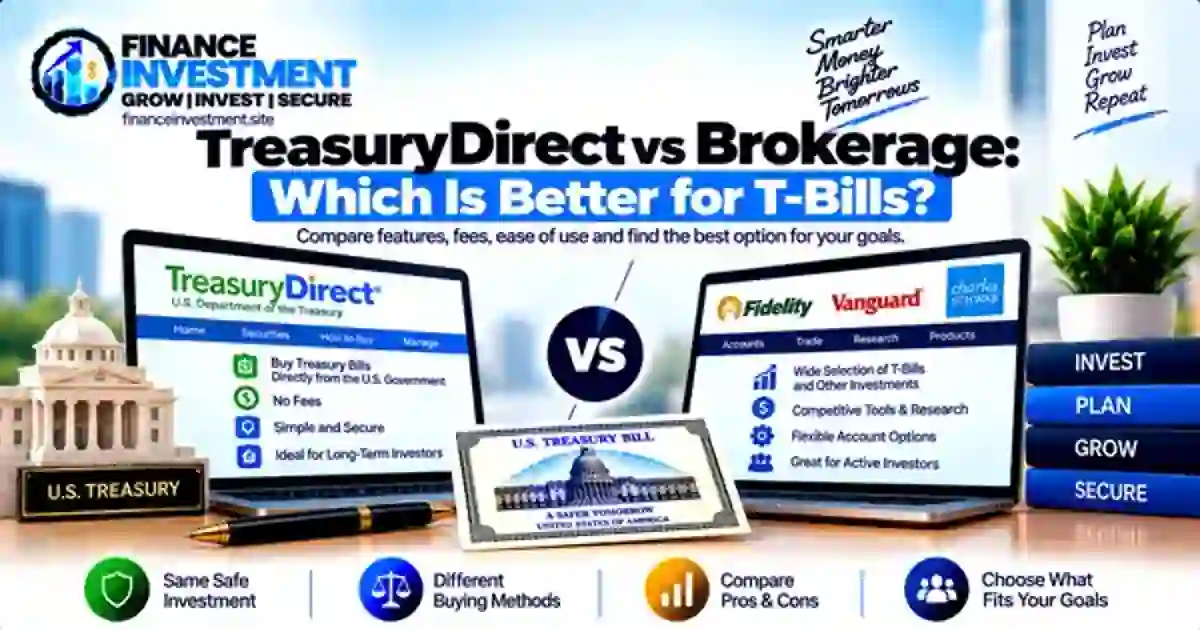
TreasuryDirect vs Brokerage: Which Is Better for T-Bills?
TreasuryDirect vs Brokerage: What Changes for T-Bill Investors?
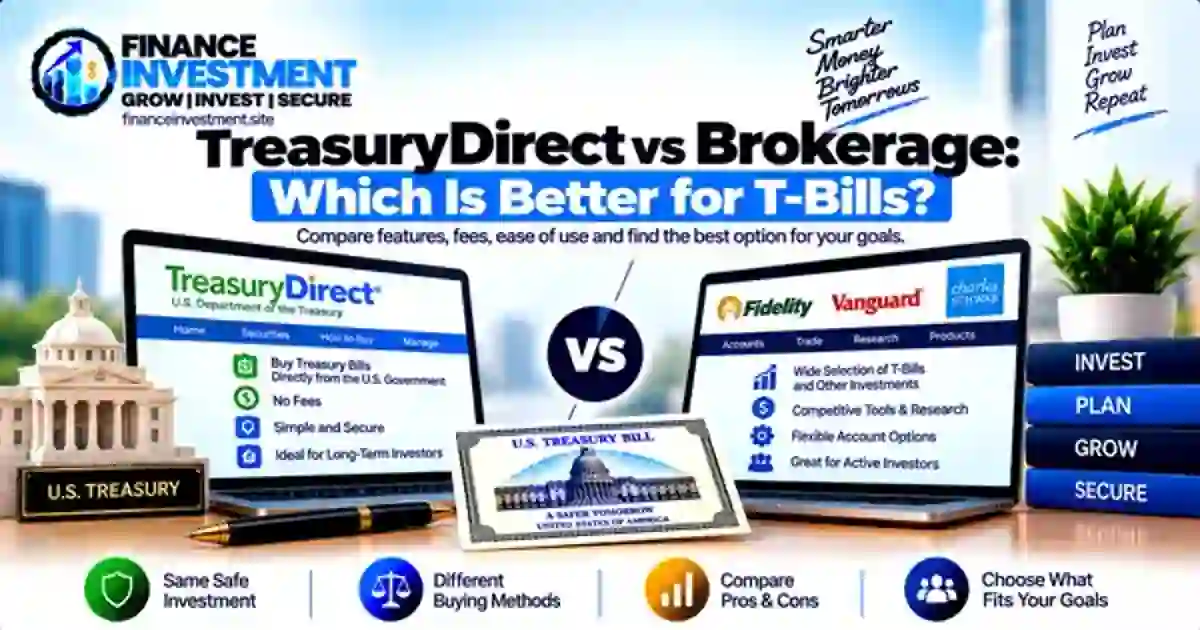 TreasuryDirect vs Brokerage: Which Is Better for T-Bills? comes down to more than where you click to place an order. TreasuryDirect lets investors buy eligible Treasury securities directly through the U.S. Treasury. A brokerage account can put individual T-bills alongside stocks, bonds, ETFs and other investments.
The differences become clearer after the purchase. Depending on the brokerage, you may have access to new Treasury issues, individual T-bills already trading in the secondary market, or automatic reinvestment features. TreasuryDirect has its own purchase, holding and reinvestment process. These differences can matter if you plan to build a T-bill ladder, keep everything in one investment account, or potentially sell before maturity.
If you’re starting from scratch, our
Treasury Bills Explained guide
covers the fundamentals. This comparison focuses on the practical differences between the two purchase routes so you can evaluate them against your own investing needs.
What You’ll Learn
- How TreasuryDirect and brokerage T-bill purchases differ.
- What changes when you buy a new issue versus a secondary-market T-bill.
- How account features, reinvestment options and potential costs can vary.
- What to consider if you may sell a T-bill before maturity.
- How taxes fit into both purchasing routes.
- Which practical factors can help you compare TreasuryDirect with your brokerage account.
Quick Answer: TreasuryDirect or Brokerage?
Neither route is automatically better for every investor. TreasuryDirect provides direct access to eligible Treasury securities through the U.S. Treasury, while a brokerage account may let you keep individual T-bills alongside your other investments. The right comparison depends on how you buy, how long you expect to hold the bill, and what account features you need.
Key points to compare
- TreasuryDirect: lets you buy eligible marketable Treasury securities directly and does not charge a purchase fee or commission for those securities.
- Brokerage: may give you access to new Treasury issues, secondary-market T-bills, and other investments within the same account, depending on the broker.
- Reinvestment: TreasuryDirect supports reinvestment of maturing securities, while some brokerages also provide automated Treasury reinvestment features.
- Early sale: a TreasuryDirect purchase cannot simply be sold inside TreasuryDirect; after the applicable transfer holding period, a marketable security can generally be transferred to a participating financial institution for secondary-market sale.
Before choosing a route, compare the T-bill’s maturity, purchase terms, account features, potential costs and your expected holding period. Also check whether you want access to the secondary market or prefer to hold the bill until maturity. The sections below examine each difference in detail.
TreasuryDirect vs Brokerage at a Glance
TreasuryDirect and brokerage accounts can both provide access to individual Treasury bills, but they are built around different account experiences. TreasuryDirect connects investors directly with the U.S. Treasury, while a brokerage may place T-bills alongside stocks, ETFs, bonds and other investments. The exact features available through a broker can vary.
| Feature | TreasuryDirect | Brokerage |
|---|---|---|
| Account | Dedicated TreasuryDirect account | Brokerage account |
| New T-bill issues | Direct access to eligible Treasury auctions | Available through some brokers |
| Secondary market | Not a secondary-market trading platform | Available through brokers that support Treasury trading |
| Other investments | Focused on Treasury securities and savings products | May hold stocks, ETFs, bonds and other assets |
| Reinvestment | Reinvestment is available for eligible Treasury securities | Some brokers offer automatic Treasury reinvestment |
| Purchase costs | No TreasuryDirect purchase fee or commission for marketable securities | Depends on the brokerage and transaction |
QUICK TAKE:
TreasuryDirect is centered on buying and holding Treasury securities directly through the government. A brokerage can offer a broader investment account, and some brokers add new-issue access, secondary-market trading or automatic reinvestment. Because brokerage features differ, check the specific platform before placing an order.
Complete Beginner Guide: Choosing Your T-Bill Purchase Route
 Buying your first Treasury bill does not have to be complicated. The main decision is where you want to purchase and hold the security. TreasuryDirect and brokerage accounts can both provide access to individual T-bills, but the account experience and available features are different.
1. Decide where you want the T-bill held
TreasuryDirect is a dedicated Treasury account. A brokerage holds the T-bill within your investment account, where you may also keep stocks, ETFs, bonds and other assets. Consider whether you prefer a separate Treasury account or a consolidated investment portfolio.
2. Choose a new issue or an existing T-bill
TreasuryDirect lets eligible investors schedule purchases of new marketable Treasury securities through its BuyDirect function using a noncompetitive bid. Some brokerages also offer new Treasury issues at auction. Depending on the broker, you may also find individual T-bills already trading in the secondary market.
3. Check the T-bill details
Before placing an order, review the term, maturity date, purchase amount, price or auction terms, settlement information and any applicable brokerage charges. Match the maturity date with when you expect to need the money.
4. Plan what happens at maturity
Decide whether you want the proceeds returned to your available cash or used for another T-bill. TreasuryDirect supports reinvestment of eligible maturing securities. Some brokerages also offer auto-roll or similar reinvestment features, but availability and settings vary by platform.
BEGINNER TIP:
Do not compare only the displayed yield. Look at the maturity date, purchase route, account setup, secondary-market access, reinvestment options and potential costs before placing the order.
How TreasuryDirect and Brokerage Buying Works
The T-bill itself is the same type of Treasury security, but the buying process can differ. TreasuryDirect gives investors direct access to Treasury auctions, while a brokerage may provide access to new issues, previously issued T-bills, or both. The exact choices depend on the brokerage platform.
Buying a New T-Bill Through TreasuryDirect
When purchasing a new T-bill through TreasuryDirect, you submit a noncompetitive bid. This means you do not specify the discount rate you want. Instead, you agree to accept the auction’s resulting terms if your order is accepted. TreasuryDirect does not accept competitive bids.
Treasury bills are issued at a discount and redeemed at their face value at maturity. The difference between the purchase price and the amount received at maturity represents the bill’s return before taxes, subject to the applicable auction price and your purchase amount.
Buying a New T-Bill Through a Brokerage
Some brokerages let customers participate in Treasury auctions through their investment accounts. The order screen, available maturities, minimums, settlement process and other requirements can vary by broker. One practical difference is that the T-bill can remain alongside your other investments within the same brokerage account.
Buying an Existing T-Bill on the Secondary Market
A brokerage may also offer T-bills that were issued previously and are being traded in the secondary market. Here, you are buying an existing security at the market price available when your order is executed. That price may differ from its original issue price, so the yield to maturity can also differ. The remaining time until maturity matters as well.
KEY DISTINCTION:
TreasuryDirect uses the noncompetitive auction route for individual Treasury purchases. A brokerage may offer both new Treasury issues and secondary-market T-bills. With a new issue, the auction determines the applicable terms; with a secondary-market purchase, the price is determined by the market when your order is executed.
Benefits and Drawbacks of TreasuryDirect vs Brokerage
TreasuryDirect and brokerage accounts can both work for individual T-bills, but they offer different ways to manage the investment. TreasuryDirect focuses on direct access to Treasury securities, while a brokerage may combine T-bills with a wider portfolio and additional trading features.
TreasuryDirect Benefits
- Direct access to eligible Treasury auctions.
- No TreasuryDirect purchase fee or commission for marketable securities.
- Reinvestment is available for eligible maturing securities.
- Provides a dedicated account for holding eligible Treasury securities.
Brokerage Benefits
- Keeps individual T-bills alongside other investments in one account.
- Some brokers offer both new Treasury issues and secondary-market T-bills.
- Some platforms provide automatic Treasury reinvestment or auto-roll.
- May provide additional portfolio and fixed-income research tools.
Potential Drawbacks
- TreasuryDirect is not a secondary-market trading platform.
- A TreasuryDirect holding may need to be transferred to a participating financial institution before a secondary-market sale.
- Brokerage features, available Treasury inventory and pricing can vary by firm.
- Secondary-market T-bills can have market prices different from their original issue prices.
QUICK TAKE:
TreasuryDirect emphasizes direct Treasury access, while a brokerage may offer a more integrated investment account with additional Treasury-trading features. The important differences are not just convenience. Check secondary-market access, reinvestment options, available securities and potential costs before deciding which account structure fits your needs.
TreasuryDirect vs Brokerage: Detailed Comparison
The biggest differences appear in how you purchase, where you hold the T-bill and what you can do with it afterward. TreasuryDirect provides direct access to Treasury auctions, while a brokerage may combine individual T-bills with other investments and, depending on the firm, provide secondary-market access.
| Factor | TreasuryDirect | Brokerage |
|---|---|---|
| New T-bill auctions | Direct access to eligible Treasury auctions using a noncompetitive bid | Available through some brokerage platforms |
| Secondary market | Not a secondary-market trading platform | Available through brokers that support Treasury trading |
| Account structure | Dedicated TreasuryDirect account | Brokerage investment account |
| Other investments | Holds eligible Treasury securities and other TreasuryDirect products | May hold stocks, ETFs, bonds and other investments |
| Reinvestment | Available for eligible maturing securities | Some brokers offer auto-roll or similar reinvestment features |
| Selling before maturity | Security generally must be transferred to a participating financial institution before a secondary-market sale | Secondary-market sale may be available through the broker |
| Purchase costs | No TreasuryDirect purchase fee or commission for marketable securities | Fees, pricing and transaction terms depend on the brokerage |
Which Differences Matter Most?
If you expect to buy new T-bills and hold them until maturity, account setup, auction access and reinvestment features may matter most. If you want to purchase an already-issued bill or potentially sell before maturity, secondary-market access becomes a more important consideration.
A brokerage can also keep T-bills within the same portfolio as your other investments. TreasuryDirect keeps the Treasury relationship in a separate account. Neither structure changes the basic terms of the T-bill itself, so compare the account features with how you actually expect to manage your money.
COMPARE BEFORE YOU BUY:
Check your brokerage’s current Treasury offerings, auction access, secondary-market availability, reinvestment tools and pricing. These features can differ between firms, so verify the actual platform before placing an order.
Costs, Taxes, Risks and Practical Tips
The account you use can affect the buying experience and potential transaction costs, but the underlying T-bill remains a U.S. government obligation. Before placing an order, pay attention to pricing, taxes, maturity timing and what could happen if you decide to sell before maturity.
Check the Costs
TreasuryDirect charges no purchase fee or commission for marketable securities. Brokerage costs depend on the firm and the transaction. For a secondary-market T-bill, also review the quoted price and any applicable spread, markup or other transaction charges before submitting an order.
Know the Tax Rules
Interest from Treasury bills is generally subject to federal income tax but exempt from state and local income taxes. The IRS says Treasury bill interest is generally reported in Box 3 of Form 1099-INT. For a Treasury bill held to maturity, the IRS generally treats the discount as interest income when the bill is paid at maturity.
Understand the Early-Sale Risk
Holding a T-bill until maturity means the Treasury pays the bill’s face value according to its terms. Selling before maturity is different. A secondary-market price can be higher or lower than the amount you originally paid, so your actual gain or loss can differ from the return you expected when you purchased the bill.
PRACTICAL TIP:
Before buying, note the maturity date, purchase price or auction terms, expected use of the money and account costs. If you may need the cash early, check how you would access the secondary market before choosing where to hold the T-bill.
Common Mistakes and a Hypothetical Example
T-bill mistakes often happen because an investor focuses on the advertised yield and overlooks the account, maturity date or purchase terms. A few checks before placing an order can make the comparison much clearer.
Mistake 1: Assuming Every Brokerage Works the Same
Brokerage platforms can differ in Treasury auction access, secondary-market inventory, reinvestment tools and transaction costs. Check the specific broker instead of relying on a general feature list.
Mistake 2: Overlooking the Maturity Date
A T-bill should match the date when you expect to need the money. Choosing a longer maturity simply because its yield looks attractive can create a cash-flow problem if you need to sell earlier.
Mistake 3: Confusing an Individual T-Bill With a Treasury ETF
A brokerage may also show Treasury ETFs. An individual T-bill has its own maturity date and Treasury terms. An ETF owns a portfolio of securities and its shares trade on an exchange. They are different investments, even though both can provide Treasury exposure.
Mistake 4: Ignoring the Price of a Secondary-Market T-Bill
An existing T-bill can trade at a price different from its original issue price. Before buying, review the quoted price, maturity date and resulting yield rather than assuming an older bill has the same economics as a newly auctioned bill.
Hypothetical Example: Alex Has $10,000 to Invest
Alex has $10,000 available for an individual T-bill and already holds stocks and ETFs in a brokerage account. The broker offers Treasury securities, while TreasuryDirect provides a separate Treasury account.
Alex expects to hold the T-bill until maturity but wants to keep the option of selling later if circumstances change. Instead of looking only at the displayed yield, Alex compares the maturity date, purchase route, secondary-market access, reinvestment features and potential costs. The exercise shows why the account decision should match the investor’s intended use of the T-bill.
SMART CHECK:
Before submitting an order, confirm the security type, maturity date, purchase price or auction terms, account features and applicable costs. If you may need the money early, understand your available selling route before buying.
Who Should Choose Which Route?
The choice between TreasuryDirect and a brokerage depends on how you plan to buy, hold and manage your T-bills. Neither account structure is automatically right for everyone. Your expected holding period, need for secondary-market access and preference for account consolidation can all influence the decision.
TreasuryDirect May Make Sense If You:
- Want to purchase eligible Treasury securities directly through the Treasury.
- Primarily expect to buy new issues and hold them through maturity.
- Prefer keeping Treasury holdings in a separate TreasuryDirect account.
- Want to use TreasuryDirect’s available reinvestment features for eligible securities.
A Brokerage May Make Sense If You:
- Want individual T-bills alongside stocks, ETFs or other investments.
- Want potential access to new issues and the secondary market through one platform.
- Prefer managing Treasury holdings through an existing investment account.
- Want brokerage-specific reinvestment or Treasury-trading tools when available.
A SIMPLE FILTER:
Start with when you expect to need the money. Then compare auction access, maturity choices, account structure, secondary-market availability, reinvestment features and potential costs. Finally, check the exact services offered by the platform you plan to use.
TreasuryDirect vs Brokerage FAQs
1. Is TreasuryDirect the same as a brokerage account?
No. TreasuryDirect is a U.S. Treasury-operated account system for eligible Treasury securities and savings products. A brokerage account is an investment account that may hold T-bills alongside stocks, ETFs, bonds and other securities.
2. Can I buy T-bills through both TreasuryDirect and a brokerage?
Yes. TreasuryDirect provides access to eligible new Treasury issues through auctions. Some brokerages also provide access to individual Treasury securities, but available maturities, auction participation and order methods vary by firm.
3. Can I buy an existing T-bill through TreasuryDirect?
TreasuryDirect is not a secondary-market trading platform. A brokerage that supports Treasury trading may offer previously issued T-bills at the market price available when the order is executed.
4. Can I sell a TreasuryDirect T-bill before maturity?
A marketable security held in TreasuryDirect generally must be transferred to a participating financial institution before a secondary-market sale. TreasuryDirect also applies a transfer holding period of 45 calendar days from the security’s issue date, or the security’s term if shorter.
5. Does TreasuryDirect charge a fee to buy T-bills?
TreasuryDirect does not charge a purchase fee or commission for marketable securities. Brokerage costs depend on the firm and transaction, so check the broker’s current pricing before buying.
6. Are T-bill taxes different between TreasuryDirect and a brokerage?
The basic federal tax treatment is generally the same. Interest from Treasury bills is subject to federal income tax but exempt from state and local income taxes. Treasury bill interest is generally reported in Box 3 of Form 1099-INT.
7. Can I automatically reinvest T-bills?
TreasuryDirect supports reinvestment for eligible maturing securities. Some brokerages also provide Treasury auto-roll or similar features, but the available options depend on the broker and security.
8. Does buying through a brokerage change the T-bill itself?
No. An individual T-bill remains the same type of Treasury security whether it is purchased through TreasuryDirect or a brokerage. What changes is the account and purchase channel. If you buy in the secondary market, however, the price and resulting yield depend on the market when the trade is executed.
QUICK ANSWER:
Both TreasuryDirect and brokerage accounts can provide access to individual T-bills. The important differences are the account structure, auction access, secondary-market availability, reinvestment features and potential costs.
Final Verdict: TreasuryDirect vs Brokerage
TreasuryDirect and brokerage accounts provide different ways to purchase and manage individual T-bills. TreasuryDirect offers direct access to eligible Treasury auctions, while a brokerage may place T-bills within a broader investment account and, depending on the firm, provide access to new issues, the secondary market or automated reinvestment features.
The account choice therefore depends on the features that matter to you. Consider whether you expect to buy new issues, whether you may need secondary-market access, how you want to handle maturing T-bills, and whether keeping Treasury holdings with your other investments is important.
Before placing an order, compare the maturity date, purchase method, account structure, reinvestment options, transfer requirements and potential costs. For a broader introduction to T-bills, you can also review our
Treasury Bills Explained guide
and then check the current terms of the platform you plan to use.
BOTTOM LINE:
The meaningful difference is the purchase and account experience—not the basic identity of the T-bill. Compare the features against your intended holding period, cash needs and investment setup before choosing a route.
Leave a Reply