How Much Money Do You Need to Open a CD?
Find out how much you may need to open a certificate of deposit, why minimum deposits vary, and what to check before moving your savings into a CD.
How Much Money Do You Need to Open a CD?
 How much money do you need to open a CD? There is no single minimum that applies to every bank or credit union in the U.S. One CD might let you start with $0 or a very small amount, while another may ask for $500, $1,000, $2,500, or more. The amount depends on the financial institution, CD product, and sometimes the rate tier.
That creates an important distinction: the minimum opening deposit is not necessarily the amount you should invest. A CD could accept $500, but that does not mean putting your entire emergency fund into it is a good idea. Your deposit should fit the goal, time frame, and cash you can comfortably leave untouched.
APY matters, too, but it should not make the decision by itself. A slightly higher rate may come with a larger minimum deposit, longer term, or less flexibility. Meanwhile, a CD with a lower minimum could give you more room to build savings gradually.
If you want the bigger picture before choosing a deposit amount, explore our CD Guide 2026.
What You’ll Learn
- How CD minimum deposits vary between institutions
- What $0, $500, $1,000, and $2,500 minimums can mean
- How to choose a deposit that fits your goal
- Why liquidity matters before funding a CD
- How minimum deposits can affect your CD choices
Quick Answer: How Much Do You Need to Open a CD?
There is no universal CD minimum. Depending on the institution and product, you may find CDs with no minimum opening deposit, while others require $500, $1,000, $2,500, or more. Always check the specific CD’s terms before transferring money.
6 Key Takeaways
- Minimums vary: Banks and credit unions set their own opening requirements.
- No-minimum CDs exist: Some products let you start with a very small amount.
- $500 to $1,000 is common territory: Many mainstream CD products use a defined minimum, although requirements differ.
- Higher deposits can unlock different rates: Some institutions offer rate tiers based on how much you deposit.
- Don’t drain your cash to meet a minimum: Money needed for emergencies or near-term bills generally belongs somewhere accessible.
- APY isn’t the whole decision: Compare the minimum deposit, term, withdrawal rules, and potential earnings together.
Bottom line: You may be able to open a CD with very little money, but the best starting amount is the one that meets the product’s minimum without putting your everyday financial cushion at risk.
CD Minimum Deposits at a Glance
The amount needed to open a CD can range from very little to several thousand dollars. What matters is not just the entry point, but whether the deposit level fits the CD’s rate, term, and your savings goal.
| Opening Amount | Potential Use | What to Watch |
|---|---|---|
| $0–$500 | Good starting range for smaller savers or people testing a CD strategy. | Check whether the rate is competitive and whether there are balance requirements. |
| $1,000 | A practical starting point for a dedicated savings goal. | Compare the interest earned with CDs requiring smaller or larger deposits. |
| $2,500+ | Useful for larger goal-based savings when the money can remain locked. | A higher minimum does not automatically mean a better APY. |
For perspective, a $500 CD earning 4% would generate far less interest in dollars than a $2,500 CD at the same rate. The difference comes from the principal, not a special tax or bonus. Actual earnings depend on the APY, term, compounding, and product rules.
Complete Beginner Guide to CD Minimum Deposits
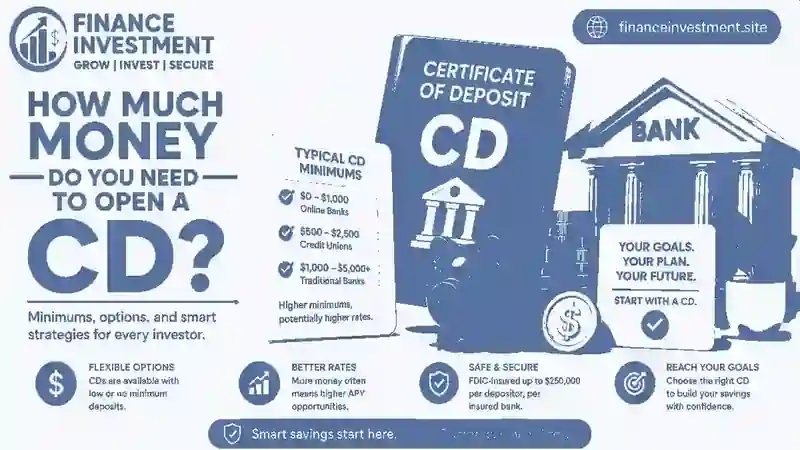 A CD minimum deposit is simply the amount a financial institution requires you to place into that specific certificate when you open it. It is a product rule, not a universal industry standard. Two CDs offered by different institutions can have completely different entry requirements.
Why Do CD Minimums Differ?
Banks and credit unions design CDs for different types of savers. An online bank may offer a low-minimum CD to attract smaller deposits, while another institution may set a higher threshold for a particular rate or term. Credit unions can also have their own deposit requirements, along with membership rules.
No-Minimum CDs
Some CDs have no stated minimum deposit or allow a very small opening amount. That can be useful if you are building savings gradually. However, no minimum does not automatically mean the product offers the best rate, flexibility, or overall value.
Minimum Deposit vs. Balance Requirement
Do not confuse the amount needed to open a CD with a later balance requirement. A CD might require $1,000 to open but not impose a separate ongoing minimum because the certificate is designed to remain invested until maturity. Always read the product’s terms instead of assuming every savings-account rule applies to CDs.
Rate Tiers and Promotional CDs
Some institutions use balance tiers. For example, one APY may apply at $1,000 while a different rate is available at a higher deposit level. Promotional CDs may also have special minimums or eligibility requirements. A higher deposit should only be used if the extra return justifies tying up more cash.
Banks, Credit Unions and Brokered CDs
Traditional and online banks can have different minimums, while credit unions may combine CD requirements with membership eligibility. Brokered CDs work differently because they are purchased through a brokerage rather than directly from the issuing bank. Minimum purchase amounts can vary by offering.
Before funding any CD, check the minimum deposit, APY, term, early-withdrawal rules, maturity instructions, insurance status, and whether the quoted rate applies to your entire deposit. That short checklist can prevent an attractive-looking CD from becoming the wrong fit.
How Opening a CD Works From Start to Finish
Once you have found a CD that fits your goal, the opening process is usually straightforward. The important part is confirming exactly what you are agreeing to before the money leaves your checking or savings account.
1. Choose the CD and Confirm the Terms
Start with the term, APY, opening deposit, and withdrawal rules. Check whether the advertised rate applies to the amount you plan to deposit. Also confirm whether the CD automatically renews when it reaches maturity.
2. Open and Fund the Certificate
After completing the application, you typically transfer or deposit the required amount. Once the CD is funded, the institution records the principal, APY, term, and maturity date. Keep the confirmation because these details are useful when you later compare the maturity offer.
3. Let the CD Run Until Maturity
Your deposit remains in the certificate according to its terms while interest accrues under the stated rate. Depositing more than the minimum generally means you have more principal earning interest. It does not necessarily mean the institution will give you a higher APY unless a separate rate tier applies.
4. Decide What Happens at Maturity
When the CD matures, you may be able to withdraw the principal and interest, move the money elsewhere, or renew the certificate. Some institutions provide a grace period for making that choice. If you take no action, automatic renewal may occur.
Illustrative Example
Imagine a CD requires $1,000 to open. You decide to deposit $3,000 because the money is earmarked for a future expense. If the CD’s APY applies to the full balance, all $3,000 can earn interest according to the product terms. The larger deposit increases potential earnings, but it also means more cash is committed until maturity.
Benefits & Drawbacks of Different CD Minimums
The amount required to open a CD can shape who can use the product and how much flexibility remains after the account is funded. A low minimum can make CDs easier to access, while a larger deposit may make sense for a clearly defined savings goal.
✓ Pros
- Lower entry point: A small minimum can help new savers start without waiting years to build a large balance.
- More choice: No-minimum or low-minimum CDs can open up products that may otherwise be out of reach.
- More interest with more principal: When the APY is the same, a larger deposit generally produces more interest in dollar terms.
- Potential rate tiers: Some products offer different APYs at higher deposit levels.
△ Cons
- More money gets locked away: Funding a CD with a large balance can leave less cash immediately available.
- A higher minimum isn’t automatically better: A $2,500 minimum does not guarantee a superior APY.
- Rate tiers can be misleading: A higher APY may require more money than you actually want to commit.
- Small balances earn less: A low minimum makes opening easier, but the dollar return may remain modest.
The sweet spot is usually the amount you can commit comfortably without sacrificing money needed for emergencies or upcoming expenses. A CD should serve the savings goal—not force the savings goal to fit the CD.
CD Minimum Deposit Comparison
The minimum deposit is only one piece of the decision. A CD with a lower entry point may be easier to access, while a larger certificate can generate more interest. The better comparison looks at the deposit requirement alongside APY, term, access, and the institution behind the product.
| CD Type | Typical Entry Point | What to Compare |
|---|---|---|
| No-minimum CD | Very low or no stated minimum | APY, term, account requirements, and whether the low entry point comes with trade-offs. |
| $500 CD | $500 | Useful for smaller goal-based balances; compare earnings with lower-minimum alternatives. |
| $1,000 CD | $1,000 | A common benchmark for comparing rates, terms, and potential interest. |
| $2,500+ CD | $2,500 or more | Check whether a higher balance actually earns a better APY. |
| Brokered CD | Varies by offering | Issuing bank, minimum purchase, maturity, liquidity, and brokerage terms. |
Online banks often compete with attractive rates and lower overhead, while traditional banks may emphasize branch access. Credit unions can offer competitive certificates but may have membership requirements. Brokered CDs add another layer because you purchase through a brokerage rather than directly from the issuing institution.
If you are comparing the amount you can earn after choosing a deposit, see our guides to 1-year CD rates and 5-year CD rates for term-specific research.
Costs, Risks & Expert Tips Before Funding a CD
A CD’s minimum deposit can look harmless until it forces you to move money that had another job. The real cost of meeting a higher minimum is sometimes the flexibility you give up elsewhere.
Watch the Opportunity Cost
Suppose a CD requires $2,500 while another suitable option accepts $500. Putting the extra $2,000 into the first CD may produce more interest, but that money is no longer sitting in an easily accessible account. If you need it unexpectedly, an early withdrawal could reduce your return.
Don’t Use Your Emergency Cushion to Reach a Minimum
A CD is generally better suited to money with a known purpose and time horizon. Keep enough readily available cash for emergencies, upcoming bills, and expenses that cannot wait until maturity.
Check Whether the Higher APY Is Worth the Extra Deposit
A rate tier can make a larger deposit attractive, but calculate the actual dollar difference. A small APY improvement may not justify committing substantially more money. Compare the expected interest, term, and access rules together.
Pay Extra Attention to Brokered CDs
With a brokered CD, verify the actual issuing bank, maturity date, purchase amount, and how the investment can be sold before maturity. The brokerage platform is not necessarily the institution providing the deposit insurance.
Verify the Institution Before You Fund It
For a bank CD, confirm that the institution is FDIC-insured. For a credit-union certificate, check whether the credit union is federally insured through the NCUA. Also review the coverage structure if you already hold other deposits at the same institution.
Premium Expert Tip
Choose your deposit amount backward from your financial goal. First decide how much cash you can safely leave untouched. Then compare CDs that accept that amount. Don’t increase your deposit simply to qualify for a slightly better APY.
Common CD Opening Mistakes + Real-Life Example
The amount you need to open a CD is easy to find on an account page. The harder part is deciding whether that minimum fits your financial situation. A few common mistakes can turn a simple savings decision into an unnecessary constraint.
Mistakes to Avoid
- Assuming every CD has the same minimum: Requirements can vary by institution, term, and product.
- Chasing the highest APY: A higher rate may require more money or a longer commitment.
- Using emergency cash: Money you may need immediately should not be committed simply to satisfy a CD minimum.
- Overfunding for a rate tier: Don’t move thousands of extra dollars just to qualify for a slightly better APY without checking the actual benefit.
- Ignoring insurance status: Confirm whether the institution providing the CD is FDIC-insured or, for an eligible credit union, federally insured through the NCUA.
- Missing brokered-CD details: If you buy through a brokerage, identify the actual issuing bank and understand the maturity and liquidity terms.
Real-Life Example: Kevin Has $4,000 to Save
Kevin has $4,000 set aside for a car purchase next year. He finds a CD requiring $2,500 with a slightly higher APY than another CD requiring $500. He considers putting the entire $4,000 into the higher-rate option.
Illustrative calculation only: If the higher-rate CD earns an extra 0.25 percentage point on $4,000 for one year, the simple difference is about $10 before taxes. That modest gain may not justify giving up flexibility for money tied to a known near-term expense.
Kevin instead considers how much he can safely commit and keeps the rest accessible. His decision is based on the job of the money, not just the largest APY on the screen.
Practical lesson: A CD minimum is a gate, not a target. Meet the requirement with money that genuinely fits the CD’s time frame, and let the purpose of your savings guide the amount you deposit.
Who Should Choose a CD Based on Their Available Cash?
The right CD deposit depends less on a magic number and more on what the money is supposed to do. A modest balance can still have a useful role when the goal and maturity date are clear.
Small Savers and Goal-Based Savers
If you have $500 to $1,000 set aside for a future expense, a low-minimum CD can be a practical way to separate that money from everyday spending. It can work well for a planned purchase, tuition payment, holiday expenses, or another goal with a known time frame.
Larger Balances, Families and Retirees
People with larger cash reserves may use CDs to divide money across different maturity dates instead of committing everything at once. Families and retirees can use this approach for predictable future expenses while keeping other cash available for unexpected needs.
When Flexible Savings May Be Better
If you do not have a separate emergency reserve, a CD may not be the best place for money you could need tomorrow. The same is true for cash needed for rent, medical expenses, debt payments, or other near-term obligations.
Quick Decision Guide
Need the money soon? Keep it flexible. Have a separate emergency fund? A CD may fit. Have a larger balance? Consider spreading maturity dates rather than locking everything into one certificate.
Frequently Asked Questions About Opening a CD
What is the minimum amount to open a CD?
There is no universal minimum. Some CDs have no stated minimum, while others may require $500, $1,000, $2,500, or more. Check the specific product terms before opening.
Can you open a CD with $100?
Yes, if the institution offers a CD with a $100-or-lower opening requirement. Minimums vary, so compare the product terms rather than assuming every CD accepts the same amount.
Are there no-minimum CDs?
Yes. Some institutions offer CDs without a stated minimum deposit. These can be useful for smaller savers, although a no-minimum CD is not automatically the highest-paying option.
Is $500 enough to open a CD?
It can be. If the CD’s required opening deposit is $500 or less, that amount may be enough. The APY, term, and withdrawal rules still matter.
Is $1,000 enough to open a CD?
For a CD requiring $1,000 or less, yes. A $1,000 deposit can also provide a useful starting point for a specific savings goal.
Do banks and credit unions have different CD minimums?
They can. Each institution sets its own product requirements. Credit unions may also have membership eligibility rules in addition to the certificate’s deposit requirement.
Do higher deposits earn higher APYs?
Sometimes. Certain CDs use balance tiers, but a larger deposit does not automatically qualify for a higher rate. Check the rate schedule for the specific certificate.
Can you add money after opening a CD?
Usually, a standard CD does not work like a savings account where you can freely add money throughout the term. Some specialized products may allow additional deposits, so read the account terms first.
What are typical brokered CD minimums?
Brokered CD purchase requirements vary by brokerage and offering. Check the minimum purchase amount, issuing bank, maturity date, and transaction terms before buying.
Illustrative: How much can a $1,000 CD earn?
Illustrative calculation only: A $1,000 CD earning a hypothetical 4% APY for one year would generate about $40 in interest before taxes. Actual earnings depend on the APY, term, compounding method, and CD terms.
Final Verdict: How Much Money Should You Put Into a CD?
There is no single amount you need to open a CD. The institution and specific certificate determine the minimum. Some products may accept a small deposit, while others require $500, $1,000, $2,500, or more.
But the minimum is only the starting line. The amount you can deposit and the amount you should deposit are two different questions. If $500 or $1,000 meets the CD’s requirement and the money has a clear purpose and time frame, either amount can be a sensible starting point.
Don’t stretch your budget just to qualify for a higher APY. Money needed for emergencies, bills, or near-term expenses should remain accessible. A slightly better rate is rarely worth creating a cash shortage.
Before choosing a certificate, compare the minimum, APY, term, early-withdrawal rules, insurance status, and maturity options. Our CD Guide 2026 can help you put those pieces together.
Practical takeaway: Start with the amount your financial plan can comfortably commit—not the largest deposit a CD will accept.
Keep Building Your CD Strategy
Want more practical guidance on CDs, rates, savings, and everyday investing? Send a note to join the FinanceInvestment newsletter and get useful money ideas without the noise.
📧 subhashr325@gmail.com
A thoughtful CD choice starts with the amount you can comfortably commit, not simply the largest balance a bank will accept.
Leave a Reply