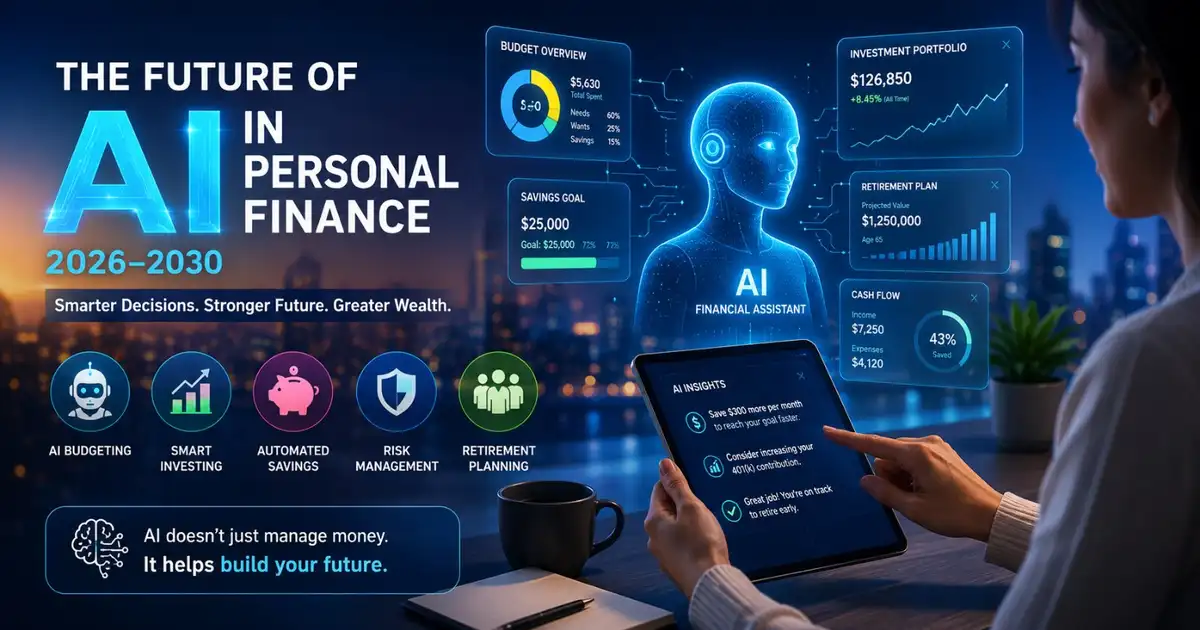
Future of AI in Personal Finance (2026–2030): What Americans Can Expect
Author: Subhash Rukade
Published: June 18, 2026
 Why the Future of AI in Personal Finance Matters
Future of AI in Personal Finance is becoming one of the most important topics for investors, savers, and everyday Americans. Artificial intelligence is no longer limited to technology companies or Wall Street firms. Today, AI-powered tools help people manage budgets, track spending, monitor investments, improve savings habits, and make smarter financial decisions.
Over the last few years, adoption of AI in personal finance has accelerated rapidly. Millions of Americans already use AI-driven budgeting apps, robo-advisors, spending trackers, and automated investing platforms. What makes the period between 2026 and 2030 especially exciting is the possibility that these tools could become far more personalized and intelligent.
Instead of simply tracking expenses, future AI systems may act like full-time financial coaches. They could analyze spending patterns, identify opportunities to save money, recommend investments, monitor credit health, and help families achieve financial goals with minimal effort.
The impact could extend beyond convenience.
AI may help close financial knowledge gaps by providing guidance that was previously available only through expensive financial advisors. This could make professional-quality financial planning more accessible to middle-class households across the United States.
Investors interested in understanding how AI is already transforming wealth creation should also explore our
AI Investing Guide 2026.
While the opportunities are significant, challenges also exist. Privacy concerns, security risks, regulatory changes, and overreliance on algorithms will continue to shape how AI evolves in the financial sector.
The future of AI in personal finance is not about replacing people. It is about helping individuals make smarter financial decisions faster and with greater confidence.
In this guide, we’ll explore how AI may transform budgeting, investing, retirement planning, wealth building, and everyday money management between 2026 and 2030.
How AI Is Changing Personal Finance Today
To understand the Future of AI in Personal Finance, it’s important to look at how artificial intelligence is already transforming money management in 2026.
Just a few years ago, managing finances often required spreadsheets, manual budgeting, and frequent meetings with financial advisors. Today, AI-powered tools can automate many of these tasks and provide personalized recommendations in real time.
For millions of Americans, this means spending less time managing money and more time focusing on financial goals.
AI Budgeting Automation
One of the biggest improvements AI has brought to personal finance is automated budgeting.
Modern AI apps can analyze income, categorize expenses, identify spending patterns, and suggest ways to reduce unnecessary costs.
Instead of manually tracking every transaction, users receive automated insights that help improve financial habits.
Readers who want a deeper understanding of current AI finance tools can explore our
AI Personal Finance 2026
guide.
AI Spending Analysis
Artificial intelligence can identify spending trends that many people overlook.
For example, AI may detect rising subscription costs, recurring charges, or categories where spending has increased unexpectedly.
These insights help users make better decisions and improve monthly cash flow.
AI Savings Optimization
Saving money consistently is often challenging.
AI-powered platforms can automate transfers into savings accounts based on income patterns and spending behavior.
Some tools even adjust savings contributions automatically without disrupting everyday finances.
Credit Monitoring and Financial Health
Many AI-driven financial apps now provide real-time credit monitoring.
Users receive alerts about credit score changes, unusual account activity, and opportunities to improve credit profiles.
Choosing the right financial products also plays an important role. Readers can compare options in our
Best Credit Cards 2026
guide.
Goal-Based Financial Planning
Future AI systems are expected to become even more effective at helping users achieve financial goals.
Whether saving for retirement, buying a home, building an emergency fund, or creating passive income, AI can monitor progress and suggest adjustments along the way.
📊 Comparison Table: AI Finance Tools vs Traditional Money Management
| Feature | AI Finance Tools | Traditional Methods |
|---|---|---|
| Budget Tracking | Automated | Manual |
| Spending Analysis | Real-Time Insights | Periodic Review |
| Savings Management | Automatic | User Controlled |
| Credit Monitoring | Continuous Alerts | Occasional Checks |
| Goal Tracking | AI Recommendations | Manual Planning |
The Future of AI in Personal Finance will likely build upon these capabilities, creating smarter and more personalized financial systems that can help Americans manage money more effectively between 2026 and 2030.
Future AI Tools Americans May Use by 2030
The Future of AI in Personal Finance will likely go far beyond simple budgeting apps and investment trackers.
Between 2026 and 2030, artificial intelligence may evolve into a comprehensive financial assistant capable of helping individuals manage nearly every aspect of their financial lives.
Many experts believe future AI systems will become more personalized, proactive, and capable of delivering advice tailored to each user’s unique situation.
AI Financial Coaches
One of the most exciting developments may be the rise of AI financial coaches.
Instead of generic recommendations, these systems could analyze income, expenses, debt levels, savings habits, and financial goals to provide personalized guidance.
Future AI coaches may send alerts when spending becomes excessive, suggest ways to increase savings, and recommend financial actions based on changing life circumstances.
AI Retirement Planning
Retirement planning is often one of the most complex financial challenges Americans face.
Future AI platforms may help users estimate retirement income needs, project healthcare expenses, calculate withdrawal strategies, and adjust portfolios automatically as retirement approaches.
This could make retirement planning more accessible for millions of households.
AI Tax Optimization
Taxes have a major impact on long-term wealth building.
Future AI systems may identify tax-saving opportunities, monitor capital gains exposure, recommend tax-efficient investments, and assist with retirement account optimization.
By reducing tax inefficiencies, investors may be able to keep more of their investment returns.
Hyper-Personalized Financial Advice
Today’s financial apps often provide recommendations based on broad categories.
By 2030, AI may deliver highly customized financial guidance based on spending behavior, career progression, family needs, risk tolerance, and long-term goals.
This level of personalization could significantly improve financial decision-making.
AI Wealth-Building Assistants
Future AI assistants may combine budgeting, investing, tax planning, debt management, and retirement planning into a single platform.
Instead of using multiple financial tools, users may interact with one intelligent system capable of managing their entire financial ecosystem.
The Future of AI in Personal Finance may ultimately be defined by convenience, personalization, and automation.
📘 Recommended Finance Book
The Psychology of Money by Morgan Housel
This bestselling finance book explains how behavior, decision-making, and long-term thinking influence financial success. Even as AI becomes more advanced, understanding human financial behavior will remain essential.
While these future tools offer exciting possibilities, investors should remember that artificial intelligence is still a tool. Long-term financial success will continue to depend on discipline, planning, and informed decision-making.
How AI Could Transform Investing and Wealth Building
One of the most exciting aspects of the Future of AI in Personal Finance is its potential to transform investing and wealth building.
For decades, successful investing required extensive research, market knowledge, and significant time commitments. Between 2026 and 2030, artificial intelligence may make professional-level investing tools accessible to millions of everyday investors.
Instead of spending hours analyzing financial statements and market trends, investors may increasingly rely on AI systems to identify opportunities, manage risk, and optimize portfolios.
AI Portfolio Management
Future AI investing platforms may continuously monitor portfolios and adjust allocations based on market conditions, risk tolerance, and financial goals.
These systems could automatically rebalance investments, identify concentration risks, and recommend diversification strategies.
This may help investors maintain disciplined long-term strategies while reducing emotional decision-making.
Investors seeking a deeper understanding of these trends should explore our
AI Investing Guide 2026.
AI and Dividend Investing
Dividend investing remains one of the most popular wealth-building strategies among Americans.
Future AI tools may help investors identify quality dividend stocks, analyze payout sustainability, monitor dividend growth, and optimize income-focused portfolios.
Readers interested in building reliable income streams can review our
How to Build a Dividend Portfolio
guide.
Investors looking for specific opportunities may also benefit from our
Top Dividend Stocks USA 2026
resource.
Personalized Investing Strategies
Future AI systems may create customized portfolios based on an investor’s age, income, spending habits, retirement goals, and risk profile.
Rather than offering generic recommendations, AI may build highly personalized investment plans designed to support specific financial objectives.

📊 Real-World Case Study
Imagine a 35-year-old investor saving for retirement while also building passive income.
A future AI platform could analyze monthly cash flow, monitor investment performance, identify tax-saving opportunities, and automatically allocate funds between retirement accounts, dividend investments, and emergency savings.
As financial goals change over time, the system could continuously adjust recommendations without requiring constant manual oversight.
This type of intelligent financial management could help investors stay on track while reducing complexity.
Long-Term Wealth Building
The Future of AI in Personal Finance is not simply about convenience.
Its greatest impact may be helping individuals develop better financial habits, remain consistent with investing plans, and avoid emotional decisions that often reduce long-term returns.
By combining automation, personalization, and advanced analytics, AI has the potential to become one of the most powerful wealth-building tools available to investors between 2026 and 2030.
Future Trends: What AI Personal Finance Could Look Like by 2030
The Future of AI in Personal Finance becomes even more exciting when we look beyond today’s budgeting apps and robo-advisors. Between 2026 and 2030, artificial intelligence is expected to evolve from a helpful financial tool into a complete digital financial assistant capable of managing many aspects of personal finance automatically.
Today, most financial applications simply react to user behavior. They show spending reports, investment performance, and savings progress after financial decisions have already been made. However, future AI systems may become predictive rather than reactive.
Instead of telling users what happened, AI could help prevent financial mistakes before they occur. This shift could dramatically improve money management for millions of Americans.
For example, an AI financial assistant may detect that a household’s spending is increasing faster than income. It could immediately suggest budget adjustments, identify unnecessary subscriptions, recommend debt repayment strategies, and propose savings opportunities before financial stress develops.
Hyper-Personalized Financial Planning
One of the biggest trends in the Future of AI in Personal Finance will be hyper-personalized financial planning. Future AI platforms may analyze hundreds of financial variables, including income, expenses, debt levels, investment goals, retirement objectives, risk tolerance, family size, and major life events.
As a result, financial recommendations may become highly customized. Two investors with similar incomes could receive completely different strategies based on their financial behavior and long-term goals.
This personalized approach could help Americans make better financial decisions while reducing common investing and budgeting mistakes.
AI-Powered Retirement Planning
Retirement planning is likely to become significantly smarter by 2030. Future AI systems may continuously monitor retirement accounts, market conditions, inflation trends, healthcare costs, and projected retirement expenses.
Instead of reviewing retirement plans once a year, investors may receive real-time recommendations whenever adjustments become necessary.
For example, if inflation rises unexpectedly, AI could recommend increasing retirement contributions or adjusting asset allocation to protect long-term purchasing power.
Investors who want to prepare for uncertain market conditions should also explore our
Recession-Proof Investing Guide
for additional wealth-preservation strategies.
Voice-Based Financial Assistants
Another major trend is the rise of conversational financial assistants. Similar to today’s virtual assistants, future AI systems may allow users to manage their finances through natural conversations.
Instead of opening multiple apps, users might simply ask:
- How much did I spend this month?
- Am I saving enough for retirement?
- Can I afford a new car payment?
- Which investment account needs attention today?
The AI assistant could instantly provide personalized answers using real-time financial information.
One Dashboard for Your Entire Financial Life
By 2030, AI platforms may connect banking, investing, insurance, mortgages, taxes, retirement accounts, and credit cards into one unified system.
Instead of managing multiple financial applications, Americans may control their entire financial life through a single AI-powered dashboard.
Readers interested in current AI money-management tools can also review our
AI Personal Finance Guide
to understand how these technologies are already transforming personal finance today.
Challenges That Still Need Solutions
Despite the exciting opportunities, challenges remain. Data privacy, cybersecurity, algorithm transparency, and regulatory oversight will become increasingly important as AI gains greater access to personal financial information.
Americans will need to balance automation with human judgment. While AI can improve financial efficiency, it should not completely replace critical thinking and personal responsibility.
The Future of AI in Personal Finance looks incredibly promising. Investors who learn how to use AI responsibly could benefit from smarter budgeting, stronger investing decisions, more efficient retirement planning, and better long-term wealth-building opportunities throughout the remainder of this decade.
Practical Strategies for Using AI Between 2026 and 2030
The Future of AI in Personal Finance offers tremendous opportunities, but success will depend on how investors use these tools.
Artificial intelligence can improve financial decision-making, automate routine tasks, and provide valuable insights. However, the most successful investors will likely combine AI technology with sound financial principles.
The goal should be to use AI as a financial partner rather than relying on it completely.
1. Use the Hybrid AI + Human Approach
One of the smartest strategies for the future is combining artificial intelligence with human judgment.
AI can analyze data, monitor portfolios, and identify opportunities, while investors provide goals, priorities, and common sense.
This combination can reduce emotional decision-making without giving up personal control.
2. Automate Savings and Investing
Future AI tools will likely make automation easier than ever.
Investors can use AI systems to automate savings contributions, retirement investing, emergency fund building, and portfolio rebalancing.
Automation helps maintain consistency even during market volatility.
3. Focus on Long-Term Goals
The most effective AI systems are likely to be goal-oriented.
Whether saving for retirement, building passive income, buying a home, or achieving financial independence, investors should clearly define objectives before using AI recommendations.
Technology works best when guided by specific goals.
4. Continue Learning About Finance
AI can simplify investing, but financial education remains important.
Investors who understand diversification, risk management, and long-term planning will be better prepared to evaluate AI recommendations.
💰 Wealth Growth Calculator Example
Assume an investor contributes $400 per month into a diversified investment portfolio earning an average annual return of 8%.
| Investment Period | Estimated Portfolio Value |
|---|---|
| 10 Years | ~$73,000 |
| 20 Years | ~$236,000 |
| 30 Years | ~$596,000 |
This example highlights the power of consistency and compounding rather than relying solely on predictions.
📊 Comparison Table: Smart AI User vs Poor AI User
| Smart AI User | Poor AI User |
|---|---|
| Uses AI with clear goals | Follows AI blindly |
| Diversifies investments | Chases trends |
| Reviews recommendations | Ignores risks |
| Focuses on long-term wealth | Seeks quick profits |
| Combines AI with financial knowledge | Relies entirely on automation |
📘 Recommended Finance Book
The Simple Path to Wealth by JL Collins
This popular investing book focuses on simplicity, long-term investing, and financial independence. These principles will remain valuable even as AI becomes more sophisticated.
The Future of AI in Personal Finance may dramatically change how people manage money, but timeless financial habits such as consistency, patience, and disciplined investing will continue to drive long-term success.
The Future of AI in Personal Finance: Looking Ahead to 2030
The Future of AI in Personal Finance is likely to be one of the most significant financial trends of the next decade.
Between 2026 and 2030, artificial intelligence may become deeply integrated into everyday money management. Instead of simply tracking spending or monitoring investments, AI systems could help Americans make smarter financial decisions in real time.
As technology improves, financial planning may become more personalized, affordable, and accessible than ever before.
Future Banking Trends
Banks are already investing heavily in artificial intelligence.
By 2030, AI-powered banking platforms may provide personalized savings recommendations, predictive cash-flow management, fraud prevention, and customized lending solutions.
Customers could receive financial guidance tailored specifically to their spending habits and financial goals.
Future Investing Trends
AI-driven investing platforms are expected to become more sophisticated.
Future systems may analyze global economic conditions, market trends, corporate earnings, and investor behavior simultaneously to provide more refined recommendations.
Investors may gain access to professional-grade portfolio management tools at a fraction of traditional advisory costs.
Future Retirement Planning
Retirement planning could become one of the biggest beneficiaries of AI innovation.
Future AI systems may automatically adjust retirement contributions, estimate healthcare expenses, monitor portfolio risk, and generate income strategies based on changing life circumstances.
This could help millions of Americans prepare more effectively for retirement.
Frequently Asked Questions
1. Will AI replace financial advisors?
AI will likely automate many routine tasks, but human advisors may continue providing emotional support, complex planning, and personalized guidance.
2. Is AI personal finance safe?
Most reputable platforms use strong security measures. However, users should always review privacy policies and security practices before sharing financial information.
3. Can AI help people save more money?
Yes. AI tools can identify spending patterns, automate savings, and provide personalized recommendations that support financial goals.
4. Will AI improve investing results?
AI may improve research and portfolio management, but it cannot eliminate investment risk or guarantee profits.
5. How will AI affect retirement planning?
AI may help investors estimate retirement needs, manage portfolios, and optimize income strategies more efficiently.
6. What is the biggest benefit of AI in personal finance?
The ability to provide personalized financial guidance at scale may be one of the greatest advantages of AI-powered finance tools.
Conclusion
The Future of AI in Personal Finance has the potential to transform how Americans budget, save, invest, and build wealth between 2026 and 2030.
Artificial intelligence may simplify financial management, improve investing decisions, strengthen retirement planning, and help individuals achieve financial goals more efficiently.
However, technology works best when combined with financial education, critical thinking, and long-term planning.
Investors who understand both the opportunities and limitations of AI will likely be best positioned to benefit from this financial transformation.
For a deeper understanding of how artificial intelligence is reshaping investing today, explore our
AI Investing Guide 2026.
Trusted Financial Resources
- U.S. Securities and Exchange Commission (SEC)
- Financial Industry Regulatory Authority (FINRA)
- Consumer Financial Protection Bureau (CFPB)
📩 Join Our Free AI Finance Newsletter
Get AI investing insights, personal finance strategies, wealth-building ideas, retirement planning tips, and future finance trends delivered directly to your inbox.
Subscribe today and stay ahead of the future of money management.
👨💼 About the Author
Subhash Rukade writes about AI investing, personal finance, retirement planning, passive income, and wealth-building strategies. His goal is to help readers make smarter financial decisions through practical, easy-to-understand financial education.
🚀 The future belongs to investors who combine smart technology with smart financial habits.
Leave a Reply