Are Treasury Bills Safe?
Are Treasury Bills Safe? A Beginner’s Guide
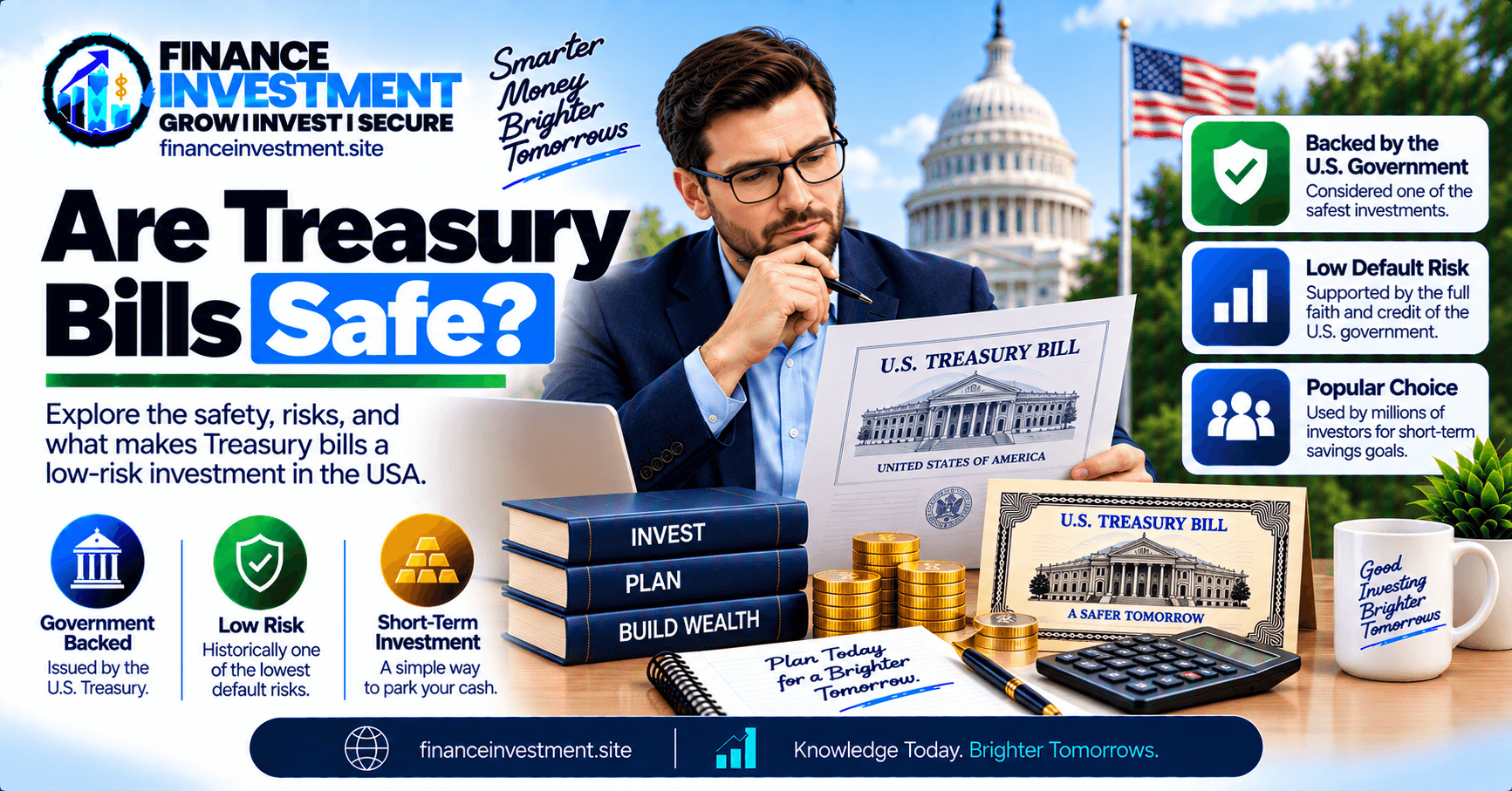 Are Treasury Bills Safe? For many investors, the answer is that T-bills are considered among the safest investments available. They are short-term debt securities issued by the U.S. Department of the Treasury and backed by the full faith and credit of the U.S. government.
Still, safe does not mean risk-free in every sense. Your experience can change depending on whether you hold the bill until maturity or sell it earlier. Inflation can also reduce the purchasing power of your return, while changing interest rates can affect a T-bill’s market value before maturity. 2
This guide looks beyond the simple “safe or unsafe” question. You’ll see what protects T-bill investors, what risks remain, how buying through a brokerage differs from buying directly, and how Treasury bills compare with other short-term cash options.
What You’ll Learn
- Why Treasury bills are considered very low-credit-risk investments.
- What the U.S. government’s backing means for T-bill investors.
- What generally happens when you hold a Treasury bill until maturity.
- How inflation, interest rates, and an early sale can affect your investment.
- Why Treasury bills are securities rather than FDIC-insured bank deposits.
- How T-bills compare with money market accounts and other short-term options.
For a broader introduction before going deeper, read our Treasury Bills Explained guide.
Quick Answer: Are Treasury Bills Safe?
The short answer: Treasury bills are considered among the safest investments because they are short-term U.S. government securities backed by the full faith and credit of the U.S. government. However, that does not mean they are completely free of investment risk. Inflation can reduce purchasing power, and selling before maturity can expose you to changes in market value.
Key Takeaways
- Very low credit risk: T-bills are direct obligations of the U.S. Department of the Treasury.
- Maturity matters: If you hold a T-bill to maturity, the Treasury generally pays its face value according to the security’s terms.
- Early sale can change the outcome: A T-bill sold before maturity can be worth more or less than its face value.
- Inflation still matters: Rising prices can reduce the purchasing power of the money you receive.
- Not FDIC insured: T-bills are government securities, not bank deposits covered by FDIC deposit insurance.
- Brokerage and Treasury protection are different: Buying a T-bill through a brokerage does not make the security an FDIC-insured deposit.
- Taxes still apply: Treasury interest is generally subject to federal income tax, while qualifying Treasury interest is generally exempt from state and local income taxes.
BOTTOM LINE: T-bills have very low credit risk, but “safe” does not mean “no risk.” Your result can depend on your holding period, need for liquidity, market conditions, and inflation.
Table of Contents
Are Treasury Bills Safe? At a Glance
Treasury bills are short-term U.S. government securities. They are considered among the safest investments because they are backed by the full faith and credit of the U.S. government. Still, “safe” does not mean every possible risk disappears. Inflation can reduce purchasing power, and selling before maturity can expose you to changes in market value.
Quick Facts
- Issuer: U.S. Department of the Treasury
- Maturity: Short-term bills with maturities ranging from a few days to 52 weeks
- Minimum purchase: $100 for TreasuryDirect purchases and current Treasury bill offerings
- At maturity: A T-bill held to maturity generally pays its face value according to its terms
- Interest structure: T-bills are generally sold at a discount, with the difference between the purchase price and face value representing the return
- Federal taxes: Treasury interest is generally subject to federal income tax
- State and local taxes: Treasury interest is generally exempt from state and local income taxes
Best For
T-bills may be relevant for investors seeking a short-term government security with a defined maturity and very low credit risk. They can also be useful when an investor wants to hold a Treasury security until maturity rather than depend on stock-market performance for short-term cash needs.
| Safety Factor | What It Means |
|---|---|
| Credit risk | Very low because T-bills are obligations of the U.S. government |
| Early-sale risk | The market value can be above or below face value before maturity |
| Inflation risk | Inflation can reduce the purchasing power of the return |
| FDIC insurance | Not applicable; T-bills are Treasury securities, not bank deposits |
QUICK TAKE: T-bills have very low credit risk, but it helps to separate credit risk from market-value and inflation risks. The distinction becomes especially important if you may need to sell before maturity.
Complete Beginner Guide to Treasury Bill Safety
 If you are new to T-bills, the easiest way to understand their safety is to separate the issuer’s ability to meet its obligation from what can happen to the investment before maturity. Treasury bills are debt obligations issued by the U.S. Department of the Treasury and are considered among the safest investments because they carry the full faith and credit of the U.S. government.
1. What Makes Treasury Bills Safe?
A Treasury bill is a short-term U.S. government security. Because it is a Treasury obligation, its credit risk is generally considered very low. That is different from investments whose repayment depends on the financial condition of a private company or other issuer.
2. What Happens If You Hold a T-Bill to Maturity?
Treasury bills are generally sold at a discount or, in some cases, at face value. When a bill reaches maturity, Treasury pays its face value according to the security’s terms. For a discounted bill, the difference between what you paid and the face value is the interest earned.
3. Can You Lose Money on a T-Bill?
It depends on when you sell. If you sell a T-bill before maturity, its market price can be above or below face value. Changes in market interest rates can affect that price, so an early sale may produce a gain or a loss compared with your purchase price.
4. What About Inflation?
Even if a T-bill pays according to its terms, inflation can reduce the purchasing power of the money you receive. This is different from credit risk: the Treasury may meet its obligation while your dollars still buy less than they did when you invested.
5. Are T-Bills the Same as a Bank Deposit?
No. A T-bill is a Treasury security, not a bank deposit. It is therefore not covered by FDIC deposit insurance. Buying the security through a bank or brokerage does not change what the investment is; the T-bill remains a Treasury obligation.
EASY WAY TO THINK ABOUT IT: T-bill safety starts with the strength of the issuer. The main risks to understand separately are market-value changes before maturity and the loss of purchasing power caused by inflation.
How Treasury Bill Safety Works
A T-bill’s safety is easier to understand when you follow what happens from purchase through maturity. The important distinction is between the U.S. government’s obligation and the market risks an investor can face before the bill matures.
Step 1: You Buy a U.S. Government Security
When you buy a Treasury bill, you are purchasing a short-term debt obligation issued by the U.S. Department of the Treasury. Treasury securities carry the full faith and credit of the U.S. government, which is why they are considered among the safest
Step 2: The Bill Has a Defined Maturity
Treasury bills are short-term securities with maturities ranging from a few days to 52 weeks. They are generally issued at a discount, although Treasury bills can also be issued at par depending on auction results. Unlike Treasury notes and bonds, T-bills do not make regular coupon payments.
Step 3: Maturity Changes the Risk Picture
If you hold the T-bill until maturity, Treasury pays the bill’s face value according to its terms. This means temporary changes in the market price do not determine the maturity payment. The situation is different if you sell before maturity because the market price can be higher or lower than the amount you originally paid.
Step 4: Interest Rates Can Affect an Early Sale
Market interest rates can influence the price of a Treasury security before maturity. If rates rise, existing securities can become less attractive relative to newly issued securities, which can push their market prices lower. The opposite can happen when rates fall.
Step 5: Inflation Is a Separate Risk
A T-bill can pay according to its terms while inflation still reduces the purchasing power of the money you receive. So, government credit safety and purchasing-power protection are two different questions.
THE SIMPLE VERSION: Treasury backing addresses the security’s credit risk. Holding to maturity avoids relying on the market price at the time of sale, but it does not eliminate inflation risk or other investment considerations.
Benefits & Drawbacks of Treasury Bills
Treasury bills offer several features that can appeal to investors who want a short-term U.S. government security. But low credit risk does not remove every trade-off. The right way to evaluate a T-bill is to look at both its safety characteristics and the risks that remain.
Benefits
- Very low credit risk: T-bills are obligations of the U.S. government and carry its full faith and credit.
- Short, defined maturities: Treasury bills mature from a few days to 52 weeks, giving investors a specific date for repayment.
- Face-value repayment at maturity: When held to maturity, Treasury pays the bill’s face value according to its terms.
- State and local tax treatment: Income from Treasury securities is generally exempt from state and local income taxes, although federal income tax generally applies.
Drawbacks
- Inflation risk: Inflation can reduce the purchasing power of the money you receive at maturity.
- Early-sale risk: If you sell before maturity, the T-bill’s market value can be higher or lower than your purchase price.
- Reinvestment risk: When a T-bill matures, the yield available on a new bill may be higher or lower than the yield you previously received.
- No FDIC deposit insurance: T-bills are Treasury securities, not bank deposits, so FDIC deposit insurance does not apply.
WHAT TO REMEMBER: Treasury bills combine very low credit risk with a defined maturity, but investors still need to consider inflation, market pricing before maturity, and the yield available when the money is reinvested.
Treasury Bills Safety Comparison Table
Treasury bills are often compared with other short-term places to keep money, but “safe” can mean different things. Government backing, deposit insurance, access to funds, and market-value changes are separate factors. This comparison focuses on those differences rather than labeling one option as universally safer.
| Safety Factor | Treasury Bills | Money Market Account | CD | Money Market Fund |
|---|---|---|---|---|
| What it is | Short-term U.S. government debt security | Bank deposit account | Bank time deposit | Mutual fund investing in short-term securities |
| FDIC insurance | No | Generally yes, if held at an FDIC-insured bank and within applicable limits | Generally yes, if held at an FDIC-insured bank and within applicable limits | No |
| Value before maturity | Market price can change if sold before maturity | Account balance is not marked to a daily market price | Usually accessed through withdrawal or maturity terms rather than daily market trading | Share value depends on the fund’s holdings and applicable valuation rules |
| Access to money | Can generally be sold before maturity, subject to market conditions | Generally accessible under the account’s terms | Early withdrawal may involve penalties or restrictions | Shares are generally redeemable under the fund’s rules |
| Main risks | Inflation, early-sale price changes, and reinvestment risk | Bank exposure beyond applicable insurance coverage and changing interest rates | Early-withdrawal restrictions, changing rates, and inflation | Market, interest-rate, liquidity, and inflation-related risks |
One distinction deserves special attention: a money market account, also called a money market deposit account, is a bank deposit that may qualify for FDIC insurance. A money market fund is a mutual fund and is not FDIC-insured. Treasury bills are also not FDIC-insured because they are securities rather than bank deposits.
COMPARE THE RIGHT FACTORS: Look beyond the word “safe.” Consider who owes you the money, whether government deposit insurance applies, how easily you can access the funds, whether the value can change before you need the money, and how inflation may affect your purchasing power.
Costs, Risks & Expert Tips for Treasury Bills
Treasury bills have very low credit risk, but the advertised yield is not the only factor to consider. How you buy the bill, whether you sell before maturity, taxes, inflation, and your reinvestment plan can all affect the overall result.
Costs to Watch
- TreasuryDirect purchase costs: TreasuryDirect states that it charges no purchase fee or commission when you buy marketable Treasury securities directly through the platform.
- Brokerage transaction costs: If you sell a T-bill before maturity through a broker, the transaction may involve a commission or a markdown in the sale price. Check the broker’s pricing before placing the order.
- Taxes: Treasury income is generally subject to federal income tax but is generally exempt from state and local income taxes.
Risks That Still Matter
The main risks include inflation, changes in market value before maturity, and reinvestment risk. If market interest rates change after you buy a bill, its price can move before maturity. Selling at that point can produce a different result from simply holding the bill until maturity.
Practical Tips
- Match maturity to your cash need: Choose a maturity that fits when you expect to use the money.
- Plan for early access: If you may need the cash before maturity, understand how market pricing could affect the amount you receive.
- Look at the after-tax result: Compare the return after considering applicable federal taxes and your state’s tax treatment of other investments.
- Consider a T-bill ladder: Multiple maturity dates can spread out when your money becomes available instead of concentrating everything in one maturity.
SMART CHECK: Before buying, ask three questions: When will I need the money? Can I reasonably hold the bill until maturity? And what costs, taxes, and reinvestment choices will apply afterward?
Common Treasury Bill Mistakes + Real-Life Example
Treasury bills are relatively simple once you understand how they work, but a few mistakes can lead to unexpected results. The biggest issue is assuming that low credit risk means there are no other risks to consider.
Common Mistakes to Avoid
- Assuming T-bills have no risk: They have very low credit risk, but inflation and market-value risk before maturity still matter.
- Confusing T-bills with FDIC-insured deposits: Treasury bills are securities, not bank deposits, so FDIC deposit insurance does not apply.
- Ignoring the maturity date: If you need the money before maturity, you may have to sell the bill at its current market price.
- Expecting the market value to stay unchanged: A T-bill’s price can move before maturity as market conditions and interest rates change.
- Forgetting reinvestment risk: The yield available when the bill matures may be different from the yield on your original purchase.
Real-Life Example: A Hypothetical $10,000 T-Bill
Suppose an investor buys a hypothetical T-bill with a $10,000 face value for $9,800. The $200 difference represents the gross discount, or return, if the bill is held to maturity. This is only an illustration; actual Treasury bill prices depend on the applicable auction or market price.
If the investor holds the bill until maturity, Treasury pays the $10,000 face value according to the security’s terms. But suppose the investor needs the money early and sells when the market price is $9,850. The investor would receive $9,850 before any applicable transaction costs, rather than waiting for the $10,000 maturity payment. A sale before maturity can produce a higher or lower amount depending on market conditions.
THE LESSON: A T-bill can have very low credit risk while still carrying inflation and early-sale market risks. Knowing your maturity date and having a plan for the money can help you avoid selling simply because you need cash unexpectedly.
Who Should Consider Treasury Bills?
Treasury bills may be relevant for investors who have a short-term financial need, want a defined maturity date, or prefer a U.S. government security with very low credit risk. T-bills mature in periods ranging from a few days to 52 weeks, so the maturity can be matched with a specific short-term cash need.
T-Bills May Be Relevant If You:
- Want exposure to a short-term U.S. government security.
- Know approximately when you expect to use the money.
- Prefer a defined maturity rather than an investment with an uncertain end date.
- Want Treasury income that is generally exempt from state and local income taxes.
- Can reasonably hold the bill until maturity and avoid relying on an early sale.
When Another Option May Fit the Goal
T-bills are not designed for every financial objective. Money needed immediately may call for an option with different access features, while long-term growth goals may require a broader investment approach. Investors specifically focused on inflation protection can also research Treasury Inflation-Protected Securities (TIPS). TIPS are Treasury notes and bonds whose principal is adjusted based on changes in the Consumer Price Index, making them different from short-term T-bills.
KEY POINT: Instead of asking only whether T-bills are safe, consider whether the bill’s maturity, access requirements, return, and inflation characteristics fit the specific purpose of your money.
Frequently Asked Questions About Treasury Bill Safety
1. Are Treasury bills safe?
Treasury bills are considered among the safest investments because they are short-term U.S. government securities backed by the full faith and credit of the U.S. government. However, inflation and market-value risks before maturity still apply.
2. Can you lose money on Treasury bills?
If you sell a T-bill before maturity, its market price can be higher or lower than what you paid. If you hold it until maturity, Treasury pays the bill’s face value according to its terms.
3. Are Treasury bills guaranteed?
Treasury bills are obligations of the U.S. government and carry its full faith and credit. This supports their very low credit risk, but it does not protect an investor from inflation or a potential market-price loss on an early sale.
4. Are Treasury bills FDIC insured?
No. Treasury bills are securities rather than bank deposits, so FDIC deposit insurance does not apply to the T-bill itself.
5. What happens if I sell a Treasury bill before maturity?
You sell it at its current market price, which can be above or below your purchase price. Interest-rate and market conditions can affect that price, and a brokerage transaction may also involve applicable costs.
6. What happens to Treasury bills if a brokerage fails?
If a Treasury bill is held at a SIPC-member brokerage, Treasury securities are among the securities that SIPC can protect when the brokerage fails and customer assets are missing, subject to applicable rules and limits. SIPC protection is generally up to $500,000 per customer, including a $250,000 limit for cash. SIPC does not protect against a decline in the market value of an investment.
7. Are Treasury bills safe during a recession?
Treasury bills remain U.S. government debt securities during a recession. Their government backing does not disappear because economic conditions weaken. However, market yields and prices can still change as interest rates and investor demand change.
8. Are Treasury bills safer than money market accounts?
They have different forms of protection. T-bills are U.S. government securities backed by the government’s full faith and credit. A money market account is a bank deposit that may qualify for FDIC insurance when held at an insured bank and within applicable limits. The two should therefore be compared by issuer, insurance, maturity, access, and market risks rather than by one overall safety label.
FAQ SUMMARY: Treasury bills have very low credit risk, but investors should still understand early-sale pricing, inflation, taxes, reinvestment, and the protections that apply when securities are held through a brokerage.
Final Verdict: Are Treasury Bills Safe?
Are Treasury Bills Safe? Treasury bills are considered among the safest investments because they are short-term U.S. government debt securities backed by the full faith and credit of the U.S. government. Their short maturities also generally limit the period during which an investor may be exposed to market-price changes before maturity.
Still, safe does not mean completely free of investment risk. If you sell before maturity, the T-bill’s market value can be higher or lower than the amount you paid. Inflation can also reduce the purchasing power of the money you receive.
For a broader explanation of how these securities work, see our Treasury Bills Explained guide.
BOTTOM LINE: T-bills offer very low credit risk, but investors should still consider maturity, early-sale pricing, inflation, taxes, and their specific cash needs before investing.
Have a Money Question? Keep Exploring.
Understanding Treasury bill safety is one part of making informed short-term investing decisions. Keep exploring Treasury bill maturities, buying methods, yields, and other cash-management topics to better understand your options.
Have a finance topic you’d like us to explain? Send your question or feedback by email.