When Is the Best Time to Open a CD? Smart Timing Guide for 2026
The best time to open a CD is not always the day you see the highest advertised rate. Your cash needs, the term you can comfortably lock in, current rates, and what you expect to do with the money at maturity all matter.
When Is the Best Time to Open a CD?
 The best time to open a CD is rarely determined by one perfect interest-rate moment. A better decision comes from looking at two things together: what CD rates are doing and when you expect to need your money. If you have cash you will not need for a defined period and you find a rate that fits your goals, opening a CD now can make sense rather than waiting indefinitely for something better.
Waiting can be reasonable when you have an important expense approaching, need easy access to the money, or are not comfortable with the available terms. But waiting for the exact top of the rate cycle is difficult because nobody knows future rates with certainty.
That is where a CD ladder can help. Instead of putting everything into one maturity date, you can spread deposits across different terms. As each CD matures, you get another opportunity to reassess rates and your cash needs. Our
CD Guide 2026
provides a broader look at how CDs can fit into a savings strategy.
What You’ll Learn
- When opening a CD now may make sense
- When waiting may be the better choice
- How your personal cash timeline affects CD timing
- Why chasing the highest possible rate can backfire
- How CD ladders can reduce the pressure to predict future rates
Quick Answer: When Should You Open a CD?
There is no single calendar date that guarantees the best CD rate. A practical decision starts with your own timeline, then weighs the rates and terms currently available.
6-Step CD Timing Test
- Check your cash timeline: Make sure the money can remain untouched for the period you are considering.
- Review current rates: Look at several comparable CD offers instead of relying on one advertised rate.
- Choose your lock-in period: Decide whether a short, medium or longer term fits your plans.
- Compare the APYs: Once the terms are comparable, see whether the available return justifies locking up the funds.
- Consider staggered maturities: A CD ladder can give you multiple opportunities to reassess rates rather than making one large timing decision.
- Decide without chasing a perfect peak: If the rate and term already work for you, waiting solely for a higher future rate can leave the money earning less in the meantime.
Bottom line: The best time to open a CD is often when the rate is reasonable and the term fits your financial timeline—not when you can somehow predict the exact market peak.
CD Timing at a Glance
Good CD timing starts with the relationship between the rate available today and the job your money needs to perform. This quick snapshot helps you judge the timing without trying to forecast every move in interest rates.
| Timing Factor | What to Look At | Timing Signal |
|---|---|---|
| Rate environment | Available CD APYs | A competitive rate may support opening now |
| Cash timeline | When you may need the money | Near-term needs favor flexibility |
| CD term | Length of commitment | Choose a term you can comfortably hold |
| Rate lock | Fixed rate for the selected term | Useful when today’s rate fits your expectations |
| Maturity date | When the CD ends | Best when it lines up with a future goal |
| Liquidity | How much cash must stay accessible | Higher liquidity needs may argue against a long CD |
| Ladder potential | Multiple maturity dates | Useful when you want several future decision points |
| Goal fit | Purpose of the money | A clear goal can make the timing decision easier |
Quick perspective: A CD can be well-timed even when rates are not at their absolute peak if the term, rate lock and maturity date fit your plan.
Complete Beginner Guide: Should You Open a CD Now?
 You do not need to predict the next move in interest rates to make a sensible CD decision. A better approach is to work from your own financial timeline and then see how today’s available offers fit it.
1. Start With Your Cash Needs
First, separate money you may need soon from money that can stay untouched. Emergency savings and cash for upcoming bills generally need easier access. Only consider a CD for funds you can reasonably leave committed for the selected term.
2. Check the Rates Available Today
Look at current offers for the terms you could actually use. You can review our
CD rates in 2026
resource as one starting point. The goal is not to find a mythical perfect rate; it is to understand what is realistically available when you are making the decision.
3. Choose a Term You Can Live With
A higher APY may come with a longer commitment. If you know you will need the money in a year, locking it away for several years simply because the rate looks attractive may create a bigger problem later. Our guide to
choosing the right CD
can help you think through the term.
4. Decide Whether the Rate Lock Is Worth Taking
A fixed CD rate gives you certainty for the agreed term. That can be valuable if the current offer already meets your expectations. On the other hand, keeping all your cash uncommitted because rates might rise can mean giving up today’s known return.
5. Plan the Maturity Date Before Opening
Picture the date when the CD will mature. If it lands near a known expense, another investment decision, or a period when you expect to need cash, that timing deserves attention.
6. Consider Staggering the Money
You do not have to make one all-or-nothing timing call. A
CD ladder
can spread money across different maturity dates, giving you recurring opportunities to access funds and reconsider available rates.
Beginner Tip
If today’s CD fits your timeline and you are comfortable with the return, you do not need to wait for a perfect market moment. If it does not fit, waiting—or splitting the money—can be the smarter move.
How CD Timing Works After You Open the Account
When you open a fixed-rate CD, the institution generally locks in the stated rate for the selected term. Your deposit then remains in the certificate until maturity, subject to the account’s withdrawal rules. The important point is that the rate you receive is tied to the CD you open—not to whatever rates become available later.
If market rates rise after you open the CD, your existing certificate normally keeps its agreed rate. You gain certainty, but you also give up the chance to move that money immediately into a newly available higher-rate CD. If rates fall, the same rate lock can work in your favor because your existing CD continues earning under its original terms.
The term determines how long this trade-off lasts. A shorter CD gives you an earlier maturity date and another opportunity to reassess. A longer CD can provide a longer period of rate certainty, but your money remains committed for more time.
Illustrative Example: Open Now vs. Wait
Illustrative only: Imagine you have $20,000 available. A hypothetical one-year CD offers 4.25% APY today. If you open it, the account would earn roughly $850 over a year if the stated APY applies and the money remains under the CD’s terms.
Now suppose you wait three months hoping for a better rate. A hypothetical offer later reaches 4.50%, but your money earned no CD interest during those three months. The higher future APY does not automatically mean waiting produced a better overall result. The outcome depends on how long the money remained uninvested and the rates actually available.
Lesson: Waiting can work when rates improve enough to compensate for the return you gave up, but that result cannot be known in advance.
This is why CD timing is partly about accepting a known return versus making a bet on future rates. A CD ladder can reduce the size of that bet by creating several maturity dates instead of requiring one large timing decision.
Benefits and Drawbacks of Opening a CD at the Right Time
Opening a CD when the rate and your timeline line up can turn idle cash into a predictable return. The trade-off is that the decision also fixes your rate and limits access for the selected term.
Pros
- Rate certainty: A fixed-rate CD can lock in the agreed return for its term.
- Predictable earnings: You can estimate the interest under the CD’s stated terms.
- Disciplined saving: Limited access can make it easier to leave designated savings untouched.
- Protection from falling rates: A later decline in available rates does not normally change the locked rate.
Cons
- Missed upside: Rates could rise after you open the CD.
- Reduced liquidity: Getting money out early may involve restrictions or penalties.
- Inflation risk: The purchasing power of the return can change while your money is locked.
- Opportunity cost: The money may have earned more elsewhere or served another financial goal.
A Practical Perspective
You do not need perfect timing for a CD to be useful. If the rate provides reasonable value, the term fits your plans, and you can accept the reduced access, locking in a known return can be more practical than waiting indefinitely for a better offer.
Best CD Timing Scenarios Compared
The right timing strategy can look different depending on how certain you are about your future cash needs and how much rate uncertainty you are comfortable accepting. These approaches offer different ways to balance today’s return with tomorrow’s flexibility.
| Strategy | Best Fit | Main Advantage | Main Trade-Off |
|---|---|---|---|
| Open now | You like today’s rate and can commit | Locks in a known return | Future rates could be higher |
| Wait | You have flexibility and expect conditions to improve | Keeps the option to choose later | Future rates may fall instead |
| Short-term CD | You want an earlier decision point | Money reaches maturity sooner | Rates may differ from longer terms |
| Longer-term CD | You value longer rate certainty | Locks the rate for a longer period | Less flexibility if plans change |
| CD ladder | You want several maturity dates | Reduces reliance on one timing decision | Requires more planning and tracking |
| Keep cash flexible | You may need the money soon | Easy access to funds | Potentially lower return |
If you want several opportunities to reassess your money, explore
how to build a CD ladder.
For money with a shorter timeline, our guide to
using CDs for short-term savings
can help you evaluate the commitment.
If your priority is deciding whether today’s rate is worth locking in, you can also review
whether to lock in a CD rate now.
Simple rule: The more flexibility you need, the less attractive a long lock-in may be. The more certain you are about the timeline, the easier it can be to use a fixed CD strategically.
Costs, Risks & Expert Tips Before Opening a CD
CD timing becomes harder when the decision is treated like a bet on where interest rates are heading. Forecasts can provide context, but they cannot tell you exactly what rates will do next. The bigger question is what you give up by waiting, locking in now, or choosing a term that later proves inconvenient.
Watch the Cost of Waiting
If your money sits in a lower-yield account while you wait for a better CD rate, the extra interest from a future offer must first make up for what you missed. A higher APY later is not automatically a better outcome.
Understand Rate and Liquidity Risk
If rates rise after you open a fixed-rate CD, your existing rate normally stays unchanged. If rates fall, that lock can become valuable. Either way, withdrawing early may trigger a penalty or other restrictions, so check the account terms before committing.
Remember Taxes and Inflation
CD interest is generally taxable income for federal tax purposes, which means the amount you keep can be lower than the headline earnings. Inflation also matters because a fixed return does not guarantee that your purchasing power will rise.
Check Deposit Insurance and Account Limits
Confirm that the institution is properly insured and consider how your total deposits are distributed across accounts and ownership categories. The standard FDIC coverage limit is generally $250,000 per depositor, per insured bank, per ownership category. Credit-union deposits use NCUA share insurance instead.
Expert Tip
Before locking in a CD, write down three numbers: the amount you are depositing, the maturity date, and the amount of accessible cash you will still have afterward. If those three numbers work together, the timing decision becomes much easier.
Common CD Timing Mistakes to Avoid
Trying to choose the perfect day to open a CD can create more uncertainty than it solves. A few common mistakes can turn an otherwise useful savings decision into an awkward one later.
- Waiting for the perfect rate: Rates can move in either direction, so holding cash indefinitely for a higher offer may mean giving up interest today.
- Following forecasts blindly: Rate predictions are estimates, not guarantees. Your financial timeline should carry more weight than a confident-sounding forecast.
- Locking up money needed soon: A CD may be a poor fit for an upcoming tuition payment, home expense, emergency reserve, or other known need.
- Ignoring early-withdrawal terms: Check the penalty and account rules before assuming you can access the money cheaply if plans change.
- Overlooking taxes or insurance: Consider the after-tax return and verify applicable deposit insurance, especially when holding larger balances.
- Choosing the wrong maturity date: A CD that matures at an inconvenient time can make a simple savings plan harder to manage.
Illustrative Example: Maria’s Timing Decision
Illustrative only: Maria has $15,000 that she expects to use for a home renovation in about 14 months. She considers a longer CD because its advertised APY is attractive, but the maturity date would fall well after her planned expense. Instead of chasing the higher rate, she chooses a shorter term that better matches her timeline and keeps other savings accessible.
Her choice does not guarantee the highest possible return. It simply avoids making a rate decision that conflicts with a known financial goal.
Who Should Open a CD?
A CD can make sense for people who have money with a defined purpose and do not need immediate access to it. The timing becomes especially useful when a predictable return matters more than keeping every dollar fully flexible.
People Who May Benefit
- Beginners: A fixed rate and defined maturity date can make the savings plan easy to understand.
- Retirees: CDs can provide predictable interest for money that is not needed immediately, although liquidity needs should come first.
- Families: A CD may work for a known future expense, such as a planned education or large purchase.
- Conservative savers: Those who prefer predictable returns may appreciate knowing the agreed rate for the CD term.
- Goal-focused savers: A CD can fit well when the maturity date lines up with a future financial milestone.
When Another Choice May Be Better
A CD may not be appropriate if you expect to need the money soon, have not built an accessible emergency reserve, or are uncomfortable with early-withdrawal restrictions. In those situations, keeping more money in a flexible savings account can be more practical. Waiting can also make sense if the available CD terms do not fit your timeline and you have a reasonable alternative for holding the cash in the meantime.
Key idea: A CD works best when its rate, term and maturity date fit the job you have assigned to the money.
Frequently Asked Questions About the Best Time to Open a CD
What is the best time to open a CD?
The best time is usually when the available rate and term fit your financial timeline. You do not need to predict the exact market peak.
Should I wait for CD rates to rise?
Waiting can make sense when you have flexibility, but rates can also fall. Consider the interest you may give up while waiting.
What happens when I lock in a CD rate?
A fixed-rate CD generally keeps its stated rate for the agreed term, even if market rates later move higher or lower.
Should I choose a short-term or long-term CD?
Choose a term based on when you can comfortably use the money again. A longer term can provide extended rate certainty, while a shorter term gives you an earlier maturity date.
Can CD rates rise after I open a CD?
Yes. If market rates rise, your existing fixed-rate CD generally remains at its original rate until maturity.
Can a CD ladder help with timing?
Yes. A ladder spreads money across different maturity dates, giving you recurring opportunities to reassess rates and cash needs.
Can I withdraw money from a CD before maturity?
Some CDs permit early withdrawal subject to the account’s rules and a possible penalty. Check the terms before opening the account.
Is CD interest taxable?
CD interest is generally taxable income for federal tax purposes, although your specific tax situation can differ.
Are CDs covered by deposit insurance?
CDs at FDIC-insured banks generally receive FDIC deposit insurance within applicable limits. Qualifying federally insured credit-union accounts receive NCUA share insurance.
Is opening a CD now always better than waiting?”
Illustrative only: Suppose $10,000 can earn 4.25% APY today. Waiting for a higher rate could help if rates rise enough, but the money may earn less while you wait. The better choice depends on the eventual rate, waiting period and your cash needs.
Final Verdict: Should You Open a CD Now or Wait?
There is no reliable way to know the exact day when CD rates will reach their highest point. That makes waiting for a perfect rate a risky strategy on its own. A better decision is to ask whether today’s available rate is attractive enough for your goals and whether you can comfortably leave the money committed for the selected term.
Opening a CD now can make sense when you have cash you will not need soon, the rate is competitive, and the maturity date fits your plans. Locking in can also provide useful certainty if you are concerned that rates could move lower.
Waiting may be reasonable when you have an upcoming expense, need greater flexibility, or have a strong reason to keep the money available. A CD ladder can offer another path by spreading maturity dates instead of forcing one large timing decision.
For a broader look at CD terms, strategies and safety considerations, explore our
CD Guide 2026
.
Bottom line: You do not need perfect market timing. You need a CD rate, term and maturity date that make sense for your money today.
Make Your Next CD Decision With Confidence
CD rates will change, but your savings goals do not have to wait for a perfect market moment. Get practical FinanceInvestment guidance on CDs, rates, savings strategies and smarter ways to plan your cash.
📧 subhashr325@gmail.com
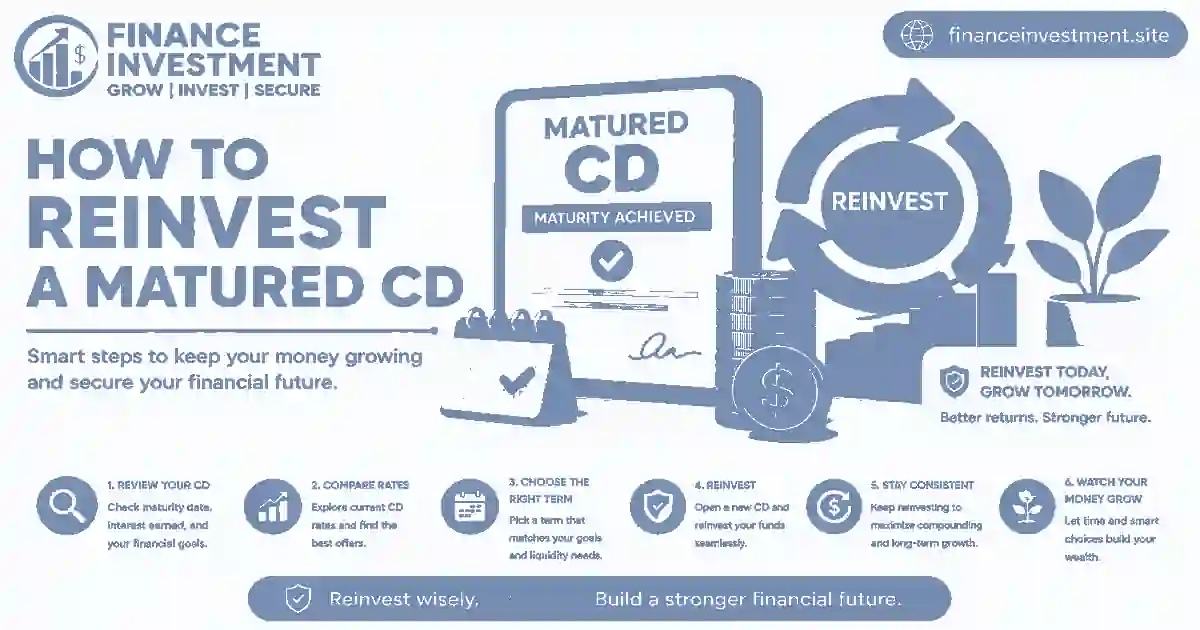
 Reinvesting a matured CD does not require a complicated strategy. The goal is to make the next deposit fit your life today, rather than simply repeating the old certificate. A few deliberate checks can make the decision much clearer.