Tag: Retirement Forecasting

  • Using AI to Estimate Retirement Income: Complete 2026 Guide

    Using AI to Estimate Retirement Income: Complete 2026 Guide


    Using AI to Estimate Retirement Income: Complete 2026 Guide

    Published: June 12, 2026

    Author: Subhash Rukade
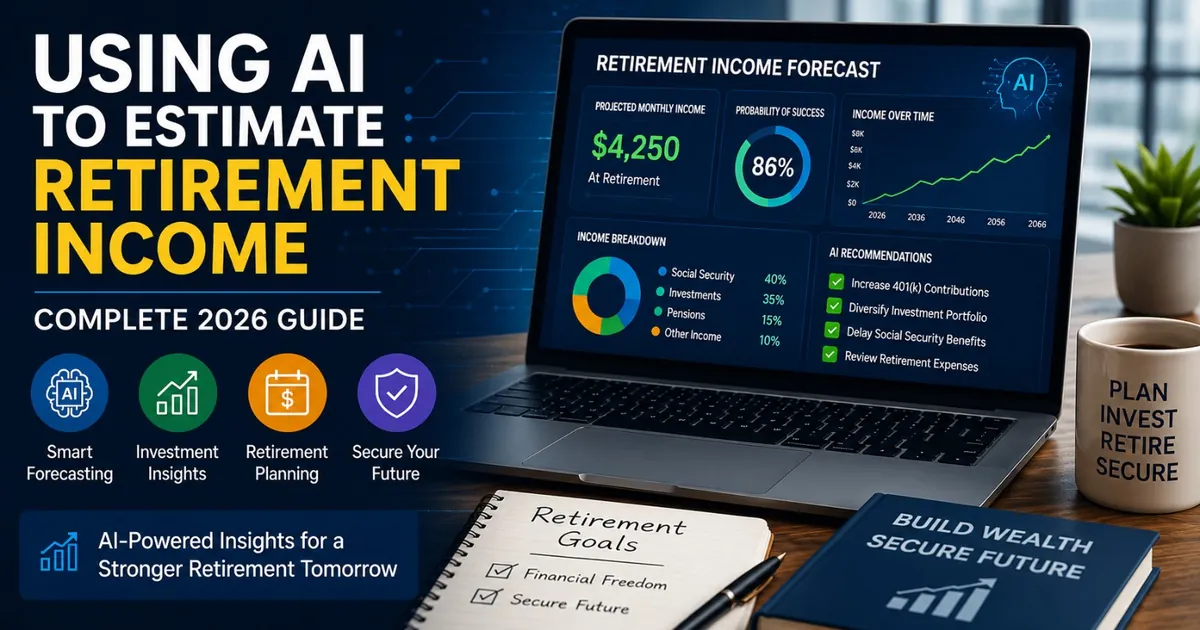
    alt="Using AI to Estimate Retirement Income in 2026"

    Using AI to Estimate Retirement Income

    Retirement planning has always been one of the biggest financial challenges for American investors. Most people know they need to save for retirement, but determining how much income those savings will generate in the future is often difficult.

    Factors such as inflation, market performance, Social Security benefits, healthcare expenses, taxes, and life expectancy can significantly impact retirement income. Even small changes in these variables can alter long-term retirement projections.

    This uncertainty has led many investors to explore new financial planning technologies. One of the fastest-growing trends in 2026 is Using AI to Estimate Retirement Income.

    Artificial intelligence is helping investors create more accurate retirement income forecasts by analyzing thousands of data points in seconds. Instead of relying on simple retirement calculators, AI-powered tools evaluate income growth, savings rates, investment performance, spending habits, and economic trends to generate personalized retirement projections.

    Many investors appreciate that AI can model multiple retirement scenarios. For example, it can show how retiring early, increasing retirement contributions, delaying Social Security benefits, or adjusting investment allocations may affect future retirement income.

    The rise of AI retirement planning is part of a much larger transformation occurring throughout personal finance. Investors interested in understanding how artificial intelligence is reshaping investing, wealth building, and retirement planning should explore our
    AI Investing & Personal Finance Guide 2026.

    While AI cannot predict the future with complete certainty, it can help investors make smarter decisions based on data-driven insights. The goal is not to eliminate uncertainty but to reduce guesswork and improve retirement planning confidence.

    In this guide, we’ll explore how AI estimates retirement income, its benefits and limitations, common mistakes investors make, and practical strategies for building a more secure retirement plan in 2026.

    How AI Estimates Retirement Income

    To understand the value of Using AI to Estimate Retirement Income, it’s important to know how these systems actually work. Unlike traditional retirement calculators that rely on a few fixed assumptions, AI-powered retirement planning tools analyze multiple financial variables simultaneously.

    Artificial intelligence can process large amounts of financial data in seconds and generate personalized retirement income forecasts based on an investor’s unique situation.

    This allows investors to make more informed decisions and adjust retirement strategies before problems arise.

    Analyzing Personal Financial Data

    Every AI retirement income forecast begins with data collection.

    The system typically reviews age, current income, retirement account balances, monthly contributions, investment allocations, savings rates, and expected retirement age.

    Some advanced AI platforms can also connect directly to financial accounts, providing real-time updates and more accurate projections.

    The better the information provided, the more reliable the retirement income estimate becomes.

    Social Security Income Forecasting

    For many Americans, Social Security represents an important source of retirement income.

    AI retirement planning tools can estimate future Social Security benefits by analyzing earnings history, retirement age assumptions, and current government guidelines.

    The system can also compare different claiming strategies to determine how delaying benefits may affect total retirement income.

    Portfolio Growth Projections

    Investment portfolios often play the largest role in retirement income planning.

    AI systems evaluate investment allocations, expected returns, contribution levels, dividend income, and historical market trends to forecast future portfolio growth.

    These projections help investors understand how current investment decisions may impact retirement income decades from now.

    Inflation and Spending Analysis

    One of the biggest challenges in retirement planning is inflation.

    The cost of living will likely be much higher in twenty or thirty years than it is today.

    AI retirement income tools account for inflation by adjusting future income projections and estimating how purchasing power may change over time.

    The system also evaluates spending patterns and lifestyle expectations to calculate future retirement expenses.

    Investors who want to learn more about how artificial intelligence improves budgeting, saving, investing, and financial planning should also explore our
    AI Personal Finance Guide 2026.

    By combining income forecasting, Social Security analysis, portfolio growth projections, inflation modeling, and spending estimates, AI retirement planning tools provide investors with a clearer picture of their future financial situation. While no forecast is perfect, AI can significantly improve retirement income planning compared to traditional methods.

    Benefits of Using AI to Estimate Retirement Income

    The growing popularity of Using AI to Estimate Retirement Income is not surprising. Retirement planning has become more complex than ever, and investors need tools that can analyze large amounts of financial information quickly and accurately.

    AI-powered retirement planning tools help investors move beyond simple assumptions and create retirement income forecasts that reflect real-world financial conditions.

    While no retirement forecast can guarantee future results, artificial intelligence provides several advantages that make retirement planning more effective.

    Personalized Retirement Income Forecasts

    One of the biggest benefits of AI retirement planning is personalization.

    Traditional retirement calculators often rely on generic assumptions. AI systems evaluate individual financial situations including income, savings, investments, spending habits, retirement goals, and expected retirement age.

    This allows investors to receive retirement income projections tailored specifically to their needs.

    Faster and More Detailed Analysis

    Artificial intelligence can process thousands of financial calculations within seconds.

    Instead of manually testing different retirement scenarios, investors can quickly see how changing contribution levels, retirement dates, investment allocations, or spending patterns may affect future retirement income.

    This speed helps investors make better financial decisions without spending hours reviewing spreadsheets.

    Multiple Retirement Scenarios

    One of the most powerful features of using AI to estimate retirement income is scenario analysis.

    Investors can compare different retirement strategies and see how each decision affects long-term financial security.

    For example, AI can estimate the impact of retiring at age 62 versus age 67, increasing annual savings, or delaying Social Security benefits.

    This flexibility helps investors prepare for multiple financial outcomes.

    Improved Long-Term Planning

    AI retirement forecasting encourages investors to think beyond short-term market fluctuations.

    By focusing on retirement income needs decades into the future, investors can create more sustainable financial plans and avoid emotional investment decisions.

    Investors who want to build strong long-term investing habits should also review our
    Complete SIP Investing Guide 2026.

    Traditional Retirement Forecasting vs AI Retirement Forecasting

    FeatureTraditional ForecastingAI Retirement Forecasting
    PersonalizationLimitedHighly Personalized
    Scenario TestingBasicAdvanced
    Inflation AnalysisSimpleDetailed
    Portfolio EvaluationMinimalComprehensive
    Forecast UpdatesManualContinuous

    These advantages explain why more investors are using AI to estimate retirement income in 2026. By combining personalization, advanced forecasting, and real-time analysis, AI tools provide valuable insights that can help investors prepare for a more secure retirement.

    Real-World Example of Using AI to Estimate Retirement Income

    One of the easiest ways to understand the value of Using AI to Estimate Retirement Income is through a real-world example. While retirement forecasting may seem complicated, artificial intelligence makes the process easier by analyzing financial information and generating personalized projections.

    Consider Jennifer, a 50-year-old investor from Arizona. She earns $110,000 annually, contributes regularly to her 401(k), maintains a brokerage account, and hopes to retire at age 65.

    Like many Americans, Jennifer wants to know whether her current savings strategy will provide enough retirement income to maintain her lifestyle.

    Using AI to Estimate Retirement Income Real World Example

    Step 1: AI Reviews Financial Information

    Jennifer enters her income, retirement account balances, monthly contributions, expected retirement age, Social Security estimates, and investment portfolio details into an AI retirement planning platform.

    The system also evaluates inflation projections, expected healthcare expenses, tax assumptions, and historical market performance.

    Within seconds, the AI generates a detailed retirement income forecast.

    Step 2: Identifying Retirement Income Gaps

    The analysis reveals that Jennifer’s current retirement strategy may leave her with an income gap during retirement.

    Although her savings are substantial, rising healthcare costs and inflation reduce future purchasing power more than she expected.

    Without AI forecasting, this potential shortfall may have gone unnoticed for years.

    Step 3: Personalized Recommendations

    The AI system recommends increasing retirement contributions by 5%, delaying Social Security benefits by two years, and allocating a portion of her portfolio to income-generating investments.

    Investors interested in creating reliable income streams during retirement should also explore our
    How to Build a Dividend Portfolio
    guide.

    The revised strategy significantly improves Jennifer’s projected retirement income and increases the likelihood of achieving her retirement goals.

    Step 4: Continuous Monitoring

    Unlike traditional retirement calculators, AI systems continuously update forecasts as market conditions, income levels, and financial circumstances change.

    For a broader understanding of how artificial intelligence is transforming investing and financial planning, revisit our
    AI Investing & Personal Finance Guide 2026.

    A highly recommended personal finance book is
    The Psychology of Money by Morgan Housel.
    The book offers valuable lessons about long-term investing, wealth building, and retirement planning.

    This example demonstrates that using AI to estimate retirement income can provide investors with more realistic forecasts, actionable recommendations, and greater confidence about their financial future.

    Common Mistakes When Estimating Retirement Income With AI

    While Using AI to Estimate Retirement Income can significantly improve retirement planning, investors still make mistakes that reduce the accuracy of their forecasts. Artificial intelligence is a powerful tool, but it depends on the quality of information and assumptions used.

    Understanding these common mistakes can help investors create more realistic retirement income projections and avoid costly planning errors.

    1. Ignoring Inflation

    Inflation remains one of the biggest threats to retirement income.

    Many investors focus only on how much money they will have in retirement without considering how much that money will actually buy in the future.

    For example, a retirement income that seems comfortable today may provide significantly less purchasing power twenty or thirty years from now.

    Although most AI retirement planning tools include inflation assumptions, investors should review those assumptions carefully and ensure they reflect realistic expectations.

    2. Overestimating Investment Returns

    Another common mistake is assuming investment portfolios will generate exceptionally high returns every year.

    While strong market performance is possible, retirement planning should be based on realistic long-term expectations rather than best-case scenarios.

    Overly optimistic assumptions may create retirement income forecasts that are difficult to achieve.

    3. Underestimating Healthcare Costs

    Healthcare expenses often become one of the largest retirement costs.

    Many investors underestimate how much they may spend on insurance premiums, medical treatments, prescriptions, and long-term care.

    AI retirement income forecasts become more useful when healthcare costs are included accurately.

    4. Failing to Update Retirement Projections

    Retirement planning is not a one-time exercise.

    Income, savings balances, spending habits, investment portfolios, and retirement goals change over time.

    Investors should update AI retirement forecasts regularly to ensure projections remain relevant and accurate.

    5. Blindly Trusting Artificial Intelligence

    AI can analyze data and identify trends, but it cannot predict future market returns or personal circumstances with complete certainty.

    Investors should use AI retirement forecasts as planning tools rather than guarantees.

    Financial decisions should always include personal judgment and long-term planning considerations.

    Investors concerned about economic uncertainty should also review our
    Recession-Proof Investing 2026
    guide.

    For additional retirement planning education, trusted resources such as the
    SEC
    and
    Investor.gov
    provide valuable guidance on investing, retirement savings, and risk management.

    The most effective retirement plans combine AI-powered forecasting with realistic assumptions, diversification, regular reviews, and informed financial decision-making.

    Practical Tips for Better Retirement Income Planning With AI

    After understanding the strengths and limitations of Using AI to Estimate Retirement Income, the next step is learning how to use these tools effectively. Artificial intelligence can provide powerful retirement insights, but investors still need a disciplined financial strategy to achieve long-term success.

    The most successful retirement plans combine AI-driven forecasting with consistent saving, diversified investing, and regular financial reviews.

    Update Retirement Information Every Year

    Financial situations change over time. Income levels increase, investment portfolios fluctuate, retirement goals evolve, and expenses shift.

    Investors should update retirement planning tools at least once a year to ensure forecasts remain accurate.

    Accurate information allows AI systems to generate more realistic retirement income projections and identify potential issues before they become serious problems.

    Increase Retirement Contributions Whenever Possible

    One of the simplest ways to improve future retirement income is increasing retirement contributions.

    Even small contribution increases can have a significant impact when compounded over many years.

    AI retirement planning tools often show how an additional 1% or 2% contribution rate may substantially increase future retirement income.

    Investors can use salary increases, bonuses, or tax refunds to strengthen retirement savings without dramatically changing their lifestyle.

    Diversify Retirement Investments

    Diversification remains one of the most important principles in retirement planning.

    AI can help investors maintain balanced portfolios by analyzing risk levels and recommending asset allocation adjustments.

    A diversified portfolio may reduce risk while supporting long-term growth and income generation.

    Review Retirement Income Projections Regularly

    Retirement planning should not be treated as a one-time calculation.

    Investors should review retirement income forecasts regularly and evaluate whether they remain on track toward financial goals.

    Regular reviews help investors respond to changing market conditions and personal circumstances more effectively.

    Plan for Unexpected Expenses

    Unexpected healthcare costs, economic downturns, and family emergencies can affect retirement income.

    A strong retirement plan should include flexibility and emergency reserves to handle unforeseen situations.

    AI Retirement Income Forecast vs Human Retirement Planning

    FeatureAI Retirement ForecastHuman Retirement Planning
    Calculation SpeedInstantManual
    Scenario AnalysisAdvancedLimited
    Data ProcessingExtensiveModerate
    Emotional GuidanceLimitedStrong
    Continuous UpdatesAutomaticPeriodic Reviews

    Investors seeking additional income-producing opportunities should also explore our
    Top Dividend Stocks USA 2026
    guide.

    Another highly recommended retirement planning resource is
    The Simple Path to Wealth by JL Collins.
    The book provides practical lessons on investing, financial independence, and building sustainable wealth.

    Ultimately, using AI to estimate retirement income works best when combined with realistic expectations, disciplined saving habits, diversification, and regular financial reviews.

    Frequently Asked Questions About Using AI to Estimate Retirement Income

    1. Can AI Accurately Estimate Retirement Income?

    AI can provide highly detailed retirement income projections by analyzing savings, investments, inflation, Social Security benefits, and spending habits. While no forecast is perfect, AI often provides more personalized estimates than traditional retirement calculators.

    2. Does AI Consider Inflation?

    Yes. Most modern AI retirement planning tools include inflation assumptions and adjust future retirement income projections to reflect changes in purchasing power over time.

    3. Can AI Help Me Retire Earlier?

    AI can identify opportunities to increase savings, improve investment strategies, and optimize retirement planning decisions. These insights may help investors reach retirement goals sooner.

    4. How Often Should I Update Retirement Income Forecasts?

    Financial experts generally recommend reviewing retirement projections at least once each year or whenever major financial changes occur.

    5. Should I Rely Completely on AI for Retirement Planning?

    No. AI should be viewed as a planning tool rather than a guarantee. Investors should combine AI insights with personal judgment, financial education, and long-term planning.

    6. What Is the Biggest Advantage of Using AI to Estimate Retirement Income?

    The biggest advantage is personalization. AI can evaluate thousands of financial data points and generate retirement income projections tailored to an individual’s unique situation.

    Conclusion: Using AI to Estimate Retirement Income

    As retirement planning becomes increasingly complex, Using AI to Estimate Retirement Income is helping investors make smarter financial decisions. Artificial intelligence can analyze retirement accounts, estimate future income, account for inflation, evaluate investment portfolios, and provide personalized retirement forecasts in ways that traditional calculators often cannot.

    While AI cannot predict the future with complete certainty, it can reduce guesswork and help investors identify opportunities to strengthen retirement plans before it is too late.

    The most successful retirement investors combine AI-powered forecasting with disciplined saving, diversified investing, realistic expectations, and regular financial reviews.

    To continue learning about artificial intelligence, investing, wealth building, and retirement planning, revisit our
    AI Investing & Personal Finance Guide 2026.

    You can also improve your overall financial strategy by reviewing our
    Best Credit Cards 2026
    guide.

    📩 Join Our Free Investor Newsletter

    Get retirement planning insights, AI investing strategies, dividend investing tips, and wealth-building ideas delivered directly to your inbox.

    Subscribe today and stay one step ahead of your financial future.

    Recommended Reading:
    I Will Teach You To Be Rich by Ramit Sethi


    About the Author

    Subhash Rukade is the founder of FinanceInvestment.site and writes about AI investing, retirement planning, stock market investing, and personal finance to help readers make smarter financial decisions.

    Thank you for reading! Here’s to a smarter retirement strategy and a stronger financial future. 🚀
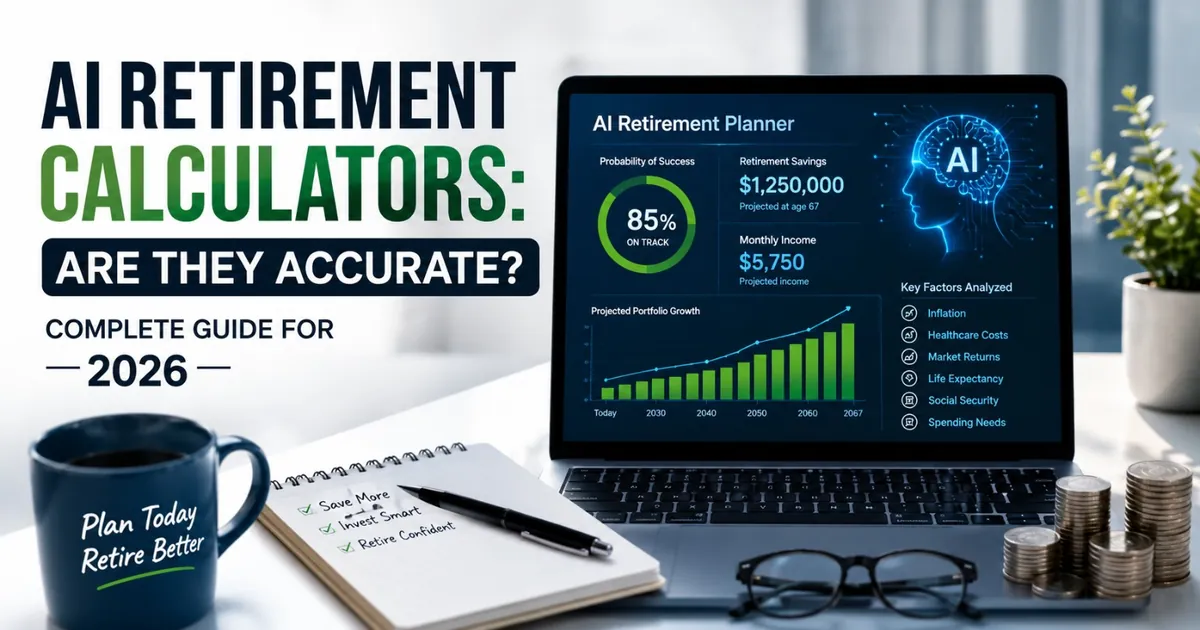
  • AI Retirement Calculators: Are They Accurate? Complete Guide for 2026

    AI Retirement Calculators: Are They Accurate? Complete Guide for 2026


    AI Retirement Calculators: Are They Accurate? Complete Guide for 2026

    Published: June 12, 2026

    Author: Subhash Rukade

    alt="AI Retirement Calculators Are They Accurate in 2026"

    AI Retirement Calculators: Are They Accurate?

    Planning for retirement is one of the most important financial goals for American investors. Yet many people struggle to answer a simple question: “Will my savings be enough?” Retirement planning involves dozens of variables including investment returns, inflation, healthcare costs, Social Security benefits, taxes, and life expectancy.

    For years, traditional retirement calculators helped investors estimate how much money they might need. While these tools provided basic guidance, they often relied on fixed assumptions that did not reflect real-world financial situations.

    Today, artificial intelligence is changing retirement planning. AI-powered retirement calculators can analyze far more information than traditional tools and create highly personalized retirement forecasts.

    This has led many investors to ask: AI Retirement Calculators: Are They Accurate?

    The answer depends on how the calculator is used and the quality of the information provided. Modern AI retirement calculators can evaluate income growth, spending habits, portfolio performance, inflation trends, retirement goals, and market conditions to generate detailed projections.

    Unlike older calculators that produce a single estimate, AI systems often create multiple retirement scenarios. Investors can see how retiring early, saving more, investing differently, or adjusting spending habits may affect future financial security.

    The growing popularity of AI retirement planning is part of a much larger shift happening across the financial industry. Investors who want to understand how artificial intelligence is transforming investing, wealth building, and personal finance should explore our
    AI Investing & Personal Finance Guide 2026.

    Although AI retirement calculators are powerful tools, they are not crystal balls. They cannot predict future market returns or personal circumstances with complete accuracy. However, they can help investors make smarter decisions and identify potential retirement challenges much earlier.

    In this guide, we’ll examine how AI retirement calculators work, where they are most accurate, their limitations, and how investors can use them effectively to build a stronger retirement plan in 2026 and beyond.

    How AI Retirement Calculators Work

    To answer the question AI Retirement Calculators: Are They Accurate?, it’s important to understand how these tools actually work. Unlike traditional retirement calculators that rely on a few simple assumptions, AI-powered retirement calculators analyze multiple financial variables simultaneously.

    Artificial intelligence uses advanced algorithms, machine learning, and predictive analytics to create retirement forecasts that are far more personalized than older planning tools.

    The quality of these forecasts depends on the information provided and the assumptions used by the system.

    Collecting Financial Data

    Every AI retirement calculator starts with data collection. Investors enter details such as age, income, current savings, retirement account balances, monthly contributions, debt levels, and expected retirement age.

    Some advanced platforms can also connect directly to financial accounts, providing real-time information about spending patterns, investment performance, and savings activity.

    The more accurate the data, the more useful the retirement projections become.

    Income Forecasting Models

    One of the biggest strengths of AI retirement calculators is income forecasting.

    Artificial intelligence evaluates current earnings, expected salary growth, Social Security benefits, and retirement account contributions to estimate future retirement income.

    These projections help investors determine whether they are on track to maintain their desired lifestyle after leaving the workforce.

    Inflation and Spending Analysis

    Inflation is one of the biggest threats to retirement savings. AI retirement calculators incorporate inflation assumptions to estimate how purchasing power may change over time.

    The system also analyzes spending habits and projects future expenses based on lifestyle expectations.

    This creates a more realistic picture of retirement needs compared with basic calculators that ignore inflation entirely.

    Retirement Age and Portfolio Growth Projections

    AI systems evaluate how different retirement ages affect financial outcomes.

    For example, retiring at age 60 instead of 67 may significantly impact savings requirements and retirement income projections.

    The calculator also estimates portfolio growth based on investment allocations, contribution levels, and historical market performance.

    Investors interested in learning how artificial intelligence is improving budgeting, saving, investing, and long-term financial planning should also explore our
    AI Personal Finance Guide 2026.

    Ultimately, AI retirement calculators combine financial data, forecasting models, inflation analysis, and investment projections to help investors build a clearer picture of their retirement future. While no forecast can be perfect, these tools often provide more detailed insights than traditional retirement calculators.

    Benefits of AI Retirement Calculators

    The popularity of AI-powered financial tools continues to grow because they offer advantages that traditional retirement calculators often cannot match. When investors ask AI Retirement Calculators: Are They Accurate?, it’s important to understand the benefits that make these tools valuable in the first place.

    While no retirement forecast can be perfect, AI retirement calculators provide deeper analysis, greater personalization, and more realistic planning scenarios than many older retirement tools.

    Personalized Retirement Projections

    One of the biggest advantages of an AI retirement calculator is personalization.

    Traditional calculators often use generic assumptions for investment returns, inflation, and retirement expenses. AI systems can adjust projections based on an individual’s age, income, savings habits, portfolio allocation, and retirement goals.

    This creates forecasts that are more relevant to the investor’s actual financial situation.

    Faster and More Comprehensive Analysis

    AI can process thousands of financial calculations within seconds.

    Instead of manually adjusting retirement assumptions, investors can instantly see how changes in contributions, retirement age, or investment strategies affect future outcomes.

    This speed allows investors to make better-informed decisions and respond more quickly to changing circumstances.

    Scenario Testing and Planning

    One of the most useful features of AI retirement calculators is scenario analysis.

    Investors can test multiple possibilities such as retiring early, increasing retirement contributions, reducing expenses, or changing investment allocations.

    This flexibility helps investors identify strategies that may improve retirement readiness.

    Investment and Risk Analysis

    Many AI retirement calculators go beyond simple savings projections.

    They evaluate investment portfolios, estimate future portfolio growth, and identify potential risks that could affect retirement outcomes.

    This allows investors to make adjustments before retirement challenges become serious problems.

    Investors interested in building disciplined long-term investment habits should also explore our
    Complete SIP Investing Guide 2026.

    Traditional Calculator vs AI Retirement Calculator

    FeatureTraditional CalculatorAI Retirement Calculator
    PersonalizationLimitedHigh
    Scenario TestingBasicAdvanced
    Inflation AnalysisOften LimitedDetailed
    Portfolio EvaluationMinimalComprehensive
    Forecast UpdatesManualDynamic

    These benefits explain why AI retirement planning tools are becoming increasingly popular. While accuracy depends on assumptions and inputs, AI retirement calculators provide investors with a more flexible and informed approach to retirement planning in 2026.

    Real-World Example: Are AI Retirement Calculators Accurate in Practice?

    The best way to evaluate the question AI Retirement Calculators: Are They Accurate? is to look at a real-world example. While artificial intelligence cannot predict the future with perfect precision, it can often provide far more useful retirement projections than traditional calculators.

    Consider Michael, a 45-year-old investor from Texas. He earns $95,000 per year, contributes to a 401(k), owns a diversified investment portfolio, and plans to retire at age 67.

    For years, Michael used a basic retirement calculator that estimated he would have approximately $1.2 million saved by retirement. While the figure seemed encouraging, the calculator failed to account for several important factors.

    AI Retirement Calculators Real World Example

    Step 1: AI Reviews Financial Information

    Michael then used an AI retirement calculator. The system analyzed his income, savings rate, retirement accounts, expected Social Security benefits, spending habits, portfolio allocation, inflation assumptions, and projected healthcare expenses.

    Unlike the traditional calculator, the AI model created multiple retirement scenarios based on different market conditions.

    Step 2: Identifying Potential Shortfalls

    The AI retirement calculator revealed that inflation and healthcare costs could significantly reduce Michael’s purchasing power during retirement.

    Although his retirement savings appeared strong, the system estimated he might face a retirement income gap if contribution levels remained unchanged.

    This insight allowed Michael to take action years before retirement.

    Step 3: Personalized Recommendations

    The AI system recommended increasing retirement contributions by 4%, maintaining a diversified portfolio, and gradually adding more income-producing investments.

    Investors interested in building reliable retirement income streams should also explore our
    How to Build a Dividend Portfolio.

    The revised retirement projection showed a much stronger probability of meeting Michael’s long-term retirement goals.

    Step 4: Continuous Monitoring

    One of the biggest advantages of AI retirement calculators is ongoing monitoring. As Michael’s income increased and market conditions changed, the system automatically updated retirement forecasts.

    For a broader understanding of how artificial intelligence is changing investing and financial planning, revisit our
    AI Investing & Personal Finance Guide 2026.

    A highly recommended personal finance book is
    The Psychology of Money by Morgan Housel.
    It offers timeless lessons about long-term planning, wealth building, and financial decision-making.

    This example demonstrates that AI retirement calculators are not perfect predictors, but they can provide more realistic and actionable retirement insights than many traditional planning tools.

    Common Mistakes When Using AI Retirement Calculators

    While AI-powered retirement tools have improved retirement forecasting dramatically, investors can still make mistakes when using them. Understanding these pitfalls is important when evaluating AI Retirement Calculators: Are They Accurate?

    In many cases, inaccurate retirement forecasts are not caused by the AI itself. Instead, they result from unrealistic assumptions, incomplete information, or poor financial planning decisions.

    By avoiding common mistakes, investors can improve the usefulness and reliability of AI retirement projections.

    1. Entering Incorrect Financial Information

    An AI retirement calculator is only as accurate as the information it receives.

    If investors enter incorrect income figures, underestimate expenses, forget retirement accounts, or ignore debt obligations, the resulting retirement forecast may be misleading.

    Accurate inputs create more reliable retirement projections.

    2. Assuming Unrealistic Investment Returns

    Many investors expect their portfolios to generate exceptionally high returns every year.

    While strong market performance is possible, relying on overly optimistic assumptions can create unrealistic retirement expectations.

    A conservative approach generally produces more dependable retirement planning results.

    3. Ignoring Inflation

    Inflation remains one of the biggest threats to long-term retirement security.

    A retirement income target that seems sufficient today may not provide the same purchasing power twenty years from now.

    Although AI retirement calculators often include inflation projections, investors should review these assumptions carefully.

    Ignoring inflation can lead to significant retirement income shortfalls.

    4. Blindly Trusting Forecasts

    Some investors treat AI retirement projections as guarantees rather than estimates.

    Even advanced AI models cannot predict future market returns, tax laws, healthcare costs, or personal circumstances with complete certainty.

    Retirement forecasts should be viewed as planning tools rather than promises.

    5. Failing to Prepare for Economic Downturns

    Market corrections, recessions, and economic uncertainty can affect retirement portfolios.

    Investors should ensure retirement plans remain flexible enough to handle unexpected challenges.

    For additional strategies on protecting investments during uncertain market conditions, explore our
    Recession-Proof Investing 2026
    guide.

    Use Trusted Financial Resources

    Retirement investors should supplement AI projections with educational resources from trusted organizations such as the
    SEC
    and
    Investor.gov.

    These sources provide valuable information about retirement planning, investing, and risk management.

    The most successful retirement plans combine AI-powered forecasting with realistic assumptions, diversification, continuous learning, and regular financial reviews.

    Practical Tips for Better Retirement Forecasting With AI

    After exploring the strengths and limitations of AI-powered retirement tools, the next step is learning how to use them effectively. When investors ask AI Retirement Calculators: Are They Accurate?, the answer often depends on how the tool is used.

    Even the most advanced AI retirement calculator cannot produce reliable forecasts if investors fail to update information or make unrealistic assumptions. Fortunately, a few practical habits can significantly improve retirement planning accuracy.

    Update Financial Information Regularly

    Life changes constantly. Income increases, expenses rise, investment balances fluctuate, and retirement goals evolve.

    Investors should update their AI retirement calculator at least once or twice each year to reflect their current financial situation.

    Accurate information helps artificial intelligence generate more realistic retirement projections.

    Test Multiple Retirement Scenarios

    One of the biggest advantages of AI retirement planning is scenario analysis.

    Instead of relying on a single forecast, investors should test different possibilities such as retiring early, delaying retirement, increasing contributions, or adjusting spending habits.

    This approach provides a broader understanding of potential retirement outcomes and helps identify areas that need improvement.

    Increase Retirement Contributions Over Time

    Small increases in retirement contributions can have a major impact over several decades.

    Many AI retirement calculators demonstrate how even modest contribution increases may significantly improve retirement readiness.

    Investors should consider directing future salary increases, bonuses, or tax refunds toward retirement accounts whenever possible.

    Diversify Retirement Investments

    Diversification remains one of the most important principles of retirement planning.

    AI systems can help investors maintain balanced portfolios, but investors should still understand the importance of spreading investments across multiple asset classes.

    Diversification may reduce risk while supporting long-term portfolio growth.

    Review Retirement Forecasts Annually

    Retirement planning is an ongoing process rather than a one-time calculation.

    Annual reviews allow investors to identify changes in retirement readiness and adjust strategies accordingly.

    This habit helps ensure retirement plans remain aligned with long-term financial goals.

    AI Retirement Calculator vs Human Retirement Planning

    FeatureAI Retirement CalculatorHuman Retirement Planning
    Calculation SpeedInstantTime Intensive
    Scenario TestingAdvancedLimited
    Data ProcessingExtensiveModerate
    Emotional UnderstandingLimitedStrong
    Personal GuidanceAutomatedCustomized

    Investors seeking additional retirement income opportunities should also explore our
    Top Dividend Stocks USA 2026
    guide.

    Another highly recommended retirement planning resource is
    The Simple Path to Wealth by JL Collins.
    The book provides timeless lessons on investing, financial independence, and long-term wealth building.

    Ultimately, AI retirement calculators work best when combined with realistic assumptions, disciplined saving habits, diversification, and regular financial reviews.

    Frequently Asked Questions About AI Retirement Calculators

    1. Are AI Retirement Calculators More Accurate Than Traditional Calculators?

    In many cases, yes. AI retirement calculators analyze more variables such as inflation, spending habits, portfolio performance, and retirement goals, creating more personalized projections.

    2. Can AI Predict My Exact Retirement Income?

    No. AI can provide estimates based on available information and assumptions, but future market performance and personal circumstances cannot be predicted with complete certainty.

    3. Should Beginners Use AI Retirement Calculators?

    Absolutely. Many AI retirement planning tools are designed to help beginners understand retirement readiness and improve long-term financial planning.

    4. How Often Should I Update My Retirement Forecast?

    Most experts recommend reviewing retirement projections at least once a year or whenever major financial changes occur.

    5. Do AI Retirement Calculators Consider Inflation?

    Most modern AI retirement calculators include inflation assumptions and adjust retirement income projections accordingly.

    6. Can AI Help Me Retire Earlier?

    AI can identify opportunities to increase savings, improve investment strategies, and reduce financial inefficiencies, potentially helping investors reach retirement goals sooner.

    Conclusion: AI Retirement Calculators — Are They Accurate?

    So, AI Retirement Calculators: Are They Accurate? The answer is that they can be highly useful when used correctly. These tools provide personalized retirement forecasts, analyze multiple financial variables, and help investors understand whether they are on track toward financial independence.

    However, retirement calculators are planning tools rather than guarantees. Their accuracy depends on the quality of information entered, realistic assumptions, and regular updates.

    The most successful investors use AI retirement calculators as part of a broader retirement strategy that includes disciplined saving, diversification, ongoing education, and long-term planning.

    To learn more about how artificial intelligence is transforming investing, personal finance, and wealth building, visit our
    AI Investing & Personal Finance Guide 2026.

    You can also strengthen your overall financial strategy by exploring our
    Best Credit Cards 2026
    guide.

    📩 Join Our Free Investor Newsletter

    Get retirement planning tips, AI investing insights, dividend strategies, and wealth-building ideas delivered directly to your inbox.

    Subscribe today and stay ahead of your financial future.

    Recommended Reading:
    I Will Teach You To Be Rich by Ramit Sethi


    About the Author

    Subhash Rukade is the founder of FinanceInvestment.site, where he writes about AI investing, retirement planning, stock market investing, and personal finance to help readers make smarter money decisions.

    Thanks for reading! Wishing you a smarter retirement and a stronger financial future. 🚀