Tag: Goal-Based Savings

  • How to Use CDs for Short-Term Financial Goals in 2026

    How to Use CDs for Short-Term Financial Goals in 2026

    FINANCEINVESTMENT • CD GUIDE 2026

    How to Use CDs for Short-Term Financial Goals

    SR
    Written by Subhash Rukade
    FinanceInvestment
    Updated August,24, 2026.
    About 10–12 min read

    A practical guide to using certificates of deposit for money you expect to need within a defined short-term time frame.

    How to Use CDs for Short-Term Financial Goals in 2026
    Learn how to use CDs for short-term financial goals, choose the right CD term, protect your cash needs, and avoid locking up money too early.
    how-to-use-cds-for-short-term-financial-goals
    How to Use CDs for Short-Term Financial Goals
    short-term CD strategy,
    CDs for short-term goals,
    short-term savings with CDs,
    CD for a financial goal,
    short-term savings goals,
    CD maturity planning,
    choosing a CD term,
    short-term certificate of deposit
    https://financeinvestment.site/how-to-use-cds-for-short-term-financial-goals/
    Subhash Rukade
    August 23, 2026
    About 10–12 minutes

    Use the Deadline to Choose the CD, Not Just the Rate
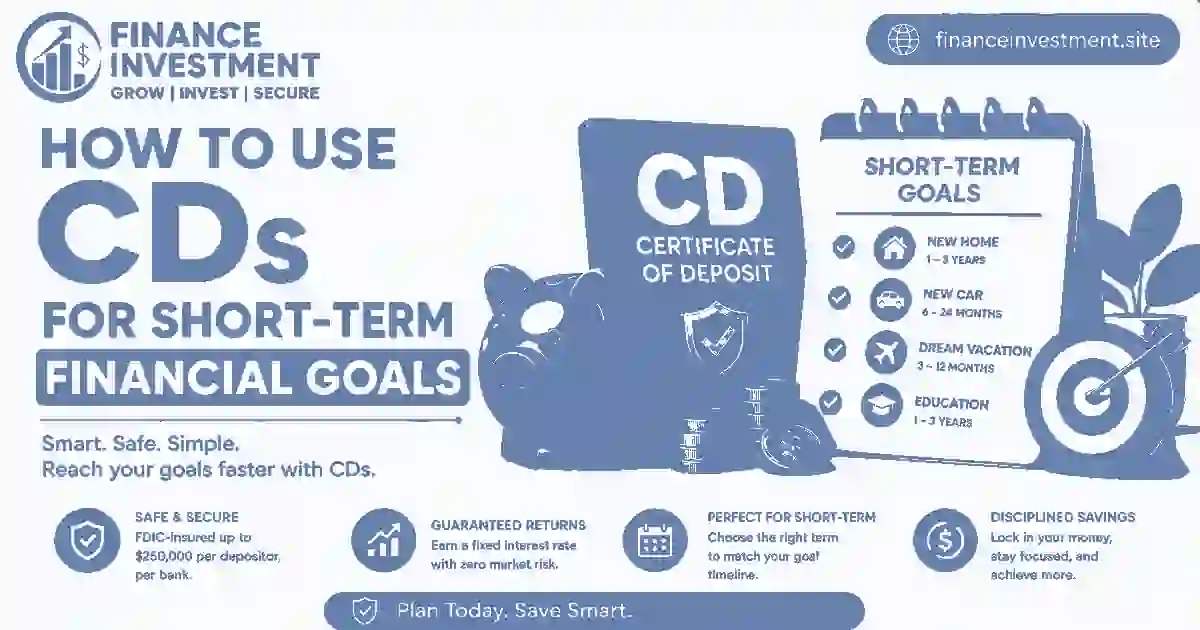
    How to Use CDs for Short-Term Financial GoalsHow to Use CDs for Short-Term Financial Goals starts with a simple question: When will I actually need this money? If you know the answer, choosing a CD term becomes much easier. A certificate that matures after your goal arrives may offer a good APY, but it may be a poor fit if your cash is needed sooner.

    Think about a planned expense such as a car purchase, tuition bill, home repair, annual insurance payment, or a family trip. These goals have something in common: the money has a job and a deadline. A CD can give that cash a defined timeline while potentially earning more than leaving it completely idle.

    The key is to work backward from the date. If you need the money in six months, a five-year CD is obviously out of step. Even a one-year certificate may create a problem if the expense cannot wait. Early withdrawal can also reduce the benefit of using a CD in the first place.

    Before choosing a term, it helps to understand how CDs fit into a broader savings plan. Our CD Guide 2026 provides that bigger picture.

    What You’ll Learn

    • How to match a CD term with a financial deadline
    • When a short-term CD can make sense
    • Why the highest APY may not be the best choice
    • How to plan around maturity dates
    • When a flexible savings account may be better

    Quick Answer: Are CDs Good for Short-Term Financial Goals?

    Yes, a CD can work well for a short-term financial goal when you know roughly when the money will be needed and choose a maturity date that fits. The goal is to earn interest without creating a cash-access problem.

    6 Key Takeaways

    1. Start with the deadline: Know when the money must be available before choosing a CD term.
    2. Match maturity to the goal: A CD that matures too late can be inconvenient, even with a strong APY.
    3. Compare flexibility: A high-yield savings account may be better when the spending date could change.
    4. Don’t chase APY alone: Consider the term, withdrawal rules, and actual dollar earnings together.
    5. Keep emergency cash separate: A CD should not replace money you may need immediately.
    6. Plan the next step: Know where the money will go when the CD matures instead of making the decision at the last minute.

    Bottom line: A short-term CD works best when the maturity date fits the purpose of the money. The best rate is useful only if the timing works, too.

    Short-Term CD Planning at a Glance

    A useful way to think about a short-term CD is to start with the calendar. The closer your financial goal is, the more important access and timing become. The table below gives a simple starting framework rather than a one-size-fits-all rule.

    Financial GoalPossible CD TermMain Consideration
    3–6 months
    Planned bill or near-term purchase
    3–6 month CD, where availableKeep the maturity date comfortably before the money is needed.
    6–12 months
    Tuition, insurance or planned purchase
    6-month or 1-year CDLeave enough time after maturity to move or spend the funds.
    12–18 months
    Longer planned expense
    1-year or 18-month CDConsider whether the goal date could move before locking in.

    Key number: Give yourself a timing cushion. If a goal requires $10,000 on June 1, a certificate maturing close to that date may leave little room for delays. A flexible account can be more appropriate when the spending date is uncertain.

    Complete Beginner Guide to Using CDs for Short-Term Goals

    A CD becomes useful for a short-term goal when three things line up: you know approximately how much the goal will cost, you have a reasonable spending date, and you can leave the deposited money alone until the certificate matures.

    Define the Amount Before Shopping for a CD

    Start with the expense rather than the bank’s advertised rate. If you expect a home project to cost $6,000 next spring, decide how much of that $6,000 is already saved and how much can safely be committed. This keeps the CD tied to a real purpose instead of turning rate shopping into the goal itself.

    Work Backward From the Spending Date

    Give the maturity date some breathing room. Money needed on a specific day generally should not be locked in a certificate that matures that same morning. Allow time to receive maturity instructions, move the funds, and handle any unexpected delay.

    Use Different Maturities for Different Goals

    If several expenses are coming at different times, you do not have to put everything into one CD. A simple ladder can split the cash among certificates with different maturity dates. For example, money needed in six months can sit separately from money earmarked for next year. Each portion then has its own timeline.

    Consider a No-Penalty CD When Timing Is Less Certain

    A no-penalty CD may provide more flexibility because qualifying withdrawals can be made without the traditional early-withdrawal penalty, subject to the institution’s rules. Compare its APY and withdrawal conditions with standard CDs and liquid savings options before choosing it.

    Keep Emergency Savings Outside the Plan

    Your short-term goal fund and emergency fund serve different purposes. A vacation, vehicle purchase, or planned renovation can often wait or change. An urgent medical bill or home repair may not. Keeping emergency cash readily accessible helps prevent an unexpected expense from forcing you to break a CD early.

    How a Short-Term CD Strategy Works

    A short-term CD strategy works best when the certificate is treated as part of a timeline, not as a permanent home for your cash. You decide what the money is for, when you need it, and then build the CD around those facts.

    Step 1: Set the Goal Amount

    Write down the amount you expect to need. If the target is $8,000, decide whether the full amount is ready now or whether you are still saving toward it. This also helps you avoid committing money that belongs to another priority.

    Step 2: Mark the Date on Your Calendar

    Choose the date when the money should be available. Then work backward to find a suitable CD term. A small cushion between maturity and the actual expense can make the plan easier to manage.

    Step 3: Fund the Certificate

    After comparing APY, term, withdrawal rules, and other conditions, open the CD and transfer the amount you have decided to commit. Save the account confirmation and maturity date so you can review the plan later.

    Step 4: Track Maturity

    Don’t wait until maturity morning to think about the next move. Check the institution’s maturity and renewal rules in advance. Some CDs automatically renew if you do nothing during the applicable grace period.

    Illustrative Example

    Maya expects to spend $5,000 on a home improvement project in about eight months. She keeps her emergency reserve separate and places the goal money into a suitable shorter-term CD. Rather than choosing a certificate that matures after the project date, she selects one that gives her time to access the funds before the contractor needs payment. When the CD matures, she reviews the proceeds and moves the money toward the project instead of automatically renewing it.

    The final step is simple but important: match the maturity decision to the goal. If the expense has arrived, use the money. If the date has changed, reassess. A CD strategy should adapt to the goal rather than lock you into a decision you no longer need.

    Benefits & Drawbacks of Using CDs for Short-Term Goals

    A CD can bring structure to money that already has a purpose. But that structure comes with trade-offs. The biggest question is whether the benefit of a defined return outweighs the loss of easy access.

    ✓ Pros

    • Predictable return: A fixed-rate CD can make the expected interest easier to estimate.
    • Defined timeline: The maturity date gives the savings a clear finish line.
    • Goal separation: Moving goal money into a separate certificate can reduce the temptation to spend it elsewhere.
    • Potentially stronger yield: Depending on current rates, a CD may offer more interest than leaving the same cash in a low-yield account.

    â–³ Cons

    • Early-withdrawal risk: Taking money out before maturity may trigger a penalty on a standard CD.
    • Timing mismatch: A goal can move, but the original maturity date does not necessarily move with it.
    • Inflation risk: Rising prices can reduce the purchasing power of the money while it is locked in.
    • Reinvestment risk: When the CD matures, comparable rates may be lower if you still need to save the money.

    The strongest case for a CD is money with a reasonably predictable purpose and timeline. If either one is uncertain, flexibility may deserve more weight than a slightly higher rate.

    Short-Term Savings Comparison: CD vs Other Options

    A CD is only one way to park money for a near-term goal. The better choice depends on how certain your spending date is and how quickly you might need access to the cash.

    OptionBest FitLiquidityReturn Characteristics
    CDKnown goal dateLimited before maturityOften fixed for the selected term
    High-yield savingsUncertain timingGenerally highVariable rate
    Treasury billsShort government-backed investment horizonDepends on whether held to maturity or soldYield set by market conditions
    Money market deposit accountSavings with easier accessGenerally highVariable rate

    If your goal date is firm, a CD can provide a useful fixed timeline. If the date could move, a high-yield savings account may give you more room to adjust. For short government securities, Treasury bills offer another route, but their market and tax characteristics differ from bank CDs.

    Before committing cash, also consider how FDIC insurance applies to CDs. Protection, access, maturity, and return should be considered together rather than comparing APYs alone.

    Costs, Risks & Expert Tips for Short-Term CD Planning

    The biggest risk with a short-term CD is not usually the rate itself. It is choosing a certificate that does not fit what happens around the goal. A little planning can prevent a good savings idea from becoming inconvenient later.

    Know the Cost of Changing Your Mind

    A standard CD may charge an early-withdrawal penalty if you need the money before maturity. That matters when the spending date is only an estimate. Review the penalty before opening the certificate, especially if the goal could move forward unexpectedly.

    Consider What the Cash Could Do Elsewhere

    Locking money into a CD has an opportunity cost. You may give up access to a savings account or another option that could become more attractive while your CD is running. Inflation also matters because a fixed return does not guarantee the same purchasing power when prices rise.

    Plan for the Rate After Maturity

    Rates may be different when your CD matures. If you still need the money for a later goal, the next available CD could offer a lower yield. A short CD ladder can spread maturity dates and reduce the chance that every dollar reaches maturity at the same time.

    Don’t Forget Taxes

    Interest from a taxable CD is generally subject to federal income tax, and state or local taxes may also apply. Factor the after-tax return into your planning rather than treating the advertised APY as the entire gain.

    Give the Money a Job After Maturity

    Before the CD matures, decide whether the money will be spent, transferred to savings, or placed into another investment. This prevents an automatic renewal from making the decision for you.

    Premium Expert Tip

    Build the exit plan when you open the CD. Put the maturity date on your calendar, note the renewal rules, and decide where the proceeds should go. A CD works best when the ending date is part of the strategy from day one.

    Common Mistakes When Using CDs for Short-Term Goals

    A short-term CD can be simple to manage, but small planning errors can make the money harder to use when the goal arrives. The most common problems happen when the certificate is chosen around the rate instead of the purpose.

    Mistakes Worth Avoiding

    • Ignoring the exact goal date: A CD that matures after the money is needed can create unnecessary pressure.
    • Locking up flexible cash: If an expense could happen earlier than expected, consider whether a standard CD gives you enough access.
    • Skipping the withdrawal rules: Understand the early-withdrawal penalty before committing the money.
    • Letting the CD renew automatically: Check maturity instructions before the certificate reaches its end date.
    • Ignoring taxes and inflation: The advertised APY does not tell the whole story about what the money will be worth after taxes and rising prices.
    • Putting every goal on one maturity date: Separate maturity dates can make several upcoming expenses easier to manage.

    Real-Life Example: Jordan’s Wedding Fund

    Jordan has $7,500 saved for a wedding planned about nine months from now. He finds a longer CD with a slightly higher rate and considers using it because the APY looks attractive.

    Illustrative calculation only: If the longer CD produced an extra $60 of interest compared with a suitable shorter certificate, that additional return would still need to be weighed against the risk of needing the money before maturity.

    Jordan chooses a maturity date that fits his planned spending window instead. The decision gives the goal a clearer path without making a small rate difference the main priority.

    Practical lesson: A CD should make a short-term goal easier to fund, not harder to access. Choose the certificate around the date and purpose of the money first, then use the APY to refine the choice.

    Who Should Use CDs for Short-Term Goals?

    CDs tend to fit best when the purpose of the money is clear and the spending date is reasonably predictable. They are less useful when you may need the cash at any moment.

    Good Candidates for a Short-Term CD

    Goal-based savers can use CDs for planned expenses such as tuition, a vehicle purchase, a home project, or an annual bill. Families may also find them useful when several known expenses are coming at different times.

    Conservative investors who value a defined return may appreciate having a specific maturity date. The strategy is especially comfortable for people who already have a separate emergency reserve and can leave the CD untouched until maturity.

    Who May Prefer Flexible Savings?

    If your income is unpredictable, your emergency fund is incomplete, or the spending date could change suddenly, a liquid savings account may be a better fit. Flexibility can be more valuable than squeezing out a little extra interest.

    Quick Decision Guide

    Firm date + separate emergency fund + money can stay untouched? A CD may fit. Uncertain date or frequent access needed? Keep the money flexible. Several future expenses? Consider different maturity dates.

    Frequently Asked Questions About CDs for Short-Term Goals

    Are CDs good for short-term goals?

    They can be useful when you know when the money will be needed and can leave it untouched until maturity. A CD is less suitable when the spending date is uncertain.

    What CD term is best for short-term savings?

    There is no single best term. Choose one that matures before you need the money, while leaving enough time to access the proceeds and complete the planned expense.

    Can I use a 6-month CD for a financial goal?

    Yes. A 6-month CD can fit a goal that is several months away, provided the maturity date works with your actual spending schedule.

    Is a 1-year CD considered short term?

    For many savers, a one-year CD can serve a short-term or near-term goal. The important point is whether the one-year maturity matches when you expect to need the funds.

    What if I need the money before maturity?

    A standard CD may impose an early-withdrawal penalty. Review the certificate’s rules before opening it. A liquid savings account or no-penalty CD may provide more flexibility.

    Are no-penalty CDs useful?

    They can be useful when your goal date is not completely certain. However, compare the APY, withdrawal conditions, and other account terms before choosing one.

    Should emergency funds go into CDs?

    Usually, emergency money is better kept readily accessible. A CD can restrict access, which may be inconvenient when an unexpected expense requires immediate cash.

    Can I create a CD ladder for short-term goals?

    Yes. You can divide money among CDs with different maturity dates. This can help coordinate several upcoming expenses without putting the entire balance behind one maturity date.

    What happens when a CD matures?

    The principal and applicable interest become available according to the institution’s maturity rules. Some CDs automatically renew if you do not provide different instructions during the applicable grace period.

    Illustrative: How much can a short-term CD earn?

    Illustrative calculation only: A $5,000 CD earning a hypothetical 4% APY for six months would produce roughly $99 of interest before taxes, assuming simple half-year proportional earnings. Actual results depend on the CD’s APY, compounding, and terms.

    Final Verdict: Use the CD to Serve the Goal

    Short-term CDs can be a useful choice when you have a defined financial goal, a reasonably firm spending date, and enough separate cash to handle unexpected expenses. The certificate should fit the timeline of the goal rather than forcing the goal to fit the certificate.

    Start with the date you expect to need the money. Then compare CD terms that mature early enough to give you a practical window for accessing the proceeds. After that, look at APY, minimum deposits, withdrawal rules, and other account terms.

    A higher APY is not automatically the better deal. If it comes with a maturity date that is too late or makes your money harder to access, the extra interest may not be worth the trade-off. When the spending date is uncertain, a flexible savings option can make more sense.

    For a broader look at CD terms, rates, safety, and strategy, explore our CD Guide 2026.

    Practical takeaway: Choose the CD that reaches the finish line when your financial goal does. Once the timing works, use the rate to make the final choice.

    FINANCEINVESTMENT

    Make Your Next Savings Goal Easier

    If you enjoy practical guidance on CDs, savings, and investing, you can join the FinanceInvestment newsletter for simple ideas you can use when planning your next financial goal.

    📧 subhashr325@gmail.com

    A good short-term savings plan gives every dollar a purpose while leaving enough room for real life to change.
  • How Much Money Do You Need to Open a CD? 2026 Guide

    How Much Money Do You Need to Open a CD? 2026 Guide

    FINANCEINVESTMENT • CD GUIDE 2026

    How Much Money Do You Need to Open a CD?

    SR
    Written by Subhash Rukade
    FinanceInvestment
    Updated August, 24, 2026.
    About 10–12 min read

    Find out how much you may need to open a certificate of deposit, why minimum deposits vary, and what to check before moving your savings into a CD.

    How Much Money Do You Need to Open a CD? 2026 Guide
    How much money do you need to open a CD? Learn about CD minimum deposits, no-minimum CDs, opening requirements, and how to choose the right amount.
    how-much-money-do-you-need-to-open-a-cd
    How Much Money Do You Need to Open a CD
    minimum CD deposit,
    CD minimum deposit,
    how much to open a CD,
    CD opening requirements,
    minimum amount for a CD,
    CD deposit requirements,
    no-minimum CD,
    high-minimum CD,
    CD minimum balance,
    certificate of deposit minimum
    https://financeinvestment.site/how-much-money-do-you-need-to-open-a-cd/
    Subhash Rukade
    August 23, 2026
    About 10–12 minutes

    How Much Money Do You Need to Open a CD?

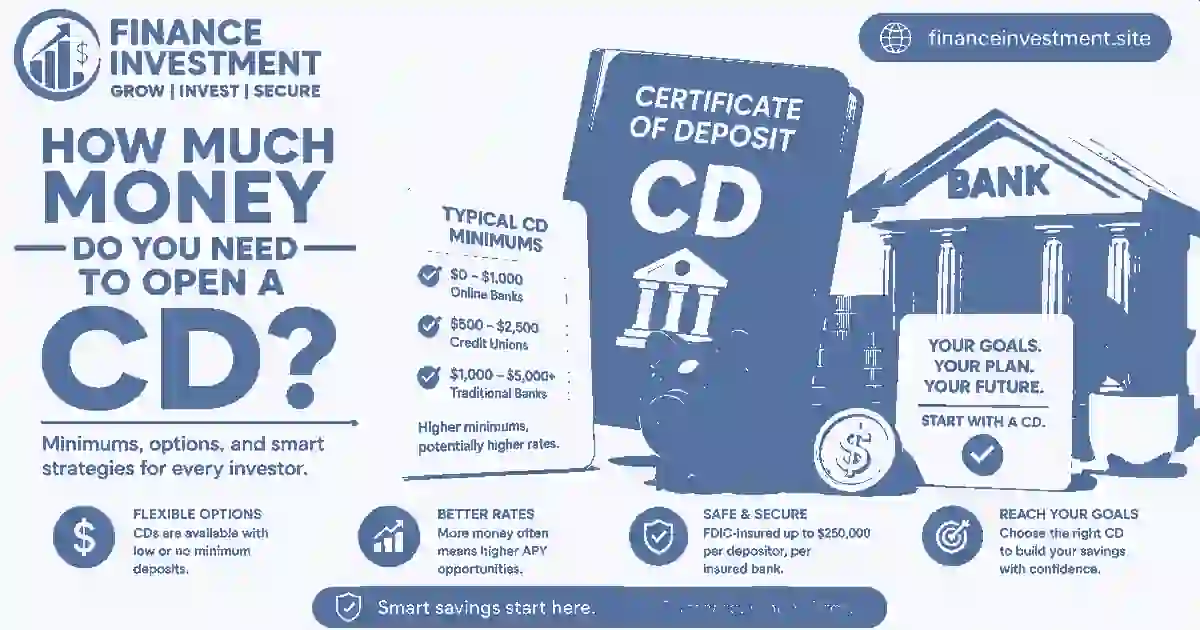
    How Much Money Do You Need to Open a CD?How much money do you need to open a CD? There is no single minimum that applies to every bank or credit union in the U.S. One CD might let you start with $0 or a very small amount, while another may ask for $500, $1,000, $2,500, or more. The amount depends on the financial institution, CD product, and sometimes the rate tier.

    That creates an important distinction: the minimum opening deposit is not necessarily the amount you should invest. A CD could accept $500, but that does not mean putting your entire emergency fund into it is a good idea. Your deposit should fit the goal, time frame, and cash you can comfortably leave untouched.

    APY matters, too, but it should not make the decision by itself. A slightly higher rate may come with a larger minimum deposit, longer term, or less flexibility. Meanwhile, a CD with a lower minimum could give you more room to build savings gradually.

    If you want the bigger picture before choosing a deposit amount, explore our CD Guide 2026.

    What You’ll Learn

    • How CD minimum deposits vary between institutions
    • What $0, $500, $1,000, and $2,500 minimums can mean
    • How to choose a deposit that fits your goal
    • Why liquidity matters before funding a CD
    • How minimum deposits can affect your CD choices

    Quick Answer: How Much Do You Need to Open a CD?

    There is no universal CD minimum. Depending on the institution and product, you may find CDs with no minimum opening deposit, while others require $500, $1,000, $2,500, or more. Always check the specific CD’s terms before transferring money.

    6 Key Takeaways

    1. Minimums vary: Banks and credit unions set their own opening requirements.
    2. No-minimum CDs exist: Some products let you start with a very small amount.
    3. $500 to $1,000 is common territory: Many mainstream CD products use a defined minimum, although requirements differ.
    4. Higher deposits can unlock different rates: Some institutions offer rate tiers based on how much you deposit.
    5. Don’t drain your cash to meet a minimum: Money needed for emergencies or near-term bills generally belongs somewhere accessible.
    6. APY isn’t the whole decision: Compare the minimum deposit, term, withdrawal rules, and potential earnings together.

    Bottom line: You may be able to open a CD with very little money, but the best starting amount is the one that meets the product’s minimum without putting your everyday financial cushion at risk.

    CD Minimum Deposits at a Glance

    The amount needed to open a CD can range from very little to several thousand dollars. What matters is not just the entry point, but whether the deposit level fits the CD’s rate, term, and your savings goal.

    Opening AmountPotential UseWhat to Watch
    $0–$500Good starting range for smaller savers or people testing a CD strategy.Check whether the rate is competitive and whether there are balance requirements.
    $1,000A practical starting point for a dedicated savings goal.Compare the interest earned with CDs requiring smaller or larger deposits.
    $2,500+Useful for larger goal-based savings when the money can remain locked.A higher minimum does not automatically mean a better APY.

    For perspective, a $500 CD earning 4% would generate far less interest in dollars than a $2,500 CD at the same rate. The difference comes from the principal, not a special tax or bonus. Actual earnings depend on the APY, term, compounding, and product rules.

    Complete Beginner Guide to CD Minimum Deposits

    How Much Money Do You Need to Open a CDA CD minimum deposit is simply the amount a financial institution requires you to place into that specific certificate when you open it. It is a product rule, not a universal industry standard. Two CDs offered by different institutions can have completely different entry requirements.

    Why Do CD Minimums Differ?

    Banks and credit unions design CDs for different types of savers. An online bank may offer a low-minimum CD to attract smaller deposits, while another institution may set a higher threshold for a particular rate or term. Credit unions can also have their own deposit requirements, along with membership rules.

    No-Minimum CDs

    Some CDs have no stated minimum deposit or allow a very small opening amount. That can be useful if you are building savings gradually. However, no minimum does not automatically mean the product offers the best rate, flexibility, or overall value.

    Minimum Deposit vs. Balance Requirement

    Do not confuse the amount needed to open a CD with a later balance requirement. A CD might require $1,000 to open but not impose a separate ongoing minimum because the certificate is designed to remain invested until maturity. Always read the product’s terms instead of assuming every savings-account rule applies to CDs.

    Rate Tiers and Promotional CDs

    Some institutions use balance tiers. For example, one APY may apply at $1,000 while a different rate is available at a higher deposit level. Promotional CDs may also have special minimums or eligibility requirements. A higher deposit should only be used if the extra return justifies tying up more cash.

    Banks, Credit Unions and Brokered CDs

    Traditional and online banks can have different minimums, while credit unions may combine CD requirements with membership eligibility. Brokered CDs work differently because they are purchased through a brokerage rather than directly from the issuing bank. Minimum purchase amounts can vary by offering.

    Before funding any CD, check the minimum deposit, APY, term, early-withdrawal rules, maturity instructions, insurance status, and whether the quoted rate applies to your entire deposit. That short checklist can prevent an attractive-looking CD from becoming the wrong fit.

    How Opening a CD Works From Start to Finish

    Once you have found a CD that fits your goal, the opening process is usually straightforward. The important part is confirming exactly what you are agreeing to before the money leaves your checking or savings account.

    1. Choose the CD and Confirm the Terms

    Start with the term, APY, opening deposit, and withdrawal rules. Check whether the advertised rate applies to the amount you plan to deposit. Also confirm whether the CD automatically renews when it reaches maturity.

    2. Open and Fund the Certificate

    After completing the application, you typically transfer or deposit the required amount. Once the CD is funded, the institution records the principal, APY, term, and maturity date. Keep the confirmation because these details are useful when you later compare the maturity offer.

    3. Let the CD Run Until Maturity

    Your deposit remains in the certificate according to its terms while interest accrues under the stated rate. Depositing more than the minimum generally means you have more principal earning interest. It does not necessarily mean the institution will give you a higher APY unless a separate rate tier applies.

    4. Decide What Happens at Maturity

    When the CD matures, you may be able to withdraw the principal and interest, move the money elsewhere, or renew the certificate. Some institutions provide a grace period for making that choice. If you take no action, automatic renewal may occur.

    Illustrative Example

    Imagine a CD requires $1,000 to open. You decide to deposit $3,000 because the money is earmarked for a future expense. If the CD’s APY applies to the full balance, all $3,000 can earn interest according to the product terms. The larger deposit increases potential earnings, but it also means more cash is committed until maturity.

    Benefits & Drawbacks of Different CD Minimums

    The amount required to open a CD can shape who can use the product and how much flexibility remains after the account is funded. A low minimum can make CDs easier to access, while a larger deposit may make sense for a clearly defined savings goal.

    ✓ Pros

    • Lower entry point: A small minimum can help new savers start without waiting years to build a large balance.
    • More choice: No-minimum or low-minimum CDs can open up products that may otherwise be out of reach.
    • More interest with more principal: When the APY is the same, a larger deposit generally produces more interest in dollar terms.
    • Potential rate tiers: Some products offer different APYs at higher deposit levels.

    â–³ Cons

    • More money gets locked away: Funding a CD with a large balance can leave less cash immediately available.
    • A higher minimum isn’t automatically better: A $2,500 minimum does not guarantee a superior APY.
    • Rate tiers can be misleading: A higher APY may require more money than you actually want to commit.
    • Small balances earn less: A low minimum makes opening easier, but the dollar return may remain modest.

    The sweet spot is usually the amount you can commit comfortably without sacrificing money needed for emergencies or upcoming expenses. A CD should serve the savings goal—not force the savings goal to fit the CD.

    CD Minimum Deposit Comparison

    The minimum deposit is only one piece of the decision. A CD with a lower entry point may be easier to access, while a larger certificate can generate more interest. The better comparison looks at the deposit requirement alongside APY, term, access, and the institution behind the product.

    CD TypeTypical Entry PointWhat to Compare
    No-minimum CDVery low or no stated minimumAPY, term, account requirements, and whether the low entry point comes with trade-offs.
    $500 CD$500Useful for smaller goal-based balances; compare earnings with lower-minimum alternatives.
    $1,000 CD$1,000A common benchmark for comparing rates, terms, and potential interest.
    $2,500+ CD$2,500 or moreCheck whether a higher balance actually earns a better APY.
    Brokered CDVaries by offeringIssuing bank, minimum purchase, maturity, liquidity, and brokerage terms.

    Online banks often compete with attractive rates and lower overhead, while traditional banks may emphasize branch access. Credit unions can offer competitive certificates but may have membership requirements. Brokered CDs add another layer because you purchase through a brokerage rather than directly from the issuing institution.

    If you are comparing the amount you can earn after choosing a deposit, see our guides to 1-year CD rates and 5-year CD rates for term-specific research.

    Costs, Risks & Expert Tips Before Funding a CD

    A CD’s minimum deposit can look harmless until it forces you to move money that had another job. The real cost of meeting a higher minimum is sometimes the flexibility you give up elsewhere.

    Watch the Opportunity Cost

    Suppose a CD requires $2,500 while another suitable option accepts $500. Putting the extra $2,000 into the first CD may produce more interest, but that money is no longer sitting in an easily accessible account. If you need it unexpectedly, an early withdrawal could reduce your return.

    Don’t Use Your Emergency Cushion to Reach a Minimum

    A CD is generally better suited to money with a known purpose and time horizon. Keep enough readily available cash for emergencies, upcoming bills, and expenses that cannot wait until maturity.

    Check Whether the Higher APY Is Worth the Extra Deposit

    A rate tier can make a larger deposit attractive, but calculate the actual dollar difference. A small APY improvement may not justify committing substantially more money. Compare the expected interest, term, and access rules together.

    Pay Extra Attention to Brokered CDs

    With a brokered CD, verify the actual issuing bank, maturity date, purchase amount, and how the investment can be sold before maturity. The brokerage platform is not necessarily the institution providing the deposit insurance.

    Verify the Institution Before You Fund It

    For a bank CD, confirm that the institution is FDIC-insured. For a credit-union certificate, check whether the credit union is federally insured through the NCUA. Also review the coverage structure if you already hold other deposits at the same institution.

    Premium Expert Tip

    Choose your deposit amount backward from your financial goal. First decide how much cash you can safely leave untouched. Then compare CDs that accept that amount. Don’t increase your deposit simply to qualify for a slightly better APY.

    Common CD Opening Mistakes + Real-Life Example

    The amount you need to open a CD is easy to find on an account page. The harder part is deciding whether that minimum fits your financial situation. A few common mistakes can turn a simple savings decision into an unnecessary constraint.

    Mistakes to Avoid

    • Assuming every CD has the same minimum: Requirements can vary by institution, term, and product.
    • Chasing the highest APY: A higher rate may require more money or a longer commitment.
    • Using emergency cash: Money you may need immediately should not be committed simply to satisfy a CD minimum.
    • Overfunding for a rate tier: Don’t move thousands of extra dollars just to qualify for a slightly better APY without checking the actual benefit.
    • Ignoring insurance status: Confirm whether the institution providing the CD is FDIC-insured or, for an eligible credit union, federally insured through the NCUA.
    • Missing brokered-CD details: If you buy through a brokerage, identify the actual issuing bank and understand the maturity and liquidity terms.

    Real-Life Example: Kevin Has $4,000 to Save

    Kevin has $4,000 set aside for a car purchase next year. He finds a CD requiring $2,500 with a slightly higher APY than another CD requiring $500. He considers putting the entire $4,000 into the higher-rate option.

    Illustrative calculation only: If the higher-rate CD earns an extra 0.25 percentage point on $4,000 for one year, the simple difference is about $10 before taxes. That modest gain may not justify giving up flexibility for money tied to a known near-term expense.

    Kevin instead considers how much he can safely commit and keeps the rest accessible. His decision is based on the job of the money, not just the largest APY on the screen.

    Practical lesson: A CD minimum is a gate, not a target. Meet the requirement with money that genuinely fits the CD’s time frame, and let the purpose of your savings guide the amount you deposit.

    Who Should Choose a CD Based on Their Available Cash?

    The right CD deposit depends less on a magic number and more on what the money is supposed to do. A modest balance can still have a useful role when the goal and maturity date are clear.

    Small Savers and Goal-Based Savers

    If you have $500 to $1,000 set aside for a future expense, a low-minimum CD can be a practical way to separate that money from everyday spending. It can work well for a planned purchase, tuition payment, holiday expenses, or another goal with a known time frame.

    Larger Balances, Families and Retirees

    People with larger cash reserves may use CDs to divide money across different maturity dates instead of committing everything at once. Families and retirees can use this approach for predictable future expenses while keeping other cash available for unexpected needs.

    When Flexible Savings May Be Better

    If you do not have a separate emergency reserve, a CD may not be the best place for money you could need tomorrow. The same is true for cash needed for rent, medical expenses, debt payments, or other near-term obligations.

    Quick Decision Guide

    Need the money soon? Keep it flexible. Have a separate emergency fund? A CD may fit. Have a larger balance? Consider spreading maturity dates rather than locking everything into one certificate.

    Frequently Asked Questions About Opening a CD

    What is the minimum amount to open a CD?

    There is no universal minimum. Some CDs have no stated minimum, while others may require $500, $1,000, $2,500, or more. Check the specific product terms before opening.

    Can you open a CD with $100?

    Yes, if the institution offers a CD with a $100-or-lower opening requirement. Minimums vary, so compare the product terms rather than assuming every CD accepts the same amount.

    Are there no-minimum CDs?

    Yes. Some institutions offer CDs without a stated minimum deposit. These can be useful for smaller savers, although a no-minimum CD is not automatically the highest-paying option.

    Is $500 enough to open a CD?

    It can be. If the CD’s required opening deposit is $500 or less, that amount may be enough. The APY, term, and withdrawal rules still matter.

    Is $1,000 enough to open a CD?

    For a CD requiring $1,000 or less, yes. A $1,000 deposit can also provide a useful starting point for a specific savings goal.

    Do banks and credit unions have different CD minimums?

    They can. Each institution sets its own product requirements. Credit unions may also have membership eligibility rules in addition to the certificate’s deposit requirement.

    Do higher deposits earn higher APYs?

    Sometimes. Certain CDs use balance tiers, but a larger deposit does not automatically qualify for a higher rate. Check the rate schedule for the specific certificate.

    Can you add money after opening a CD?

    Usually, a standard CD does not work like a savings account where you can freely add money throughout the term. Some specialized products may allow additional deposits, so read the account terms first.

    What are typical brokered CD minimums?

    Brokered CD purchase requirements vary by brokerage and offering. Check the minimum purchase amount, issuing bank, maturity date, and transaction terms before buying.

    Illustrative: How much can a $1,000 CD earn?

    Illustrative calculation only: A $1,000 CD earning a hypothetical 4% APY for one year would generate about $40 in interest before taxes. Actual earnings depend on the APY, term, compounding method, and CD terms.

    Final Verdict: How Much Money Should You Put Into a CD?

    There is no single amount you need to open a CD. The institution and specific certificate determine the minimum. Some products may accept a small deposit, while others require $500, $1,000, $2,500, or more.

    But the minimum is only the starting line. The amount you can deposit and the amount you should deposit are two different questions. If $500 or $1,000 meets the CD’s requirement and the money has a clear purpose and time frame, either amount can be a sensible starting point.

    Don’t stretch your budget just to qualify for a higher APY. Money needed for emergencies, bills, or near-term expenses should remain accessible. A slightly better rate is rarely worth creating a cash shortage.

    Before choosing a certificate, compare the minimum, APY, term, early-withdrawal rules, insurance status, and maturity options. Our CD Guide 2026 can help you put those pieces together.

    Practical takeaway: Start with the amount your financial plan can comfortably commit—not the largest deposit a CD will accept.

    FINANCEINVESTMENT

    Keep Building Your CD Strategy

    Want more practical guidance on CDs, rates, savings, and everyday investing? Send a note to join the FinanceInvestment newsletter and get useful money ideas without the noise.

    📧 subhashr325@gmail.com

    A thoughtful CD choice starts with the amount you can comfortably commit, not simply the largest balance a bank will accept.