AI Spending Analysis: Where Your Money Really Goes in 2026
Author: Subhash Rukade
Published: June 15, 2026
Why Understanding Your Spending Matters More Than Ever
Most Americans know how much they earn.
Far fewer know exactly where their money goes every month.
That disconnect is one of the biggest reasons people struggle to build savings, reduce debt, and grow investments.
In 2026, rising living costs, subscription overload, impulse purchases, and digital payment convenience make it easier than ever to lose track of spending.
A quick coffee, a streaming subscription, a food delivery order, and an online purchase may seem insignificant individually.
However, when repeated throughout the month, these small expenses can quietly consume thousands of dollars every year.
This is where AI Spending Analysis is changing personal finance.
Modern AI-powered financial tools can automatically track transactions, categorize expenses, identify spending patterns, and reveal hidden financial leaks that many consumers never notice on their own.
Instead of manually reviewing bank statements and spreadsheets, users receive clear insights into where their money is actually going.
For investors, this information is extremely valuable.
Every unnecessary dollar spent is a dollar that cannot be invested for future growth.
Many Americans discover that improving spending habits creates more wealth-building opportunities than trying to find the next hot investment.
Artificial intelligence is rapidly becoming a powerful financial assistant for budgeting, saving, investing, and long-term money management.
Readers interested in the broader impact of artificial intelligence on investing and financial planning should also explore our
AI Investing Guide 2026.
Throughout this guide, you’ll learn how AI Spending Analysis works, where Americans typically overspend, common financial mistakes, practical savings strategies, and how AI can help transform everyday spending decisions into long-term wealth-building opportunities.
By the end, you’ll have a clearer understanding of where your money really goes—and how to take greater control of it.
Understanding AI Spending Analysis in 2026
The average American completes hundreds of financial transactions every month.
From groceries and gas to streaming subscriptions and online shopping, money moves quickly through bank accounts and credit cards.
Unfortunately, most people do not have the time to manually review every transaction.
This is why AI Spending Analysis has become one of the most valuable personal finance tools available in 2026.
AI Spending Analysis uses artificial intelligence to examine spending behavior, categorize expenses, identify patterns, and provide personalized recommendations that help consumers make smarter financial decisions.
What Is AI Spending Analysis?
AI Spending Analysis is the process of using artificial intelligence to automatically review financial transactions and generate insights about spending habits.
Instead of relying on spreadsheets or manual tracking, AI systems continuously monitor financial activity and organize purchases into categories.
This allows consumers to quickly understand where their money is going.
Many AI-powered financial apps connect directly to checking accounts, savings accounts, credit cards, and investment platforms.
Once connected, they begin analyzing financial behavior almost immediately.
How AI Categorizes Transactions
One of the biggest advantages of AI Spending Analysis is automatic categorization.
Artificial intelligence can identify spending patterns and place transactions into categories such as:
- Housing
- Utilities
- Transportation
- Groceries
- Restaurants
- Subscriptions
- Healthcare
- Shopping
- Entertainment
- Travel
This organization makes spending behavior much easier to understand.
Instead of seeing hundreds of individual transactions, users see a clear breakdown of how money is being spent.
Real-Time Expense Tracking
Traditional budgeting often relies on reviewing expenses after the month has ended.
AI Spending Analysis works differently.
Many platforms provide real-time updates whenever spending occurs.
This gives consumers immediate visibility into financial activity.
Real-time tracking helps prevent overspending before it becomes a problem.
Users can identify budget issues early and make adjustments quickly.
AI-Powered Budget Insights
Tracking expenses is only part of the process.
AI Spending Analysis also generates personalized insights based on spending behavior.
For example, the system may identify:
- Increasing dining expenses
- Unused subscriptions
- High discretionary spending
- Unusual transactions
- Opportunities to increase savings
These insights help consumers make informed financial decisions without manually analyzing large amounts of data.
Spending Alerts and Notifications
Many AI-powered budgeting tools provide automated alerts.
Users can receive notifications when:
- Spending exceeds budget limits
- Large purchases occur
- Subscription prices increase
- Account balances fall below target levels
- Potential savings opportunities are detected
These alerts help improve financial awareness and reduce unnecessary spending.
Benefits of AI Spending Analysis
There are several reasons why millions of Americans now use AI Spending Analysis tools:
- Automatic expense tracking
- Real-time financial insights
- Improved budgeting accuracy
- Better spending awareness
- Identification of hidden expenses
- Personalized savings recommendations
- More efficient money management
Consumers looking to expand their AI-powered financial strategy should also review our
AI Personal Finance 2026
guide.
Limitations of AI Spending Analysis
Although AI Spending Analysis is extremely useful, it is not perfect.
Artificial intelligence can identify patterns and trends, but it does not fully understand personal priorities, family goals, or emotional factors that influence spending decisions.
This is why consumers should use AI insights as guidance rather than blindly following every recommendation.
When combined with personal judgment and financial discipline, AI Spending Analysis can become a powerful tool for building stronger financial habits.
In the next section, we’ll explore where Americans actually spend most of their money and uncover the biggest spending categories impacting household budgets in 2026.
Where Americans Really Spend Their Money in 2026
One of the biggest surprises people experience after using AI Spending Analysis is discovering how different their actual spending habits are from what they believed.
Many consumers think they have a clear understanding of where their money goes.
However, AI Spending Analysis often reveals hidden patterns, overlooked expenses, and spending categories that consume a larger portion of income than expected.
Understanding these categories is essential because every dollar saved can potentially be redirected toward investing and wealth building.
1. Housing: The Largest Expense for Most Americans
Housing remains the biggest expense category for most households.
Mortgage payments, rent, property taxes, insurance, maintenance, and utilities often consume a substantial percentage of monthly income.
AI Spending Analysis frequently shows that housing costs account for 25% to 40% of total household spending.
While housing expenses are often difficult to reduce significantly, AI tools can identify opportunities to lower utility bills and improve overall efficiency.
2. Transportation Costs Continue Rising
Transportation is another major spending category.
Vehicle payments, fuel, maintenance, insurance, parking, and rideshare services can add up quickly.
Many Americans underestimate transportation expenses because costs are spread across multiple transactions throughout the month.
AI Spending Analysis consolidates these expenses into one category, making them easier to evaluate.
3. Food and Dining Expenses
Food spending is one of the areas where AI Spending Analysis often uncovers surprising insights.
Small restaurant purchases, food delivery fees, coffee runs, and convenience purchases may seem harmless individually.
However, over the course of a year, these expenses can become substantial.
Many users discover that dining-related spending exceeds their expectations by thousands of dollars annually.
4. Subscription Spending
The subscription economy continues expanding in 2026.
Streaming services, software subscriptions, fitness memberships, cloud storage, gaming platforms, and premium apps create recurring monthly charges.
Many households pay for services they rarely use.
AI Spending Analysis is particularly effective at identifying forgotten subscriptions and recurring charges that quietly drain cash flow.
5. Shopping and Impulse Purchases
Online shopping has made spending easier than ever.
With one-click purchasing and mobile payment systems, impulse buying has become a major challenge for many consumers.
AI Spending Analysis can identify spending spikes and reveal behavioral patterns that contribute to unnecessary purchases.
Recognizing these trends is often the first step toward reducing wasteful spending.
6. Entertainment and Lifestyle Spending
Entertainment spending includes streaming platforms, sporting events, concerts, hobbies, gaming, and leisure activities.
These expenses are important for quality of life, but they can sometimes grow beyond intended limits.
AI Spending Analysis helps consumers maintain balance between enjoying life today and preparing for future financial goals.
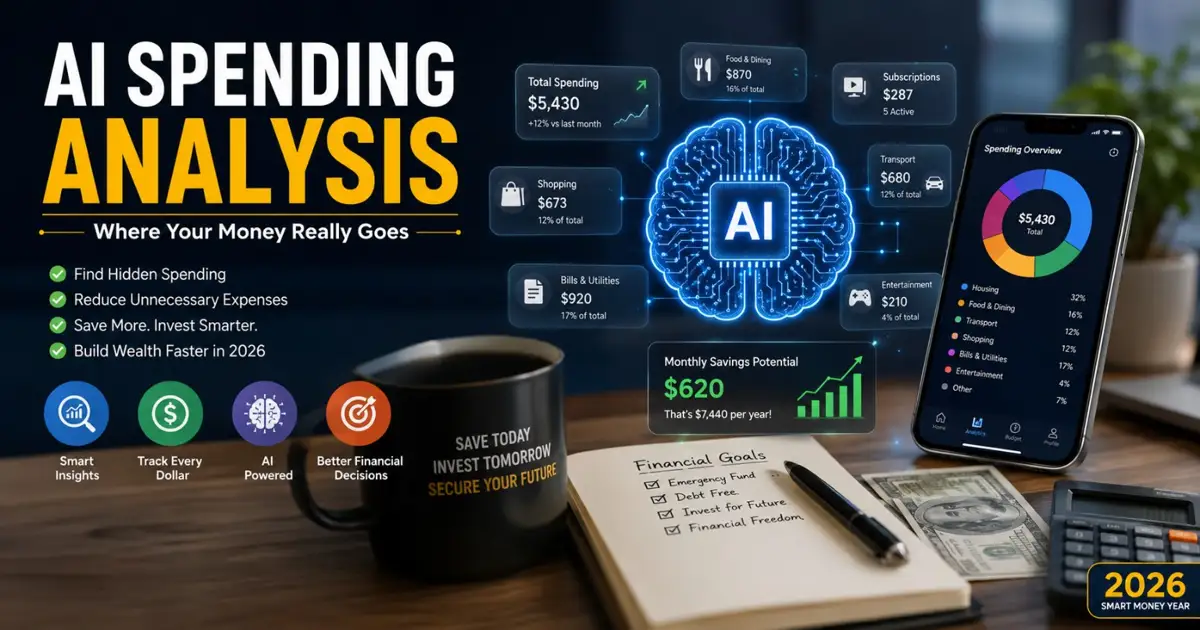
📊 Average Household Spending Categories (Example)
| Category | Estimated Share of Monthly Spending |
|---|---|
| Housing | 35% |
| Transportation | 15% |
| Food & Dining | 13% |
| Healthcare | 8% |
| Subscriptions | 5% |
| Entertainment | 7% |
| Shopping | 10% |
| Other Expenses | 7% |
Why This Information Matters for Investors
The goal of AI Spending Analysis is not simply tracking expenses.
The goal is identifying opportunities to free up cash that can be used more effectively.
For example, reducing subscription spending by $50 per month creates an additional $600 annually.
When invested consistently, small savings can grow into meaningful long-term wealth.
Consumers looking to maximize spending efficiency should also review our
Best Credit Cards 2026
guide.
📘 Recommended Reading:
The Psychology of Money by Morgan Housel
The most important lesson from AI Spending Analysis is simple:
You cannot improve what you do not measure.
Once spending patterns become visible, smarter financial decisions become much easier to make.
Real-World Case Study: How AI Spending Analysis Exposed Hidden Spending Leaks
Many Americans believe they have a good understanding of their spending habits.
However, once they begin using AI Spending Analysis, the results are often surprising.
Small purchases, recurring charges, and overlooked expenses can quietly drain thousands of dollars every year.
The following case study demonstrates how artificial intelligence helped one investor uncover hidden spending leaks and improve overall financial health.
Meet Michael, a 38-year-old professional from Florida earning approximately $92,000 per year.
Despite earning a solid income, he struggled to increase his savings account balance and felt frustrated that he never seemed to have enough money available for investing.
To better understand his finances, Michael connected his bank accounts and credit cards to an AI Spending Analysis platform.

Step 1: AI Reviews 12 Months of Transactions
The AI system analyzed over 3,000 transactions from the previous year.
Within minutes, it identified spending patterns that Michael had never noticed.
Several categories stood out:
- Food delivery services
- Streaming subscriptions
- Online shopping purchases
- Coffee and convenience purchases
- Unused memberships
Individually, these expenses seemed small.
Collectively, they represented a significant amount of money.
Step 2: Hidden Spending Leaks Discovered
The AI Spending Analysis report revealed:
- Food Delivery: $285/month
- Streaming Services: $72/month
- Coffee Purchases: $118/month
- Impulse Shopping: $210/month
- Unused Memberships: $35/month
Michael was shocked.
He knew he spent money in these areas but never realized the total impact.
The AI system highlighted several opportunities to reduce spending without making major lifestyle sacrifices.
📊 Before vs After AI Spending Analysis
- Monthly Spending Before Review = $5,800
- Monthly Spending After Optimization = $5,420
- Monthly Savings Improvement = $380
- Annual Savings Potential = $4,560
By making a few adjustments, Michael immediately improved his monthly cash flow.
How the Savings Were Used
Instead of increasing discretionary spending, Michael redirected most of the savings toward:
- Emergency fund contributions
- Retirement investments
- Dividend stock purchases
This allowed him to strengthen both short-term financial security and long-term wealth-building goals.
📈 Case Study Summary
- Location: Florida
- Annual Income: $92,000
- Transactions Reviewed: 3,000+
- Monthly Savings Found: $380
- Annual Savings Potential: $4,560
- Time Required: Less Than One Hour
Key Lesson for Investors
The biggest lesson from this case study is that wealth building often starts with understanding spending behavior.
Many investors spend enormous amounts of time searching for better investments while ignoring spending leaks that could immediately improve financial results.
AI Spending Analysis provides visibility that many consumers simply do not have on their own.
Once hidden expenses become visible, making smarter financial decisions becomes much easier.
For many households, the fastest way to increase investable cash is not earning more money—it’s gaining a better understanding of where current money is actually going.
Common Spending Mistakes Americans Make
One of the biggest benefits of AI Spending Analysis is its ability to expose spending habits that often go unnoticed.
Many Americans work hard, earn good incomes, and still struggle to build wealth because small financial mistakes quietly accumulate over time.
These mistakes are rarely dramatic.
Instead, they involve everyday spending decisions that slowly reduce savings and limit investing opportunities.
Understanding these habits is the first step toward improving financial outcomes.
1. Lifestyle Inflation
Lifestyle inflation occurs when spending increases every time income increases.
A promotion, bonus, or raise should improve financial security.
However, many consumers immediately increase spending on cars, dining, entertainment, travel, or shopping.
As a result, higher earnings never translate into higher savings.
AI Spending Analysis often detects lifestyle inflation by comparing spending trends over time.
Many users are surprised to discover that expenses have risen almost as quickly as income.
2. Subscription Overload
Subscription services have become a major source of hidden spending.
Streaming platforms, cloud storage plans, fitness memberships, premium apps, software subscriptions, and online services can create dozens of recurring charges.
Because each charge seems small, consumers often overlook the total monthly cost.
AI Spending Analysis helps identify subscriptions that are rarely used and highlights opportunities to reduce recurring expenses.
3. Impulse Buying
Online shopping has made impulse purchases easier than ever.
One-click ordering, targeted advertisements, and mobile payment systems encourage spending without much planning.
While individual purchases may seem harmless, repeated impulse buying can significantly impact long-term financial goals.
AI tools frequently identify patterns showing that impulse purchases occur more often than consumers realize.
4. Emotional Spending
Money decisions are often emotional.
Many people spend more when they feel stressed, bored, excited, or frustrated.
This behavior can create spending habits that are difficult to recognize without objective analysis.
AI Spending Analysis tracks spending behavior over time and may reveal emotional patterns linked to specific situations or events.
Recognizing these triggers is often the first step toward better financial control.
5. Ignoring a Budget
Many households create budgets but rarely follow them consistently.
Others never create a budget at all.
Without clear spending limits, expenses can gradually drift beyond intended levels.
AI Spending Analysis provides continuous visibility, making it easier to stay aligned with financial goals.
6. Failing to Track Small Purchases
Large expenses attract attention.
Small purchases often do not.
Daily coffee runs, convenience-store purchases, food delivery fees, and minor online purchases may seem insignificant individually.
However, AI Spending Analysis frequently reveals that these transactions add up to hundreds or even thousands of dollars annually.
Example of How Small Expenses Grow
Consider the following monthly spending habits:
- Coffee Purchases = $120/month
- Food Delivery Fees = $150/month
- Unused Subscriptions = $40/month
- Impulse Shopping = $100/month
Total Monthly Impact = $410
Annual Impact = $4,920
This example demonstrates why spending awareness is so important.
Even small financial leaks can significantly reduce long-term wealth-building opportunities.
Investors looking to develop stronger saving habits should review our
SIP Investing Guide 2026.
Additionally, households preparing for uncertain economic conditions can benefit from our
Recession-Proof Investing 2026
guide.
The most successful investors understand that building wealth is not only about earning more money.
It is also about understanding where money goes and ensuring that spending decisions support long-term financial goals.
Practical Strategies to Reduce Spending and Build Wealth
Understanding spending habits is important, but lasting financial success comes from taking action.
The real value of AI Spending Analysis is its ability to turn financial insights into measurable improvements.
Once spending leaks become visible, investors can make smarter decisions that improve savings, increase investment contributions, and strengthen long-term financial security.
The following strategies can help Americans gain greater control over their money in 2026.
1. Automate Your Budget
One of the easiest ways to improve financial discipline is automation.
Many AI Spending Analysis platforms automatically categorize transactions, monitor spending limits, and generate monthly financial reports.
Automation reduces the need for manual budgeting and helps consumers stay informed about their finances.
Instead of reacting after overspending occurs, users receive real-time visibility into spending activity.
2. Set Clear Savings Goals
People are more likely to save when they have a specific goal.
Whether the objective is building an emergency fund, purchasing a home, funding retirement, or investing for passive income, clear goals improve motivation.
AI Spending Analysis tools can help identify how much money is available for saving each month.
Even small monthly contributions can create significant long-term results.
3. Use Spending Alerts
Many financial mistakes occur because consumers do not realize spending is increasing.
AI-powered alerts provide early warnings when expenses exceed normal levels.
These notifications help prevent overspending before it affects financial goals.
Spending alerts are particularly useful for dining, entertainment, subscriptions, and discretionary purchases.
4. Review Expenses Monthly
Financial reviews should not happen only once a year.
Monthly reviews help consumers identify trends, evaluate progress, and adjust spending behavior before problems become larger.
AI Spending Analysis makes these reviews much easier by organizing financial information automatically.
5. Invest the Money You Save
Reducing expenses creates an opportunity that many people overlook.
Instead of spending the extra cash elsewhere, investors can redirect those savings into wealth-building assets.
Dividend investing remains one of the most popular strategies for generating passive income.
If you’re interested in creating a long-term income stream, explore our
How to Build a Dividend Portfolio
guide.
You can also review our
Top Dividend Stocks USA 2026
article for additional ideas.
💰 Annual Savings Calculator Example
Assume AI Spending Analysis identifies the following opportunities:
- Dining Reduction = $100/month
- Subscription Savings = $50/month
- Impulse Purchase Reduction = $75/month
- Shopping Optimization = $50/month
Total Monthly Savings = $275
Annual Savings = $275 × 12 = $3,300
If invested consistently, that money could contribute significantly to long-term wealth accumulation.
Recommended Financial Resources
📘
Atomic Habits by James Clear
📘
The Psychology of Money by Morgan Housel
💰
Rocket Money Budgeting Platform
The goal of AI Spending Analysis is not simply spending less.
The goal is spending more intentionally.
When consumers understand where their money really goes, they gain the ability to align spending decisions with long-term financial goals and create a stronger financial future.
Future of AI Spending Analysis (2026–2030)
The future of AI Spending Analysis looks incredibly promising.
What began as a simple budgeting technology is rapidly evolving into a complete financial intelligence system capable of helping consumers make smarter money decisions every day.
Between 2026 and 2030, artificial intelligence is expected to become even more integrated into banking, investing, budgeting, and personal financial planning.
For millions of Americans, AI may become a permanent financial assistant working behind the scenes to improve financial outcomes automatically.
AI Financial Assistants Will Become Standard
Today’s AI Spending Analysis tools primarily focus on categorizing transactions and tracking expenses.
Future systems will do much more.
AI financial assistants may:
- Monitor spending continuously
- Predict future expenses
- Optimize savings contributions
- Track investment performance
- Recommend debt reduction strategies
- Identify financial risks before they become problems
Instead of simply reporting financial information, AI systems will increasingly help consumers make proactive decisions.
Predictive Spending Alerts
One of the most exciting developments is predictive spending analysis.
Rather than identifying problems after they occur, future AI Spending Analysis platforms may predict spending patterns before transactions happen.
For example, AI could recognize seasonal spending trends, holiday shopping behavior, or recurring expense increases and warn users in advance.
This capability could dramatically improve budgeting accuracy.
Hyper-Personalized Financial Planning
Artificial intelligence is becoming more personalized every year.
Future AI Spending Analysis systems will likely create recommendations based on individual goals, risk tolerance, income levels, family responsibilities, and spending habits.
Instead of generic budgeting advice, consumers will receive customized recommendations designed specifically for their financial situations.
This personalization may significantly improve financial outcomes.
Better Integration with Investing
Spending and investing are closely connected.
Future AI systems may automatically identify surplus cash and suggest investment opportunities that align with personal goals.
This could help consumers transition more easily from spending management to long-term wealth building.
The connection between AI Spending Analysis and investing is expected to become much stronger over the next decade.
Frequently Asked Questions
1. What is AI Spending Analysis?
AI Spending Analysis uses artificial intelligence to track transactions, categorize expenses, identify spending patterns, and provide personalized financial insights.
2. Can AI Spending Analysis really save money?
Yes. Many consumers discover hidden subscriptions, unnecessary spending habits, and budget inefficiencies that can be corrected immediately.
3. Is AI Spending Analysis safe?
Most reputable financial platforms use advanced encryption and security measures. Consumers should always choose trusted providers and follow good cybersecurity practices.
4. How often should spending be reviewed?
Monthly reviews are ideal. AI tools make this process much easier by organizing and summarizing financial activity automatically.
5. Can AI Spending Analysis help investors?
Absolutely. Understanding spending behavior often creates additional cash flow that can be redirected toward savings and investments.
6. Will AI replace financial advisors?
AI will likely complement financial advisors rather than replace them entirely. Human expertise remains valuable for complex financial planning and major life decisions.
Conclusion
The biggest lesson from AI Spending Analysis is simple:
Most financial problems begin with a lack of visibility.
When consumers understand where their money really goes, they gain the power to make better decisions.
Artificial intelligence helps reveal spending patterns, identify wasteful expenses, improve budgeting, and create opportunities for saving and investing.
For many Americans, AI Spending Analysis is becoming one of the most valuable tools available for improving financial health.
The same technology helping consumers understand spending behavior is also transforming investing, retirement planning, and wealth management.
To learn more about the future of AI-driven investing and financial planning, explore our
AI Investing Guide 2026.
For additional financial education resources, visit:
- Consumer Financial Protection Bureau (CFPB)
- U.S. Securities and Exchange Commission (SEC)
- Federal Reserve
📩 Join Our Free Finance Newsletter
Get AI investing insights, spending strategies, budgeting tips, and wealth-building ideas delivered directly to your inbox.
Subscribe today and take greater control of your financial future.
👨💼 About the Author
Subhash Rukade writes about AI, personal finance, investing, budgeting, and wealth-building strategies. His mission is to help readers make smarter financial decisions through practical, easy-to-understand financial education designed for modern investors.
🚀 Every dollar you understand is a dollar you can control, save, or invest.