How to Switch Checking Accounts Without Missing Payments
Updated August 9, 2026
10–12 Min Read
2026 Banking Guide
Changing banks doesn’t have to mean chasing missed bills, failed subscriptions, or a missing paycheck. This guide walks through the switch carefully so your everyday payments keep moving while you make the change.
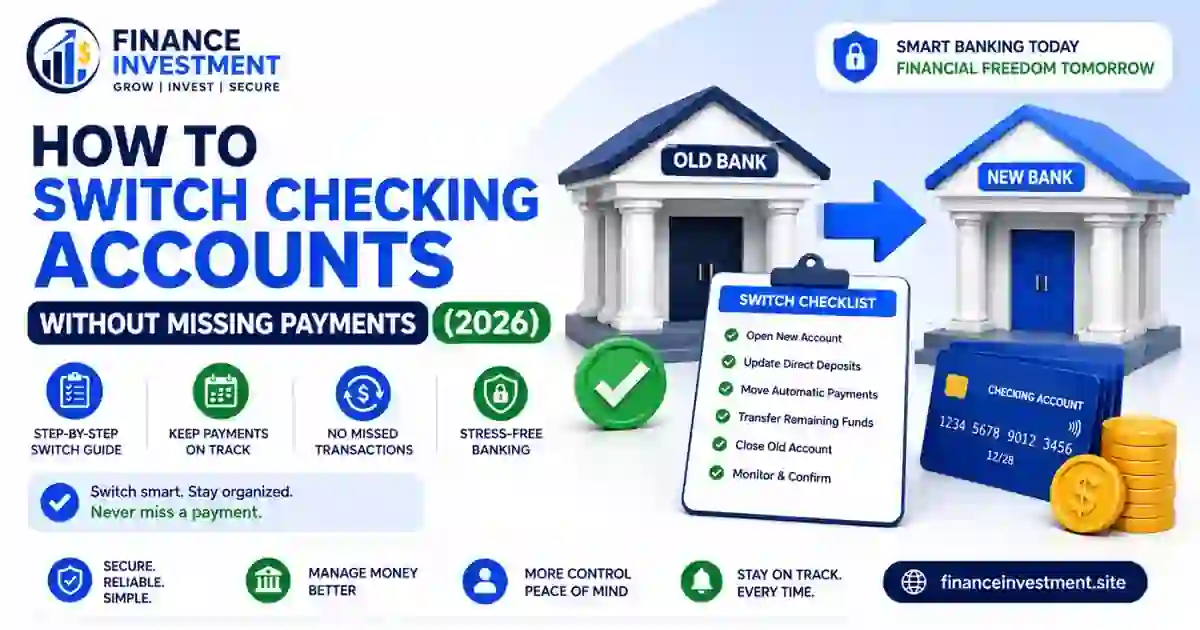 Changing banks sounds simple until you remember how many things are quietly connected to your checking account. A utility company may pull your payment automatically. A credit card may be set to pay the balance each month. Streaming services, loan payments, and other subscriptions can also charge the old account without sending you a reminder.
That’s why How to Switch Checking Accounts Without Missing Payments is really about timing, not just opening a new account. Moving your money too quickly can leave an automatic withdrawal pointing toward an account that no longer has enough funds.
A safer approach is to open the new account first, move your direct deposit, and update recurring withdrawals one by one. Keep enough money in the old account while those changes take effect. Once the last payment has cleared and you’re confident nothing important is still connected to it, closing the old account becomes much easier.
For a broader look at account types and banking choices, see our Checking Accounts USA 2026 guide.
What You’ll Learn
- How to plan the switch without disrupting regular payments.
- Which bills, subscriptions, and transfers need attention.
- When to move your paycheck and other direct deposits.
- How long to keep the old account open.
- How to check everything before finally closing it.
Think of the change as moving a busy financial mailbox: first set up the new address, then redirect everything, and only afterward retire the old one. With that picture in mind, let’s look at the quickest way to handle the switch safely.
Quick Answer & Key Takeaways
💡 Quick Answer
The safest way to switch checking accounts is to open the new account first, move your paycheck, update every recurring payment, and leave enough money in the old account until pending transactions have cleared. How to Switch Checking Accounts Without Missing Payments comes down to giving each change enough time to take effect.
📌 Key Takeaways
- Open the replacement account before closing the old one.
- Move direct deposit only after the new account is ready.
- Review bills, subscriptions, loan payments, and automatic transfers.
- Keep enough money in the old account for pending withdrawals.
- Check recent statements for payments you might have forgotten.
- Watch both accounts during the transition period.
Bottom line: Don’t treat the switch like a single-day task. A short overlap between the two accounts gives your paycheck and recurring payments time to move safely. Once the old account shows no remaining activity, you can close it with much less worry.
Now let’s lay out the guide so you can jump directly to the part you need.
Table of Contents
Moving a checking account involves more than transferring your balance. Use the links below to jump to the part you need, from planning the move to handling payments, comparing options, and closing the old account.
With the route mapped out, the next stop is a quick snapshot of the timing, payments, and account details worth checking before you make the move.
At a Glance
A smooth bank switch is mostly about timing. You want the new account ready before your paycheck and regular withdrawals leave the old one. How to Switch Checking Accounts Without Missing Payments becomes much easier when you treat the move as a short transition instead of shutting one account down immediately.
📌 Quick Facts
- Open the new account before closing the old one.
- Give direct deposit time to move successfully.
- Review every recurring withdrawal and subscription.
- Keep enough money available for pending transactions.
- Close the old account only after activity has stopped.
⭐ Best For
Anyone moving to a bank with lower fees, better features, stronger ATM access, or a more convenient setup.
| Task | Good Timing |
|---|---|
| Open new account | Before changing payments |
| Move direct deposit | After new account is active |
| Update automatic payments | One by one |
| Close old account | After final activity clears |
That basic timeline gives you a safer starting point. Now let’s walk through the actual switch, including what to move first and what deserves a final check before the old account is closed.
Complete Beginner Guide
 Switching checking accounts is easier when you handle the move in a sensible order. Start with the new account, not the old one. Compare monthly fees, ATM access, minimum-balance rules, mobile banking, and any features you actually use. Once you’ve chosen a bank, open the new account and make sure you can log in and access your account before changing anything else.
1. Open the New Account First
Give yourself some breathing room between opening the new account and closing the old one. Confirm the new account number and routing number, then make the required opening deposit. Keep your old checking account active while the transfer is underway.
2. Move Your Paycheck and Other Deposits
Update your employer’s direct-deposit information with the new routing and account numbers. Don’t assume the change happens immediately. Your employer or payroll provider may need time to process it. Other deposits, such as government payments or recurring transfers, may need separate updates.
3. Make a List of Every Automatic Payment
Look through several months of old statements. Check for electricity, internet, insurance, credit cards, loans, memberships, streaming services, phone bills, and automatic savings transfers. Change each payment method individually. A forgotten subscription can be just as troublesome as a missed utility bill.
💡 Did You Know?
Some payments may continue to arrive or leave the old account even after you’ve started using the new one. That’s why checking recent transactions is more reliable than assuming every connection has already moved.
4. Don’t Forget Checks, Apps, and Linked Services
Outstanding paper checks can still reach the old account. Also review payment apps, budgeting tools, brokerage accounts, savings accounts, and any service that stores your old banking information. If you use a debit card for recurring purchases, update those merchants as well.
For a better understanding of the account you’re moving from, see our guide to how checking accounts work.
5. Keep Money in the Old Account
Don’t move every dollar out just because the new account is ready. Leave enough to cover pending checks, automatic withdrawals, and charges that haven’t posted yet. Watch both accounts regularly during this overlap.
A Real-Life Example
Sarah opened a new checking account because it had fewer monthly fees. She moved her paycheck and changed her phone bill and credit-card payment. Before closing the old account, she reviewed three months of statements and spotted an annual insurance payment scheduled for the following week. She left enough money behind, updated the insurer, and waited until the payment cleared. Only then did she close the old account.
That’s the safer way to approach How to Switch Checking Accounts Without Missing Payments: give the new account time to take over while the old one remains available for anything that hasn’t made the move yet.
Once the last pending transaction has cleared and you’ve checked your statements carefully, closing the old account becomes much less stressful. Next, we’ll look at what actually happens behind the scenes as each part of the switch takes effect.
How It Works
A checking-account switch usually happens in stages rather than all at once. The new account can be ready within a short time, but your paycheck, bills, subscriptions, and other transactions may each follow their own schedule. Giving those changes time to settle is what helps prevent an avoidable missed payment.
Start With the New Account
After opening the replacement account, confirm that online banking works and that your debit card and account details are available. Fund the account before moving important payments. This gives you a working destination for your money rather than trying to move everything while the new account is still being set up.
Give Each Change Time to Take Effect
Direct deposit may require a payroll cycle or more to switch. A credit-card company might process an updated payment account on a different schedule. Subscriptions can follow yet another timetable. That’s why changing everything on the same day isn’t always the safest choice.
Watch Both Accounts
During the overlap, check both accounts for deposits, withdrawals, checks, and pending charges. Keep enough money in the old account to cover anything that has not cleared. At the same time, make sure the new account has enough available funds for payments you’ve already moved.
For example, Mark changed his checking account on a Friday. His paycheck went to the new bank the following week, but his car payment still pulled from the old account. Because he had left enough money there, the payment went through without a problem. He updated the lender afterward and continued watching the old account until no further activity appeared.
🔎 A Simple Timing Check
Before closing the old account, review recent statements and confirm that your paycheck, recurring bills, subscriptions, transfers, and outstanding checks have been accounted for. Our guide to opening a checking account online can also help when you’re setting up the replacement account.
The process is much easier when you treat the old account as a temporary bridge rather than something that has to disappear immediately. Once the activity has settled, you can make the final move with confidence. Now let’s look at the benefits of switching, along with a few situations where changing accounts may not be worth the trouble.
Benefits & Drawbacks
A new checking account can be a worthwhile move when your current bank no longer gives you good value. Maybe the monthly fee has become annoying, your nearest ATM is too far away, or the mobile app makes simple tasks harder than they should be. Still, changing accounts takes some attention, especially when several payments are attached to the old one.
✅ Pros
- Lower monthly fees can leave more money in your account.
- A larger ATM network can make cash withdrawals easier.
- Better mobile banking may simplify transfers, deposits, and alerts.
- A new bank may offer features your current account lacks.
- Changing banks can make sense when your needs have changed.
❌ Cons
- You have to update bills, subscriptions, and payment information.
- A forgotten automatic withdrawal can cause trouble.
- Keeping two accounts open temporarily may mean paying two fees.
- Some transfers or direct deposits take time to move.
- The process requires careful checking before the old account is closed.
For example, Lisa switched banks because her old account charged a monthly fee. The new account had no monthly charge and a larger ATM network. She spent an afternoon updating her utility bill, gym membership, credit-card payment, and direct deposit. The extra work was worth it, but she kept the old account open until everything had cleared.
That’s the trade-off with How to Switch Checking Accounts Without Missing Payments: the long-term benefits can be attractive, but the changeover deserves attention. Before choosing a new account, it helps to compare the two options side by side.
Comparison Table
Before moving everything to a new bank, compare what you have now with what you’re getting. A lower fee is helpful, but it shouldn’t be the only reason to switch. Look at the everyday details that affect how you receive money, pay bills, withdraw cash, and manage the account.
📘 How to Read This Table
Start with the features you use every week. Then check the costs and rules that could create problems later. The new account should offer a clear advantage without making your regular banking harder.
| Feature | Old Account | New Account | What to Check |
|---|---|---|---|
| Monthly Fee | Current charge | New charge | How to avoid the fee |
| ATM Access | Existing network | New network | Locations and out-of-network charges |
| Mobile Banking | Current features | New features | Alerts, transfers, mobile deposit |
| Direct Deposit | Already active | Needs updating | Payroll processing time |
| Automatic Payments | Existing withdrawals | Payments to move | Bills, subscriptions, loans |
| Minimum Balance | Current requirement | New requirement | Fee waiver conditions |
| Overdraft Rules | Existing policy | New policy | Fees and protection options |
| Customer Support | Current access | New support options | Phone, branch, and online help |
| Account Closure | Still active | Replacement account | Wait for pending activity |
A useful new account should make everyday banking easier, not simply look cheaper on paper. For a broader comparison of account choices, you can also read our Online Banks vs. Traditional Banks guide.
This comparison also highlights why closing the old account too early can be risky. Before making the final move, take a closer look at fees, possible charges, and the small risks that can show up during the overlap.
Costs, Risks & Expert Tips
A bank switch can save you money, but the changeover itself can create a few charges. Check the new account’s monthly fee and any minimum-balance rule before moving your paycheck. Keeping two accounts open for a short period may also mean paying two monthly charges if neither account offers a fee waiver.
ATM costs deserve attention too. A bank with a smaller network could leave you paying out-of-network fees when you need cash. Overdrafts are another concern. A forgotten bill hitting the old account after you’ve moved most of the money can push the balance below zero.
Subscriptions and automatic payments are easy to overlook because they may charge only once a month, every few months, or once a year. Review several months of statements instead of relying on memory. That can reveal insurance premiums, annual memberships, loan payments, or less frequent transfers.
💡 Expert Tip
Keep a simple checklist with three columns: payment name, old account, and new account. Mark each item only after the company confirms the new banking details. It gives you a quick record of what’s already moved and what’s still waiting.
⚠️ Warning
Don’t empty the old account immediately after opening the new one. A payment you forgot about can still arrive, and an insufficient balance could lead to an overdraft or returned payment. Keep a reasonable cushion until you’ve confirmed that the old account is no longer being used.
This is where How to Switch Checking Accounts Without Missing Payments becomes a practical exercise in patience. Give each payment time to move, check both accounts, and pay attention to the fee schedule. A few extra minutes of checking can prevent an avoidable charge later.
With the costs under control, there’s one more area worth watching: simple mistakes. The next section looks at the errors people commonly make and what a real bank switch can look like when something gets overlooked.
Common Mistakes + Real-Life Example
Most problems during a bank switch aren’t caused by the new account itself. They happen when one small payment or old connection gets overlooked. A careful checklist makes How to Switch Checking Accounts Without Missing Payments much easier to manage.
- Closing the old account too soon: Wait until pending activity and outstanding checks have cleared.
- Forgetting an annual payment: Look beyond monthly statements for insurance, memberships, taxes, or other yearly charges.
- Moving direct deposit too early: Confirm the new account is active before changing payroll information.
- Leaving too little money behind: Keep enough available for withdrawals that haven’t posted yet.
- Missing subscriptions: Review streaming services, apps, cloud storage, and other digital memberships.
- Ignoring linked financial accounts: Update brokerage, savings, payment apps, and budgeting tools that use the old account.
- Overlooking pending checks: Paper checks can arrive after you’ve started using the new bank.
- Not confirming changes: Don’t assume a company updated your payment details until you’ve received confirmation.
✅ Avoid These Mistakes
- ✔ Keep both accounts available during the transition.
- ✔ Check several months of statements.
- ✔ Mark every payment after its banking details are changed.
- ✔ Leave a reasonable balance for pending transactions.
- ✔ Check the old account one final time before closing it.
A Real-Life Example
Tom switched banks in early spring and moved his paycheck, utility bills, and credit-card payments without trouble. Two weeks later, his old account showed a $96 withdrawal from an insurance company. It was an annual premium he had completely forgotten about. Fortunately, Tom had left enough money in the old account. The payment cleared, and he immediately contacted the insurer to replace the old account information.
That small oversight could have caused a returned payment or overdraft. Instead, the temporary overlap gave him time to catch it. That’s one reason How to Switch Checking Accounts Without Missing Payments works best when you allow room for unexpected transactions rather than trying to finish everything in one afternoon.
Once the payment list is clean and both accounts have been checked, the question becomes simpler: who actually benefits from making the move? That’s where we’ll turn next.
Who Should Choose This?
A checking account should make everyday money management easier, not add another chore to your week. Switching can make sense when your current bank has become expensive, inconvenient, or simply out of step with the way you handle money today.
Someone paying a monthly maintenance fee may find a lower-cost account appealing. Better ATM access can matter just as much, especially for people who regularly need cash. Families may prefer a bank with useful spending alerts and simple account controls, while frequent travelers might value a broad ATM network and dependable mobile banking.
Your needs can also change over time. A checking account that worked well in college may not be as useful after starting a career, managing household bills, or traveling more often. In those cases, How to Switch Checking Accounts Without Missing Payments becomes a practical way to move into an account that better matches your current routine.
⭐ Best Fit
A switch is worth considering when the new account offers a clear advantage, such as lower fees, easier access, better digital tools, or features you will actually use. Compare those benefits with transfer costs, closing requirements, and any temporary fees before making the move.
Staying put can be the smarter choice when your current account has no meaningful fees, works well for your daily needs, and changing banks would create more work than savings. There’s no prize for switching simply for the sake of switching.
With that decision in mind, the next part answers the questions readers commonly have before moving their money and payment instructions to a new bank.
Frequently Asked Questions
How long should you keep your old checking account open when switching banks?
Keep the old account open until your direct deposit has moved, recurring payments have been updated, and pending transactions or checks have cleared. For many people, that means keeping both accounts active for a few weeks. Review the old account regularly during this period so an overlooked payment doesn’t catch you by surprise.
Can I switch checking accounts without changing my direct deposit?
Yes, but your paycheck will continue going to the old account until you change the deposit instructions. You can use the new account for other banking needs while making the payroll change separately. Once the employer confirms the update and the first paycheck arrives at the new bank, you can stop relying on the old account.
How do I move automatic payments to a new checking account?
Contact each company that pulls money from your old account and provide the new routing and account numbers. Start with important bills such as utilities, loans, insurance, and credit cards. Then work through subscriptions and memberships. Check your statements afterward to make sure the old payment instructions are no longer being used.
What happens if a payment goes to my old checking account after I switch?
The result depends on whether the old account is still open and has enough money available. A payment may clear normally, or it could be returned if the account has been closed or lacks sufficient funds. Keeping the old account open during the transition gives you time to catch these late transactions.
Should I transfer all my money before closing my old account?
Not immediately. Leave enough money in the old account to cover pending withdrawals, outstanding checks, and payments that haven’t appeared yet. Transfer the remaining balance after you’ve reviewed recent activity and confirmed that important deposits and withdrawals have moved. This reduces the chance of an overdraft or returned payment.
How can I find subscriptions and bills linked to my old account?
Review several months of bank statements and look for repeating charges, including small ones. Check your email for billing receipts, then review payment settings inside shopping apps, streaming services, utilities, insurance accounts, and other memberships. A yearly charge can be easy to miss, so don’t rely only on the previous month’s statement.
Can switching checking accounts affect my credit score?
Simply changing checking accounts generally doesn’t change your credit score because checking activity isn’t normally reported like a credit card or loan. However, problems such as unpaid overdraft balances could create separate financial issues. During a switch, keep both accounts in good standing and deal with any negative balance promptly.
What should I do with outstanding paper checks?
Find out which checks have already cleared and which are still outstanding. Leave enough money in the old account for checks that haven’t been deposited. For checks that should no longer be used, contact the recipient and arrange another payment method. Don’t assume an old check becomes invalid simply because you’ve opened a new account.
When is it safe to close the old checking account?
Close the old account after your paycheck and other deposits have moved, recurring withdrawals have been updated, outstanding checks have cleared, and recent statements show no remaining activity. Save the final statement and confirmation of closure. Taking these steps makes changing checking accounts far less likely to leave behind an unexpected payment.
One last thought: a successful bank switch isn’t about moving your balance quickly. It’s about making sure every important connection moves with it. With the main steps covered, it’s time to decide whether changing accounts makes sense for you.
Final Verdict
Switching checking accounts can be worth it when the new bank gives you a meaningful improvement, such as lower fees, better access, or features you will actually use. But rushing the move is rarely helpful. A careful transition gives your paycheck, bills, and other transactions time to settle without creating unnecessary payment problems.
✓ Final Switch Checklist
- New checking account is active and accessible.
- Direct deposit has successfully moved.
- Recurring bills and subscriptions use the new account.
- Pending payments and outstanding checks have cleared.
- Old account statements have been reviewed for missed activity.
The goal isn’t simply to leave one bank for another. You want the change to happen without disrupting the financial routines that depend on your checking account. For a broader look at account types, features, and banking choices, visit our Checking Accounts USA 2026 guide.
Once you’ve checked those five items, closing the old account becomes a much cleaner final step. From here, the related resources below can help you explore other checking-account topics before making your next banking decision.
Ready to Switch Checking Accounts?
A better checking account can be useful, but the move deserves a little planning. Open the new account, update your payments and deposits, watch both accounts for a while, and close the old one only when you’re sure nothing is left behind.
📩 Enjoy practical banking tips? Subscribe to the Finance Investment newsletter for useful money ideas delivered to you.
💬 Have you switched banks before? Share what went smoothly—or what surprised you—in the comments. And if this guide helped, pass it along to someone planning a bank switch.