When a Bank Closes Your Checking Account
 Imagine checking your phone on payday and seeing that your usual paycheck did not arrive. Then you notice a message from your bank saying your checking account has been closed. Your rent, utilities, and automatic payments are still connected to that account, so the timing can feel especially stressful.
Can a Bank Close Your Checking Account is an important question because account closures can happen for several reasons, and the next steps depend on the circumstances. A bank may have its own account terms and procedures for ending a banking relationship.
This guide explains what to check, how to protect incoming money and scheduled payments, and what questions to ask the bank. For a broader look at checking accounts, see our
Checking Accounts USA 2026 guide
.
What You’ll Learn
You’ll learn common reasons for account closure, what can happen to your balance, how pending deposits may be handled, and what to do if the bank ends the relationship.
Quick Answer & Key Takeaways
Can a Bank Close Your Checking Account? Yes, a bank may close an account in certain circumstances under its account terms and applicable rules. The important part is knowing why, what happens to your money, and how to protect upcoming payments.
- Check the notice: Find the closure date and information provided by the bank.
- Ask why: Request clarification if the reason is unclear.
- Protect your paycheck: Redirect future direct deposits when necessary.
- Review payments: Move bills and automatic withdrawals linked to the account.
- Check the balance: Ask how remaining funds will be returned.
- Keep records: Save notices, statements, messages, and reference numbers.
Bottom line:
Don’t ignore a closure notice. Confirm the status, protect your incoming and outgoing payments, and deal with the bank promptly.
Table of Contents
At a Glance
Can a Bank Close Your Checking Account? Yes. The circumstances can vary, so the first step is to read the bank’s notice and confirm what happens next.
A bank may end an account relationship under its terms.
Anyone who receives an unexpected closure notice.
Check 3 things first: closure date, balance, and pending payments.
| Check | Why It Matters |
|---|---|
| Reason | Shows what you need to address. |
| Balance | Helps you protect or recover your money. |
Complete Beginner Guide
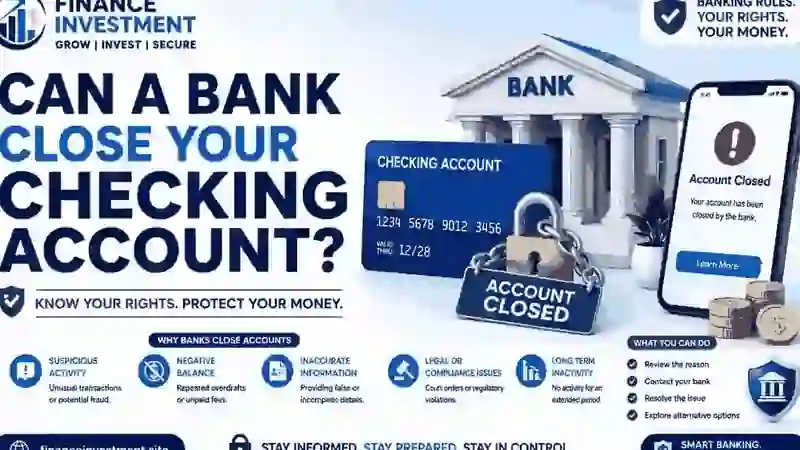 Can a Bank Close Your Checking Account? Yes. A bank or credit union can generally close a checking account without getting your permission first. Common situations include a prolonged negative balance, suspected fraudulent activity, writing bad checks, or long periods without activity. Your account agreement and applicable state or federal rules can affect the details. 0
Why Would a Bank Close It?
A closure does not automatically mean you did something wrong. Banks may review accounts for different reasons, including unpaid balances, unusual activity, or inactivity. If fraud is suspected, the bank may take action while protecting its own systems and customers. Some account closures can also create a record with specialty checking-account reporting companies, which may affect your ability to open another account later. 1
What Should You Do First?
Start with the closure notice. Confirm the effective date, remaining balance, and instructions from the bank. Then list every paycheck, benefit, bill, subscription, check, and automatic withdrawal tied to the account. The CFPB recommends mapping automatic deposits and payments when moving banking relationships, then updating direct deposits and recurring transactions. 2
Real-life situation: Maya receives a closure notice two days before payday. Instead of waiting for her salary to sort itself out, she contacts payroll, asks the bank how incoming funds will be handled, and reviews every automatic payment connected to the old account. That quick check helps prevent one bank decision from turning into several missed-payment problems.
How It Works
Can a Bank Close Your Checking Account? If the bank decides to end the relationship, the process usually starts with a notice or other communication explaining that the account will no longer remain available. The exact timing and information provided can vary by institution and circumstances. 0
Check the closure date, instructions, and any information about your remaining balance.
Review paychecks, benefits, subscriptions, bills, and other transactions connected to the account.
If needed, open another account and update your direct deposit and recurring payments.
Keep statements, notices, payment records, and bank reference numbers until everything is settled.
Consider Alex, a freelance designer whose bank closes his checking account after a review. His next client payment is scheduled for Friday. Alex opens a replacement account, gives the new details to his client, and checks every automatic debit tied to the old account. The CFPB recommends listing automatic deposits and withdrawals and updating direct deposits when changing accounts. 1
Can a Bank Close Your Checking Account? Yes, but the closure does not mean you should simply wait. Confirm what the bank is doing, protect upcoming transactions, and keep a clear record of each step.
Benefits & Drawbacks
A bank-initiated closure can protect the institution from certain account risks, but it can also create immediate headaches for the customer. The CFPB notes that banks and credit unions may close accounts in situations such as unpaid negative balances, bad checks, or prolonged inactivity. 0
✓ Pros
- Can help a bank limit fraud and account-related risks.
- May stop continued losses from an unresolved negative balance.
- Can end an account relationship that no longer fits the bank’s requirements.
⚠ Cons
- Paychecks and benefits may need to be redirected.
- Automatic payments can fail if they are not updated.
- An involuntary closure may appear in checking-account reports and make another account harder to obtain. 1
Bottom line:
The closure itself may be inconvenient, but the bigger concern is what happens next. Protect your incoming money, update scheduled payments, and resolve any unpaid balance promptly.
Comparison Table: Why a Checking Account May Be Closed
Can a Bank Close Your Checking Account? Yes, but the reason can make a major difference in what you should do next. The CFPB identifies unpaid negative balances, bad checks, suspected fraud, and prolonged inactivity among situations that can lead to closure. 0
| Situation | Possible Outcome | What to Check | Next Move |
|---|---|---|---|
| Negative Balance | Account may be closed | Amount owed | Resolve the balance |
| Suspected Fraud | Bank may restrict or close access | Bank notice and transactions | Contact the bank promptly |
| Bad Checks | Closure may follow | Outstanding checks | Settle unresolved items |
| Long Inactivity | Dormant account may be closed | Last account activity | Review the bank’s policy |
Important: Closure rules and notice requirements can vary. Check your account agreement and any communication from your bank before assuming why the account was closed.
Costs, Risks & Expert Tips
Can a Bank Close Your Checking Account? Yes, and the bigger concern may be what follows. An unpaid negative balance can be reported to checking-account reporting companies, which may make opening another account harder. In some cases, a remaining debt can also reach collections and affect your traditional credit report. 0
💡 Expert Tip
Ask the bank for the final balance and written instructions. Then check every paycheck, benefit, bill, subscription, and automatic withdrawal connected to the account. Moving these transactions quickly can prevent avoidable fees and missed payments.
⚠ Warning
Do not assume a closed account means every related payment disappears. Pending transactions can still create problems. Contact the bank and the payment provider, and keep records until the situation is settled. 1
Common Mistakes + Real-Life Example
Can a Bank Close Your Checking Account? Yes, and the trouble often starts when customers ignore what happens after the closure. Common mistakes include waiting too long to redirect a paycheck, forgetting automatic withdrawals, ignoring a negative balance, or assuming every pending transaction will simply disappear.
A Mortgage Payment Is Due Monday
Sarah receives a bank closure notice on Friday. Her paycheck has already been redirected, but her mortgage payment is still scheduled from the old account. Instead of waiting for Monday, she contacts the lender, checks the bank’s instructions, and arranges another payment method.
She also reviews subscriptions and other automatic debits. The CFPB recommends listing recurring deposits and withdrawals when changing accounts because missed updates can lead to returned payments or fees. 0
Better move:
Treat the closure notice like a financial deadline. Protect your paycheck, check upcoming bills, confirm what happens to remaining funds, and keep written records until the transition is complete.
Can a Bank Close Your Checking Account? The answer is yes, but quick action can reduce the disruption. Focus first on payments, deposits, balances, and documentation.
Who Should Choose This?
Can a Bank Close Your Checking Account is especially worth understanding if your paycheck, bills, benefits, or everyday spending depend heavily on one account.
✓ Premium Best Fit
- People who have received a bank closure notice.
- Workers who rely on direct deposit for regular income.
- Families with several automatic bills or subscriptions.
- Freelancers and small-business owners receiving frequent payments.
- Anyone trying to understand why a bank ended an account relationship.
If your account has been closed, focus first on protecting incoming money and scheduled payments. If you are still deciding where to bank, compare account requirements and make sure the new institution fits your regular spending and deposit needs.
Frequently Asked Questions
Can a Bank Close Your Checking Account? Yes. The reason, timing, and next steps can vary, so it helps to understand what may happen after a bank decides to end the account relationship.
1. Can a bank close your checking account without permission?
Yes. A bank or credit union may close an account without the customer’s permission. The reason and notice requirements can depend on the circumstances and applicable rules.
2. Why would a bank close a checking account?
Common reasons include prolonged negative balances, bad checks, suspected fraud, or long periods without activity.
3. Can a bank close an account without giving notice?
Notice requirements can vary. Some states may require notice in certain circumstances, so check the bank’s communication and applicable rules.
4. What happens to money in a closed checking account?
Ask the bank how any remaining positive balance will be returned and how pending deposits or transactions will be handled.
5. Can you reopen an account the bank closed?
It depends on the institution and the reason for closure. Ask the bank whether reinstatement is available or whether you must open a new account.
6. Can a negative balance lead to account closure?
Yes. An unpaid negative balance is one situation that can lead to an involuntary closure.
7. Does a closed checking account hurt your credit?
A closure is not automatically placed on a traditional credit report. However, unpaid debts may later be sent to collections, and checking-account reporting companies may keep related banking information.
8. What should you do after a bank closes your account?
Confirm the closure, review your balance, protect direct deposits, update automatic payments, and keep copies of the bank’s notices and statements.
9. Can you open another checking account after a bank closes one?
Yes, although another bank may review your banking history before approving the new account. Resolving unpaid balances can improve your position.
Quick reminder: Keep your closure notice, final statement, payment records, and correspondence together until every related transaction has been settled.
Final Verdict
Can a Bank Close Your Checking Account? Yes, and receiving that notice can be unsettling, especially when your paycheck and household bills depend on the account. The smartest response is to act quickly rather than assume the bank will sort everything out automatically.
First, confirm the closure date and ask what happens to your remaining balance. Then protect your next paycheck, update automatic payments, and keep records of every conversation. If you need another account, give yourself enough time to move your regular banking activity without creating missed payments.
For a broader look at choosing and managing checking accounts, visit our
Checking Accounts USA 2026 guide
.
A closed account does not have to derail your finances if you protect your deposits, payments, and cash flow early.
Related Resources
Explore these practical guides for managing everyday banking, payments, and account choices: