How Long Should You Keep Money in a CD?
A practical guide to choosing a CD term, understanding maturity dates, and deciding how long your money should stay locked in.
How Long Should You Keep Money in a CD?
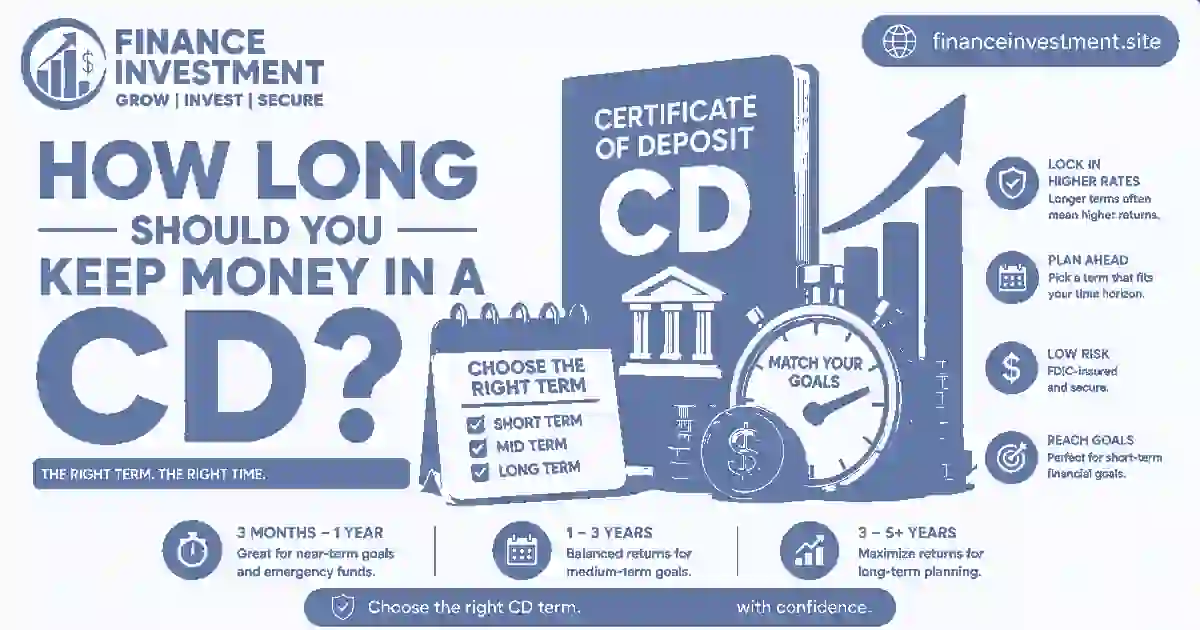 How long should you keep money in a CD? The answer is not simply “until the rate stops looking attractive.” A better question is: When will this money need a new job? If the cash is being saved for a future purchase, tuition bill, home project, or another known purpose, the CD term should fit the date when that money becomes useful again.
A six-month CD can make sense for a near-term expense. A one-year certificate may suit a goal farther away. Longer terms can work when you have no plans for the money for several years. The important part is leaving enough room between the CD’s maturity date and the point when you actually need the funds.
Rate certainty is another reason people choose longer certificates. A fixed-rate CD can keep the agreed rate in place during the term, even if market rates change. But that certainty comes with less flexibility. If your plans change, accessing the money early may involve a penalty.
Before choosing a term, it helps to understand the broader CD landscape. Our CD Guide 2026 can help you compare terms, rates, maturity rules, and other factors.
What You’ll Learn
- How to match a CD term with your financial timeline
- When shorter or longer CDs may make sense
- Why maturity timing matters as much as APY
- How rate certainty can affect your decision
- When keeping money flexible may be smarter
Quick Answer: How Long Should You Keep Money in a CD?
Usually, keep money in a CD for as long as you can comfortably leave it untouched. A 6-month or 1-year CD may fit a near-term goal, while a 2-, 3-, or 5-year CD can make more sense for money you will not need for several years. The best term balances the maturity date, rate certainty, and your need for access to the cash.
6 Key Takeaways
- Match the term to your goal: Choose a maturity date that fits when you expect to need the money.
- Shorter terms offer more flexibility: They can reduce the time your cash stays committed.
- Longer terms can lock in a rate: This may be useful when you are comfortable leaving the money untouched.
- Liquidity still matters: A CD may charge an early-withdrawal penalty if you need the money before maturity.
- Do not chase APY alone: A slightly higher rate may not be worth a term that does not fit your plans.
- Have a maturity plan: Decide in advance whether you will withdraw, move, or renew the money when the CD ends.
Bottom line: The ideal CD term is the one that keeps your money earning a predictable return without putting an important future expense out of reach.
At a Glance: Choosing a CD Term
Think of a CD term as a calendar commitment, not just an interest-rate choice. The closer your spending date, the more carefully you should protect access to the money. A longer certificate can provide rate certainty, but it also keeps your cash committed for more time.
These are planning ranges, not rules. A CD should not replace emergency cash or money you may need unexpectedly. Also check the institution’s early-withdrawal terms and whether the certificate automatically renews at maturity.
Complete Beginner Guide to Choosing a CD Term
A CD term is simply the length of time your money is committed to the certificate before its scheduled maturity date. Choosing one is easier when you start with the purpose of the money rather than the rate on the screen. How long should you keep money in a CD? Start by asking when you expect to need the cash and how much flexibility you want until then.
Start With the Date, Not the Rate
Suppose you are setting aside money for a home project next summer. A certificate that matures after the project begins could create an unnecessary problem. Instead, work backward from the spending date and leave some breathing room. This gives you time to review the maturity notice and decide what to do next.
The same idea applies to money you expect to leave untouched for several years. If you have no planned use for the funds, a longer certificate may provide useful rate certainty. However, committing for longer also means giving up some access to the cash during the term.
Understand What Happens at Maturity
When a CD reaches maturity, the principal and applicable interest become available according to the institution’s terms. Some CDs automatically renew if you do nothing during the specified grace period. Others give you a window to withdraw or move the money. Check these rules before opening the certificate rather than discovering them later.
Keep Liquidity in the Picture
Money needed for emergencies should generally remain readily accessible rather than being locked into a CD. For planned cash, however, a certificate can create a useful boundary between money you intend to spend and money you are deliberately leaving alone.
If you are unsure about the commitment, consider a shorter term or a CD ladder instead of putting the entire balance into one long certificate. For more background on the mechanics, see our guide to how CDs work.
How a CD Term Works From Opening to Maturity
 Once you choose a CD, the term creates a simple timeline for your money. You deposit the agreed amount, accept the stated rate and maturity date, and generally leave the funds in place until the certificate ends. The important part is knowing what happens at each stage so the maturity date does not catch you by surprise.
1. Choose the Term and Maturity Date
Look beyond the number of months. Check the exact maturity date shown by the bank or credit union. If you expect to use the money for a specific expense, make sure the certificate matures before you need to pay the bill.
2. Fund the CD
After opening the certificate, you transfer or deposit the amount required by the institution. The account then earns interest according to its stated terms. Some CDs compound interest, while others may offer different interest-payment options.
3. Monitor the Timeline
You usually do not need to manage the CD every day. Still, mark the maturity date on your calendar. Review the renewal instructions, grace period, and available choices before the certificate ends.
4. Decide What Happens Next
At maturity, you may be able to withdraw the money, transfer it to another account, or renew it into a new CD. The new certificate may have a different APY and term, so automatic renewal should not be treated as a decision you have already made.
Illustrative example: Jordan places $8,000 into a 12-month CD because the money is earmarked for a planned expense the following year. About a month before maturity, Jordan reviews the renewal rate and decides whether the funds should be used, moved to savings, or placed into another certificate.
Benefits and Drawbacks of Keeping Money in a CD
Knowing how long should you keep money in a CD also means weighing what you gain from a fixed term against what you give up in flexibility. A CD can be useful when the money has a clear purpose, but it is not designed for every type of cash.
✓ Pros
- Predictable return: A fixed-rate CD can provide a known rate for the agreed term.
- Useful discipline: Limited access can make it easier to leave goal-specific money alone.
- Rate certainty: You generally keep the agreed rate during the CD term even if market rates move.
- Potentially stronger earnings: Some CDs may offer higher yields than readily accessible cash accounts.
⚠ Cons
- Early-withdrawal risk: Taking money out before maturity may result in a penalty.
- Less flexibility: Your cash is less accessible than money kept in a checking or savings account.
- Inflation risk: Rising prices can reduce the purchasing power of a fixed return.
- Reinvestment risk: When the CD matures, available rates may be lower than the rate you previously earned.
CD Term Comparison: 6 Months to 5 Years
Different CD terms solve different cash-planning problems. Instead of asking only which certificate pays the highest APY, consider how long you can leave the money untouched and how comfortable you are waiting for maturity.
| Term | May Fit | Flexibility | Commitment |
|---|---|---|---|
| 6 months | Near-term cash needs | Higher | Short |
| 1 year | Annual goals | Moderate | Medium |
| 18 months | Medium-term plans | Moderate-low | Longer |
| 2 years | Planned medium-term expenses | Lower | Long |
| 3 years | Longer-range goals | Lower | Long |
| 5 years | Money with no near-term use | Lowest | Longest |
If you are considering a shorter commitment, compare current options in our
6-month CD guide.
For a longer horizon, our
3-year CD guide
and
5-year CD guide
can help you explore those terms.
Ultimately, how long should you keep money in a CD comes down to the relationship between your expected cash needs and the value of locking in a rate for longer.
Costs, Risks and Expert Tips Before You Extend a CD
A CD can look straightforward when you open it, but the decision becomes more important as the maturity date approaches. Before deciding how long should you keep money in a CD, review what could happen if your plans, rates, or cash needs change.
Watch the Cost of Giving Up Flexibility
An early withdrawal can trigger a penalty, depending on the certificate’s terms. That penalty is only one part of the cost. You may also miss better opportunities elsewhere if market rates rise while your money remains locked at an older rate.
Inflation matters too. A fixed return can look attractive today but buy less in the future if prices rise faster than your earnings. Taxes can also reduce the amount you ultimately keep in a taxable account. Review the tax treatment before comparing the CD with another cash option.
Think About What Happens After Maturity
Reinvestment risk appears when a CD matures and new certificates offer lower rates. One way to reduce this timing problem is a CD ladder. Instead of putting everything into one certificate, you spread money across different maturity dates. That can create regular opportunities to reassess rates and cash needs.
Expert Tip
About a month before maturity, check four things: your upcoming cash needs, the new CD rates available, your savings alternatives, and the renewal terms. Then compare the after-tax return and flexibility—not just the headline APY.
If the money still has no immediate purpose, renewing may be reasonable. If your plans have changed, moving the funds to a more accessible account could be the better move. The goal is not to keep a CD for a particular number of years; it is to keep the money committed only while the arrangement still fits your plan.
Common CD-Term Mistakes and a Real-Life Example
Many CD problems do not start when the certificate is opened. They appear later, when the saver needs the money, sees a better rate elsewhere, or discovers that the account renewed automatically. A few simple checks can prevent an attractive rate from becoming an awkward financial decision.
Mistakes Worth Avoiding
- Choosing only by APY: A higher rate is not helpful if the maturity date conflicts with an upcoming expense.
- Ignoring the maturity date: Put the date on your calendar so you have time to review your options.
- Using emergency cash: Money needed for unexpected bills generally needs easier access than a standard CD provides.
- Overlooking automatic renewal: A CD may renew under the institution’s stated terms if you do not act during its grace period.
- Skipping the penalty details: Check the early-withdrawal rules before committing money you might need early.
Illustrative Example: Marcus Plans Ahead
Marcus has $12,000 that he expects to use for a planned home renovation in about 14 months. He finds a 24-month CD with a slightly higher APY than a 12-month option. Instead of focusing only on the rate, he checks the maturity dates and realizes that the longer certificate would extend well beyond his planned spending date.
Illustrative lesson: Marcus chooses a term that better fits his timeline and keeps his emergency reserve separate. The numbers and outcome are hypothetical; they are included only to demonstrate the decision process.
The practical takeaway is simple: when deciding how long should you keep money in a CD, check the purpose, maturity date, access rules, and renewal terms before you look at the final APY.
Who Should Choose a Longer CD Term?
A CD can be a good fit for people who know when they will need their money and can leave it untouched until then. The key is having a clear reason for the commitment, rather than choosing a term simply because it offers an attractive rate.
People Who May Benefit
- Goal-based savers: Useful for money set aside for a known future expense.
- Conservative investors: A fixed-rate CD can provide a predictable return during its term.
- Families with planned expenses: A maturity date can line up with tuition, a vehicle purchase, or another scheduled cost.
- Retirees: CDs may suit cash that is not needed immediately and is being held for a known future need.
- Savers with emergency reserves: Having separate accessible cash makes it easier to leave the CD untouched.
If you may need the money unexpectedly, a flexible savings account may be more appropriate. When asking how long should you keep money in a CD, the strongest signal is not your comfort with the term alone—it is whether you can genuinely leave the funds committed without disrupting your plans.
Frequently Asked Questions About CD Terms
How long should you keep money in a CD?
Keep it for a term that ends before you need the money. Shorter certificates may suit near-term goals, while longer terms can fit cash you can leave untouched for several years.
What happens when a CD reaches maturity?
At maturity, the bank or credit union generally makes the principal and applicable interest available according to the account terms. You may be able to withdraw the money, transfer it, or renew the CD.
Is a 5-year CD too long?
Not necessarily. A 5-year term can make sense for money you are confident you will not need during that period. It may be less suitable for a planned expense that arrives sooner.
Can I withdraw money from a CD before maturity?
Usually, you can request an early withdrawal, but a standard CD may charge an early-withdrawal penalty. Check the certificate’s terms before opening it.
Should I renew my CD when it matures?
Not automatically. Compare the new APY, your upcoming cash needs, available savings options, and the new term before deciding whether to renew.
Are shorter CDs better than longer CDs?
Neither is automatically better. A shorter term can provide earlier access to your money, while a longer term can provide more time with a fixed rate.
Can a CD ladder help with different maturity dates?
Yes. A CD ladder spreads money across certificates with different maturity dates. This can create more regular opportunities to access funds or reassess available rates.
Are CD earnings taxable?
Interest from a CD held in a regular taxable account is generally taxable as interest income. Tax treatment can differ when a CD is held inside a tax-advantaged account.
Illustrative: How much could a $10,000 CD earn?
Illustrative calculation only: At a hypothetical 4% APY for one year, $10,000 would earn approximately $400 if the stated APY and compounding assumptions applied. Actual earnings depend on the CD’s terms, rate, and compounding method.
Final Verdict: Choose the CD Term That Fits Your Timeline
There is no universal answer to how long you should keep money in a CD. The better approach is to start with the date when you expect the money to become useful. A 6-month or 1-year certificate may work well for a nearer-term goal, while a 2-, 3-, or 5-year term can suit money that has a longer runway.
The biggest mistake is choosing a term simply because its APY looks attractive. A higher rate can lose some of its appeal if you need the cash early and face a penalty or have to give up another opportunity. Maturity planning gives you a clearer way to make the decision.
If you want to compare CD terms, rates, and key features in one place, explore our
CD Guide 2026
.
Practical takeaway: Pick the shortest term that comfortably meets your goal, or choose a longer term only when you are confident the money can stay untouched.
Make Your Next CD Decision With Confidence
CD terms are easier to choose when your money has a clear purpose and timeline. If you enjoy practical guides on saving, CDs, and smarter money decisions, join our newsletter for useful updates without the noise.
📧 subhashr325@gmail.com
“