Cash Management Account vs High-Yield Savings Account: Which One Makes More Sense in 2026?
 Imagine you’ve just received a tax refund, a work bonus, or the proceeds from selling an investment. Now comes the question almost every saver faces: Where should this money go? A bank recommends a high-yield savings account, while your brokerage promotes a cash management account. Both promise convenience, security, and interest, yet they aren’t built for the same purpose.
That’s exactly why so many people search for Cash Management Account vs High-Yield Savings Account. At first glance they appear similar, but once you look at everyday banking features, cash access, insurance coverage, and interest earnings, the differences become much easier to spot.
This guide breaks everything down in plain English. You won’t need a finance background to understand it. By the time you finish reading, you’ll know which account fits your spending habits, where to keep your emergency fund, and when using both accounts together can actually make life simpler.
What You’ll Learn
- The biggest differences between a cash management account and a high-yield savings account.
- Which account works better for everyday cash and which is better for longer-term savings.
- How interest, insurance coverage, and account features compare.
- Common situations where using both accounts makes practical sense.
- Where to find more savings ideas in our Complete High-Yield Savings Accounts USA Guide.
Choosing between a Cash Management Account vs High-Yield Savings Account becomes much easier once you understand how each account matches the way you use money instead of looking only at the advertised APY.
Quick Answer & Key Takeaways
💙 Quick Answer
When comparing a Cash Management Account vs High-Yield Savings Account, the better choice depends on how you plan to use your money. A cash management account combines everyday banking features such as debit cards, bill payments, and cash access with interest earnings. A high-yield savings account is designed mainly for saving, offering competitive APYs while encouraging you to leave your money untouched until you actually need it.Plenty of households keep one account for spending and another for savings.
⭐ Key Takeaways
- A cash management account is built for everyday cash movement.
- A high-yield savings account is better suited for money you don’t spend regularly.
- Interest rates shouldn’t be the only factor when comparing accounts.
- Think about debit card access, transfers, ATM availability, and account flexibility.
- Emergency savings are commonly kept in a dedicated savings account.
- The Cash Management Account vs High-Yield Savings Account decision becomes much clearer once you match the account to your daily financial routine.
In simple terms: Don’t choose an account simply because it advertises the highest APY. Pick the one that fits the way you handle your money today, and remember that using two different accounts can often provide more flexibility than relying on just one.
Table of Contents
Jump to any section below and read the part that matters most to you.
At a Glance
At first, these two accounts seem almost identical. Both are designed to hold cash, both can earn interest, and both help keep your money accessible. The difference is how they fit into everyday life. A Cash Management Account vs High-Yield Savings Account comparison is really about deciding whether you need an account for daily spending, long-term savings, or a combination of both.
| Quick Facts | Overview |
|---|---|
| Best For | Managing cash, building savings, or using both accounts together. |
| Interest | Rates vary by provider and can change over time. |
| Daily Access | Cash management accounts usually include more spending features. |
| Emergency Savings | Many people prefer a dedicated high-yield savings account. |
| Who Benefits? | Beginners, families, retirees, freelancers, and active investors. |
Instead of asking which account is universally better, think about what your money needs to do. Once that answer is clear, choosing between the two becomes much less confusing.
Complete Beginner Guide
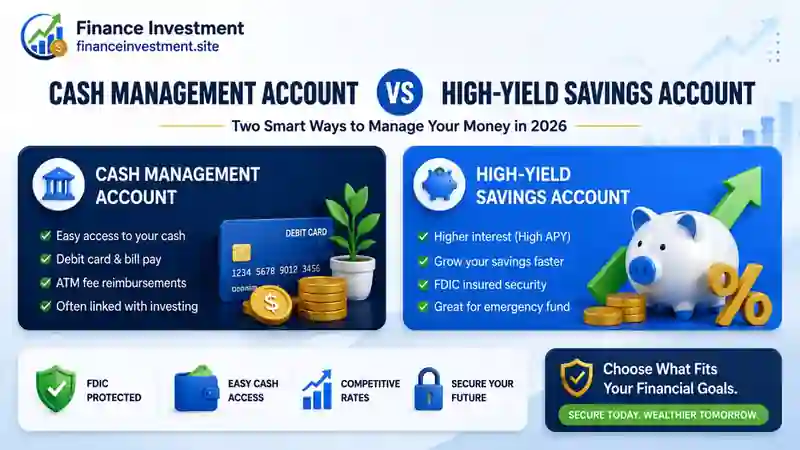 Choosing where to keep your cash has become more interesting over the last few years. Banks continue to promote high-yield savings accounts, while many investment companies now offer cash management accounts with banking features built in. Looking at a Cash Management Account vs Savings account side by side makes it much easier to understand which one matches your everyday needs.
What Is a Cash Management Account?
A cash management account, often called a CMA, is usually offered by a brokerage firm instead of a traditional bank. It combines several everyday money tools into one place. Depending on the provider, you may receive a debit card, online bill payment, ATM access, mobile check deposit, and electronic transfers while still earning interest on your cash balance.
Many investors like using a CMA because they can keep spending money close to their investment accounts without moving cash between different financial institutions.
What Is a High-Yield Savings Account?
A high-yield savings account focuses on one primary job—helping your savings earn more interest than many standard savings accounts. These accounts are commonly offered by online banks and some traditional banks. Since they aren’t designed for everyday spending, they often encourage people to leave their money untouched until it’s actually needed.
If you’re still comparing available options, our Best High-Yield Savings Accounts for Retirees guide and Best High-Yield Savings Accounts for Young Adults comparison highlight features that different savers often value most.
Where they start to separate
The easiest way to think about the comparison is this: a cash management account behaves more like a spending account with extra earning potential, while a high-yield savings account is built to separate savings from everyday purchases. One helps manage daily cash flow, while the other helps protect money you don’t plan to spend regularly.
Insurance protection also deserves attention. Cash management accounts may use partner banks to provide FDIC insurance, while high-yield savings accounts offered directly by banks generally include FDIC coverage on eligible deposits. Either way, checking how your provider handles insurance is always worthwhile.
Everyday Banking vs Saving
People who regularly pay bills, withdraw cash, or use a debit card may appreciate the convenience of a CMA. Someone building an emergency fund or saving for a home often prefers the separation that comes with a dedicated savings account. That’s why the Cash Management Account vs Cash account discussion doesn’t end with interest rates alone.
💡 Premium Expert Tip
Many financially organized households use both accounts. A cash management account handles everyday transactions, while a separate high-yield savings account holds emergency cash and future expenses. Keeping these jobs separate often makes budgeting much easier.
Instead of asking which account wins, think about how you actually use your money each month. That simple shift makes the Cash Management Account vs CMA decision far more practical than comparing APYs alone.
How It Works
Picture two wallets with different purposes. One helps you handle money that moves in and out regularly, while the other gives your savings a dedicated place to sit until you need it. Once you see how cash flows through each account, the Cash Management Account vs HYSA comparison becomes much easier to understand.
Using a Cash Management Account
Most people fund a cash management account through direct deposit, bank transfers, or incoming payments. From there, the account can be used for everyday activities such as paying bills, sending money electronically, withdrawing cash from ATMs, or making purchases with a debit card. Any unused balance may continue earning interest while it remains in the account.
Using a High-Yield Savings Account
A high-yield savings account works differently. Money is deposited, left in place, and earns interest over time. Instead of being your everyday spending account, it acts as a home for cash you want available without mixing it into your daily budget. That’s why many people use it for emergency savings, home purchases, vacations, or other planned expenses.
Can You Use Both?
Absolutely. Many households transfer part of every paycheck into a savings account while keeping the remaining balance in a cash management account for regular expenses. This simple routine separates spending money from savings without making your finances more complicated.
If you’re planning automatic transfers between accounts, our How to Automate Your Savings guide explains how to set up a system that runs quietly in the background.
💡 Good to Know
You don’t have to choose only one account. Plenty of people use a cash management account for everyday banking and a separate high-yield savings account for money they don’t expect to spend anytime soon.
Rather than focusing only on interest rates, think about how you move money throughout the month. That perspective usually provides a much clearer answer to the High-Yield Savings Account question than comparing promotional rates alone.
Benefits & Drawbacks
They solve different problems. Each solves a different problem. One keeps everyday money moving smoothly, while the other gives savings a dedicated place to grow. Looking beyond the advertised APY makes it easier to understand which account deserves a place in your financial setup.
✅ Benefits
- Cash Management Account offers debit card access, ATM withdrawals, electronic bill payments, and simple cash transfers.
- High-Yield Savings Account helps cash earn competitive interest while staying separate from daily spending.
- Both account types provide convenient online and mobile banking.
- Eligible deposits may qualify for federal insurance, depending on the provider and account structure.
- The Cash Management Account vs High-Yield Savings Account comparison gives many people a practical reason to use both instead of forcing one account to handle every job.
❌ Drawbacks
- Interest rates can rise or fall as market conditions change.
- Some cash management accounts may not include every banking feature offered by traditional checking accounts.
- High-yield savings accounts generally aren’t intended for frequent everyday purchases.
- Insurance coverage can differ depending on the financial institution, so reading the account details is important.
💡 Expert Insight
Instead of searching for a single “perfect” account, decide what each dollar is expected to do. Money needed this week doesn’t have the same job as money reserved for emergencies or future plans. Organizing cash by purpose often makes everyday money decisions much simpler.
Comparison Table
Seeing the features side by side is often the quickest way to decide which account fits your needs. Instead of focusing on a single feature, compare how each account handles everyday banking, savings, and cash access.
| Feature | Cash Management Account | High-Yield Savings Account |
|---|---|---|
| Interest | May earn competitive interest depending on the provider. | Typically designed to offer higher savings rates. |
| Debit Card & ATM Access | Usually available. | Often limited or not included. |
| Bill Payments | Commonly supported. | Not intended for everyday bill paying. |
| Insurance | Often provided through partner banks. | Usually FDIC-insured when offered by eligible banks. |
| Liquidity | Built for frequent access. | Easy access, but mainly intended for savings. |
| Best Use Case | Daily cash management and routine spending. | Emergency funds and planned future expenses. |
Conclusion: The Cash Management Account vs High-Yield Savings Account Each account shines in different situations. It’s about matching the account to the job. If your money moves often, a cash management account offers greater flexibility. If you’re setting cash aside for tomorrow instead of today, a high-yield savings account usually makes more sense.
Costs, Risks & Expert Tips
Neither account is automatically expensive, but small details can affect how useful it becomes over time. Before opening an account, Before opening an account, check a few details that are easy to overlook.Features, fees, and access to your money often matter just as much.
Some providers charge monthly maintenance fees or require certain balances to unlock their highest interest rates. Others offer free accounts with no minimum balance. Interest rates can also change as market conditions shift, so today’s APY shouldn’t be treated as a permanent return.
Insurance deserves a closer look as well. High-yield savings accounts at eligible banks generally include FDIC protection, while many cash management accounts extend coverage by placing deposits across partner banks. Reading the account details helps you understand exactly how your cash is protected.
Accessing your money is another important difference. A cash management account usually supports debit card purchases, ATM withdrawals, and electronic bill payments. A high-yield savings account provides easy transfers, but it’s designed more for saving than everyday spending.
⚠️ Watch Out For
Don’t assume two accounts offering similar APYs work the same way. Compare fees, banking features, insurance details, ATM access, and transfer options before making your decision.
5 Practical Tips
- Read the fee schedule before opening any account.
- Check how interest is calculated and how often it’s credited.
- Confirm how insurance coverage applies to your deposits.
- Choose an account that matches how often you expect to access your cash.
- When comparing a Cash Management Account , think about your daily routine first and interest rates second.
Common Mistakes + Real-Life Example
Michael thought he had found the perfect account. The Cash Management Account vs High-Yield Savings Account decision becomes much simpler when you match the account to your daily habits instead of choosing based on advertising alone.
5 Common Mistakes
- Looking only at the APY. A higher rate can be attractive, but it doesn’t replace useful banking features or lower fees.
- Using one account for everything. Mixing everyday spending with emergency savings makes it harder to see how much money is truly available.
- Ignoring account rules. Before opening an account, check transfer options, ATM availability, and any balance requirements.
- Skipping insurance details. Understanding how your deposits are protected helps avoid confusion later.
- Choosing based on advertisements. Promotions don’t always reflect how an account performs once you start using it every week.
Real-Life Example
Michael, a software engineer from Colorado, moved all of his savings into a cash management account because it offered convenient banking features. A few months later, he realized he was regularly dipping into money that had been set aside for emergencies simply because it was easy to access with his debit card.
He adjusted his approach by keeping his paycheck and monthly expenses in the cash management account while moving his emergency fund into a separate high-yield savings account. The extra separation made budgeting easier, and he no longer mixed long-term savings with everyday spending.
✅ Lesson Learned
The smartest setup isn’t always a single account. Giving everyday money and emergency savings separate homes makes spending decisions clearer and reduces the temptation to use savings for routine purchases.
Who Should Choose This?
The answer depends less on your income and more on how you handle money. The Cash Management Account comparison isn’t about finding a universal winner. It’s about choosing an account that fits the way you spend, save, and organize your cash.
Who Can Benefit Most?
- Working professionals who want everyday banking features together with interest on idle cash.
- People building an emergency fund who prefer to keep savings separate from regular spending.
- Freelancers and self-employed workers receiving payments from different sources throughout the month.
- Investors looking for a simple way to move cash between brokerage and banking services.
- Families who want clearer separation between monthly expenses and future savings.
✔️ Best Choice If…
You expect to use your money in different ways. Keep daily spending in an account built for frequent access, and place emergency or planned savings where they’re less likely to be spent. Giving each account a clear purpose often makes personal finances easier to manage.
Frequently Asked Questions
1. What is the biggest difference between a cash management account and a high-yield savings account?
A cash management account is designed to help you handle everyday money. It often includes a debit card, ATM access, and bill payment features. A high-yield savings account focuses on earning interest while keeping savings separate from daily spending. That’s the main difference in the Cash Management Account comparison.
2. Which account usually pays more interest?
That depends on the provider. High-yield savings accounts are often known for competitive APYs, but some cash management accounts also offer attractive rates. Comparing current rates and account features gives a clearer picture than looking at APY alone.
3. Are both accounts protected by FDIC insurance?
High-yield savings accounts at eligible banks are generally covered by FDIC insurance within federal limits. Many cash management accounts also provide FDIC protection by placing deposits with one or more partner banks. Always review the provider’s insurance details before opening an account.
4. Can I get a debit card with both accounts?
Cash management accounts commonly include a debit card and ATM access. High-yield savings accounts usually don’t focus on everyday spending, so debit cards may be unavailable or have limited functionality.
5. Should I keep my emergency fund in a cash management account?
Many people prefer using a dedicated high-yield savings account because it separates emergency money from routine purchases. Keeping those funds in a different account can reduce the temptation to spend them unnecessarily.
6. Are cash management accounts offered by banks?
Some are, but many are provided by brokerage firms that combine investing and banking services in one platform. Available features can vary from one provider to another, so reading the account description is always worthwhile.
7. Is it possible to use both accounts together?
Yes. Plenty of households keep spending money in a cash management account while storing emergency savings in a high-yield savings account. This approach gives each account a clear purpose and makes budgeting easier.
8. How do I decide which account is right for me?
Start by thinking about how you’ll use the money. If you expect frequent purchases, ATM withdrawals, and bill payments, a cash management account may be more convenient. If the goal is earning interest on money you won’t need immediately, a high-yield savings account is often a better fit. Looking at your own routine usually provides the best answer to the Cash Management Account question.
Final Verdict
After comparing features side by side,After looking at both accounts side by side: there isn’t a single answer that fits everyone. The Cash Management Account vs High-Yield Savings Account decision depends on how you expect to use your money over the coming months.
If your balance moves in and out regularly through debit card purchases, bill payments, or ATM withdrawals, a cash management account offers everyday convenience. If your priority is setting money aside for emergencies, a home purchase, or another future expense, a dedicated savings account usually keeps those funds separate from routine spending.
If you’re still exploring different savings options, our Complete High-Yield Savings Accounts USA Guide provides additional comparisons and practical tips for choosing an account.
For official consumer information, visit the FDIC, the Consumer Financial Protection Bureau (CFPB), and Consumer.gov.
✔️ Final Thought
Choose the account that matches the job your money needs to do today. If your finances include both regular spending and long-term savings, using two separate accounts can give you convenience without mixing everyday cash with money you’ve set aside for the future.
Keep Learning. Make Every Dollar Count.
If this guide answered your questions, join our free newsletter for practical banking tips, savings ideas, and easy-to-follow financial guides. Have experience using a cash management account or a high-yield savings account? Share your thoughts in the comments. Your experience could help someone else make a more confident decision. If you found this article useful, consider sharing it with friends or family.