Variable-Rate CDs Explained: How They Work, Rates & Risks
 Variable-Rate CDs work a little differently from the fixed-rate CDs most savers know. Instead of locking the interest rate for the entire term, the rate on a variable-rate certificate of deposit can change according to the rules set by the financial institution. That can be useful when market rates are moving up, but it also means your future interest earnings are less predictable.
That trade-off is the part worth understanding. A changing rate may give you an opportunity to benefit from higher rates without closing the CD, yet a rate decrease could work against you. The details can also differ from one institution to another, including how often the rate may change, whether there is a floor or cap, and how the adjustment is calculated.
If you’re still getting familiar with CDs, our
complete CD Guide 2026
provides the broader picture before you compare variable-rate options.
What You’ll Learn
In this guide, you’ll see how variable-rate CDs operate, what can trigger a rate change, and how they compare with fixed-rate and other flexible savings choices. We’ll also cover potential advantages, rate-change risks, early-withdrawal rules, deposit insurance, fees, inflation and practical questions to ask before opening one.
A variable-rate CD is a certificate of deposit whose interest rate can change during the term under rules set by the financial institution. It can make sense for savers who want some exposure to rising rates, but the trade-off is less certainty about future earnings than with a fixed-rate CD.
Key Takeaways
- The rate can change during the CD term, unlike a typical fixed-rate CD.
- Higher market rates may benefit you, but falling rates can reduce future interest.
- The bank’s rate-change formula and adjustment rules matter as much as the starting APY.
- Check for rate floors, caps, minimum deposits and withdrawal restrictions.
- Confirm applicable FDIC or NCUA insurance before depositing a large amount.
- Compare the CD with savings accounts and other CD structures before committing your cash.
Bottom Line
The appeal of a variable-rate CD is flexibility in how the rate responds to changing conditions. The catch is that you give up some predictability. Look at the adjustment rules, not just today’s advertised APY, and make sure the term fits the date you’ll actually need the money.
Variable-Rate CDs at a Glance
A variable-rate CD can be useful when you want a defined savings term without committing to a rate that must stay unchanged. The key difference is simple: the interest rate may move during the term according to the account’s rules.
May change
Fixed period
Usually limited
May be insured
Best For
Variable-rate CDs may appeal to savers who expect rates to rise and are comfortable trading some earnings certainty for the possibility of a higher rate later. They are less attractive when predictable returns or easy access to cash is the priority.
Quick Comparison
| Feature | Variable-Rate CD |
|---|---|
| Rate certainty | Lower than a fixed-rate CD |
| Upside potential | Possible if the rate rises |
| Liquidity | Generally limited during the term |
Complete Beginner Guide to Variable-Rate CDs
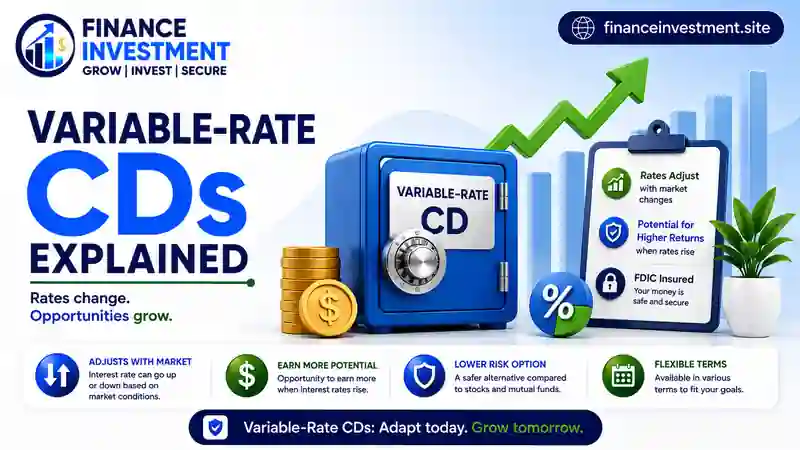 If you’ve used a regular certificate of deposit before, the main difference here is the interest rate. With a traditional fixed-rate CD, the rate is generally set when you open the account and remains unchanged through the term. A variable-rate CD can adjust during that period based on the terms of the account.
That doesn’t mean the bank can simply change the rate whenever it wants without conditions. The account agreement should explain what can cause an adjustment, how often changes can occur and whether the rate has a minimum or maximum. Some products may tie changes to a particular benchmark, while others give the institution more discretion. Those details can make two variable-rate CDs look similar at first but behave quite differently.
Why Would a Bank Offer One?
Variable pricing gives a bank a way to offer a deposit product whose return can respond to changing interest-rate conditions. For a saver, that can create an opportunity when rates move higher. The downside is just as important: a lower rate can reduce the interest you earn later in the term.
What Should Beginners Check?
- Adjustment rules: Find out exactly when and why the rate can change.
- Rate floor or ceiling: Check whether the account limits how far the rate can move.
- Early withdrawal: Understand the penalty and any conditions for accessing your money early.
- Minimum deposit: Confirm how much you need to open and maintain the CD.
- Insurance: Verify applicable FDIC or NCUA coverage before depositing your savings.
If you’re deciding between a variable-rate product and a more predictable option, comparing the account’s actual rules is more useful than looking at the starting APY alone. For broader background, you can also review our guide to
standard CDs
before making the comparison.
How Variable-Rate CDs Work
A variable-rate CD starts much like other CDs: you deposit money, choose a term and agree to the account’s conditions. The important difference is that the interest rate may change before the CD reaches maturity. The exact adjustment process comes from the bank’s disclosure, so don’t assume every variable-rate CD follows the same formula.
Rate Adjustments and Benchmarks
Some products may connect their rate to a benchmark or another stated measure. Others may allow the financial institution to adjust the rate under specified conditions. If a benchmark is involved, check whether the CD uses a fixed spread, a particular adjustment schedule or another calculation. The starting APY alone won’t tell you how the account could perform later.
Practical check
Before opening the account, look for the rate-change trigger, adjustment frequency, minimum rate and maximum rate. If any of these are unclear, ask the institution for the written terms.
How Interest Is Earned
Your earnings depend on the balance, the applicable rate and how long each rate applies. If the rate changes halfway through the term, the interest calculation reflects the applicable rates for their respective periods. For a refresher on the basics, see our guide to
how CDs work
.
What Happens at Maturity?
At maturity, the CD generally reaches the end of its agreed term and the institution follows the maturity instructions in the account agreement. Depending on the product, you may receive the balance and interest, renew the CD or move the money elsewhere. Check the maturity window and renewal terms ahead of time rather than letting the account renew automatically without reviewing the new rate.
Benefits & Drawbacks of Variable-Rate CDs
A variable-rate CD sits somewhere between predictable fixed-rate savings and more flexible deposit accounts. Its appeal comes from the possibility of earning more if the rate moves higher, but that possibility comes with less certainty.
Pros
- You may benefit if the CD’s rate rises.
- It can provide a structured savings term.
- It may suit savers who expect changing rates.
- Eligible deposits may receive federal deposit insurance.
Cons
- The rate can fall, reducing future interest.
- Returns are harder to predict than with fixed-rate CDs.
- Early withdrawals may trigger penalties.
- Terms can be more complicated than a standard CD.
The trade-off in one sentence
You give up some rate certainty in exchange for the chance to participate in higher rates later.
Variable-Rate CDs vs. Other Savings Options
A variable-rate CD can look attractive when rates are changing, but it is not automatically the best place for every dollar. The biggest differences come down to rate certainty, access to your money and how the account handles future rate changes.
| Option | Rate behavior | Access | Best fit |
|---|---|---|---|
| Variable-rate CD | Can change under the account’s stated rules | Usually limited before maturity | Savers comfortable with changing returns |
| Standard CD | Generally fixed for the term | Usually limited before maturity | Savers who value predictable earnings |
| Step-Up CD | Scheduled increases may apply | Usually limited before maturity | Savers seeking predetermined rate increases |
| High-yield savings account | Typically variable | Generally easier access | Emergency funds and flexible savings |
| Money market account | Typically variable | Generally more flexible than a CD | Cash that may need occasional access |
If certainty matters most, a
standard CD
may be easier to plan around. If access matters more, compare the CD with a
high-yield savings account
or
money market account
before committing your cash.
Costs, Risks & Expert Tips for Variable-Rate CDs
The starting APY is only one piece of the puzzle. With a variable-rate CD, the details behind future rate changes can have a bigger effect on your final earnings. A few minutes spent reading the account terms can help you avoid an unpleasant surprise later.
Watch the Early-Withdrawal Rules
A CD is designed for money you can leave alone for the agreed term. Taking funds out early may result in an early-withdrawal penalty, and the exact cost depends on the account. If there is a reasonable chance you’ll need the cash soon, compare the CD with a more accessible savings option first.
Check the Deposit and Insurance Rules
Look at the minimum opening deposit, any balance requirements and whether additional deposits are permitted. Also confirm that the institution and account qualify for applicable federal deposit insurance. Coverage limits can depend on ownership category and the amount held at the same insured institution.
Expert tip: don’t judge the CD by its first rate
Ask what happens if rates fall. A variable-rate CD can become less attractive when its rate declines, especially if you’re unable to move the money without paying a penalty.
Don’t Ignore Inflation and Reinvestment Risk
Even when your account earns interest, inflation can reduce what that money can buy. At maturity, you’ll also face reinvestment risk: the rates available for a new CD may be lower than the rate you were earning.
A Simple Liquidity Check
Keep money you may need for emergencies, bills or near-term purchases outside the CD when possible. Then use the CD for the portion of your savings that can remain untouched. This simple separation makes the withdrawal penalty less likely to become a problem and gives the variable rate room to work as intended.
Common Mistakes With Variable-Rate CDs
Variable-rate CDs can be useful, but a high opening APY can distract you from the details that matter over the full term. Here are some mistakes worth avoiding.
Mistakes to Watch For
- Chasing the opening rate: A strong starting APY does not guarantee the same return throughout the term.
- Skipping the adjustment rules: Make sure you understand what can cause the rate to change and whether limits apply.
- Forgetting withdrawal restrictions: Needing the money early could trigger a penalty or other account conditions.
- Ignoring insurance: Confirm that your deposit is held at an appropriately insured institution and stay within applicable coverage limits.
A Simple Example
Imagine Maya has $15,000 that she does not expect to need for the next year. She finds a variable-rate CD with an attractive opening APY and deposits the money. Instead of focusing only on that first rate, she checks how adjustments work, whether the rate has a floor or ceiling, what an early withdrawal would cost and how the deposit is insured.
During the term, the CD’s rate changes. Maya’s actual return therefore depends on the rates that apply during each period, rather than simply the rate shown when she opened the account. Her careful review does not eliminate market or rate risk, but it helps her understand what she is agreeing to. For more CD decision-making guidance, see our
common CD mistakes guide
.
Who Should Choose a Variable-Rate CD?
A variable-rate CD can make sense for someone who wants the structure of a CD but does not want to lock every dollar into one fixed rate. It may be especially interesting when you expect rates to change and are comfortable with some uncertainty in your future earnings.
A Good Fit If You…
- Can leave the money invested until maturity.
- Accept that the rate may move lower.
- Want a chance to benefit from higher rates.
- Are willing to read the CD’s adjustment rules.
Consider Another Option If You…
- Need frequent access to the money.
- Want a predictable return from day one.
- Would be uncomfortable with rate changes.
- Need an emergency fund rather than a term deposit.
For a broader look at choosing among CD types, our
guide to choosing the right CD
can help you compare the trade-offs before committing your
Frequently Asked Questions About Variable-Rate CDs
1. Can the rate on a variable-rate CD change?
Yes. Unlike a traditional fixed-rate CD, a variable-rate CD can allow the interest rate to change during the term. The account agreement should explain what triggers an adjustment, when it can happen, and whether limits apply.
2. Can I add money to a variable-rate CD?
It depends on the product. Some variable-rate CDs may allow additional deposits, while others accept only the initial deposit. Check the deposit window, contribution rules, and any minimum amount before opening the account.
3. Are variable-rate CDs safe?
A variable rate does not by itself make a CD unsafe. If the CD is an eligible deposit at an FDIC-insured bank, it can receive FDIC deposit insurance within applicable limits. That protection does not guarantee a particular interest rate or return.
4. Are variable-rate CDs FDIC insured?
A variable-rate CD issued by an FDIC-insured bank can generally qualify for FDIC deposit insurance, subject to ownership categories, coverage limits, and other applicable rules. Verify the institution’s insurance status before depositing money.
5. Can I withdraw money from a variable-rate CD early?
Often, early withdrawal can result in a penalty or other cost. The exact rule depends on the CD. Some products may offer limited withdrawal features, so review the early-withdrawal terms before committing money you might need soon.
6. What happens when a variable-rate CD matures?
At maturity, the bank generally handles the principal and earned interest according to the CD agreement. If the account automatically renews, there is usually a limited grace period when you may be able to withdraw the money or change the renewal instructions.
7. Do variable-rate CDs require a minimum deposit?
Minimum deposits vary by bank and CD. Some accounts may have low or no minimums, while others require a larger opening balance. Compare the minimum with the APY, term, and withdrawal rules rather than looking at the rate alone.
8. Are variable-rate CDs good for short-term savings?
They can make sense when you have a defined time horizon and can leave the money in place. For cash needed for an emergency, upcoming bill, or frequent spending, an accessible savings account may be more practical.
9. Is the APY guaranteed on a variable-rate CD?
No. If the CD allows rate adjustments, the APY can change during the term. Read the disclosure for the adjustment method, timing, minimum or maximum rates, and any other limits that could affect future earnings.
Final Verdict: Is a Variable-Rate CD Worth Considering?
A variable-rate CD can be a useful middle ground for savers who want a CD’s structured term while keeping some exposure to changing interest rates. The trade-off is simple: you give up some certainty in exchange for the possibility of benefiting when rates move higher.
Before opening one, look beyond the advertised APY. Check how often the rate can change, what determines the adjustment, whether a minimum or maximum rate applies, the early-withdrawal penalty, deposit requirements, maturity rules and applicable deposit insurance. Those details can matter more than the opening rate.
The key takeaway
Don’t choose a variable-rate CD simply because its starting APY looks impressive. Choose it when the rate-adjustment rules, term, access restrictions and potential return fit the job your savings need to do.
Rates and account terms can change, so review the current disclosure before opening any CD.