Published: June 25, 2026
Author: Subhash Rukade
Best Roth Conversion Strategies Before Retirement: Complete 2026 Guide
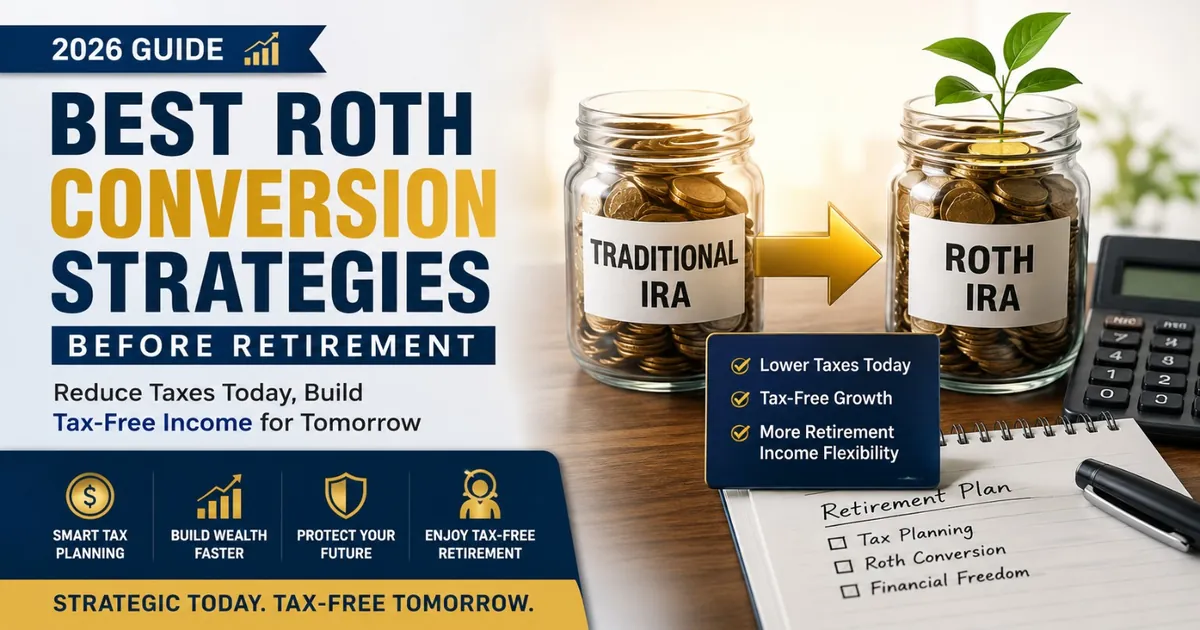 The best Roth conversion strategies can help American investors reduce future taxes and create more tax-free income during retirement. As retirement approaches, many people focus on growing their savings. However, reducing taxes can be just as important as increasing investment returns.
A Roth conversion allows you to move money from a Traditional IRA into a Roth IRA. While you pay taxes on the converted amount today, future qualified withdrawals can be completely tax-free. This strategy has become increasingly popular among retirees looking for greater control over their retirement income.
In 2026, rising retirement costs, changing tax rules, and concerns about future tax rates are encouraging investors to review their retirement plans carefully. Many financial professionals believe that strategic Roth conversions during lower-income years can significantly improve long-term retirement outcomes.
If you are building a complete retirement strategy, our
Retirement Planning Guide
provides a detailed roadmap for retirement income, tax planning, Social Security decisions, and investment management.
In this guide, you’ll learn how Roth conversions work, when they make sense, common mistakes to avoid, and the best Roth conversion strategies before retirement that could potentially save thousands of dollars in future taxes.
Understanding How Roth Conversions Work Before Retirement
To understand the best Roth Conversion Strategies, you first need to know how a Roth conversion works.
A Roth conversion occurs when money is transferred from a Traditional IRA into a Roth IRA. The amount converted is generally treated as taxable income in the year of conversion.
While paying taxes today may not sound appealing, many investors choose this strategy because future qualified Roth IRA withdrawals can be completely tax-free.
This can provide significant retirement income flexibility and potentially reduce lifetime tax liability.
Traditional IRA vs Roth IRA
| Feature | Traditional IRA | Roth IRA |
|---|---|---|
| Contributions | May Be Tax Deductible | After-Tax Contributions |
| Growth | Tax Deferred | Tax Free |
| Retirement Withdrawals | Generally Taxable | Generally Tax Free |
| Required Minimum Distributions | Yes | No During Owner’s Lifetime |
Simple Roth Conversion Calculator Example
Suppose an investor converts $50,000 from a Traditional IRA into a Roth IRA.
If the investor falls into a 22% federal tax bracket, the conversion may create approximately $11,000 in federal taxes.
However, future qualified withdrawals from that Roth IRA could potentially be tax-free for the rest of retirement.
This is why Roth Conversion Strategies are often most effective during years when taxable income is temporarily lower.
The goal is simple:
Pay taxes at a lower rate today to potentially avoid higher taxes later.
For investors approaching retirement, understanding tax brackets, future income needs, and withdrawal strategies is critical before making conversion decisions.
The best Roth Conversion Strategies are not about avoiding taxes completely. They are about managing taxes intelligently across your retirement years.
Best Roth Conversion Strategies Before Retirement
The most successful Roth Conversion Strategies are built around careful tax planning rather than making large conversions all at once.
Every investor has a different income level, retirement timeline, and tax situation. That is why there is no one-size-fits-all approach.
Instead, investors should focus on strategies that help reduce lifetime taxes while creating more tax-free retirement income.
1. Use Partial Roth Conversions
One of the most popular Roth Conversion Strategies is converting smaller amounts over several years.
Rather than converting an entire Traditional IRA in a single year, investors spread conversions across multiple tax years.
This approach may help avoid moving into a higher tax bracket while still gradually building tax-free retirement assets.
2. Convert During Low-Income Years
Many retirees experience a period between leaving work and claiming Social Security benefits.
During these years, taxable income may be lower than normal.
This can create an excellent opportunity for Roth conversions at lower tax rates.
Many financial planners consider this one of the best Roth Conversion Strategies available.
3. Manage Your Tax Bracket Carefully
Successful Roth conversions often involve filling up a tax bracket without crossing into the next one.
For example, an investor may convert only enough money to remain within the 22% federal tax bracket.
This strategy helps maximize conversions while controlling tax costs.
Example Scenario
Consider a retired couple with $65,000 of annual taxable income.
After reviewing their tax situation, they determine they can convert an additional $20,000 from a Traditional IRA without moving into a significantly higher tax bracket.
Over several years, this approach gradually shifts retirement assets into a Roth IRA while managing taxes efficiently.
Investors interested in technology-driven planning can also explore our
AI Investing Guide 2026
.
Modern planning tools can help estimate future tax liabilities, evaluate conversion opportunities, and identify the most effective Roth Conversion Strategies for long-term retirement success.
Real-World Roth Conversion Example and Retirement Tax Savings Case Study
Understanding Roth Conversion Strategies becomes easier when you look at a real-world example.
Many investors assume Roth conversions are only for wealthy retirees. In reality, they can benefit middle-class investors as well.
The key is implementing the strategy carefully and aligning it with long-term retirement goals.
Case Study: A Retired Couple’s Roth Conversion Plan
Mark and Susan are both 62 years old and recently retired.
They have $700,000 in Traditional IRA accounts and expect to claim Social Security benefits at age 67.
Because their income temporarily dropped after retirement, they found themselves in a lower tax bracket than during their working years.
Instead of waiting, they began converting a portion of their Traditional IRA to a Roth IRA each year.
By spreading conversions across several years, they avoided large tax spikes while steadily building tax-free retirement assets.
Their strategy reduced future Required Minimum Distributions and provided greater flexibility for retirement withdrawals.
Adding Dividend Income to a Roth Strategy
Many investors combine Roth Conversion Strategies with dividend-focused investing.
A diversified dividend portfolio can create an additional source of retirement income while Roth assets continue growing tax-free.
To learn more, explore our
How to Build a Dividend Portfolio
guide.
Investors seeking income opportunities may also benefit from our
Top Dividend Stocks USA 2026
resource.
The biggest lesson from this case study is simple:
The best Roth Conversion Strategies are usually gradual, tax-efficient, and integrated into a broader retirement plan.
When combined with smart investing and disciplined planning, Roth conversions can create meaningful tax savings and improve retirement income flexibility for decades.
Common Roth Conversion Mistakes Investors Should Avoid
Even the best Roth Conversion Strategies can produce disappointing results if investors make avoidable mistakes.
A Roth conversion can be a powerful retirement planning tool, but timing and execution matter.
Before converting retirement assets, investors should understand the most common pitfalls that can increase taxes and reduce long-term benefits.
1. Converting Too Much in One Year
One of the biggest mistakes is converting a large Traditional IRA balance all at once.
A large conversion may push taxable income into a higher tax bracket and create a much larger tax bill than expected.
Many successful retirees use gradual Roth Conversion Strategies spread across several years instead of making one massive conversion.
2. Ignoring Medicare and Healthcare Costs
Higher taxable income from Roth conversions can affect Medicare premiums.
Some retirees are surprised when a large conversion increases future healthcare costs.
Before implementing Roth Conversion Strategies, investors should evaluate how additional income could affect Medicare-related expenses.
3. Forgetting State Taxes
Federal taxes are not the only consideration.
Some states tax retirement income differently than others.
Investors should review both federal and state tax consequences before making conversion decisions.
4. Failing to Coordinate With a Broader Retirement Plan
Roth conversions should be part of a larger retirement strategy.
Social Security timing, investment income, required minimum distributions, and future withdrawal needs should all be considered together.
Investors looking for consistent long-term investing habits may benefit from our
SIP Investing Guide 2026
.
5. Making Emotional Decisions During Market Volatility
Some investors delay retirement planning decisions because markets become unpredictable.
However, retirement tax planning should focus on long-term goals rather than short-term headlines.
Those concerned about uncertain economic conditions can explore our
Recession-Proof Investing 2026
guide.
Investors should also maintain strong everyday financial habits. Managing expenses efficiently can create more flexibility for retirement planning, which is why many readers also review our
Best Credit Cards 2026
resource.
Avoiding these common mistakes can help investors maximize the benefits of Roth Conversion Strategies while reducing unnecessary tax surprises before and during retirement.
Future Trends in Roth Conversion Planning for 2026 and Beyond
The best Roth Conversion Strategies are not only focused on today’s tax situation. They also consider future retirement trends, potential tax law changes, and evolving financial planning tools.
As retirement planning becomes more sophisticated, investors are paying closer attention to tax diversification and long-term income flexibility.
This shift is making Roth conversions an increasingly important part of retirement planning.
Tax Diversification Is Becoming More Important
Many retirees traditionally relied on tax-deferred retirement accounts.
However, financial planners now emphasize the importance of holding assets across different tax categories.
A combination of Traditional IRAs, Roth IRAs, brokerage accounts, and dividend investments can provide greater control over retirement income and taxes.
This flexibility is one reason Roth Conversion Strategies continue gaining popularity among investors approaching retirement.
AI-Powered Retirement Planning Tools
Artificial intelligence is changing how retirement decisions are made.
Modern planning platforms can evaluate tax brackets, estimate retirement income needs, forecast future account balances, and identify conversion opportunities.
These tools help investors make more informed decisions instead of relying solely on estimates.
As technology improves, personalized retirement planning is becoming more accessible than ever.
Future Tax Uncertainty
No one knows what future tax rates will look like.
Because of this uncertainty, many investors use Roth Conversion Strategies to create tax-free income sources that may provide protection against higher future tax rates.
Having tax-free retirement assets can offer valuable flexibility regardless of future policy changes.
For a complete retirement planning framework, revisit our
Retirement Planning Guide
.
Trusted Retirement Resources
Internal Revenue Service (IRS)
U.S. Securities and Exchange Commission (SEC)
Recommended retirement resources include:
The Bogleheads’ Guide to Retirement Planning
Fidelity Retirement Calculator
Investors who stay informed, manage taxes strategically, and use Roth Conversion Strategies thoughtfully may improve both retirement income flexibility and long-term financial security.
Frequently Asked Questions About Roth Conversion Strategies
1. What Is a Roth Conversion?
A Roth conversion moves money from a Traditional IRA into a Roth IRA. Taxes are generally paid on the converted amount today, but future qualified withdrawals may be completely tax-free.
2. When Is the Best Time to Use Roth Conversion Strategies?
Many investors use Roth Conversion Strategies during lower-income years, after retirement but before Social Security benefits begin, or when temporary tax opportunities arise.
3. Can Roth Conversions Reduce Future Taxes?
Yes. Many investors use Roth conversions to reduce future taxable retirement income and create additional tax-free income sources.
4. Do Roth Conversions Affect Social Security?
A Roth conversion may temporarily increase taxable income. Therefore, investors should carefully evaluate potential effects on taxes, Medicare premiums, and retirement planning goals.
5. Should I Convert My Entire IRA at Once?
For many investors, gradual conversions spread over several years are often more tax-efficient than converting an entire account in one year.
6. Are Roth Conversion Strategies Right for Everyone?
No. The effectiveness of Roth Conversion Strategies depends on income, tax brackets, retirement goals, future income expectations, and estate planning objectives.
Conclusion: Building Tax-Free Retirement Income With Smart Roth Conversion Strategies
The best Roth Conversion Strategies are not about avoiding taxes entirely. Instead, they focus on managing taxes intelligently throughout retirement.
For many Americans, Roth conversions provide an opportunity to create tax-free retirement income, reduce future required distributions, improve retirement flexibility, and potentially lower lifetime taxes.
Whether you are approaching retirement or already retired, understanding how Roth conversions fit into your broader retirement strategy can make a significant difference.
The most successful investors evaluate tax brackets carefully, convert gradually when appropriate, and coordinate conversions with their long-term financial plans.
If you want a complete roadmap for retirement income planning, investing, Social Security, tax strategies, and wealth preservation, review our
Retirement Planning Guide
.
Retirement success is not determined by a single financial decision. It is built through consistent planning, disciplined investing, and smart tax management over many years.
📩 Get Weekly Retirement & Tax Planning Insights
Join thousands of investors receiving retirement planning strategies, tax-saving ideas, Roth IRA insights, dividend income opportunities, and wealth-building tips every week.
Free Updates • No Spam • Unsubscribe Anytime
✨ About the Author
Subhash Rukade
is the founder of
FinanceInvestment.site and specializes in retirement planning, investing, dividend income, tax-efficient wealth building, and personal finance education for American investors.
His mission is to simplify complex financial topics and help readers make smarter decisions that lead to long-term financial independence and a more secure retirement.
🇺🇸 Helping Americans Build Wealth, Reduce Taxes & Retire With Confidence
Leave a Reply