HSA vs PPO vs HMO (2026): Complete Guide to Choosing the Right Health Plan
Published: July 4, 2026 |
Author: Subhash Rukade
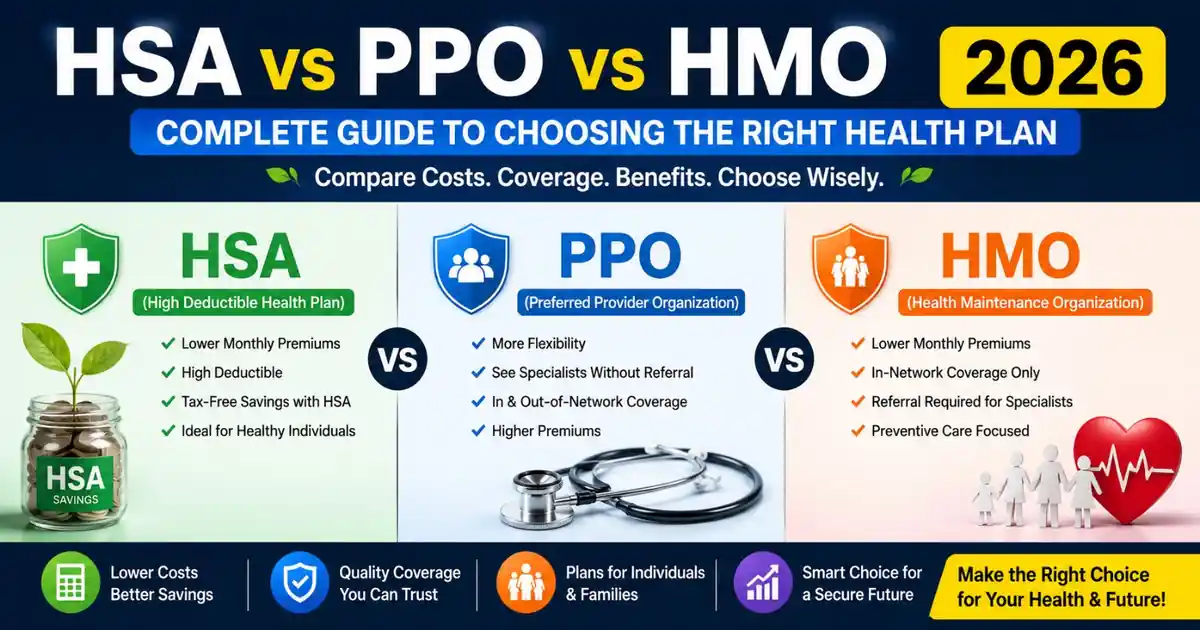 Compare HSA, PPO, and HMO health plans to choose the best insurance coverage for 2026.
HSA vs PPO vs HMO is one of the most important comparisons Americans should understand before selecting a health insurance plan in 2026. Each option offers different costs, provider flexibility, tax advantages, and coverage rules. Choosing the wrong plan can increase your medical expenses, while choosing the right one can help you save money and receive better healthcare throughout the year.
Health insurance is more than just paying a monthly premium. You should compare deductibles, copayments, coinsurance, provider networks, prescription drug coverage, preventive care benefits, and annual out-of-pocket limits. Understanding these features makes it easier to select a plan that matches both your healthcare needs and your budget.
If you’re new to health insurance, begin with our comprehensive
Insurance for Beginners USA 2026: Complete Guide to Choosing the Right Coverage
.
This pillar guide explains health insurance terminology, premiums, deductibles, claims, provider networks, and policy comparisons in simple language, giving you the confidence to compare different health plans.
In this guide, we’ll explain how HSA-compatible health plans work, how PPO and HMO plans differ, who benefits most from each option, and which plan may be the smartest choice for young adults, families, self-employed professionals, and retirees. You’ll also find a comparison table, a simple healthcare cost calculator, a real-life case study, expert recommendations, and answers to the most common questions Americans ask before enrolling in health insurance.
By the end of this article, you’ll understand the advantages and disadvantages of each plan type and know exactly how to choose the best health insurance coverage for your personal and financial situation in 2026.
What Is an HSA and How Does It Work?
Understanding an HSA vs PPO vs HMO comparison starts with learning how a Health Savings Account (HSA) works. An HSA isn’t a health insurance plan by itself. Instead, it’s a tax-advantaged savings account that can only be paired with a qualified High-Deductible Health Plan (HDHP). It allows you to save money for eligible healthcare expenses while receiving valuable tax benefits.
How Does an HSA Work?
You contribute pre-tax money to your HSA throughout the year. These funds can be used to pay qualified medical expenses such as doctor visits, prescription medications, laboratory tests, hospital bills, dental care, vision care, and many other healthcare costs. Unlike a Flexible Spending Account (FSA), unused HSA funds roll over every year and remain yours permanently.
Triple Tax Advantages
- Tax-deductible contributions.
- Tax-free investment growth.
- Tax-free withdrawals for qualified medical expenses.
Because of these benefits, many financial planners consider an HSA one of the most tax-efficient healthcare savings tools available in the United States.
Who Is Eligible?
To contribute to an HSA, you must generally be enrolled in a qualified High-Deductible Health Plan (HDHP). You also cannot be enrolled in most other non-HDHP health coverage that would make you ineligible under IRS rules.
Advantages of an HSA
- Lower monthly insurance premiums with many HDHPs.
- Long-term tax savings.
- Money rolls over every year.
- Account remains yours even if you change employers.
- Funds may be invested for long-term growth.
Potential Drawbacks
- Higher deductibles before insurance begins sharing costs.
- Greater out-of-pocket expenses if significant healthcare is needed early in the year.
- Not everyone qualifies for HSA contributions.
Building healthy finances goes beyond choosing the right health insurance. Learn how to prepare for retirement with our
Retirement Planning Guide
and discover how technology is changing investing through our
AI Investing Guide 2026
.
For official HSA contribution limits, eligibility rules, and qualified medical expenses, visit the
Internal Revenue Service (IRS)
.
Additional health insurance information is available through
Healthcare.gov
.
Understanding how an HSA works is the first step in comparing HSA vs PPO vs HMO. In the next section, we’ll examine PPO and HMO plans in detail and compare their flexibility, provider networks, and overall healthcare costs.
Triple Tax Advantages
PPO vs HMO: Understanding the Key Differences
After understanding how an HSA works, the next step in comparing HSA vs PPO vs HMO is learning how Preferred Provider Organization (PPO) and Health Maintenance Organization (HMO) plans operate. Both offer comprehensive health insurance coverage, but they differ in provider flexibility, referral requirements, monthly premiums, and overall healthcare costs.
What Is a PPO?
A Preferred Provider Organization (PPO) plan gives members greater flexibility when choosing healthcare providers. You can generally visit specialists without obtaining a referral from a primary care physician, and you’ll usually receive partial coverage even when using out-of-network providers. This flexibility makes PPO plans popular among individuals who travel frequently or prefer having more provider choices.
Advantages of a PPO Plan
- Freedom to visit specialists without referrals.
- Larger provider network.
- Coverage for many out-of-network services.
- Greater flexibility for families and frequent travelers.
What Is an HMO?
A Health Maintenance Organization (HMO) plan focuses on coordinated healthcare through a designated primary care physician (PCP). Your PCP manages your healthcare and provides referrals to specialists when necessary. HMO plans generally have lower monthly premiums and lower out-of-pocket costs but require members to stay within the plan’s provider network for most medical services.
Advantages of an HMO Plan
- Lower monthly premiums.
- Lower out-of-pocket healthcare costs.
- Strong emphasis on preventive care.
- Simple care coordination through one primary physician.
If you’re building long-term financial security alongside quality healthcare, explore our
SIP Investing Guide 2026
and discover passive income opportunities in our
Top Dividend Stocks USA 2026
.
For official information about Marketplace health insurance plans and consumer protections, visit
Healthcare.gov.
Additional insurance education is available through the
National Association of Insurance Commissioners (NAIC).
Understanding the differences between PPO and HMO plans makes comparing HSA vs PPO vs HMO much easier. In the next section, we’ll compare all three options side by side using a detailed comparison table, a healthcare cost calculator, and a real-life case study to help you choose the best health plan for 2026.
HSA vs PPO vs HMO Comparison: Costs, Benefits, and Which Plan Saves More
Now that you understand how each health plan works, it’s time to compare HSA vs PPO vs HMO side by side. Each option serves a different purpose. Your ideal choice depends on your healthcare needs, budget, preferred doctors, and expected medical expenses throughout the year.
HSA vs PPO vs HMO Comparison Table
| Feature | HSA (HDHP) | PPO | HMO |
|---|---|---|---|
| Monthly Premium | Low | High | Low to Moderate |
| Deductible | High | Medium | Low |
| Provider Flexibility | Depends on Plan | Excellent | Limited |
| Specialist Referral | Usually No | No | Yes |
| Out-of-Network Coverage | Limited | Yes | Usually No |
| Tax Benefits | Excellent (HSA) | No | No |
| Best For | Healthy Savers | Maximum Flexibility | Lower Overall Costs |
Simple Healthcare Cost Calculator
Estimated Annual Healthcare Cost
(Monthly Premium × 12)
+
Annual Deductible
+
Estimated Copays
+
Prescription Drug Costs
=
Estimated Total Healthcare Cost
Example
Monthly Premium = $320
Annual Premium = $3,840
Deductible = $1,800
Medical Expenses = $900
Total Estimated Annual Cost = $6,540
Real-Life Case Study
Emily, a 33-year-old self-employed graphic designer from Texas, compared an HSA-qualified High-Deductible Health Plan, a PPO, and an HMO before Open Enrollment. Because she rarely visited doctors and wanted long-term tax savings, she selected an HSA-qualified HDHP and contributed regularly to her Health Savings Account. After one year, she saved more than $2,500 in healthcare costs and accumulated tax-free savings that continued growing for future medical expenses.
If Emily had expected frequent specialist visits or ongoing prescription medications, a PPO or HMO may have offered better overall value despite higher monthly premiums.
If you’re still learning health insurance basics, continue with our
Insurance for Beginners USA 2026: Complete Guide to Choosing the Right Coverage
.
It explains premiums, deductibles, provider networks, claims, and policy terminology before comparing different health plans.
For official Marketplace health insurance comparisons, visit
Healthcare.gov.
You can also review consumer information from the
Centers for Medicare & Medicaid Services (CMS)
and the
National Association of Insurance Commissioners (NAIC).
Comparing HSA vs PPO vs HMO side by side makes it much easier to choose a health insurance plan that fits both your healthcare needs and your financial goals. Instead of focusing only on monthly premiums, evaluate total annual healthcare costs, provider flexibility, tax advantages, and long-term value before making your final decision.
Which Health Plan Is Right for You? Choosing Between HSA, PPO, and HMO
There isn’t a single health insurance plan that’s perfect for everyone. The best choice depends on your age, income, healthcare needs, family size, and financial goals. Understanding HSA vs PPO vs HMO helps you choose coverage that balances affordability, flexibility, and long-term value instead of simply selecting the lowest monthly premium.
Best for Young Adults
Healthy young adults who rarely visit doctors may benefit from an HSA-qualified High-Deductible Health Plan (HDHP). Lower monthly premiums combined with tax-free HSA contributions can help build healthcare savings for future medical expenses. However, it’s important to maintain an emergency fund because deductibles are generally higher.
Best for Families
Families usually require regular doctor visits, pediatric care, vaccinations, and prescription medications. A PPO plan offers greater provider flexibility, while an HMO may provide lower overall healthcare costs if your preferred doctors are within the network. Carefully compare annual deductibles, copayments, and family out-of-pocket maximums before enrolling.
Best for Self-Employed Professionals
Freelancers, consultants, and business owners should compare Marketplace plans carefully. Many self-employed Americans choose an HSA-qualified plan because of its valuable tax advantages, while others prefer a PPO for broader provider access. Your expected healthcare usage should guide your decision.
Best for Retirees and Pre-Retirees
People approaching retirement often need specialist care, ongoing prescriptions, and frequent medical appointments. In many cases, a PPO provides greater flexibility, while an HMO may reduce monthly healthcare expenses if your providers are already within the network. Review your expected healthcare costs before selecting a plan.
Recommended Resources
- Healthcare.gov Plan Finder — Compare Marketplace health insurance plans and estimate premium tax credits.
- Fidelity Health Savings Account (HSA) — A tax-advantaged savings account for eligible healthcare expenses.
- The Bogleheads’ Guide to Investing — A trusted personal finance book covering long-term investing and financial planning.
Recommended Health Insurance Providers
- Blue Cross Blue Shield — Broad nationwide provider network and multiple plan options.
- Kaiser Permanente — Integrated healthcare and insurance services in participating states.
- Fidelity HSA — Popular Health Savings Account for qualified High-Deductible Health Plans.
Choosing the right health plan is only one part of building financial security. Strengthen your future with our
Retirement Planning Guide
,
learn how technology is transforming investing in our
AI Investing Guide 2026
,
and build consistent wealth with our
SIP Investing Guide 2026
.
For official health insurance information, compare plans through
Healthcare.gov.
You can also review consumer education from the
National Association of Insurance Commissioners (NAIC).
By understanding the strengths and limitations of each option, comparing HSA vs PPO vs HMO becomes much easier. Selecting the right health plan today can reduce future medical expenses, improve access to quality healthcare, and support your long-term financial well-being throughout 2026.
Common Mistakes to Avoid When Choosing Between HSA, PPO, and HMO
Choosing the wrong health insurance plan can increase your healthcare expenses for years. Understanding HSA vs PPO vs HMO isn’t just about learning definitions—it’s about selecting coverage that matches your medical needs, financial goals, and lifestyle. Avoiding these common mistakes can help you save money while receiving better healthcare throughout 2026.
1. Choosing a Plan Based Only on Monthly Premiums
Many people automatically select the lowest monthly premium without considering deductibles, copayments, coinsurance, and annual out-of-pocket maximums. A slightly higher premium may actually reduce your overall healthcare expenses if you frequently visit doctors or specialists.
2. Ignoring Your Healthcare Needs
Healthy individuals who rarely visit doctors may benefit from an HSA-qualified High-Deductible Health Plan, while families or people with chronic medical conditions often benefit from a PPO or HMO with lower cost-sharing and broader healthcare coverage.
3. Forgetting About Provider Networks
Always verify that your preferred physicians, specialists, hospitals, and pharmacies participate in the plan’s provider network. Out-of-network care can dramatically increase medical expenses, especially under HMO plans.
4. Missing Valuable Tax Benefits
Eligible individuals often overlook the significant tax advantages offered by Health Savings Accounts. Contributing regularly to an HSA can reduce taxable income while creating long-term savings for future healthcare expenses.
Future Trends in Health Insurance
Health insurance continues evolving through artificial intelligence, digital claims processing, telehealth services, wearable health devices, personalized preventive care, and advanced healthcare analytics. These innovations are helping insurers improve customer experiences while making healthcare more accessible and efficient.
Protecting your health also means protecting your finances. Learn how to prepare for uncertain markets with our
Recession-Proof Investing Guide 2026
and compare money-saving financial products in our
Best Credit Cards 2026
.
Trusted Government Resources
For official information about Marketplace plans, Health Savings Accounts, and healthcare regulations, visit
Healthcare.gov,
the
Centers for Medicare & Medicaid Services (CMS),
the
IRS Health Savings Account Guide,
and the
National Association of Insurance Commissioners (NAIC).
These trusted organizations provide reliable information to help consumers make informed health insurance decisions.
By carefully comparing HSA vs PPO vs HMO, reviewing your healthcare needs, and avoiding these common mistakes, you’ll choose a health insurance plan that offers the right balance of affordability, flexibility, tax advantages, and long-term financial protection for you and your family.
Expert Checklist, Trusted Resources, and Frequently Asked Questions
Choosing the right health insurance becomes much easier once you understand HSA vs PPO vs HMO. Instead of focusing only on monthly premiums, compare provider flexibility, deductibles, tax benefits, prescription drug coverage, and your expected healthcare usage. Taking time to review these factors before Open Enrollment can save thousands of dollars while giving you better healthcare protection throughout 2026.
Expert Checklist Before Choosing a Health Plan
- ✔ Compare at least three health insurance plans before enrolling.
- ✔ Estimate your total yearly healthcare expenses—not just monthly premiums.
- ✔ Compare deductibles and annual out-of-pocket maximums.
- ✔ Verify that your preferred doctors, hospitals, and pharmacies are in-network.
- ✔ Review prescription drug coverage carefully.
- ✔ Check whether you’re eligible for a Health Savings Account (HSA).
- ✔ Compare provider flexibility before selecting PPO or HMO coverage.
- ✔ Review your health insurance every Open Enrollment period.
Recommended Resources
- Healthcare.gov Plan Finder — Compare Marketplace health insurance plans.
- Fidelity Health Savings Account (HSA) — Tax-advantaged healthcare savings solution.
- The Bogleheads’ Guide to Investing — One of the most trusted personal finance books for long-term wealth building.
Frequently Asked Questions (FAQs)
1. What is the biggest difference between HSA, PPO, and HMO?
An HSA is a tax-advantaged savings account used with a qualified High-Deductible Health Plan (HDHP). A PPO offers greater provider flexibility without specialist referrals, while an HMO generally provides lower costs but requires members to stay within the provider network and usually obtain referrals for specialist care.
2. Which health plan is best for healthy individuals?
Healthy individuals with low medical expenses often benefit from an HSA-qualified High-Deductible Health Plan because of its lower premiums and valuable tax advantages.
3. Is a PPO better than an HMO?
It depends on your healthcare needs. A PPO offers greater flexibility and broader provider access, while an HMO usually has lower monthly premiums and lower out-of-pocket costs if you stay within the network.
4. Who should choose an HMO plan?
Families and individuals who prefer lower healthcare costs, coordinated medical care, and regularly use in-network providers may find an HMO to be an excellent choice.
5. Where can I compare HSA, PPO, and HMO plans?
You can compare Marketplace plans through
Healthcare.gov,
learn about Medicare and healthcare regulations from
CMS.gov,
review HSA rules at
IRS.gov,
and explore consumer insurance education through the
National Association of Insurance Commissioners (NAIC).
By understanding the differences between HSA vs PPO vs HMO, comparing total healthcare costs, and reviewing trusted government resources, you’ll be prepared to choose a health insurance plan that supports both your healthcare needs and your long-term financial goals. In the final section, we’ll summarize the key takeaways, revisit our pillar guide, include a professional email subscribe box, and finish with a premium colorful author box.
Conclusion
Choosing between HSA vs PPO vs HMO doesn’t have to be confusing. Each health plan offers unique advantages depending on your medical needs, budget, lifestyle, and long-term financial goals. An HSA-qualified High-Deductible Health Plan can provide valuable tax savings and lower monthly premiums, a PPO offers maximum flexibility when choosing healthcare providers, and an HMO generally delivers lower overall healthcare costs through coordinated in-network care.
Before enrolling, compare monthly premiums, deductibles, copayments, provider networks, prescription drug coverage, annual out-of-pocket maximums, and preventive care benefits. Taking a few extra minutes to compare plans during Open Enrollment can help you avoid unnecessary healthcare expenses while ensuring you receive the coverage that’s right for you and your family.
If you’re still learning about health insurance, continue with our complete
Insurance for Beginners USA 2026: Complete Guide to Choosing the Right Coverage
.
You can also strengthen your financial future by reading our
Retirement Planning Guide
and discover money-saving financial tools in our
Best Credit Cards 2026
.
Combining smart healthcare decisions with strong financial planning will help you build lasting financial security throughout 2026 and beyond.
📩 Subscribe for Weekly Insurance & Money Tips
Receive free weekly guides on health insurance, retirement planning, investing, tax-saving strategies, and personal finance. Stay informed and make smarter financial decisions every week.
✔ Free Weekly Updates | ✔ No Spam | ✔ Unsubscribe Anytime
Subhash Rukade
Founder • FinanceInvestment.site
Subhash Rukade publishes research-backed articles on insurance, investing, retirement planning, passive income, and personal finance. His mission is to simplify complex financial topics into practical, easy-to-understand guides that help readers make smarter financial decisions with confidence.
Health Insurance
Investing
Retirement
USA Finance
Leave a Reply