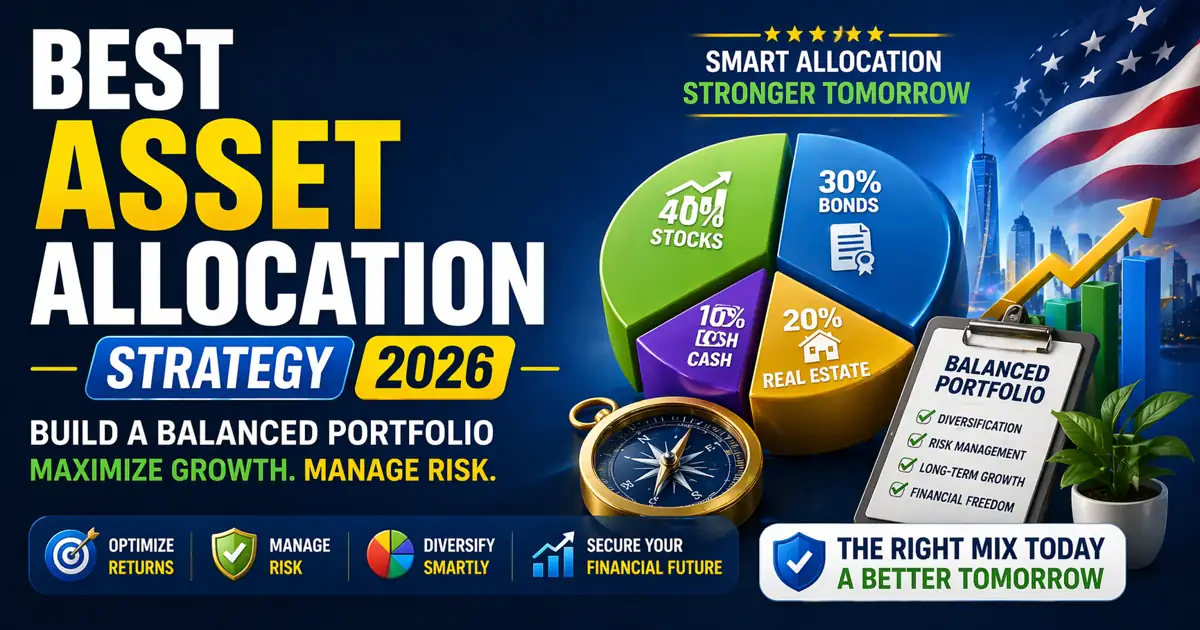
Best Asset Allocation Strategy 2026: Build a Balanced Portfolio
By Subhash Rukade | 📅 Updated: April 25, 2026.

Best Asset Allocation Strategy 2026 is the foundation of successful investing. Many U.S. investors focus only on picking the “best stocks” or chasing high returns. However, the truth is different.
👉 Most investment success does not come from stock selection—it comes from how you allocate your money across different assets.
In 2026, financial markets are more unpredictable than ever. Inflation, interest rates, and global uncertainty are constantly changing. Because of this, putting all your money in one place can be risky.
👉 Smart investors don’t guess—they follow structured systems like
smart money management strategies in 2026
to balance risk, growth, and long-term stability.
💡 Why Asset Allocation Matters More Than Ever
Asset allocation is simply how you divide your money between different types of investments.
- ✔ Stocks for growth
- ✔ Gold for protection
- ✔ Cash for stability
👉 This combination helps you manage risk while still growing your wealth.
👉 Many investors are also using:
AI investing strategies in 2026
to optimize their portfolios and reduce emotional decisions.
⚠️ The Biggest Mistake Investors Make
The biggest mistake is putting too much money into one asset.
- ❌ 100% in stocks → high risk
- ❌ 100% in cash → low growth
- ❌ No diversification → unstable portfolio
👉 This approach can lead to major losses or missed opportunities.
📊 What You Will Learn in This Guide
- ✔ What asset allocation really means
- ✔ Types of investment assets
- ✔ Best allocation strategies for 2026
- ✔ Real-world portfolio examples
- ✔ Mistakes to avoid
🚀 Section 1 Final Insight
In 2026, the smartest investors don’t rely on luck. They build balanced portfolios using proven asset allocation strategies. This approach reduces risk and improves long-term returns.
👉 Next, let’s understand what asset allocation really is and how it works.
What Is Asset Allocation in 2026? (Simple Guide for U.S. Investors)
To understand the best asset allocation strategy 2026, you first need to know what asset allocation actually means. In simple terms, asset allocation is how you divide your money across different types of investments.
👉 Instead of putting all your money in one place, you spread it across multiple assets to reduce risk and improve returns.
—
💡 Simple Definition
Asset allocation = how you split your money between assets like stocks, gold, and cash.
For example:
- ✔ 60% in stocks (growth)
- ✔ 20% in gold (protection)
- ✔ 20% in cash/savings (stability)
👉 This balance helps protect your portfolio from market ups and downs.
—
📊 Why Asset Allocation Is Important
Many investors think picking the right stock is the key to success. But in reality, asset allocation plays a bigger role.
- ✔ Reduces overall risk
- ✔ Improves long-term returns
- ✔ Protects wealth during downturns
- ✔ Creates financial stability
👉 That’s why successful investors follow structured systems like
smart money management strategies in 2026
to manage their portfolios effectively.
—
⚖️ Asset Allocation vs Diversification
These two terms are often confused, but they are different:
- ✔ Asset Allocation: Deciding how much to invest in each asset type
- ✔ Diversification: Spreading investments within each asset
👉 Both are important for building a strong portfolio.
—
🤖 Role of Technology in Asset Allocation
In 2026, investors are not managing portfolios manually anymore. Technology is playing a big role.
- ✔ AI-based portfolio recommendations
- ✔ Automated rebalancing
- ✔ Real-time risk analysis
👉 Learn more:
AI-powered personal finance tools in 2026
—
🏦 Key Assets in a Portfolio
Most portfolios are built using three main asset types:
- ✔ Stocks (growth)
- ✔ Gold (protection)
- ✔ Cash/savings (liquidity)
👉 Each asset plays a different role in your financial plan.
—
⚡ Pro Tip
Do not chase returns blindly. Focus on building a balanced portfolio that can handle both good and bad market conditions.
—
🚀 Section 2 Final Insight
Asset allocation is the backbone of successful investing in 2026. Once you understand it, you can build a portfolio that grows steadily while staying protected.
👉 Next, let’s explore different types of asset classes and how they work.
Types of Asset Classes in 2026 (Where Should You Allocate Your Money?)
To build the best asset allocation strategy 2026, you need to understand the different types of assets available. Each asset class has a unique role in your portfolio.
👉 Smart investors don’t rely on one asset. They combine multiple assets to balance risk and growth.
—
📈 1. Stocks (Growth Engine)
Stocks represent ownership in companies. They are one of the most powerful tools for long-term wealth creation.
- ✔ High growth potential
- ✔ Long-term returns beat inflation
- ✔ Ideal for wealth building
👉 However, stocks come with volatility, so they should be balanced with safer assets.
—
🪙 2. Gold (Wealth Protection)
Gold is a traditional asset used to protect wealth during uncertainty and inflation.
- ✔ Stable during market downturns
- ✔ Hedge against inflation
- ✔ Reduces portfolio risk
👉 Learn more:
gold investment strategies in the USA
—
💰 3. Cash & Savings (Liquidity)
Cash is essential for short-term needs and financial security.
- ✔ Emergency funds
- ✔ Immediate access
- ✔ Low risk
👉 To improve returns on savings:
high-yield savings accounts in the USA
—
💻 4. Digital Investments (Modern Growth)
Digital assets include ETFs, index funds, and cryptocurrencies. These are becoming increasingly popular in 2026.
- ✔ Easy access through apps
- ✔ Diversified investment options
- ✔ High growth potential
👉 Many investors are using:
AI investing strategies in 2026
to manage digital portfolios efficiently.
—
🏦 5. Bonds & Fixed Income (Stability Layer)
Bonds provide steady income and lower risk compared to stocks.
- ✔ Stable returns
- ✔ Lower volatility
- ✔ Good for conservative investors
👉 They help balance high-risk assets like stocks.
—
⚖️ How These Assets Work Together
Each asset plays a specific role:
- ✔ Stocks = Growth
- ✔ Gold = Protection
- ✔ Cash = Stability
- ✔ Bonds = Income
- ✔ Digital = Modern growth
👉 Combining these creates a strong and balanced portfolio.
—
⚡ Pro Tip
Do not depend on one asset class. A mix of assets protects you during market ups and downs.
—
🚀 Section 3 Final Insight
Understanding asset classes is the key to building a successful investment strategy. The right mix ensures both growth and protection.
👉 Next, let’s explore the best asset allocation models for 2026 and how to apply them.
Best Asset Allocation Models in 2026 (Aggressive, Balanced & Conservative)
Choosing the best asset allocation strategy 2026 depends on your goals, risk tolerance, and investment timeline. There is no one-size-fits-all model. However, most successful investors follow three proven allocation styles.
👉 The key is selecting the right model based on your financial situation.
👉 For a complete system, revisit:
smart money management strategies in 2026
—
🚀 1. Aggressive Portfolio (High Growth)
This model focuses on maximizing returns. It is ideal for young investors or those with a long investment horizon.
- ✔ 70–80% Stocks / Digital assets
- ✔ 10–15% Gold
- ✔ 5–10% Cash
👉 Best for:
- ✔ Long-term investors (10+ years)
- ✔ High risk tolerance
- ✔ Wealth growth focus
👉 Use tools like:
AI investing strategies in 2026
to manage risk effectively.
—
⚖️ 2. Balanced Portfolio (Most Popular)
This is the most commonly used strategy. It balances growth and safety.
- ✔ 50–60% Stocks / ETFs
- ✔ 15–20% Gold
- ✔ 20–30% Cash / Bonds
👉 Best for:
- ✔ Medium risk investors
- ✔ Stable long-term growth
- ✔ Wealth protection + growth
👉 This approach works well with structured planning from:
AI-powered personal finance tools in 2026
—
🛡️ 3. Conservative Portfolio (Safety First)
This model prioritizes capital protection over growth.
- ✔ 20–30% Stocks
- ✔ 20–30% Gold
- ✔ 40–50% Cash / Fixed income
👉 Best for:
- ✔ Retirees
- ✔ Low risk tolerance
- ✔ Income-focused investors
👉 To improve returns on savings:
high-yield savings accounts in the USA
—
📊 Which Model Should You Choose?
Your ideal allocation depends on:
- ✔ Age
- ✔ Income stability
- ✔ Financial goals
- ✔ Risk tolerance
👉 Younger investors → aggressive
👉 Mid-age investors → balanced
👉 Retirees → conservative
—
⚡ Pro Tip
You don’t have to stick to one model forever. Adjust your allocation as your life and goals change.
—
📘 Recommended Reading
👉 Learn long-term investing:
👉 The Little Book of Common Sense Investing
—
🚀 Section 4 Final Insight
The best asset allocation strategy in 2026 depends on your goals. Whether aggressive, balanced, or conservative, the key is consistency and discipline.
👉 Next, let’s compare these strategies side by side to find the best fit for your needs.
Asset Allocation Models Compared (Risk, Returns & Best Use in 2026)
In the best asset allocation strategy 2026, choosing the right model becomes easier when you compare them side by side. Each portfolio type offers a different balance of risk, protection, and growth.
👉 Let’s break it down clearly so you can pick what suits your goals.
—
📊 Asset Allocation Comparison Table
| Portfolio Type | Risk Level | Return Potential | Stability | Best For |
|---|---|---|---|---|
| Aggressive | High | Very High | Low | Young investors, long-term growth |
| Balanced | Moderate | High | Moderate | Most investors |
| Conservative | Low | Moderate | High | Retirees, low-risk investors |
—
💡 Key Insights from the Comparison
- ✔ Aggressive portfolios deliver higher returns but come with higher risk
- ✔ Balanced portfolios offer the best mix of safety and growth
- ✔ Conservative portfolios protect capital but grow slowly
👉 Most U.S. investors prefer the balanced approach for long-term stability.
—
⚖️ Which Strategy Is Best in 2026?
There is no universal answer. The best strategy depends on your situation:
- ✔ Choose aggressive if you want high growth
- ✔ Choose balanced for stability + growth
- ✔ Choose conservative for safety
👉 Smart investors often adjust their strategy over time.
—
📈 Real Strategy Used by Experts
Financial experts recommend a dynamic approach:
- ✔ Start aggressive when young
- ✔ Shift to balanced in mid-life
- ✔ Move to conservative near retirement
👉 This ensures both growth and protection throughout your life.
—
⚡ Pro Tip
Don’t stick to one allocation forever. Your portfolio should evolve as your goals change.
—
🚀 Section 5 Final Insight
Understanding different allocation models helps you make smarter investment decisions. The right strategy ensures long-term success.
👉 Next, let’s look at real-life examples, common mistakes, and practical tips for building a balanced portfolio.
Real-Life Example + Common Mistakes + Practical Tips for Asset Allocation in 2026
Understanding the best asset allocation strategy 2026 becomes much clearer when you see how real investors apply it. Let’s look at a practical U.S. example and then break down mistakes and smart tips.
—
👤 Real-Life Example: Sarah from New York
Sarah is a 35-year-old marketing professional. Before 2024, her investment strategy was unstructured.
- ❌ 80% money in stocks
- ❌ No gold allocation
- ❌ No emergency fund
- ❌ Panic selling during market dips
👉 When markets became volatile, her portfolio dropped sharply, and she faced financial stress.
—
🚀 What She Changed
Sarah switched to a balanced asset allocation strategy:
- ✔ 55% in stocks & ETFs
- ✔ 15% in gold for stability
- ✔ 20% in savings & bonds
- ✔ 10% in cash for liquidity
👉 She improved her financial stability using:
high-yield savings accounts in the USA
👉 She also used:
AI investing strategies in 2026
to manage her portfolio efficiently.
—
📈 Results After 1 Year
- ✔ Reduced portfolio volatility
- ✔ More stable returns
- ✔ Better financial confidence
- ✔ Consistent long-term growth
👉 The key difference was proper allocation, not higher risk.
—
❌ Common Asset Allocation Mistakes
- ❌ Putting all money in one asset
- ❌ Ignoring gold or safety assets
- ❌ Keeping too much idle cash
- ❌ Not rebalancing the portfolio
- ❌ Emotional investing decisions
👉 These mistakes can reduce returns and increase risk.
—
💡 Practical Tips for U.S. Investors
- ✔ Diversify across multiple asset classes
- ✔ Rebalance portfolio every 6–12 months
- ✔ Maintain an emergency fund
- ✔ Use automation and AI tools
- ✔ Stay consistent with long-term investing
👉 Build your safety net here:
how much emergency fund you should have
👉 Protect your portfolio with:
gold investment strategies in the USA
—
📘 Recommended Reading
👉 Learn smarter investing:
—
⚡ Pro Tip
Asset allocation is not a one-time decision. It requires regular updates based on market conditions and life goals.
—
🚀 Section 6 Final Insight
Real success in the best asset allocation strategy 2026 comes from balance, discipline, and consistency. A well-structured portfolio reduces risk and improves long-term returns.
👉 Next, let’s explore future trends, FAQs, and the final strategy to build a powerful investment portfolio.
Future of Asset Allocation in 2026 + FAQs + Final Strategy
The best asset allocation strategy 2026 is no longer static. Markets are changing fast, and smart investors are adapting with flexible, data-driven approaches.
👉 To build a complete long-term system, revisit:
smart money management strategies in 2026
—
🚀 Future Trends in Asset Allocation
- ✔ AI-driven portfolio management
- ✔ Increased diversification across global assets
- ✔ More focus on risk management
- ✔ Growing use of ETFs and automated investing
👉 According to
U.S. Securities and Exchange Commission, diversification and long-term planning are essential for reducing investment risk.
👉 Financial education platforms like
Investopedia emphasize asset allocation as one of the most important factors in investment success.
—
❓ Frequently Asked Questions (FAQ)
1. What is the best asset allocation for beginners?
A balanced portfolio (stocks + gold + cash) is ideal for beginners.
2. How often should I rebalance my portfolio?
Every 6–12 months or when allocation changes significantly.
3. Is 100% stock allocation good?
No. It increases risk. Diversification is important for stability.
4. Should I change allocation with age?
Yes. Younger investors can take more risk, while older investors should focus on safety.
5. Can AI help with asset allocation?
Yes. AI tools can optimize portfolios and reduce emotional decisions.
—
💰 Final Strategy for Smart Investors
To succeed in the best asset allocation strategy 2026, follow this simple framework:
- ✔ Diversify across multiple asset classes
- ✔ Balance growth and protection
- ✔ Maintain liquidity for emergencies
- ✔ Invest consistently over time
- ✔ Rebalance regularly
👉 Strengthen your financial base:
how much emergency fund you should have
👉 Improve your investment strategy:
AI investing strategies in 2026
—
📩 Subscribe for Smart Finance Tips
Want to stay ahead financially in 2026?
- ✔ Latest investing strategies
- ✔ Money management tips
- ✔ Passive income ideas
—
🚀 Final Verdict
The best asset allocation strategy in 2026 is not about chasing returns—it’s about building a balanced portfolio that can handle both growth and uncertainty.
👉 Stay disciplined, stay diversified, and your financial future will remain strong.
—
—
👤 About the Author
Subhash Rukade
Subhash Rukade is a finance content creator and founder of FinanceInvestment.site, helping U.S. investors build smarter financial strategies in a rapidly evolving economy.
He specializes in simplifying complex financial concepts like investing, asset allocation, and wealth protection into practical, easy-to-follow strategies.
- 📊 Personal Finance & Portfolio Strategy
- 💰 Investment & Wealth Building
- 🤖 AI in Finance & Smart Investing
His mission is to help everyday investors take control of their finances and achieve long-term financial freedom.
👉 Visit:
FinanceInvestment.site
🚀 Mission: Help millions of investors build wealth with smart, balanced strategies.
Leave a Reply