CD vs High-Yield Savings Account: Which Is Better in 2026?
A CD can lock in a fixed return, while a high-yield savings account keeps your money easier to reach. The better home for your cash depends on how much access you need and how much rate certainty matters to you.
Where Should Your Cash Sit?: Start With the Job of Your Money
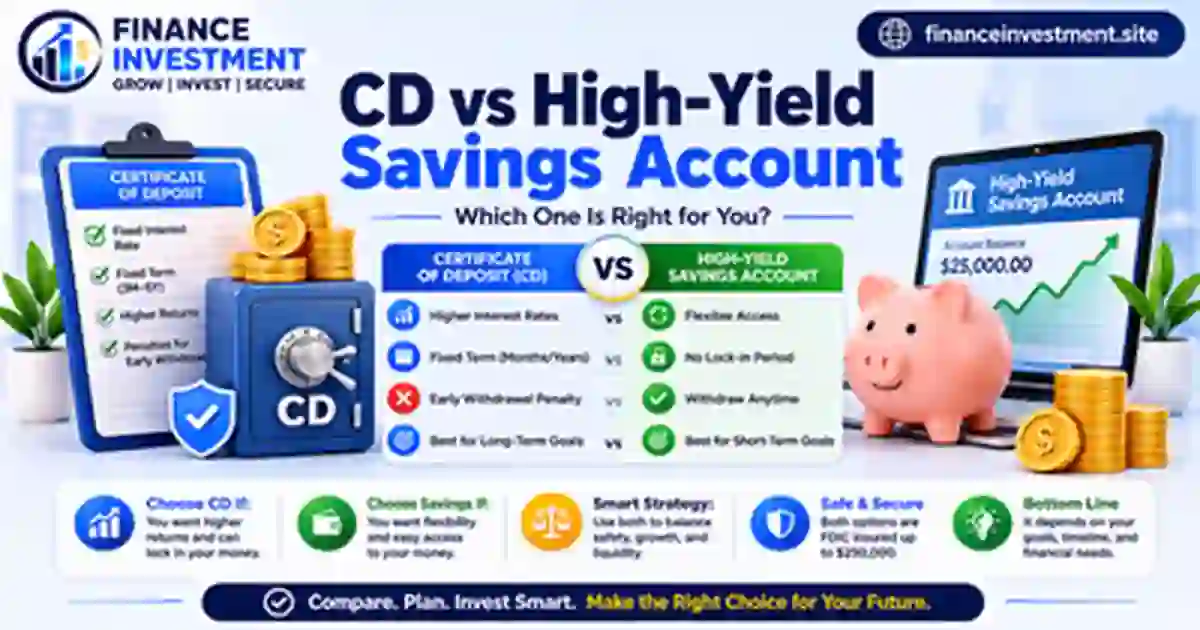 CD vs high-yield savings account is not simply a contest to see which account advertises the higher APY. The better choice often comes down to what you need the money to do. A CD can lock in a fixed rate for a defined period, while a high-yield savings account generally gives you easier access while allowing its rate to change.
Think about a planned expense, emergency reserve, or cash you do not expect to touch for a while. Money needed soon may be better suited to an account that keeps it accessible. Cash with a longer runway may benefit from the certainty of a CD, provided you are comfortable with the commitment and any early-withdrawal rules.
Your time horizon matters just as much as the advertised rate. A slightly lower return with easy access can be more useful than a higher rate that leaves your money tied up when you need it. If you want the broader picture of CD terms, safety, rates and strategies, explore our
CD Guide 2026
.
What You’ll Learn
This guide compares CDs and high-yield savings accounts across rates, access, time horizons, taxes, insurance, penalties and real-world uses, so you can decide where each dollar fits rather than forcing all your savings into one account.
Quick Answer: CD or High-Yield Savings Account?
Quick answer: A CD can be a strong fit when you want a fixed return and can leave the money untouched for a set period. A high-yield savings account can be more useful when access matters and you want the flexibility to add or withdraw money as your needs change.
Run These Six Questions Before Choosing
- Will you need the money soon?
If yes, easier access may matter more than locking in a rate. - Do you value rate certainty?
A fixed-rate CD can keep its agreed rate through the term. - How long can the money stay untouched?
Match the account to your realistic time horizon, not an ideal one. - How important is the APY difference?
Compare the actual return, but don’t ignore access and account conditions. - Could you need an early withdrawal?
A CD may impose an early-withdrawal penalty or other restrictions. - What job does the money have?
Emergency cash, a near-term purchase and long-term savings can deserve different homes.
Bottom line: Don’t choose an account simply because its headline APY is higher. Choose the structure that fits how and when you expect to use the money.
CD vs High-Yield Savings Account at a Glance
Before getting into the details, this snapshot shows how the two account types differ in the mechanics that matter after you deposit your money. Specific rates, minimums and account rules vary by institution, so always check the offer you are considering.
| Feature | CD | High-Yield Savings |
|---|---|---|
| APY behavior | Usually fixed for the selected CD term | Generally variable and can change |
| Access | Limited during the term | Generally easier to access |
| Rate lock | Yes, for a fixed-rate CD | No fixed-rate guarantee |
| Term | Set maturity period | No fixed maturity |
| Minimum deposit | Depends on the institution | Depends on the account |
| Withdrawals | Early withdrawal may trigger a penalty | Generally more flexible, subject to account rules |
| Adding money | Usually not after opening a standard CD | Generally allows additional deposits |
| Maturity | Yes | No |
| Insurance | Generally FDIC or NCUA insured when eligible | Generally FDIC or NCUA insured when eligible |
| Best use | Money that can stay untouched | Cash that needs ongoing access |
One useful distinction: A CD gives you a maturity date; a high-yield savings account gives you ongoing flexibility. That structural difference can matter as much as the APY.
Complete Beginner Guide: How to Choose Between a CD and HYSA
 If you are new to CDs and high-yield savings accounts, start with the money itself rather than the account name. Ask what the cash is for, when you might need it, and how uncomfortable you would be if accessing it became harder than expected.
1. Protect Your Emergency Cash First
Money reserved for unexpected expenses generally deserves easy access. A high-yield savings account can be useful for this role because you can keep adding money and typically have more flexibility than with a CD. Do not lock up your emergency reserve simply to chase a higher advertised yield.
2. Set a Clear Access Deadline
Next, identify money you expect to use within the next few months or years. A home purchase, tuition bill, vehicle expense or planned family event can give you a natural deadline. If the money must be available by a specific date, that date should influence the account you choose.
3. Compare Current APYs
Once you know how accessible the money needs to be, compare the available yields. Our guide to
high-yield savings accounts
can help you research the savings side, while our
CD rates in 2026
resource can help you review CD offers.
4. Read the CD Terms Before Comparing the Yield
A CD’s APY does not tell the whole story. Check the term length, minimum deposit, early-withdrawal penalty, interest-payment options and maturity instructions. A higher rate may be less useful if the account’s restrictions conflict with your plans.
5. Decide How Much Rate Certainty You Want
A fixed-rate CD can protect you from a decline in available rates during its term. A high-yield savings account gives you more flexibility, but its APY can move. Think about which trade-off you would rather accept.
6. Consider Splitting the Money
You do not necessarily have to choose one account for every dollar. For example, you could keep your accessible reserve in a high-yield savings account and place money with a longer timeline into CDs. A
CD ladder
can add several future maturity points rather than putting everything behind one deadline.
Beginner Tip
If you cannot comfortably explain when you will need the money and why you are choosing the account, slow down before opening it. A few minutes spent matching the account to the purpose of the cash can prevent a costly mismatch later.
How CD and High-Yield Savings Interest Works
Both accounts pay interest, but the way that return behaves can be quite different. With a CD, a fixed-rate certificate generally locks the stated APY for the selected term. Once the account is opened, a change in market rates normally does not change that locked rate.
A high-yield savings account usually has a variable APY. The bank can change the rate as market conditions and its pricing decisions change. That flexibility can work in either direction: your savings rate may rise, but it can also fall without the account reaching a maturity date.
APY reflects the effect of compounding under the account’s stated terms. Interest may be credited on a schedule set by the institution, and the way credited interest compounds can affect the final balance. Savings accounts also generally allow additional deposits, while a standard CD usually starts with a defined deposit and ends at maturity.
Withdrawals create another important difference. Savings accounts are designed for ongoing access, subject to the institution’s current account rules. A CD may restrict early withdrawals or impose a penalty before maturity.
Illustrative Example: $15,000 in a CD vs. HYSA
Illustrative only: Suppose you place $15,000 into a hypothetical one-year CD earning 4.50% APY. If the stated APY applies for the full year and the money remains under the account terms, the balance would be approximately $15,675 at the end of the year.
Now imagine the same $15,000 in a hypothetical HYSA starting at 4.50% APY. If that APY stayed unchanged for the entire year and no additional deposits or withdrawals were made, the result would be broadly similar. The key difference is what happens afterward: the CD’s rate is locked for its term, while the HYSA rate can change.
The lesson: identical starting APYs do not make the accounts identical. The CD trades flexibility for rate certainty, while the HYSA keeps the money more accessible and leaves the future rate open.
Remember: A CD reaches a defined maturity date. A high-yield savings account generally does not, so your money can continue earning interest while the account remains open and eligible.
Benefits & Drawbacks of CDs and High-Yield Savings Accounts
Neither account wins every category. A CD gives structure to money you can leave alone, while a high-yield savings account gives you more room to react when your plans change.
CD — Pros
- Rate certainty: A fixed-rate CD can lock in the agreed APY for its term.
- Predictable return: You can estimate the interest under the account’s stated terms.
- Saving discipline: Limited access can help keep goal-based money untouched.
- Protection from falling rates: A locked rate generally stays unchanged through maturity.
CD — Cons
- Limited access: Early withdrawals may cost you.
- Rate opportunity: New CDs could offer better rates later.
- Inflation risk: A fixed return may not keep pace with rising prices.
HYSA — Pros
- Easy access: Your cash remains more available for changing needs.
- Ongoing deposits: You can generally keep building the balance.
- Flexibility: You are not tied to a fixed maturity date.
HYSA — Cons
- Variable APY: The rate can fall after you open the account.
- Less rate certainty: Future earnings are harder to predict.
- Opportunity cost: A higher fixed CD rate could sometimes produce more for money you do not need soon.
Practical takeaway: Use the CD when certainty has value; use the HYSA when flexibility has value. And for larger savings goals, combining both can be a sensible middle ground.
CD vs High-Yield Savings Account Compared
Looking at the two accounts side by side makes the trade-offs easier to see. The biggest difference is not just the advertised APY; it is what happens to your money after the account is opened.
| Factor | CD | High-Yield Savings Account |
|---|---|---|
| APY | Typically fixed for the selected term | Generally variable |
| Rate certainty | Strong during the fixed term | Future rate is not guaranteed |
| Access | Limited until maturity or subject to withdrawal rules | Generally easier to access |
| Adding money | Usually requires another CD for new funds | Generally allows ongoing deposits |
| Maturity date | Yes | No fixed maturity |
| Early access | May involve an early-withdrawal penalty | Generally more flexible, subject to account rules |
| Minimum deposit | Varies by institution and CD | Varies by institution and account |
| Taxes | Interest is generally taxable | Interest is generally taxable |
| Deposit insurance | Generally available when eligible | Generally available when eligible |
| Best use | Money with a defined timeline | Accessible savings and changing needs |
If a CD looks more suitable, you can learn
how CDs work
before opening one. If flexibility is the priority, explore
how to open a high-yield savings account.
You can also compare current options through our
2026 CD rates guide
and review
ways to maximize savings interest
before deciding where each portion of your cash belongs.
Best middle ground: You can use both accounts—keep money that needs access in a HYSA and place longer-horizon cash into CDs.
Costs, Risks & Expert Tips Before Choosing
The account with the higher advertised APY can still be the weaker choice if its conditions do not fit your plans. Look beyond the headline number and check what could reduce your actual return or create a problem later.
Watch for Promotional Rates
Some savings accounts may advertise an attractive introductory or promotional APY. Check how long it lasts, whether a minimum balance applies and what rate may apply afterward. Compare the ongoing terms rather than judging an account by its opening offer alone.
Understand the Cost of Access
A standard CD may charge an early-withdrawal penalty if you take money out before maturity. That cost can matter if your plans change. A high-yield savings account generally provides easier access, but it may have its own transfer, withdrawal or account-management rules.
Remember That Rates Can Move
A CD’s fixed rate can provide certainty during its term. A HYSA’s variable APY can change as market conditions and the institution’s pricing change. If savings rates decline, your future earnings may be lower even though your money remains accessible.
Consider Taxes and Inflation
Interest from both account types is generally taxable for federal income-tax purposes when applicable. Also consider inflation: a positive nominal return does not necessarily mean your purchasing power increased.
Check Deposit-Insurance Coverage
Confirm that the bank or credit union is properly insured and understand applicable coverage limits. For larger balances, spreading deposits across institutions or ownership categories may require additional planning.
Expert Tip
Before opening either account, write down the APY, minimum balance, access rules, expected holding period and insurance status. Then ask one practical question: “What happens if I need this money earlier than planned?” The answer can reveal more than the advertised rate.
Common Mistakes When Choosing Between a CD and HYSA
Comparing two accounts can look simple until the money has to serve a real purpose. These mistakes often come from focusing on the advertised APY while overlooking how the account fits into everyday finances.
1. Choosing Only by the Highest APY
A higher rate is attractive, but it does not automatically make an account better. Check the term, balance requirements, access rules and what happens after any promotional period.
2. Putting Emergency Money Into a CD
Emergency cash may be needed without warning. Locking the entire reserve into a CD can create unnecessary pressure if an unexpected bill arrives.
3. Ignoring Future Rate Changes
A HYSA rate can change, while a fixed-rate CD generally stays locked for its term. Treat that difference as part of the decision rather than assuming today’s rate will last forever.
4. Overlooking Withdrawal Conditions
Read the CD’s early-withdrawal terms before depositing money. Also review the current transaction and transfer rules for a savings account.
5. Forgetting Taxes and Insurance
Interest can create taxable income, and larger balances deserve an insurance check. Make sure you understand which institution provides coverage and whether your full balance qualifies.
Illustrative Example: Jordan’s $30,000
Illustrative only: Jordan has $30,000 but expects $8,000 may be needed within the next year. Instead of locking the entire amount into one CD, Jordan keeps the accessible portion in a HYSA and considers a CD for money with a longer timeline. The decision sacrifices some potential rate certainty on the flexible portion, but avoids making one account responsible for every financial need.
Who Should Choose a CD and Who Should Choose a HYSA?
The better account often becomes clearer when you look at the person’s cash needs rather than the account’s headline rate. Different savings goals can justify different levels of access and commitment.
A CD May Suit You If:
- You have money you are unlikely to need before a known date.
- You prefer a fixed rate and predictable earnings.
- You are saving for a planned expense with a defined timeline.
- You want some structure that makes it harder to spend the money casually.
- You are comfortable with the CD’s maturity and early-withdrawal rules.
A HYSA May Suit You If:
- You need your savings to remain readily accessible.
- You are building or maintaining an emergency fund.
- Your income or expenses can change unexpectedly.
- You want to keep adding money without opening a new CD each time.
For many families, the choice does not have to be either-or. Keeping accessible cash in a HYSA while placing longer-term savings into CDs can create a practical balance between flexibility and rate certainty. If your priority is a predictable maturity schedule, a
CD ladder
can also spread access across several dates.
Frequently Asked Questions About CDs vs High-Yield Savings Accounts
Which is better, a CD or a high-yield savings account?
Neither is automatically better. A CD can suit money you can leave untouched for a set period, while a high-yield savings account can be more useful when access and flexibility matter.
Is a CD APY fixed while a HYSA APY can change?
Generally, a fixed-rate CD keeps its stated rate through the selected term. A high-yield savings account normally has a variable rate that can change.
Can I withdraw money from a CD early?
Usually, but an early withdrawal may result in a penalty or other restrictions. Check the specific CD agreement before opening the account.
Can I add money to a high-yield savings account?
Yes. Savings accounts generally allow additional deposits, although account-specific rules may apply.
Are CDs and high-yield savings accounts FDIC insured at eligible banks?
Eligible deposits at an FDIC-insured bank are generally covered within applicable limits. Eligible accounts at federally insured credit unions may receive NCUA share insurance.
Which account is better for an emergency fund?
A high-yield savings account is often more practical because emergency money may need to be accessed without waiting for a CD maturity date or paying an early-withdrawal penalty.
Do CDs and high-yield savings accounts have taxable interest?
Interest is generally taxable income for federal purposes, although your exact tax treatment depends on your circumstances.
Can I use both a CD and a HYSA?
Yes. Some savers keep accessible cash in a HYSA while using CDs for money with a longer, predictable timeline.
Illustrative example: What if a CD and HYSA have the same APY?
Illustrative only: If $10,000 earned the same 4.50% APY for a full year in either account, the ending interest would be broadly similar under the same assumptions. The difference is that the CD generally locks the rate for its term, while the HYSA rate can change.
Final Verdict: CD or High-Yield Savings Account?
In the CD vs high-yield savings account decision, start with when the money will be needed. A strong APY is useful, but it cannot make up for an account that puts your cash in the wrong place at the wrong time.
A CD can make sense for money with a clear future date and little chance of being needed sooner. Locking a fixed rate also removes the uncertainty of wondering whether your APY will drop during the term.
A high-yield savings account can be the better home for emergency reserves, upcoming expenses or savings that are still growing. You give up the CD’s fixed-rate certainty, but your cash remains easier to manage as life changes.
There is also no rule that says every dollar must go into the same account. Keeping a liquid reserve while putting longer-horizon money into CDs can give each part of your savings a specific job. For more on CD terms, rates, maturity and safety, visit our
CD Guide 2026.
Give Every Dollar a Clear Job
Your savings do not all need the same account. Stay informed about CDs, savings rates and practical money strategies so you can make thoughtful choices as your goals and the market change.
📧 subhashr325@gmail.com
Leave a Reply