Traditional IRA vs Roth IRA: Which Wins for Retirement in 2026?
Published: June 24, 2026 |
Author: Subhash Rukade
Traditional IRA vs Roth IRA: Why This Retirement Decision Matters More Than Ever
The Traditional IRA vs Roth IRA debate continues to be one of the most important retirement planning decisions for American investors in 2026.
Both retirement accounts offer valuable tax advantages. Both help investors build long-term wealth. However, the way they deliver those benefits is completely different.
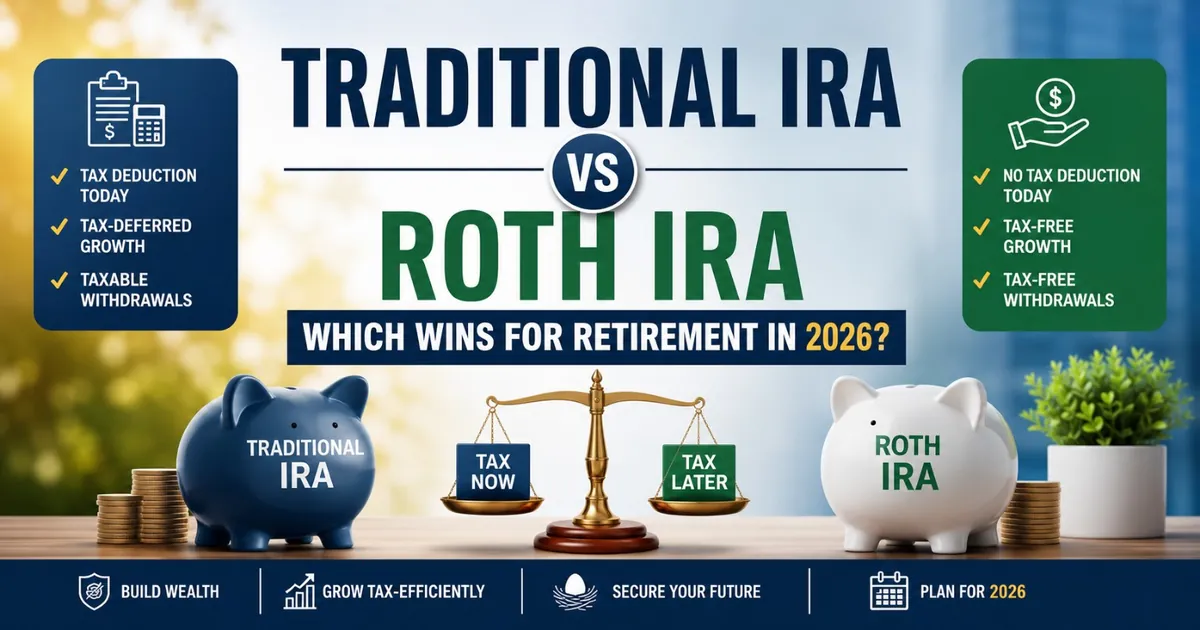
A Traditional IRA can reduce your taxable income today through potential tax deductions. A Roth IRA, on the other hand, offers tax-free withdrawals in retirement when certain requirements are met.
Because of these differences, choosing the right account can affect your retirement income, tax bill, and overall financial flexibility for decades.
Many Americans automatically open the first retirement account they hear about without understanding how each option fits their long-term goals.
That mistake can lead to missed tax opportunities and a less efficient retirement strategy.
The good news is that there is no need to guess.
By understanding how these accounts work, investors can make smarter decisions and potentially keep more money throughout retirement.
If you are building a complete retirement roadmap, start with our comprehensive
Retirement Planning Guide
.
That pillar guide explains how retirement accounts, Social Security benefits, investing strategies, tax planning, and retirement income work together to create financial security.
In this guide, we will compare Traditional IRA vs Roth IRA, examine tax benefits, review contribution rules, analyze real-world examples, and explore which account may be the better choice for different types of investors.
Whether you are just starting your retirement journey or approaching retirement age, understanding the strengths and weaknesses of each account can help you make more confident financial decisions.
The goal is simple: maximize retirement income, reduce unnecessary taxes, and build lasting financial freedom.
Key Differences Between Traditional IRA and Roth IRA
To understand the Traditional IRA vs Roth IRA decision, investors must first understand how these accounts differ in taxes, withdrawals, contribution rules, and retirement benefits.
While both accounts are designed to help Americans save for retirement, the timing of the tax benefits is what separates them.
How a Traditional IRA Works
A Traditional IRA allows eligible investors to contribute money that may be tax-deductible.
This means you could lower your taxable income in the year you contribute.
Your investments then grow tax-deferred until retirement.
However, withdrawals during retirement are generally taxed as ordinary income.
For investors seeking immediate tax savings, this can be a major advantage.
How a Roth IRA Works
A Roth IRA uses after-tax contributions.
You do not receive a tax deduction today.
However, qualified withdrawals in retirement are completely tax-free.
This feature makes a Roth IRA attractive for younger investors and anyone expecting higher tax rates in the future.
Many retirement planners value the flexibility and tax-free income potential that Roth IRAs provide.
Traditional IRA vs Roth IRA Comparison Table
| Feature | Traditional IRA | Roth IRA |
|---|---|---|
| Tax Benefit | Potential Tax Deduction Today | Tax-Free Retirement Withdrawals |
| Contribution Type | Pre-Tax or Deductible | After-Tax |
| Retirement Withdrawals | Taxable | Generally Tax-Free |
| Required Minimum Distributions | Yes | No During Owner’s Lifetime |
| Income Restrictions | Deduction Limits May Apply | Income Limits Apply |
| Best For | Current Tax Savings | Future Tax Savings |
Which Account Offers More Flexibility?
When comparing Traditional IRA vs Roth IRA, flexibility often favors the Roth IRA.
Because qualified withdrawals are tax-free and there are no required minimum distributions during the owner’s lifetime, investors have greater control over retirement income planning.
That said, a Traditional IRA may still be the better option for investors looking to reduce taxable income today.
The best choice often depends on your expected future tax bracket, retirement goals, and overall financial strategy.
Many successful investors eventually use both accounts to create tax diversification and improve retirement flexibility.
Traditional IRA vs Roth IRA Tax Benefits Explained for 2026
For most investors, taxes are the deciding factor in the Traditional IRA vs Roth IRA comparison.
The investment options inside both accounts are often similar. The real difference is when you pay taxes and how those taxes affect your retirement income.
Choosing the right tax strategy today can potentially save thousands of dollars over a lifetime.
Traditional IRA Tax Advantages
A Traditional IRA may allow eligible investors to deduct contributions from taxable income.
This can provide immediate tax savings and reduce the amount owed to the IRS each year.
For example, if an investor contributes $7,000 and qualifies for a full deduction, taxable income may be reduced by the same amount.
This benefit is especially attractive for workers currently in higher tax brackets.
In addition, investments inside the account grow tax-deferred until withdrawals begin.
The trade-off is that future withdrawals are generally taxed as ordinary income.
Roth IRA Tax Advantages
A Roth IRA takes the opposite approach.
Contributions are made using after-tax dollars, so there is no immediate tax deduction.
However, qualified withdrawals during retirement are generally tax-free.
This means future investment growth may never be taxed if account rules are followed.
For younger investors with decades of growth ahead, this tax-free income can become extremely valuable.
Tax Example: Traditional IRA vs Roth IRA
Consider an investor earning $70,000 annually.
They contribute $7,000 to an IRA and fall into a moderate tax bracket.
- Traditional IRA: Potential tax deduction today.
- Roth IRA: No deduction today, but tax-free retirement withdrawals later.
If the investor expects retirement taxes to be lower, the Traditional IRA may produce greater value.
If future tax rates are expected to rise, the Roth IRA may become the better long-term choice.
This is why retirement planning should focus on future tax exposure rather than current tax savings alone.
Investors interested in technology-driven financial planning can explore our
AI Investing Guide 2026
.
Modern financial tools can help estimate future retirement income, tax liabilities, and account growth projections.
For official retirement account rules and contribution limits, investors should also review guidance from the IRS:
IRS Individual Retirement Arrangements (IRAs)
The best retirement strategy is not always choosing one account over the other.
Many successful investors use both account types strategically to balance current tax savings with future tax-free retirement income.
Real-Life Case Study and Retirement Calculator Example
Understanding the Traditional IRA vs Roth IRA decision becomes much easier when we look at real-world examples.
While tax rules can seem complicated, practical retirement scenarios often reveal which account may provide the greatest benefit.
Case Study #1: Sarah, Age 35
Sarah earns $75,000 per year and expects her income to increase significantly over the next two decades.
She believes future tax rates could be higher than they are today.
Because of that expectation, Sarah chooses a Roth IRA.
Although she gives up an immediate tax deduction, she values the possibility of receiving tax-free retirement income later.
She contributes consistently each year and plans to allow her investments to grow for more than 25 years.
For investors like Sarah, the long-term tax-free growth potential of a Roth IRA can be extremely attractive.
Case Study #2: Mike, Age 55
Mike earns $120,000 annually and plans to retire within the next 10 years.
His current tax bracket is significantly higher than what he expects during retirement.
As a result, Mike prefers a Traditional IRA.
The potential tax deduction helps lower his taxable income today while allowing investments to grow tax-deferred.
Because he expects lower retirement taxes, the Traditional IRA may provide greater overall value.
Retirement Calculator Example
Let’s compare a simple retirement investing scenario.
- Monthly Contribution: $500
- Investment Period: 20 Years
- Average Annual Return: 8%
Using a retirement calculator, the account could potentially grow to more than $290,000 over two decades.
The investment growth may be similar regardless of whether funds are placed in a Traditional IRA or Roth IRA.
The key difference is how taxes affect withdrawals.
That is why understanding your future tax situation remains one of the most important parts of retirement planning.
Investors seeking a complete retirement strategy should also review our
Retirement Planning Guide
.
That guide explains how retirement accounts, Social Security benefits, tax planning, and retirement income strategies work together.
Long-term investors may also benefit from our
SIP Investing Guide 2026
for disciplined investing strategies.
To improve everyday financial efficiency, readers can explore our
Best Credit Cards 2026
resource.
Ultimately, the best retirement account is the one that aligns with your tax situation, retirement timeline, and long-term financial goals.
Common Mistakes Investors Make When Choosing Between a Traditional IRA and Roth IRA
The Traditional IRA vs Roth IRA decision can have a major impact on retirement income, taxes, and long-term wealth.
Unfortunately, many investors make avoidable mistakes that reduce the benefits these retirement accounts can provide.
Understanding these mistakes can help investors build a stronger retirement strategy in 2026 and beyond.
Mistake #1: Focusing Only on Current Taxes
Many investors choose a Traditional IRA simply because they want an immediate tax deduction.
While reducing today’s tax bill can be valuable, retirement planning should also consider future taxes.
A lower tax bill today does not automatically mean lower taxes over a lifetime.
Investors should think about where they expect tax rates to be during retirement before making a final decision.
Mistake #2: Ignoring Future Tax Brackets
One of the biggest mistakes in the Traditional IRA vs Roth IRA debate is assuming future tax rates will remain unchanged.
No one knows exactly what future tax laws will look like.
However, investors expecting higher retirement income or future tax increases may benefit from the tax-free withdrawal potential of a Roth IRA.
Tax diversification can provide valuable flexibility later in life.
Mistake #3: Waiting Too Long to Start Investing
Some investors spend years researching retirement accounts but delay contributions.
The biggest advantage of retirement investing is time.
Starting early allows compound growth to work for decades.
Even modest contributions can grow into significant retirement assets when given enough time.
Mistake #4: Ignoring Diversification
Retirement planning should not depend entirely on one account.
Many successful investors combine retirement accounts with dividend-producing investments and other income sources.
Investors interested in building additional retirement cash flow can review our
How to Build a Dividend Portfolio
guide.
Income-focused investors may also find value in our
Top Dividend Stocks USA 2026
resource.
Mistake #5: Not Reviewing Retirement Plans Regularly
Financial goals change over time.
Income levels, tax laws, family situations, and retirement objectives can all evolve.
Investors should review retirement plans annually to ensure their account strategy remains aligned with long-term goals.
Recommended Retirement Resources
The Bogleheads’ Guide to Retirement Planning
Avoiding these common mistakes can significantly improve retirement outcomes and help investors maximize the benefits of both Traditional IRAs and Roth IRAs.
Future Retirement Trends and Strategies for 2026
As retirement planning continues to evolve, the Traditional IRA vs Roth IRA decision is becoming even more important for American investors.
Changes in tax policy, inflation, technology, and life expectancy are influencing how people save and invest for retirement.
Investors who understand these trends can make better decisions and build more resilient retirement plans.
Trend #1: Greater Focus on Tax Diversification
Financial professionals increasingly recommend maintaining multiple sources of retirement income.
Instead of relying entirely on one type of retirement account, many investors are creating tax diversification through a combination of Traditional IRAs, Roth IRAs, workplace retirement plans, and taxable investment accounts.
This strategy can provide more flexibility when managing retirement withdrawals and taxes.
Tax diversification may also help retirees respond to future tax law changes more effectively.
Trend #2: Rising Interest in Roth Conversions
Many investors are exploring Roth conversion strategies before retirement.
A Roth conversion involves moving eligible assets from a Traditional IRA into a Roth IRA and paying taxes on the converted amount.
The goal is to potentially reduce future taxable withdrawals while increasing tax-free retirement income.
For some investors, strategic Roth conversions may become an important part of retirement planning over the next decade.
Trend #3: AI-Powered Financial Planning
Technology is changing how Americans manage retirement accounts.
Advanced planning tools can analyze savings rates, investment allocations, retirement income projections, and withdrawal strategies.
Investors interested in modern retirement planning techniques can review our
AI Investing Guide 2026
.
These tools can help investors identify opportunities and improve long-term decision-making.
Trend #4: Inflation Remains a Retirement Challenge
Inflation continues to affect retirement spending across the United States.
Healthcare costs, insurance premiums, housing expenses, and everyday necessities have become major concerns for retirees.
As a result, retirement plans must focus on both growth and income generation.
Investors who combine retirement accounts with diversified investments may be better positioned to maintain purchasing power over time.
Trend #5: Preparing for Market Volatility
Market fluctuations are a normal part of investing.
Retirees and future retirees should prepare for periods of uncertainty rather than reacting emotionally to short-term market movements.
Our
Recession-Proof Investing 2026
guide provides practical strategies for navigating challenging economic environments.
Trusted Retirement Resources
Investors should regularly review information from trusted financial organizations:
U.S. Securities and Exchange Commission (SEC)
Fidelity Retirement Education Center
The future of retirement planning will likely reward investors who stay flexible, continue learning, and regularly adapt their strategies as financial conditions evolve.
Frequently Asked Questions About Traditional IRA vs Roth IRA
1. Is a Roth IRA better than a Traditional IRA?
Not necessarily. The answer depends on your current tax bracket, future income expectations, and retirement goals. Investors expecting higher future tax rates often prefer a Roth IRA, while those seeking immediate tax deductions may favor a Traditional IRA.
2. Can I have both a Traditional IRA and a Roth IRA?
Yes. Many investors use both accounts to create tax diversification. This strategy can provide greater flexibility when managing retirement withdrawals and future tax obligations.
3. What happens after age 59½?
Once you reach age 59½, qualified withdrawals from a Roth IRA can generally be taken tax-free if account requirements are met. Traditional IRA withdrawals are usually taxed as ordinary income.
4. Can retirees still contribute to an IRA?
If you have eligible earned income, you may still be able to contribute to an IRA even after reaching traditional retirement age. Eligibility depends on IRS rules and income requirements.
5. Which account is better for young investors?
Many younger investors prefer a Roth IRA because decades of potential tax-free growth can create significant retirement income advantages later in life.
6. What is the best IRA strategy in 2026?
For many Americans, the best strategy is not choosing one account exclusively. Combining Traditional IRA and Roth IRA benefits can create tax diversification and improve retirement flexibility.
Conclusion: Which Account Wins in 2026?
The Traditional IRA vs Roth IRA decision does not have a universal winner.
Both accounts offer powerful retirement benefits, but they serve different financial goals.
A Traditional IRA may be the better choice for investors seeking current tax deductions and lower taxable income today.
A Roth IRA may be more attractive for investors who want tax-free retirement income and greater flexibility in the future.
For many Americans, the strongest retirement strategy includes both account types.
Combining tax-deferred and tax-free retirement savings can help reduce future tax uncertainty while providing more withdrawal options during retirement.
If you are building a complete retirement strategy, revisit our
Retirement Planning Guide
.
That pillar guide explains how retirement accounts, Social Security benefits, investing strategies, tax planning, and retirement income planning work together to create long-term financial security.
The most important step is not choosing the perfect account.
The most important step is starting early, investing consistently, and reviewing your retirement strategy regularly.
Small decisions made today can create a significant difference in retirement wealth tomorrow.
📩 Get Retirement Planning Tips Every Week
Receive retirement planning strategies, IRA insights, dividend investing ideas, tax-saving opportunities, and wealth-building tips directly in your inbox.
Free Updates • No Spam • Unsubscribe Anytime
✨ About the Author
Subhash Rukade
is the founder of
FinanceInvestment.site
and writes about retirement planning, investing, passive income, dividend strategies, and long-term wealth building for American investors.
His mission is to simplify personal finance and help readers build stronger retirement income through practical, easy-to-understand financial strategies.
🇺🇸 Helping Americans Build Wealth & Retire With Confidence
Leave a Reply