401(k) vs Roth IRA for Retirement in 2026: Which Account Wins?
Published: June 23, 2026 |
Author: Subhash Rukade
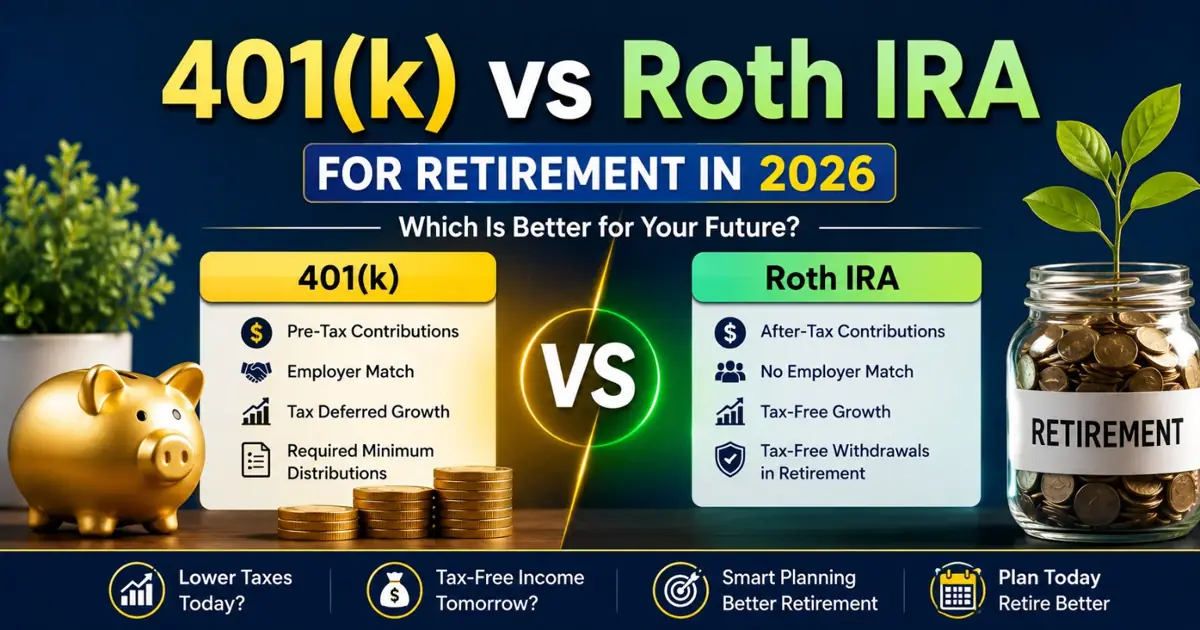
401(k) vs Roth IRA: Why This Retirement Decision Matters in 2026
Choosing between a 401(k) vs Roth IRA is one of the most important retirement decisions American investors can make in 2026.
Both accounts offer powerful tax advantages. Both can help you build long-term wealth. However, they work in very different ways.
A 401(k) provides tax-deferred growth and is often offered through employers. A Roth IRA allows tax-free withdrawals in retirement and gives investors more control over their investment choices.
The challenge is figuring out which account fits your financial goals, income level, tax situation, and retirement timeline.
Many investors automatically contribute to a workplace retirement plan without understanding how a Roth IRA might improve their long-term financial future.
Others focus only on Roth contributions and miss valuable employer matching contributions available through a 401(k).
The truth is that there is no one-size-fits-all answer.
The right choice depends on your personal retirement strategy.
If you’re building a complete retirement roadmap, start with our comprehensive
Retirement Planning Guide
.
That guide explains how Social Security, retirement accounts, investments, taxes, and income planning work together to create financial security in retirement.
In this article, you’ll learn the key differences between a 401(k) and Roth IRA, tax advantages, contribution rules, common mistakes, retirement planning strategies, and how each account may perform in 2026 and beyond.
You’ll also see practical examples, retirement calculators, comparison tables, and real-world scenarios that can help you decide which account deserves a place in your retirement portfolio.
By the end of this guide, you’ll have a clear understanding of how to use a 401(k), a Roth IRA, or a combination of both to build long-term retirement wealth.
Understanding the Key Differences Between a 401(k) and Roth IRA
To make the right retirement decision, you first need to understand how a 401(k) vs Roth IRA works.
Although both accounts help Americans save for retirement, the tax benefits, contribution rules, and withdrawal options are very different.
What Is a 401(k)?
A 401(k) is an employer-sponsored retirement account that allows employees to contribute a portion of their salary before taxes are deducted.
One of the biggest advantages of a 401(k) is the immediate tax benefit.
Traditional 401(k) contributions reduce your taxable income today, which may lower your current tax bill.
Your investments then grow tax-deferred until retirement.
Many employers also offer matching contributions.
For example, an employer may match 50% or 100% of employee contributions up to a certain limit.
This employer match is essentially free money for retirement.
What Is a Roth IRA?
A Roth IRA is an individual retirement account funded with after-tax dollars.
Unlike a traditional 401(k), contributions do not reduce your taxable income today.
However, qualified withdrawals in retirement are completely tax-free.
This feature makes a Roth IRA attractive for investors who expect higher tax rates in the future.
A Roth IRA also offers greater flexibility because investors can choose from a wider range of investment options.
The Biggest Difference: Taxes
When comparing a 401(k) vs Roth IRA, taxes are usually the deciding factor.
- 401(k): Tax savings now, taxes later.
- Roth IRA: Taxes now, tax-free withdrawals later.
If you believe your retirement tax rate will be lower than your current rate, a traditional 401(k) may be attractive.
If you expect tax rates to rise or your income to increase significantly over time, a Roth IRA may provide greater long-term value.
Employer Match Can Change the Equation
Many financial planners recommend contributing enough to a 401(k) to receive the full employer match before investing elsewhere.
Failing to capture employer matching contributions can leave thousands of dollars on the table over a working career.
For many investors, the best retirement strategy is not choosing one account over the other.
Instead, it involves using both accounts strategically to create tax diversification in retirement.
In the next section, we’ll compare contribution limits, withdrawal rules, investment flexibility, and tax advantages side by side using a simple comparison table and real-world retirement example.
401(k) vs Roth IRA Comparison: Which Account Offers More Value?
When comparing a 401(k) vs Roth IRA, investors should focus on the features that have the biggest impact on long-term retirement wealth.
The right account depends on your income, tax situation, retirement goals, and access to employer benefits.
The table below highlights the most important differences.
401(k) vs Roth IRA Comparison Table
| Feature | 401(k) | Roth IRA |
|---|---|---|
| Tax Treatment | Tax Deferred | Tax-Free Retirement Withdrawals |
| Employer Match | Yes (Many Plans) | No |
| Investment Choices | Limited Plan Options | Broad Investment Choices |
| Contribution Type | Pre-Tax | After-Tax |
| Required Minimum Distributions | Generally Yes | No During Owner’s Lifetime |
| Retirement Tax Benefit | Deferred Taxes | Tax-Free Qualified Withdrawals |
Retirement Calculator Example
Let’s compare two investors who each contribute $500 per month for 30 years and earn an average annual return of 8%.
- Monthly Contribution: $500
- Investment Period: 30 Years
- Average Annual Return: 8%
Using a retirement calculator, both investors could potentially accumulate more than $700,000 by retirement.
However, the key difference comes at withdrawal time.
The 401(k) investor may owe taxes on distributions, while qualified Roth IRA withdrawals could be completely tax-free.
That difference can significantly affect retirement income.
Real-World Case Study
Sarah is 30 years old and earns $75,000 per year.
Her employer offers a 401(k) with a 100% match on the first 5% of salary contributed.
Instead of choosing between a 401(k) vs Roth IRA, Sarah uses both accounts strategically.
She contributes enough to her 401(k) to receive the full employer match and then directs additional retirement savings into a Roth IRA.
This approach gives her:
- Immediate employer contributions
- Tax diversification
- Tax-free retirement income potential
- Greater investment flexibility
Over time, this balanced strategy can provide more retirement options than relying on a single account.
Many financial professionals consider this one of the most effective retirement planning approaches available.
As retirement approaches, investors can decide which account to draw from based on tax rates, market conditions, and income needs.
In the next section, we’ll examine the most common mistakes investors make when choosing between a 401(k) and Roth IRA and how those mistakes can reduce retirement wealth.
Common Mistakes Investors Make With a 401(k) and Roth IRA
Choosing between a 401(k) vs Roth IRA is important, but avoiding costly mistakes may be even more important.
Many investors make decisions that reduce long-term retirement wealth without realizing the consequences.
The good news is that most of these mistakes can be avoided with proper planning.
Mistake #1: Ignoring Employer Matching Contributions
One of the biggest retirement mistakes is failing to contribute enough to receive the full employer match in a 401(k).
Employer matching contributions provide an immediate return on your investment.
For example, if your employer matches 100% of the first 5% of salary contributed, failing to contribute that amount means leaving free retirement money behind.
Over a 20- or 30-year career, the lost growth potential can be substantial.
Mistake #2: Choosing the Wrong Tax Strategy
Taxes play a major role in the 401(k) vs Roth IRA decision.
Some investors focus only on today’s tax savings and ignore future tax consequences.
Others contribute exclusively to a Roth IRA without considering whether current tax deductions from a traditional 401(k) could improve their financial situation.
The best choice often depends on expected future income and tax rates.
Mistake #3: Delaying Retirement Investing
Many Americans spend years researching retirement accounts but never actually invest.
Time is one of the most powerful wealth-building tools available.
Starting early allows compound growth to work in your favor.
Even modest contributions can grow significantly over decades.
If you’re creating a complete retirement strategy, review our
Retirement Planning Guide
.
The guide explains how retirement accounts, Social Security, investments, and income planning fit together.
Mistake #4: Ignoring Investment Allocation
Opening a retirement account is only the first step.
Investors must also choose appropriate investments.
Many retirement accounts remain invested in overly conservative options that fail to keep pace with inflation.
Others become excessively aggressive and take unnecessary risks.
A diversified portfolio can help balance growth and risk.
Mistake #5: Forgetting About Additional Income Sources
Retirement income should not depend entirely on one account.
Many retirees supplement retirement accounts with dividend-producing investments.
To learn more, visit our
How to Build a Dividend Portfolio
guide.
You can also review our
Top Dividend Stocks USA 2026
resource for additional retirement income ideas.
Avoiding these common mistakes can significantly improve retirement outcomes and help investors maximize the benefits of both a 401(k) and Roth IRA.
Next, we’ll examine which account may be best for different types of investors and how to build a retirement strategy that fits your personal goals.
Which Is Better: 401(k) or Roth IRA for Different Types of Investors?
The answer to the 401(k) vs Roth IRA debate depends largely on your financial situation, income level, career stage, and retirement goals.
There is no universal winner.
Instead, the best account is the one that aligns with your long-term retirement strategy.
Young Investors: Roth IRA Often Has the Edge
Young professionals typically have decades before retirement.
Because their current tax rates may be relatively low, paying taxes now and enjoying tax-free withdrawals later can be highly attractive.
A Roth IRA allows young investors to lock in today’s tax rates while giving investments decades to compound.
The longer the investment horizon, the more valuable tax-free growth can become.
High-Income Earners: 401(k) Can Provide Immediate Benefits
Investors in higher tax brackets often appreciate the immediate tax deductions available through a traditional 401(k).
Reducing taxable income today can generate meaningful tax savings.
In addition, employer matching contributions can significantly increase retirement savings.
For many high-income professionals, maximizing a workplace 401(k) is a key retirement planning strategy.
Middle-Class Families: A Combination Strategy Works Well
Many financial planners recommend using both accounts.
This approach creates tax diversification and provides greater flexibility during retirement.
A common strategy includes:
- Contribute enough to receive the full 401(k) employer match.
- Fund a Roth IRA for tax-free retirement income.
- Increase retirement contributions as income grows.
This balanced approach allows investors to benefit from both current tax savings and future tax-free withdrawals.
Retirees and Pre-Retirees
Investors approaching retirement should focus on future withdrawal strategies.
Having both taxable and tax-free retirement income sources can create greater flexibility when managing retirement taxes.
This is one reason many retirees appreciate the combination of a 401(k) and Roth IRA.
Using AI for Retirement Planning
Technology is changing how Americans prepare for retirement.
Modern planning tools can analyze savings rates, investment performance, tax strategies, and future retirement income projections.
To learn more about these innovations, visit our
AI Investing Guide 2026
.
AI-powered tools can help investors make more informed retirement decisions and identify opportunities for improvement.
Building Additional Retirement Income
Retirement accounts are important, but they should not be your only source of retirement income.
Many investors also build dividend-focused portfolios that generate passive income throughout retirement.
Our
How to Build a Dividend Portfolio
guide explains how dividend investing can complement retirement accounts.
The strongest retirement plans often combine a 401(k), Roth IRA, Social Security benefits, and investment income into one coordinated strategy.
Next, we’ll examine future retirement trends, trusted planning resources, recommended retirement books, and additional strategies investors should consider in 2026.
Future Retirement Trends and Planning Resources for 2026
The retirement landscape continues to evolve, making it more important than ever for investors to stay informed.
When evaluating a 401(k) vs Roth IRA, investors should not focus only on today’s benefits.
Instead, they should consider how retirement planning may change over the next decade.
Economic conditions, tax policies, inflation, technology, and life expectancy all influence retirement outcomes.
Retirement Trends Investors Should Watch in 2026
Several trends are shaping retirement planning across America.
- Longer life expectancy
- Higher healthcare costs
- Growing use of AI-powered financial planning
- Increased focus on tax-efficient retirement income
- Greater interest in passive income investing
These trends highlight the importance of building multiple retirement income sources rather than relying on a single account.
Investors who diversify their retirement strategy often have greater financial flexibility.
Trusted Retirement Planning Resources
Before making retirement decisions, investors should review information from trusted government sources.
These resources provide guidance on retirement accounts, investor education, and retirement planning rules.
Retirement Planning Example
Imagine a 35-year-old investor contributing:
- $500 monthly to a 401(k)
- $250 monthly to a Roth IRA
- Additional savings into dividend investments
Over several decades, this diversified approach may create multiple retirement income streams while reducing dependence on any single account.
This strategy can also provide greater flexibility when managing taxes during retirement.
Recommended Retirement Books
The Bogleheads’ Guide to Retirement Planning
Additional Investing Resources
Investors interested in consistent long-term investing should review our
SIP Investing Guide 2026
.
For navigating economic uncertainty, our
Recession-Proof Investing 2026
guide offers practical ideas for protecting wealth during challenging markets.
Retirees looking to improve everyday financial efficiency may also find value in our
Best Credit Cards 2026
resource.
The most successful retirement plans are built gradually through disciplined saving, smart investing, tax planning, and regular financial reviews.
In the final section, we’ll answer the most common questions about 401(k) vs Roth IRA, summarize key retirement planning lessons, and provide a practical action plan for investors in 2026.
Frequently Asked Questions About 401(k) vs Roth IRA
1. Is a Roth IRA better than a 401(k)?
Not necessarily. A Roth IRA offers tax-free retirement withdrawals, while a 401(k) often provides employer matching contributions. The best option depends on your income, tax situation, and retirement goals.
2. Can I contribute to both a 401(k) and a Roth IRA?
Yes. Many investors contribute to both accounts. This strategy provides tax diversification and can help maximize retirement savings.
3. Should I take the employer match before funding a Roth IRA?
In many cases, yes. Financial professionals often recommend contributing enough to a 401(k) to receive the full employer match before directing additional retirement savings elsewhere.
4. Which account offers more investment flexibility?
A Roth IRA generally provides a wider range of investment options because it is not limited by an employer-sponsored plan menu.
5. What is the best retirement strategy in 2026?
For many investors, the most effective strategy combines a 401(k), a Roth IRA, Social Security benefits, and diversified investments to create multiple retirement income streams.
Conclusion
The 401(k) vs Roth IRA decision is not about choosing a winner and a loser.
Both retirement accounts offer valuable advantages that can help investors build long-term financial security.
A 401(k) can provide immediate tax benefits and employer matching contributions. A Roth IRA offers tax-free retirement withdrawals and greater investment flexibility.
For many Americans, the strongest retirement plan includes both accounts working together.
This combination creates tax diversification, improves retirement income flexibility, and helps reduce future financial uncertainty.
If you’re building a complete retirement strategy, revisit our
Retirement Planning Guide
.
That pillar guide connects retirement accounts, Social Security benefits, investing, tax planning, and wealth preservation into one practical roadmap.
The earlier you start investing, the more time compound growth has to work in your favor.
Whether you choose a 401(k), a Roth IRA, or both, consistency is often the biggest factor behind retirement success.
📩 Get Weekly Retirement & Investing Insights
Receive retirement planning strategies, investing ideas, dividend income tips, and wealth-building insights delivered directly to your inbox.
Free Updates • No Spam • Unsubscribe Anytime
✨ About the Author
Subhash Rukade
is the founder of
FinanceInvestment.site
and writes about retirement planning, investing, dividend income, passive income strategies, and long-term wealth building.
His mission is to help American investors make smarter financial decisions, build sustainable retirement income, and achieve long-term financial freedom through practical investing strategies.
🇺🇸 Helping Americans Build Wealth & Retire Confidently
Leave a Reply