401(k) vs Roth IRA: Which Is Better in 2026?
By Subhash Rukade | Updated May 12, 2026
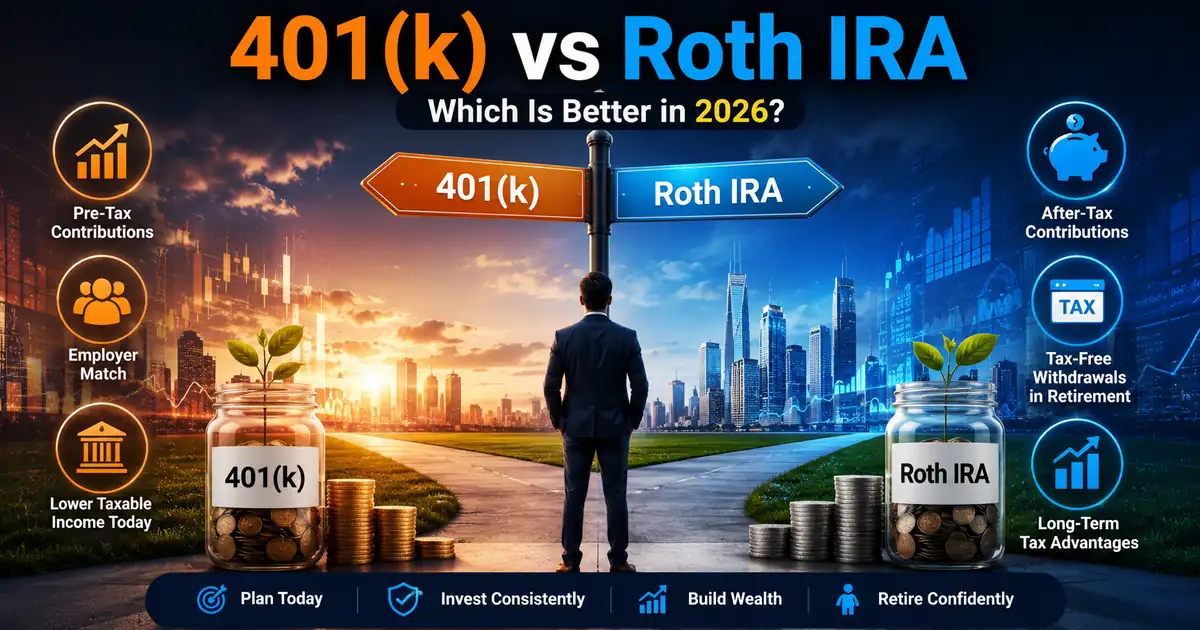
Why Retirement Accounts Matter More Than Ever in 2026
For millions of Americans, understanding the difference between 401k vs Roth IRA retirement accounts has become one of the most important financial decisions in 2026.
Rising living costs, inflation pressure, healthcare expenses, and longer life expectancy are pushing more investors to focus seriously on retirement planning and long-term financial security.
Unlike older generations that relied heavily on pensions, many modern Americans now depend primarily on personal retirement accounts and long-term investing systems to support future financial freedom.
This is one reason retirement-focused investing continues growing rapidly across the United States.
Both 401(k) plans and Roth IRAs may help investors build retirement wealth through:
- Tax advantages
- Long-term compounding
- Retirement-focused investing
- Passive income opportunities
However, each account works differently.
Understanding those differences may help investors choose stronger retirement strategies based on:
- Income level
- Tax situation
- Retirement goals
- Investment style
- Long-term financial planning
Many successful retirement investors first learn how long-term investing works before choosing retirement account strategies. This beginner-friendly guide explains those fundamentals clearly:
How to Invest in Stocks in 2026.
Retirement account planning also becomes easier when investors understand broader wealth-building systems used by Americans today. This detailed pillar guide explains how long-term retirement portfolios are being built in 2026:
How Americans Are Building Retirement Wealth in 2026.
Many Americans now realize retirement planning is no longer simply about saving money quietly in bank accounts.
Instead, successful retirement strategies often depend on building diversified investment systems capable of generating long-term growth, passive income, and financial flexibility for decades.
In this guide, we’ll compare 401(k) vs Roth IRA retirement accounts, explain the advantages and disadvantages of each option, and explore how investors are using both strategies to build stronger retirement wealth in 2026.
What Is the Difference Between 401(k) and Roth IRA?
Understanding the differences between 401k vs Roth IRA accounts is extremely important for Americans building long-term retirement strategies in 2026.
Although both retirement accounts offer tax advantages and long-term investing benefits, they work very differently.
Choosing the right account often depends on:
- Income level
- Tax strategy
- Employer benefits
- Retirement goals
- Investment preferences
1. How a Traditional 401(k) Works
A 401(k) is typically offered through employers and allows workers to invest money directly from paychecks before taxes are deducted.
This may help investors:
- Reduce taxable income today
- Build retirement savings automatically
- Benefit from employer matching contributions
However, withdrawals during retirement are generally taxed as ordinary income.
2. How a Roth IRA Works
A Roth IRA uses after-tax contributions instead of pre-tax contributions.
This means investors pay taxes now, but qualified withdrawals during retirement may become tax free later.
Many long-term investors prefer Roth IRAs because they may provide:
- Tax-free retirement withdrawals
- Flexible investing options
- Long-term compounding potential
3. Employer Matching Is a Major Advantage of 401(k)s
One of the biggest benefits of employer-sponsored 401(k) plans is matching contributions.
Many employers contribute additional retirement money when employees contribute part of their paycheck.
This may significantly accelerate retirement wealth growth over time.
4. Roth IRA Income Limits Matter
Unlike many 401(k) plans, Roth IRAs have income eligibility limits.
Higher-income earners may eventually face contribution restrictions depending on annual IRS rules.
Because of this, some investors prioritize employer retirement accounts first before adding Roth IRA contributions later.
5. Investment Flexibility Can Differ
Many Roth IRAs offer broader investing flexibility compared to employer-sponsored 401(k) plans.
Depending on the provider, investors may access:
- ETFs
- Dividend stocks
- Index funds
- REITs
- Broad-market investments
This flexibility attracts many long-term retirement investors focused on diversification and passive income.
| Feature | 401(k) | Roth IRA |
|---|---|---|
| Tax Treatment | Pre-tax contributions | After-tax contributions |
| Retirement Withdrawals | Taxable | Potentially tax free |
| Employer Match | Usually available | Not available |
| Investment Flexibility | Limited by employer plan | Broader investment choices |
| Income Limits | Usually none | Income restrictions apply |
| Automatic Payroll Contributions | Yes | No |
Many retirement investors also continue researching stronger dividend investing systems capable of supporting passive income during retirement:
Top Dividend Stocks USA 2026.
If you’re still learning long-term investing basics, this beginner-friendly guide explains how retirement-focused investing works:
How to Invest in Stocks in 2026.
Recommended Retirement Investing Book
Many long-term investors continue learning retirement and passive income strategies from this respected investing classic:
The Simple Path to Wealth by JL Collins
.
Which Retirement Account Is Better for Different Investors?
Choosing between 401k vs Roth IRA often depends on personal financial goals, income level, tax strategy, and long-term retirement planning preferences.
There is no single perfect answer for every investor.
Many Americans actually combine both retirement accounts to build stronger and more diversified retirement systems.

1. Roth IRA May Benefit Younger Investors
Many younger investors prefer Roth IRAs because they often expect higher income and tax rates later in life.
Since Roth IRA contributions are taxed today, qualified retirement withdrawals may become tax free later.
This long-term tax advantage may become especially valuable after decades of compounding growth.
Many younger investors also value the broader investment flexibility available through Roth IRAs.
2. 401(k) Plans May Benefit Higher-Income Workers
Many higher-income earners prioritize 401(k) plans because pre-tax contributions may reduce taxable income immediately.
Employer matching contributions may also significantly accelerate retirement portfolio growth over time.
For many Americans, employer matching remains one of the biggest advantages of 401(k) investing.
3. Passive Income Investors Often Use Both
Many long-term retirement investors combine:
- Employer-sponsored 401(k) plans
- Roth IRAs
- Dividend ETFs
- Dividend stocks
This combination may help create:
- Tax diversification
- Passive income potential
- Long-term flexibility
- Broader retirement stability
Many investors also continue building stronger dividend income systems through long-term investing strategies explained in this detailed guide:
How to Build a Dividend Portfolio.
4. Long-Term Retirement Planners Focus on Compounding
Many experienced retirement investors focus less on short-term market movements and more on:
- Consistency
- Monthly contributions
- Long-term compounding
- Diversification
This disciplined approach often matters more than trying to predict short-term market performance.
5. Tax Strategy Plays a Major Role
Some investors prefer paying taxes now through Roth IRAs while others prioritize immediate tax reductions through 401(k) contributions.
Many financial planners believe tax diversification may become valuable because future tax conditions remain uncertain.
Using both account types may provide greater retirement flexibility later in life.
Many Americans also continue studying broader retirement wealth-building systems focused on passive income and long-term financial security:
How Americans Are Building Retirement Wealth in 2026.
Popular Platform for Retirement Investing
Many retirement-focused investors use platforms offering ETFs, retirement accounts, dividend investing tools, and automated portfolio management:
Fidelity Investments
.
Why Many Investors Use Both Accounts
Many successful retirement investors eventually realize that combining multiple retirement strategies may provide stronger financial flexibility.
Using both 401(k) and Roth IRA accounts may help investors balance:
- Tax advantages
- Employer matching
- Investment flexibility
- Long-term retirement income planning
This is one reason many Americans continue using both account types while building retirement wealth in 2026.
Real-World Retirement Planning Example
Understanding how 401k vs Roth IRA strategies work becomes much easier when you look at realistic long-term retirement planning examples.
Many successful retirement investors are not trying to predict every market movement or chase risky investment trends.
Instead, they focus on building diversified long-term retirement systems through consistency and disciplined investing habits.
Meet Jennifer From California
Jennifer is a 34-year-old marketing professional from California who started taking retirement planning seriously during her late 20s.
At first, she contributed only small amounts to her employer-sponsored 401(k) plan because she believed retirement was still far away.
However, after learning more about long-term investing, passive income, and compounding, she gradually expanded her retirement strategy.
Instead of relying on only one account, Jennifer combined:
- Employer 401(k) contributions
- Roth IRA investing
- Dividend ETFs
- Broad-market ETFs
- Dividend reinvestment strategies
How Jennifer Structured Her Retirement Portfolio
Jennifer prioritized employer matching contributions first because it provided additional retirement savings growth automatically.
After maximizing employer matching, she contributed consistently to her Roth IRA for long-term tax diversification.
| Investment Type | Monthly Contribution |
|---|---|
| 401(k) Contributions | $500 |
| Roth IRA Contributions | $300 |
| Dividend ETFs | $250 |
| Broad-Market ETFs | $220 |
| Dividend Stocks | $180 |
| Emergency Savings | $150 |
Why Diversification Helped Jennifer Stay Calm
Because Jennifer diversified across multiple retirement accounts and investments, she avoided depending too heavily on one strategy.
During periods of market volatility:
- Some investments temporarily declined
- Others remained more stable
- Automatic investing continued consistently
This reduced emotional investing decisions during uncertain market conditions.
How Compounding Changed Her Retirement Outlook
After several years of consistent investing and dividend reinvestment, Jennifer noticed that compounding started accelerating portfolio growth more than she expected.
This motivated her to continue focusing on:
- Long-term investing
- Tax diversification
- Passive income growth
- Monthly consistency
Over time, her retirement confidence improved significantly.
What Jennifer Learned About Retirement Planning
Jennifer eventually realized successful retirement investing is rarely about generating quick profits.
Instead, strong retirement systems are often built gradually through:
- Consistency
- Diversification
- Compounding
- Long-term financial discipline
Her experience reflects a growing trend across America as more investors combine 401(k) plans, Roth IRAs, ETFs, and passive income investing strategies to build stronger retirement wealth in 2026.
Biggest Retirement Account Mistakes Americans Should Avoid
Many investors comparing 401k vs Roth IRA retirement strategies accidentally slow long-term wealth growth because of poor financial habits and emotional investing decisions.
Avoiding common retirement mistakes may significantly improve long-term retirement security and financial flexibility.
1. Ignoring Employer Matching Contributions
One of the biggest retirement planning mistakes is failing to take advantage of employer 401(k) matching programs.
Many employers contribute additional retirement money when workers invest through company-sponsored retirement plans.
Ignoring employer matching may reduce long-term retirement growth significantly.
Many financial experts consider employer matching one of the strongest benefits of traditional 401(k) accounts.
2. Starting Retirement Investing Too Late
Many Americans delay retirement investing because retirement feels far away during younger years.
However, compounding becomes much more powerful when investors start earlier and remain consistent for decades.
Even smaller monthly contributions may grow substantially over long periods through reinvestment and portfolio growth.
3. No Diversification Strategy
Some investors rely too heavily on one retirement account or one investment category.
Overconcentration may increase risk during:
- Economic downturns
- Market volatility
- Sector-specific declines
Many successful retirement investors diversify across:
- 401(k) accounts
- Roth IRAs
- Dividend ETFs
- Broad-market ETFs
- Passive income investments
Diversification may help reduce emotional investing stress during uncertain markets.
4. Emotional Investing During Market Volatility
Fear and panic continue causing many poor retirement investing decisions.
Some investors stop contributing during market declines because of short-term headlines and economic uncertainty.
Experienced long-term investors often understand volatility is a normal part of investing.
This guide explains broader market trends affecting American investors in 2026:
Stock Market Analysis 2026 USA.
5. Poor Inflation and Tax Planning
Inflation continues reducing purchasing power over time, especially during retirement years.
Some investors also fail to consider future tax flexibility while building retirement portfolios.
Many retirement-focused investors now prioritize:
- Tax diversification
- Passive income systems
- Dividend investing
- Inflation protection assets
Some Americans also diversify retirement portfolios with defensive assets during uncertain economic periods:
Gold Investment Strategies USA.
What Experts Recommend
The U.S. Securities and Exchange Commission encourages investors to focus on diversification, realistic expectations, and long-term retirement planning:
SEC Investor Education.
Many successful retirement investors believe consistency, diversification, and disciplined long-term investing usually outperform emotional short-term financial decisions over time.
Future Trends in Retirement Investing and Tax Planning
The future of retirement planning continues evolving rapidly as technology, automated investing tools, and passive income strategies become more popular across the United States.
In 2026, many investors comparing 401k vs Roth IRA strategies now have access to more retirement planning tools and financial education resources than ever before.
This is helping Americans build smarter long-term retirement systems focused on flexibility, diversification, and passive income.
1. AI-Powered Retirement Planning Tools Are Expanding
Artificial intelligence is increasingly influencing retirement investing and portfolio analysis.
Modern investing platforms now use AI systems to help analyze:
- Retirement projections
- Tax strategies
- Portfolio diversification
- Risk management
- Passive income potential
These tools may help investors make more informed long-term retirement decisions while reducing emotional investing behavior.
2. Automated Investing Continues Growing
Many Americans now use automated investing systems to maintain retirement contributions consistently regardless of market conditions.
Modern retirement platforms may automatically:
- Invest monthly contributions
- Reinvest dividends
- Balance portfolios
- Maintain asset allocation
Automation helps many investors remain disciplined during volatile markets.
3. Fractional Investing Helps Smaller Investors
Fractional investing continues making retirement investing more accessible for Americans with smaller starting budgets.
Instead of needing large amounts of money to purchase expensive ETFs or dividend stocks, investors can now buy partial shares.
This may help beginners:
- Start investing earlier
- Diversify more easily
- Build retirement portfolios gradually
4. Passive Income Retirement Systems Are Becoming More Popular
Many retirement investors now prioritize portfolios capable of generating passive income instead of depending only on portfolio appreciation.
This trend has increased interest in:
- Dividend ETFs
- Dividend stocks
- REITs
- Income-focused retirement portfolios
Investors increasingly value long-term cash flow and retirement flexibility.
5. ETF Retirement Portfolios Continue Growing
ETFs remain extremely popular because they simplify diversification and long-term retirement investing.
Many retirement-focused investors use ETFs for:
- Broad-market exposure
- Dividend income
- Lower investment costs
- Simplified portfolio management
ETF-based retirement systems are expected to continue growing rapidly in the coming years.
6. Professional Market Research Is Easier to Access
Modern retirement investors now have access to professional-quality financial research and retirement market analysis.
Platforms like Nasdaq continue publishing retirement investing insights and financial research for long-term investors:
Nasdaq Market Research.
Popular Platform for Retirement Investing
Many retirement-focused investors use platforms offering retirement accounts, ETFs, dividend investing tools, and automated portfolio management:
Charles Schwab
.
Why Retirement Planning Will Continue Changing
Many financial experts believe retirement planning will continue becoming more personalized and technology-driven over time.
As Americans prioritize:
- Financial independence
- Passive income
- Tax flexibility
- Long-term diversification
- Retirement security
modern retirement systems using 401(k)s, Roth IRAs, ETFs, and passive income investing will likely remain extremely important in 2026 and beyond.
Frequently Asked Questions About 401(k) vs Roth IRA
Is Roth IRA Better Than 401(k)?
The answer depends on personal financial goals, tax strategy, and retirement planning preferences.
Many investors comparing 401k vs Roth IRA accounts choose Roth IRAs for tax-free retirement withdrawals, while others prefer 401(k) plans for employer matching and immediate tax benefits.
Can Americans Use Both 401(k) and Roth IRA Accounts?
Yes. Many successful retirement investors use both account types together.
Combining retirement accounts may help improve:
- Tax diversification
- Passive income flexibility
- Long-term retirement planning
- Investment diversification
What Happens if You Withdraw Money Early?
Early withdrawals from retirement accounts may trigger taxes and penalties depending on the account type and withdrawal situation.
Many financial experts recommend allowing retirement accounts to remain invested long term whenever possible.
Are ETFs Good for Retirement Accounts?
Yes. ETFs remain extremely popular because they provide diversification, lower costs, and simplified portfolio management.
Many retirement investors use ETFs for:
- Broad-market investing
- Dividend income
- Long-term growth
- Passive income strategies
Which Account Helps Reduce Taxes More?
Traditional 401(k) accounts may reduce taxes today through pre-tax contributions.
Roth IRAs may provide tax-free retirement withdrawals later.
Many investors combine both strategies to create greater long-term tax flexibility.
Can Beginners Start Retirement Investing With Small Amounts?
Yes. Many Americans now use automated investing and fractional investing tools to begin retirement planning gradually.
Consistency and long-term discipline often matter more than starting with large amounts of money.
Final Thoughts on 401(k) vs Roth IRA in 2026
Retirement planning has become one of the most important financial priorities for Americans in 2026.
Understanding the differences between 401k vs Roth IRA retirement accounts may help investors build stronger long-term financial systems focused on:
- Tax advantages
- Passive income
- Diversification
- Retirement flexibility
- Long-term wealth growth
Many successful investors now realize retirement security is rarely created through risky speculation or short-term market timing.
Instead, long-term retirement confidence is often built gradually through:
- Consistent monthly investing
- Compounding
- Diversification
- Employer matching
- Tax-efficient retirement planning
Both 401(k) plans and Roth IRAs may play valuable roles in retirement wealth building depending on financial goals and tax preferences.
Many Americans now combine both account types to improve retirement flexibility and long-term financial security.
If you want to understand broader retirement wealth-building systems used by Americans today, this detailed pillar guide explains the process step-by-step:
How Americans Are Building Retirement Wealth in 2026.
The most important step is starting early, remaining disciplined, and continuing to invest consistently over time.
Long-term financial freedom often grows gradually through patience, diversification, and strong retirement habits.
Join Our Retirement Investing Community
Want more retirement investing guides, passive income strategies, ETF investing ideas, dividend stock research, and 2026 market insights?
Subscribe to our newsletter and receive beginner-friendly investing strategies designed specifically for long-term U.S. investors building financial freedom and retirement security.
Leave a Reply